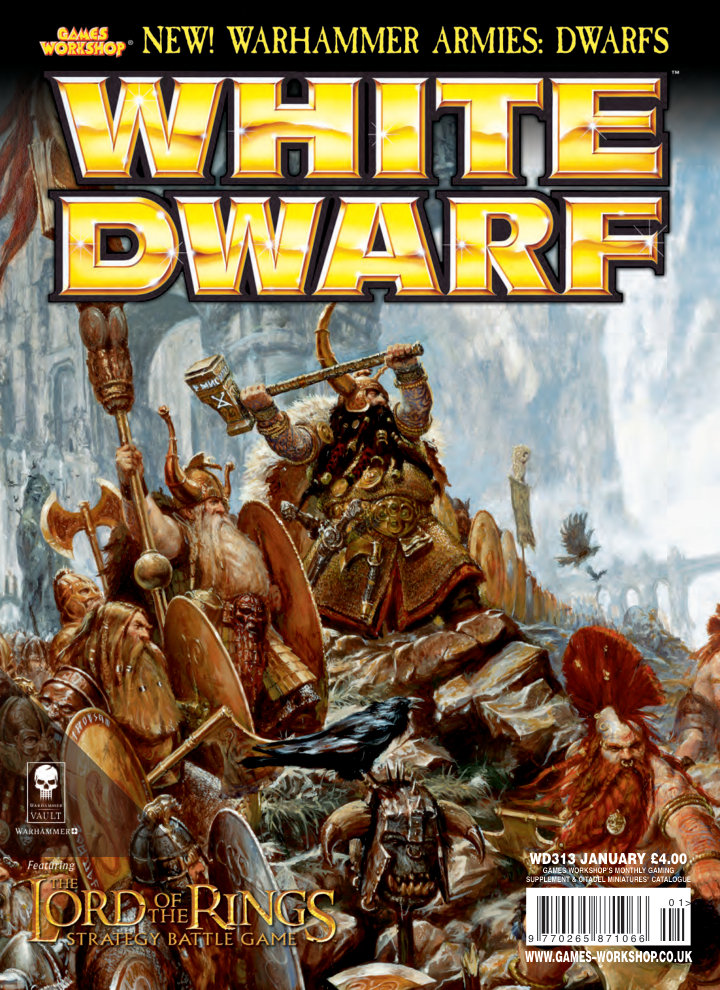
EditorialWD 313 · Inside cover
Owen Rees reflects on the enlarged Games Day and the practical possibilities of newly available Middle-earth components. He introduces the reorganized Astronomican as a stronger home for clubs, stores and readers’ models, while describing progress on the Tahnelians’ heavy weapons platoon and a converted officer. The editorial also anticipates a staff Mordheim campaign, linking the team’s personal projects with the following months’ coverage.
Warhammer 40,000Warhammer Fantasy Battles
CommunityWD 313 · pp. 10–13
Andy Hoare previews the expanded Tau armoury, including plastic Sky Rays, Piranhas, XV25 suits and Commander Shadowsun. Other reports introduce Middle-earth component ordering, a Wood Elf stag rider, two Forge World Hellhound variants and the coming Mark of Chaos computer game. A school animation project demonstrates another use for miniatures, while Horus Rising heralds a new fiction series. The news also flags missing profiles in the new Middle-earth rulebooks and a consolidated historical rules release.
Warhammer 40,000Warhammer Fantasy BattlesTau Empire
InterviewWD 313 · p. 10
Andy Hoare connects the new Tau codex with improvements in plastic manufacture that make Stealth suits and formerly resin vehicles available as plastic kits. The Sky Ray’s seeker missiles depend on allied markerlights, while Piranhas work in fast squadrons to contest objectives. XV25 armour introduces a revised suit with a support-system option, and Shadowsun symbolizes the third expansion. The interview presents the additions as complementary tools within the Tau’s interdependent army.
Warhammer 40,000Tau Empire
CommunityWD 313 · pp. 14–17
Nick Kyme and Owen Rees explore the Birmingham NEC’s three huge halls, dividing their report between the Forum, Pavilion and Arena. Fully booked Bring and Battle tables, conversion contests and scenery workshops give visitors hands-on activity alongside Studio conversations, author signings and digital games. Giant battles include an entire Steel Confessors Chapter fighting Tyranids and a walk-through Minas Tirith. The day closes with Golden Demon awards and Kiril Kanaev’s Slayer Sword, among a record attendance of roughly nine thousand hobbyists.
Warhammer 40,000Warhammer Fantasy Battles1 paint colour
ModellingWD 313 · p. 18
Wade Pryce rebuilds plastic Loyalist Terminators into ancient servants of Khorne, drawing on codex artwork, Jes Goodwin sketches and earlier Chaos models. Components from many plastic kits provide variety while remaining straightforward to cut and join. Thin putty rolls become armour banding after a short curing period, and individually sliced plastic studs cover each figure. More than a hundred studs per model give the armour an ornate, laboriously constructed identity.
Warhammer 40,000World Eaters
EditorialWD 313 · p. 19
Phil Kelly recommends occasionally breaking the routine of pitched battles with unusual objectives or famous characters. He recalls a Christmas game that combined fighting with herding undead pigs into goals, then argues that special characters refresh old collections and provide impressive centrepieces. Adding points to accommodate a chosen hero lets regular opponents agree on a narrative spectacle, with the issue’s Thorgrim-versus-Greasus battle serving as his example.
Warhammer Fantasy BattlesDwarfs
InterviewWD 313 · pp. 20–27
Nick Kyme interviews Gav Thorpe about a Dwarf book that preserves the race’s established image while widening its playing styles. Oathstones, improved Ranger options and the Anvil help a slow army dictate more of the battle without gaining uncharacteristic cavalry or monsters. Engineers and revised artillery reinforce its traditional strengths, while a fuller bestiary, history and guild background deepen the book itself. Aly Morrison’s reflections on earlier sculpts place the new plastic range within the Dwarfs’ evolving visual identity.
Warhammer Fantasy BattlesDwarfs
RulesWD 313 · pp. 22–24
Gav explains how Oathstones secure positions outside the deployment zone by removing a unit’s vulnerable flanks and rear. Longbeards become Warrior upgrades and Rangers can draw on different Core units, even combining both upgrades for elite scouts. Shieldbearers add attacks and armour to a Lord while giving him a Dwarfish centrepiece. Master Engineers and crew Engineers then make artillery characters a meaningful alternative to the army’s other heroes.
Warhammer Fantasy BattlesDwarfs
InterviewWD 313 · p. 25
Aly Morrison recalls a range that once explored Dwarfs through pith helmets, samurai, Vikings and Renaissance costumes. Over time, selected models established the recurring beards, mail and conical helmets that now define their appearance. His new work pushes stone and iron construction further, treating wood as a material ill-suited to Dwarf craftsmanship. Photographs of classic figures, including the Goblobber and its cook, illustrate that gradual visual evolution.
Warhammer Fantasy BattlesDwarfs
Battle reportWD 313 · pp. 28–45
Nick Kyme fields Thorgrim Grudgebearer and a heavily armed Dwarf throng against Phil Kelly’s Greasus-led Ogre army in a roughly 3,000-point battle. Ogres, a Hunter and Gorgers threaten the artillery from multiple directions, but the Anvil delivers Thorgrim into a crucial countercharge. Stubborn infantry survive repeated flank attacks while the High King batters Greasus through several regenerative recoveries. The Dwarfs win 2,441 to 1,077, with both players crediting resilient warriors and Thorgrim more than the unreliable guns.
Warhammer Fantasy BattlesDwarfs
FictionWD 313 · pp. 29–45
A Dwarf warrior surveys the Ogre camp beside a quiet stranger, only recognizing Thorgrim when the army forms for battle. The High King remembers an old insult as his warriors prepare their guns and axes. After victory, he strikes the dead cannon crew of an earlier defeat from the Great Book of Grudges, then enters the newly fallen. The paired passages show vengeance as a continuing duty rather than an end achieved by a single triumph.
Warhammer Fantasy BattlesDwarfs
TacticsWD 313 · pp. 46–51
Three 2,000-point Dwarf armies demonstrate mixed, shooting-heavy and aggressive approaches. The mixed force narrows the enemy’s frontage with a refused flank, the gun line prioritizes fast threats while using Rangers and a Gyrocopter to delay them, and the assault force advances behind Strollaz’s Rune. Slayers anchor flanks and characters add decisive combat power. Each list explains how deployment and supporting units compensate for the army’s slow movement rather than assuming artillery alone will win.
Warhammer Fantasy BattlesDwarfs
TacticsWD 313 · pp. 46–47
The mixed Dwarf army anchors one end of its line against a board edge and uses combat troops to protect the other, forcing a faster enemy onto a narrower front. Artillery and missile troops weaken advancing units while Slayers delay dangerous opposition near the open flank. A centrally placed Battle Standard and general improve the resilience of the counterattacking infantry. The list also illustrates how an army deal and battalion can form a workable force rather than merely a convenient purchase.
Warhammer Fantasy BattlesDwarfs
TacticsWD 313 · pp. 48–49
The shooting army depends on deployment because repositioning costs precious fire. Rangers provide a flexible late placement, a Gyrocopter blocks marches and flees to delay pursuit, and a lone Dragonslayer occupies enemies without needing to beat them. Target priorities begin with fast units and opposing artillery, then shift toward removing ranks or provoking several Panic tests. The Anvil’s movement rune and an explosive bolt thrower supply surprises once opponents focus on the barrage.
Warhammer Fantasy BattlesDwarfs
TacticsWD 313 · pp. 50–51
Strollaz’s Rune brings an aggressive Dwarf force forward, with a rune-equipped Lord and Hammerers forming its main attack. Slayers secure one flank while an Organ Gun advances with the infantry to cover the other. The plan accepts enemy charges and relies on resilience in prolonged fighting, but preserves the Gyrocopter to pursue fleeing units that ordinary Dwarfs might never catch. Continual pressure prevents faster opponents from choosing every engagement.
Warhammer Fantasy BattlesDwarfs
TacticsWD 313 · pp. 52–58
Jervis Johnson explains why five-hundred-point games deserve attention after years of magazine coverage and playtesting concentrated on tournament-sized forces. They work with the existing rules but create different tactical puzzles rather than reproducing large battles in miniature. Sample Skaven, Tomb King, Goblin and Bretonnian forces demonstrate how sharply a few choices define an army. Practical discussion covers compact boards, heavy cavalry, fast troops, stubborn infantry and monsters, followed by Mike Mason’s Bretonnian experiment against Alessio Cavatore.
Warhammer Fantasy BattlesSkaven
TacticsWD 313 · pp. 54–55
Alessio Cavatore returns to classic Skaven, combining a Warlock Engineer’s machinery with infantry and support creatures. Kyoko Okuda uses a Tomb Prince to strengthen a Skeleton combat unit while a Liche Priest and archers extend its options. Guy Haley’s Goblins exploit inexpensive troops to fit mounted warriors, a chariot, magic and a larger infantry block into a tiny force. Together the lists show that small games can retain distinct army identities and multiple battlefield roles.
Warhammer Fantasy BattlesSkaven
TacticsWD 313 · p. 55
A compact game needs enough open space for manoeuvre rather than a miniature version of a crowded display board. The article recommends approximately three terrain pieces and suggests themed combinations such as an inn, farm or Dwarf mining site. Building larger boards from separate four-foot-square sections makes storage and small games easier. Existing deployment methods can be used without inventing an entirely separate rules system.
Warhammer Fantasy Battles
TacticsWD 313 · pp. 56–57
Mike Mason assembles a small Bretonnian army from a battalion, but compulsory heroes and Knights of the Realm leave little room for other troops. Two Paladins and nine Knights concentrate the force’s striking power, while skirmishing bowmen supply flexibility. Expanding to a thousand points lets him use the remaining Men-at-Arms and Pegasus Knights alongside a Damsel. Building in stages therefore turns the initial constraints into a practical collecting plan.
Warhammer Fantasy BattlesBretonnia
PaintingWD 313 · p. 57
Mike paints bright heraldic barding over white while black separates the armour, leather and hooves. Chainmail drybrushing supplies metal, then thinned Sunburst Yellow and Enchanted Blue establish alternating quarters with white-mixed highlights. Scorched Brown horses receive Chestnut Ink shading and Graveyard Earth drybrushing. Small silver rivets, white teeth and sharply lined shields complete a repeatable treatment suited to an army with many mounts.
Warhammer Fantasy BattlesBretonnia9 paint colours
Battle reportWD 313 · p. 58
Mike Mason’s Bretonnians face Alessio Cavatore’s Skaven on a small board where the Knights soon lose their desired charge initiative. Clanrats attack the front and Rat Ogres reach the flank, but repeated friendly-fire mishaps turn the combat against the rats. Warp Lightning, a Globadier and a Ratling Gun injure their own force while the armoured Knights survive. The Skaven break and are subsequently hunted down, illustrating the unpredictable concentration of risks in a small game.
Warhammer Fantasy BattlesBretonnia
PaintingWD 313 · pp. 60–63
The workshop compares drybrushing, controlled layers and ink washes on iron armour, then adapts those techniques to different armies and metals. Blue-shaded Elven steel contrasts with brown Orc armour and green-tarnished Skaven plates. Four gold methods show how bases and shading alter warmth and brightness, while coloured inks and painted blue lightning create magical weapons. The examples treat metallic finish as part of a model’s character, with quick army techniques and precise highlights serving different surfaces.
Warhammer Fantasy BattlesDwarfs18 paint colours
PaintingWD 313 · p. 60
Three iron recipes reach bright steel through different tools. Drybrushing progresses from black mixed with Boltgun Metal through Chainmail to Mithril Silver, while layering leaves each darker stage in the recesses and draws sharper edges. The wash approach instead starts with a solid metallic coat, shades it with Black Ink and restores the raised detail. Comparing them on mail and plate shows why the choice of method depends on texture and desired control.
Warhammer Fantasy Battles5 paint colours
PaintingWD 313 · p. 61
Chainmail receives a Blue Ink wash to give the armour a cold, clean character. Restoring Chainmail to raised areas preserves that blue in the shadows, and fine Mithril Silver edges supply the brightest reflections. The method uses coloured shading to distinguish Elven steel from the darker or dirtier metals elsewhere in the workshop.
Warhammer Fantasy BattlesHigh Elves3 paint colours
PaintingWD 313 · p. 61
Tin Bitz is layered while leaving the black undercoat in recesses, then forceful Boltgun Metal drybrushing breaks up its dark surface. Brown Ink stains the armour before a lighter Chainmail edge treatment. The resulting battered metal suits irregular Orc equipment and can be varied across a regiment to reinforce its disorderly appearance.
Warhammer Fantasy BattlesOrcs & Goblins4 paint colours
PaintingWD 313 · p. 61
Boltgun Metal is washed with Dark Green Ink, giving armour plates a dull, contaminated cast. Light metallic drybrushing returns definition to the edges before a final Chainmail pass. The illustrated Stormvermin show how a strongly tinted wash can make the same basic silver paints look aged and unhealthy.
Warhammer Fantasy BattlesSkaven3 paint colours
PaintingWD 313 · p. 61
Brazen Brass establishes the dark base, with Dwarf Bronze layered above while retaining recessed shadows. An equal mixture of bronze and Mithril Silver defines raised edges, followed by a thinner pure-silver highlight. The sequence keeps the warm body colour while using silver sparingly to suggest a polished metallic surface.
Warhammer Fantasy Battles3 paint colours
PaintingWD 313 · p. 62
Four approaches create gold on engraved metal. A Brazen Brass base can be drybrushed or carefully layered with Shining Gold and silver-mixed highlights; a Dwarf Bronze alternative rises through Shining Gold to Burnished Gold. Over white, a Brown Ink and Flesh Wash mixture supplies warm shading before Burnished Gold restores the flat areas. The recipes demonstrate how different base colours and application methods change the depth of the finished ornament.
Warhammer Fantasy Battles7 paint colours
PaintingWD 313 · p. 63
A metallic magical blade builds from Boltgun Metal through Chainmail, then takes a Purple Ink wash and ink-tinted silver edges. The alternative uses no metallic paint: Regal Blue and Enchanted Blue form the blade, Blue Ink deepens it and dilute Ice Blue traces stylized lightning. The contrasting methods provide either a coloured reflective weapon or an overtly supernatural surface marked by luminous lines.
Warhammer Fantasy Battles8 paint colours
EditorialWD 313 · p. 65
Andy Hoare considers how the same Witch Hunter collection would behave in jungle, swamp or daemon-world battles. Terrain might favour rarely used Sisters Repentia or Grey Knights and discourage familiar flame weapons. He argues that varied environments encourage different missions and army choices, then imagines fighting among floating rocks or in a gas giant’s atmosphere. The column frames the following hostile-world rules as an invitation to expand ordinary games.
Warhammer 40,000Witch Hunters
RulesWD 313 · pp. 66–75
Adam Troke and Andy Hoare add hostile terrain and six landscape effects to ordinary missions on worlds overwhelmed by Chaos. Extra danger, lethal woods, unsettling ruins and predatory waters make movement itself a risk, while the world’s ruling power can inflict plague, hesitation or confused shooting. A broad definition identifies the daemon models exempt from many effects. Tzeentchian scenery, an iron-skinned fortress world and a short account of Golia VII’s destruction turn the rules into a setting for themed campaigns.
Warhammer 40,000Chaos Daemons2 paint colours
RulesWD 313 · p. 68
Every area-terrain entry imposes an additional Dangerous Terrain roll and prevents regrouping. Woods can strike moving models with powerful hits, ruins lower non-daemonic Leadership and hinder escape, and water consumes models that fail Initiative tests. Armoured vehicles are handled separately where appropriate. The rules turn normally protective terrain into a calculated hazard and apply on top of whichever mission the players choose.
Warhammer 40,000Chaos Daemons
RulesWD 313 · p. 69
Players choose or roll for one of six world-wide conditions before placing scenery. Boiling blood punishes stationary infantry, plague kills according to failed Toughness tests, and Tzeentchian mutation can redirect fire onto friendly units. Slaaneshi beauty immobilizes distracted forces, another world lowers non-daemonic Leadership, and the final result supplies a relatively stable place of damnation. Exemptions differ by result, making the selected landscape a major influence on tactics and force selection.
Warhammer 40,000Khorne
ModellingWD 313 · p. 70
Textured wallpaper supplies the cracked surface of a constantly shifting daemon world, with Royal Blue and Ice Blue painted into fissures as electrical energy. A floating monolith replaces an ordinary hill, and a polystyrene pool on a hard base contains Horror figures beneath a Water Effects surface. The examples translate Tzeentch’s unstable geography into recognizable gaming terrain with extraordinary visual treatment.
Warhammer 40,000Tzeentch2 paint colours
RulesWD 313 · p. 71
The rules define “Daemons” broadly for these environmental exceptions. Alongside summoned creatures and Daemonhosts, the list includes certain possessed vehicles, Eldar Avatars, Possessed Marines and sufficiently altered Chaos Lords. The surrounding background contrasts entities formed from the Warp with Daemon Princes who retain mortal purpose and individuality. Players are encouraged to use judgement for comparable creations beyond the named examples.
Warhammer 40,000Chaos Daemons
ModellingWD 313 · p. 72
Perturabo’s daemon world is imagined as a planet of metal, industry and immense fortifications. The scenery follows that theme with overlapping card and plasticard plates studded with plastic-rod rivets, while girder offcuts form a sharp steel tree. The demonstration shows how familiar industrial materials can replace ordinary earth and vegetation to make a battlefield unmistakably the domain of the Iron Warriors.
Warhammer 40,000Iron Warriors
FictionWD 313 · p. 75
Blood rain and dead Astropaths signal a catastrophe that Governor Torres mistakes for a conventional invasion. Vast defence lines and mobilized populations wait for an enemy that never comes, while dreams, desertion and religious hysteria unravel the world from within. Soldiers abandon the perimeter to fight crowds in the cities, and the arriving Warp storm makes their nightmares material. Golia VII is destroyed through civil slaughter and supernatural upheaval rather than an external army.
Warhammer 40,000Imperium
LoreWD 313 · pp. 76–81
Graham McNeill follows Paresh Rammius from the destruction of his tribe to recruitment, apprenticeship and eventual service among the Sword Brethren. His training of Neophytes and friendship with Helbrecht connect personal advancement with the Chapter’s continuing institutions. Terminator boarding actions at Armageddon culminate in a near-fatal duel while his brothers escape the Dethburna. Recovered alive, he receives the chance to continue fighting within a Dreadnought, and an accompanying mission recreates his final stand.
Warhammer 40,000Black Templars
RulesWD 313 · p. 81
A foot-based Black Templar force containing Rammius and Sword Brethren Terminators tries to break out through an Ork ship. The defender divides most units between opposite short edges, leaving Elites more flexible, while corridors shape the route to escape. Half the attacking units must leave through designated edges within six turns. Rammius’s death triggers a universal Righteous Zeal move, and retreating Templars fall back toward the centre where desperation automatically regroups them.
Warhammer 40,000Black Templars
FictionWD 313 · p. 81
Rammius forces his injured body into a duel with the heavily armoured Ork slaughtering his brethren. Lightning claws pierce the machine plates, but the Ork catches him in a crushing grip and eventually severs an arm. The Templar uses the last of his strength to drive his remaining claws through the creature’s skull. The close, brutal scene supplies the personal cost behind the more distant chronicle of his last boarding action.
Warhammer 40,000Black Templars
TacticsWD 313 · pp. 82–87
Experienced players explain both commanding and defeating Black Templars. Small fire-support squads back large combat units, mechanized forces concentrate pressure through Rhinos and Crusaders, and Chaplains manipulate the army’s Zeal movement. Opponents answer by redirecting that compulsory aggression, focusing fire and selecting units suited to fighting power armour. Ork, Chaos, Eldar and Tyranid advice makes the Chapter’s strengths and vulnerabilities visible from both sides of the table.
Warhammer 40,000Black Templars
TacticsWD 313 · pp. 82–83
Andrew Harris divides five Crusader squads into two large advancing threats and three small shooting units. Opponents often concentrate on the large squads, leaving the support teams intact to claim objectives later. A Marshal’s army-wide Leadership helps both Righteous Zeal and difficult target-priority tests, while an Emperor’s Champion supplies another hard combat leader. The approach makes enemy attention a resource that the quieter units can exploit.
Warhammer 40,000Black Templars
TacticsWD 313 · pp. 84–85
Graham Bailey advances Rhino-mounted troops for rapid-fire attacks while a Crusader carries a heavily equipped assault unit. The expensive central threat attracts fire, leaving supporting Razorbacks freer to operate and supplying the guns absent from his infantry. The Chaplain sidebar offers a different delivery mechanism, combining infiltrating command troops with control of Righteous Zeal. Cenobyte Servitors extend the Zeal move but sacrifice that infiltration option.
Warhammer 40,000Black Templars
TacticsWD 313 · p. 86
Connor Buckley puts Assault Terminators and a powerful character in a Land Raider Crusader rather than leaving them waiting to teleport. Concentrating so many points in one vehicle is risky, but successful delivery creates a formidable close-combat strike. Blessed Hull is his answer to Eldar lance weapons, protecting the expensive transport against a particular threat. The tactic deliberately commits to a dramatic, focused assault rather than dispersing the army’s elite fighters.
Warhammer 40,000Black Templars
TacticsWD 313 · p. 87
Alan Borthwick uses flank Warbuggies to pull Zeal moves sideways or backward, buying more time for Ork guns. Fire is concentrated on one Crusader squad rather than provoking the whole army forward. Killa Kans can hold Templars in combat, while Tankbustas and Zzap guns must stop dangerous Chaplain-led units before they reach the Ork line. The advice makes the opponent’s compulsory aggression work against its owner.
Warhammer 40,000Orks
TacticsWD 313 · p. 87
Matt Plonski welcomes an opponent eager to close, but still recommends isolating and weakening a target before the final assault. Bloodletters and Daemonettes cut power armour, while Berserkers, Chosen and Possessed can outperform ordinary Templars. The Emperor’s Champion can be swamped rather than always fought by a Lord, and exceptionally powerful daemons offer another answer. Troop selection determines the final blow after the same careful approach.
Warhammer 40,000Chaos Space Marines
TacticsWD 313 · p. 87
Ugo Oliveti exploits the Templars’ lack of Whirlwinds, psykers and cheap infiltrators to manoeuvre with Eldar shooting units. Starcannons, War Walkers and a Wraithlord supply useful fire or defence, while Aspect choices require care. Fortuned Scorpions are more reliable than Banshees against these opponents, Fire Dragons need protection until their short-ranged weapons matter, and Dark Reapers benefit from the absence of indirect Whirlwind fire.
Warhammer 40,000Eldar
TacticsWD 313 · p. 87
Paul Gebhart advises Tyranids to resist the obvious headlong rush. Concentrated shooting weakens one Templar unit and draws it away through Righteous Zeal, after which numerous assault creatures overwhelm it. A sufficiently decisive combat can then provide consolidation movement to reset the trap or enter the main battle line. Even a Templar consolidation into the swarm can help, because it denies them an ordinary charging bonus.
Warhammer 40,000Tyranids
ShowcaseWD 313 · pp. 90–95
George Dellapina presents a fully mechanized Imperial Guard collection of sixteen tanks, converted Sentinels and elite infantry. Unexpected Tank Shock tactics inspired its Arthurian naming scheme, with Arthur and Excalibur acting as armoured knights. Double-width tracks, sculpted relics, elaborate equipment and matching mesh camouflage give each model an identity. Seventeen heavily converted Storm Troopers and command figures complement the tanks as a smaller force built around precise operations.
Warhammer 40,000Imperial Guard
ModellingWD 313 · pp. 92–95
Arthur combines two Leman Russ kits for widened tracks and guards beneath a distinctive resin turret. Handmade purity seals serve as an in-world expression of Excalibur’s extra armour, while Cadian command figures receive sculpted carapace and individually built equipment. Car-body mesh, model plants and diagonally arranged clump foliage connect infantry and tanks to the same environment. The collection’s many hours of work show how repeated materials can unify highly individual conversions.
Warhammer 40,000Imperial Guard
RulesWD 313 · p. 96
Draco’s fixed profile equips a Black Templar Castellan with a master-crafted power sword, artificer armour, bionics and crusader seals. His Rites of Battle let other Templar units use his Leadership for relevant tests, and he may take an ordinary or Terminator command squad. The background traces his survival of the corrupted Vinculus’s temple, bionic reconstruction and elevation after slaying its possessing daemon. His later boarding actions and campaign against the Tau establish the veteran’s continuing role.
Warhammer 40,000Black Templars
EditorialWD 313 · p. 97
Adam Troke describes attending the Agram Summer Arena tournament in Zagreb and enjoying games with opponents from several countries. The experience inspires him to add more events to his calendar, but his return journey also supplies a cautionary story: he leaves his Haradrim and Dwarf army case on an Austrian station platform. His advice connects travel planning and looking after models with the friendships and new opponents that make tournaments worthwhile.
Middle-earth Strategy Battle GameDwarves
LoreWD 313 · pp. 98–101
The preview introduces an Easterling invasion campaign in Ithilien, supported by new troops, characterful scenarios and extensive hobby projects. Easterlings gain bows and heavy cavalry, Khand brings mercenaries and chariots, and Khamûl supplies a named Ringwraith. Madril, Eorl, Cirion, Murin and Drár expand the Good side. The book also teaches Eastern buildings, Khandish tents and stockades, tying army heraldry and terrain to the same setting.
Middle-earth Strategy Battle GameEasterlings
RulesWD 313 · pp. 102–109
Mat Ward revisits Moria as a three-dimensional battlefield of platforms, ladders and hazardous stonework. Broken walkways, recoverable weapons, valuable mine workings and the Throne of Acclamation change movement, objectives and combat behaviour. Optional darkness, tremors and unstable footing make the underground realm less predictable. Terrain-building instructions accompany a scenario in which Durin’s defenders must survive the Balrog and an unending Goblin tide long enough to earn a final act of resistance.
Middle-earth Strategy Battle GameDwarves5 paint colours
RulesWD 313 · pp. 103–104
Damaged walkways can collapse under nearby models or send failed jumpers down a chasm. Weapon stashes allow unengaged fighters to exchange equipment, while holding mine workings can shift a battle’s final result. Dwarves on the royal throne’s platform fight with banner support but must charge reachable foes, making reverence a tactical liability as well as an advantage. Rubble barricades can be dismantled by sufficiently strong models, opening new routes during play.
Middle-earth Strategy Battle GameDwarves
RulesWD 313 · p. 105
A pre-game roll can make mounts unreliable, lower Goblin and Troll Courage, threaten combatants on stairs or trigger tremors when priority is tied. Unnatural darkness introduces a second table ranging from almost total blindness to usable daylight. In pitch blackness, fighters roll to determine whether an intended charge, spell or shot can reach its target; under ordinary gloom different creatures see different distances. These optional effects reinforce the underground setting without requiring a new mission.
Middle-earth Strategy Battle GameDwarves
ModellingWD 313 · pp. 106–107
Foam offcuts become rubble barriers and broken walkways, with gouged rather than completely severed surfaces preserving playable connections. A tiered rock spire supports an octagonal platform and foamboard throne made from earlier templates. Roughcoat textures the stone before black paint, Dark Flesh in recesses and grey-to-pale drybrushing finish it. The projects expand an existing Dwarrowdelf collection while supplying the pieces used by this issue’s rules.
Middle-earth Strategy Battle Game5 paint colours
RulesWD 313 · pp. 108–109
Durin and scattered defenders confront the awakening Balrog in the depths of Moria. Evil wins by killing every Dwarf within twenty turns; lasting into the twenty-first earns Good a victory despite the kingdom’s historical doom. The Balrog enters from below with reduced Fight and improved climbing, while Goblins continually arrive from the edges. Durin’s inherited armour, helm, axe and horn improve his chance of holding the throne against an otherwise overwhelming tide.
Middle-earth Strategy Battle GameDwarves
CampaignWD 313 · pp. 110–115
Mat Ward completes the Goblin-raiding campaign with a night attack, village improvements and the hunt for Azghûr himself. Evil can spend accumulated loot on temporary mercenaries, sacrificing part of the force it might otherwise bring to the finale. Good gradually fortifies settlements with barriers, supplies and warning lights. Profiles for the Scavenger King and Mountain Trolls accompany a final search through the lair, where the strength of outside heroes changes the opposition they attract.
Middle-earth Strategy Battle GameMoria Goblins
RulesWD 313 · p. 110
The sixty-five-point Scavenger King combines heavy armour, several Might points and a Backstabber bonus against trapped enemies. He can escape ordinary campaign battles through any edge, but his death before the finale immediately grants Good the campaign. The final scenario removes that escape, turning a previously elusive commander into the target of a determined search. A conventional Goblin King model represents him without requiring a new miniature.
Middle-earth Strategy Battle GameMoria Goblins
RulesWD 313 · p. 110
Mountain Trolls, called Snow Trolls in Rohan, are described as stronger and braver than the Cave Trolls normally serving Goblins. The seventy-point profile has powerful Strength, three attacks and Terror, using a Cave Troll miniature as a substitute. Their availability is restricted to the campaign’s final confrontation, concentrating their impact in the battle for Azghûr’s survival rather than the earlier village raids.
Middle-earth Strategy Battle GameTrolls
RulesWD 313 · p. 111
Goblins approach a sleeping village while half its defenders act as scattered sentries and the remainder wait for the alarm. Loot is taken from buildings and must be carried off the board, so stealth can secure the raiders’ aim before the defenders assemble. The game ends when Evil is slain or has escaped, with results based on stolen goods. The printed thresholds repeat the earlier campaign scenario’s incomplete treatment of odd counter totals.
Middle-earth Strategy Battle GameMoria Goblins
RulesWD 313 · p. 112
After the first turn, Evil may trade each loot point for fifteen points of Goblins, Orcs or Uruk-hai in a single warband. These hired fighters remain for only one campaign turn, making immediate reinforcements a drain on the strength available at the end. Mountain Trolls become an additional spending option for the final battle. The system turns successful raids into a choice between protecting future expeditions and preparing the Scavenger King’s ultimate defence.
Middle-earth Strategy Battle GameMoria Goblins
RulesWD 313 · pp. 112–113
Good gains a small random pool of defence points after the first campaign turn and permanently assigns each purchase to a village. Weapon stashes improve shooting reliability, ancient symbols reduce nearby Evil Courage, and spiked palisades create hazardous obstacles. Wells help extinguish fires, bonfires extend sentry detection and watchtowers provide protected elevation. Because improvements cannot move between settlements, players must decide where continuing protection is most valuable.
Middle-earth Strategy Battle GameDwarves
RulesWD 313 · pp. 114–115
A mixed expedition enters Azghûr’s rocky lair and searches eight potential hiding places while dispersed Evil groups close around it. A successful search reveals the Goblin king, who must be found at the last counter if he has avoided discovery earlier and cannot flee the table. Good’s chosen wandering hero may bring extra enemy Trolls, with Aragorn trading improved search ability for particularly heavy opposition. Saved loot adds more Evil warriors, making the campaign’s earlier spending decisions decisive.
Middle-earth Strategy Battle GameMoria Goblins
RulesWD 313 · pp. 116–117
A Rohirrim village caught between Orc Warg Riders and Isengard Uruk-hai receives help from nearby cavalry. Its foot defenders represent old men and children with reduced Fight and Courage, while the two Evil contingents distrust one another and test their losses separately. Heroic leadership also stays within each contingent’s own race. Good must annihilate the attackers, whereas Evil needs only reduce the combined defenders to a quarter of their starting strength.
Middle-earth Strategy Battle GameRohan
EditorialWD 313 · p. 119
Owen Rees explains the redesigned Astronomican’s emphasis on hobbyists’ models, terrain, clubs and events. Separate sections will highlight Warhammer World collections, community groups and projects found in local stores, retaining letters and component references alongside them. He presents the change as an opportunity to uncover work beyond the Studio and encourages readers to regard the back of the magazine as another source of practical ideas.
CommunityWD 313 · p. 126
Leicester’s unusual tournament gives players random armies borrowed from other participants for the first two games, returning their own force only in the third. The format tests adaptability and familiarity with more than a single preferred list. It also encourages a player to design a force whose effective use rewards particular knowledge. The report describes its initial Combat Patrol version and possible extension to other systems, rather than presenting a formal new rules pack.
Warhammer 40,000
ShowcaseWD 313 · p. 127
Mark Edwards’s new Chapter uses beaked helmets and avian command backpacks to create a consistent Black Hawk identity. Purple, black and bone armour distinguish the collection, while shoulder colours identify Tactical, Veteran and Devastator roles. Large scenic bases emphasize the figures and improve stability, and Grey Knight weapons give veterans an individual appearance without changing their ordinary in-game role. The feature includes Mark’s warm bone recipe and explains his preference for collecting flexible forces beyond his usual game size.
Warhammer 40,000Black Hawks4 paint colours
PaintingWD 313 · p. 127
Mark Edwards starts the Black Hawks’ pale ornament over Chaos Black with a Vomit Brown and Flesh Wash base. Vomit Brown mixed with Bleached Bone supplies the main highlight, followed by pure Bleached Bone on the sharpest edges. The small recipe retains a warm shaded foundation beneath the pale finish, connecting helmets and decorative elements across his purple-and-black Chapter.
Warhammer 40,000Black Hawks4 paint colours
CommunityWD 313 · p. 142
Nicola Brierley describes earning an English coursework grade by analysing a store introduction game, making a case for the hobby’s educational benefits. Other readers submit a 170-model Tyranid swarm and converted Speed Freeks, extending the ongoing horde challenge and reader gallery. Replies discuss the army’s limited Synapse coverage and sources for modelling materials. The page ties practical questions and personal achievements to the growing collection of reader projects.
Warhammer 40,000Tyranids
EditorialWD 313 · p. 143
Rik Turner combines the new Dwarf plastics with Mordheim accessories for the Treasure Hunters of Karaz Skarrenruf. Nick Kyme grows his Karak Kyme army and prepares Witch Hunters for a campaign around a ruined Temple of Morr. Christian Byrne returns to his Imperators Marines after finishing High Elf and Chaos forces, balancing new models with the desire to improve his games. The projects introduce the staff campaign through the figures its participants are actually building.
Warhammer 40,000Warhammer Fantasy BattlesDwarfs