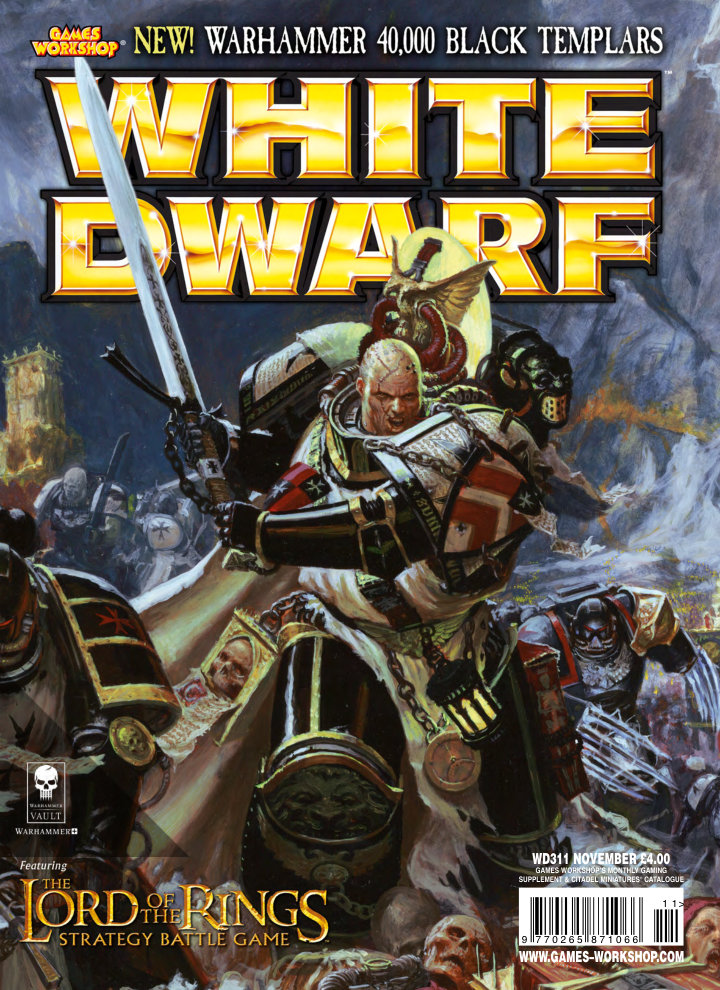
EditorialWD 311 · Inside cover
Guy Haley ends eighteen months with the UK magazine, including ten as official editor, and hands responsibility to Owen Rees. He explains how the seven national editions combine local material with central studio content, the latter becoming his new responsibility. Thanks to the team and memories of finishing issue 300 make the farewell a record of both personal change and the magazine’s production structure.
CommunityWD 311 · pp. 10–15
A Shadow in the East previews Easterlings, Khand and Khamûl, while Forge World shows its modular Phaeton outpost and a developing Keeper of Secrets. Realms of Sorcery, Vlad the Impaler and Fell Cargo broaden the book coverage. Reports also cover Cambridge’s gaming-room refurbishment, a regional doubles event, Space Hulk on mobile phones and a Winter Assault computer competition, with a new club-account service supporting organized groups.
Warhammer 40,000Middle-earth Strategy Battle GameEasterlings
InterviewWD 311 · p. 10
Adam Troke describes a region-focused supplement set around Rhûn rather than another retelling of a film. A Gondorian campaign against Easterlings and Khand will escalate through linked scenarios, with an appendix connecting the armies to wider history. Perry concepts and new plastic bowmen and cavalry expand the range, while Khamûl supplies a named Ringwraith and Good heroes ensure the book is not confined to Evil forces.
Middle-earth Strategy Battle GameEasterlings
InterviewWD 311 · pp. 18–23
Nick Kyme interviews Graham McNeill and the design team about giving Black Templars a distinct identity. Historical crusaders, knight-and-squire relationships and a relentless fleet-based mission shape the codex, while chains, lanterns, tabards and older armour marks carry those themes into miniatures. The discussion connects revised Righteous Zeal and character choices to the intended battlefield behaviour, with concept art and sculptors’ accounts tracing the project from sketches to finished models.
Warhammer 40,000Black Templars
LoreWD 311 · pp. 18–19
McNeill presents the Templars as heirs to the original outward-looking mission of the Legions, using conquered-world keeps to support mobile fleets. Sigismund’s heraldry defines their colours and crusading vow, while Initiates teach Neophytes personally through battle. Sword Brethren join a Marshal’s household through proven deeds rather than ordinary company progression. The account explains how organization and historical imagery support a shared identity of warrior brotherhood.
Warhammer 40,000Black Templars
InterviewWD 311 · p. 20
Mark Gibbons distinguishes the crusading Templars from the monastic Dark Angels through weapons manacled to their wielders, flames and lanterns. Repeated visual motifs survive successive concept sketches and become more elaborate on the leading characters. For Helbrecht and Grimaldus, the process comes full circle as Gibbons later illustrates the completed sculptures. His account shows a coherent set of symbolic ideas guiding the entire range.
Warhammer 40,000Black Templars
RulesWD 311 · pp. 21–23
Righteous Zeal now rewards a passed morale check after even one infantry casualty, replacing the earlier incentive to fail. Its movement is reduced, but large squads can benefit without first losing many warriors. Chaplains direct that zeal and commanders improve the chance of passing, making HQ selection a tactical decision. The discussion also relates transport choices and absent artillery to the chapter’s preference for facing its enemies directly.
Warhammer 40,000Black Templars
InterviewWD 311 · p. 22
Dave Thomas, Mark Harrison and Martin Footitt explain assembling the large Crusader frame and defining a range previously represented mainly in artwork. Chains were symbolically important but difficult in plastic, while shorter tabards kept the legs visible and avoided the Dark Angels’ appearance. Compatible parts, medieval helmets and restored Mark IV details support conversion work. Helbrecht, Grimaldus and the Cenobyte Servitors become the sculptors’ culminating examples.
Warhammer 40,000Black Templars
RulesWD 311 · p. 23
Helbrecht embodies determination and passes his experience to Neophytes even within his command squad; his ancestral sword adds attacks in the opening assault. Grimaldus’s temple relics and Cenobyte attendants express his survival at Helsreach. His rules extend control over nearby Righteous Zeal and allow repeated leadership tests to sustain him after a fatal wound. The sidebar explains how the two characters intensify the chapter’s ordinary ideals.
Warhammer 40,000Black Templars
CampaignWD 311 · pp. 24–29
Graham McNeill builds three linked missions around Mark Jones’s Chapter keep scenery. Dark Eldar first raid recruits, then a downed flyer’s relics become contested, before a Chaos-backed assault reveals the Alpha Legion’s wider conspiracy. Results from the opening games alter the final battle’s obstacles or attacking deployment advantages. Alternative force guidance lets other collections use the escort, recovery and fortress-fighting structures.
Warhammer 40,000Black Templars
RulesWD 311 · p. 25
A separate Neophyte squad must cross mountain terrain to waiting Rhinos and escape through the opposite edge. Dark Eldar deploy on both flanks, seeking recruits for slavery, while the Chaplain survives independently of the vulnerable squad. At least five voluntary escapees plus the Chaplain secure a Templar win; total capture wins for the raiders and lesser outcomes draw. Combat Patrol guidance adapts the mission to other armies.
Warhammer 40,000Black Templars
RulesWD 311 · pp. 26–27
Templars and their enemies contest a random number of relic-and-body counters after a flyer is shot down. Models with Weapon Skill can collect, carry and transfer them, but death or retreat drops the prize. Their point value scales with the game total and number of counters, making possession significant alongside casualties. Six turns, raid force charts and restricted initial Chaos options create a recovery battle before the enemy’s full conspiracy is exposed.
Warhammer 40,000Black Templars
RulesWD 311 · pp. 28–29
A reinforced Lost and the Damned army attacks a gun-bristling Templar keep while both sides seek the opposing leaders. Characters killed by enemy independent characters are worth triple points, encouraging personal intervention despite the fortifications. Sustained Attack returns ordinary attackers, and random game length prevents an exact final-turn plan. Earlier mission results can add defender obstacles or attacker Scouts and Night Fighting, giving the finale consequences from the whole campaign.
Warhammer 40,000Black Templars
Battle reportWD 311 · pp. 30–49
Graham McNeill commands Black Templars against Adam Troke’s evolving coalition of Dark Eldar, mutants, traitors and Alpha Legion Marines. The opening escort ends in lost recruits, but Graham wins the relic-recovery battle through disciplined objective play and a timely Terminator intervention. The deciding siege uses a fortress built for the codex and rewards leaders for personally slaying their counterparts.
Warhammer 40,000Black Templars
Battle reportWD 311 · pp. 32–33
Graham sends Rhinos toward the recruits while Initiates provide cover and Chaplain Develain attacks the flank. Adam’s infantry largely breaks, but the surviving Raider forces already-fleeing Neophytes off the board. Graham recognizes that shooting the warriors instead of the transport squandered his chance to stop that pursuit. Adam takes the campaign’s first win through the mission objective despite losing control of much of his force.
Warhammer 40,000Black Templars
Battle reportWD 311 · pp. 34–35
Three counters fall to the Templars while Adam retains two, but the fighting threatens to reverse possession. Reinforcing Marines save the Chaplain’s unit from Wyches, and deep-striking Terminators absorb fire and destroy the Leman Russ in assault. The Archon’s retinue and transports are subsequently lost, leaving Graham a decisive points victory. Both players conclude that objective discipline and practical troop selection mattered more than the army’s aggressive reputation.
Warhammer 40,000Black Templars
Battle reportWD 311 · pp. 36–49
Adam’s opening fire destroys key fortress guns and later immobilizes the Crusader, forcing Graham’s elite counterattack onto foot. A mistaken rapid-fire volley delays the Incubi charge, while the Rogue Psyker wipes out the Sword Brethren and briefly endangers the Templar line. The three surviving characters then kill the Chaos leaders, and Marquand destroys the Defiler single-handed. Recycled mutants repeatedly harm themselves with overheated weapons, while the delayed Daemonettes arrive too late to prevent a Templar win.
Warhammer 40,000Black Templars
PaintingWD 311 · pp. 50–55
Adrian Wood builds five Initiates from the new Crusader, Tactical and Assault components, choosing poses suited to their weapons and visible detail. He first paints a fast black-white-red gaming scheme, then develops it with controlled edge highlights, crosses, lenses and richer details. The tutorial progresses from practical construction and transfers to freehand heraldry and the fine liturgy on studio Helbrecht and Grimaldus models, offering successive improvements to an already playable squad.
Warhammer 40,000Black Templars17 paint colours
ModellingWD 311 · pp. 50–51
Wood maps the component choices for five ranged and melee Initiates, including a meltagunner, power fist and older-style helmets. Open poses reveal the ornate Crusader torsos, while tabarded bodies need Tactical legs and a firing bolter may fit better with one less-decorated component. Extra seals, lanterns and vehicle or Terminator parts show the frame’s uses beyond these five infantry models.
Warhammer 40,000Black Templars
PaintingWD 311 · pp. 52–53
The fast finish leaves much of the black undercoat visible and uses restrained grey drybrushing before flat detail colours. White shoulder pads can be built over Shadow Grey or painted separately from a white start. A later stage replaces broad drybrushing with fine grey edge lines so the armour remains clearly black. The illustrated excessive highlight warns that too much grey changes the whole character of the scheme.
Warhammer 40,000Black Templars10 paint colours
PaintingWD 311 · p. 53
Transfers keep chapter symbols consistent in size and shape, while a freehand method begins with an eight-pointed star and adds V-shaped tips before filling the arms. White can repair untidy edges, and red crosses offer a striking alternative. Wood advises practising with diluted paint on paper first, making the method a manageable next step after finishing the basic squad.
Warhammer 40,000Black Templars2 paint colours
PaintingWD 311 · p. 54
Boltgun Metal, a thin black wash and Chainmail edges establish the metallic details. Red lenses receive orange in one corner and a bone reflection in the other, while skulls move from leather through bone to white on the prominent features. Seals use a darker red foundation, bright red body and orange highlights. Four short recipes explain how limited colours can still separate very different materials.
Warhammer 40,000Black Templars10 paint colours
PaintingWD 311 · p. 55
Bronzed Flesh parchment receives bone texture lines and thin black writing, while exposed faces progress from Tanned Flesh through Dwarf Flesh to Elf Flesh. Studio examples then show more ambitious additions: centered lettering, half-cross cloak borders and a cross outlined against a tabard. Grimaldus’s prayer cloth uses tiny vertical red strokes and dots, demonstrating how convincing text can emerge from marks rather than fully readable sentences.
Warhammer 40,000Black Templars8 paint colours
CommunityWD 311 · pp. 56–57
The Wargear reference manual is presented as a portable answer to carrying every possible opponent’s codex. Model and weapon profiles, vehicle access and fire points, an alphabetical equipment listing and illustrated guns are compressed into eighty pages. The feature explicitly describes it as a companion rather than a replacement for rules and codexes, and anticipates future updates as new books change the available equipment.
Warhammer 40,000
ModellingWD 311 · pp. 58–61
Steve Cumiskey and Chad Mierzwa show how different weapon types leave distinguishable marks on vehicles, infantry and scenery. Drilled impacts and painted glass cracks contrast with scorched paint, gouged beam strikes, explosive pitting and molten or acid-damaged armour. Examples also add flowing oil and Tyranid erosion. The introduction asks modellers to match the damage level to whether the piece represents a functioning vehicle or an outright wreck.
Warhammer 40,00012 paint colours
ModellingWD 311 · p. 58
Drilled holes and radiating white-painted cracks turn blister plastic into shot glass. A knife enlarges stone impacts irregularly, while metal craters remain shallower and rounder. Wire coated in a brown-black gloss mixture creates oil escaping from damaged drums. These compact details allow a model to suggest a specific recent attack without covering the entire surface in destruction.
Warhammer 40,0004 paint colours
ModellingWD 311 · p. 59
Black and grey drybrushing produces scorched paint, with PVA blobs added before painting to suggest blistering. Tin Bitz beneath Boltgun Metal imitates chipped metal, while a burned jungle patch uses chopped vegetation and brown-grey drybrushes. The text notes that alien hulls need an appropriate underlying material rather than automatically exposing human-style metal, tying the effect to the model’s construction.
Warhammer 40,0006 paint colours
ModellingWD 311 · p. 60
Precise beam weapons create relatively small holes or tracks, modelled with a rotary tool and exposed Boltgun Metal. Explosive hits instead pit wider areas and bend cut railings outward, while a near-miss mine damages the front of a Chimera. The comparison asks modellers to vary the physical pattern and presence of scorching according to the weapon rather than use one generic crater for every attack.
Warhammer 40,0001 paint colour
ModellingWD 311 · p. 61
Large irregular holes surrounded by orange, yellow and white suggest still-molten armour after a plasma or melta strike. The same cut openings become chemical damage when glossy green slime replaces the heat glow. A final Tyranid example erodes a bulkhead and melts foam to convey an alien bio-weapon. These examples extend the preceding realistic impacts into effects specific to the setting.
Warhammer 40,0005 paint colours
LoreWD 311 · pp. 62–66
An Imperial intelligence account studies Dark Eldar physiology, alleged home territory, tactics, equipment and social organization. It mixes observations with uncertain theories about Commorragh and its portals, portraying the kabals as fast raiders seeking captives rather than total extermination. Imperial policy weighs their dispersed attacks against other threats, revealing the narrator’s willingness to tolerate enormous civilian losses. A Warrior squad profile and Ian Wilson’s converted kabal accompany the background.
Warhammer 40,000Dark Eldar
RulesWD 311 · p. 65
The reprinted entry permits ten to twenty Warriors, two special weapons and two dark lances or splinter cannons. A Sybarite can take additional armoury equipment, and Fleet of Foot exchanges shooting for an extra random move unaffected by difficult terrain. Positioned beside the intelligence account, the profile gives a compact gaming reference for the ordinary raiders whose speed and weapons the text describes.
Warhammer 40,000Dark Eldar
ShowcaseWD 311 · p. 66
Ian Wilson’s tournament-tested Dark Eldar collection is represented by intricately converted lords, Warriors and a Talos. The introduction links the army’s strong event results with highly commended Golden Demon entries, while the photographs emphasize individual construction and presentation. The full collection is referred to the Eldar collectors’ guide; this page gives no component breakdown or named paint recipe.
Warhammer 40,000Dark Eldar
RulesWD 311 · pp. 68–71
Adam Troke adapts the Mines of Moria starter to Balin’s doomed expedition, borrowing the narrative premise from Shadow and Flame. Profiles for Balin, captains, Warriors and Khazâd Guard support four rewritten scenarios, while beginners can ignore heroic characteristics and special rules just as in the starter booklet. The substitutions let players use the same compact scenery to tell a different story, progressing from exploration to the final Chamber of Mazarbul defence.
Middle-earth Strategy Battle GameDwarves
RulesWD 311 · pp. 68–69
Balin receives his own profile and optional Durin’s Axe, which combines a wounding bonus with a fight reroll without the ordinary two-handed penalty. Generic captains can represent named members of the expedition, while Warriors choose bows, shields or two-handed axes. Khazâd Guard protect a nominated hero and automatically pass courage until he dies or leaves. The notes explain equipment interactions so the profiles work beyond the introductory scenarios.
Middle-earth Strategy Battle GameDwarves
RulesWD 311 · p. 70
The first adaptation sends Balin’s mixed company past four Goblin archers, requiring every Dwarf to escape alive. The second isolates Balin against eight Goblins and makes reaching the doorway his sole route to victory. Reusing the starter layouts keeps the changes manageable while testing the difference between protecting a whole expedition and using a powerful lone leader against superior numbers.
Middle-earth Strategy Battle GameDwarves
RulesWD 311 · p. 71
The expedition first tries to close reinforcing trapdoors while awaiting Balin, losing if four defenders fall. The final adaptation gathers a stronger Dwarf guard in the tomb but adds a second Cave Troll and a Goblin captain. Both Trolls must die for Good to win, while Evil needs only Balin’s death. The escalating conditions turn the same room into a last stand centred on its leader rather than the Fellowship’s original objective.
Middle-earth Strategy Battle GameDwarves
CampaignWD 311 · pp. 72–79
Adam Troke revises the small-warband campaign in response to reader feedback, giving each starting company a lieutenant and two lesser heroes. A new bow limit restrains shooting-heavy forces, and separate Fighting, Shooting and Leadership skills offer more control over advancement. The complete post-game sequence covers injuries, experience, influence, equipment and ratings, with updated Warg Rider and Rohan companies demonstrating the revised framework. Existing collections can adopt the changes without discarding their histories.
Middle-earth Strategy Battle Game
RulesWD 311 · p. 73
Players name their warriors and promote three to starting heroes, with the lieutenant gaining Might, Will and Fate and the sergeants receiving Fate. After a game every casualty rolls immediately for injury, using different tables for ordinary warriors and heroes. Lost heroes can trigger a rescue battle, lasting wounds alter future play and exceptionally fortunate survivors gain patronage or Fate. Dead characters lose their equipment, while mounts normally survive unless their rider dies.
Middle-earth Strategy Battle Game
RulesWD 311 · pp. 74–75
Wounds inflicted and battles fought earn experience, with heroes also rewarded for victories. Every five points offer an advance: warriors may be promoted or become heroes, while existing heroes improve characteristics or gain a skill. Caps prevent unlimited growth and unusable results can be exchanged. The system makes campaign history change a miniature’s abilities, while a maximum experience total eventually fixes even the greatest veteran’s development.
Middle-earth Strategy Battle Game
RulesWD 311 · p. 75
Three selectable skill tables let a hero develop toward a role rather than rely on one undifferentiated random list. Fighting skills manipulate duels and charges, shooting skills improve accuracy, rate or movement, and leadership skills strengthen influence, courage and nearby allies. Free heroic actions and occasional wound protection provide exceptional abilities without simply increasing every profile value. Each table can also add Might or Will, preserving access to core heroic resources.
Middle-earth Strategy Battle Game
RulesWD 311 · pp. 76–77
Games, draws and wins earn influence that can recruit allies, adjust recruitment rolls or buy visible equipment. A rating calculation prices each hero’s original body, increased characteristics, skills and wargear, then adds the ordinary warriors. Lower-rated companies receive in-game rerolls and additional post-game support to help uneven opponents compete. The bow limit applies to recruitment and purchases, while a photocopiable roster records the growing company’s costs, injuries and accomplishments.
Middle-earth Strategy Battle Game
RulesWD 311 · p. 78
A small mixed group of riders and Wild Wargs scouts ahead of Mordor or Isengard’s armies. Reinforcement is more expensive than normal, and promotions can turn an ordinary Warg into a ridden mount or a rider into an optional tracker. Wargs that become heroes remain riderless, support only other Wargs through Stand Fast and substitute additional strength growth for shooting skills. Terror is the company-specific heroic option, emphasizing its swift predatory identity.
Middle-earth Strategy Battle GameMordor
RulesWD 311 · p. 79
Rohan’s starting infantry seeks promotion into mounted warriors and Royal Guard, proving its members fit for an éored. Mounted models gain Expert Rider, but only figures visibly carrying bows count as bow-armed riders, permitting an all-mounted company within the shooting limit. Recruitment and equipment tables support that progression, while Horse Lord lets a hero spend Fate on his mount. The rules align the campaign’s advancement with the riders’ cultural aspirations.
Middle-earth Strategy Battle GameRohan
RulesWD 311 · pp. 84–85
Fredegar maintains Frodo’s Crickhollow disguise until three Ringwraiths burst into the house. Fatty can make a personal heroic move every turn while the Nazgûl gradually abandon their search to pursue him. Raising Buckland’s alarm brings repeating Hobbit archer reinforcements, but the wraiths can answer with a terrifying cry. Good must keep Fatty alive or escape; if he falls, either side can carry him as a heavy object, turning the chase into a contested rescue or capture.
Middle-earth Strategy Battle GameThe Shire
PaintingWD 311 · pp. 86–89
Adrian Wood contrasts his individually coloured Mordor warbands with a uniform Last Alliance host led by Elrond. Eight armour tests compare undercoats and green washes before he selects Catachan Green, Ardcoat and water over a light gold foundation. The same mixture shades the whole warrior, creating consistent muted colour quickly. Elrond begins in the same batch but gains extra skin, hair, cloth and blade highlights so the army’s leader stands apart.
Middle-earth Strategy Battle GameHigh Elves19 paint colours
PaintingWD 311 · pp. 87–88
Wood compares how water, PVA, washing-up liquid and Ardcoat alter a wash’s colour and gathering behaviour. Eight test models vary black or white undercoat and several green or brown shades over Shining Gold. His preferred mixture uses two parts Catachan Green, one Ardcoat and three water, producing subdued green-gold rather than an excessively bright or brown finish. The experiment then becomes a single unifying wash for cloth, armour and base alike.
Middle-earth Strategy Battle GameHigh Elves11 paint colours
PaintingWD 311 · p. 89
Gold armour, pale flesh, brown equipment and grey-blue robes are applied as thin base layers over white. A Catachan Green and Ardcoat wash covers the entire miniature, including feathers and sand, supplying common shadows in one pass. Bone drybrushing and a brown rim finish the base. Small differences in how the wash dries add natural variation without losing the batch-painted unit’s coherence.
Middle-earth Strategy Battle GameHigh Elves9 paint colours
PaintingWD 311 · p. 89
Elrond shares the army’s washed gold armour but uses a green skirt and fully blue cloak. Additional layers restore his face, brighten the cloth folds and pick out hair texture, while Chainmail and Mithril Silver sharpen the sword. The recipe keeps him part of the same force while directing extra work toward the exposed face and distinctive costume rather than repainting every area differently.
Middle-earth Strategy Battle GameElrond13 paint colours
RulesWD 311 · p. 90
Elrond’s arriving host must rescue Elendil and a small Númenórean group surrounded by Orcs, Trolls and Warg Riders. The allies enter from opposite sides, and the exhausted leaders begin with only one Might and Fate each. Unruly Wargs may refuse to move, giving the otherwise powerful encircling force its own uncertainty. The game continues until one side is gone, but losing both allied leaders limits Good to a draw.
Middle-earth Strategy Battle GameLast Alliance
CampaignWD 311 · pp. 92–101
Mat Ward concludes the Cairns campaign with Kemmler’s full army advancing deep into winter-bound Athel Loren. Sceolan’s desperate defence supplies the historical frame for a grand final scenario, followed by a complete variant list of ancient kings, skeletal warriors, statues and tormented spirits. Unit backgrounds, archaeological magic items and practical model substitutions turn the campaign’s burial landscape into a distinctive undead force rather than simply renaming a standard Vampire Counts army.
Warhammer Fantasy BattlesUndead
LoreWD 311 · p. 92
Kemmler’s growing legions overwhelm the forest spirits’ earlier resistance, forcing the Elves to assemble despite Orion and Ariel’s winter dormancy. Sceolan leads Eternal Guard against the Lichemaster and dies to Krell, but leaves Kemmler grievously wounded. His flight breaks control of the dead, allowing the forest’s defenders to destroy the army. Krell alone escapes into the woods, leaving victory costly and the larger threat unresolved.
Warhammer Fantasy BattlesWood Elves
RulesWD 311 · p. 93
A 3,000-point Wood Elf army surrounds Kemmler’s 3,500-point force in the barrow glade for six turns. Drycha, Durthu and Amalric can join the defenders of the forest, whose units reroll failed psychology but whose spirits still suffer winter Stupidity. Standard victory points decide the battle, with Kemmler’s death limiting his army to a draw. Alternative forces can use the same encircled last-stand structure.
Warhammer Fantasy BattlesWood Elves
RulesWD 311 · pp. 94–101
Kemmler and Krell are compulsory anchors of an army designed for games of at least 2,000 points. Ordinary undead restrictions coexist with spirits that resist the caster’s control, ghostly chill attacks and resilient constructs. Shadow Druids and Barrow Kings lead distinct Core, Special and Rare troops, supported by a new magic-item collection. Suggested models often return to ordinary Vampire Counts service later, reducing the commitment needed to build the variant.
Warhammer Fantasy BattlesUndead
RulesWD 311 · p. 94
Kemmler’s death triggers leadership-based crumbling, while ordinary undead psychology, marching and combat-loss rules govern the army. Tormented spirits test even while he lives and cannot borrow his leadership; Spirit Levy adds ranks to ease that burden. Ghosts damage nearby living enemies through leadership-based cold, constructs resist combat losses and a charging monster can impale victims. These mechanics distinguish reluctant souls, animated matter and obedient corpses.
Warhammer Fantasy BattlesUndead
RulesWD 311 · p. 96
Ethereal Shadow Druids remain bound to graves they designed in life and use Shadow or Death magic, with optional greater spellcasting ability. Barrow Kings bring an ancient ruler’s entourage back under a Necromancer’s command, combining a chariot, heavy armour and killing attacks. Conversions use a Dark Emissary body or classic Wight and Chaos figures, demonstrating how existing models can express the old burial culture.
Warhammer Fantasy BattlesUndead
RulesWD 311 · p. 97
Animated death-god statues become durable Simulacra, while solitary Ghosts burn the living with cold but fight their binding through Tormented. Ghosts do not satisfy the required Core minimum, leaving at least one Skeleton regiment central to the army. The Skeleton options include javelins and several melee configurations, emphasizing ancient warbands rather than one uniform corpse levy. Classic figures and plastic conversions supply the suggested models.
Warhammer Fantasy BattlesUndead
RulesWD 311 · pp. 98–99
Embalmed attendants supply tough but flammable infantry, and scarce Unquiet Horsemen represent the ancient kingdoms’ mounted elite. Barrow Guardians wield still-deadly old weapons with magical attacks and Killing Blow, while Tomb Stalkers are constructed horrors guarding the graves. Each entry includes equipment or command options and model suggestions, tying its battlefield function to how the original rulers prepared for an afterlife.
Warhammer Fantasy BattlesUndead
RulesWD 311 · p. 100
Glooms are the resentful spirits of sacrificed slaves, weak individually but supported by numbers through Spirit Levy. Ethereal and Tormented rules make their presence different from obedient skeleton infantry. Winged Nightmares instead combine great monster corpses into flying terror-causing beasts whose charges impale victims. Rebasing Spirit Host figures and removing a monster’s saddle provide straightforward ways to field these contrasting Rare choices.
Warhammer Fantasy BattlesUndead
RulesWD 311 · p. 101
The army’s magical objects evoke the gods and rituals of its barrow builders. A storm sword shocks nearby models, an ancient shield increases toughness and a protective ring can drive its bearer into frenzy. Druids manipulate dispel dice or draw on celestial storms, while a shadow casket, flying chariot and expendable charms add unusual battlefield effects. Common items remain available alongside these list-specific relics.
Warhammer Fantasy BattlesUndead
PaintingWD 311 · pp. 102–105
Steve Cumiskey uses real trees to challenge the assumption that all Forest Spirits should be brown. Four bark schemes reproduce pale birch, patchy dark trunks, moss and purple-tinged grey, while seasonal foliage, rain, snow and leaf litter connect them to the rest of a Wood Elf army. Construction advice keeps fragile branches intact and ranked Dryads usable. A final brown scheme gains natural variety through grey-green highlights rather than successively lighter browns alone.
Warhammer Fantasy BattlesWood Elves17 paint colours
PaintingWD 311 · p. 103
The pale birch recipe drybrushes earth, khaki and white across the model, then establishes dark areas separately before rebuilding them with brown and ochre. The contrast follows a photographed tree’s real bark rather than an invented uniform timber colour. Applying the pattern across a Dryad’s limbs makes the creature recognizable as a particular living tree species.
Warhammer Fantasy BattlesWood Elves6 paint colours
PaintingWD 311 · p. 103
This scheme reverses the pale birch balance by making most bark dark and reserving khaki-white for isolated patches. Scorched Brown, Codex Grey and Rotting Flesh establish the trunk’s muted texture before the light areas are added. The same high contrast gives a striking silhouette while producing a different natural pattern from the predominantly white example.
Warhammer Fantasy BattlesWood Elves5 paint colours
PaintingWD 311 · p. 103
A dark Scorched Brown and grey mixture gives the bark a slight purple cast. Patches of Catachan Green, Camo Green and Rotting Flesh then build the moss, retaining enough dark ground for it to stand out. The method treats green as growth on the trunk rather than simply colouring all wood green, making the texture’s different origins visible.
Warhammer Fantasy BattlesWood Elves6 paint colours
PaintingWD 311 · p. 103
The moss-covered scheme’s purple-grey foundation is lightened with Kommando Khaki and grey to create a paler trunk. Small breaches in the bark receive Dark Flesh, Vomit Brown and Chestnut Ink, breaking up the otherwise uniform surface. These exposed warmer marks reproduce the photographed tree and show how selective colour can suggest living structure beneath weathered bark.
Warhammer Fantasy BattlesWood Elves7 paint colours
ModellingWD 311 · pp. 104–105
Leaves from plastic sprues, lichen and clump foliage make spring and summer trees visibly alive, especially on larger bases. Winter can mean wet mud as well as deep snow: herbs imitate rotting leaves, gloss adds rain and a thin scattering of snow can suggest frost. Autumn relies on warm-coloured leaf litter and exposed roots. The guide recommends forest-floor flock mixtures where ordinary static grass would imply an open plain instead.
Warhammer Fantasy BattlesWood Elves1 paint colour
PaintingWD 311 · p. 105
Graveyard Earth bark and green leaves receive a Brown Ink wash before the raised texture is restored. Patches of green, grey and white then vary the wood, while bone mixed into the leaf colour provides its highlights. Yellow eyes with a small white reflection finish the creature. The recipe uses brown as a foundation while avoiding a uniformly brown result.
Warhammer Fantasy BattlesWood Elves7 paint colours
LoreWD 311 · pp. 106–111
The feature descends through Clan Moulder’s stronghold, where captured creatures and slaves supply mutation, breeding and brutal entertainment. Nine levels contain laboratories, wealth, arenas, punishment grounds and monstrous barracks, all held together by precarious Skaven authority. Throt’s experiments and Ghoritch’s rise provide individual stories within that landscape, with Throtling and Ghoritch conversions connecting its grotesque inhabitants to actual models.
Warhammer Fantasy BattlesSkaven2 paint colours
LoreWD 311 · pp. 107–110
A lava-river guardian, imprisoned experimental stock and breeding pens occupy the upper approach to Hell Pit. Feast halls and a vast treasury give way to a suspended arena whose surviving creations earn military service or further modification. Lower levels punish rivals, house Ghoritch’s standing army and channel waste around the worst surviving aberrations. Giant winches eventually lift the deepest monsters back into war, making the whole warren a production system for Moulder’s power.
Warhammer Fantasy BattlesSkaven
LoreWD 311 · p. 108
Throt’s warped metabolism forces constant consumption even while he produces ingenious new monsters. Flayerkin, Throtlings and successful mind transplants place him at the forefront of Clan Moulder’s experiments. Yet a human intellect inside a massive killing body proves so effective that Lord Verminkin demands more, and Throt resents the political success of his own creation. Scientific ambition and Skaven rivalry therefore become the same problem.
Warhammer Fantasy BattlesSkaven
ModellingWD 311 · p. 109
Adrian Wood combines mismatched parts while retaining at least one Skaven element in each tiny creature. Rat Ogre hands become crawling horrors, rats acquire inappropriate heads or bells, and severed limbs, whips and banner pieces form new anatomies. Horror films, Mordheim art and Bosch inspire the results. The examples encourage small imaginative conversions rather than a single standardized recipe for every mutant.
Warhammer Fantasy BattlesSkaven
RulesWD 311 · p. 111
A disobedient berserker sent to Moulder as punishment survives Throt’s brain transplant into an enhanced Rat Ogre. His intellect and strength win the arena, rank and eventual command, provoking his creator’s jealousy. The Hell Pit-only Lord must lead his army, steadies nearby Moulder psychology and ignores armour with piston claws. Frenzy becomes Stupidity if lost, preserving the violent instability beneath his apparent success.
Warhammer Fantasy BattlesSkaven
ModellingWD 311 · p. 111
Phil Kelly replaces Boneripper’s arms with mismatched Ork power claws, retaining torn skin around one shoulder to disguise the join. A bandaged Rat Ogre head makes the recent brain operation visible, and Chestnut Ink mixed with Scab Red suggests dried blood along the opened skull. The conversion deliberately uses unequal mechanical limbs to reinforce the creature’s improvised, laboratory-built character.
Warhammer Fantasy BattlesSkaven2 paint colours
RulesWD 311 · pp. 112–119
Phil Kelly builds a force around Clan Moulder’s private stock of unusually successful monsters rather than only the creatures it sells to other clans. Ghoritch or Throt leads, Giant Rats form the mainstay, and new units range from scurrying Throtlings to modified Rat Ogres and huge tunnelling beasts. Opponent consent is explicitly required. Conversion examples by Kelly and Kirsten Williams show how existing kits can supply the unfamiliar bodies the rules demand.
Warhammer Fantasy BattlesSkaven
RulesWD 311 · pp. 113–114
The list represents the defenders emerging when Hell Pit itself is threatened, keeping the clan’s best experiments under its own command. Ghoritch can be exchanged for Throt, and the army retains selected Skaven characters and troops while excluding Clanrat weapon teams. Many starred unit types may not outnumber the army’s Giant Rat units, so collecting more monsters still requires a vermin foundation. Moulder-only items are available to the appropriate non-Seer characters.
Warhammer Fantasy BattlesSkaven
RulesWD 311 · p. 114
Throtlings come in mixed packs with handlers, causing fear through their hideous bodies while relying on Packmasters to control them. Wolf Rats instead supply fast-moving packs of an unusually large, relatively stable breed kept for the clan’s own use. Their descriptions frame one unit as the waste of ceaseless experimentation and the other as a proven success withheld from customers, giving two very different meanings to Moulder’s Core creatures.
Warhammer Fantasy BattlesSkaven
RulesWD 311 · p. 115
Armoured Rat Ogres add crude protection and weapons, while Mutant packs choose enhancements to strength, speed, toughness, attacks, regeneration or intelligence. Brain transplants remove the need for handlers, and the quadrupedal option also changes their Packmasters’ movement. Augmented Rat Ogres combine flesh and Skryre machinery with heavier armour and an optional template Warpfire Thrower, retaining Stupidity as a cost of their unstable construction.
Warhammer Fantasy BattlesSkaven
RulesWD 311 · p. 116
Human, rat and iron are fused into clawed scouts capable of killing and climbing fortifications. Skirmishing and Killing Blow make them dangerous raiders, while Human Chains allows other infantry to follow walls that enough Flayerkin have already scaled. Ignoring the defended-obstacle penalty gives them a dedicated role in assaulting strongpoints, turning their mutilated bodies into both weapons and climbing equipment.
Warhammer Fantasy BattlesSkaven
RulesWD 311 · p. 117
Troll packs retain vomit and regeneration under Skaven handlers, while solitary Aberrations seek death with unpredictable attacks and unbreakable desperation. Burrowing Behemoths emerge through tunnelling rules with enormous bulk and claws; the rare Chimaerat instead spreads terror and panic-inducing warpfire. Phil Kelly’s sidebar connects these impossible forms to Bosch, Doré and John Blanche, explaining the visual imagination behind the list’s most extreme inhabitants.
Warhammer Fantasy BattlesSkaven
ModellingWD 311 · pp. 118–119
Kirsten Williams armours Rat Ogres with Ogre Bull parts and sculpted chainmail, while Phil Kelly adds machinery for the augmented version. Rat Ogre heads and tails transform plastic wolves into Wolf Rats. A Wyvern body covered in static grass, with sculpted nose and ears, becomes a Burrowing Behemoth; multiple Rat Ogre heads on a Dark Elf Hydra create the Chimaerat. The gallery makes the rules’ unfamiliar monsters reproducible through recognizable kits.
Warhammer Fantasy BattlesSkaven
PaintingWD 311 · pp. 120–123
The guide treats brush choice and care as practical parts of improving painting. Cleaning, repointing, protective sleeves and keeping paint away from the ferrule preserve the tools, while comparisons rate ordinary brushes for control and coverage. Drybrush techniques and a worked model show why several brush sizes can complete a figure faster than one tiny point. A final Masters set discussion connects specialized tools to display painting.
PaintingWD 311 · p. 120
Cold-water cleaning, occasional soap and repointing on tissue keep a natural-hair brush usable. The guide recommends storing it point-up with its protective sleeve and loading paint only partway along the bristles. Dried colour at the base can split the point and contaminate later mixes, so old tools or handles should stir paint instead. Photographs contrast good habits with damaged and poorly stored brushes.
PaintingWD 311 · pp. 121–123
Fine Detail and Detail brushes trade paint capacity for precision, while Standard, Basecoat and Large brushes progressively favour coverage. Examples connect these properties to eyes, lettering, layers, washes and broad surfaces, then map different tools onto one painted Gaunt. The argument is practical: changing brush with the task avoids forcing either tiny details or large areas through an unsuitable tool.
PaintingWD 311 · p. 122
Drybrushing removes nearly all paint before gentle strokes deposit colour only on raised texture, gradually building a dusted highlight. The article distinguishes this from wetter overbrushing while acknowledging how painters combine them. Round tools suit controlled textured areas, and the new flat brushes cover edges, vehicles and scenery quickly. Progressively lighter layers increase contrast without requiring a single heavy application.
ModellingWD 311 · p. 124
Stuart Spengler’s Thorfinn Hausakluif uses a closed helm, sculpted leather yoke and fully reposed limbs to bridge heavy head armour and a lightly clothed body. John Shaffer’s Jagged Spear hero combines Marauder parts with an Orc spear tip, Catachan head and Skink victim. Carved trouser folds become leg musculature, and Green Stuff finishes hair and joins. The two builds offer contrasting Norse or native-jungle leaders for Skeggi-themed forces.
Warhammer Fantasy BattlesNorse
CommunityWD 311 · p. 142
Owen Rees answers praise and suggestions about the reorganized magazine, promising release dates and future Mordheim coverage. His reply clarifies that rules outside rulebooks, supplements and FAQs need opponent agreement unless expressly stated otherwise. A reader recounts visiting the French Minas Tirith display, another asks about submitting Klinic conversions, and a first painted Lysander earns encouragement. Together the letters connect editorial policy with readers’ own hobby ambitions.
Warhammer 40,000Warhammer Fantasy Battles
EditorialWD 311 · p. 143
Owen Rees expands his Tahnelian armoured cars and reports losses while testing for the Grand Tournament, adding a practical mud recipe to the photographed vehicles. Rik Turner builds a Last Alliance Elf army and converts a younger-looking Haldir to lead archers, Christian Byrne refreshes High Elves, and Nick Kyme prepares Dwarfs while reporting continuing Necron games with his brother. The group also discusses using existing battle honours as agreed house rules.
Warhammer 40,000Warhammer Fantasy Battles2 paint colours
ModellingWD 311 · p. 143
Owen Rees mixes flock, coarse turf, modelling debris and sharp sand with an equal amount of PVA. An old brush applies the mixture around wheels, tracks and legs, creating the heavy dirt appropriate to his swamp-world Tahnelians. Graveyard Earth colours the dried texture, and Gloss Varnish marks wet patches. The short complete recipe gives vehicles an environmental history without requiring specialized texture products.
Warhammer 40,000Imperial Guard2 paint colours