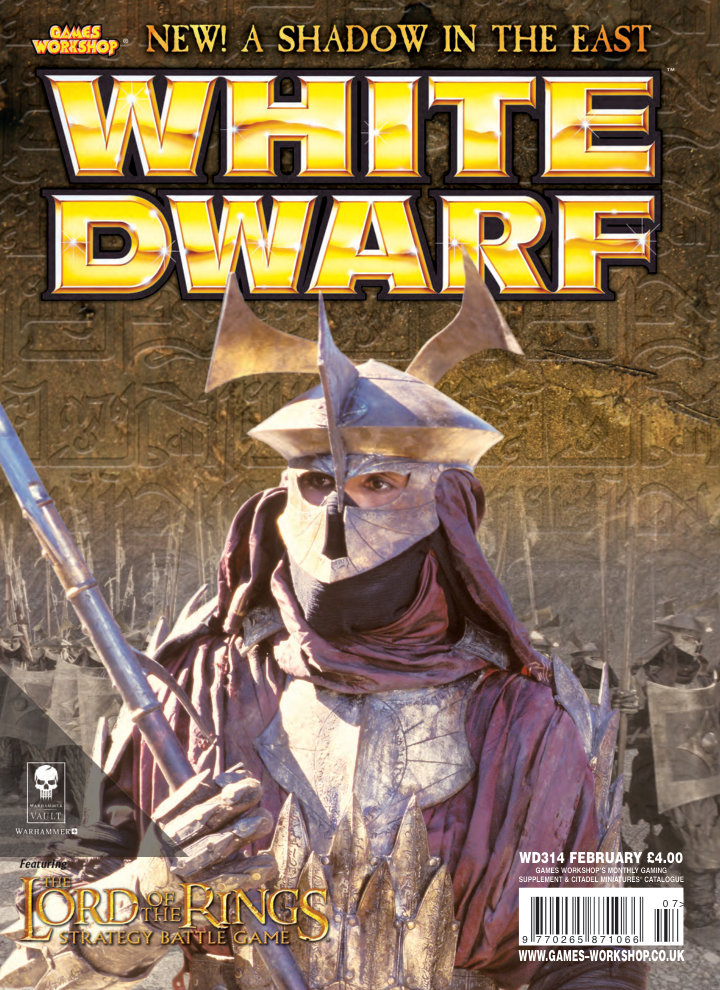
EditorialWD 314 · Inside cover
Owen Rees welcomes the Easterlings as worthy opponents for his Gondor cavalry and introduces the staff campaign around Mordheim’s Temple of Morr. His first evil force centres on a Vampire whose suitably dramatic name becomes a running joke. Tournament qualification, doubles preparation and several unfinished armies illustrate the competing demands on his hobby time. He also previews free reference sheets and the return of Jervis Johnson’s column.
Warhammer 40,000Warhammer Fantasy Battles
CommunityWD 314 · pp. 8–11
The news reveals the large plastic Giant kit and its interchangeable identities for Greenskins, Ogres, Chaos and mercenary armies. Clint Langley’s card artwork, historical releases and fiction merchandise sit alongside Simon Egan’s burrowing Forge World Trygon. Mordheim returns as both a boxed game and a forthcoming magazine campaign. The varied announcements emphasize model-building possibilities as well as additions to existing forces.
Warhammer Fantasy BattlesWarhammer 40,000Orcs & Goblins
EditorialWD 314 · p. 13
Gav Thorpe returns to the game after an absence and finds its familiar basic rules easy to recover, but effective play much harder to master. Studio opponents teach him new interactions by using them against his own forces. Reading the Easterling tactics becomes preparation for the issue’s battle report. His account distinguishes remembering how to move pieces from understanding when to spend Might or combine spells for a useful result.
Middle-earth Strategy Battle Game
InterviewWD 314 · pp. 14–19
The designer’s notes introduce an Evil mounted force able to challenge Rohan and Gondor on their own terms. Mat Ward explains the durability of Easterling Kataphrakts, Khamûl’s ability to recover Will through combat and the new Khandish chariots. The Variags grow from Tolkien’s brief references through historical inspiration and the Perry twins’ designs, including better but less reliable mercenary troops. Eorl and other Good heroes ensure that the expanded armies arrive with opponents and a campaign setting.
Middle-earth Strategy Battle GameEasterlings
RulesWD 314 · p. 17
Khamûl recovers Will for wounds caused, making combat an opportunity to sustain a Ringwraith rather than only exhaust him. Before the Fight phase he may spend Will to increase Strength, Fight or Attacks for that phase. These options join the usual magical powers and Terror, giving players a reason to send the named Nazgûl into selected engagements. The preview explains the distinctive ability without reproducing a complete character profile.
Middle-earth Strategy Battle GameRingwraiths
RulesWD 314 · p. 18
Khandish chariots combine fast movement with the Stable Platform and Monstrous Mount rules, allowing shooting on the approach and devastating charges against foot troops or cavalry. Three wounds make them harder to neutralize than ordinary mounts despite familiar Defence. A King supplies heroic movement and acts as a banner for nearby fighters. The discussion presents these interactions as a new answer for Evil players accustomed to being ridden down.
Middle-earth Strategy Battle GameKhand
TacticsWD 314 · pp. 20–23
Adam Troke starts with a small Easterling war party and develops three different five-hundred-point armies. Orcs and a Troll add numbers and power, Haradrim archers support a hammer-and-anvil alliance, and an entirely Easterling force trades bodies for consistent heavy armour. Khamûl and Kataphrakts wait for the decisive charge while a shielded phalanx fixes enemies in place. The lists show how the new figures can stand alone or integrate into existing Evil collections.
Middle-earth Strategy Battle GameEasterlings
TacticsWD 314 · p. 21
The first expanded list combines an Easterling fighting core with numerous Orcs, a Shaman and a Mordor Troll. Orc spears enlarge the phalanx’s support while a captain at its centre provides heroic movement and leadership. Fury keeps the Orc contingent active after losses and offers protection, while the Troll supplies exceptional combat power. The army uses each ally’s role rather than asking the better-armoured Easterlings to do everything.
Middle-earth Strategy Battle GameEasterlings
TacticsWD 314 · pp. 22–23
The allied force places heavily armoured Easterlings in front of Haradrim spears while bowmen apply ranged pressure. Khamûl and Kataphrakts form the hammer that strikes foes pinned by that block. The pure Easterling alternative is smaller but has no lightly armoured weak link, and can invite an advance through a shooting duel before launching its reserve. Both plans depend on timing cavalry support rather than spending the strongest mounted models too early.
Middle-earth Strategy Battle GameEasterlings
Battle reportWD 314 · pp. 25–37
Gav Thorpe’s Gondorians attempt a breakthrough against Alessio Cavatore’s Easterling and Khandish army. Early loss of Aragorn’s horse and an isolated advance expose the Citadel Guard to encirclement, while the trebuchet remains a dangerous counter to chariots. Once Gondor breaks, Khamûl exhausts the remaining heroes’ resolve and their followers flee. Aragorn alone fights his way off the table after seventeen turns, denying Evil a major victory but leaving Alessio the minor win.
Middle-earth Strategy Battle GameGondor
PaintingWD 314 · pp. 38–41
This intermediate workshop gives the wandering Dwarf heroes unusual colours while preserving their sturdy equipment. Dark blue-grey clothing, a green shield and a red bedroll contrast with layered steel and warm gold. Hair, leather and flesh each receive their own controlled highlight sequence, with washes restoring depth after lighter paint is applied. A pale patterned cloth border and common earth bases finish the pair, followed by an Iron Hills force and related Dwarf character gallery.
Middle-earth Strategy Battle GameIron Hills22 paint colours
PaintingWD 314 · p. 38
Shadow Grey darkened with black begins the cloth, rising through Shadow Grey and Fortress Grey mixtures to fine white-tinted edges. Metal starts over a black-and-grey foundation, then builds through Boltgun Metal, Chainmail and Mithril Silver. The two sequences keep their deepest tones in recesses while concentrating the brightest paint on raised areas, making heavily layered clothing and armour legible at miniature scale.
Middle-earth Strategy Battle GameDwarves8 paint colours
PaintingWD 314 · p. 39
Shining Gold receives thinned Flesh Wash, then Burnished Gold and Mithril Silver highlights on Drár’s decorated helmet. The shield instead starts with Camo Green darkened by black and gradually moves toward pure green, retaining a dark boundary. Bleached Bone mixed into green defines the upper edges. The paired treatments distinguish warm ornament from the shield’s painted field while using the same controlled application of thin layers.
Middle-earth Strategy Battle GameDwarves7 paint colours
PaintingWD 314 · p. 39
Scorched Brown leather receives bone-mixed edges, a Brown Ink wash and a final pale highlight. The wash restores depth and softens the contrast before the last narrow line. Múrin’s bedroll follows a separate warm red sequence from Scab Red through Blood Red, blended with Flesh Wash and finished by a little white in the highlight. Distinct materials therefore remain visible even where several small accessories overlap.
Middle-earth Strategy Battle GameDwarves7 paint colours
PaintingWD 314 · p. 40
Dark hair rises from blackened Scorched Brown through Tanned Flesh and a bone-mixed finish. Skin uses Tanned Flesh, Dwarf Flesh and thin pale layers, while boots and bow fittings rely on Dark Flesh over a dark foundation. A white border receives tiny black lines as a repeating pattern. Sand bases painted Graveyard Earth and drybrushed brown and bone unify the heroes with their expeditionary force.
Middle-earth Strategy Battle GameDwarves9 paint colours
ModellingWD 314 · pp. 42–47
The fortress workshop expands the architectural style of A Shadow in the East into a complete set of walls, towers and a gatehouse. Precisely cut foamboard creates the main structures, with bevelled battlements and firing slots adding depth without elaborate materials. Recessed doors, scored balsa gates and card banding complete the functional details. Textured walls, drybrushed warm earth colours, pale tiles and gold fittings tie the castle to the Eastern army.
Middle-earth Strategy Battle GameEasterlings8 paint colours
ModellingWD 314 · pp. 43–44
Wall sections are assembled from measured foamboard pieces, separating the lower structure from its battlement face. Peeling away selected card surfaces allows the exposed foam to be bevelled around lips and firing slots. Towers repeat the same construction around a raised floor, with roof templates supplied by the supplement. Building one complete set of components before duplicating it keeps the four walls and towers compatible.
Middle-earth Strategy Battle GameEasterlings
ModellingWD 314 · pp. 45–47
The gatehouse is built from its internal passage outward so the tunnel aligns cleanly with the front and rear openings. Tower doorways are recessed by removing only one card layer and its foam, leaving the rear surface intact. Scored balsa imitates wooden planks, thin card becomes metal banding and a pin supplies the handle. These details turn simple boxes into a coherent, usable fortification.
Middle-earth Strategy Battle GameEasterlings
PaintingWD 314 · p. 47
Textured paint and a black undercoat prepare the castle for a warm Scorched Brown wall base. Successive brown-yellow drybrushing defines the masonry, while wooden doors finish with Graveyard Earth. Roof tiles progress from Dark Flesh through Vomit Brown to Bleached Bone, and metal ornaments use Brazen Brass and Shining Gold. The repeated materials visually join the separately constructed sections into one fortress.
Middle-earth Strategy Battle GameEasterlings7 paint colours
ShowcaseWD 314 · pp. 48–51
Dominic Murray relocates his Gondorian collection from a generic city garrison to a force guarding passes in the White Mountains. The simple narrative gives games recurring characters and makes each engagement part of its history. Reliable infantry form the core, minor captains direct them, Rangers provide accurate fire and reserved cavalry exploit the right moment. Fast armour painting and Madril’s weathered cloak demonstrate how the theme extends onto the models.
Middle-earth Strategy Battle GameGondor9 paint colours
TacticsWD 314 · pp. 48–51
Dominic’s infantry combines high Defence, spears and banners to offer a dependable base for his army. Captains provide inexpensive heroic resources without attracting the attention reserved for famous characters. Rangers exploit stationary shooting positions but avoid major assaults, and lance-armed Knights wait in reserve until a favourable charge appears. Larger games can add Aragorn or Boromir, but the regular force is built around ordinary soldiers supporting one another.
Middle-earth Strategy Battle GameGondor
PaintingWD 314 · p. 49
Dominic Murray uses drybrushing to finish the armoured rank and file quickly. Boltgun Metal over a black undercoat establishes the main surface, followed by a light Chainmail pass that picks out sharper detail. The deliberately short recipe supports his collecting goal: a substantial infantry body ready to play, with more individual attention reserved for characters and scenic elements.
Middle-earth Strategy Battle GameGondor3 paint colours
PaintingWD 314 · p. 51
Thin Bestial Brown and Snakebite Leather washes build dirt at Madril’s cloak hem, then Vomit Brown and increasingly pale additions suggest accumulated wear and fraying. The layers become more selective as they brighten, finishing with white at the edge. A separate mixture of Shadow Grey, Bestial Brown and black is diluted into repeated face washes to represent stubble. Both effects distinguish a campaigning Ranger from a freshly equipped soldier.
Middle-earth Strategy Battle GameGondor7 paint colours
CampaignWD 314 · pp. 54–61
Nick Kyme and Andy Hall begin a campaign in the Death’s Head district, where High Priest Soloman Vantor appears to have changed from guardian to collector of souls. Six former priests receive contradictory visions ordering them back to the Temple of Morr, each distrusting the others and recruiting a different warband. The framework adapts ordinary campaign play with a local scenario table, protected emissaries and a narrator-controlled finale. Staff players introduce their forces through both collecting choices and short fictional encounters.
MordheimPriests of Morr
LoreWD 314 · pp. 54–55
The introduction recalls Mordheim’s decline from a prosperous capital into a city consumed by corruption before the twin-tailed comet strikes. The surviving Sisterhood and scattered wyrdstone draw mercenaries, treasure seekers and darker creatures into its ruins. A survey of Reiklanders, Middenheimers, Marienburgers, Witch Hunters, Skaven, Undead and the Possessed explains the different motives and strengths available to players. Campaign advancement turns these competing expeditions into continuing stories.
MordheimSisters of Sigmar
CampaignWD 314 · pp. 56–57
A map and local history connect Executioner’s Square, the split gaol, St Voller’s cemetery and the Temple of Morr. Former processions carrying condemned bodies now give way to rumours of restless spirits and surviving prisoners. Warbands use a dedicated scenario table and must encounter one another during the campaign, while an organizer reveals events and chooses when the final confrontation occurs. The district’s geography therefore structures both the random games and the unfolding mystery.
Mordheim
RulesWD 314 · pp. 58–59
Each warband receives one of six emissaries with a shared profile and ceremonial dagger plus individual equipment and abilities. They count as Dramatis Personae who do not advance and cannot buy more gear. Protected by Morr prevents selected permanent-removal injury results, ensuring their role in the final meeting with Vantor. The authors allow narrative allocation instead of strict randomness and suggest disguises or substitution when a warband would never plausibly serve a genuine priest.
MordheimPriests of Morr
RulesWD 314 · p. 58
Borin travels the suffering northern Empire, using his gift to offer the dying a peaceful passage into Morr’s realm. In the campaign that compassion becomes a dangerous battlefield effect: nearby knocked-down or stunned models, friend and foe alike, must reroll injury with an added penalty at the end of hand-to-hand fighting. His ceremonial staff and shared priestly protections accompany a power that can hasten death without distinguishing allegiance.
MordheimPriests of Morr
RulesWD 314 · p. 58
The eldest emissary accepts that every mortal ultimately comes before Morr, and leaves Talabheim reluctantly after his vision. Once in each hand-to-hand phase he can force an opposing successful wound roll within twelve inches to be rerolled. The ability gives his patient philosophy a protective expression, potentially preserving a companion at a critical moment while retaining the priests’ ordinary staff and campaign restrictions.
MordheimPriests of Morr
RulesWD 314 · p. 59
Young Krieger believes protecting the dead requires confronting those who violate death’s laws. Fear immunity and hatred of Undead, Possessed and Beastmen make him an unusually direct fighter among the emissaries. A staff and axe support that role, and his accompanying story places him naturally with Witch Hunters. The authors use his personality as an example of why suitable narrative pairing may be preferable to random allocation.
MordheimPriests of Morr
RulesWD 314 · p. 59
Reinhardt the Wise hides learning that might otherwise have raised him to high office, preferring humble service and rescued books to authority. He ignores fear and terror and lends a Leadership bonus to all models close to his calming presence. A holy relic and blessed water accompany his staff. The rules translate experience and spiritual confidence into a small area of steadiness amid the city’s horrors.
MordheimPriests of Morr
RulesWD 314 · p. 59
Vorgan’s gaunt appearance and rumoured encounter with a dead Necromancer suggest that binding the spirit left something within him. Touch of Death replaces ordinary weapon use with a single attempt that can force an immediate injury roll regardless of wounds or toughness. Failure leaves only a fist attack. The uncertain origin of his power makes him especially suited to an Undead companion without establishing that the priest’s darker rumours are known to others.
MordheimPriests of Morr
RulesWD 314 · p. 59
Narris deliberately cultivates the dread that most priests try to reassure away, hiding beneath a hood and carrying a great scythe. His belief that the dead god’s servants should themselves be feared becomes the simple ability to cause fear. The scythe supplies extra Strength but is difficult and two-handed. His design contrasts intimidation with the more protective or compassionate philosophies of the other emissaries.
MordheimPriests of Morr
ShowcaseWD 314 · p. 60
Andy Hall chooses a straightforward mercenary band with numerous ranged weapons. Four skilled Reiklander Marksmen exploit the province’s shooting advantage, two Warriors protect them and Champions add fighters for closer work. His captain and accompanying priest are expected to handle larger threats. The fictional opening lures the victorious mercenaries away from a tavern with a priest’s purse, establishing an ominous purpose behind an otherwise practical starting force.
MordheimReiklanders
ShowcaseWD 314 · p. 60
Christian reuses painted Beastmen and pays heavily for a Minotaur, accepting a small starting warband in exchange for the monster he most wants to field. Its introduction takes a darker route into the campaign: a Shaman eats the slain priest’s heart and absorbs visions of the city and temple. The band therefore acquires the emissary’s mission without pretending that Beastmen would peacefully join an ordinary Priest of Morr.
MordheimBeastmen
ShowcaseWD 314 · p. 60
Nick chooses Witch Hunters for their uncompromising imagery and maximizes heroes to include a Warrior Priest alongside the hunters. Hounds supply speed while Flagellants provide muscle. The story introduces Dietrich’s band rescuing Krieger Valiant from Zombies, recognizing his shared zeal and hearing of his mission. The warband’s collecting choices and fiction both stress determined attacks on the supernatural.
MordheimWitch Hunters
ShowcaseWD 314 · p. 61
Owen’s first evil collection uses a small Vampire-led warband as a potential foundation for a future army. Malachias hoards wyrdstone while sending meagre offerings to Vlad, hoping eventually to supplant his powerful relative. Vorgan’s apparent affinity with death promises a route to Vantor’s greater power. The short narrative gives the few figures a motive extending beyond the immediate campaign and connects Owen’s interest in vampire fiction with his new models.
MordheimUndead
ShowcaseWD 314 · p. 61
Rik begins Mordheim with Dwarf treasure hunters, using the new Warrior and Thunderer plastics and advice from Fanatic’s earlier tactica. His noble Thorgrck and companions meet two Slayers in a tavern, where Borin Fatalismus easily wins their attention by promising wealth. The introduction aligns the figures with the campaign priest while showing how a familiar Warhammer preference can make starting a new skirmish game less daunting.
MordheimDwarf Treasure Hunters
ShowcaseWD 314 · p. 61
James builds around two Great-Clawed Possessed and two Beastmen for a durable group of two-wound fighters. Additional followers finish knocked-down opponents, while fear provides another advantage. The Magister’s story begins with an amnesiac murderer emerging from the shattered gaol and interpreting a priest’s direction as a command to collect heads. It turns the campaign’s false visions into a mission fitted to a distinctly murderous warband.
MordheimCult of the Possessed
EditorialWD 314 · p. 63
Gav Thorpe credits Grand Tournaments with showing that competitive games could also celebrate painted armies, good scenery and sportsmanship. He welcomes disagreement about composition systems, scenarios and scoring as evidence that players enjoy different kinds of events. Comparing more conventional tournaments with distinctive gatherings such as Necronomicon and DogCon, he argues for a varied calendar rather than a single imposed model of organized play.
Warhammer Fantasy Battles
TacticsWD 314 · pp. 64–71
Gav Thorpe combines the history of Dwarf runecraft with practical advice on designing magical equipment. The Anvil’s three powers, army-wide spending choices, character combinations and Oathstones show how runes support a plan rather than simply maximize one hero. Background on lost artefacts and legendary smiths gives that equipment a past, while a modelling guide and record sheet encourage players to create named heirlooms of their own. Spreading runes across the army balances flexibility against concentrated risk.
Warhammer Fantasy BattlesDwarfs2 paint colours
LoreWD 314 · p. 64
The Ancestor Gods bind magic into crafted weapons, standards and protective objects, teaching the first Runesmiths their skills. Kurgaz’s Anvils of Doom enable a flourishing age in which even humble objects bear enduring enchantments. Earthquakes, invasions and the fall of holds destroy smiths before they pass on their lore, turning once-common creations into rare treasures. The account explains why surviving Dwarf rune items combine technical mastery with reverence for a diminished past.
Warhammer Fantasy BattlesDwarfs
RulesWD 314 · p. 65
Wrath and Ruin damages an unengaged enemy and restricts its mobility, including grounding flyers or slowing retreat. Hearth and Hold steadies friendly troops against fear and terror, while Oath and Honour grants an extra move or charge during the Shooting phase. Ancient Power expands each effect to more units or stronger protection. The rules explain the Anvil as a tool for controlling tempo and morale as well as directly inflicting casualties.
Warhammer Fantasy BattlesDwarfs
TacticsWD 314 · pp. 66–67
Gav recommends establishing an army’s intended strategy before designing its rune items. Characters, standards and artillery should reinforce shared strengths or offset weaknesses, with roughly a tenth of the army’s points serving as a flexible brake on overspending. A sample force demonstrates the distribution, and a Battle Standard can carry effects into units that normally lack them. Its placement must still preserve ordinary Break-test coverage rather than becoming solely a delivery system for magical bonuses.
Warhammer Fantasy BattlesDwarfs
LoreWD 314 · p. 68
Four artefacts illustrate the heights and uncertainties of ancient runecraft. Ghal Maraz carries runes rarely seen elsewhere, Norgrim’s golden sceptre inspires warriors, and Rori’s Fiery Thing retains destructive power despite conflicting accounts of its form. The Staff of Valaya is associated with life, death and defence against the Undead, guarding the tombs of fallen Karak Azgal. Their surviving stories connect everyday army equipment to exceptional relics and forgotten makers.
Warhammer Fantasy BattlesDwarfs
TacticsWD 314 · pp. 68–69
Reader combinations range from a swift, strong Dragonslayer to heavily protected Shieldbearer Lords and weapons aimed at tough regenerating foes. Other suggestions favour inexpensive strike-first equipment or an almost unadorned Lord, arguing that slow characters can be avoided regardless of their cost. The different builds reveal competing priorities: holding a flank, destroying specific enemies or leaving more points for regiments. No single combination is treated as the answer to every army.
Warhammer Fantasy BattlesDwarfs
LoreWD 314 · p. 69
Kadrin Redmane recovers the upper reaches of Karak Varn and crafts extraordinary gromril armour before an ambush ends his expedition; he throws his hammer into a lake to deny it to Goblins. Alaric the Mad instead becomes famous for the long labour that produces the Empire’s Runefangs and his master rune capable of cutting armour. The two histories pair dangerous recovery of lost treasures with obsessive creation of new ones.
Warhammer Fantasy BattlesDwarfs
RulesWD 314 · p. 70
A character nominates Stonebearers at deployment and stays with them, supplying magical resistance until a charge prompts him to set his stone. The unit then loses its flanks and rear but cannot voluntarily move or flee, while its champion must issue and accept challenges. If the unit breaks, the lost stone forfeits the character’s victory points even if he survives. The rules make stubborn territorial commitment powerful and costly rather than a freely reversible benefit.
Warhammer Fantasy BattlesDwarfs
ModellingWD 314 · p. 70
Aly Morrison mounts a small square miniature base on a rough card surround and textures the ground to match his army. Codex Grey establishes the stone, a graphic pen draws the runic design and Bleached Bone creates highlights that suggest carved depth. Matte varnish protects the finished marker. The separate counter represents an Oathstone without requiring a permanently elevated character or a fully rearranged regiment.
Warhammer Fantasy BattlesDwarfs2 paint colours
TacticsWD 314 · pp. 72–73
Paul Sawyer, Rik Turner and Nick Kyme reassess favourite Dwarf units under the new army book. Miners gain more reliable arrival, the Anvil improves movement and Gyrocopters can bait and pursue in new ways. Ironbreakers remain durable, Flame Cannons benefit from entrenchment and a revised misfire table, and Shieldbearers create economical fighting lords. Slayers’ choice of weapons and extra unit allowances give them a more flexible role than simply absorbing attacks.
Warhammer Fantasy BattlesDwarfs
ModellingWD 314 · pp. 74–81
The workshop uses the Dwarf artillery kits’ spare tools and ammunition to create small scenes around their machines. It compares fixed bases with removable crews in fitted trays, explains clean barrel assembly and shows simple foam entrenchments. James Griffiths adds runic plasticard and turning rails to a more elaborate position. A final cross-army gallery demonstrates how individual bases, scenic platforms and converted crews can extend the same idea beyond Dwarf guns.
Warhammer Fantasy BattlesDwarfs
ModellingWD 314 · pp. 75–77
Fixed bases improve stability and leave room for artillery accessories, but complicate removing a fleeing crew or forming them for combat. Cutting fitted holes in a foamboard insert lets ordinary based figures remain detachable inside a textured tray. The guide also recommends dry fitting the cannon and trimming its glued seam after curing. Separate accessories can be based individually when a full scenic assembly would interfere with play.
Warhammer Fantasy BattlesDwarfs
ModellingWD 314 · pp. 78–79
A shaped foam embankment on a firm base represents the protected position available to Dwarf artillery. Cocktail-stick stakes create a simple anti-cavalry version, while James Griffiths uses ceiling tile, textured plasticard and runic trim for a more detailed Grudge Thrower emplacement. The weapon remains loose on its turning rails so it can be repositioned during games. Tools, telescope and barrow supply believable working details without turning the model into a fixed display.
Warhammer Fantasy BattlesDwarfs
ShowcaseWD 314 · pp. 80–81
Eric van den Broek’s separately based Elven artillery includes a lizard linking it to a Lustrian army. Nick Christofili adds a captive Dwarf, prodding Goblin and remodelled Troll to an Orc Rock Lobber. Mark Bedford builds a balsa firing platform and broom-bristle grass for an Empire cannon, while Mark Jones integrates a Hellcannon’s chains, stakes and skulls into one scenic base. The examples vary the scale of intervention while preserving a clear army theme.
Warhammer Fantasy BattlesHigh Elves
PaintingWD 314 · pp. 82–83
The Slayer guide concentrates on the bare skin and orange hair that make these Dwarfs stand out from armoured regiments. Vermin Brown and flesh-coloured layers define muscles, while orange over a dark brown mixture gains warm Bronzed Flesh highlights. Gold and steel ornaments receive separate finishes and common earth bases unify the unit. Additional Human, Elf and Orc face recipes show how the same controlled progression can produce distinctly different skin tones.
Warhammer Fantasy BattlesDwarfs21 paint colours
PaintingWD 314 · p. 82
Repeated thin Vermin Brown coats establish the Slayer’s skin before a brown-and-Dwarf-Flesh mixture and progressively paler highlights define the muscles. The hair starts with Scorched Brown mixed into Blazing Orange, then receives careful orange overbrushing and Bronzed Flesh additions. The brightest colour is reserved for strand tips. Broad visible skin and a narrow crest therefore use different brushwork while sharing a warm palette.
Warhammer Fantasy BattlesDwarfs7 paint colours
PaintingWD 314 · p. 83
Brazen Brass supplies a solid dark foundation for Shining Gold and Burnished Gold, with silver mixed into the final edge highlight. Other metal begins as Boltgun Metal, shaded with a Black Ink and Codex Grey wash before Chainmail and Mithril Silver restore raised detail. The recipes give a lightly equipped Slayer’s small ornaments and weapons definition without competing with his skin and bright hair.
Warhammer Fantasy BattlesDwarfs8 paint colours
PaintingWD 314 · p. 83
Human skin builds from Dark Flesh through a mixture with Dwarf Flesh, then a more selective flesh layer. Elf Flesh highlights the nose, brows, cheeks and lips. Leaving earlier colours around deep features gives the face shape without a separate ink wash, and thin controlled applications keep the contrast concentrated on its prominent planes.
Warhammer Fantasy BattlesEmpire3 paint colours
PaintingWD 314 · p. 83
The lighter Elf face starts with Tanned Flesh and moves through Dwarf Flesh to Elf Flesh. A little Skull White in the final mix brightens the features while the darkest layer remains visible in recesses. The sequence achieves pallor through successive coverage rather than beginning with an opaque white face.
Warhammer Fantasy BattlesHigh Elves4 paint colours
PaintingWD 314 · p. 83
Catachan Green forms the Orc’s dark foundation, with Goblin Green mixed in for the first highlight. Pure Goblin Green covers the raised features and a bone-tinted mixture supplies the final definition. The recipe retains shaded contours beneath a brighter green face, using the same layered approach as the neighbouring Human and Elf examples.
Warhammer Fantasy BattlesOrcs & Goblins3 paint colours
TacticsWD 314 · pp. 84–89
Phil Kelly shows how troops that refuse to break can shape a battle even when they cannot win their own combat. They delay powerful enemies, anchor exposed flanks, span multiple units in a thin line or bait attackers into countercharges. Comparisons of Slayers, Flagellants, Undead, swarms, monsters and resilient characters explain their different vulnerabilities. The crucial measure is often the time and position gained for the rest of the army rather than the survival of the sacrificial unit.
Warhammer Fantasy BattlesDwarfs
TacticsWD 314 · pp. 84–85
The basic formations turn an enemy’s successful charge into a positional problem. A stubborn obstacle buys time, an anchored flank blocks encirclement and an extended rank can occupy several enemy units at once. Angled Flagellants or Slayers also expose the charging foe to a stronger counterattack. Pursuit direction depends on the supporting unit’s strength, so arranging the rescue can create another flank charge along the enemy line.
Warhammer Fantasy BattlesDwarfs
TacticsWD 314 · pp. 86–87
Slayers and Flagellants offer strong return attacks but suffer badly from shooting, while Undead require magical replenishment and swarms dislike magical missiles. Single monsters are economical roadblocks yet easier to kill than a regiment. Selected characters can hold entire units if their equipment offsets combat-resolution losses, with a healing Tomb King combination given as an example. The comparison encourages matching the delaying unit to the threat it must absorb.
Warhammer Fantasy BattlesDwarfs
LoreWD 314 · pp. 90–93
Mat Ward and Gav Thorpe recount a disastrous dispute over a new bridge through the Moot. Marius Leitdorf interprets Halfling obstruction as an insult, massacres the first defenders and loses much of his own army to disgust at his conduct. Desperate appeals draw mercenary Halflings and Ogre allies into the struggle as Imperial intervention approaches. A scenario, Leitdorf profile and improvised Halftank turn the comic but brutal episode into a refight.
Warhammer Fantasy BattlesEmpire
RulesWD 314 · pp. 91–92
A three-thousand-point Ogre and Halfling coalition attacks Leitdorf’s exhausted Averlanders in the Moot. Empire defenders deploy first and cannot use the general’s Leadership, while Gnoblars representing rebel Halflings deploy as scouts. The Ogres take the first turn and normal victory points determine the six-turn result. Optional mercenary Fighting Cocks, Hot Pots and the Halftank give the attackers a suitably unusual identity within their ordinary army framework.
Warhammer Fantasy BattlesEmpire
RulesWD 314 · p. 92
The Mad Lord’s profile combines full plate, a barded horse and Runefang with an additional dagger. His unstable fury produces extra attacks, separating the magical sword’s blows from the dagger’s ordinary Strength. Background balances his tantrums and depression with artistic intelligence and exceptional swordsmanship, ending with his death at Black Fire Pass. The character must lead the defending Empire force in the accompanying scenario.
Warhammer Fantasy BattlesEmpire
RulesWD 314 · p. 93
Kathleen is an Unbreakable, fear-causing Halfling contraption with a soup cannon and unusual movement classification. It cannot march, inflicts impact hits on the charge and grinds foes with smaller automatic hits in later turns. The cannon projects a powerful template that ignores armour. Chad Mierzwa’s model combines old Steam Tank pieces, a Dwarf limber and a Cauldron of Blood, doubling as a Scraplauncher in other games.
Warhammer Fantasy BattlesHalflings
EditorialWD 314 · p. 95
Andy Hoare revisits arguments about powerful armies through his experience of both competitive and narrative games. The same optimized list can be welcome in a tournament and disappointing when the other player expects a story-driven campaign. He argues that both approaches are valid when participants share expectations from the outset. The column’s practical concern is the purpose of the game agreed between players rather than a universal judgement on particular choices.
Warhammer 40,000
LoreWD 314 · pp. 96–103
Graham McNeill expands the histories of Folker, Gervhart, Ludoldus and Sigenandus while hobbyists model each leader’s defining character. A recruit’s inherited blade, a pilgrim’s power maul, archaic Terminator armour and a vengeful thunder-hammer warrior link equipment to personal stories. Full-page galleries place them within the Templar range. The feature continues the earlier crusade histories by giving the commanders recognizable origins and individually constructed miniatures.
Warhammer 40,000Black Templars
LoreWD 314 · p. 96
Folker survives his recruitment journey by killing a mountain drake and turning its ravenous fellows against the fallen beast, allowing the recruits to reach safety. The Chapter transforms his father’s sword into a power weapon he continues to carry as Castellan. Graham’s kneeling model holds a sheathed sword instead of a conventional raised-weapon pose, using shortened tabard and altered arms to suggest the weight of that personal history.
Warhammer 40,000Black Templars
LoreWD 314 · p. 98
A scholar of earlier Marshals, Gervhart draws inspiration from reliefs on the Emperor’s palace during a long pilgrimage. Their image of a crackling staff prompts his new power maul and shield fighting style, though his later disgrace shadows the weapon’s honoured survival. Matt Hutson converts the maul from a banner haft and holy orb, then adds large shoulders, shields and seals to convey a formidable armoured commander.
Warhammer 40,000Black Templars
LoreWD 314 · p. 100
The history acknowledges portraits of apparently identical Ludoldus figures separated by thousands of years. The Vinculus warrior carries archaic Terminator armour, a sacred lantern, brazier and fiery weaponry into the darkness of Peleregon. Pete Jarman combines plastic Terminator parts, a Warsmith bionic leg, Ork shoulder plates and a torch from the Throne of Judgement. Straps and small rivets turn the mixed components into a coherent ancient suit.
Warhammer 40,000Black Templars
LoreWD 314 · p. 102
The destruction of Chapter keeps drives Sigenandus to gather four crusade fleets against Vandire, then hunt the traitor’s remaining supporters long after the palace falls. Neil Hodgson starts from Lysander’s armoured pose but removes Imperial Fist insignia and changes the weapons. An eagle-headed thunder hammer, Templar shoulder ornament, moustache and circlet distinguish the new identity. The conversion matches the biography’s relentless authority without needing an entirely sculpted character.
Warhammer 40,000Black Templars
RulesWD 314 · pp. 104–109
Four developers add unusual native fauna to battlefields, from territorial Catachan Devils and Warp-travelling Crotalid to metal-eating Ferro-beasts and dangerous Grox. Siltwalkers and explosive Barking Toads turn familiar movement and shooting assumptions into risks. Individual backgrounds accompany profiles, conversion ideas and three missions that make the creatures central to victory. The feature encourages new beasts assembled from existing models and games whose environment is an active third presence.
Warhammer 40,0004 paint colours
RulesWD 314 · p. 104
Catachan Devils are huge segmented predators whose nesting groups defend territory against rival creatures or entire military formations. The profile distinguishes ordinary adults, smaller Devilspawn and stronger male Fiddlers with enlarged claws. Movement through cover, stealth, fleetness and infiltration accompany their monstrous strength. The entry gives the jungle world a social, territorial predator rather than an army-aligned monster.
Warhammer 40,000Catachan fauna
RulesWD 314 · p. 105
Crotalid dominate tropical waterways until scarce prey drives instinctive migration through the Warp. Their rules force movement and assaults toward nearby models of either side, while failed morale makes them vanish rather than conventionally retreat. Graham builds the adults by placing Cold One heads on Salamander bodies, using a Jungle Swarm creature for the juvenile. The simple conversion and neutral aggression suit scenarios where local wildlife threatens any intruder.
Warhammer 40,000Native fauna
RulesWD 314 · p. 105
A mineral-poor world produces an armoured grazer able to digest metal, which becomes dangerously excited around refined military equipment. Its corrosive secretion acts as melta-bombs against vehicles and bypasses armour on selected metallic or heavily armoured targets, including most Necrons. Andy’s model combines a Stegadon crest, Cold One limbs and a Ripper head. Rust-coloured painting and luminous slobber make its feeding habits immediately visible.
Warhammer 40,000Native fauna2 paint colours
RulesWD 314 · p. 106
An attempt to rebuild Calana VII’s ecology with imported predators instead produces another death world. Slasher Beasts first ensnare prey with a fast pelvic-claw strike, then exploit the victim’s greatly reduced Weapon Skill and Initiative with their remaining attacks. Graham reverses Rat Ogre and Tyranid components, adds a Cold One head and uses tails as tentacles. The profile and conversion give the failed ecological experiment a distinctive silhouette and combat sequence.
Warhammer 40,000Native fauna
RulesWD 314 · p. 106
Grox are valuable livestock because they can thrive on almost any food, but their solitary aggression makes herding hazardous. Wild or uncontrolled Psycho-grox charge readily and strike harder, while lobotomized animals wander without aggression. Laser-equipped herd members automatically fire at nearby enemies to deter rustlers. The contrasting profiles turn a commonplace Imperial food source into several distinct battlefield hazards rather than one interchangeable monster.
Warhammer 40,000Native fauna
RulesWD 314 · p. 107
Jalgrax’s sudden tides favour adaptable creatures, including cunning tripods that cross soft ground by shifting part of their mass into another dimension. Returning that mass mid-pounce pins prey with surprising force. Their squad profile combines quick reactions with fleetness, stealth, scouting and movement through cover. The entry makes their unusual biology support a recognizable ambush role in the creature missions.
Warhammer 40,000Native fauna
RulesWD 314 · p. 107
The lesser relative of Catachan’s catastrophic amphibian wanders unpredictably and explodes when threatened by most creatures, shooting or nearby gunfire. Its blast is exceptionally lethal but exempts several non-biological or supernatural targets. Kroot and trained Jungle Fighters can approach and attempt to kill it without triggering the usual immediate detonation. Andy converts a small Jungle Swarm lizard with putty and gives Jade Green skin a glossy Ardcoat finish.
Warhammer 40,000Catachan fauna2 paint colours
RulesWD 314 · p. 108
An attacking expedition seeks specimens from a creature-infested area while defenders wait to exploit the hunters’ engagement. Wildlife begins on the table and the defender’s conventional force enters later from reserve. The attacker receives doubled destruction points, while the defender values surviving scoring units instead. Requiring a substantial but limited investment in creatures makes hunting the beasts central without removing the risk of the organized ambush.
Warhammer 40,000
RulesWD 314 · p. 109
A force must cross the battlefield and escape after entering dangerous beasts’ territory. The opposing player places creatures ahead of the column and brings conventional troops from the long edges, turning the retreat into a moving ambush. Bonus points reward destruction and escape, but the printed paragraph misidentifies the beneficiary of the escape bonus. The scenario needs that wording agreed before use, while its deployment still clearly establishes the intended fleeing defender.
Warhammer 40,000
RulesWD 314 · p. 109
Two armies fight to control table quarters while native beasts arrive from reserve. Both players purchase a separate creature allowance, but a fresh opposed roll each turn decides who actually commands each beast or herd. Arrival location and uncertain control create an environmental threat that neither side can safely regard as a dependable ally. The victory condition remains territorial, encouraging players to use or evade the wildlife while preserving scoring units.
Warhammer 40,000
TacticsWD 314 · pp. 110–111
Andy Smilie treats the Necron Lord’s equipment as the main way to alter an otherwise relatively fixed army. A Destroyer body and warscythe answer powerful characters or distant artillery, while resurrection orbs keep Warriors or mobile Destroyers functioning and delay phase-out. Two illustrated plans use Monolith extraction or concentrated Destroyer movement to preserve firepower. The Lord’s task is to extend the army’s survival and respond where its ordinary units cannot.
Warhammer 40,000Necrons
TacticsWD 314 · p. 111
The first illustrated plan keeps Warriors on home objectives and uses Monolith portals to extract them from combat, repair losses and block the pursuers. Destroyers and a mounted Lord can redeploy through the same network against threats. The second plan concentrates Destroyer fire to clear one area, moves there and repeats, with two Lords extending orb coverage. Widely separated Warriors hold quarters while the mobile group eliminates the threats most able to stop it.
Warhammer 40,000Necrons
LoreWD 314 · pp. 112–113
An intercepted Tau broadcast offers Imperial soldiers peace, purpose and the Greater Good, while an Imperial annotation warns of seductive alien promises. The opposing voices frame a photographic preview of XV25 armour, Commander Shadowsun, the Sky Ray and Aun’Va. The spread introduces the next month’s army through propaganda and model imagery rather than complete rules, giving its technological additions an ideological setting.
Warhammer 40,000Tau Empire
ShowcaseWD 314 · pp. 114–117
Victoria Lamb discusses a miniature-painting practice connected to her theatrical set and costume work. Her gallery values character, humour and dramatic storytelling, from Sister Joan’s rescue and an auspex-lit ambush to sunburnt Ogres and an Orc squabble. Conversion and sculpting reinforce each scene’s expression rather than merely adding detail. The accompanying lighting advice explains how painted illumination can work on three-dimensional models and on pieces without a painted backdrop.
Warhammer 40,000Warhammer Fantasy BattlesAdepta Sororitas
PaintingWD 314 · p. 116
Victoria explains how looking at painted light in two-dimensional art suggested her treatment of Sister Joan’s rescue. A dark underlying model gives the illumination room to stand out, and the flame must remain the brightest point. Straight paths from the source determine which surfaces receive red, orange and yellow drybrushing. Blending and layering can refine the result, but experimentation and believable direction matter more than a fixed recipe of named paints.
Warhammer 40,000Warhammer Fantasy Battles
ModellingWD 314 · p. 118
James Griffiths turns the Nightbringer’s cloak into a shifting Tzeentchian body by making four Horrors emerge as limbs. Putty blends the joins, while flames from a Disc form a Blade of the Ether held by one of the creatures. A deep brass-rod support hidden within textured putty creates the illusion of magical hovering. The final positioning keeps the model’s centre of gravity over its base, making an apparently precarious conversion stable.
Warhammer Fantasy BattlesWarhammer 40,000Tzeentch
EditorialWD 314 · p. 119
Nick Kyme explains his role as the magazine’s travelling journalist and the kinds of projects he hopes to uncover. Themed armies, conversions, terrain and campaigns from clubs and stores can all provide material for White Dwarf. He asks for strong, interesting work without insisting on professional competition standards. The column connects the revised community section with a deliberate search for practical hobby stories beyond the Studio.
CommunityWD 314 · pp. 120–121
Nick Kyme visits Kurt Baker’s remote Cornish club and finds that regular play, simple scenery and an energetic organizer matter more than elaborate facilities. The members move between game systems, stage monthly tournaments and cooperate with neighbouring groups. A siege and nautical Warhammer battle show the variety available when players choose their own activities. The report presents the club as a practical example of a thriving local community built with modest resources.
Warhammer Fantasy BattlesWarhammer 40,000
ModellingWD 314 · p. 125
Sutton Coldfield’s staff reshape Ultramarines into distinct in-battle poses, from communicating and aiming to firing from the hip or kneeling. Martin Jennens and Stu Morris cut and reposition the parts, with Adam Sharpes painting the completed Marines. The brief showcase connects conversion work with teaching: unusual personal models become a talking point for explaining how familiar plastic figures can be changed.
Warhammer 40,000Ultramarines
CommunityWD 314 · p. 142
A father recounts his first game with his children after years of painting, showing how shared play changes the family’s experience of the collection. Readers also submit a large converted High Elf army, recall Man O’ War and share a fantasy-themed wedding. Owen’s replies connect these personal accounts with the magazine’s broader coverage, treating miniature gaming as a source of stories and relationships as well as finished models.
Warhammer 40,000Warhammer Fantasy BattlesHigh Elves
EditorialWD 314 · p. 143
Nick Kyme adds Dwarf heroes and prepares Witch Hunters for the newly introduced campaign. Rik Turner shows the Blood Raven Librarian created during his Sabbat Crusade project and explains the time gap between website and magazine coverage. Christian Byrne advances the Imperators with a Dreadnought, Terminators and planned plasma weapons, then outlines computer-designed transfers for the Chapter badge. The staff’s unfinished work provides continuing context for the armies seen elsewhere in the issue.
Warhammer Fantasy BattlesWarhammer 40,000Dwarfs