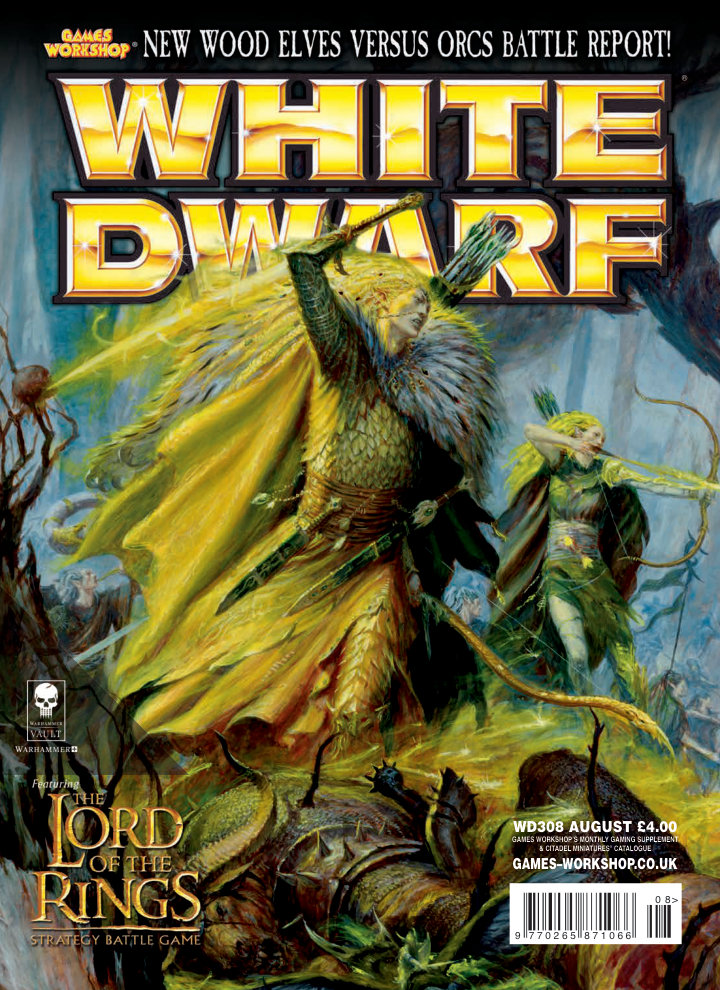
CommunityWD 308 · pp. 2–5
Graham McNeill previews the Black Templars’ first complete standalone codex, emphasizing knightly identity, Crusader squads and vows chosen through the Emperor’s Champion. Helbrecht and Grimaldus lead the accompanying character range, with the latter’s rescued relics borne by servitors. Other reports introduce Shas’O R’myr, new publications, the Games Day Aurelius model and the forthcoming Lord of the Rings rulebook offer, while campaign news urges players into the War of the Ring’s final phase.
Warhammer 40,000Middle-earth Strategy Battle GameBlack Templars
EditorialWD 308 · pp. 6–7
Guy Haley recounts a catastrophic mechanised Guard defeat in which Jes Bickham’s winged Hive Tyrant survived concentrated fire and opened his transports for the swarm. Christian Byrne completes Chaos models and rethinks his Imperators around larger infantry squads. Greg MacGregor describes a failed three-way Battle Companies recovery game, Nick Kyme’s Dwarfs finally lose to Colin Goodwin’s Skaven, and Paul Rudge returns to Harad gaming despite one exceptionally unproductive opening battle.
Warhammer 40,000Warhammer Fantasy BattlesImperial Guard
InterviewWD 308 · pp. 14–19
Graham McNeill interviews the team behind the revised Wood Elves. Mat Ward explains their darker, capricious identity, the sometimes uneasy alliance with forest spirits and a flexible army supported by enhancing magic. Alun Davies discusses organic page textures, Paul Jeacock draws on unsettling early faerie stories, and Alex Hedstrom describes translating detailed concepts into layered, flowing miniatures. The combined approach makes Athel Loren and its inhabitants feel connected without turning them into a uniformly harmonious society.
Warhammer Fantasy BattlesWood Elves
RulesWD 308 · pp. 15–16
Mat Ward explains how the new list can form a conventional battleline or a mobile skirmishing army, with short-ranged support spells encouraging units to act together. The Lore of Athel Loren draws thematic ideas from old Jade and Amber magic while reducing their power for the current game. Spites use a character’s magic-item allowance, enchanted arrows combine with magical bows, and special characters represent different sides of the forest. Ariel is absent because her principal role is renewal rather than routine warfare.
Warhammer Fantasy BattlesWood Elves
InterviewWD 308 · p. 16
Alun Davies describes the Wood Elf book as the third part of an Elven visual trilogy, following the High and Dark Elves while using stronger earthy colours and natural forms. Branches and watching Spites are enlarged and faded into page textures to suggest being observed in the forest. He stresses restraint: the graphics should communicate a sinister, organic setting while allowing the actual content to remain clear.
Warhammer Fantasy BattlesWood Elves
InterviewWD 308 · p. 17
Paul Jeacock explains developing the range through exchanges with Anthony Reynolds and Alex Hedstrom rather than working only from a fixed brief. Dark faerie tales provide dangerous, magical qualities, while thinking about life beyond the battlefield makes the designs coherent. The aim is for the Elves to appear part of the forest itself and still retain a family relationship with other Elven peoples. Jeacock names the bizarre Dryads as a personal favourite.
Warhammer Fantasy BattlesWood Elves
InterviewWD 308 · pp. 18–19
Alex Hedstrom discusses sculpting Glade Guard, riders, characters and the Sisters of Twilight as part of a wider team effort involving the Perry twins, Steve Saleh, Trish Morrison, Brian Nelson and Gary Morley. Tall, slender forms allow flowing robes and a sense of motion even in a standing figure. Interlocking armour, leaf shapes and layered clothing turn the concepts into distinctive miniatures, with necessary changes where an illustration’s detail cannot survive at gaming scale.
Warhammer Fantasy BattlesWood Elves
Battle reportWD 308 · pp. 20–37
Mat Ward commands 2,500 points of new Wood Elves against Pete Haines’s Orcs and Goblins. Eternal Guard anchor Mat’s centre while Forest Spirits and small elite units cover the flanks; Pete fields a mass of infantry backed by boar cavalry, chariots, Trolls and a Giant. Early Elf losses include the Wardancers, Tree Kin and one Eternal Guard unit, although Pete’s Orc Shaman destroys himself in a miscast.
Warhammer Fantasy BattlesWood Elves
FictionWD 308 · p. 37
After the battle, Retala surveys the forest’s dead and wounded with little concern for the defeated intruders but a sober awareness of Elven losses. She senses Athel Loren returning to the grove and knows that new growth will eventually cover the ruined ground. Before leaving, a faint green light from the fallen Treeman catches her attention: she recognises that its life is returning, softening the cost of victory.
Warhammer Fantasy BattlesWood Elves
ModellingWD 308 · pp. 38–41
Mark Jones builds an Elven boundary stone from a carefully measured polystyrene block, shaving angled faces and impressing Tree Singer runes with a pen. A raised base and surrounding vegetation place it at Athel Loren’s edge, turning simple scenery into a narrative landmark. Textured paint seals the foam before grey drybrushing and green weathering finish the stone. Brown and bone ground colours sit under flock, with foliage and hedge fragments suggesting age and encroaching growth.
Warhammer Fantasy BattlesWood Elves9 paint colours
PaintingWD 308 · pp. 40–41
The stone receives a black undercoat followed by Codex Grey, Fortress Grey and Skull White drybrushes, then small Camo Green additions for moss and weathering. The ground is painted Bestial Brown, Graveyard Earth and Bleached Bone before flock, ensuring that worn patches reveal natural earth colours. Clump foliage and hedge pieces supply ivy and bushes, with a Bubonic Brown drybrush aging their appearance. The nine-paint index includes colours omitted from the introductory materials list.
Warhammer Fantasy BattlesWood Elves9 paint colours
RulesWD 308 · pp. 44–45
Andy Hoare introduces Anakonda’s Amazons, a hireable warband whose names and trophies commemorate battles with Lustrian creatures. Humming Bird carries their sacred feathered banner and Pirrana blows a conch recovered from a giant fish. The regiment uses ancient blades for stronger melee attacks, protective energy and short-ranged shooting, alongside skirmishing and native encounter immunity. Stories of Tilean employers underline that paying these warriors does not guarantee permanent safety or loyalty.
Warhammer Fantasy BattlesAmazons
RulesWD 308 · p. 45
The minimum band costs 125 points for Anakonda and four Amazons including the named standard bearer and musician, with additional models bought up to a maximum of twenty. Any army can hire them for Lustria jungle-fighting games; use elsewhere requires the opponent’s agreement. Blades of the Ancients grant strength, a ward and an accurate short-range missile attack, while Skink-hide armour and skirmishing complete the profile. The three leaders occupy the front rank when the unit forms for melee.
Warhammer Fantasy BattlesAmazons
ModellingWD 308 · pp. 46–51
Four hobbyists demonstrate different Lustrian forces through conversions rather than new army lists. John Shaffer adapts Mordheim Amazons with Lizardmen equipment and counts-as Totem Guardians, Eric Sarlin mixes Empire and mercenary figures into Estalian conquistadors, Andy Gould gives Goblins feathered trophies and spider mounts, and Jeff Keyser modifies Savage Orc leaders and archers. Component photographs and unpainted examples explain construction, while finished models show the combined themes without naming paint recipes.
Warhammer Fantasy BattlesAmazons
ModellingWD 308 · pp. 46–47
John Shaffer equips Amazons with adapted Saurus spears and Skink shields, bends archers’ arms to hold arrows naturally and builds a crone Priestess from a Ghoul body with replaced head and arms. His Totem Guardians use two-handed composite weapons, reposed bodies, Saurus shoulder pads and scaled cloaks. They count as Empire Greatswords in his chosen list, showing how an unusual visual unit can use existing rules without inventing unsupported statistics.
Warhammer Fantasy BattlesAmazons
ModellingWD 308 · pp. 48–49
Eric Sarlin builds a mixed pirate-and-conquistador force by selecting older Empire and Pirazzo figures with morion helmets, then varying their heads and weapons with Free Company parts. A more involved standard bearer uses brass rod, skull-and-crossbones fittings and a cut-down flag rounded with Green Stuff. The finished models illustrate how a small number of donor figures can yield a coherent but varied expeditionary army.
Warhammer Fantasy BattlesThe Empire
ModellingWD 308 · pp. 49–50
Andy Gould develops a deliberately exaggerated adventure-film theme using skulls, bones and feathers from several plastic ranges. Big Boss Ugharh ’Eadtaker receives an Amazon plume, Skaven back banner and improvised stone-headed weapon, while his infantry standard becomes a trophy rack. Drums, nose bones and spider riders carrying Amazon weapons extend the motif across the force. The explanation concentrates on matching repeated visual details rather than a new rules variant.
Warhammer Fantasy BattlesOrcs & Goblins
ModellingWD 308 · p. 51
Jeff Keyser finds that ordinary Savage Orcs already suit a Lustrian force and concentrates his alterations on a leader and bow-armed warriors. Irkfang Slasha combines a champion body, boar-rider head and arm, plus a large Ogre bone, creating a conspicuous commander. The archers use Gorkamorka Spanner Boyz with Night Goblin bows and arrows. Photographs present the simple component changes before showing their painted effect in a unit.
Warhammer Fantasy BattlesOrcs & Goblins
CampaignWD 308 · pp. 52–59
Guy Haley closes eight months of budget army collecting with reflections from all four participants. Stephen Green values the discipline of a fixed budget, Asger Granerud plans to expand his unique Nurgle force, Dave Allen wants mobility and more consistent painting across his Orc ranks, and Paul Scott has rediscovered enthusiasm through a strongly themed Empire army. Their completed forces illustrate different priorities rather than a single route to success.
Warhammer Fantasy BattlesTomb Kings
Battle reportWD 308 · pp. 58–59
Dave Allen defends with 750 points against Asger’s 1,500-point Daemons, needing to destroy at least his own army’s value to win. He hires an Ogre Maneater and tries to trap the chariot and Exalted Daemon, but Asger repeatedly denies useful charges while jungle encounters add uncertainty. Borgut’s unit is run down after failing terror, and the remaining Orcs collapse. The Maneater finally reaches the chariot only for quicksand to remove it first; Asger wins both battle and campaign.
Warhammer Fantasy BattlesOrcs & Goblins
CommunityWD 308 · pp. 60–62
The event preview maps the new NEC venue into Forum, Arena and Pavilion areas, combining participation games, hobby advice, army clinics, competitions and access to the Design Studio. New Bring and Battle tables encourage visitors to use small forces, while a screen-based presentation replaces seminars. Displays cover Wood Elf development, forthcoming Black Templars and Jes Goodwin’s work; other stands feature books, specialist games, historical releases and the Dark Millennium card game. Golden Demon categories are restated for entrants.
Warhammer Fantasy BattlesWarhammer 40,000
TacticsWD 308 · pp. 64–71
Phil Kelly and Marco Schulze demonstrate opposite uses of the new Tyranid codex. Phil’s 120-model Jormungandr swarm floods the board with cheap broods, relying on fast assaults and rending claws rather than heavy monsters. Marco and Katja Schimmel build Moloch around two Tyrants, six distinct Carnifexes and a few Ripper bases, gaining formidable individual strength at the cost of speed and attacks against hordes. Army lists and conversion close-ups connect the tactical choices to the models.
Warhammer 40,000Tyranids
TacticsWD 308 · pp. 64–65
Phil Kelly fields a tentacled Broodlord, Warriors, large numbers of Gaunts, Genestealers and Gargoyles in a swarm of 120 models. Hormagaunts engage firing units before the heavier combat broods arrive, while cheap or returning Gaunts absorb casualties. The theme deliberately forgoes dedicated anti-tank monsters, leaving rending claws to deal with vehicles once they are caught. The printed list totals 1,502 points, showing how the horde fills every available Troops selection.
Warhammer 40,000Tyranids
TacticsWD 308 · pp. 66–67
Marco Schulze and Katja Schimmel give each monster a distinct purpose and shape, from a winged Tyrant and a commanding ground leader to economical Elite Carnifexes and heavily modified support beasts. Rippers supply limited speed, venom cannons handle vehicles and Catalyst helps slow monsters fight effectively. Marco accepts the theme’s weakness against numerous infantry and stresses sheltering the winged Tyrant from concentrated fire. The army demonstrates extreme specialization rather than an all-purpose competitive list.
Warhammer 40,000Tyranids
ShowcaseWD 308 · pp. 68–71
Close-ups explain the anatomy of Moloch’s converted monsters. The flying Tyrant keeps six limbs by turning its feet into talons, while Necromunda Ripperjacks become mobile Ripper swarms and seashells create alien bases. Individual Carnifexes receive names such as Scarfex, Stranglefex and Devourerfex, reflecting merged heads, weapons, battle damage and poses. Captive Guardsmen and reconstructed limbs emphasize different behaviours without supplying a named paint recipe.
Warhammer 40,000Tyranids
PaintingWD 308 · pp. 72–77
Guy Haley batches devourer Gaunts on a taped painting stick, using broad coats, ink washes and drybrushing while reserving greater care for visible carapace stripes. He adds murky pools, reeds and torn lichen to the bases and explains finishing varnishes. Keith Robertson then presents the studio’s Kraken, Behemoth and Leviathan schemes, with complete recipe descriptions and additional pictured colour variants. Together the features compare practical army painting with more elaborate studio finishes.
Warhammer 40,000Tyranids31 paint colours
PaintingWD 308 · pp. 72–74
A reusable stick and large brushes let Guy Haley apply Graveyard Earth and Brown Ink quickly across a whole brood. Pale drybrushing establishes the chitin, then progressively lighter fine stripes concentrate detail on the eye-catching carapace. Rotting Flesh and coloured inks distinguish tubes and soft tissues, while dark claws and purple tongues keep the palette compact. Haley recommends batches of at least eight and deliberately limits perfectionism so the force reaches the table.
Warhammer 40,000Tyranids16 paint colours
ModellingWD 308 · p. 74
Untextured patches on the Gaunts’ bases become murky pools painted from Rotting Flesh, Graveyard Earth and a touch of Camo Green. Three blobs of PVA create the water surface, while torn lichen and long modelling grass suggest alien vegetation and reeds. Scorched Brown finishes the rim. The models are varnished before the water is added so the pool retains its gloss rather than being dulled by the final protective coat.
Warhammer 40,000Tyranids6 paint colours
PaintingWD 308 · p. 75
Keith Robertson describes Kraken’s warm exoskeleton, shaded with Flesh Wash and highlighted from Bubonic Brown toward Bleached Bone, against black-based red carapaces and claws. Small green weapon tubes and pink tongues complete the main palette. The illustrated variants add different flesh and orange-brown combinations beyond the prose recipe. The army itself favours eighteen gun-armed Warriors and numerous lesser creatures, demonstrating that a recognizable swarm need not include Genestealers or great monsters.
Warhammer 40,000Tyranids12 paint colours
PaintingWD 308 · p. 76
Dave Gallagher’s Battle for Macragge artwork inspires Behemoth’s bright red flesh and dark blue-green carapace. Repeated Blood Red coats over Red Gore build the skin, while turquoise stripes and grey mixes create ridged armour; claws use separate grey highlights. A prepared mixing pot keeps the army consistent. Pictured alternative Warriors introduce pink and Regal Blue combinations, and the force balances shooting and melee with several larger organisms.
Warhammer 40,000Tyranids10 paint colours
PaintingWD 308 · p. 77
Leviathan uses strong dark-and-bone contrast, with diluted Liche Purple paint supplying matte shadows instead of glossy ink. Bone flesh is repainted over the wash and finished with white, while black carapaces receive purple and grey edge highlights. Red claws are striped and brightened toward orange. Additional pictured variants include blue-grey and white, and the 4,000-point studio collection spans nearly the entire Tyranid range.
Warhammer 40,000Tyranids9 paint colours
CampaignWD 308 · pp. 78–81
Andy Hoare and Phil Kelly describe the transition from hidden infestation to mass attack. Spores carry creatures, poisons and mutagens that alter vegetation and atmosphere, while Gargoyles herd survivors toward ground swarms and heavy organisms finish concentrated resistance. The Living Tide scenario turns this into an unequal last stand, and Dominic Murray builds segmented capillary towers to show the planet being physically transformed. The series connects escalating biological destruction with changing battlefield scenery.
Warhammer 40,000Tyranids7 paint colours
RulesWD 308 · p. 79
A Tyranid attacker brings twice the defender’s points and advances from its own edge against prepared obstacles and fortifications. Sustained Attack recycles Elites and Fast Attack as well as Troops, making the swarm unusually difficult to exhaust. The defender wins only by killing more than its own army’s value during six turns, so survival alone is insufficient. The scenario represents a costly delaying action that might buy time for a wider defence.
Warhammer 40,000Tyranids
ModellingWD 308 · pp. 80–81
Dominic Murray cuts a tapered polystyrene triangle into sections and offsets them into a leaning, segmented tower. Sculpted lips and a second front piece create chitin plates; a PVA-and-talc mixture adds organic texture, with thicker glue filling the gaps as slime. A bevelled base and filler make it appear to erupt from the ground. Purple-grey armour and pale flesh match Leviathan, while browns and static grass finish the surrounding earth.
Warhammer 40,000Tyranids7 paint colours
CampaignWD 308 · pp. 82–90
Andy Hoare expands the Eye of Terror campaign’s Creed of Cadia event into Operation Chrysos, a playable node campaign for Imperial Guard and Chaos. Players contest a network of factories, ports, fortresses and bridges, with local mission tables, route difficulties and victory at ten captured nodes. Optional campaign-specific units add Imperial High Command staff and Ahriman’s Webway-raiding disciples. The article encourages adaptation while carefully limiting the formal status of these new units to the campaign.
Warhammer 40,000Imperial Guard
CampaignWD 308 · pp. 82–85
The campaign draws on Creed’s use of warp storms to redeploy Imperial forces without exposing stripped worlds to fresh attack. Each turn a Strategy Rating roll establishes initiative, then each player can claim one adjacent empty node or attack an occupied one. Route difficulties may prevent movement, and a drawn battle leaves the location unoccupied. Fifteen described sites supply initial control, themed terrain and mission selections; the first side to capture ten nodes wins.
Warhammer 40,000Cadian Shock Troopers
CampaignWD 308 · p. 84
This productive industrial city has become a vast Chaos shrine and launch point for hordes of traitors and cultists. It begins under Chaos control and is always fought over using Bunker Assault. Dense terrain should visibly reflect the occupiers’ desecration, making the campaign’s first major enemy stronghold different from less transformed urban locations.
Warhammer 40,000Black Legion
CampaignWD 308 · p. 84
Khol Anka has only recently fallen after a determined defence, leaving the Imperial command planning a counterattack. It starts in Chaos hands, with battles using either Secure and Control or Take and Hold. Ruined urban pieces represent the city, emphasizing a recoverable position devastated by fighting rather than the deeply altered shrine-city of Khol Velok.
Warhammer 40,000Imperial Guard
CampaignWD 308 · p. 84
The fishing fleet at this bleak settlement supplies brinekrill and moonfins essential to the regional army’s rations. The Imperium holds it initially, and Ambush or Patrol missions reflect fighting around a comparatively open logistical site. Sparse buildings and windswept ground make protecting food production a different challenge from holding a heavily fortified city.
Warhammer 40,000Imperial Guard
CampaignWD 308 · p. 84
Once a logistical hub, Port Ilol is now a desecrated Chaos-controlled ruin filled with fanatics and worshippers. Hold at All Costs and Seek and Destroy form its mission table. The article recommends strongly corrupted scenery and permits the same terrain collection used for Khol Velok, linking the appearance of these two entrenched enemy nodes.
Warhammer 40,000Black Legion
CampaignWD 308 · p. 84
Khol Kimra’s armoured manufactoria produce essential weapons and ammunition, so Imperial commanders have reinforced it by weakening other positions. It begins in Imperial hands and offers Secure and Control, Seek and Destroy or Take and Hold. Its largely intact urban terrain should contrast with the ruined campaign cities, making its preservation visibly valuable.
Warhammer 40,000Imperial Guard
CampaignWD 308 · p. 84
The Imperium is reluctant to abandon this vital fortress, but its effective control has already slipped and both sides are committing resources. The node begins unoccupied despite its contested background. Patrol, Secure and Control and Ambush are played across wartorn urban terrain, representing an unresolved battle for a defensive position rather than a secure garrison.
Warhammer 40,000Imperial Guard
CampaignWD 308 · p. 84
Port Tarn has lost most of its defenders to more urgent fronts and now suffers ceaseless bombardment from fallen Port Ilol. Initially unoccupied, it is contested through Take and Hold or Cleanse missions. Widely spaced ruined buildings and an optional coastline represent a port whose weakened defence invites the next assault.
Warhammer 40,000Imperial Guard
CampaignWD 308 · p. 84
An ancient island fortress stands on meteoric iron inside a partly flooded crater, but most of its garrison has been transferred to protect the St Jallen battery. The initially unoccupied node uses Take and Hold or Secure and Control. Wild rock and rubble terrain conveys the unusual site and the vulnerability caused by competing Imperial priorities.
Warhammer 40,000Imperial Guard
CampaignWD 308 · p. 85
Herek Sound’s bridge connects coastal approaches to Lemek Fields, but a suspicious plague outbreak has forced the undermanned defenders into quarantine. The node begins unoccupied and uses Take and Hold or Patrol. Bleak terrain, with a coastline if available, expresses the exposed route and the strategic consequences of a garrison unable to support its neighbours.
Warhammer 40,000Imperial Guard
CampaignWD 308 · p. 85
Pestilence struck this once-busy port early in the war, leaving cratered runways and corpse-filled terminals. The unoccupied spaceport offers Cleanse, Patrol and Ambush missions. Players can fight on an open airfield scattered with craters or use purpose-built terminal scenery, allowing the same node to represent different parts of the abandoned installation.
Warhammer 40,000Imperial Guard
CampaignWD 308 · p. 85
A small force of Traitor Marines holds this crossing between the northern and southern mainland, blocking a push toward Khol Anka. Recon is the likeliest mission, with Secure and Control also possible. The node begins under Chaos control, and ruined bunkers, craters and a constructed bridge provide an appropriately focused battlefield for repeated campaign clashes.
Warhammer 40,000Black Legion
CampaignWD 308 · p. 85
Regional Command retreats to this bunker network around sheer-sided Mount Gideon after Kasr Gerh is devastated. Chaos wants the installation captured intact, while the Imperium begins in control. Every battle uses Bunker Assault, and the suggested table contains as many fortifications as the players can provide, reflecting the headquarters’ strategic importance.
Warhammer 40,000Imperial Guard
CampaignWD 308 · p. 85
Low-orbit Chaos bombardment cripples the original regional command centre and forces its staff to evacuate to Kasr Shylo. An Imperial garrison still holds the surviving bunkers, making the site initially loyal despite its destruction. Cleanse, Recon and Secure and Control are fought among the worst urban ruins the players can assemble.
Warhammer 40,000Imperial Guard
CampaignWD 308 · p. 85
Chaos reinforces this major crossing of the River Ivene to protect captured Khol Velok, replacing Imperial engineering with iron spikes and displayed corpses. It starts under enemy control and usually uses Recon, with Secure and Control or Ambush possible. A bridge is ideal, but open Cadian moorland can represent the approach if suitable scenery is unavailable.
Warhammer 40,000Black Legion
CampaignWD 308 · p. 85
The Imperial orbital defence battery has repeatedly denied enemy landings and claimed several warship kills. Its underground generator is exceptionally well defended because the guns’ loss would expose the entire region. The initially Imperial node uses Sabotage or Strongpoint Attack, with bunkers, wire and a potential battery-building project making its defensive purpose clear.
Warhammer 40,000Imperial Guard
RulesWD 308 · pp. 86–89
The optional High Commander enters battle with a personal staff of bodyguards, veterans, Guardsmen and orderlies. His presence supplies nearby leadership and target-priority support, but the group cannot fulfil the army’s compulsory HQ selection. Equipment, advisers and doctrines adapt the unit to a chosen force, while specialist staff confer broader tactical benefits. Andy Hoare states that the rules are official only within the Battle for Cadia campaign; Jonathan Carter’s converted Ganamede 101st models illustrate the possibilities.
Warhammer 40,000Imperial Guard
RulesWD 308 · pp. 87–89
A High Command staff can include several types of specialist aide. Staff Officers progressively provide scanners, artillery scatter control and Reserve rerolls, while a Master Astropath counters hostile psychic powers. Scribes inspire counterattacks, a batman can absorb the commander’s wound, Sages improve shooting and a Pastor makes the group stubborn. Their combined effects reward assembling a command organisation rather than simply maximizing the officer’s personal combat equipment.
Warhammer 40,000Imperial Guard
RulesWD 308 · p. 90
Trusted disciples exploit Ahriman’s penetration of the Webway to strike behind Imperial positions. One HQ selection supplies up to three independently deployed Chosen, each with armoury options and the Mark of Tzeentch. The Key replaces normal movement by relocating the sorcerer, followers and a nearby Rubric unit through Deep Strike, even out of combat. They can fill ordinary HQ roles in Thousand Sons forces but cannot be compulsory commanders in other Chaos armies.
Warhammer 40,000Thousand Sons
CampaignWD 308 · pp. 92–93
The summer campaign reaches the closing battles of The Return of the King, with a changing weekly emphasis on Dol Amroth, Minas Tirith, Cirith Ungol and the Black Gate. Games played in the appropriate week earn extra weight, while store results count double. The feature explains how to submit results and encourages stores to gather exceptionally large collections for the finale; it directs players to existing scenario books rather than reprinting their rules.
Middle-earth Strategy Battle GameGondor
InterviewWD 308 · pp. 94–99
Adam Troke introduces the forthcoming consolidated rules manual after three film-based editions and several supplements. Its Rules, Forces and Hobby sections gather siege warfare, naval combat, Mûmakil and geographically organized profiles into one volume, with limited changes to established mechanics. The preview also explains how the Mines of Moria starter and a new Fellowship journey book will support newcomers and narrative players.
Middle-earth Strategy Battle Game
CommunityWD 308 · p. 97
The starter recreates the Fellowship’s encounter in Balin’s tomb with all nine companions, twenty-four Goblins and a Cave Troll. A small complete rulebook and separate introductory booklet accompany pillars, doors, the tomb and other room furnishings. Troke presents the compact set as a way to learn the game through a recognizable scene while retaining the rules needed to expand into larger battles.
Middle-earth Strategy Battle GameThe Fellowship
CommunityWD 308 · pp. 98–99
The forthcoming ninety-six-page book follows the journey from the Nazgûl’s arrival in the Shire through Weathertop, Rivendell, Moria and Amon Hen. Eighteen scenarios are paired with painting and scenery projects so players can build the journey progressively. New Dúnedain and individually sculpted Ringwraiths on foot broaden the encounters that can be represented, with the preview emphasizing linked narrative games over a simple collection of army profiles.
Middle-earth Strategy Battle GameThe Fellowship
Battle reportWD 308 · pp. 100–109
Devin McKenzie hunts John Thissel’s escaping Orcs across Rick Smith’s branching underground board. Shelob can move through the walls and gains courage in her own lair, but the Orcs split into groups and find the webs easier to remove than expected. The report follows successive turns as the spider stalks isolated warriors and tries to intercept the captain’s route to freedom.
Middle-earth Strategy Battle GameMordor
RulesWD 308 · pp. 101–102
Shelob secretly starts near the exits of a tunnel network while an Orc captain and eight warriors enter from the far side. Four escapees secure an Orc victory, two or three produce a draw, and fewer give Shelob the win. Webs block movement until cut or escaped, but the captain can spend Might to overcome them. Alternative small forces are permitted, making the scenario an asymmetrical pursuit in which routes and timing matter as much as casualties.
Middle-earth Strategy Battle GameMordor
ModellingWD 308 · p. 102
Wire loops mounted on bases establish the shape of Shelob’s removable webs. Strands of hot glue are stretched across each opening to produce the tangled membrane, while holes at the frame’s ends help support it. The small pieces can block different passages between games; the larger cavern board is illustrated here, but its complete construction instructions are referred to the website.
Middle-earth Strategy Battle GameShelob
CampaignWD 308 · pp. 110–113
Mat Ward adds an uneven resource contest to the Last Alliance campaign. Good has a finite reserve of Command Points, while Evil generates fresh Shadow Points each turn from its surviving strength. These resources alter battles, movement and initiative, encouraging Good to press an advantage before its command reserves run out. A siege of Barad-dûr provides a possible campaign turning point because taking the fortress ends the Shadow Point supply.
Middle-earth Strategy Battle GameLast Alliance
RulesWD 308 · pp. 110–111
Sauron’s growing influence funds combat assistance, heroic actions, forced marches and terrain rerolls, but unused Shadow Points disappear each turn. Good can strengthen courage, change priority or reorganize campaign movement using its ten irreplaceable Command Points. The different economies give the same tactical decision a long-term cost for the Alliance and an immediate opportunity cost for Mordor, changing how both sides manage the campaign map.
Middle-earth Strategy Battle GameLast Alliance
RulesWD 308 · pp. 112–113
The Alliance has twenty-five turns to achieve two of three goals: establish a substantial force beyond the walls, kill the enemy heroes, or reduce the garrison to a quarter of its starting strength. Ladders, a tower and a ram support the assault, while Sauron casts from off the battlefield through his captains. Capturing the fortress removes Mordor’s Shadow Point advantage for the rest of the campaign, giving the siege consequences beyond its own victory conditions.
Middle-earth Strategy Battle GameLast Alliance
ShowcaseWD 308 · pp. 114–117
Adam Troke compares two tournament collections: a compact army of Erebor led by Dáin, Balin and Gimli, and a larger Second Age force built around Durin III and Mardin. He describes their results, the practical need to finish the first army quickly for a Croatian event, and the value of a strong shieldwall. Painting recipes, homemade banners and sculpted packs show how the collections’ shared identity was established without giving every warrior a unique treatment.
Middle-earth Strategy Battle GameDwarves6 paint colours
TacticsWD 308 · pp. 115–117
High Fight and Defence make a close Dwarf line difficult to dislodge, but its flanks and limited mobility need deliberate protection. Troke places a courageous hero centrally for Stand Fast, keeps banners within reach of the fighting, and retains spare warriors to close gaps or support an exposed wing. Shielding can buy time rather than win fights, while a curved defensive formation makes it harder for enemies to surround individual Dwarves.
Middle-earth Strategy Battle GameDwarves
PaintingWD 308 · p. 116
A black undercoat and straightforward drybrushing establish the armour, while consistent premixed colours speed the cloth. The red scheme progresses from Red Gore mixed with Scorched Brown to pure Red Gore; the green begins with Dark Angels Green, brown and a little black, then lightens with Bleached Bone. Numbered mixing pots let later additions match the first models, and Gloss Varnish protects the deliberately shiny finish.
Middle-earth Strategy Battle GameDwarves6 paint colours
ModellingWD 308 · p. 117
Troke cuts a banner from flexible metal foil, suggesting wine-bottle labels, purée tubes or drink cans as sources. Tabs wrap around a copper-wire pole and the material can be bent into a convincing hanging shape. Advice from Michael Perry and Aly Morrison informs the Anglo-Saxon-inspired outline, letting the banner reinforce the army’s historical visual references while remaining robust enough for gaming.
Middle-earth Strategy Battle GameDwarves
ModellingWD 308 · p. 117
A small peanut-shaped lump of Green Stuff becomes a pack on the Dwarf’s back. A wet sculpting tool defines the flap, rolled top and carrying strap, keeping the added equipment simple enough to repeat throughout an army. The guide warns against disturbing nearby beard and hair detail, and uses the packs to make the force look equipped for a journey rather than merely ranked for display.
Middle-earth Strategy Battle GameDwarves
RulesWD 308 · pp. 118–119
Iron Hills Dwarves enter a valley from two directions to reclaim treasure carried away by Easterlings. Both sides fight for the central hoard, whose nearby warriors automatically pass courage and can sometimes ignore wounds. Once either army has lost half its models, a die roll may end the game immediately, awarding victory to the side with more warriors around the loot. The uncertain ending makes committing reserves and keeping bodies near the objective more important than chasing fleeing opponents.
Middle-earth Strategy Battle GameDwarves
ModellingWD 308 · p. 120
Christian Byrne combines opposite-handed weapon parts to create a great-weapon champion and a halberd-armed charioteer. Drilled pins, a measured replacement shaft and Green Stuff hide the joins. Weapon orientation is chosen for use: a dramatic horizontal pose suits an individual, while a shorter upright weapon fits ranked warriors and their shields. A converted chariot driver also uses Marauder, Warrior and Skaven whip components.
Warhammer Fantasy BattlesChaos Warriors2 paint colours
ModellingWD 308 · p. 120
The snow mixture combines three parts icing sugar with one part each of PVA and Ardcoat. Applied to a base, it produces a thick snowy surface that can be topped with the newly available Snow Scatter for extra texture. Red Ink adds blood staining where appropriate, providing a compact alternative to an entirely painted winter base.
2 paint colours
PaintingWD 308 · p. 141
Two short complete recipes translate animal-reference photographs into patterned miniature fur. Tiger colouring builds orange over Dark Flesh before adding irregular black stripes; snow leopard fur uses pale grey and white with dark spots. The guide highlights the markings as well as the underlying coat, preventing the patterns from looking like flat shapes pasted onto a textured surface.
7 paint colours
PaintingWD 308 · p. 141
Dark Flesh provides the base for a Blazing Orange overbrush and Fiery Orange drybrush. Chaos Black stripes are added in a series of uneven marks, then highlighted with a three-to-one Codex Grey and black mix. The sequence preserves the depth of the fur texture while separating the dark pattern from its bright orange ground.
5 paint colours
PaintingWD 308 · p. 141
Fortress Grey is drybrushed with Skull White to create a cold pale coat. Large U-shaped Chaos Black markings suggest the leopard’s rosettes rather than simple dots. A one-to-three black and Codex Grey mix highlights those markings, softening their edges enough to sit naturally on the light fur.
4 paint colours
CommunityWD 308 · pp. 142–143
Guy Haley answers requests for more reader models, Painting Masterclasses and the return of Roving Reports. He explains that sharp photographs matter more than whether a miniature is new, while demanding Masterclasses will appear less frequently than smaller regular tutorials. Other letters discuss Battle Companies attracting a new Middle-earth player, the delayed UK appearance of Gnoblar rules, and the classical-sounding names of Tyranid organisms.
Warhammer 40,000Warhammer Fantasy Battles
CommunityWD 308 · p. 143
Owen Rees and Rik Turner explain the move from the old Conversion Corner to a more focused Conversion Klinic tied to current magazine projects. Linked features expand the issue’s Wood Elves, Amazons, Thousand Sons and Dwarf coverage. Rik also shows Khorne Berserker Terminators assembled from plastic Terminators, Berserker parts and a few metal components, illustrating the sort of practical conversion the team now wants to feature.
Warhammer 40,000Warhammer Fantasy BattlesWorld Eaters