CommunityWD 305 · pp. 2–3
Mat Ward previews Wood Elves as capricious defenders inseparable from the spirits of Athel Loren, with rules intended to support fighting as well as skirmishing. Other news introduces Winter Assault’s Imperial Guard, a Forge World Chaos Dragon and Warmaster Ancients, while the exhibition hall refurbishment and downloadable hobby material show changes beyond the miniature releases.
Warhammer Fantasy BattlesWarhammer 40,000Wood Elves
CommunityWD 305 · pp. 4–5
The painting competition moves to Birmingham’s NEC with more display space and a separate entrance for competitors. Detailed guidance covers eligible ranges, categories, removable scenic bases and conversion restrictions, while the judges’ emphasis on both presentation and the game worlds explains the standards against which creative entries will be assessed.
Warhammer Fantasy BattlesWarhammer 40,000
EditorialWD 305 · p. 6
Guy Haley argues that a green tabletop need not limit every battle to pleasant parkland. A handful of industrial terrain pieces changes both atmosphere and tactics, and he points readers toward winter and swamp projects as manageable ways to broaden their games before returning to the persistent failures of his increasingly reinforced Goblins.
Warhammer Fantasy BattlesWarhammer 40,000Orcs & Goblins
CommunityWD 305 · pp. 6–7
Christian returns to unfinished Chaos armies, Paul Rudge turns a damaged terrain tile into an arid experiment and Greg’s Eldar cooperate with Catachans in a rescue. Nick wins an unusual Dwarf civil battle and starts Reiklanders for Mordheim, while preparations for the forthcoming Middle-earth campaign push several hobby projects toward larger forces.
Warhammer Fantasy BattlesWarhammer 40,000Hordes of Chaos3 paint colours
InterviewWD 305 · pp. 14–19
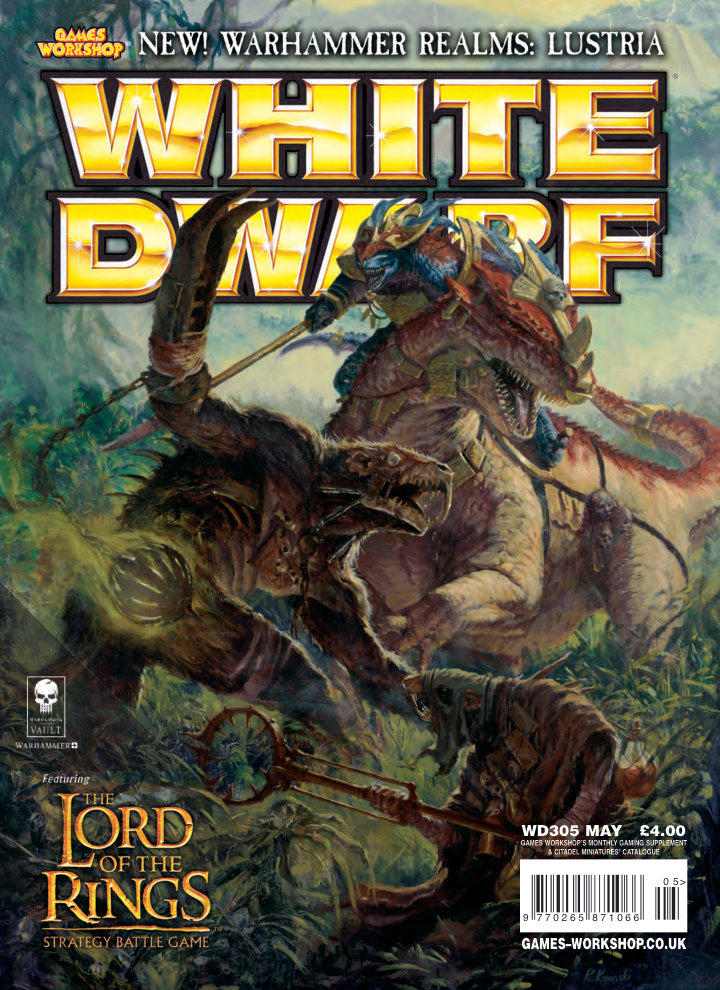
Phil Kelly interviews Andy Hoare about a supplement built around a dangerous environment rather than a single army. Loose Order lets infantry enter dense terrain at a tactical cost, while Events and persistent Encounters make the jungle part of the fight; new Skaven and Lizardman figures accompany a setting intended to refresh many existing armies.
Warhammer Fantasy BattlesLizardmen
InterviewWD 305 · pp. 15–16
The designers reject a battlefield filled with universal skirmishers and instead create Loose Order for ordinary infantry. Freedom to negotiate difficult terrain comes without the usual skirmisher shooting protection or ranks, giving players a choice between rapid engagement and retaining the formations that normally make massed infantry effective.
Warhammer Fantasy Battles
InterviewWD 305 · p. 16
Encounter Points activate hazards that remain near terrain and continue threatening the combatants, with an extra phase giving even combat-heavy armies an active part in manipulating the battlefield. Pre-game Events and background-inspired scenarios add context, while simple markers and new jungle plants reduce the preparation needed to make the environment visible.
Warhammer Fantasy Battles
InterviewWD 305 · p. 17
Colin Grayson explains how early digital tools simplify chains, icons and geometric components that are awkward to sculpt by hand. Software converts designs into precise coordinates for light-cured resin prototypes, making the new Skaven plastics an example of a cautiously adopted manufacturing method rather than a complete replacement for traditional sculpting.
Warhammer Fantasy BattlesSkaven
InterviewWD 305 · pp. 18–19
Graham McNeill describes a campaign that can generate new maps or organise an existing scenery collection, with four to seven players as its intended scale. Andy contrasts meaningful local decisions with worldwide results and explains the complete Rise of Sotek sequence, placing the forthcoming Conquest event within a system designed to give small groups control of their own wars.
Warhammer Fantasy Battles
CampaignWD 305 · pp. 20–33
Marco Colombo’s return triggers a scramble for Lustrian wealth in this complete campaign using the new Lustria system. Armies hold linked territories to generate Plunder Points, but special locations alter spells, initiative, equipment and hazards, making the map a set of strategic choices rather than a purely decorative route between games.
Warhammer Fantasy Battles
LoreWD 305 · pp. 20–22
Marco Colombo seeks a profitable second expedition but jealous rivals follow him across the ocean. Ancient traps, jungle predators, disease and determined Lizardmen make the supposed wealth dangerous to reach, while the accompanying timeline connects Norse settlement, Luthor Harkon’s Vampire Coast and earlier plundering to the present scramble.
Warhammer Fantasy BattlesLizardmen
RulesWD 305 · pp. 22–23
Controlled territories provide plunder representing whatever each army values, from gold and slaves to relics or food. Losing a territory transfers that value to its conqueror, tying accumulated wealth directly to military control; the supplied node map gives movement connections and rewards for a ready-made Lustrian campaign.
Warhammer Fantasy Battles
RulesWD 305 · pp. 24–26
Distinctive sites make the campaign’s geography matter: temples hold extra treasure, sacred pyramids grant spells and monoliths exchange wealth for strategic energy. More dangerous places bring darkness, lightning or intensified encounters, so armies must weigh rich rewards against environmental disadvantages and the particular scenario each territory can generate.
Warhammer Fantasy Battles
RulesWD 305 · p. 24
Ruined temple-cities offer valuable plunder and improve the reward from successful digging. Their scenario table ranges from an ordinary pitched battle to defiling sacred ground or breaking through defenders, making the former centres of Lizardman civilisation attractive both for wealth and for varied campaign encounters.
Warhammer Fantasy BattlesLizardmen
RulesWD 305 · p. 24
The Ziggurat’s fiery summit is associated with the power of the sun and grants the controlling army’s Wizards access to Pha’s Illumination. Its selection of possible battles includes fighting over the structure itself, linking a valuable magical benefit to a recognisable objective on both map and tabletop.
Warhammer Fantasy Battles
RulesWD 305 · p. 24
The monoliths replenish a force’s strategic energy but demand continuing offerings from its treasure stock. Their owner gains an additional Campaign Point while losing a random quantity of plunder each turn, creating an explicit trade between the ability to act and the wealth needed for ultimate victory.
Warhammer Fantasy Battles
RulesWD 305 · p. 24
Dense vegetation and supposed hidden barrows make the Jungles of Despair unusually hostile even by Lustrian standards. Both armies must use Events and Encounters regardless of the scenario’s normal requirements, and extra Encounter Points increase their ability to turn the surroundings against one another.
Warhammer Fantasy Battles
RulesWD 305 · p. 25
Studying the pyramids offers insight into approaching events, represented by a reroll when deciding the first turn. That benefit applies only when the scenario leaves initiative uncertain, giving the territory a useful predictive advantage without overriding a battle whose narrative already determines who begins.
Warhammer Fantasy Battles
RulesWD 305 · p. 25
Sotek’s sacred pyramid receives treasure from pilgrims and promises influence over the jungle’s creatures. Its controlling army gains two additional Beast-lore spells for its Wizards, while possible battles include Rodrik’s desperate escape, tying the temple’s significance to both supernatural power and the consequences of plunder.
Warhammer Fantasy BattlesLizardmen
RulesWD 305 · p. 25
Golden plaques make the Tomb a rich target for treasure seekers and an especially offensive place for invaders to desecrate. Successful digging finds additional plunder, but every Lizardman unit fighting there gains hatred, including normally unaffected troops, expressing the defenders’ outrage through the battle rules.
Warhammer Fantasy BattlesLizardmen
RulesWD 305 · p. 25
Hexoatl combines the rewards of a wealthy temple-city with the protection of a fortress and its surrounding defences. Attacking it leads to the modified siege rules rather than a random ordinary scenario, making it a strategically demanding objective whose obvious riches are guarded by equally explicit military strength.
Warhammer Fantasy BattlesLizardmen
RulesWD 305 · p. 25
Treasure taken from sacrificial victims fills this threatening pyramid, but its most unusual benefit is control of how an attack is resolved. A defending owner chooses the scenario and, where appropriate, its attacking or defending role, giving preparation and local knowledge more value than a simple defensive bonus.
Warhammer Fantasy Battles
RulesWD 305 · p. 25
The pool’s divinatory reputation becomes a once-per-game attempt to turn an enemy Wizard’s successful spell back upon its caster. A Leadership test gives the victim a chance to resist, and remaining power dice or a scroll may still prevent the reversed spell, making the effect disruptive without being an automatic punishment.
Warhammer Fantasy Battles
RulesWD 305 · p. 25
A drowned temple-city promises substantial treasure beneath Xuhua Lake, but extracting it leaves the occupying force exposed. The holder always takes the second turn when fighting there, even if the scenario normally dictates otherwise, exchanging an attractive plunder value for a predictable tactical disadvantage.
Warhammer Fantasy Battles
RulesWD 305 · p. 26
A coastal monument above a forgotten necromancer’s tomb surrounds battles with shifting darkness. Visibility changes each turn and limits shooting, charges and sight-dependent spells, until a possible clearing restores ordinary vision; fighting for its riches therefore requires adaptation to an uncertain horizon.
Warhammer Fantasy Battles
RulesWD 305 · p. 26
Valuable deposits near the unexplained column allow its owner to equip one Core unit and champion with their normally available mundane upgrades for free. The chosen unit can change between battles, making this a flexible material advantage rather than a permanent alteration to one regiment.
Warhammer Fantasy Battles
RulesWD 305 · p. 26
Lightning repeatedly strikes units from both armies fighting near the temple, with players choosing possible targets until a strike occurs. The hits ignore armour and can cause panic, so this wealthy location adds a symmetrical but manipulable environmental threat to whichever scenario resolves possession of it.
Warhammer Fantasy Battles
RulesWD 305 · p. 26
Armies may dig for more treasure, spend some of it to motivate followers or hire permitted Dogs of War units as temporary Core choices. Fortifying territory is prohibited, and victory follows accumulated plunder rather than ordinary campaign dominance, so commanders must balance expansion, investment and the risks of losing wealth with a defeated force.
Warhammer Fantasy Battles
RulesWD 305 · p. 27
Luthor Harkon offers dark allies through Ebony Skulls that summon a fixed pirate regiment onto the battlefield, potentially from any water feature. Aquatic, slow and unbreakable in the Undead fashion, the pirates briefly cause terror when rising from water; recruitment restrictions and the separate summoning artefact make them a distinctive bargain rather than ordinary hired infantry.
Warhammer Fantasy BattlesVampire Coast
RulesWD 305 · p. 28
Pirazzo’s abandoned expedition survives Lizardman attacks by combining a crossbow front rank with deep pikes, eventually receiving a strange opportunity to escape with supplies and treasure. The rules preserve that mixed formation, protecting the shooters behind surviving pikemen and giving the pikes their strongest effects against frontal attacks by charging cavalry and monsters.
Warhammer Fantasy BattlesDogs of War
RulesWD 305 · p. 29
A portentous Skink and Horned One spawning sends Tichi Huichi abroad to recover the Old Ones’ treasures. Revised rules combine fast cavalry and protection from enemy pursuit with special Conquest benefits: the mounts avoid stupidity, their Initiative improves and the riders receive Sotek’s extra charge attack, reflecting the urgency of their divine mission.
Warhammer Fantasy BattlesLizardmen
RulesWD 305 · p. 30
An invading force must push from open beach through undergrowth into increasingly dense jungle, while defenders gain rewards for driving in the opposite direction. Bonus points depend on surviving units wholly occupying the relevant zones, making territorial progress central; attackers cannot deploy artillery, but alone may use Scouts in this campaign-opening landing battle.
Warhammer Fantasy Battles
RulesWD 305 · p. 31
Two armies converge on a central prize as an escalating magical storm brings increasingly frequent lightning strikes. The nearest eligible unit decides victory, with unit strength breaking a tie and individual characters unable to claim the objective, creating a campaign finale in which surviving position matters more than the ordinary tally of destruction.
Warhammer Fantasy Battles
LoreWD 305 · pp. 32–33
Narrative hooks explain why nearly every major army might risk Lustria, from merchant wealth and Bretonnian fame to Elven containment, undead ambition and simple Orc appetite. The Lizardmen defend or reclaim sacred sites, Skaven seek revenge and expansion, and hired Ogre tribes or Sartosan crews offer ways to personalise an expedition beyond generic gold fever.
Warhammer Fantasy BattlesEmpire
Battle reportWD 305 · pp. 34–49
Andy Hoare and Adam Troke command eight heavily equipped Bretonnian outcasts trying to escape Graham McNeill’s Lizardmen after plundering Xlanhuapec. Their stolen magical treasures provide unusual abilities, but early lashworm attacks and unnecessary fighting erode the small force while Skinks and Saurus move to close its route through the temple-city.
Warhammer Fantasy BattlesBretonnia4 paint colours
RulesWD 305 · p. 35
The escaping side consists entirely of dismounted characters, with generous Lord selection and bonus points for reaching an exit. Pursuers receive extra Encounter Points, and the historical version lets the Bretonnians carry stolen Lizardman items at the price of provoking hatred, turning unusual army construction into the scenario’s central narrative device.
Warhammer Fantasy BattlesBretonnia
TacticsWD 305 · pp. 36–37
Graham selects numerous poisonous Skink skirmishers to threaten lone heroes and fast swarms to hold them in place. Saurus and a Stegadon provide the killing strength once routes narrow, while magical items and Priests add ways to damage characters whose formidable individual profiles would otherwise let them evade a conventional regiment-heavy army.
Warhammer Fantasy BattlesLizardmen
TacticsWD 305 · p. 38
Andy and Adam divide the characters and their magical equipment into small groups, hoping to force the larger army to split unevenly. Defensive items protect the Prince while challenges, extra attacks and enhanced movement distinguish his companions, but Adam’s deliberately selfish plan relies on one band taking the pressure while another finds the exit.
Warhammer Fantasy BattlesBretonnia
ModellingWD 305 · p. 39
Questing Knight torsos and older foot-knight legs create the dismounted adventurers, with Lizardman and Amazon weapons showing their stolen equipment. Rodrik’s mirror shield uses chrome leaf beneath a prepared ink layer, while putty packs, a Saurus-hide cloak and muddy blue-and-white heraldry give the group a shared expedition-worn identity.
Warhammer Fantasy BattlesBretonnia4 paint colours
RulesWD 305 · pp. 40–41
The report explains how pre-game Events change conditions, how terrain-targeted Encounter Points awaken lasting hazards and how Loose Order lets infantry negotiate the jungle. A separate note suggests assigning native status when adapting the system to another forest, acknowledging that the home army’s environmental familiarity should follow the chosen setting.
Warhammer Fantasy Battles
TacticsWD 305 · p. 48
Graham attributes the victory mainly to careful encounter placement and herding the heroes rather than to every unit joining combat. Andy and Adam enjoy the disastrous historical narrative but identify early distractions, overly confident charges and slow progress as failures that left their survivors too weak to break the remaining cordon.
Warhammer Fantasy BattlesBretonnia
FictionWD 305 · p. 49
A Skink Priest examines the smoking remains of the human thief and orders the stolen artefacts returned. He recognises that the men nearly escaped and that the jungle’s intervention preserved the sacred treasures, then turns the aftermath into a dark reflection on invaders who enter the land of ancient gods and death.
Warhammer Fantasy BattlesLizardmen
CommunityWD 305 · pp. 52–55
The collectors prepare for Conquest by reconsidering forces built for more open battles. Asger weighs infantry against another Nurgle chariot, Dave addresses Orc mobility and outflanking problems, Stephen discovers how smaller armies restrict his Tomb King favourites, and Paul’s Knights of Morr add a personal religious theme to his Stirland militia.
Warhammer Fantasy BattlesNurgle
TacticsWD 305 · p. 52
Asger’s completed chariot performs well against Ogres, but dense Lustrian terrain makes a second less obvious. Loose Order instead encourages additional Plaguebearers and Nurglings, showing how a campaign’s environment can revise a collector’s shopping and tactical priorities before the first territory changes hands.
Warhammer Fantasy BattlesDaemons of Chaos
CampaignWD 305 · p. 53
Dave’s Orcs suffer from bottlenecks against Bretonnians and rapid encirclement against Chaos, exposing their limited mobility and few elite units. New Boyz, a distinctive Big ’Un standard and a chariot address the collection’s needs, while a movement-tray Rock Lobber diorama makes the artillery easier to transport at the cost of using proxies in combat.
Warhammer Fantasy BattlesOrcs & Goblins
TacticsWD 305 · p. 54
Stephen looks forward to joining rather than organising a campaign, but his new Bone Giant competes with the catapult for limited Rare choices in smaller armies. Without the Lord-level advantages of his usual force, he must find different answers to daemonic and armoured opponents, prompting an Ushabti purchase and more advice from Pete Scholey.
Warhammer Fantasy BattlesTomb Kings
ModellingWD 305 · p. 55
Paul Scott gives spare Empire components a stronger identity through helmeted, hammer-bearing Knights of Morr and a mounted Death Cleric. Cut banner ribbons and putty form seals, pennants vary the decoration and a card-and-putty book supplies the cleric’s grimoire; the resulting bodyguard has a reason to patrol Stirland’s border with Sylvania.
Warhammer Fantasy BattlesEmpire
Battle reportWD 305 · pp. 56–58
Andy Smillie and Adam Hall take their paired Wood Elf armies through nine doubles games, winning all five on the first day with concentrated shooting, magic and mobile support. The second day brings harder counters and a costly misunderstanding of Capture’s objective, leaving them twelfth overall despite briefly reaching the top table and finishing with a useful collection of tactical lessons.
Warhammer Fantasy BattlesWood Elves
TacticsWD 305 · pp. 56–57
Andy stresses concentrated fire, march-blocking Waywatchers, protective Tree Singing and the survival of the army’s decisive pieces. The accompanying doubles discussion highlights duplicated magic items available through two separate armies, while the tournament narrative demonstrates how psychological pressure and attention to scenario conditions can matter as much as inflicted casualties.
Warhammer Fantasy BattlesWood Elves
InterviewWD 305 · pp. 60–63
Phil Kelly previews a Tyranid overhaul that supports vast regenerating hordes, flying forces, varied Warrior-sized creatures or an army crowded with monsters. Biomorphs and living ammunition emphasise rapid biological adaptation, while the infiltrating Broodlord and highly configurable Carnifex give different styles recognisable new leaders and centrepieces.
Warhammer 40,000Tyranids
TacticsWD 305 · pp. 62–63
The preview outlines four army concepts rather than a single compulsory Tyranid build. Recycled Termagants provide numbers, winged creatures provide speed, Synapse supports resilient medium creatures and Shock Troops allows more Carnifexes in a monster-heavy force, encouraging players to make the new codex’s biological variety the basis of their strategy.
Warhammer 40,000Tyranids
RulesWD 305 · pp. 64–73
Andy Hoare adds environmental rules for battles on worlds where swamp dominates the surface. Armour limits movement, submerged infantry gains cover and immobilised vehicles may sink, while untouchable creature markers make nearby ground dangerous; ordinary missions remain the framework, but route choice and adaptation become major parts of winning.
Warhammer 40,0003 paint colours
RulesWD 305 · pp. 66–67
Infantry’s maximum swamp movement follows its armour save, and sacrificing movement can improve cover by partial submersion. Poor terrain rolls prevent assaults, while immobilised non-walking vehicles risk escalating damage until they disappear beneath the surface; Chimeras retain a specific amphibious protection without gaining freedom from slow muddy travel.
Warhammer 40,000
RulesWD 305 · p. 67
Players place and scatter hazard markers before the battle, representing the presence of creatures rather than individual targets. Moving close to them counts as dangerous terrain and can remove models, but the markers cannot be shot or destroyed, forcing troops to negotiate hostile habitat rather than eliminate another conventional enemy unit.
Warhammer 40,000
ModellingWD 305 · pp. 68–71
George and Chris build a complete wetland setting around shaped bases, wire trees, sponge foliage and layered varnish water. Small details establish scale and character, while a converted communications shack and distressed Land Speeder turn the terrain into an abandoned Imperial location rather than a collection of anonymous green pools.
Warhammer 40,0003 paint colours
ModellingWD 305 · p. 68
Twisted garden wire supplies trunks, branches and roots, then masking tape builds thickness and knots before filler and textured paint establish bark. Torn car sponge dyed with food colouring creates irregular crowns, giving the swamp distinctive trees through inexpensive materials that can be varied without repeating a single commercial shape.
Warhammer 40,0001 paint colour
ModellingWD 305 · p. 69
Textured bases receive a brown foundation and stippled dark colours that suggest differing depth. Several coats of water-based floor varnish create the wet surface, while a hand-sculpted crocodile provides a memorable local inhabitant; the method relies on painted depth under a shallow reflective layer rather than casting a thick body of water.
Warhammer 40,0001 paint colour
ModellingWD 305 · p. 70
Coffee stirrers become a weathered pier, discarded Cadian boots suggest a missing occupant and wire-and-putty rushes join brush-bristle grasses. A Basilisk platform supports corrugated walls and clear windows for the radio shack, with a prepainted bloody handprint and mesh camouflage completing the abandoned outpost’s story.
Warhammer 40,000
ModellingWD 305 · p. 71
Clay ridges and scored channels show where a distressed Land Speeder ploughed into the mud. The accompanying section guide uses ceiling tiles for banks, textured paint to blend them and successive brown drybrushes before layered flock, providing a repeatable construction method for both the crash site and the surrounding wetland pieces.
Warhammer 40,000Space Marines3 paint colours
TacticsWD 305 · pp. 72–73
Four example tables demonstrate narrow causeways, defended firm ground and the difficulty of moving between quarters in a Cleanse mission. Each offers at least two usable routes, so swamp armies can contest chokepoints or risk slower dispersal; a basic sand-and-plants example shows that the same tactical ideas do not require a permanent bespoke table.
Warhammer 40,000Ultramarines
TacticsWD 305 · pp. 74–79
Pete Haines places Terminators within five contrasting Space Marine army styles instead of treating their powerful profiles as a complete plan. Sample forces illustrate concentrated Terminator strength, static guns, fast assaults and two mechanised approaches, with repeated emphasis on mutual support, transport choices, reserve timing and giving enemy heavy weapons competing targets.
Warhammer 40,000Space Marines
TacticsWD 305 · p. 75
Pete contrasts flexible armies with specialised builds that can dominate favourable matchups but lack room to adapt. His Terminator-heavy example uses command and elite slots alongside minimal Scouts, including a teleport homer for an entertaining infiltrate-and-call-for-help approach, while openly accepting the risks of concentrating so much capability in one troop type.
Warhammer 40,000Space Marines
TacticsWD 305 · p. 76
Terminators add moving heavy weapons and a power-fist counterattack to an otherwise stationary gun line. Unlike Devastators, they can begin concealed and move into fire position, or contribute immediately after arriving in Escalation, giving the force tactical options while its numerous small Tactical squads and support weapons hold the battlefield.
Warhammer 40,000Space Marines
TacticsWD 305 · p. 77
Bikes can carry a teleport homer forward and coordinate Terminators with Assault Marines, allowing supporting fire before a concentrated attack. Pete also considers reversing the usual reserve relationship so deployed troops support incoming units, and warns that scattered arrivals or stronger enemy combat armies require a different use of the same flexible force.
Warhammer 40,000Space Marines
TacticsWD 305 · p. 78
Terminators advance or withdraw behind an armoured gun line rather than automatically consuming points in Land Raider transports. Tanks shield sight lines and compete for hostile anti-tank fire, while mobile heavy weapons and power fists let the infantry act like resilient Dreadnought support without pretending its armour is immune to weapons built to destroy vehicles.
Warhammer 40,000Space Marines
TacticsWD 305 · p. 79
Rhino squads need staged movement under the revised transport rules, and close-range bolter fire may be preferable to an immediate ordinary assault. A Land Raider-borne Terminator unit can then deliver the decisive charge or protect those supporting squads, while its own shooting and the transport’s bulk remain useful alternatives when the ideal assault opportunity fails to appear.
Warhammer 40,000Space Marines
ModellingWD 305 · pp. 80–83
Five hobbyists exploit the new plastic Terminators to express Chapter identity through pose, trophies and religious decoration. Black Templars and Ultramarines emphasise heraldry, the Legion of the Damned gains an undead aquila and dusty armour, and converted Librarians and a Chaplain demonstrate how existing plastic components can create distinctive elite characters.
Warhammer 40,000Black Templars6 paint colours
ModellingWD 305 · p. 80
Matthew Hutson poses the squad as if clearing its landing zone and turns a simple black-and-white scheme into a platform for extra detail. Ornamental swords, personal shoulder heraldry, scripture and a sergeant’s facial cross tattoo make the veterans read as knightly Sword Brethren without losing the unit’s common battlefield role.
Warhammer 40,000Black Templars
ModellingWD 305 · p. 81
Adrian Wood establishes fighting poses first, then layers compatible Space Marine decorations instead of attaching them randomly. Prayer cloths, enlarged banners and crossed devotional elements reinforce a Gothic appearance, while batch painting preserves unity beneath varied hand-painted icons and individually scaled Chapter symbols.
Warhammer 40,000Ultramarines
PaintingWD 305 · p. 82
Dominic Murray arranges his Terminators around an advancing sergeant as if they have just emerged firing from the warp. A Tomb Guard sword and converted two-headed undead vulture reinforce their deathly identity, while grey-edged black armour, blended flame patterns and brown-to-bone dust weathering make the squad both ominous and visibly battle-worn.
Warhammer 40,000Legion of the Damned5 paint colours
ModellingWD 305 · p. 83
Mark Bedford cuts down a shoulder pad to form a psychic hood, then combines a command banner shaft, Iron Halo and Chapter symbol into a force staff. Large Tomb King parchments and a Chaos Marine head supply ritual detail, allowing a relatively simple blue scheme to support the elaborate silhouette and devotional writing.
Warhammer 40,000Ultramarines
ModellingWD 305 · p. 83
Keith Robertson makes the Chapter’s Tyranid wars visible through a Ripper-topped axe and a Warrior carapace shoulder trophy. A raised, pinned torso improves stature, while putty fills the gap and forms the psychic hood and fine power cables, producing a personal history through construction rather than relying only on painted insignia.
Warhammer 40,000Sons of Orar
ModellingWD 305 · p. 83
A command-sprue eagle on a Chaos Warrior axe haft creates Mark Bedford’s crozius, while Tomb King ribbons and an Empire banner crest add movement and status. A skull-masked Chaos head supplies the Chaplain’s most recognisable feature, and varnish over the Chapter transfer helps integrate it with the finished armour.
Warhammer 40,000Ultramarines1 paint colour
LoreWD 305 · pp. 84–89
Graham McNeill describes a Chapter whose earliest history is missing and whose pursuit of knowledge centres on the example of Azariah Vidya. His apparent prescience saves the Blood Ravens from carefully concealed Chaos traps, establishing research and unusually influential Librarians as foundations of their military culture.
Warhammer 40,000Blood Ravens
LoreWD 305 · pp. 84–86
Azariah Vidya inherits a Chapter devastated by deceptive cult resistance and studies enemy history, movement and supply before launching a remarkably precise counteroffensive. His combined Chapter Master and Librarium leadership becomes a foundational example, but the Blood Ravens’ own earlier lineage remains the most important missing knowledge in their extensive records.
Warhammer 40,000Blood Ravens
LoreWD 305 · p. 85
Gabriel Angelos returns to Cyrene, a technologically uneven recruiting world with a troubling incidence of mutation and newly appearing psykers. He interrupts the Blood Trials and sends a secret message, after which Imperial fleets destroy the planet; sealed records leave the reason known only to Angelos and the Inquisition, preserving ambiguity rather than a public explanation.
Warhammer 40,000Blood Ravens
LoreWD 305 · p. 86
The Omnis Arcanum serves as the Blood Ravens’ mobile fortress and archive while recruits come from several favoured worlds. Intensive study precedes tightly planned campaigns, and Librarians occupy unusually influential positions within an otherwise recognisable Codex structure, bringing the Chapter praise for foresight and suspicion from less patient allies.
Warhammer 40,000Blood Ravens
LoreWD 305 · pp. 86–88
Close ties to the Mechanicus and a reverence for the Emperor accompany the Chapter’s hunt for ancient information and artefacts. Its reluctance to prove the destruction of corrupted finds attracts Inquisitorial concern, while extra gene-seed testing provides no clear explanation for abundant psykers or reliable answer to competing claims about the Blood Ravens’ ancestry.
Warhammer 40,000Blood Ravens
LoreWD 305 · p. 88
Trials meant to strengthen a Librarian against warp predation can instead leave an aspirant alive but insane. Such failures are chained within the Omnis Arcanum’s Tower, where rumours of possession and uncontrolled manifestations sit alongside the possibility that they might unwittingly provide conduits for daemons through the Chapter’s own protective rituals.
Warhammer 40,000Blood Ravens
TacticsWD 305 · p. 89
Rik Turner’s small patrol expands toward a Librarian-led army as the Chapter background and new trait system suggest further options. Infiltrate, True Grit and Counter-attack improve Tactical squads, while planned infiltrating Devastators establish fire lanes after the opponent deploys, making guerrilla positioning part of the force’s identity rather than merely a visual theme.
Warhammer 40,000Blood Ravens
ShowcaseWD 305 · pp. 90–91
Chris Blair’s eclectic collection repeatedly turns intended armies into distinctive skirmish models and warbands. A disillusioned priest, Cathayan conversions, small-scale experiments and a deliberately miniature Nightbringer reflect his emphasis on imagining the whole model’s possibilities, with a long Golden Demon record supporting his preference for individuality over completing one large force.
Warhammer Fantasy BattlesWarhammer 40,000Empire
RulesWD 305 · pp. 94–105
Mat Ward follows Arnor’s division and destruction into the later Rangers’ defence of its scattered inhabitants. Profiles for northern leaders, Elven allies and Angmar’s servants make several periods playable, using converted existing figures and agreed substitutions for troops without a dedicated range.
Middle-earth Strategy Battle GameArnor
LoreWD 305 · p. 95
The northern realm divides over its great sites and becomes vulnerable to Angmar’s long assault, ending despite eventual help from Elves and Gondor. Ruined fortifications survive where its armies once stood, while the Rangers preserve Isildur’s line and continue guarding ordinary folk whose safety depends on largely unseen defenders.
Middle-earth Strategy Battle GameArnor
RulesWD 305 · p. 96
Aragorn’s grandfather appears as an experienced leader whose extended Stand Fast range steadies nearby Men. A conversion of Aragorn at Weathertop gains a Westernesse dagger and an older appearance, giving a historical Ranger force a recognisable commander whose final defence of others anticipates the Ettenmoors scenario.
Middle-earth Strategy Battle GameRangers of the North
RulesWD 305 · p. 96
Arathorn’s brief leadership between his father’s death and his own fatal encounter with Orcs supplies another period commander. His shield, bow and optional horse or Elven cloak distinguish the profile, while replacing Aragorn’s dagger and adding a putty cloak provides an accessible model for the future king’s father.
Middle-earth Strategy Battle GameRangers of the North
RulesWD 305 · p. 96
Existing Gondor Warriors represent ordinary Arnorian troops, Rangers of the North supply the elite and High Elves stand in for Lindon’s allies. The article recommends agreement before using the historical characters outside their intended scenarios, allowing a themed army to function through clear contemporary substitutions rather than requiring an entirely new miniature range.
Middle-earth Strategy Battle GameArnor
RulesWD 305 · p. 97
Círdan’s great age and authority are expressed through terror and supportive magic rather than a conventional warrior’s equipment. Renew restores a friendly model’s wound, while Aura of Command steadies nearby Good troops as long as his Will remains; repainting Celeborn supplies the figure for Lindon’s intervention in the northern wars.
Middle-earth Strategy Battle GameLindon
RulesWD 305 · p. 97
Eärnur’s courage and pride compel him to charge an enemy Hero whenever movement makes it possible, anticipating his eventual disappearance in Minas Morgul. Adam Troke combines Isildur, Army of the Dead and Gondor components with a sculpted coat, creating a distinct prince whose dangerous temperament matters as much as his martial profile.
Middle-earth Strategy Battle GameGondor
LoreWD 305 · pp. 98–101
The Witch-king draws on both haunted Eriador and the organised human strength of Carn Dûm. Unquiet spirits become instruments of terror, while fortified northern Men provide the armed force that brings down Arnor’s strongholds; the account distinguishes these mortal servants from the spectres and lesser wraiths bound to their master’s will.
Middle-earth Strategy Battle GameAngmar
RulesWD 305 · p. 98
A Revenant attacks the victim’s Courage rather than relying on ordinary physical wounds and makes nearby courage checks harder through its chill aura. Enemies slain in combat can become new Spectres without increasing the army’s original break-point count, turning each successful supernatural attack into a possible expansion of the haunting force.
Middle-earth Strategy Battle GameAngmar
RulesWD 305 · p. 99
Spectres represent bodiless survivors whose hatred lets them harm the living through fear rather than armour penetration, while Spectral Wargs give that same Ethereal Touch an animal form. The article associates such apparitions with haunted places across Middle-earth and explicitly groups its undead profiles under a shared Spirit movement category.
Middle-earth Strategy Battle GameAngmar
RulesWD 305 · p. 100
Skilled northern raiders become the Witch-king’s principal mortal instrument of conquest despite uncertainty about their origins. Separate Warlord and Warrior profiles offer axes, shields, spears and limited banners, while repainting Army of the Dead models as living archaic soldiers provides a coherent visual force without new sculpts.
Middle-earth Strategy Battle GameAngmar
RulesWD 305 · p. 101
Duskwraiths serve as the Witch-king’s distant eyes and reserve of Will, using terror, Drain Courage and Transfix while remaining different from ordinary Ringwraiths. Suggested conversions reshape existing sinister figures, and a closing roster brings the new spirits and Carn Dûm troops together with familiar Orcs, Wargs, Trolls and Barrow-wights into a themed army.
Middle-earth Strategy Battle GameAngmar
RulesWD 305 · pp. 102–103
Arnor’s defenders hold the watchtower while the Witch-king attacks with mortal and spectral servants. Good wins by killing him, Evil by killing every defending Hero, and both sides can recycle fallen warriors as reinforcements; the defenders’ replenishment depends on surviving leaders, making the tower’s garrison a struggle over command as well as ground.
Middle-earth Strategy Battle GameArnor
RulesWD 305 · p. 104
Arador and six Rangers enter Troll-haunted hills ahead of Arathorn’s possible reinforcements. Their limited starting force must reduce a group of powerful Trolls severely, while Evil must both kill Arador and inflict heavy losses; delayed aid and dense broken terrain give the doomed historical expedition a playable chance to fare differently.
Middle-earth Strategy Battle GameRangers of the North
RulesWD 305 · p. 105
A watchtower garrison faces Revenants and Spectres sent south before the Witch-king commits his main army. Darkness restricts the Men’s charges and shooting while the spirits see freely, making a familiar hilltop defence unsettlingly unequal; both forces seek to reduce the other to a quarter of its initial numbers.
Middle-earth Strategy Battle GameArnor
ModellingWD 305 · pp. 106–111
Adrian Wood builds an Arnorian watchtower from a round polystyrene box, wrapped card pillars and a removable domed roof, with an alternate foamboard core for those lacking the original container. A layered hill, inset stairs, doors and masonry details make it both an evocative centrepiece and usable terrain, finished through distinct rock, timber and weathered stone painting stages.
Middle-earth Strategy Battle GameArnor10 paint colours
ModellingWD 305 · pp. 106–107
A reusable pillar template wraps around the cylindrical building core, with foamboard reinforcement carrying a fitted roof ring. One pillar is removed for the door and the lid can remain detachable, balancing the building’s Gondorian architectural appearance with enough access to use models inside it during a game.
Middle-earth Strategy Battle Game
ModellingWD 305 · pp. 108–109
Successively wider polystyrene layers raise the tower above the battlefield, while stacked foamboard steps fit into traced openings across two levels. A carved winding approach and natural-looking rock shelves connect the structure to the table and preserve places for miniatures to stand, turning a decorative height into practical scenario terrain.
Middle-earth Strategy Battle Game
PaintingWD 305 · p. 110
The hill moves through warm browns and bone highlights before flock breaks up the rock, while the tower’s recesses receive a warmer shade beneath cool grey stone drybrushing. Painted plank lines establish the wooden doors, final white accents lift the masonry and small green patches suggest moss and lichen on an ancient northern building.
Middle-earth Strategy Battle Game10 paint colours
ModellingWD 305 · pp. 112–115
Mat Ward and Adam Troke bring additional Shire personalities into games through existing profiles rather than inventing an entirely new rules set. Repainting and modest conversions distinguish a mayor, gardener, miller, old Thain and collaborator, while their histories emphasise the ordinary social character that makes Hobbit resistance and occupation meaningful.
Middle-earth Strategy Battle GameHobbits
ModellingWD 305 · p. 113
Fatty Bolger’s miniature and profile suit the prosperous Mayor, with Paladin’s hat and cane giving Adam’s conversion extra authority. The accompanying history balances Whitfoot’s ceremonial duties and impressive appetite with the resolve that later lands him in the Lockholes, making the well-fed public figure more than a joke about Hobbit comfort.
Middle-earth Strategy Battle GameHobbits
ModellingWD 305 · p. 113
Replacing a Hobbit Militia axe with a crude hammer makes Ted look at home in Sharkey’s industrial mill. His militia profile can accompany Ruffians, while the background explains how willing cooperation costs him control of his father’s business without breaking his attachment to the brutal regime that replaced it.
Middle-earth Strategy Battle GameHobbits
ModellingWD 305 · p. 113
The Paladin model left over from Whitfoot’s conversion gains a putty spade and replacement hand to become the Gaffer. A simple militia-style profile suits the honest gardener, whose respected skill and grounded judgement contrast with the gossip of neighbours and the destruction Sharkey’s occupation brings to his beloved allotments.
Middle-earth Strategy Battle GameHobbits
ModellingWD 305 · p. 114
Paladin’s important clothes and elderly appearance need only a different paint scheme to represent the Old Took with the same profile. Gerontius’s long life, friendship with Gandalf and continued authority among his family explain his renown through character and longevity rather than battlefield accomplishment.
Middle-earth Strategy Battle GameHobbits
ModellingWD 305 · p. 114
Adam’s invented stone-throwing champion becomes a Shirriff through a feathered Militia hat, a pouch, a putty-covered paperclip stave and a spare hand. His local celebrity and later lawkeeping supply an intentionally small-scale story, showing how a character created for the supplement can gain a distinctive figure without a bespoke rules profile.
Middle-earth Strategy Battle GameHobbits
ModellingWD 305 · p. 115
A repainted Bilbo carrying a small gold bag represents Lotho using Fatty Bolger’s profile. His dealings with Sharkey erase debts and bring apparent power, but escalating rule turns him into an expendable puppet; the account leaves his final fate uncertain while explaining why the Shire remembers his collaboration with little sympathy.
Middle-earth Strategy Battle GameHobbits
CampaignWD 305 · pp. 116–119
The team turns its developed Battle Companies into larger armies as the War of the Ring approaches. Harad gains a Mûmak and Easterling allies, Isengard adds Saruman and specialist Uruks, Gondor prepares Boromir and a bolt thrower, and Mordor and Dol Amroth seek heavier support, preserving their campaign histories while confronting ordinary army-building restrictions.
Middle-earth Strategy Battle GameHarad
TacticsWD 305 · p. 117
Paul Rudge totals his promoted heroes and company before adding a Mûmak, discovering that his collection already forms a sizeable army. Too many bows create the next problem, so Easterling allies offer variety and tougher infantry instead of solving every restriction with more Harad spearmen, while another narrow win maintains his unbeaten record.
Middle-earth Strategy Battle GameHarad
TacticsWD 305 · p. 118
Christian’s pike core gains Berserkers, crossbows, a banner and Saruman to form a small Isengard army. Another Shaman and more Uruks are in progress, while group agreement rejects a tempting Troll, illustrating how the project’s shared expectations shape his force as well as the available models and battlefield roles.
Middle-earth Strategy Battle GameIsengard
CommunityWD 305 · p. 118
The campaign website is described as offering revised Battle Company rules and a method for assigning points to developed heroes so they can join larger games. Scenarios, themed terrain and territorial effects accompany that continuity, extending the magazine’s collecting project toward a campaign whose additional procedures are referenced rather than reproduced on the page.
Middle-earth Strategy Battle Game
TacticsWD 305 · p. 119
Nick Kyme retains the company’s Rangers and developing heroes while adding cavalry, banners and Fountain Court support around them. Boromir supplies leadership and formidable Might, while an Avenger bolt thrower is selected with Rudge’s Mûmak in mind, making the expanded Gondor army a planned answer to the forthcoming opponents.
Middle-earth Strategy Battle GameGondor
TacticsWD 305 · p. 119
Guy’s cheap company leaves many models still to paint before reaching a full army, and Ugbrag’s formal cost ignores the injuries that make him so ineffective. Sentiment keeps the hero in service while Uruks, a Troll and a Ringwraith provide heavier options unavailable in the earlier company games, giving the losing force fresh ways to compete.
Middle-earth Strategy Battle GameMordor
CampaignWD 305 · p. 119
Greg’s night raid on Harad again fails to break Rudge’s winning streak, despite an opportunity for a final draw. The next step is more mounted Swan Knights and Prince Imrahil, with possible allies or a war machine providing variety as the Dol Amroth company grows toward the coming larger battle.
Middle-earth Strategy Battle GameDol Amroth
ModellingWD 305 · p. 120
John Schaffer’s wealthy Goldtooth Hunter gains a rebuilt harpoon launcher and conspicuous armour details, while Dave Taylor’s Maneater displays a taste for Bretonnian chivalry in both clothing and trophies. The paired conversions show how employment, travels and previous meals can give Ogres an identity through spare parts from another army.
Warhammer Fantasy BattlesOgre Kingdoms
ModellingWD 305 · p. 120
John replaces the Hunter’s original armour with plastic Irongut and command pieces to convey Goldtooth wealth. A Bruiser pistol, spearhead, Bretonnian bow and twisted florist’s wire form a more complex harpoon launcher, with a vehicle hook and drilled pistol hammer making the rope and drawstring appear physically connected.
Warhammer Fantasy BattlesOgre Kingdoms
ModellingWD 305 · p. 120
Dave Taylor dresses a Maneater in a sculpted tunic and Bretonnian accessories, giving him a shield gut plate and several lances bound into a single great weapon. A knight’s helmet hangs as a meal trophy, making the mercenary’s travels and refined appetite readable through the same small collection of borrowed components.
Warhammer Fantasy BattlesOgre Kingdoms
PaintingWD 305 · p. 141
Two Terradon schemes demonstrate how strong patterns can distinguish Lustrian creatures. The striped version builds warm yellow-brown skin beneath green markings, while the speckled version uses red-orange highlights and pale wing membranes under dark shoulder spots; each pattern receives its own controlled highlights rather than being left as a flat decoration.
Warhammer Fantasy BattlesLizardmen9 paint colours
PaintingWD 305 · p. 141
The Terradon’s warm brown foundation gains mixed highlights and thin wing streaks before dark green stripes spread back from the neck and leading edge. A brighter green then picks out raised parts of those markings, preserving a bold pattern while letting the creature’s anatomy remain visible beneath it.
Warhammer Fantasy BattlesLizardmen4 paint colours
PaintingWD 305 · p. 141
Red skin receives an orange-red highlight and paler mixed wing membranes, then progressively smaller black spots extend away from the shoulder. Grey accents lift the spots without removing their dark character, offering a second distinct naturalistic pattern through a short sequence suitable for several Lizardman beasts.
Warhammer Fantasy BattlesLizardmen5 paint colours
CommunityWD 305 · pp. 142–143
Readers share a feathered Tepok army, a working remote-control Rhino and original scenery while asking about Necromunda access and old conversion articles. The replies correct Asger’s earlier miniature prices and point to free rules, linking the letters page’s showcases to practical collecting questions and the magazine’s willingness to amend its own record.
Warhammer Fantasy BattlesWarhammer 40,000Lizardmen
CommunityWD 305 · p. 143
Owen Rees takes charge of the web team and links readers to Blood Ravens, Bretonnian adventures, Aragorn painting and Catachan hobby material. His own head-swapped Faramir illustrates a growing Gondor collection, while a short answer about website downloads discusses the website’s then-current software requirements rather than supplying extra magazine rules.
Warhammer Fantasy BattlesWarhammer 40,000Blood Ravens