CommunityWD 306 · pp. 2–4
Mat Ward introduces the Treekin as mobile forest spirits that temporarily inhabit dead branches, contrasting them with Treemen bound to living trees. Other reports announce Namco’s Warhammer computer-game agreement, changes to Dogs of War packaging and the online store, and the forthcoming public Citadel Miniatures Hall. Robin Dews describes converting a gloomy room into an illuminated gallery of studio and Golden Demon work; Andy Hall explains the downloadable scenarios, reference sheets and hobby support planned for the redesigned Fanatic site.
Warhammer Fantasy BattlesWarhammer 40,000Wood Elves
EditorialWD 306 · pp. 6–7
Guy Haley celebrates the new plastic Carnifex and improves movement trays before a large Goblin battle, then recounts how Animosity and a Ravenwing force spoiled two games. Paul Rudge strengthens his Haradrim with Easterling shields while Christian Byrne converts a Black Legion commander and starts Dwarfs. Nick Kyme reports two more campaign wins for his gun-heavy Dwarfs, and Greg MacGregor recalls a successful rehearsal against the Mûmak before the team’s final Battle Companies encounter.
Warhammer 40,000Warhammer Fantasy BattlesOrcs & Goblins
InterviewWD 306 · pp. 14–16
Nick Kyme interviews Dan Abnett about moving from illustration and comics into novels, maintaining a demanding daily writing schedule and finding ideas through wide reading. Abnett explains why human experience and military history helped him enter Warhammer 40,000, with Double Eagle drawing on the Battle of Britain and Eisenhorn and Ravenor exploring civilian life beyond the battlefield. He discusses the character decisions behind Traitor General, forthcoming Sabbat Worlds books and the pirate clichés assembled for Fell Cargo, before urging aspiring writers to practise consistently.
Warhammer 40,000Warhammer Fantasy BattlesImperial Guard
InterviewWD 306 · pp. 18–23
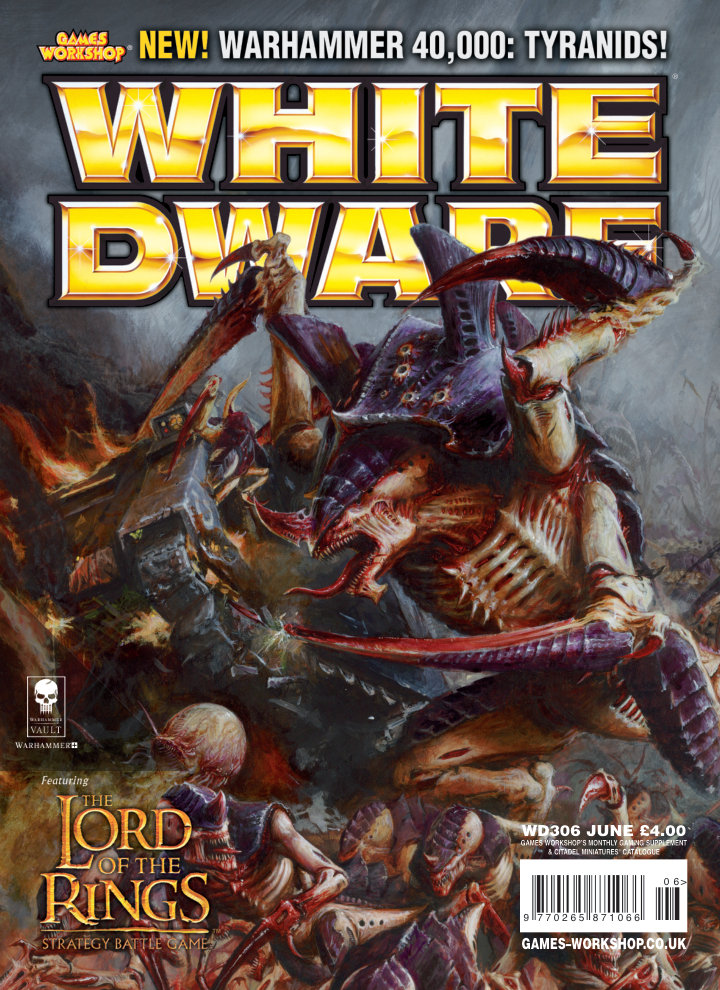
Andy Hoare talks to Phil Kelly, Jes Goodwin and Roberto Cirillo about renewing the Tyranids without discarding their established identity. Kelly integrates custom hive fleets into each brood’s options, strengthens Synapse protection and develops the Broodlord and new Lictor rules; Goodwin carries consistent six-limbed anatomy and details from early miniatures into the new plastics. Cirillo describes coordinating organic concepts with sculpting and game requirements, while the studio explains Leviathan’s distinctive pale flesh and purple carapace.
Warhammer 40,000Tyranids
RulesWD 306 · pp. 18–21
Phil Kelly explains why customization now represents whole broods rather than isolated mutants and why the codex omits special characters in favour of the swarm. Revised Instinctive Behaviour uses familiar Leadership tests, while Synapse protects medium-sized creatures from Instant Death. The discussion introduces deep-striking Spore Mine broods, a Broodlord-led infantry force and Lictors that arrive through terrain and improve Reserve rolls; playtesting favoured a mixed swarm over either extreme of tiny creatures or monsters.
Warhammer 40,000Tyranids
InterviewWD 306 · p. 20
Roberto Cirillo recalls joining Games Workshop in 2004 after nearly thirteen years in computer-game design and immediately working on Tyranids. His Hive Tyrant concepts developed Jes Goodwin’s existing ideas while preserving a recognizable family resemblance. Cirillo’s fascination is the complete integration of weapons and organs into a living creature; discussions with Phil Kelly also keep imaginative designs compatible with their intended battlefield role.
Warhammer 40,000Tyranids
InterviewWD 306 · pp. 22–23
Jes Goodwin explains the Tyranids as evolving alien dinosaurs rather than literal insects, with six limbs, forehead plates, breathing spiracles and weapon-bonded claws linking generations of sculpts. Genestealers retain clues to human ancestry and an optional tentacled head recalls the original Ymgarl creature. The Hive Tyrant becomes a more characterful commander, while the plastic Carnifex provides the swarm’s tank equivalent and enough components to echo the original Screamer Killer.
Warhammer 40,000Tyranids
ModellingWD 306 · pp. 24–27
Phil Kelly shows how small changes of limbs, heads and weapons can give individual roles to otherwise repetitive Tyranid broods. Termagants become hunters or firing beasts, separate Spinegaunt arms suggest movement, and Gargoyle bodies produce airborne-looking Hormagaunts. The final technique uses partly cured epoxy to stretch thin strands of drool between jaws or from living weapons, with a warning that restrained effects look more convincing than excessive slime.
Warhammer 40,000Tyranids1 paint colour
ModellingWD 306 · p. 24
Termagant poses are built around the fleshborer arm: lowering it suggests searching for prey, turning the head away suggests communication, and bringing both arms up aligns the eyes with a firing weapon. The feed arm is adjusted gently to fit the chosen stance, either by extending the elbow or removing a small wedge before closing it. This approach gives a brood visual purpose without replacing its basic components.
Warhammer 40,000Tyranids
ModellingWD 306 · p. 25
Alternative toxin-sac positions on the carapace, feed arm or fleshborer make upgraded Termagants legible while leaving space for other biomorphs. Spinegaunts use their separate gun arms and sometimes running Hormagaunt bodies to create sprinting or firing-on-the-move poses. Gentle changes at a leg or knee tilt the body, but bending the thin ankle connection is discouraged because it readily breaks the model.
Warhammer 40,000Tyranids
ModellingWD 306 · p. 26
A Gargoyle body attached to a normal round base by its curled tail supplies the height for a Hormagaunt that appears to leap over an opponent. The tail is bent to bring the centre of mass above the base, which is weighted underneath, then Hormagaunt limbs and forward-reaching scything talons are added. A few such models in each brood create the impression of a cascading attack without rebuilding every miniature.
Warhammer 40,000Tyranids
PaintingWD 306 · p. 27
Epoxy resin becomes stringy as it sets, allowing a cocktail stick to pull fine strands between Tyranid jaws or down from a tongue. A tiny amount of Scorpion Green colours the mixture, which can also suggest sticky secretions from devourers and deathspitters. The author recommends practising on spare Carnifex heads or weapons and limiting the amount so that the creature looks ravenous rather than overwhelmed by its own drool.
Warhammer 40,000Tyranids1 paint colour
RulesWD 306 · pp. 30–31
Graham McNeill updates the alien-hunting Deathwatch as an allied HQ Kill-team for eligible Imperial armies or as individual veteran upgrades in a Codex Space Marines force. The team combines a Captain or Librarian with specially equipped Marines, True Grit and flexible transport or Deep Strike options. Detailed ammunition rules distinguish mobile suspensor heavy bolters, acidic Hellfire rounds, silenced targeter shots and Metalstorm, Inferno and Kraken bolts, each trading range, penetration or wounding ability for a particular target.
Warhammer 40,000Deathwatch
Battle reportWD 306 · pp. 32–51
Phil Kelly’s 2,500-point Tyranid swarm attacks Owen Rees’s Imperial Guard while Inquisitor Kluctmier tries to carry a potentially decisive biological weapon across Granica IV to his shuttle. Owen deploys three infantry-and-tank groups, counterattack troops and a costly Deathwatch escort; Phil sends fast broods into the line while monsters and infiltrators converge on the fleeing Chimera. The transport falls and Genestealers kill the Inquisitor, securing the Tyranids’ primary objective.
Warhammer 40,000Tyranids
RulesWD 306 · p. 32
This six-turn mission places an Inquisitor’s Chimera and waiting shuttle 56 inches apart in the defender’s zone. The Imperial player must reach the shuttle and can earn a greater victory by preserving more than half the army’s value. The attacker wins by stopping the Inquisitor or eliminating all other infantry, and achieves the strongest result by doing both. Alternating deployment, Infiltrate and Deep Strike force both sides to balance the escape route against the wider battle.
Warhammer 40,000Imperial Guard
FictionWD 306 · p. 51
Brother Zapherion senses fresh Tyranid waves closing around the survivors after the battle. He understands that the swarm is regrouping around its leader-beasts and that further resistance cannot recover Kluctmier’s canister in time. A delayed teleport request reaches the strike cruiser just as Genestealers charge; the Deathwatch disappear in blue light, leaving the recovery of the biological weapon for another fight.
Warhammer 40,000Deathwatch
LoreWD 306 · pp. 52–57
Graham McNeill traces the Tyrannic War Veterans from the loss of the Ultramarines First Company at Macragge to Chaplain Cassius’s campaign for specialist anti-Tyranid training. Deathwatch service gives replacements experience, but their proposed status provokes a chapter-wide argument over the Codex Astartes. Marneus Calgar finally authorizes a trial on Espandor, where the veterans destroy an isolated nest without losing a warrior. Their success establishes methods combining Hellfire ammunition, flamers, anatomical knowledge and coordinated support from other squads.
Warhammer 40,000Ultramarines
FictionWD 306 · p. 54
Cassius interviews Sergeant Remas, one of only two survivors of a Scythes of the Emperor boarding action against a Tyranid vessel. Remas describes walls that lived, creatures that tore through armour and a devastating biological weapon, before admitting the abandonment of a stranded brother. Cassius offers continued service as a form of redemption and asks for everything Remas can teach him about defeating the aliens.
Warhammer 40,000Scythes of the Emperor
RulesWD 306 · p. 57
Space Marines including Tyrannic War Veterans raid a spawning pool concealed inside the Tyranid deployment area. Shooting cannot destroy the target: a non-vehicle model must assault it, remain in contact through its following Assault phase and release a mutagenic bomb. Both sides have Sustained Attack, but their returning troops enter from different edges; the defenders also use Hidden Set-up. The fixed six-turn limit rewards a concentrated assault rather than merely inflicting casualties.
Warhammer 40,000Ultramarines
ModellingWD 306 · p. 58
George Dellapina resculpts Bloodletters into energetic poses inspired by Chaos codex artwork, giving each two Hellblades and the appearance of bursting out of the Warp. A practical six-step companion explains attaching metal figures to slate: remove the original tab, drill and pin the feet, match holes in the slate, test the fit and secure everything with superglue. The advice accounts for brittle slate and awkward contact angles instead of relying on a weak surface join.
Warhammer 40,000Warhammer Fantasy BattlesDaemons of Chaos
RulesWD 306 · pp. 60–73
Andy Hoare and Mat Ward expand Luthor Harkon’s neglected Vampire Coast background into an official alternative Vampire Counts army. Its compulsory commander determines a minimum army size of 2,000 points, and the authors caution that tournament use depends on permission for special characters. Undead sailors combine aquatic movement and conventional crumbling rules with unreliable black-powder shooting, always striking last in combat.
Warhammer Fantasy BattlesVampire Counts
RulesWD 306 · pp. 62–63
Luthor Harkon is the compulsory general whose death threatens to crumble the Vampire Coast army. His attempted plunder of a warded Slann vault shattered his mind and severed his normal access to magic, leaving an anti-magic field instead. A personality table can make him confused, frenzied, rational or hate-filled; a final-wound trigger can briefly grant regeneration. The surrounding history follows his arrival in a stolen sarcophagus and his continuing search for artefacts that might restore his sanity.
Warhammer Fantasy BattlesVampire Coast
RulesWD 306 · p. 64
Pirate-only magic items trade familiar fantasy equipment for hooks, drinking supplies, a parrot and navigational tools. Several drinks grant a brief combat or terror effect but risk harming the drinker, while Slann Gold makes its bearer a low-level Death wizard. Other choices provide scouting, character targeting, additional attacks or protection from hostile magic. These items are selected within the army list’s ordinary allowances; Ship’s Colours grants fear to its unit.
Warhammer Fantasy BattlesVampire Coast
RulesWD 306 · pp. 65–71
The army construction rules require Luthor Harkon and a minimum number of Core units while increasing character, Special and Rare allowances with army size. Fleet Captains provide wight weaponry and the optional battle standard; the ethereal Syreen weakens enemies with an automatic spectral call. Detailed entries then specify the sizes, equipment and costs of infantry, beasts and artillery, including the unusual requirement that Queen Bess consumes both a Special and a Rare slot.
Warhammer Fantasy BattlesVampire Coast
RulesWD 306 · pp. 66–67
Deckhand mobs form large melee units, while smaller gunnery mobs carry handguns or purchase pairs of pistols despite their unreliable undead shooting. Bloated Corpses occupy individual Core selections without satisfying the minimum requirement and burst into a poisonous template when killed. Scurvy Dogs instead offer fast cavalry movement and a stronger initial charge. Together these entries distinguish the army’s slow mass from disposable hazards and mobile support.
Warhammer Fantasy BattlesVampire Coast
RulesWD 306 · pp. 68–69
Razortooth Rats are skirmishing swarms that neither block sight nor accept characters, while Deck Droppers use bats carrying Zombies to supply a flying unit. Carronades are short-ranged cannons able to move and fire, Animated Hulks are reanimated Ogres with an unpredictable number of attacks, and Deck Gunners wield unusually powerful long-ranged swivel guns. The selection adds mobility and heavier weapons without replacing the army’s mass of ordinary dead sailors.
Warhammer Fantasy BattlesVampire Coast
RulesWD 306 · pp. 70–71
The Rotting Leviathan supplies a terrifying, heavily scaled sea monster whose slimy hide makes it harder to hit in melee. Queen Bess is a unique cannon with an exceptional range and a template-based impact and bounce procedure, but its initial shot rolls two artillery dice and risks misfires. The background suggests an origin as a Hell-Hammer cannon, subsequently altered by Harkon; the rules charge it against both Special and Rare allowances.
Warhammer Fantasy BattlesVampire Coast
ModellingWD 306 · pp. 72–73
Mark Jones describes turning his enthusiasm for horror-film Zombies into a pirate army assembled mainly from Zombie and Empire Militia sprues. Tricorn hats, cutlasses and other recognisable pirate details carry the theme, while trimmed beads and Green Stuff bridge neck sockets that do not naturally fit. The gallery adds Rob Hawkins’s gunners and Gretchin-bodied captain, Chad Mierzwa’s salvaged cannon crew and Gabrio Tolentino’s Luthor Harkon built from Kislev, Necrarch and Mordheim components.
Warhammer Fantasy BattlesVampire Coast
LoreWD 306 · pp. 74–81
This survey presents Itza as the first and most sacred Lizardmen temple-city, protected by inaccessible jungle, formidable armies and relics whose loss would threaten the wider world. It describes Sotek’s sacrificial ceremonies, Kroak’s pyramid, Skink barrios, spawning pools and the Bridge of Stars where Nakai fought daemonic invaders. Histories of Tepec-Inzi’s pursuit of Dark Elf thieves, Xlotc’s manipulation of Harkon and Ten-zlati’s service as Kroak’s oracle lead into suggestions for building an appropriately themed army.
Warhammer Fantasy BattlesLizardmen
LoreWD 306 · p. 76
An in-world chronicle recounts the successive spawnings, construction of Itza, collapse of the polar gates and struggle against Chaos before turning to Elven arrivals, Skaven infestation and the era of Sotek. Translator Mendoza adds uncertain interpretations and eager speculation about treasure, providing a human counterpoint to the Lizardmen’s cosmic history. The manuscript ends abruptly and its illegible or incomplete passages preserve uncertainty about prophecies, rather than presenting a definitive scholarly account.
Warhammer Fantasy BattlesLizardmen
TacticsWD 306 · pp. 80–81
Army choices are tied to Itza’s residents and duties: Xlotc favours Life and Light against the undead, Tepec-Inzi suggests Fire and Death, and Saurus generals or Skink Priests often lead more ordinary expeditions. Saurus and Skinks remain the core, with Sacred Hosts, Terradons and Stegadons supporting the theme. A proposed ambush game imagines a relocating Slann escorted by great beasts, potentially changing victory conditions to reward escape rather than destruction.
Warhammer Fantasy BattlesLizardmen
RulesWD 306 · p. 81
Ten-zlati can be represented conventionally by a Skink Priest with the Cloak of Feathers modelled on a Terradon, or by the printed 150-point special-character profile. The latter is a fixed Level 2 Heavens wizard riding Zwup, with poisoned attacks extending to his mount and the relevant Terradon movement rules. The accompanying conversion replaces a Terradon rider’s hands with those from a Priest and adds Saurus Cavalry banner and feather components.
Warhammer Fantasy BattlesLizardmen
CampaignWD 306 · pp. 82–88
The four growing armies begin the Conquest of the New World campaign, with future monthly purchases reduced to £10 as attention shifts to battles and plunder. Asger’s Nurgle force defeats Dave’s Orcs at a river crossing, while Stephen’s Tomb Kings beat Paul’s Stirland expedition at a coastal encampment. Diary entries cover veteran Black Orc conversions, a widened Nurgle chariot base, Empire pirate auxiliaries and Ushabti. The closing table records territories, spending and plunder after the first campaign turn.
Warhammer Fantasy BattlesDaemons of Chaos3 paint colours
Battle reportWD 306 · pp. 84–85
Dave Allen hires Ogre Leadbelchers to strengthen his Orcs before meeting Asger Granerud’s Daemons in the Fall of Kjell Redfist river-crossing scenario. Initial shooting hurts the daemons and the Trolls resist a chariot, but poor morale and terrain leave the Orcs vulnerable to concentrated charges. Asger turns the intended pincer against Dave, breaks the Trolls and overwhelms the surviving units. Dave retreats to the Blood Pyramid, while Asger concedes that the report understates his opponent’s bad luck.
Warhammer Fantasy BattlesOrcs & Goblins
Battle reportWD 306 · pp. 86–88
Stephen Green’s Tomb Kings meet Paul Scott’s Empire at a coastal encampment in a 1,500-point pitched battle. Paul’s two wizards initially suppress undead magic and his knights cut through skeletons, but a decisive counterattack brings Tomb Swarms, a Scorpion and chariots into vulnerable targets. Both wizards die, the mortar is destroyed and the chariots eventually sweep away the infantry. Stephen wins but notes that the territory itself provides no plunder and Asger’s daemon army remains a looming threat.
Warhammer Fantasy BattlesTomb Kings
PaintingWD 306 · p. 87
Stephen Green adds three Ushabti as a fast, hard-hitting unit capable of confronting the growing number of Ogres in the office. They preserve his army’s blue-and-bronze theme, with Chaos Black skin highlighted by adding Skull White. Gloss Varnish supplies a shine to selected areas of the loincloths, including crocodile skin. The short diary also describes the practical difficulty of obtaining the desired mix of sculpts.
Warhammer Fantasy BattlesTomb Kings3 paint colours
CampaignWD 306 · pp. 90–97
The 2005 online campaign invites players to fight ordinary strategy battles, report results and influence control of twelve Middle-earth regions. A weekly sequence follows the Fellowship from Weathertop through the Black Gate, unlocking themed scenarios during the June–August campaign. The guide explains support through clubs, stores, forums and the Wrath of Umbar roadshow, then surveys each region’s history, suggested armies and terrain. Historical consistency is encouraged when assembling forces, with references to earlier White Dwarf rules for local hazards and troops.
Middle-earth Strategy Battle GameGondor
CampaignWD 306 · pp. 92–97
Regional army and scenery suggestions connect campaign battles to their setting. Eriador offers ruins and scattered Free Peoples; Angmar encourages monster hunts; Mirkwood and Lothlórien favour forest warfare; the Misty Mountains add underground encounters. Southern regions range from Rohan’s mounted battles and Gondor’s cities to Mordor’s hostile landscapes and Harad’s deserts or riverbanks. The lists point to published historical profiles and earlier terrain articles rather than reprinting their detailed rules.
Middle-earth Strategy Battle GameAngmar
Battle reportWD 306 · pp. 98–109
Nick Kyme and Greg MacGregor combine their expanded Gondor and Dol Amroth Battle Companies against Christian Byrne’s Isengard and Paul Rudge’s Harad, each player contributing roughly 500 points. The Good side finds the hidden relic early and escorts it toward the enemy edge while Boromir and Imrahil delay pursuit. Saruman repeatedly immobilises the heroes, the Mûmak tramples the King of the Dead and concentrated archery neutralises the Avenger Bolt Thrower.
Middle-earth Strategy Battle GameGondor
RulesWD 306 · p. 99
Six face-down counters are scattered across a battlefield of ruins, with only one marking the relic. Both armies arrive piecemeal on a 3+ roll for each model, search counters privately and can retain decoys to confuse their opponent. Once found, the relic must be carried on foot off the opposing long edge; a slain carrier drops it for another model to recover. The scenario adapts the earlier Battle Companies recovery game to equal-points armies.
Middle-earth Strategy Battle Game
ModellingWD 306 · pp. 110–117
A complete coastal modelling project converts Corsairs from existing human miniatures, paints them in muted clothing and builds ships for both Umbar and Gondor. Green Stuff, plasticard and wire create the distinctive pirate equipment, while layered foamboard frames and individual balsa planks give the vessels usable decks and curved hulls. Detailed steps cover fittings, sails and rigging, with room for gaming models taking priority over excessive ropes. The article refers readers to earlier coastal raid rules instead of supplying new naval mechanics.
Middle-earth Strategy Battle GameCorsairs of Umbar20 paint colours
ModellingWD 306 · pp. 110–111
The Corsair Captain combines a Minas Tirith body, Rohan cloak, replacement head and Wildman scimitar, with putty providing trousers and a sash. Ordinary pirates gain bucklers cut from plasticard discs, head wraps built in overlapping Green Stuff bands and grappling hooks made from paperclips and twisted wire or twine. Mixing several human ranges gives the crew variety while keeping its equipment recognisably seaborne.
Middle-earth Strategy Battle GameCorsairs of Umbar
PaintingWD 306 · p. 112
A six-stage recipe gives Corsairs drab green cloaks, brown clothing and leather, warm flesh and weathered steel. The cloak starts with a mixed black, green and bone drybrush, while the skin progresses from Dark Flesh through Tanned, Dwarf and Elf Flesh before a thin wash. Brown and Black Inks shade the metal before Mithril Silver picks out edges. The printed palette omits several colours named in the steps, all of which are included in the archive’s paint index.
Middle-earth Strategy Battle GameCorsairs of Umbar18 paint colours
ModellingWD 306 · pp. 113–115
Nick Davis builds a large three-masted patrol ship from stepped foamboard layers separated by insulation-foam blocks. Tape establishes the hull shape before softened balsa strips cover it with planking; gunwales, a forecastle and a poop deck provide scale and elevation. Dowel masts, a spoked wheel, stiffened sails and PVA-treated rigging finish the structure. Successive grey drybrushes weather the wood, while layered browns and bone give the sails stained cloth.
Middle-earth Strategy Battle GameGondor8 paint colours
ModellingWD 306 · pp. 115–117
Mark Gregory develops a Corsair vessel from a measured paper plan and a temporary cardboard-and-foamboard frame held with tape. After checking the shape, he glues and planks the hull, adds a rudder and suggests a ramming prow with foil-covered card plates. Balsa trim disguises rough portholes and joins; masts, sails and rigging complete the ship. He stresses matching planks on both sides and limiting rigging so figures can still move around the deck.
Middle-earth Strategy Battle GameCorsairs of Umbar
ShowcaseWD 306 · pp. 118–120
Keith Robertson recounts being recruited after a Dundee store recommendation and becoming the ’Eavy Metal supervisor after six and a half years. His personal collection mixes favourite sculpts across systems, from a Mordheim Freelancer and Dark Elf characters to Yarrick and Inquisitor-scale figures. His own Sons of Orar and Tyranids exchange colour-matched trophies, while his Ogre army substitutes Halflings for Gnoblars. He argues that variety keeps painting fresh, and the gallery illustrates fine detail without supplying named recipes.
Warhammer 40,000Warhammer Fantasy BattlesSons of Orar
PaintingWD 306 · pp. 138–141
Mark Jones uses photographs of real rust to explain why age, wear and exposed metal edges produce different finishes. Worked examples apply stippling, toothbrush flicking, verdigris, combined rust-and-chipping effects and thin washes over metallic terrain. Brown and orange layers build corrosion while selected bright edges suggest recent use; green underpainting beneath bronze creates a different form of oxidation. Examples range from Ogre weapons and Chaos armour to building panels and a warp gate.
Warhammer Fantasy BattlesWarhammer 40,00013 paint colours
PaintingWD 306 · p. 139
Two methods create a broken rust surface over Dark Flesh. Stippling uses a nearly dry old brush to dab Vermin Brown and Blazing Orange, then restores worn metal at the edges with Chainmail. Flicking instead sprays successive colours from an old toothbrush, producing a finer irregular speckle. Ogre examples painted by Dave Cross and Dave Andrews demonstrate how these textures can be applied to weapons and armour.
Warhammer Fantasy Battles4 paint colours
PaintingWD 306 · p. 140
Steve Cumiskey’s Ogre gut-plate reverses the usual metallic-first approach: Dark Angels Green, Snot Green and Rotting Flesh establish the oxidised surface before drybrushed Tin Bitz, Brazen Brass and Mithril Silver restore exposed metal. The green stays in recesses while brighter raised areas suggest worn bronze. Photographs of real oxidation and a large chapel show how the same principle scales from small armour pieces to terrain.
Warhammer Fantasy Battles6 paint colours
PaintingWD 306 · p. 140
A Chaos Warrior demonstrates a brighter rust finish made by combining mottled colour and chipped metal. Vermin Brown covers the armour before a Chaos Black glaze supplies depth; stippled Blazing Orange and Fiery Orange build vivid corrosion. Chainmail then marks the edges where use would expose the original surface. The sequence adapts the earlier Ogre technique while increasing colour contrast across larger armour plates.
Warhammer Fantasy BattlesWarriors of Chaos5 paint colours
PaintingWD 306 · p. 141
A building panel starts with Tin Bitz and a Boltgun Metal drybrush to establish reflective metal. Diluted Vermin Brown is then worked into the surface, followed by a more restrained Blazing Orange wash, producing matte rust against the metallic base. The method suits larger architectural surfaces, and nearby examples show corroded corrugated iron on a Guard emplacement and blistered corrosion on a Chaos warp gate.
Warhammer 40,0004 paint colours
CommunityWD 306 · pp. 142–143
Elaine, Teagan and Cherish share an extensive homemade Middle-earth collection, including Minas Tirith, Helm’s Deep and fourteen differently posed Oliphaunts. Other letters ask about Elysian rules, reviving Arena of Death and delayed store information, while a merchant sailor describes carrying miniatures and paints around the world. Guy Haley points Elysian collectors toward a forthcoming Imperial Armour campaign supplement and corrects the assumption that attractive older models must have been painted by the person submitting their photographs.
Middle-earth Strategy Battle GameWarhammer 40,000
CommunityWD 306 · p. 143
Owen Rees explains the website’s army-focused archive material and weekly articles, with links to Tyranid background, Guard tactics, coastal raids and a Lustrian adventurer’s journal. Rik Turner describes staining his Elves’ gold armour with green ink after noticing different film-era finishes. Dave Allen directs readers to support for the interactive army builder. The brief painting remark names no particular Citadel ink, so it does not create a guessed paint entry.
Warhammer 40,000Warhammer Fantasy BattlesTyranids