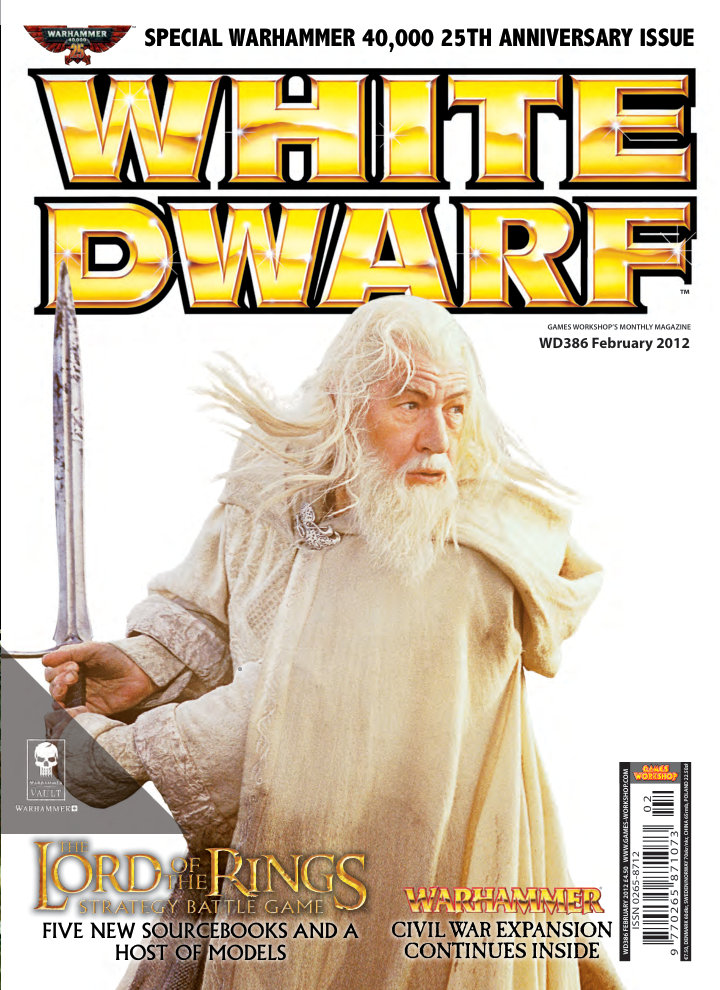
EditorialWD 386 · Inside cover
Andrew Kenrick recalls beginning his Rohan collection while at university and losing his first recreation of Helm’s Deep. The new Middle-earth sourcebooks and the Great Beast of Gorgoroth tempt him towards Mordor, while the issue also continues Warhammer Civil War and turns over for a separate celebration of Warhammer 40,000’s twenty-fifth birthday.
Middle-earth Strategy Battle GameWarhammer Fantasy Battles
CommunityWD 386 · pp. 2–7
Andy Hall introduces the Strategy Battle Game through the stories and alternative outcomes it lets players explore, from saving Boromir to pitching unlikely opponents against each other. He explains how individual warriors, exceptional Heroes and their reserves of Might recreate Tolkien’s adventures, then describes routes into collecting through the Mines of Moria set, the Journey books and the new army sourcebooks. The emphasis is on choosing a story and growing models and terrain around it rather than beginning with a large army.
Middle-earth Strategy Battle Game
InterviewWD 386 · pp. 3–9
Andy Hall brings Alan Merrett, John Blanche and Jervis Johnson together to recall how Warhammer 40,000 grew from a successful Space Marine miniature into Rogue Trader and then a succession of larger battle games. They describe decisions driven by available models, practical production limits and players using the rules in unexpected ways: the Horus Heresy gave identical Titans a reason to fight, while expanding collections drove later editions towards faster mass combat. Their discussion also follows changes in art direction, codex design and the influence of Forge World on Apocalypse, presenting the setting as a collaborative creation shaped by experiments rather than a fixed master plan.
Warhammer 40,000
InterviewWD 386 · p. 9
John Blanche explains how ordinary encounters and decaying surroundings become raw material for the atmosphere of the forty-first millennium. Architecture, rust, weather, strange animals and the variety of people matter alongside literary and artistic influences such as Peake, Dickens, Shakespeare, Turner and Rembrandt. His approach seeks evocative character and mood by pushing lived observation into a distant dystopian future, rather than beginning with a catalogue of futuristic machinery.
Warhammer 40,000
CommunityWD 386 · pp. 10–11
Black Library staff select twenty-five novels and omnibuses to celebrate the breadth of Warhammer 40,000 fiction, placing Eisenhorn first, followed by the Iron Warriors omnibus and Battle of the Fang. The selection spans Space Marine Chapters, alien perspectives, the Imperial Guard and the Inquisition, while deliberately excluding the Horus Heresy because it belongs to an earlier legendary age. Dan Abnett reflects on the imaginative continuity from Rogue Trader to contemporary fiction, and Aaron Dembski-Bowden credits the depth of the background for giving the setting a life beyond the tabletop.
Warhammer 40,000
LoreWD 386 · pp. 12–13
The anniversary retrospective revisits Hive Fleet Behemoth’s assault on the Ultramarines’ home world, whose defenders had been warned by Kryptman’s discoveries on Tyran. Adam Troke explains why the contrast between a thin line of determined blue-armoured defenders and an apparently inexhaustible alien swarm makes the conflict memorable. He also recalls how the Battle for Macragge starter set’s opening skirmish helped renew his appreciation of the larger story.
Warhammer 40,000Ultramarines
LoreWD 386 · pp. 14–15
Ghazghkull Thraka’s invasion brings Armageddon close to defeat until Yarrick’s defence of Hades Hive buys time for Dante and three Space Marine Chapters to intervene. Jervis Johnson recalls developing a planetary-scale board game and handing its outline to Bill King, whose narrative gave the principal characters and the world their enduring identity. The feature connects a familiar campaign in the background to the collaborative creation of its original story.
Warhammer 40,000Orks
LoreWD 386 · pp. 16–17
Abaddon brings the Planet Killer to Thesus Reach in pursuit of Creed, while Imperial commanders prepare to sacrifice the world in the hope of trapping the Despoiler. Andy Hall celebrates the conflict’s presentation in Apocalypse as a huge Dave Andrews battlefield filled with Titans, aircraft and massed armies. For him, its combination of a classic Chaos–Imperium confrontation and dramatic personal action, including Abaddon dispatching two Assassins, captures the appeal of the expansion’s grand scale.
Warhammer 40,000Chaos Space Marines
LoreWD 386 · pp. 18–19
Hive Fleet Kraken devastates Iyanden and drives the craftworld to awaken its dead before Prince Yriel and his Eldritch Raiders return to save it from extermination. Robin Cruddace recalls encountering the story through Doom of the Eldar and being struck by its scale: space warfare, vast living ships, an Avatar facing alien monsters and an exiled prince’s costly return. The feature presents the near-destruction as both a spectacular battle and a defining tragedy for the surviving Eldar.
Warhammer 40,000Iyanden
LoreWD 386 · pp. 20–21
The Badab retrospective follows Lufgt Huron’s ambition from secession to the Astral Claws’ fall and the emergence of Huron Blackheart’s Red Corsairs. Alan Bligh describes the attraction of a story in which the Imperium’s greatest defenders turn their strength against each other through pride, greed and treachery. He recalls expanding the few hundred words and Chapter colour schemes of White Dwarf 101 into two Imperial Armour books, illustrating how a small early piece of background could become a fully developed civil war.
Warhammer 40,000Astral Claws
Battle reportWD 386 · pp. 22–41
The anniversary game recreates the Crimson Fists’ desperate defence through four simultaneous linked battles: an Apocalypse fight for New Rynn City and side games using Cities of Death, Planetstrike and Spearhead. Matt Hutson’s escape with Pedro Kantor and Tom Hibberd’s rapid armoured victory reinforce the Imperial line early, but Andrew Kenrick’s surviving Orks eventually arrive from the Stompa factory to restore the greenskins’ chances. The main table swings between devastating Stompa fire, a Reaver Titan, aircraft and a Thunderhawk, before a last Ork assault secures the objective needed for a draw. The report shows how timely reinforcements and local victories can change a much larger multiplayer battle.
Warhammer 40,000Crimson Fists
CommunityWD 386 · p. 23
The news roundup highlights The Jericho Reach for the Deathwatch roleplaying game, including its three war zones and the opportunities for missions into Tyranid-infested territory. It also announces the high-definition release of the Ultramarines film and points readers towards work in Games Workshop retail, combining licensed 40K developments with hobby community notices.
Warhammer 40,000DeathwatchDeathwatch
Battle reportWD 386 · pp. 24–31
Andy Hall’s Fellowship races Andrew Kenrick’s Moria force towards a central ruin in Hold Ground, with random arrivals separating the opposing warbands. The Watcher in the Water appears behind the Hobbits and draws the Fellowship’s powerful fighters away from the objective: Aragorn and Legolas wound it badly, but it still kills Merry, Legolas and Sam. Gandalf, Boromir and Gimli bring down the Cave Troll, yet the Goblin Captain’s Heroic Move and Aragorn’s exhausted Might leave the Fellowship broken. Moria wins twelve victory points to three, illustrating how scenario positioning can outweigh a handful of heroic combat successes.
Middle-earth Strategy Battle GameThe Fellowship
Battle reportWD 386 · pp. 24–41
The main Apocalypse table pits a fortified Crimson Fists defence and a Reaver Titan against Ork Stompas and a mechanised horde. The Imperials deploy quickly to seize the first turn, but the Stompas’ opening return fire shreds their left flank; successful side games then bring Kantor, a Baneblade and supporting squadrons onto the field. A Thunderhawk and Drop Pods help secure the western objective, while the Orks’ late reinforcements and a final attack led by Jervis Johnson’s Warboss take the south-eastern position. Neither side establishes lasting dominance, and the city battle ends in a draw.
Warhammer 40,000Crimson Fists
RulesWD 386 · p. 25
The Watcher’s profile makes it an ambush monster whose delayed arrival can suddenly disrupt an opponent’s formation. Its tentacles can strike at range and drag surviving targets into contact, even while the creature is already fighting, while each wound reduces its number of Attacks. Terror, resistance to magic and the courage penalty it imposes reinforce its control over the surrounding battlefield; its arrival restrictions and steadily diminishing attack pool give enemies ways to manage that threat.
Middle-earth Strategy Battle GameMoria
Battle reportWD 386 · pp. 25–31
Matt Hutson leads Pedro Kantor and his surviving Crimson Fists through Andy Hall’s Ork Kommandos in the Cities of Death Gauntlet mission. The Space Marines begin moving immediately and withstand the Orks’ aggressive attack, then disciplined bolter fire cuts down the infiltrators. Kantor escapes with his force and enters the main Apocalypse battle by Flank March, turning the success of this smaller urban fight into crucial reinforcements for New Rynn City.
Warhammer 40,000Crimson Fists
Battle reportWD 386 · pp. 25–37
Glenn More’s Crimson Fists launch a Planetstrike attack on Andrew Kenrick’s Ork factory, treating its Big Mek Stompa as one of the defending bastions. The opening firestorm achieves little and the Terminators are overwhelmed, though an Ironclad destroys a bastion and the attacking Captain trades his life for the Ork Warboss. As defeat becomes inevitable, the Assault Squad reaches the Stompa and destroys it with melta bombs, reducing the strength of the Ork reinforcements even though Andrew wins the side battle.
Warhammer 40,000Crimson Fists
Battle reportWD 386 · pp. 25–35
Tom Hibberd’s Crimson Fists and Imperial Guard armoured column must break through Phil Cowey’s Ork Spearheads to reach the city. Winning the first turn gives Tom a decisive opening: his Dreadnought finishes the Stompa and his Baneblade destroys the Gargantuan Squiggoth while the Orks struggle to inflict damage in return. The swift victory brings the surviving vehicles onto the main table before its second turn, retaining their Spearhead benefits and giving the Imperials an early numerical advantage.
Warhammer 40,000Crimson Fists
RulesWD 386 · p. 26
Hold Ground sends warbands onto randomly determined table edges before they converge on an objective at the centre. A poor arrival roll can delay a formation or let the enemy choose its entry point, with Might offering Heroes a way to influence the result. Victory primarily rewards models within reach of the central objective, alongside wounds inflicted on enemy leaders and breaking the opposing army, so preserving movement and numbers matters as much as winning isolated fights.
Middle-earth Strategy Battle Game
TacticsWD 386 · pp. 34–45
Simon Grant surveys the five new sourcebooks and explains their shared warband system: ordinarily a Hero leads up to twelve Warriors, with special exceptions for groups such as the Fellowship and White Council. The books supplement the existing Rules Manual, gather a wide variety of army lists and provide six matched scenarios as well as historical encounters. His overview shows how the same selection framework accommodates cheap Goblin hordes, elite Elves, cavalry kingdoms and Mordor’s unusually broad range of troops and monsters.
Middle-earth Strategy Battle Game
TacticsWD 386 · pp. 36–37
Moria offers inexpensive Goblins supported by monsters and newly available characters, allowing numbers, drums and creatures such as the Dweller in the Dark to work together. Angmar instead combines Orcs with the supernatural servants of the Witch-king, including Barrow-wights, Spectres and Shades. Grant also highlights narrative games in underground passages and bridges, where the setting and unusual deployment opportunities matter alongside the army list.
Middle-earth Strategy Battle GameMoria
TacticsWD 386 · p. 37
The sample five-hundred-point Moria army divides its Goblins among Groblog, a Captain and a Shaman while adding a Cave Troll, a Dweller in the Dark and a drum. It demonstrates how the new warband allowance constrains even a cheap horde: the drum crew occupy Warrior places, so the accompanying unit must be reduced accordingly. Monsters provide the killing power that the numerous ordinary Goblins lack.
Middle-earth Strategy Battle GameMoria
TacticsWD 386 · pp. 38–39
The Free Peoples sourcebook spans several distinct styles of Good army, from the strong individual fighters of Eregion and Rivendell to the more numerous troops of Lothlórien and Mirkwood. Dwarfs bring resilient close-combat troops, while the Shire and the Wanderers offer very different supporting characters and fighters. The Fellowship and White Council receive an exception to normal warband organisation, preserving their identity as small companies of Heroes rather than forcing them into ordinary Warrior formations.
Middle-earth Strategy Battle GameRivendell
TacticsWD 386 · p. 39
This 495-point force places Rúmil, a Galadhrim Captain and a Stormcaller at the heads of three complementary warbands. Shield-bearing fighters, spear support and bows give the army options at different ranges, while its banner, war horn and spellcaster invest points in keeping the formation effective. It illustrates an Elf army built around coordinated support rather than relying entirely on a few expensive named Heroes.
Middle-earth Strategy Battle GameLothlórien
TacticsWD 386 · pp. 40–41
Grant contrasts the evil kingdoms gathered in The Fallen Realms. Isengard combines elite Uruk-hai, affordable leaders and Saruman’s magic with auxiliaries such as Dunlendings, Orcs and Wargs; Harad and Umbar rely more heavily on lightly armoured troops, poisoned arrows and unusual specialists. Easterlings offer disciplined heavy infantry and cavalry, whereas Khand supplies a more mobile force. Named leaders can also unlock elite upgrades, showing how character choice changes the identity of an otherwise familiar troop selection.
Middle-earth Strategy Battle GameIsengard
TacticsWD 386 · pp. 42–43
Mordor’s sourcebook brings together a particularly extensive selection of Warriors and Heroes, from ordinary Orcs to Nazgûl, Trolls and the greatest powers of Sauron’s realm. Its narrative scenarios reach from the Last Alliance to Osgiliath and the Black Gate. Grant uses the breadth of that roster to explain how a collector can build a distinctive Mordor army instead of treating it as a single uniform horde.
Middle-earth Strategy Battle GameMordor
RulesWD 386 · p. 42
The Great Beast carries an Orc controller and a platform of archers, combining mobile shooting with a powerful trampling attack. The archers can continue firing while the beast moves or fights, but the elevated platform affects incoming shots and surviving crew may be thrown if their mount dies. Its slam can let it continue through a victim, and its collapsing body threatens the crew; the selection rules count the whole creature as a single warband place rather than charging separately for every rider.
Middle-earth Strategy Battle GameMordor
TacticsWD 386 · p. 43
The 749-point Mordor example combines the Witch-king on a Fell Beast, a Great Beast of Gorgoroth, Gothmog and two warbands of Morannon Orcs. Tough Orc infantry form the fighting body while a drummer helps them keep pace with the monsters, and the Witch-king supplies both mobility and a deep pool of Will for magic. The list shows how Mordor can combine durable numbers with threats that force an opponent to defend several different kinds of attack.
Middle-earth Strategy Battle GameMordor
TacticsWD 386 · pp. 44–45
The Kingdoms of Men encompasses Gondor’s armoured troops and regional allies, the cavalry of Rohan and earlier kingdoms such as Arnor and Númenor. The overview highlights how Fiefdoms, the Army of the Dead and the bow-heavy Grey Company produce different forces even within the broad category of human armies. It positions the new Knight of the White Tower among those choices as a specialist whose unusual weapon makes him dangerous to important opponents.
Middle-earth Strategy Battle GameGondor
RulesWD 386 · p. 44
The Knight of the White Tower is a small Hero equipped with heavy armour and a distinctive two-handed White Sword. Its key rule doubles wounds that remain after Fate has been used, giving a successful strike disproportionate force against multi-wound enemies. The profile therefore offers Gondor a focused combat specialist whose impact depends on winning the fight and turning a hit into an unsaved wound.
Middle-earth Strategy Battle GameGondor
Battle reportWD 386 · pp. 46–53
Simon Grant’s Gondor force, led by Aragorn, Legolas and Gimli with the Dead and the Knight of the White Tower, meets Duncan Rhodes’s Easterling-led army in Lords of Battle. A Nazgûl repeatedly drains and immobilises Aragorn, while Gimli kills enemy Heroes and the White Knight brings down the Great Beast of Gorgoroth. In the final exchanges the Fell Beast kills Aragorn, but its Nazgûl spends its last Will and vanishes; Gondor takes the victory after a battle dominated by the interaction between magic, Heroic actions and the scenario’s rewards for wounds.
Middle-earth Strategy Battle GameGondor
RulesWD 386 · p. 46
Lords of Battle turns damage itself into the principal source of victory points, counting wounds and Fate spent rather than rewarding only the destruction of whole formations. A Hero who kills an enemy Hero in a fight can restore Might to a friendly Hero, creating a strong incentive to seek decisive character combats. Breaking the enemy still matters, and the variable ending after an army breaks makes both timing and the survival of wounded leaders important.
Middle-earth Strategy Battle Game
EditorialWD 386 · pp. 56–57
Jervis Johnson considers the emotional attachment gamers develop to tape measures, dice and other familiar tools, recalling Rick Priestley’s tape and Andy Chambers’s formidable presence across the table. He argues that templates and physical measurement shape the experience of a miniature battle as well as resolving its mechanics: flame weapons change how models spread out, and modest imprecision invites judgement and trust between players. Those tactile habits become part of the pleasure and memory of the hobby.
RulesWD 386 · pp. 58–61
Jervis Johnson adds three more faction tables to the Civil War rules introduced in the previous issue. Orcs & Goblins, Tomb Kings and Warriors of Chaos gain internal feuds, supernatural interventions and battlefield objectives that make a struggle against the same army feel different from a normal battle. The variations range from altered discipline and magic to rival leaders and valuable terrain, with additional victory rewards making each faction’s peculiar motives matter in play.
Warhammer Fantasy BattlesOrcs & Goblins
RulesWD 386 · p. 59
The greenskin Civil War table intensifies infighting through harsher Animosity, rebellious Goblins and Orcs eager to prove themselves against rivals. Other results give importance to territory, an idol, unusually potent beasts or a leader determined to demonstrate his personal strength. The accompanying bonuses and victory conditions turn an ordinary clash of similar troops into a contest over tribal authority, with spectacular monsters or a particularly reckless general sometimes becoming liabilities as well as assets.
Warhammer Fantasy BattlesOrcs & Goblins
RulesWD 386 · p. 60
Rival Tomb Kings can fight under delusions of life, emerging sands or intensified resurrection magic, changing the familiar behaviour of their undead armies. The table also introduces quarrelling priests, empowered constructs, chariot rivalries and royal grudges in which the fate or achievements of a particular general become decisive. These results give the battle a dynastic purpose and encourage players to adapt their priorities to the personality of the awakened rulers.
Warhammer Fantasy BattlesTomb Kings
RulesWD 386 · p. 61
The Warriors of Chaos table makes rival warbands compete for divine notice through altered Eye of the Gods rolls, mutations, monsters and disputes over the patronage of the Chaos Gods. A monolith or a relic can become the centre of the battle, while other results change the magical conditions or allow a leader’s transformation to erupt violently among nearby troops. The additional rewards and sudden reversals reinforce a struggle where winning favour can be as important as defeating the enemy line.
Warhammer Fantasy BattlesWarriors of Chaos
RulesWD 386 · pp. 62–65
Jervis Johnson develops the Deathknell Watch as both an Imperial warning station and a distinctive battlefield building. Its signal apparatus can improve the coordination of nearby forces, but its unstable magical power also creates a dangerous weapon for the occupants. A dedicated raiding scenario then tests whether an attacker can seize scattered intelligence while the defenders use the tower and incoming reinforcements to stop them.
Warhammer Fantasy Battles
RulesWD 386 · p. 63
The Deathknell Watch rewards a garrison with improved coordination of scattered shots and arriving reinforcements while denying enemy Scouts the nearby ground. Its occupants can also unleash a short-ranged magical attack, though a dangerous miscast can destroy the tower and everyone inside it. The rules retain the Wyrding Well after the building’s destruction and explain how to judge possession of the site, allowing a damaged watchtower to remain relevant to the scenario.
Warhammer Fantasy Battles
RulesWD 386 · pp. 64–65
Raiders attempt to carry away six scattered pieces of intelligence while a defending garrison holds the watchtower and its relief force enters the field. Victory rewards recovered or secured information and the survival of the garrison rather than ordinary casualties, so fast troops can steal an early advantage but need protection on the return journey. Rules for picking up and dropping loot make charges, fleeing and pursuit consequential, and the raider must decide how much effort to spend on the tower itself.
Warhammer Fantasy Battles
PaintingWD 386 · pp. 66–69
Chris Peach explains how his Nihilakh collection follows a visual hierarchy, with Warriors forming its broad base, more elaborate elites above them and Overlords at the top. Turquoise, aged silver and gold unify the force, but their balance changes with status: ordinary Warriors look like dirty machinery, while nobles display richer decoration. On the vehicles the turquoise represents weathered stone; on the infantry it becomes smoother painted livery, giving the same palette different material identities.
Warhammer 40,000Necrons
PaintingWD 386 · p. 68
Peach builds the Monolith’s turquoise stone from Hawk Turquoise, drybrushing lighter mixtures with Bleached Bone and then pure Bleached Bone to catch the texture. A Graveyard Earth wash is wiped back so the recesses stay dirty without obscuring the blue, and Scorched Brown picks out the gaps between blocks. The result treats the vehicle as an ancient weathered structure rather than clean painted armour.
Warhammer 40,000Necrons4 paint colours
PaintingWD 386 · p. 68
Gold begins over Tin Bitz with Shining Gold, while the silver areas start in Chainmail. Badab Black and Devlan Mud darken the metallic surfaces, with extra shading on the silver helping establish the army’s worn mechanical appearance; Chainmail then restores sharp edges and Scorched Brown adds chips to the gold. The Eternity Gate receives a diluted black wash to deepen its sculpted swirling detail.
Warhammer 40,000Necrons6 paint colours
PaintingWD 386 · p. 69
The Necrons’ power sources are painted green to stand out against turquoise armour and aged metal. Peach moves from Dark Angels Green through Snot Green and Scorpion Green, finishing the brightest spots with a Scorpion Green and Skull White mixture. The same progression works on weapon conduits, eyes, orbs and control panels, keeping the appearance of internal power consistent across very different models.
Warhammer 40,000Necrons4 paint colours
ShowcaseWD 386 · pp. 70–73
Two Vampire Counts collectors show how the same army range supports very different visual stories. Matt Hutson’s force uses deep red and green balefire around a mounted aristocratic core, whereas Carl Dafforn builds a darker, muddy collection with snowy bases and models clawing up from the earth. Their accounts connect the choice of an initial box or favourite unit with the later additions and conversions that give a growing army its identity.
Warhammer Fantasy BattlesVampire Counts
ShowcaseWD 386 · pp. 70–71
Matt Hutson’s army grows around Blood Dragon Morivar Darkstalker and the imposing Blood Knights that first inspired the project. Crimson cloth and exposed muscle link cavalry, infantry and newly raised creatures, with green balefire providing a sharp contrast on the Corpse Cart. His Black Knights established the painting approach before he expanded into larger infantry units, demonstrating how a small model group can serve as a reliable visual template for a whole host.
Warhammer Fantasy BattlesVampire Counts
ShowcaseWD 386 · pp. 72–73
Carl Dafforn develops a Vampire Counts Battalion into a larger collection with Grave Guard, massed Skeletons, Crypt Horrors and Mannfred. Dark reds, earthy browns and snowy bases establish a bleak setting, while green monsters and a blue Banshee give selected units a different focus. Conversions strengthen the narrative: skeleton spearmen emerge from a swamp across a shared base, and elevated Crypt Horrors make an otherwise regimented army appear to be clawing its way into motion.
Warhammer Fantasy BattlesVampire Counts
ShowcaseWD 386 · pp. 74–75
Nick Bayton builds an Ultramarines Fourth Company display after many years without collecting Space Marines, then turns to Graham McNeill’s novels to give its characters and details a stronger identity. His converted Uriel Ventris, named officers and helmeted Scouts connect the army to that fiction, while a missile suspended above a Whirlwind on wire and foliage creates a moment of action. An Imperial Strongpoint brings the collection together as a coherent defensive display.
Warhammer 40,000Ultramarines
PaintingWD 386 · pp. 76–80
Duncan Rhodes chooses Easterlings for their disciplined ranks, ornate armour and impassive enclosed helmets, building a compact force from Warrior and Kataphrakt boxes. He shows how the same red, gold and dark neutral scheme transfers from infantry to cavalry and banners, and uses spare cavalry parts to distinguish a mounted Captain. The feature ends by explaining how the collection’s infantry line, archers and mobile Heroes support each other in battle.
Middle-earth Strategy Battle GameEasterlings
PaintingWD 386 · p. 77
Rhodes starts with a brown base and separates dark sashes and boots, red cloth and gold armour before giving the model an all-over Devlan Mud wash. Chainmail and Badab Black establish the weapon, while restored red, grey and metallic highlights sharpen the figure without removing its sombre appearance. A pale brown mixed into the red finishes the cloth, and fine lines of Graveyard Earth suggest grain on the shield’s wood.
Middle-earth Strategy Battle GameEasterlings10 paint colours
PaintingWD 386 · p. 78
The mounted models reuse the Warrior method for their riders and barding, keeping cavalry and infantry visibly part of the same army. The horse itself begins over Chaos Black with Scorched Brown, receives a generous Devlan Mud wash and is then layered and highlighted with warmer browns. The reins use Dark Flesh lightened with Bleached Bone, giving a controlled difference between leather and the animal’s coat.
Middle-earth Strategy Battle GameEasterlings14 paint colours
PaintingWD 386 · p. 79
The banner uses the same shaded red cloth as the Easterling Warriors, then adds a contrasting yellow emblem. Rhodes bases the design with Iyanden Darksun, washes it with Devlan Mud alongside the cloth, restores the yellow and applies Bleached Bone to its edges. This shared shading stage integrates the emblem with the folds, while the final bright edge keeps the intricate design legible at gaming distance.
Middle-earth Strategy Battle GameEasterlings5 paint colours
TacticsWD 386 · p. 80
Rhodes presents his 654-point Easterling collection as a practical fighting force rather than only a painting project. Shield and pike infantry hold the line while the mounted Captain can bring Might where it is needed, and the War Priest supports the archers or empowers a fighter with Bladewrath. Amdûr and the Kataphrakts provide a mobile striking group, while the Dragon Knight hunts vulnerable archers or enemy Heroes and can recover Might through successful combat.
Middle-earth Strategy Battle GameEasterlings
CommunityWD 386 · p. 84
The Bluewater store profile introduces a hobby community anchored by a life-size Space Marine and regular opportunities to play, paint and learn. Its evening club accommodates large games, tournament preparation and campaign activity, showing how a busy shopping-centre location can also support an established local gaming group.
CommunityWD 386 · p. 87
Kingston’s Deathmarks club combines regular gaming with painting competitions and larger Apocalypse or Storm of Magic battles. The profile highlights the group’s participation in an inter-store doubles event at Warhammer World, using that trip to illustrate how a local club can connect its weekly activities to a wider hobby community.
CommunityWD 386 · pp. 94–95
Archie Black explains how a library hobby club grew from a small group of children and teenagers into regular gaming and painting sessions supported by shared supplies and a modest kitty. Becoming an independent stockist helped fund the activity, bring families into the library and provide the basics new hobbyists actually needed. His advice stresses listening to customers, stocking useful introductory materials and resisting the temptation to make the shelves merely reflect the organiser’s own taste.