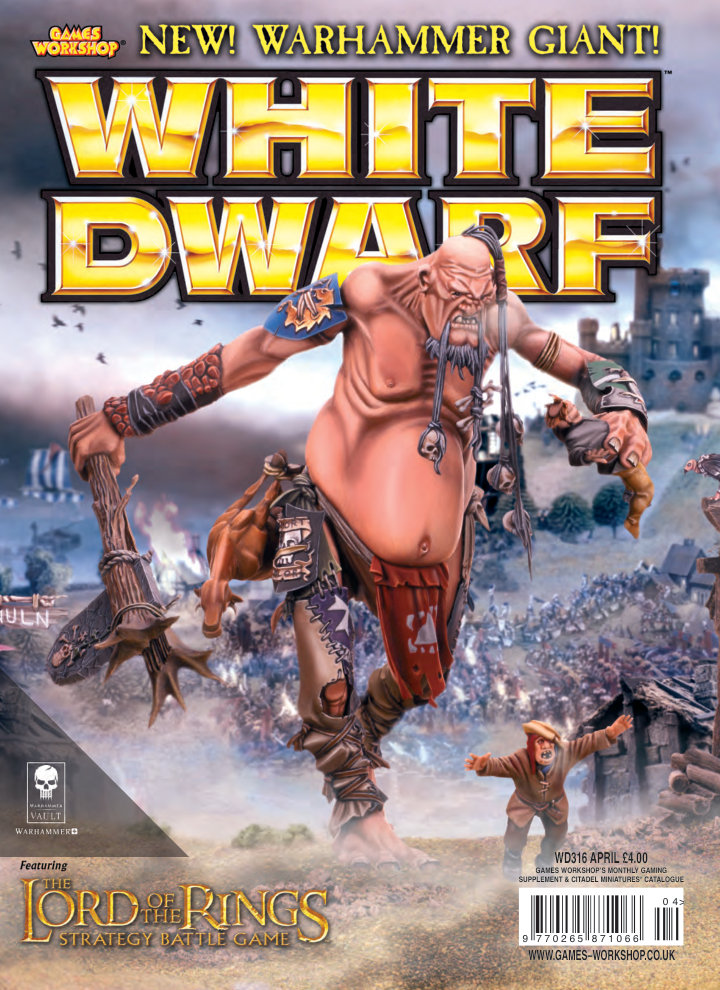
EditorialWD 316 · Inside cover
Owen Rees introduces the plastic Giant as a monster whose interchangeable parts suit four different armies and whose mercenary rules bring it to still more forces. He also highlights the expanding Tau range, the Tallarn desert feature and the approaching Medusa V campaign. His own Empire and Drop Troop projects connect these announcements to the month’s collecting opportunities. The editorial presents new miniatures alongside the games and settings in which readers can use them.
Warhammer Fantasy BattlesWarhammer 40,000T’au Empire
CommunityWD 316 · pp. 16–19
The news previews new plastic Tau Stealthsuits, sniper-armed Space Marine Scouts and Eldar weapons platforms. A free Medusa V booklet will explain the world and the competing forces gathering there. Black Library announcements include the opening Horus Heresy novel and accompanying publications, while historical and roleplaying news turns to the Alamo and Skaven. These pages mix early model previews with the wider publishing programme of spring 2006.
Warhammer 40,000Warhammer HistoricalT’au Empire
LoreWD 316 · pp. 20–30
The feature traces Giants back to the Sky-titans, whose mountain civilization was destroyed when the Ogres were driven into their realm. Their scattered descendants survive as slaves, Greenskin companions, Chaos-warped creatures or mercenaries. The new plastic kit translates those identities into interchangeable heads, weapons and accessories. Assembly instructions, Dogs of War rules and Brian Nelson’s account of sculpting the model connect that background to a versatile new battlefield centrepiece.
Warhammer Fantasy BattlesOgre Kingdoms
LoreWD 316 · pp. 20–21
The ancestors of Giants once inhabited cloud-wrapped mountain castles, largely removed from smaller civilizations below. The arrival of Ogres after the catastrophe of the Great Maw overwhelms their isolated realm. Survivors disperse into small groups and decline in both numbers and intellect. This history turns the familiar drunken monster into the remnant of a destroyed civilization rather than an inexplicable oversized human.
Warhammer Fantasy BattlesOgre Kingdoms
LoreWD 316 · p. 22
Ogre tribes capture the remaining Giants of the Mountains of Mourn as trophies and living weapons. Chains, collars and heavy burdens display their broken status, and the kit’s millstone makes that relationship immediately visible. Their lost resolve distinguishes them from free Giants even as their shackles become weapons. Crogg the Blind supplies a short example of a captive whose apparent helplessness may conceal a coming revenge.
Warhammer Fantasy BattlesOgre Kingdoms
LoreWD 316 · p. 23
Giants find congenial companions among Greenskins, who appreciate destructive enthusiasm and sometimes treat them as manifestations of their gods. Tribal paint and scavenged beast jaws let the monsters adopt an Orcish identity. The model’s dragon trophies suggest a victory that can be extended through additional sculpted scales. Little Gork’s mistaken belief that he is a god illustrates the affectionate absurdity of this relationship.
Warhammer Fantasy BattlesOrcs & Goblins
LoreWD 316 · p. 24
Giants near the Chaos Wastes range from recognizable mutants to swollen creatures whose original species is uncertain. Horns, hooves and a herdstone establish that distortion within the limitations of a shared plastic torso. Brian Nelson explains how accessories carry the theme when the central body cannot change. A Tilean glutton’s transformation shows that an apparently Giant creature need not have begun life as one.
Warhammer Fantasy BattlesChaos
LoreWD 316 · p. 25
Paying a wandering Giant with food and beer can make it a defender instead of a menace. Mercenary Giants tend to be relatively resourceful and accumulate equipment from many employers, while some communities keep them as mascots. The account includes Albion’s population and Middenheim’s unfortunate Thunderball, whose mutation turns a useful helper into a threat. Their employment is framed as a practical response to a hungry neighbour of enormous size.
Warhammer Fantasy BattlesDogs of War
ModellingWD 316 · pp. 26–27
An illustrated parts guide separates the shared body from the heads, weapons and accessories that establish a Giant’s allegiance. The assembly sequence joins groin, front torso, back and rump before attaching the completed legs. Once that core is secure, the modeller can choose a coherent identity or combine details to personal taste. The guide makes a large, crowded frame easier to approach without prescribing one finished version.
Warhammer Fantasy BattlesOgre Kingdoms
RulesWD 316 · pp. 28–29
The mercenary Giant is available as a Rare choice to six listed armies and combines Terror, stubborn resolve and unpredictable attacks. Separate tables distinguish its treatment of large opponents from its assaults on smaller victims. Falling can damage either side, and even the Giant’s own death may influence combat around it. The complete rules explain recovery from the ground, picking up enemies and the consequences of its improvised attacks.
Warhammer Fantasy BattlesDogs of War
RulesWD 316 · p. 29
A Giant may silence a combat through sheer noise, club a large opponent or repeatedly jump on a smaller unit. Picking up a victim begins another random sequence that can see the model bagged, thrown, crushed or eaten. Some results provide a chance to fend the monster off, while others leave it unable to attack again immediately. The variety creates battlefield stories as well as a deliberately unreliable damage output.
Warhammer Fantasy BattlesDogs of War
InterviewWD 316 · p. 30
Brian Nelson explains the practical difficulty of fitting four Giant identities and numerous realistic accessories onto two plastic frames. Research into animals grounds small comic details such as the vulture and dead cow, while deliberately inconsistent anatomy keeps the creature fantastical. Seb Perbett assists with components during a project lasting more than eighteen months. The feature also places the traditionally sculpted Giant at a turning point before computer-based production becomes more widespread.
Warhammer Fantasy Battles
Battle reportWD 316 · pp. 31–43
Nick Kyme’s Empire and Phil Kelly’s Greenskins each field two Giants in a battle whose carefully prepared plans soon dissolve. Fanatics cripple the Knights, Terror disrupts both armies and falling monsters inflict crucial damage after death. The Empire’s infantry recovers from the loss of its general, while depleted Black Orcs and their Warlord finally flee. The game ends in a draw, remembered chiefly for a Captain hurled into a friendly regiment and the Giants’ destructive exits.
Warhammer Fantasy BattlesThe Empire
TacticsWD 316 · pp. 31–33
Nick divides the Empire into an attacking wing of Knights and Giants and a defensive group of artillery and infantry. The monsters act as disruptive spoilers, buying openings for conventional troops. Phil instead uses Giants as stubborn shock troops alongside fast Greenskin attackers, with Fanatics and bolt throwers addressing opposing threats. The opposing army photographs show how the same monster can support different tactical plans.
Warhammer Fantasy BattlesThe Empire
TacticsWD 316 · p. 43
A Giant can wait behind a shooting line as a counterattack unit or anchor a flank where enemy troops must face Terror without their general nearby. Two advancing together may force an opponent to rearrange an entire plan. The opposing advice recommends Giant Slayers, accurate bolt throwers and the devastating direct hit of a Trebuchet. Each suggestion links the monster’s size and special rules to a practical use or vulnerability.
Warhammer Fantasy BattlesDogs of War
EditorialWD 316 · pp. 44–45
Jervis Johnson uses the Giant to introduce changes in how Citadel plastic models are designed and manufactured. Computer sculpting and scanning allow a physical model to become editable digital material, while production improvements promise faster and more ambitious kits. The scanned Carnifex and a partly digital Eldar platform demonstrate early examples. He anticipates more complete plastic armies and much larger models, while warning that the new methods will take time to become routine.
Warhammer Fantasy BattlesWarhammer 40,000
ModellingWD 316 · pp. 46–49
The vehicle workshop focuses on the clean curves that make mould lines and careless trimming especially visible on Tau kits. Removable stands, commanders and interchangeable weapons offer practical ways to personalize the finished model. A geometric Piranha painting sequence contrasts with Chad Mierzwa’s stippled, masked Hammerhead camouflage. The interior receives its own pale finish, showing how attention beneath the hull can complement the exterior scheme.
Warhammer 40,000T’au Empire16 paint colours
ModellingWD 316 · pp. 46–47
Leaving a small sprue remnant before trimming prevents damage to the smooth hull surfaces. Pinning a flying stand allows removal, and separately painted crew remain easier to reach than a fully fixed commander. Illustrated positions identify sensor spines, seekers, drones and smart missiles while leaving room for personal placement. Pins also permit the main turret weapon to be exchanged, provided moving or removable parts are recognized before glue is applied.
Warhammer 40,000T’au Empire
PaintingWD 316 · p. 48
Vomit Brown provides the foundation for a camouflage pattern drawn lightly in pencil. Bronzed Flesh and a brown-fur mixture fill the geometric panels, and thinned Bestial Brown restores their boundaries. Increasingly pale edge highlights emphasize the vehicle’s clean shape. A separate colour key supplies the named colours for five sept markings, allowing the same hull treatment to identify different military origins.
Warhammer 40,000T’au Empire9 paint colours
PaintingWD 316 · p. 49
Chad builds mottled camouflage through stippled greens and greys, then masks irregular lightning shapes before applying a dark grey finish. Removing the tape reveals a layered pattern rather than a single flat accent colour. Inside, a pale bone wash over white contrasts with green seats and grey doors. The two treatments give the open transport compartment and exterior hull different materials while preserving a shared restrained palette.
Warhammer 40,000T’au Empire8 paint colours
LoreWD 316 · pp. 50–53
An Ordo Xenos account describes Stingwings as inhabitants of a high-pressure gas giant whose floating islands house separate nations. Tau-designed neutron weapons incorporate dangerous native crystals, and the aliens’ wings enable attacks through terrain other Tau troops might avoid. The annotated anatomy examines vision, armour and communication, including Imperial suspicions about the strain leader’s helmet. Four painted contingents connect biological variation with service alongside different septs.
Warhammer 40,000Vespid
LoreWD 316 · p. 51
The diagram distinguishes three pairs of eyes, armoured wings, excavating claws and a vestigial abdominal structure. Equipment notes separate Tau-made armour and gun mechanisms from the crystal supplied by the Vespid. The observer speculates that wing harmonics may help contain the weapon’s radiation and that communication helmets do more than translate commands. These claims are framed as an Imperial investigation, preserving its uncertain and suspicious perspective.
Warhammer 40,000Vespid
ShowcaseWD 316 · pp. 52–53
T’au, Sa’cea, Vior’la and D’yanoi contingents show how Vespid chitin and Tau-issued equipment can vary independently. The T’au example recalls a strain associated with Puretide, while the urban Sa’cea group is linked to a settlement near Medusa V. Vior’la demonstrates a different native coloration, and the D’yanoi unit may be serving away from its home sept. The gallery provides setting and visual examples without supplying named paint recipes.
Warhammer 40,000Vespid
CampaignWD 316 · pp. 56–61
The summer campaign preview describes online battle reporting, personal service records and varied battlefields on a world approaching destruction. Each faction arrives with a different objective, from Imperial control and Ork escape to Tau research and Eldar containment of a damaged webway portal. Ygethmor seeks a daemon world while other armies pursue captives or prey. A final Inquisitorial dispatch makes the new Death Leaper strain a particular threat amid the hive cities.
Warhammer 40,000Astra Militarum
CommunityWD 316 · pp. 56–57
The preview explains how players will register an account, submit results and follow their contribution through a service record. Battlefield sections, leader boards, scenario ideas and hobby material support the shared campaign beyond individual games. Local events and new releases are intended to connect online reporting with games in stores. The printed timeline records the planned summer 2006 sequence as a historical announcement.
Warhammer 40,000
LoreWD 316 · pp. 58–60
Graf Harazahn leads Imperial troops seeking control, while Nazdreg needs a route off the doomed planet. Tau researchers investigate the Warp and Alaitoc’s Elarique Swiftblade tries to prevent Chaos entering an open webway portal. No’Akei pursues slaves, Necrons see an opportunity to isolate their prey, and Sicarius opposes Ygethmor’s plan to claim a daemon world. The differing stakes establish objectives more specific than simple conquest.
Warhammer 40,000Astra Militarum
FictionWD 316 · p. 61
Kryptman warns that a Lictor strain on Medusa V has developed exceptional camouflage and must not return its adaptation to a hive fleet. The accompanying accounts describe disappearing victims and a fleeting pict-capture obtained at the cost of human lives. The threat escalates from hive-city rumour to an Inquisitorial concern extending far beyond one world. Preventing the creature’s recovery becomes a reason to fight even as the planet itself appears doomed.
Warhammer 40,000Tyranids
CampaignWD 316 · pp. 62–73
The Taros feature combines a survey of Imperial Armour’s campaign book with collecting, painting and battlefield material for desert warfare. Tallarn profiles and Pete Jarman’s Combat Patrol show how existing Guard models can build a themed force. Syckava’s escape supplies a rescue scenario, while a terrain generator introduces dunes, wadis, storms and dangerous creatures. Andy Hoare’s tactics explain why open ground can favour either defended strongpoints or coordinated mobile attacks.
Warhammer 40,000Tallarn Desert Raiders6 paint colours
CommunityWD 316 · pp. 62–64
The book overview emphasizes a campaign told through detailed operations, maps, photographs and technical drawings rather than a detached catalogue of vehicles. Its chapters follow the invasion through major battles and the Imperial withdrawal. New vehicle rules, three army lists, scenarios and supporting material make the conflict playable at several scales. The article presents the range of material in the volume without reproducing those additional army or fleet lists.
Warhammer 40,000Battlefleet GothicT’au Empire
LoreWD 316 · p. 65
Tallarn troops are portrayed as mobile guerrilla fighters who stalk opponents through desert terrain rather than relying solely on static firepower. Riding between engagements and dismounting for stealth supports their hit-and-run character. Sentinels and lance-armed Rough Riders extend that mobility, while plasma guns and missile launchers are identified as preferred squad weapons. The description connects the regiment’s visual identity to a recognizable way of fighting.
Warhammer 40,000Tallarn Desert Raiders
RulesWD 316 · p. 65
The article adapts the classic Tallarn officer through a Heroic Senior Officer profile and a specified collection of standard wargear. Master-crafted weapons, a refractor field and command-related items represent his experience without introducing a new bespoke special-character system. His familiar sunglasses become the trademark item. The command squad can still be upgraded normally, making the old miniature usable within the contemporary Guard structure.
Warhammer 40,000Tallarn Desert Raiders
ShowcaseWD 316 · pp. 66–67
Pete Jarman returns to his favourite metal Guard regiment with a four-hundred-point scouting force. A basic infantry platoon supplies numbers, Veterans add dependable shooting, Rough Riders provide a carefully timed assault and a Sentinel addresses armoured transports. His restrained desert palette makes the models a coherent group. Future expansion would bring mechanised troops and converted Ogryns rather than simply applying every available doctrine to the small patrol.
Warhammer 40,000Tallarn Desert Raiders6 paint colours
TacticsWD 316 · pp. 66–67
Pete avoids costly doctrines in the initial patrol so that it retains infantry numbers and a variety of weapons. One squad deals with larger units, another with tougher targets and light armour, while Veterans cover gaps in ordinary shooting. Rough Riders wait for a decisive charge and the Sentinel adds another anti-vehicle tool. Planned mechanised expansion reflects the army’s scouting background while acknowledging that appearance matters to his choices.
Warhammer 40,000Tallarn Desert Raiders
PaintingWD 316 · p. 67
A black undercoat supports brown camouflage built from Bestial Brown with Snakebite Leather and Bleached Bone patches. Pouches stay black or use Scorched Brown to prevent small equipment from complicating the scheme. Fortress Grey headscarves and trousers provide a cooler contrast without becoming too bright for the desert theme. The short recipe aims at a coordinated army that remains practical to complete.
Warhammer 40,000Tallarn Desert Raiders6 paint colours
LoreWD 316 · p. 68
Captured General Syckava refuses a Tau offer to negotiate an Imperial withdrawal in exchange for status and command over human auxiliaries. Sent back to forced labour, he uses the information gathered during captivity to organize an escape. The desert nearly defeats him after several days, and his last act is to mark an Imperial eagle in the sand. The extract presents stubborn loyalty as both his motive for resistance and his final hope of rescue.
Warhammer 40,000Elysian Drop Troops
RulesWD 316 · p. 69
A weakened officer and surviving prisoners begin between arriving Tau and Tallarn patrols. The Guard must escort Syckava off their table edge without his falling back, while the Tau must prevent that escape. Both armies enter from reserve, and Rough Riders receive a guaranteed arrival that suits their role as desert scouts. Reduced characteristics make the rescued group vulnerable and turn movement and protection into the mission’s central problems.
Warhammer 40,000Tallarn Desert Raiders
RulesWD 316 · pp. 70–71
A desert terrain generator supplies recognizable landforms alongside environmental hazards. Sangars, wadis, scrub and oases offer different movement or cover effects, while heat haze and sandstorms reduce effectiveness and can change during the game. Sun Worms make nearby movement dangerous and Sand Worm attacks threaten unsuspecting models. The rules turn apparently empty ground into a varied battlefield while allowing players to agree their own terrain arrangement.
Warhammer 40,000
RulesWD 316 · pp. 70–71
Sun Worms store solar energy and discharge it as a defence, explaining the dangerous ground around their positions. Sand Worms instead emerge at unpredictable locations and can pull victims below the surface if they fail to react. Both results are generated as part of the desert’s terrain rather than purchased army units. The accompanying biological note makes the hazards feel like inhabitants of the setting rather than arbitrary damage rolls.
Warhammer 40,000
TacticsWD 316 · p. 71
Andy Hoare argues that open desert changes movement coordination as much as shooting. Long defensive lines are exposed to being outflanked, so static armies should form strongpoints covering several approaches. Mobile forces can concentrate attacks without the bottlenecks of denser terrain, especially when transports work together. Their freedom also exposes vehicles to long-range antitank fire, making coordinated target selection essential.
Warhammer 40,000
ShowcaseWD 316 · p. 72
Matthew Toone’s historically inspired Tallarns use dark skin, thin bases and distinctive officers’ turbans to give an old collection a new finish. Rhys Knight’s mounted troops draw on his affection for neglected units and the imagery of The Mummy. The White Dwarf team adds ice-world, forest, red-desert and ash-waste examples, showing that the same uniform need not belong only on sand. The gallery names themes and contributors without offering additional paint recipes.
Warhammer 40,000Tallarn Desert Raiders
ModellingWD 316 · pp. 74–75
Dave Taylor turns Black Library fiction and art into figures for an Empire army. Blood on the Reik is especially useful for its grimy ordinary characters, inspiring a priest, lamplighter, executioner, wizard and fanatical preacher. Parts from fantasy and science-fiction ranges are stripped of their original context and joined through small sculpted details. The feature encourages readers to treat narrative illustrations and a well-kept bits collection as starting points for distinctive units.
Warhammer Fantasy BattlesThe Empire
ModellingWD 316 · p. 75
A Space Marine torso and Marauder legs become a Warrior Priest, while an Inquisitorial henchman becomes a lamplighter carrying a regiment’s standard. Free Company and Beastman parts create an executioner, and a Daemonhunter Acolyte gains a skull and scythe as an Amethyst Wizard. The preacher combines a supporting monk with a collection of spare parts and an enormous book. Selective removal and simple Green Stuff hoods turn disparate components into convincing Empire characters.
Warhammer Fantasy BattlesThe Empire
PaintingWD 316 · pp. 78–80
The Rohan gallery compares the cleaner brightness of Eorl with the weathered royal household of the War of the Ring. Pete Foley explains the thin layers behind Eorl’s pale cloak, while close views identify armour, leather and character details on Éomer, Théoden, Gamling and Éowyn. A common basing sequence unifies them. Five colour wheels then give named recipes for the green cloth, leather, gold and steel repeated across the range.
Middle-earth Strategy Battle GameRohan20 paint colours
PaintingWD 316 · p. 78
Pete Foley uses Eorl’s earlier, more prosperous setting to justify a brighter appearance than the later Rohan heroes. The white cloak rises from Fortress Grey through numerous thin white mixtures, preserving an even finish on small cloth surfaces. The base follows Brown Ink with brown and grey drybrushing, a pale final pass and patches of vegetation. Matching armour and barding makes horse and rider read as one royal figure.
Middle-earth Strategy Battle GameRohan5 paint colours
PaintingWD 316 · pp. 79–80
Éomer’s armour is painted from the metal outward, with straps re-established in black before the red leather is added. Théoden’s bronze shield and patterned dark tack distinguish the king, while Gamling’s white horse banner becomes his focal detail. Éowyn’s ordinary warrior equipment is deliberately subdued so that her hair draws attention. The commentary shows how selective emphasis can identify characters who share a military palette.
Middle-earth Strategy Battle GameRohan1 paint colour
PaintingWD 316 · p. 80
The green cloth begins with Dark Angels Green darkened by Chaos Black. Pure Dark Angels Green forms the first highlight, followed by a brighter mixture with Snot Green. Concentrating each stage on more exposed folds preserves the depth of the original shade. The colour wheel supplies a reusable three-stage recipe for cloaks and saddlecloths throughout a Rohan force.
Middle-earth Strategy Battle GameRohan3 paint colours
PaintingWD 316 · p. 80
Scorched Brown forms a dark leather base with sufficient depth to separate straps and armour plates. Dark Flesh provides the warmer first highlight, followed by pale bone on the most exposed edges. The compact sequence is designed to repeat across several heroes and their equipment. It gives brown leather a different visual character from both green cloth and red decorative fittings.
Middle-earth Strategy Battle GameRohan3 paint colours
PaintingWD 316 · p. 80
The red leather recipe moves from Scab Red to Red Gore, then lightens the latter with Bronzed Flesh. A warm flesh addition softens the final highlight instead of producing an unrelated pale edge. Used selectively on straps and decorated equipment, the red can stand out from the darker leather without dominating the whole model. The wheel names each stage for consistent repetition.
Middle-earth Strategy Battle GameRohan3 paint colours
PaintingWD 316 · p. 80
Gold begins with Shining Gold and Flesh Wash, then returns to cleaner gold before a Mithril Silver highlight. Armour and weapons instead start from Boltgun Metal with Black Ink and rise through Chainmail to the same pale silver finish. The separate warm and cool foundations keep ornament distinct from functional steel. Both recipes reserve their strongest shine for the final edges.
Middle-earth Strategy Battle GameRohan6 paint colours
TacticsWD 316 · pp. 82–85
Four illustrated forces show how a coherent setting can produce different armies from familiar Gondor and Mordor models. A Minas Tirith garrison relies on armoured infantry and Boromir, while Ithilien combines Rangers with a timed cavalry strike. Morgul Vale uses Orc numbers around powerful Trolls, and the Black Gate adds elite allies and magical support. Each page explains an important leader’s role rather than treating the force as merely a points total.
Middle-earth Strategy Battle GameGondor
TacticsWD 316 · p. 82
The garrison army exchanges cavalry and light scouts for a durable body of heavily armoured warriors and Citadel Guard. Boromir’s resources, horn and banner make him the force’s central combat leader, supported by less expensive captains and Beregond. The plan favours a steady engagement in which good fighting skill and Defence preserve the line. Nazgûl remain a concern even for so formidable a hero.
Middle-earth Strategy Battle GameGondor
TacticsWD 316 · p. 83
Rangers reduce the enemy at a distance before Knights deliver the decisive charge, demanding good judgement about when to stop shooting and commit. Faramir leads the mounted component while inexpensive heroes strengthen the infantry and supply Might. Damrod offers economical local leadership and Madril helps reinforcements reach the battle. The army can be outnumbered, so the timing of its transition into combat is central to its success.
Middle-earth Strategy Battle GameGondor
TacticsWD 316 · p. 84
A mass of Orcs protects and supports a Troll Chieftain, a second Troll and Gothmog. The monsters set the pace, but losses among ordinary fighters must be controlled so the army retains enough bodies to fulfil its objectives. Gothmog’s Master of Battle pressures opposing heroes by answering their actions without the same expenditure. The combined force relies on numbers and powerful centres rather than asking either element to fight alone.
Middle-earth Strategy Battle GameMordor
TacticsWD 316 · p. 85
The Black Gate army mixes Orcs, Easterlings, a Troll and a mounted Ringwraith into an elite force with fewer reserves than a conventional horde. Its heroes must make their actions count, using Transfix and Compel to isolate vulnerable enemies. The Mouth of Sauron is highlighted as both a useful fighter and a focused spellcaster who can exploit his own disabling magic. The list turns the final battle’s mixed forces into a compact collection.
Middle-earth Strategy Battle GameMordor
ModellingWD 316 · p. 87
Chris Straw turns a plastic Ogre Bull into a veteran Maneater through equipment, movement and extensive piercings. The shoulder is rebuilt to support the new pose, while accessories suggest the experience of a travelling mercenary. A short sculpting sequence creates rings whose weight pulls visibly on the skin, and shaped plastic rod supplies tooth piercings. The result makes an ordinary regiment model a distinct character without requiring a wholly new sculpt.
Warhammer Fantasy BattlesOgre Kingdoms
ModellingWD 316 · p. 87
A small putty lump is shaped into a ring using a blunted stick, then refined with its flattened end. Once the ring sets, a fresh bead of Green Stuff creates the stretched skin beneath it. Sharpened plastic rod provides a tooth-shaped alternative, blended on both sides to appear embedded. The sequence separates hard jewellery from soft flesh so that the detail conveys both weight and attachment.
Warhammer Fantasy BattlesOgre Kingdoms
ModellingWD 316 · pp. 88–91
The workshop compares inexpensive and more permanent ways to create a gaming surface at home. Blankets and grass mats offer fast setup, polystyrene tiles allow lightweight modular scenery, and wooden boards provide a durable flat foundation. Storage, transport and susceptibility to damage are weighed alongside appearance. Matching flock and static grass across the board and its terrain gives even straightforward construction a coherent finished result.
Warhammer 40,000Warhammer Fantasy Battles
ModellingWD 316 · p. 89
A coloured blanket laid over books can create rolling ground with almost no permanent construction. Rocks and household objects provide quick terrain, while a grass mat gives a more purpose-made surface that can still be rolled away. The comparison notes the space required to spread either option and the mat’s risk of creasing or tearing. These are presented as practical first battlefields rather than projects needing specialist skills.
ModellingWD 316 · p. 90
Separate foam sections make a light gaming area that can stack away and carry sculpted scenery. High-density material is stronger and can be shaped more precisely, while cheaper low-density sheets require better protection. A folding example joins sections with duct tape and uses different finishes on its two faces. The options solve storage and transport problems at the cost of needing a supporting table and careful handling.
ModellingWD 316 · p. 91
A painted wooden sheet on a sturdy support creates a gaming table quickly with readily available materials. The guide compares MDF, chipboard, hardboard and plywood, noting their different strengths and tendency to warp or suffer edge damage. Finishes can range from simple paint to a textured surface matched by the scenery. Storage and damp matter as much as the initial construction when choosing a board intended for repeated use.
ModellingWD 316 · p. 94
The toolbox distinguishes the work suited to each cutting tool. Clippers remove parts and casting tags, a knife trims remnants and scrapes mould lines, and a modelling saw offers control for major conversion cuts. A cutting mat protects the surface while clamping a part steadies a saw and reduces twisting. The advice centres on choosing the appropriate tool before attempting the cut rather than forcing one implement to do every job.
CampaignWD 316 · pp. 96–101
Nick Kyme and Andy Hall bring the Death’s Head campaign to the Temple of Morr, where rival warbands confront Vantor and his Soul Engine. The remaining players describe the successes and injuries that shaped their forces before the finale. Multiplayer rules give the corrupted priest a neutral turn and powers that grow as his intended victims fall. The concluding story has Malachias destroy the machine, while galleries show the hired fighters and Stu Morris’s ruined temple.
MordheimPriests of Morr
CampaignWD 316 · p. 97
Andy’s Reiklanders lose essential heroes early and struggle to replace them until surviving Youngbloods begin to bring in income. James’s Possessed enjoy a strong opening and devastate the Dwarfs, only to suffer against Witch Hunters and then overextend in the gaol. The accounts show how campaign outcomes depend on casualties and future earnings as well as wins. Both arrive at the finale carrying the consequences of earlier decisions.
MordheimReiklanders
RulesWD 316 · pp. 98–99
Several warbands approach the central temple, competing to destroy the Soul Engine and thereby win the entire campaign. Its influence drains nearby fighters and strengthens Vantor, while his disciples act as a neutral defending force. Injured priests can return for this final game at reduced strength, ensuring they remain part of the confrontation. A shared external multiplayer framework supplies deployment and turn order, with this scenario adding its own central objective and experience rewards.
MordheimPriests of Morr
RulesWD 316 · p. 99
Vantor begins with defensive skills, mutations and the ability to improve his protective rerolls. Priests taken out of action unlock stronger powers, from a discouraging aura and resurrected disciples to a deadly touch. Claiming all six brings increased physical power and further resistance to damage. The escalation links the campaign’s character stakes directly to a growing battlefield threat instead of treating the priests as ordinary casualties.
MordheimPriests of Morr
FictionWD 316 · p. 99
The final confrontation begins with warbands still pursuing rivalries even as the machine consumes nearby souls. Malachias reaches Vantor first, and Borin’s dramatic arrival creates the opening that ends the corrupted priest. The surviving priest then hesitates over the possible uses of the engine’s power. The Vampire destroys its core before another temptation can take hold, leaving the ordinary world unknowingly saved by an evil creature.
MordheimUndead
ShowcaseWD 316 · p. 101
Stu Morris’s ruined temple provides the campaign finale with a multilevel centrepiece. A cutaway view exposes stairs, arches and the elevated chamber around the machine, while the complete view shows its tower and shattered outer structure. Close photographs make the playable interior and weathered architectural details clear. The gallery presents the finished setting without construction measurements or a named paint recipe.
Mordheim
EditorialWD 316 · p. 103
Rik Turner retires the persona of Inquisitor Robespierre as the long-running Inquisitor newsletter becomes White Dwarf Online. The replacement gains images, a redesigned appearance and a Tuesday schedule previewing Friday’s website material. It will continue news and article links while adding occasional exclusives. The column marks a change in the magazine’s online companion and explains what existing subscribers can expect.
ModellingWD 316 · pp. 104–105
Nick Kyme returns to the store where he first encountered the hobby and meets a team with strong modelling and tournament interests. Dan Doughty’s Moria board uses expanding foam around removable forms to create rock passages, then plaster bandage and texture unify the surface. His converted Emperor’s Children models and the accompanying staff gallery show the same appetite for distinctive projects. The visit also records how regular events and social connections keep a local hobby group active.
Middle-earth Strategy Battle GameWarhammer 40,000Emperor’s Children
ShowcaseWD 316 · p. 106
Dave Binnie bases a mechanised Crimson Fists collection on Crimson Tears rather than only the chapter’s famous early cover art. Prolific bionics represent wounded veterans, and a converted Tigurius becomes the army’s Librarian after removing Ultramarines symbols. A compact blue-and-red recipe supports quick tabletop painting, with snow bases separating the dark armour from its surroundings. Further command models and transports are planned as the thousand-point force grows.
Warhammer 40,000Crimson Fists6 paint colours
PaintingWD 316 · p. 106
Darkened Regal Blue is washed over black armour before fine blue lines establish the edges. A white-and-blue mixture picks out the sharpest points, keeping most of the plate deliberately dark. Red areas start with Red Gore, rise through Blood Red and receive Red Ink to blend the effect. The sequence aims at a clean gaming finish that can be repeated across an entire mechanised force.
Warhammer 40,000Crimson Fists6 paint colours
ModellingWD 316 · p. 107
Andy Vaughn models his Blood Axes around captured or imitated Imperial Guard equipment. Sentinels become Killa Kans with plasticard and putty, while sniper and observer teams use heavily concealed bodies to fit the desert theme. The army’s organization and conversions repeatedly mirror Guard ideas without losing its chaotic Ork character. Boss Snikrot supplies inspiration for a collection that treats military imitation as another form of Greenskin humour.
Warhammer 40,000Orks
CommunityWD 316 · pp. 110–111
Nick Kyme and Owen Rees visit a club that has grown from a garage into a large group with regular campaigns and tournament weekends. Its organizers use bring-and-battle days to help other groups learn how to run their own events. A Mordheim campaign and a Battle of Five Armies game illustrate the range of activity, while nearby store tables provide another meeting point. The account presents experienced volunteers and shared habits as the foundation of a thriving club.
MordheimMiddle-earth Strategy Battle Game
CommunityWD 316 · p. 110
Darren Wadland’s moderation of several hobby forums extends the Chelmsford community beyond its physical club night. His online identity draws on the Howling Griffons and includes work on the magazine’s own forums. The short profile connects internet discussion with the same friendships and organizational efforts found in local clubs. It treats online participation as another part of the hobby rather than a separate audience.
Warhammer 40,000Howling Griffons
CommunityWD 316 · p. 126
The letters page introduces Grombrindal’s Gallery with a multi-view Brazen Claws collection and a Tyranid Hunter conversion. A reader identifies the missing Guard weapon choices in the earlier Kill-team article, prompting a reference to an online correction. The recurring misspelled Dwarf grudge and a newspaper’s accidental Storm of Chaos headline supply lighter moments. Photographs, replies and brief requests remain grouped as one community feature.
Warhammer 40,000Warhammer Fantasy BattlesBrazen Claws
CommunityWD 316 · p. 127
Owen prepares the Witch Hunters’ painted army for a Doubles event, while Nick recruits varied Hired Swords for Mordheim’s final confrontation. Rik uses accumulated campaign wealth for hired muscle and begins Inquisitorial support for his Blood Ravens. Christian divides his attention between High Elves, Chaos and the continued Black Legion repaint. Their reports show how an imminent game encourages modelling choices and how completed projects lead to new additions.
Warhammer 40,000Warhammer Fantasy BattlesWitch Hunters