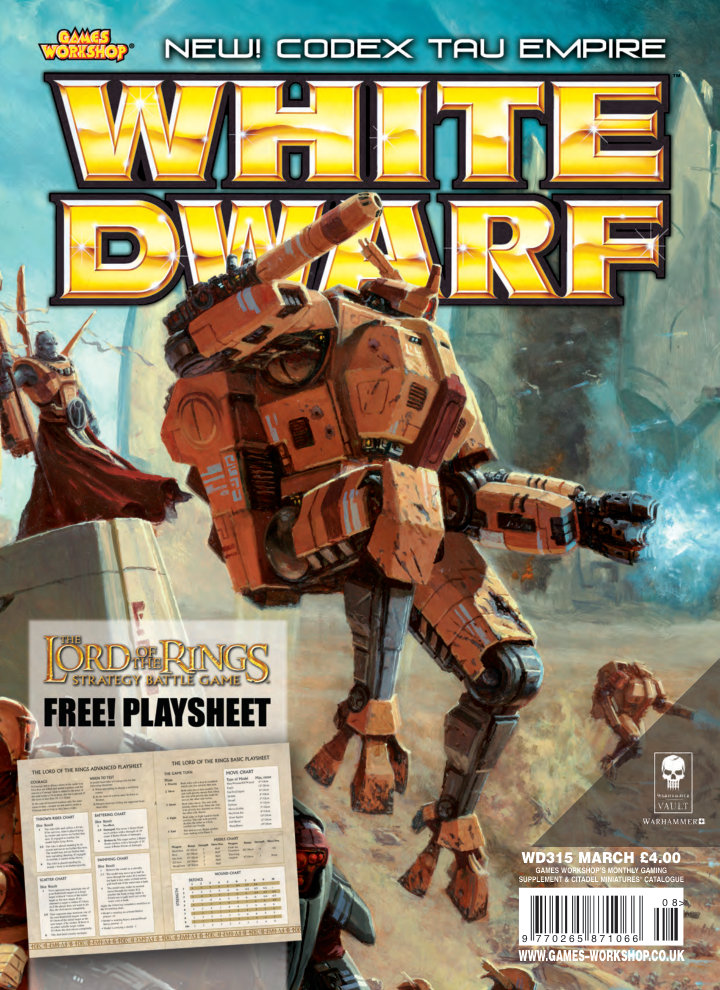
EditorialWD 315 · Inside cover
Owen Rees introduces the expanded Tau Empire, especially Shadowsun, the Vespid and the new vehicles. The army deal offers an early opportunity to collect them before the normal release, while returning Tallarn models and Specialist Games releases provide other temptations. A free Golden Demon booklet and the coming summer campaign round out a month whose centrepiece is the Tau’s renewed expansion.
Warhammer 40,000MordheimT’au Empire
CommunityWD 315 · pp. 12–15
The news previews Cities of Death as an urban expansion supported by modular plastic buildings and stratagems that give ordinary armies new choices. Forge World’s Cadian equipment, Mordheim components and an Old West historical release show other ways of extending existing collections. Studio sculpting previews, a Copenhagen gaming venue and the Golden Demon winners booklet place forthcoming products alongside the people and places that support the hobby.
Warhammer 40,000Warhammer Fantasy BattlesT’au Empire
CommunityWD 315 · p. 13
The forthcoming urban expansion promises tactical choices before the battle through stratagems rather than requiring a specially built army. New plastic building sections are designed to fit together in many arrangements and give city boards a more consistent Imperial appearance. The preview links these physical kits to a wider summer of urban fighting, offering an early description rather than a complete rules system.
Warhammer 40,000
InterviewWD 315 · pp. 18–31
Andy Hoare explains how the Tau’s Third Sphere expansion changes the army’s identity and its revised codex. New auxiliaries and vehicles widen the force’s options while battlesuit equipment and markerlights deepen its characteristic coordination. The discussion moves from Shadowsun and Aun’Va to Vespid, Piranhas, Sky Rays and revised Kroot organization. Example gunline and air-cavalry armies demonstrate different ways to combine these developments without losing the Tau emphasis on supporting fire.
Warhammer 40,000T’au Empire
LoreWD 315 · pp. 18–20
The renamed Tau Empire codex reflects a growing power whose armies include more than the Tau species alone. Expansion after the Damocles conflict supplies the setting for new conquests and new allies. Aun’Va represents central Ethereal authority, while Shadowsun embodies a new generation of commanders whose approach differs from Farsight’s independent path. Their contrast gives the new military options a political and historical context.
Warhammer 40,000T’au Empire
RulesWD 315 · p. 19
Shadowsun’s experimental XV22 suit combines advanced protection with two fusion blasters, allowing her to confront threats a conventional Fire Warrior line cannot handle. Shield drones and a command drone reinforce her survival and command role. The preview connects these capabilities to her status as the leading commander of the Third Sphere, presenting a mobile leader rather than simply another long-range gun.
Warhammer 40,000T’au Empire
RulesWD 315 · p. 22
The Sky Ray brings a reserve of seeker missiles and its own markerlights to the army’s support network. Other units can help it engage targets, allowing the vehicle to contribute beyond a straightforward exchange of direct fire. Its missile supply makes timing important, while the markerlight system gives it a role after missiles are expended. The design is presented as another element in a coordinated Tau force.
Warhammer 40,000T’au Empire
RulesWD 315 · p. 23
Piranhas add a fast, light skimmer that can operate in squadrons or hunt independently. Burst cannon fire suits vulnerable infantry, while a fusion blaster creates a more direct threat to vehicles. Detachable drones and rapid repositioning make the craft useful for objectives as well as shooting. The designer stresses the opportunities created by speed while acknowledging that a light vehicle needs careful handling.
Warhammer 40,000T’au Empire
RulesWD 315 · pp. 24–25
Revised battlesuit options make individual teams more adaptable without turning every suit into the same all-purpose model. Targeting equipment, support systems and unique experimental devices offer different solutions for commanders and specialists. The newer Stealth armour retains its battlefield role alongside older suits, while Broadside stabilization improves the movement choices of heavy teams. Prototype equipment emphasizes the continuing development of Tau military technology.
Warhammer 40,000T’au Empire
RulesWD 315 · p. 26
Vespid Stingwings supply the Tau with a fast auxiliary unit armed to threaten heavily armoured infantry. Their neutron weapons depend on crystals associated with their home world, linking the equipment to the species rather than issuing them ordinary Tau guns. Mobility helps the short-ranged unit reach useful targets, but coordination with the rest of the army remains essential. The accompanying background places these relatively recent allies within the expanding Empire.
Warhammer 40,000T’au Empire
RulesWD 315 · p. 27
Markerlight hits become a pool of support effects that can improve shooting, reduce the benefit of cover and assist target selection. Several hits can be combined, rewarding armies that coordinate observers with their firing units. Shield drones use the characteristics of the models they protect, and new commander equipment offers additional command and reserve options. These changes make support units active contributors to the Tau battle plan.
Warhammer 40,000T’au Empire
TacticsWD 315 · p. 28
The gunline example builds a broad infantry base around Fire Warriors and an Ethereal’s bodyguard, with Kroot protecting the formation and adding numbers. Broadsides and Sniper Drone teams engage more durable targets while markerlights improve the efficiency of selected fire. Photon grenades help reduce the damage of an assault that reaches the line. Its plan depends on layered support and holding useful firing positions rather than seeking combat.
Warhammer 40,000T’au Empire
TacticsWD 315 · p. 29
The mobile example combines Devilfish-mounted Fire Warriors with battlesuits, Vespid, Piranhas and Hammerheads. Pathfinder support helps direct the army’s concentrated fire while transports deliver infantry to a useful engagement range. Each contingent can reposition to reinforce the next attack, avoiding the dependence on a permanent firing line. The list illustrates how several mobile elements can produce a coordinated strike instead of fighting isolated skirmishes.
Warhammer 40,000T’au Empire
RulesWD 315 · pp. 30–31
Kroot Hounds and Krootox are folded into the same broader unit structure, allowing the contingent’s composition to reflect its intended job. Hounds add speed in combat while Krootox supply a heavy gun at the cost of some deployment flexibility. Pathfinder support also extends beyond marking targets, with their transport assisting incoming troops. These revisions encourage players to consider the entire supporting group rather than buying each component in isolation.
Warhammer 40,000T’au Empire
Battle reportWD 315 · pp. 33–48
Andy Hoare’s Tau relief force confronts Adam Troke’s Dark Eldar raiders over three objectives on Kol’n. The static Tau elements suffer badly, including Shadowsun’s death to the Warp Beast pack, but their losses create time for mobile Fire Warriors to reach the communications sites. A late Devilfish move secures the second objective while the remaining site is unclaimed. The Tau win two objectives to none, and Adam identifies his prolonged attack on a Hammerhead as a costly distraction from the mission.
Warhammer 40,000T’au Empire
LoreWD 315 · pp. 33–34
Dark Eldar raids leave a Tau colony fighting for its population and its communications network. Archon No’Akei’s force seeks captives while Shadowsun’s relief troops must restore control over scattered sites. The setting explains why the Tau cannot win merely by destroying enemies from a safe distance. The isolated colony becomes a test of the Empire’s ability to protect the settlements created by its expansion.
Warhammer 40,000T’au Empire
ModellingWD 315 · pp. 50–55
The Fire Warrior workshop starts with expressive head and weapon angles before tackling more demanding running, kneeling and crawling conversions. Cut joints, rebuilt cloth and careful assembly give the plastic squad a broader range of battlefield actions. Painting guides cover the T’au scheme, blue-grey skin and a darker Sniper Drone team. Sept markings and a finished gallery show how those techniques can connect individual models to a recognizable army.
Warhammer 40,000T’au Empire14 paint colours
ModellingWD 315 · pp. 50–51
Small changes in head direction and rifle angle make standard parts appear to be aiming, observing or moving together. More ambitious conversions cut and reposition legs and arms, then replace damaged cloth with Green Stuff worked after it begins to firm. A crawling figure and a running warrior demonstrate how to plan the relationship between torso, limbs and equipment. Carried helmets and commander parts provide additional variations without changing the unit’s identity.
Warhammer 40,000T’au Empire
PaintingWD 315 · p. 52
Warm armour is layered from Vomit Brown through Bronzed Flesh to pale bone edges, contrasting with dark brown undersuits and grey-edged black rifles. Small metallic components rise from Tin Bitz through gold highlights, while red lenses receive a final white point. The sept emblem is painted as a small contrasting shape rather than relying entirely on transfers. These separate treatments keep the restrained uniform readable across a whole squad.
Warhammer 40,000T’au Empire12 paint colours
PaintingWD 315 · p. 53
The skin recipe starts with Shadow Grey and gradually adds Bleached Bone, making each highlight smaller as it becomes lighter. The adjoining marking guide explains how repeated stripes can identify a team and how leaders receive more prominent helmet markings. Examples from several septs show how those signs can change the character of otherwise similar armour. Skin and insignia thus provide individuality within a deliberately consistent military force.
Warhammer 40,000T’au Empire2 paint colours
PaintingWD 315 · p. 54
Neil Hodgson matches his Sniper Drone team to the dark red Stealth colour scheme. The base combines Scab Red, black and Scorched Brown, with a small addition of bone supplying the highlight. Black areas receive Codex Grey and then Fortress Grey edges. The compact palette gives the observer and drones a shared stealthy appearance while keeping their angular equipment legible.
Warhammer 40,000T’au Empire6 paint colours
ShowcaseWD 315 · pp. 56–59
Glyn James describes rebuilding an Imperial Fists collection through a steady routine of individual models rather than racing through entire units. Red trim places the army in the Third Company, while redesigned leaders and veterans make its hierarchy visible. Converted robes, skull details and less heavily gilded command models give the collection a distinct character. The feature connects patient painting habits with the confidence to revisit and retire older work.
Warhammer 40,000Imperial Fists
ModellingWD 315 · pp. 57–59
A Mk VI helmet becomes a skull-faced Chaplain through filing and Green Stuff additions around its eye sockets. Sculpted robes and tabards draw on artwork while keeping the armour beneath them recognizable. Sergeants use winged skulls as an alternative to prominent banners, and dynamic assault poses emphasize movement. Glyn’s changes are intended to distinguish leaders without covering every figure in gold ornament.
Warhammer 40,000Imperial Fists
EditorialWD 315 · pp. 60–61
Jervis Johnson acknowledges that the growing collection of army books, campaign supplements, magazine rules and online material makes it difficult to know what a game requires. He proposes clearer separation between army books and expansions, with the latter offering an agreed alternative style of play. Players and tournament organizers should make their choices explicit so opponents share expectations. The column presents clearer labels as a way to support future experiments while retaining an understandable core.
Warhammer 40,000Warhammer Fantasy Battles
CampaignWD 315 · pp. 62–68
Nick Kyme and Andy Hall reveal the darker purpose behind Soloman Vantor’s summons while the studio warbands report their progress. The corrupted Soul Engine needs the former priests who have returned to the Death’s Head district, turning their supposed divine mission into a trap. Undead, Dwarfs, Witch Hunters and Beastmen develop different strengths through their early games. Three local scenarios make the gaol, execution ground and cemetery active dangers rather than background scenery.
MordheimPriests of Morr
LoreWD 315 · pp. 62–63
Soloman Vantor has mistaken the promises of corrupted wyrdstone and a hell-forged machine for a path to divine power. The engine traps souls, but completing his ambition requires the six priests he has summoned back to Mordheim. Their dreams originated with Soloman rather than Morr, and the competing warbands are carrying their intended victims toward him. This revelation reframes the campaign’s apparent pilgrimage as a carefully prepared betrayal.
MordheimPriests of Morr
CampaignWD 315 · p. 64
Owen’s Undead have won three of five games, helped by Malachias’s speed and heavy blows. Zombies absorb danger and raise the warband’s tolerance for casualties, while inexpensive Dregs earn valuable exploration income. The once-promising Blidun survives an impressive victory only to die in a later encounter. Cramner’s ability to reanimate dead heroes gives the force another distinctly Undead means of turning campaign losses into resources.
MordheimUndead
CampaignWD 315 · p. 64
Rik’s Dwarfs recover from two early defeats with a sharp victory over Reiklanders. Their Engineer extends missile range, their leader supplies dependable courage and their Slayers add fearless combat power. Equipment changes help the Beardlings contribute before the veteran fighters arrive. The account shows how a slow, resilient warband can develop useful specialist roles without abandoning its Dwarfish character.
MordheimDwarf Treasure Hunters
CampaignWD 315 · p. 65
Nick’s Witch Hunters begin with five victories, though the account makes clear how close several games have been. Warhounds supply aggressive early pressure and Flagellants provide the durable fighting core. A captured hero and costly casualties against Owen’s Undead remind him that campaign success is more complicated than the result of a single game. His final approaching opponent promises a harder test for the confident warband.
MordheimWitch Hunters
CampaignWD 315 · p. 65
Christian’s first Mordheim campaign starts with a painful defeat against the Possessed and the loss of a Gor. Saving enough money for a Minotaur transforms the warband’s striking power, producing a memorable win against Owen’s Vampire. Replacement Gors and Bestigors strengthen the group, but a later encounter with Nick’s hounds again exposes its limits. The report captures a new player learning through both investment choices and battlefield reversals.
MordheimBeastmen
RulesWD 315 · p. 66
Two warbands fight for loot near a prison whose Warden and inmates take their own turn after both players. The inmates capture incapacitated fighters and drag them toward a master capable of permanently consuming them. Killing the Warden offers extra experience, while remaining in the gaol at the end improves exploration. These rewards encourage players to approach a dangerous neutral force instead of merely avoiding it.
Mordheim
RulesWD 315 · p. 67
An open central square exposes fighters to attacks from angry spirits as well as the opposing warband. Random events decide who chooses the victim of a weak but disruptive strike, which can push models from ledges or knock others down through collisions. A hero who holds the gallows for a complete turn earns an additional trophy reward. The scenario uses movement hazards to make otherwise clear ground feel haunted.
Mordheim
RulesWD 315 · p. 68
A modified Surprise Attack places a warband amid open graves while its opponent closes in. New Zombies can emerge after completed turns, pursuing the nearest suitable victim and complicating both players’ movements. St Voller’s statue provides a small refuge from these restless dead, while open graves impose falling and climbing hazards. Particular priests can alter who takes the first turn, connecting the encounter to the ongoing campaign.
Mordheim
ModellingWD 315 · p. 70
Four examples show how PVA can do more than attach scenery. A sand-rich mixture fills and textures joints, a diluted paint-and-ink mixture settles as a wash, and a water-and-glue seal protects polystyrene from spray damage. Thickening a little glue before applying it with a paperclip also creates small studs or rivets. The recipes emphasize inexpensive, repeatable techniques and supply proportions without naming particular paint colours.
EditorialWD 315 · p. 71
Mat Ward offers a humorous approach to recruiting a new opponent by matching the first game to the person’s taste. A heroic player receives a bold Good character and a dramatic escape, while an enthusiastic villain gets the chance to cause memorable trouble. Familiar scenes, dangerous scenery and cinematic actions take precedence over detailed concern with armour saves. The column treats an entertaining first story as the strongest invitation to play again.
Middle-earth Strategy Battle Game
TacticsWD 315 · pp. 72–75
Mat Ward builds a Khandish collection in stages, first attaching a small group to a Minas Morgul force and then replacing its remaining Orcs. Horsemen and chariots add a mobile striking arm before a King leads the final themed army. A separate Haradrim example demonstrates the appeal and unreliability of Khandish mercenaries. Each step connects a manageable purchase of models with a different battlefield role.
Middle-earth Strategy Battle GameKhand
TacticsWD 315 · pp. 72–73
Khandish Warriors provide inexpensive close-combat support but need protection from prolonged shooting. A small contingent led by its own Chieftain joins the Witch-king’s Orcs before Horsemen and chariots replace Warg Riders. Their courage, mobility and monstrous-mount attacks make the mounted additions more than cosmetic changes. The staged mixed army also retains suitable foot models to represent dismounted riders.
Middle-earth Strategy Battle GameKhand
TacticsWD 315 · pp. 74–75
A King in a chariot anchors the fully Khandish army through both his combat ability and his support for nearby warriors. The mercenary alternative offers higher fighting skill at a lower cost, offset by weaker courage and the possibility of failing to arrive. A Haradrim raiding force spreads that risk across numerous hired fighters. The examples contrast a dependable themed command structure with the bargain and uncertainty of mercenary troops.
Middle-earth Strategy Battle GameKhand
PaintingWD 315 · pp. 76–81
The workshop treats a chariot as five separate assemblies so that the warrior, banner, horses and vehicle remain accessible throughout painting. Red armour and cloth, highlighted black fabric and warm gold establish the Khandish appearance, while separate recipes distinguish leather, wood, animal skin and horse tack. A geometric sequence constructs the sun emblem on both banner faces. Final assembly waits until the painted pieces and textured base can be arranged together safely.
Middle-earth Strategy Battle GameKhand27 paint colours
ModellingWD 315 · p. 77
The chariot body, charioteer, back banner and two horses are handled as separate models on temporary bases. Superglue joins the metal parts, while Green Stuff fills the chassis pins and leg seams. Keeping the banner separate allows its repeated emblem to be painted on both sides. The assembly sequence prioritizes access for brushes and a clean final fit rather than building the entire vehicle immediately.
Middle-earth Strategy Battle GameKhand
PaintingWD 315 · p. 78
Bright red armour is built in several thin coats and edged with Fiery Orange, contrasting with pale skin and a highlighted skull. The sash uses a brown-yellow foundation, a flesh-and-wash mixture and bone highlights. Grey highlights define black horses, manes and tails, while warm brown bridles receive narrow flesh-coloured edges. Steel and gold recipes finish the rider’s equipment and the horses’ fittings.
Middle-earth Strategy Battle GameKhand19 paint colours
PaintingWD 315 · p. 79
Animal skins and ropes use Graveyard Earth shaded with mixed inks and lifted with Kommando Khaki. Wood and boots start from Dark Flesh, while cloth and tassels repeat red or pale yellow accents from the crew. Chestnut Ink deepens the gold trim before its final highlight. Brown Ink, Bubonic Brown and bone on the sandy base complete a coherent ground treatment beneath the separate assemblies.
Middle-earth Strategy Battle GameKhand17 paint colours
PaintingWD 315 · p. 80
The sun emblem begins as a black circle with successively added triangles, making a difficult freehand design a sequence of simple shapes. Vomit Brown fills the interior while a circular black line preserves its centre, and bone highlights finish the symbol. Only then are the horses and vehicle removed from their temporary bases and fixed to the final ground. The banner and rider are attached last, leaving touch-ups accessible.
Middle-earth Strategy Battle GameKhand3 paint colours
CampaignWD 315 · pp. 82–87
A two-player map campaign follows a Khandish invasion of Ithilien across twenty-five hexes. Six counters per side represent troop groups whose movement and combination determine the armies used in tabletop encounters. Forests slow advances, defeat forces withdrawal or retreat, and occupied regions change ownership at the end of the turn. Fifteen controlled hexes decide the campaign, while two new scenarios and printable counters supply the material needed to play.
Middle-earth Strategy Battle GameKhand
RulesWD 315 · pp. 82–83
Players alternate counter movement after establishing priority, stopping when an enemy force is encountered. Every contingent in a contested hex contributes to the tabletop battle, whose scenario is selected through competing rolls. Major defeat sends a force to a base region and minor defeat permits a nearby withdrawal, but an army without a legal retreat is destroyed. Claiming territory after these movements makes position and escape routes as significant as individual wins.
Middle-earth Strategy Battle GameKhand
RulesWD 315 · p. 84
A divided Good force must carry a dispatch through an Evil ambush and off the board. The bearer can lose the message through death, with close-combat victors able to claim it and shooting leaving it on the ground. Good survivors and the fate of their heroes determine whether successful escape is a major or minor result. The messenger objective gives the outlying rescuers a reason to intervene rather than merely seek casualties.
Middle-earth Strategy Battle GameGondor
RulesWD 315 · p. 85
Two armies meet in heavy rain and darkness, beginning the game already Broken. Opponents displace one another’s deployed fighters before play, disrupting the lines and making leadership especially valuable. Short visibility limits charges, shooting and magic, so scattered troops must close before they can act effectively. Victory requires the enemy’s destruction or desertion, with the surviving proportion of the winner determining its scale.
Middle-earth Strategy Battle Game
RulesWD 315 · pp. 86–87
The counter sheets distinguish infantry, cavalry, chariots and the two sides’ commanding groups. Most represent a hundred points with a hero included, allowing armies to be selected when counters meet rather than permanently fixed at the start. Mounted groups move faster, and Ithilien Rangers can negotiate dense terrain without the usual movement roll. These simple differences produce strategic asymmetry without requiring a detailed logistics system.
Middle-earth Strategy Battle GameKhand
ShowcaseWD 315 · pp. 88–91
Adam Troke builds a themed force for a tournament in Finland around Shelob and the quarrelsome inhabitants of Cirith Ungol. Shagrat and Gorbag lead Orcs and Mordor Uruk-hai, with a Ringwraith and a few Trackers completing the army. A limited dirty palette ties the infantry together, while Shelob receives an intentionally unpleasant pale finish. The accompanying tactics explain how the chosen heroes and troops support a rapid advance into combat.
Middle-earth Strategy Battle GameMordor14 paint colours
PaintingWD 315 · p. 90
Adam’s homemade green mixes Goblin Green with Shadow Grey and rises through Rotting Flesh highlights. Simple steel and two brown sequences distinguish armour, leather and lighter equipment before a diluted Brown Ink coat ties them together. The restricted palette makes a large force easier to finish and gives unrelated Orc sculpts a shared grimy appearance. The guide values consistency and practical speed over elaborate individual recipes.
Middle-earth Strategy Battle GameMordor11 paint colours
PaintingWD 315 · p. 90
A childhood misreading of Tolkien’s description inspires Adam’s unusually pallid Shelob. Bestial Brown over black is progressively lightened with bone until the creature takes on a fleshy, unhealthy appearance. A diluted Brown Ink wash draws the stages together, and two gloss varnish coats create a wet-looking surface. The finish deliberately follows his personal image of the monster rather than copying the film’s coloration.
Middle-earth Strategy Battle GameMordor5 paint colours
TacticsWD 315 · p. 91
The infantry advances quickly because it cannot compete in a long shooting exchange, leaving Trackers to threaten exposed leaders and banners. Shelob uses fast movement and terrain to approach valuable targets from cover. The Ringwraith stays close enough to weaken enemy courage once their force breaks. If Adam’s own troops break first, surviving heroes retreat into the line to use their leadership and Stand Fast support.
Middle-earth Strategy Battle GameMordor
EditorialWD 315 · p. 93
Alessio Cavatore poses a choice between safely shooting a wounded Wyvern and sending a surviving Slayer into the death he has sworn to seek. His answer depends on the opponent and the kind of game both players enjoy. Tournament play may justify the safer calculation, while a narrative-minded opponent may value the dramatic charge. The column asks players to shape the experience around the person across the table.
Warhammer Fantasy BattlesDwarfs
Battle reportWD 315 · pp. 94–101
Gav Thorpe and Phil Kelly turn a passage from Grudgebearer into a full underground battle, building an inexpensive Dwarf hall from floor tiles and household materials. Dwarfs enter through one gateway while Night Goblins reinforce from three approaches. After a long struggle, Goblin artillery and the loss of a Dwarf banner swing the running victory-point calculation. The Goblins win with 1,952 points against 927, narrowly satisfying the scenario’s decisive margin.
Warhammer Fantasy BattlesDwarfs
ModellingWD 315 · pp. 94–96
Self-adhesive vinyl tiles make a removable stone floor without altering the existing table. Spare tiles become a raised arena and rubble bases, decorative wooden beading becomes pillars, and doorknobs form oversized mushrooms. Chad Mierzwa adds a stepped throne and mining carts built from plasticard and Ork artillery wheels. The feature shows how common materials can support a distinctive full-sized battlefield in a short project.
Warhammer Fantasy BattlesDwarfs
RulesWD 315 · p. 97
Barundin’s Dwarfs begin at a single entrance while Goblin missile troops, Shamans and artillery occupy the raised hall. Both armies receive units through designated gateways, with the Goblins enjoying more entry points. From the fourth turn onward, running victory points determine whether the Dwarfs establish a foothold or suffer enough losses to retreat. The asymmetric thresholds encourage a battle of endurance without a fixed final turn.
Warhammer Fantasy BattlesDwarfs
RulesWD 315 · p. 97
The terrain table adds tactical effects to the features found in subterranean halls and tunnels. Treasuries inspire stubborn resistance, fungus can cause confusion, and a throne improves its occupant’s leadership. Mine workings threaten collapse while chasms, pools and pillars constrain movement. The chart can represent Dwarf holds, Skaven tunnels, Goblin warrens and other underground regions, giving the same collection of scenery several possible identities.
Warhammer Fantasy Battles
RulesWD 315 · pp. 102–105
Classic Dwarf character models are updated through combinations of the revised army book’s ordinary profiles, equipment and runes. Kazador, Kragg, Alrik and Burlok each receive a fixed configuration tied to their history. Suggestions for accompanying armies make their holds and professional traditions visible across the collection. A closing note explains how Karak Kadrin can also be represented through the revised list or the Storm of Chaos material.
Warhammer Fantasy BattlesDwarfs
RulesWD 315 · p. 102
Kazador’s desire to rescue his captives and avenge Gorfang’s humiliation explains his joyless rule. His fixed Lord configuration combines a multiple-wound hammer, resilient armour and a horn that can disrupt enemy charges. Longbeards, mercenary Slayers and Thorek’s Anvil suit an accompanying Karak Azul force. The adaptation makes an older character playable using familiar runes rather than a new independent equipment system.
Warhammer Fantasy BattlesDwarfs
RulesWD 315 · p. 103
The ancient master Runelord is represented by a heavily protected rune-worker with a hammer particularly dangerous to tough opponents. His staff provides spell defence, protection from fire and deployment alongside Rangers or Miners. Elite troops bearing runic standards and well-equipped war machines extend his craftsmanship into the army around him. His reclusive background and distrust of successors reinforce that theme.
Warhammer Fantasy BattlesDwarfs
RulesWD 315 · p. 104
Alrik rides the ancestral shield of Karak Hirn and insists on traditions older than many of its neighbouring holds. His fixed runes combine a chosen grudge, destruction of magical weapons and a challenge that forces enemies to respond. A supporting army favours crossbows and older artillery while avoiding black powder and Gyrocopters. The list advice makes his traditionalism a collecting constraint as well as background.
Warhammer Fantasy BattlesDwarfs
RulesWD 315 · p. 105
A disastrous youthful experiment costs Burlok an arm and converts an inventor into a stern guardian of engineering tradition. His mechanical replacement is represented through Strength-enhancing runes, supported by tough armour and a swift-striking hammer. Master Engineers, artillery and Thunderers create an appropriate accompanying force. The profile translates the character’s unusual machinery through the revised army book’s established upgrades.
Warhammer Fantasy BattlesDwarfs
TacticsWD 315 · pp. 106–109
Paul Gayner builds his Necrarch plan around large infantry blocks and a strong magic phase, using expendable summoned Zombies to control the enemy’s movements. Fast and ethereal support units interfere with shooting and protect the slow centre. His converted characters and spectral-looking vehicles give the force a coherent identity as Absolom von Helsnicht’s experiments. Advice against Dwarfs and other Undead acknowledges opponents who undermine fear, replenishment or magical superiority.
Warhammer Fantasy BattlesVampire Counts
TacticsWD 315 · pp. 106–107
Skeletons and Zombies form the large centre that protects spellcasters and supplies combat resolution. Ghouls screen and guard flanks, while Dire Wolves and Fell Bats threaten war machines and isolated targets. Wraiths, Wights and Spirit Hosts offer different forms of protection and disruption around the infantry. Paul warns that several expensive options remain difficult for him to use profitably, making this a practical account of his preferred force.
Warhammer Fantasy BattlesVampire Counts
ModellingWD 315 · p. 108
Paul combines a classic Chaos Sorcerer with a Vampire head to make von Helsnicht, giving the oversized hand an experimental explanation. Other characters mix Wight, wizard and Genestealer components, and dead Templars combine Knight and Zombie parts. A crooked coach drawn by wolves and a composite dragon with wire-framed papier-mâché wings become major centrepieces. A captive priest links the dragon’s construction to the army’s hostility toward Morr.
Warhammer Fantasy BattlesVampire Counts
TacticsWD 315 · p. 109
Invocation of Nehek can create blockers, redirect charges, obscure missile targets and reinforce attacks on war machines. Paul prefers newly summoned Zombies for these temporary jobs because they are easier to raise and surrender fewer points when destroyed. The same spell also repairs existing units and restores wounds, ensuring spare magical power remains useful. Purchased Skeletons provide a sturdier fighting foundation while free Zombies do the expendable work.
Warhammer Fantasy BattlesVampire Counts
TacticsWD 315 · p. 109
Against Dwarfs, Paul prioritizes missile screens and rapid attacks on artillery before his infantry is reduced beyond repair. Ethereal and mounted troops deal with shooting units while expendable swarms delay dangerous Slayers. Against other Undead, fear and normal morale pressure disappear, so he targets spellcasters and troops that cannot be summoned back. Those priorities isolate the opposing vampire before the final confrontation.
Warhammer Fantasy BattlesVampire Counts
TacticsWD 315 · pp. 112–115
Jeff Leong separates heavy cavalry into line-breakers, flankers, hunters and mobile reserves. Strong armour and long charges provide opportunities, but static combat resolution and baited advances can still defeat an expensive unit. Diagrams demonstrate how positioning changes an apparently favourable engagement and how supporting formations exploit the resulting gaps. Unit size and command choices are then matched to each role, with a final warning about artillery and exposed flanks.
Warhammer Fantasy BattlesThe Empire
TacticsWD 315 · p. 113
A frontal charge must overcome ranks, banners and numbers immediately if the cavalry is to pursue through the enemy line. Jeff’s worked example shows armoured Knights inflicting wounds yet merely drawing combat against ranked infantry. A fleeing target can also leave them stranded in countercharge range. Supporting units should be ready to exploit the opening, ensuring an opponent who declines the charge still gives something away.
Warhammer Fantasy Battles
TacticsWD 315 · pp. 113–114
A flank charge removes much of the infantry’s static advantage, letting a smaller mounted unit turn a fight decisively. Baiting an enemy into a failed charge can reveal the necessary flank, while careful angling of friendly infantry can create a similar opportunity even if they hold. The diagrams compare apparently similar positions whose charge arcs produce different results. Positioning the supporting cavalry matters as much as buying it.
Warhammer Fantasy Battles
TacticsWD 315 · pp. 114–115
Small heavy cavalry units can survive ordinary missile fire long enough to overwhelm lightly ranked shooting troops. Their armour and speed make them efficient hunters without the cost of a large shock formation. A musician is useful, but the other command upgrades are less essential for this limited job. Jeff warns that an enticing shooting unit can still be bait for a prepared counterattack.
Warhammer Fantasy Battles
TacticsWD 315 · p. 115
Mounted reserves can close an unexpected gap or delay a breakthrough while slower troops reform. Five or six models with flexible command provide enough power for several emergency roles without consuming the army’s entire striking budget. Larger line-breakers demand greater investment, while flankers and hunters can stay compact. All remain vulnerable to war machines, particularly when a shot can pass along the unit’s flank.
Warhammer Fantasy Battles
EditorialWD 315 · p. 117
Brian Aderson describes events as opportunities to play, paint and meet opponents beyond a regular group. Grand Tournaments, Doubles and campaigns offer different balances of competition, accessibility and narrative. Playing in a tournament himself reminds the organizer that enjoyable opponents matter even when he loses. The column encourages participation through the experiences an event creates rather than through results alone.
Warhammer 40,000Warhammer Fantasy Battles
ShowcaseWD 315 · p. 122
Paul Cocks builds an Inquisitorial retinue inspired by the ambiguity of the Eisenhorn novels. A converted leader combines Dark Elf legs, Cadian parts and ornate weapons, while a Missionary carries equipment on his master’s behalf. The centrepiece Daemonhost uses Ungor and Daemonhost components with sculpted joints, chains, rods and paper seals. Each unusual choice reinforces the warband’s willingness to use dangerous tools against its enemies.
Warhammer 40,000Daemonhunters
ModellingWD 315 · p. 122
The Cherubael illustration inspires a bound creature assembled from Daemonhost legs and an Ungor upper body. Green Stuff disguises the joins and forms shackles, while inexpensive chain, brass rod, foil and paper supply restraints and devotional details. A plasticard plate anchors the chains. Paul spends two weeks on construction before painting, using carefully chosen simple materials to produce a distinctive narrative model.
Warhammer 40,000Inquisition
ShowcaseWD 315 · p. 123
Tom Knight turns Catachan figures into an urban regiment equipped for close city fighting and mechanised transport. Grey uniforms replace jungle camouflage, while seven-stage skin painting gives the bare-armed figures unusual attention. Female models drawn from other ranges interrupt the repeated Catachan silhouettes, inspired by the mixed regiments in the Ciaphas Cain novels. The growing collection uses a familiar plastic range to tell a different military story.
Warhammer 40,000Astra Militarum
CommunityWD 315 · p. 125
Cairan O’Connor organizes a campaign day around civilians trapped between Space Marines and Genestealer cults in the city of Lomas. Early games decide how much of the militia supports each side in the final battle. The event spreads across a forty-eight-foot tabletop with large forces and more than fifty converted civilian models. Participants gain a shared history for their armies while the changing loyalties make the campaign more than a sequence of equal-point matches.
Warhammer 40,000Space Marines
CommunityWD 315 · pp. 126–127
Ken South explains how he makes enormous participation games accessible to visitors with very different experience levels. His Ithilien battle combines two supplements and over five hundred models, with players rotating between commands after each turn. The arrangement lets participants try famous monsters and heroes without becoming trapped in one long game for an entire show. Ken’s voluntary work grows from a wish to return something to the hobby and help newcomers see what is possible.
Middle-earth Strategy Battle GameGondor
CommunityWD 315 · p. 142
Readers send a Dwarfish complaint about a misspelled grudge, an improbable Wood Elf battle story and photographs of a returning hobbyist’s new Space Marines. Quad-mounted Imperial Guard riders provide another example of personal interpretation through conversions. Owen’s replies retain the page’s playful tone while acknowledging the effort behind the shared models. Brief correspondence and the recurring requests box remain together as one letters feature.
Warhammer 40,000Warhammer Fantasy BattlesDwarfs
CommunityWD 315 · p. 143
The team reports on games and projects competing for its attention. Owen changes his Guard’s support choices and paints Red Scorpions, Rik takes completed Blood Ravens to a campaign weekend, and Nick alternates Mordheim with games against clubs and family. Christian returns to the Black Legion while entering a winter-themed painting competition. The page shows completed armies leading naturally into fresh conversions, events and renewed painting plans.
Warhammer 40,000Warhammer Fantasy BattlesAstra Militarum