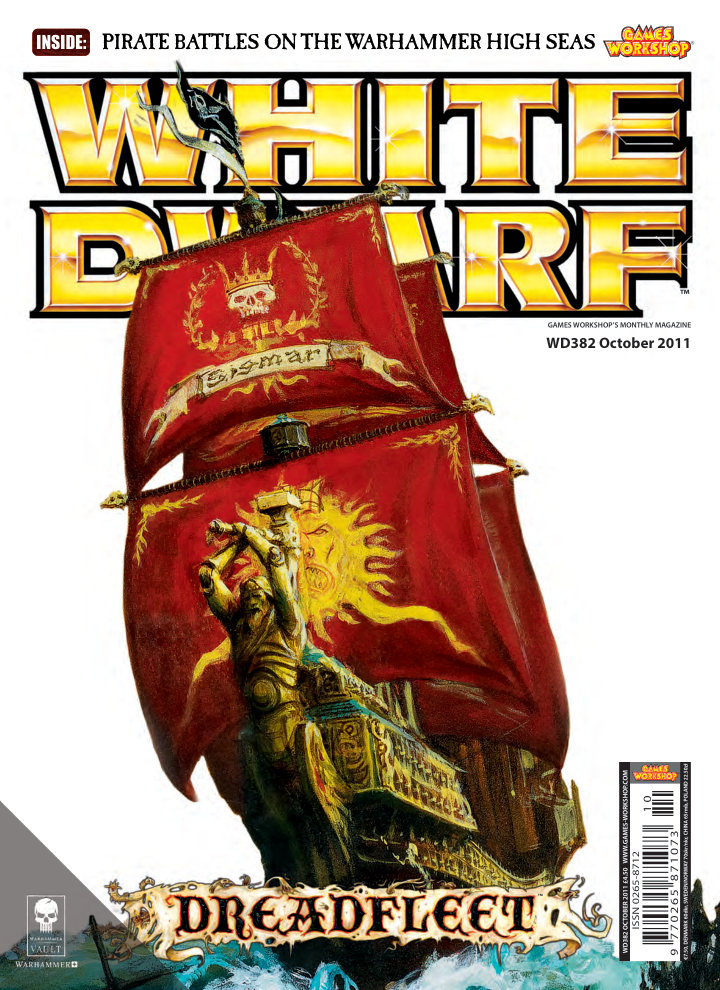
EditorialWD 382 · Inside cover
Andrew Kenrick introduces Dreadfleet through the studio’s lunchtime campaign and the rivalry it has generated between writers and designers. The issue follows the boxed game from story and miniatures to tactical advice, two narrated games and a complete painting workshop. He presents the individual warships and their unusual captains as central to its appeal.
Dreadfleet
InterviewWD 382 · pp. 10–17
Phil Kelly talks to Andy Hall about a self-contained naval adventure driven by Jaego Roth’s revenge against Count Noctilus. John Blanche explains the importance of a convincing haunted setting, while the design discussion connects huge characterful ships, three-dimensional islands and damage cards to unpredictable games. Twelve scenarios teach the system through different adventures, with momentum and manoeuvring requiring captains to plan several turns ahead.
Dreadfleet
LoreWD 382 · p. 16
Jaego Roth returns to Sartosa to find his family killed by the supposedly legendary Dreadfleet. Denied official help, he steals the Heldenhammer and raids Zandri to pay other captains to join his pursuit. The Golden Magus, Aranessa Saltspite and Red Brokk bring their own interests to the expedition, with Prince Yrellian encountered later inside the Galleon’s Graveyard.
DreadfleetGrand Alliance
LoreWD 382 · p. 17
Nyklaus von Carstein masters Shadow magic and moves his castle and followers into the ocean’s supernatural Maelstrom. Reborn as Count Noctilus, he assembles the Bloody Reaver from the wreckage drawn into that realm and recruits or binds other sinister captains. The account explains the Galleon’s Graveyard as a source of vanished ships and Undead sea creatures rather than simply a remote stretch of water.
DreadfleetDreadfleet
LoreWD 382 · pp. 18–27
The ten warships are introduced through their captains’ motives and the details built into each miniature. Imperial grandeur, a transplanted Vampire castle, elemental minarets, Dwarf engineering and a reanimated sea beast make each vessel recognisable as part of the Warhammer world. Their mismatched alliances arise from revenge, profit, rivalry and supernatural obligation, giving the fleet a cast of individual characters.
DreadfleetGrand Alliance
LoreWD 382 · p. 18
Stolen from the Grand Theogonist by Jaego Roth, the Heldenhammer carries an Imperial cathedral, immense gun batteries and a steam-powered Sigmar figurehead. Its scale makes the armed statue and siege artillery part of a floating city rather than a conventional galleon. Roth turns this symbol of religious authority into the flagship of his private campaign of revenge.
DreadfleetGrand Alliance
LoreWD 382 · p. 19
Count Noctilus forms his flagship around his Sylvanian castle and its uprooted rocky foundation. Wrecked hulls gathered around it create a monstrous sea-going hulk crewed by thousands of reanimated sailors. The bridge, pathway and surviving citadel make the model’s scale visible while presenting the Vampire’s land-bound power transplanted into the sea.
DreadfleetDreadfleet
LoreWD 382 · p. 20
Aranessa Saltspite’s uncertain origins connect her either to Manann or to a Norscan tribe that cast her out. Her Swordfysh carries sea-monster teeth, whale horns, a fin-like rudder and a giant skull figurehead, reinforcing that maritime identity. The account emphasises her proven seamanship and fighting skill even where the stories of her birth remain contradictory.
DreadfleetGrand Alliance
LoreWD 382 · p. 21
King Amanhotep raises a tireless workforce to build a warship after Roth steals treasures from Zandri. Skeletal oarsmen, a Necrosphinx and four Necrolith Colossi turn the vessel into a royal weapon of vengeance. Its great gem focuses the Light of Ptra, alongside skull catapults and ballistae, giving the miniature a distinctly Nehekharan identity.
DreadfleetDreadfleet
LoreWD 382 · p. 22
The Golden Magus presents himself as a cultivated and wealthy Sultan of the Seas, but his pleasure-barge conceals powerful elemental weapons. Fire Efreets burn enemies while Tempest Djinns fill the sails, and their minarets and sail motifs make the bindings visible on the model. Libraries and luxurious quarters coexist with the machinery of a formidable warship.
DreadfleetGrand Alliance
LoreWD 382 · p. 23
Vangheist murders his wizard master to secure an offered immortality and discovers that both crew and vessel have received it as ghosts. The Shadewraith’s rotten hull and torn sails preserve the image of that betrayal. Tortured souls lift it above the water, which recoils beneath the spectral ship, making its unnatural movement part of the miniature’s story.
DreadfleetDreadfleet
LoreWD 382 · p. 24
Red Brokk Gunnarsson returns to sea in a Grudgebreaker-class battleship after Tordrek Hackhart destroys his earlier Ironclad. Roth’s rescue gives the Dwarf engineer a reason to join the hunt, alongside his personal grudge. Armoured paddles, immense engines, self-loading flame cannons and aircraft turn Grimnir’s Thunder into both a floating fortress and a carrier.
DreadfleetGrand Alliance
LoreWD 382 · p. 25
Once a gifted Barak Varr engineer, Tordrek Hackhart is exiled after trying to murder his rival Gunnarsson. He escapes in the tentacled Black Kraken, a submersible born from disturbing dreams, and later joins Noctilus through an unexplained bargain. Articulated mechanical limbs and paddles hidden within its body make the ship resemble a terrifying creature as much as an engine.
DreadfleetDreadfleet
LoreWD 382 · p. 26
Prince Yrellian searches the Galleon’s Graveyard for the body of a younger brother lost to a Leech Wyrm, refusing to return to Ulthuan without him. The Seadrake’s low, slender hull and tall mast-towers embody High Elf elegance. Its accompanying Dragons are powerful allies in their own right, with a rear tower providing the prince a place to communicate with them.
DreadfleetGrand Alliance
LoreWD 382 · p. 27
Skretch’s clanfleet mistakes an Orb Leviathan’s luminous lure for warpstone and is swallowed by the monster. The trapped Skaven kill it from within but suffocate before escaping, then rise alongside its corpse when Noctilus performs a necromantic ritual. They adapt the rotting body with warp generators and gas propulsion, replacing the lure with a Screaming Bell.
DreadfleetDreadfleet
Battle reportWD 382 · pp. 28–33
Jervis Johnson and Phil Kelly introduce Dreadfleet through a duel between the Heldenhammer and Bloody Reaver, with victory going to the first vessel to inflict eight damage cards. The narrative demonstrates wind, orders, handling, broadsides and the sudden appearance of sea monsters. After the Heldenhammer runs aground, Noctilus closes for boarding; repeated crew victories secure Phil’s win and show why manoeuvring and current damage matter as much as an initial profile.
Dreadfleet
TacticsWD 382 · pp. 36–39
Phil Kelly offers five principles for commanding the fleets: form a plan, understand each ship, deploy for the mission, concentrate forces and exploit pirate tricks. Slow flagships need several turns of foresight, while faster craft can flank or recover objectives. The article combines a comparative ship table with formations and boarding examples, repeatedly placing scenario success ahead of simply sinking an attractive target.
Dreadfleet
TacticsWD 382 · p. 37
Phil Kelly groups ships as durable anvils, destructive hammers, precise rapiers and flexible cutlasses. Their roles overlap: the Bloody Reaver can both absorb punishment and finish damaged enemies, while fast craft exploit openings the tougher ships create. A table compares every vessel’s strengths and limitations, and the raking-fire explanation shows how positioning can amplify a first broadside.
Dreadfleet
TacticsWD 382 · p. 38
Spacing ships away from obstacles reduces the danger of unpredictable wind and handling, but deployment must still serve the scenario. Supporting pairs or trios can overwhelm an isolated vessel, particularly in boarding actions. Line abreast supports offensive reactions, whereas line astern creates overlapping broadsides at the cost of congestion if the enemy gets around the formation.
Dreadfleet
TacticsWD 382 · p. 39
An angled approach can let a ship fire before boarding while avoiding the enemy’s easy raking shot. Phil Kelly develops that principle into a deadly blockade, placing a fast vessel directly ahead of a target and using Fire As She Bears to punish its forced advance. A disposable auxiliary can perform a related stall, buying time by blocking a much larger enemy’s movement.
Dreadfleet
Battle reportWD 382 · pp. 40–49
Jervis Johnson and Phil Kelly use both complete fleets in a five-turn treasure hunt complicated by drifting warpstone and electrical storms. Jervis launches auxiliaries early and continues collecting even after losing the Seadrake and eventually the Heldenhammer. Phil’s attacks destroy major ships but fail to stop the escaping Dragon and Cog, leaving the Grand Alliance victorious by three treasures to one. Their reflections underline how dramatic destruction can distract a captain from the actual objective.
DreadfleetGrand Alliance
LoreWD 382 · pp. 50–51
A brief illustrated overview presents the Warhammer world at a moment of mounting conflict. Older civilisations muster in mountain holds and across the seas while Chaos expands, Skaven emerge from below and Vampires raise new armies from the dead. The piece frames war as a constant that links the ocean adventures of Dreadfleet with the land battles of the wider setting.
Warhammer Fantasy Battles
EditorialWD 382 · pp. 54–55
Jervis Johnson argues that a gaming group’s varied skills make shared projects both achievable and rewarding. He recommends beginning with painting or terrain sessions before progressing to a themed multiplayer refight, a campaign or a public display game. A deadline and a common story can unite those activities, but the scale should grow from experience rather than outrun the group’s ability to finish.
ModellingWD 382 · pp. 56–61
Chris Peach assembles Finecast Azhag and his Wyvern from the base upwards, demonstrating cutters, a mould-line scraper, flash brush and emery boards. Thin glue applications and dry fitting help the large pieces meet cleanly, while Liquid Green Stuff fills seams and bubbles. The rider can remain separate for painting, and gentle heat fixes the rein’s resin chain in position. The article also distinguishes tools and adhesives suited to resin from those intended for plastic or metal.
Warhammer Fantasy BattlesOrcs & Goblins2 paint colours
ModellingWD 382 · pp. 64–69
Chris Peach builds two large Ogre hordes with irregular poses and swapped components to avoid the appearance of disciplined ranks. Standard-bearer arms alter Irongut weapon poses and a hanging cow becomes a banner, while red markings and weathered bronze connect the units. Leadbelcher powder burns, a dark Stonehorn and varied Mournfang coats add individual character without abandoning the collection’s common palette.
Warhammer Fantasy BattlesOgre Kingdoms5 paint colours
PaintingWD 382 · p. 68
The Mournfang’s brown fur is drybrushed through Khemri Brown and Bleached Bone before black patterns and a sepia wash add variation. The face uses related stages but a black wash and khaki highlights create a different texture. Tusks and teeth return to a brown foundation, sepia shade and pale bone finish, tying the mount’s separate surfaces together.
Warhammer Fantasy BattlesOgre Kingdoms6 paint colours
PaintingWD 382 · p. 69
Tallarn Flesh provides the base for the riders and ordinary Ogre infantry, with Devlan Mud confined to the recesses. Dwarf Flesh restores the broad areas before Elf Flesh highlights the muscles. The restrained sequence gives a large force consistent flesh while preserving the shadows between its exaggerated forms.
Warhammer Fantasy BattlesOgre Kingdoms5 paint colours
PaintingWD 382 · p. 69
Tin Bitz over black establishes dark worn metal, followed by Badab Black shading. A red wash in the recesses lends the surface warmth and corrosion before Chainmail picks out rivets and edges. The method keeps armour subdued enough for the army’s flesh and markings to remain prominent.
Warhammer Fantasy BattlesOgre Kingdoms5 paint colours
PaintingWD 382 · p. 69
The blood markings begin with Scab Red, deepen under a black wash and receive Blood Red highlights. Tattoos use Scab Red directly over the finished flesh, giving the same red theme a less glossy and less raised appearance. The guide supports the irregular individual markings described earlier in the army workshop.
Warhammer Fantasy BattlesOgre Kingdoms3 paint colours
RulesWD 382 · pp. 72–75
Three new scrolls add unmounted creatures from the Mountains of Mourn to a Storm of Magic army’s extra Monsters and Magic allowance. The introduction identifies three useful roles: dislodging fulcrum Wizards, hunting opposing monsters and compensating for a weakness in the main army. The separate entries provide profiles, prices and optional upgrades for a Thundertusk, Mournfang pack and Stonehorn.
Warhammer Fantasy BattlesOgre Kingdoms
RulesWD 382 · p. 73
The 190-point bound Thundertusk retains its freezing aura and mobile sphere-of-ice attack without Ogre riders. Spike Tail adds another attack and Icy Breath offers a Strength 4 breath weapon, subject to the stated restriction on combining cold attacks in one turn. The background traces its supernatural winter to long exposure to Chaos and recounts an escaped specimen from the Imperial Zoo.
Warhammer Fantasy BattlesOgre Kingdoms
RulesWD 382 · p. 74
Packs of two to eight Mournfangs cost 50 points per beast and bring high movement, multiple attacks and D3 Impact Hits. Uniform upgrades can add Vanguard or a protective thick hide. The accompanying lore describes relentless pack hunters whose ferocity makes even enormous mountain predators avoid them, explaining their value as a direct assault unit.
Warhammer Fantasy BattlesOgre Kingdoms
RulesWD 382 · p. 75
The 210-point bound Stonehorn combines a petrified skeleton, natural armour and the devastating impact of Earth-shattering Charge. Optional iron jaws add a multiple-wound bite, while a mace tail supplies another strong attack. Its background explains a life spent smashing mountains for precious metals and a slow petrifaction that eventually leaves the oldest beasts as immobile stone.
Warhammer Fantasy BattlesOgre Kingdoms
RulesWD 382 · pp. 76–85
Robin Cruddace introduces three missions that translate the Sisterhood’s religious duties into different battlefield objectives. A shrine defence, a search for relics and the destruction of an arch-heretic each alter deployment, reserves or scoring rather than merely changing the battle’s story. A final illustrated engagement shows how recovering a sacred weapon can become the turning point of a costly victory.
Warhammer 40,000Adepta Sororitas
RulesWD 382 · pp. 78–79
The Sisters form a circle around a central shrine while an enemy approaches from outside, with prescribed unit types held in reserve on each side. Controlling the objective decides victory, and the intact shrine strengthens nearby Faith tests and saves. An enemy that spends a turn desecrating it strips Shield of Faith from the entire Sisters army and penalises later Acts of Faith, making the ground’s religious importance a concrete tactical risk.
Warhammer 40,000Adepta Sororitas
RulesWD 382 · pp. 80–81
Units search scattered markers for relics while the armies deploy in opposite quarters. Discoveries can be empty, saintly bones, a blessed blade or a living Cardinal; the Sisters gain useful effects but must preserve the recovered bearer to score. An enemy that finds or later destroys the treasure gains the points instead, turning each search into both an opportunity and a protection task.
Warhammer 40,000Adepta Sororitas
RulesWD 382 · pp. 82–83
The defender deploys around the centre and names a non-vehicle HQ model as the Arch-Heretic, while the Sisters enter from the long edges. Destroyed units score normally, but killing the leader adds a bonus that increases if flame weapons have wounded him. Leaving him alive causes an automatic Sisters defeat, while his followers gain local Fearless protection and the attackers gain Preferred Enemy against their designated quarry.
Warhammer 40,000Adepta Sororitas
LoreWD 382 · pp. 84–85
Canoness Verena Armenii leads the Argent Shroud to recover Saint Helena’s relics from Ork-occupied Angel Spire on Acheron IV. The Sisters suffer heavily, lose their commander and see a Cardinal murdered amid the ruins. Seraphim Superior Camille discovers the saint’s sword, kills Grog Chewtops and helps a flank attack rout the greenskins, securing the relics at a high cost.
Warhammer 40,000Adepta Sororitas
PaintingWD 382 · pp. 88–105
Duncan Rhodes and Steve Bowerman paint the entire Dreadfleet box, planning subassemblies around difficult interior detail and separate sails. They recommend tackling messy decking before clean hull surfaces and using related methods across ships where a particular material is not repeated in every guide. Individual recipes cover each vessel, auxiliaries, sea bases, wrecks and islands, with staged finishes that can be stopped earlier if a simpler result is preferred.
Dreadfleet
PaintingWD 382 · pp. 90–91
Steve Bowerman paints the deck first, then the red hull, stone temple and brass figurehead, leaving the sails separate. Red washes and warm highlights enrich the hull and canvas, while grey stone and blue-grey tiles keep the cathedral distinct. Sigmar’s Wrath progresses from a brown-gold foundation to brighter gold and silver highlights, giving the enormous statue a strong focal point.
Dreadfleet19 paint colours
PaintingWD 382 · pp. 92–93
Duncan Rhodes keeps the hull halves and sails apart to reach Noctilus’ citadel and the wrecks around it. Drybrushed grey rock supports differently coloured broken ships, purple sails and a pale castle with a red roof. The guide combines dark washes with fine highlights so that the many small details remain distinct within the largest vessel in the set.
Dreadfleet19 paint colours
PaintingWD 382 · p. 94
The Flaming Scimitar’s purple hull and pale sails frame contrasting fire and air elementals. Orange and yellow stages brighten the Efreet, while blue-grey shading and white highlights describe the Djinn; the same methods recur in the sail motifs. Separate sails allow the delicate pale canvas and its warm recess shading to stay clean while the deck is drybrushed.
Dreadfleet14 paint colours
PaintingWD 382 · p. 95
The Shadewraith is painted in separate hull halves so its interior remains accessible. Pale grey is washed green, restored on the raised surfaces and finished with white, with selective brighter green mixtures suggesting spectral energy. A related sequence gives the torch flame a deeper green core, while brown seaweed distinguishes ordinary debris from the supernatural hull.
Dreadfleet9 paint colours
PaintingWD 382 · p. 96
Black hull surfaces receive narrow grey highlights beside gold trim, pale shells and bone. The sails combine dark grey cloth with blue-green decorative areas and cold pale motifs, using black washes to separate the details. Painting the hull, base and sails independently protects those crisp contrasts during assembly.
Dreadfleet15 paint colours
PaintingWD 382 · p. 97
The assembled Curse of Zandri receives dark marble edging through green, turquoise and ice-blue highlights, with gold trimming around the statuary. Its wicker hull uses brown, a dark wash and progressively paler drybrushing. These separate treatments distinguish the ship’s worked organic material from the polished monumental figures it carries.
Dreadfleet8 paint colours
PaintingWD 382 · p. 98
The Dwarf ship’s steel, gold and bronze engine parts are painted separately before common silver edge highlights bring their surfaces together. Green panels progress from a dark base and wash to brighter layers without covering the recesses. Keeping the three hull parts separate gives access to the interior before the finished ship is attached to its painted base.
Dreadfleet11 paint colours
PaintingWD 382 · p. 99
The Black Kraken is assembled with its base because several tentacles are moulded into the sea. Fine grey edges define its black hull, while shaded steel and brass establish the machinery. The caged eye progresses from dark green to a bright green centre and a white dot, making the small detail read as a luminous focal point.
Dreadfleet14 paint colours
PaintingWD 382 · p. 100
Pale towers and hull are shaded differently to distinguish warm stone from cold painted surfaces, with blue-grey roofs above them. The separate sails build from deep blue through brighter blue to pale edge highlights, and their runes are picked out in cold white. Painting the three tower-masts apart from the hull preserves access to the ship’s slender detailing.
Dreadfleet11 paint colours
PaintingWD 382 · p. 101
The Skabrus is kept in three parts so its exposed organs can be painted before enclosure. A purple-and-flesh wash shades pale corpse skin, while green stages brighten the bell and warm brown highlights pick out wood. Red guts receive dark washes and a final red glaze; turquoise-green corrosion on brass contrasts with the decaying body.
Dreadfleet19 paint colours
PaintingWD 382 · p. 102
The auxiliaries generally repeat their parent ships’ colours, but the Dirigible and Dragon receive separate guides. A shaded warm-white balloon contrasts with the Dwarf vessel’s metal and green fittings, while the Dragon uses blue-grey shadows beneath white skin. The page also directs painters to earlier gold and bone methods for tokens and navigation pieces.
Dreadfleet15 paint colours
PaintingWD 382 · p. 103
Sea bases begin with deep blue and receive two progressively lighter drybrushes, the palest concentrated on wave crests. A black-and-green wash reunites the layers and deepens the water, then diluted white marks the breaking foam. The same method across the fleet makes separately coloured ships look at home on one seascape.
Dreadfleet6 paint colours
PaintingWD 382 · p. 103
A brown foundation and stippled orange build heavy corrosion on the small Dwarf wreck. Devlan Mud shades the texture before rough silver edges suggest exposed metal. The intentionally broken finish distinguishes sunken debris from the fleet’s maintained machinery.
Dreadfleet4 paint colours
PaintingWD 382 · p. 104
Stippled and drybrushed rocky islands receive ochre, green patches and grey highlights, with dark green and black washes settling into lower recesses. Pale skulls, green spectral castles and glowing lava provide contrasting landmarks. The lava stages spread red and orange onto adjacent rocks before yellow and white concentrate the brightest heat around individual bubbles.
Dreadfleet14 paint colours
ModellingWD 382 · p. 105
The closing preparation guide stresses removing mould lines before painting and choosing tools that protect delicate pieces. Cutters free components, the cleanup kit removes flash, emery boards smooth fragile surfaces and Liquid Green Stuff seals gaps. It repeats the workshop’s key assembly caution: many ships need interior details and sails painted before all their parts are joined.
Dreadfleet