EditorialWD 347 · p. 1
Mark Latham explains why convincing scenery matters to the stories he imagines while playing, welcoming ready-made terrain when time for construction is scarce. The Realm of Battle board and Warriors of Chaos provide this month’s main gaming combination. He also shows Captain Perseon, a converted Sicarius painted for his Sons of Medusa, and introduces a two-part Marine painting guide intended to connect basic methods with ’Eavy Metal detail.
Warhammer 40,000Warhammer Fantasy BattlesSons of Medusa
CommunityWD 347 · pp. 12–13
January’s Ork preview promises plastic Nobz, Stormboyz, Gretchin and a Battlewagon, with Fil Dunn’s advance example appearing later in the issue. Studio news reports a sixteen-player, twenty-thousand-point Ork event organised by Dom Murray and won by the greenskins. Other notices mark Warhammer Online’s arrival, Adam Troke’s return to the web team and the Perry twins’ long service, capturing the hobby activity surrounding the coming releases.
Warhammer 40,000Warhammer Fantasy BattlesOrks
CommunityWD 347 · p. 13
Warhammer Online’s release is framed by converging crises: greenskins at Karak Eight Peaks, Chaos in Ostland and Dark Elf attacks on Ulthuan. A council at Altdorf unites Karl Franz, Thorgrim and Finubar against their enemies. The notice presents realm-against-realm conflict as the computer game’s defining experience, inviting players to choose an allegiance within that shared war rather than describing a separate tabletop rules supplement.
Warhammer Fantasy BattlesEmpire
InterviewWD 347 · pp. 16–31
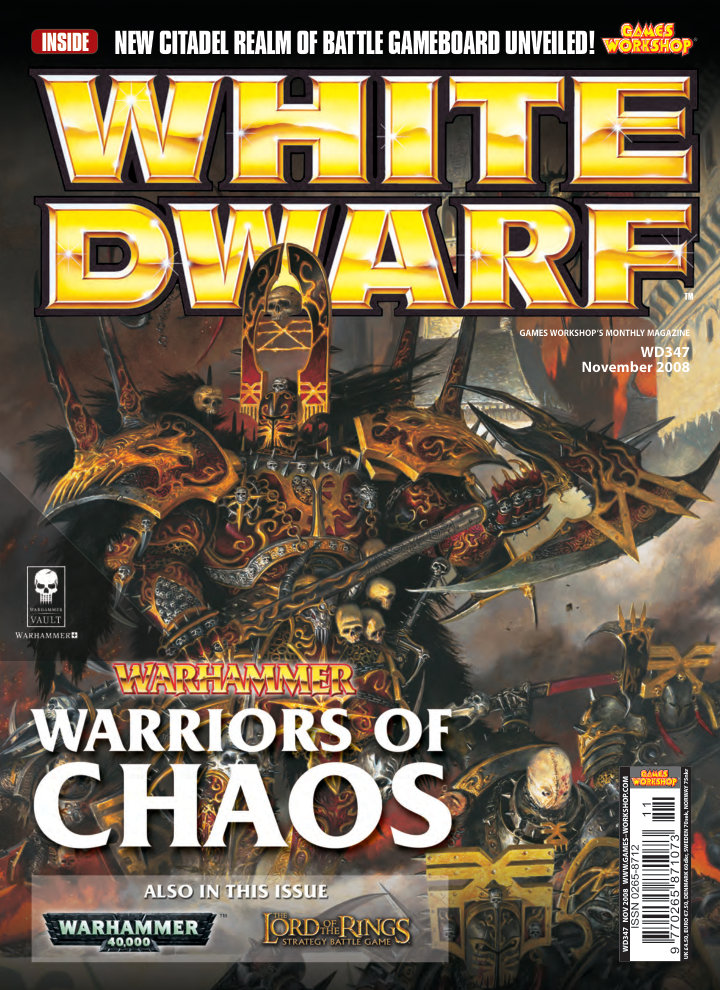
Phil Kelly explains the mortal northern tribes and the bargain that separates a Chaos Warrior from an ordinary Marauder. Heavy armour, strong Core troops and the challenge-driven Eye of the Gods turn that background into an aggressive army. Sample forces show both balanced and monster-supported approaches. Mark Harrison’s sculpting discussion and the selected artwork connect the new designs with older Chaos imagery while preserving individual champions within recognisable units.
Warhammer Fantasy BattlesWarriors of Chaos
LoreWD 347 · p. 23
For the northmen, the Chaos Gods are visible and active forces rather than distant beliefs mediated by southern priesthoods. The text connects direct devotion to the four great powers and their underlying emotional drives: rage, hope, despair and pleasure. Illustrations of marked champions and sorcerers distinguish those allegiances. This brief background page explains why worship can encompass a pantheon while still producing individually devoted warriors.
Warhammer Fantasy BattlesWarriors of Chaos
TacticsWD 347 · pp. 24–25
Phil Kelly’s balanced 1,999-point list uses a powerful but economical Exalted Hero, two Sorcerers and a substantial infantry core. Differently marked Warriors fulfil distinct jobs, supported by Marauders, Knights, Horsemen, hounds and Spawn. Fast units protect against flanking and threaten war machines, while magical items raise the Sorcerers’ output. The commentary shows how complementary units prevent an armoured army from relying only on its direct hitting power.
Warhammer Fantasy BattlesWarriors of Chaos
TacticsWD 347 · pp. 26–27
Christian Byrne’s 1,996-point force anchors its line in two Warrior units with characters providing magical resistance. Slaaneshi spells slow or disrupt the enemy, buying time for the elite army to manoeuvre. Chosen, a Giant and a Hellcannon supply flank pressure and Terror. The plan uses psychology and overlapping protection to compensate for limited numbers rather than simply adding the largest available monster.
Warhammer Fantasy BattlesWarriors of Chaos
InterviewWD 347 · pp. 28–29
Rick Priestley credits Bryan Ansell with the foundational Chaos concepts, while early Perry and Jes Goodwin models establish their miniature history. Mark Harrison then explains combining those older ornate details with Brian Nelson’s shapes and Goodwin’s weapons for the new Knights. Extra heads, shields and compatible parts let each rider appear as a champion without losing the unit’s identity. The Chosen illustrations demonstrate related design priorities.
Warhammer Fantasy BattlesWarriors of Chaos
ShowcaseWD 347 · pp. 30–31
Alex Boyd’s Festus embraces the mixture of disgust and glee that makes Nurgle imagery distinctive. Paul Dainton contrasts Sigvald’s beauty with cruelty beneath the surface, while Adrian Smith supplies both the cover and a Tzeentch warrior illustration. The spread presents different visual expressions of Chaos within the same army book, showing how artists convey personality and allegiance beyond weapons and armour.
Warhammer Fantasy BattlesWarriors of Chaos
InterviewWD 347 · pp. 34–41
Andy Hall asks Dave Andrews how a six-tile plastic battlefield can offer both sculpted interest and a practical playing surface. Gentle stepped hills, recessed details and removable clips preserve model stability and storage flexibility. Jeremy Vetock supplies nine scenario ideas for three games, using hilltops, valleys and skull crevices in different ways. Painting and flocking demonstrations then show how the same board can become a grassy field or another environment.
Warhammer Fantasy BattlesWarhammer 40,0009 paint colours
RulesWD 347 · p. 36
A central hill carries an Arcane Monolith whose controller receives extra victory points as well as magical benefits. Skull crevices grant passing units Frenzy and punish nearby rally attempts, making the board’s sculpted details active elements of the battle. Already frenzied models gain further attacks. The scenario gives a familiar fight for high ground a specifically Chaos-tainted character, demonstrated later in the issue’s main battle.
Warhammer Fantasy BattlesWarriors of Chaos
RulesWD 347 · p. 36
Several hills become the objectives on an otherwise flat world, rewarding the force that controls the most summits. Extra hills can be stacked to make those positions especially prominent. The article contrasts an early occupation with a late counterattack, noting that variable game length can punish excessive delay. It is a scenario outline for adapting the board’s terrain rather than a fully specified force-selection package.
Warhammer 40,000
RulesWD 347 · p. 37
Thick fog covers a hilly battlefield except for its summits, turning a fight to the death into a problem of uncertain visibility. Each Move and Shoot phase receives a fresh random sight distance, while models starting on a hill can see farther. The clear heights can therefore help shooting and charges but also shape predictable routes through the mist. The rules use the terrain to make an ordinary encounter feel like the Barrow Downs.
Middle-earth Strategy Battle Game
RulesWD 347 · p. 38
A travelling warband begins in the middle of a narrow mountain route while its enemy surrounds it from the table edges. The defenders must escape through a short edge, forcing a choice between opening a path and becoming trapped in piecemeal combats. The setting can accommodate Goblin or Warg attacks as readily as Rangers or Elves intercepting evil creatures. The outline adapts the opposing ridges into a purposeful ambush terrain.
Middle-earth Strategy Battle Game
RulesWD 347 · p. 38
An attacking force chooses a short edge after its opponent has deployed on the two ridgelines, then attempts to cross to the opposite end. Defenders must form a blockade while Deep Strike can either open the route or add late obstacles. The article highlights the road’s vehicle movement bonus as a potentially decisive resource. The same outline can represent a planned breakthrough or a desperate escape from encirclement.
Warhammer 40,000
RulesWD 347 · p. 38
Two armies begin on opposing high ground and confront one another across the intervening valley. Moving uphill is difficult, but units descending directly gain a random movement bonus even while marching or charging. Restricting that extra movement to a nearly straight route prevents it from becoming unrestricted manoeuvrability. The terrain encourages forceful downhill attacks while complicating the timing and geometry of the two battlelines.
Warhammer Fantasy Battles
RulesWD 347 · p. 39
Rival warbands search the wilderness roads’ hills and woods for the hidden gains of local raiders. Each terrain feature can be searched once by a model on foot, with a successful roll producing treasure carried as a light item. Holding the most treasure wins, so searching and stealing from the opponent offer competing routes to success. The same prizes may represent recovered property, precious metals or something more personal.
Middle-earth Strategy Battle Game
RulesWD 347 · p. 39
A research station at the centre of a crater becomes the sole objective, with corner hills forming its rim. Each army splits roughly in half and alternates placing those groups on the elevated corners. Since the station is the only cover, reaching and holding it exposes troops to fire from several directions. The sparse layout turns the board’s central low ground into a highly contested and dangerous destination.
Warhammer 40,000
RulesWD 347 · p. 39
Defenders assemble in the valley centre around a Historic Landmark, with attackers arriving from both short table edges. The central army must form two fronts that protect each other, while the enemy needs to pressure both rather than allowing an easy concentration of defence. The feature suggests a baggage train, watchtower or raided village as the narrative focus. Its layout makes the terrain’s funnel shape central to the battle.
Warhammer Fantasy Battles
PaintingWD 347 · pp. 40–41
A black undercoat is followed by the Scenery Pack’s brown foundation, with grey rocks and carefully layered bone giving the board detail before grass is added. Two shades of static grass are applied in overlapping sections of diluted PVA so the joins remain irregular. Excess flock is recovered and optional varnish secures the surface. Alternative finished environments demonstrate how colour changes the same sculpted landscape.
9 paint colours
CommunityWD 347 · pp. 44–51
The four completed 1,500-point armies meet in a three-week mini-league, with painting points still contributing to the wider challenge. Pete’s revised Eldar win twice and draw, while Neil remains difficult to defeat despite lacking a victory. Matt beats the Crimson Fists but loses to both alien armies, and Fil’s improved mission discipline secures an important win. Fil retains the overall lead as everyone prepares for an Apocalypse finale.
Warhammer 40,000Crimson Fists
TacticsWD 347 · pp. 44–45
Neil Hodgson spends a holiday-shortened month adding a Land Raider Redeemer with Crimson Fists doors. Its durability lets it burn through Matt’s Night Lords before a chainfist finally destroys it, though Matt wins their Annihilation game five to three. Neil later draws with both alien opponents, testing defensive deployment against Eldar mobility and destroying Fil’s Battlewagon. The instalment presents the Redeemer as both a painting project and a new tactical resource.
Warhammer 40,000Crimson Fists
TacticsWD 347 · pp. 46–47
Pete Foley removes the Autarch and Shining Spears in favour of two Banshee units and Harlequins, then adds a second Falcon. Doom and power weapons give the army close-combat pressure while larger Jetbike squads handle mobile objectives. This revised force defeats Matt and Fil and draws against Neil, restoring confidence after the previous month’s loss. The account shows substantial army redesign through testing rather than merely completing the original shopping list.
Warhammer 40,000Eldar
ModellingWD 347 · p. 48
Matt Hutson completes the force with a Predator Annihilator, a new Marine squad and a converted character. Night Lords add a background-supported variation in colour, with labour-intensive lightning and terror markings. A Collector’s Techmarine becomes Armanneus Valthex using a power fist and combi-flamer from spare Chaos parts. The additions improve anti-tank and scoring options, but league results leave Matt wondering whether the army needs further resilience or less predictable tactics.
Warhammer 40,000Red Corsairs
TacticsWD 347 · pp. 49–50
Fil Dunn’s final additions include a scratch-converted Wazdakka, another power-klaw Nob and an advance plastic Battlewagon. He chooses a restrained weapon fit and redistributes spare kit parts elsewhere in the army. Wazdakka’s mobile shooting devastates Matt’s vehicles and infantry while Fil finally protects his own objective, producing a two-to-zero win. A draw with Neil and loss to Pete leave timing and target selection as the next lessons.
Warhammer 40,000Orks
TacticsWD 347 · pp. 52–57
Simon Grant turns from spells to their users, distinguishing fragile but versatile Sorcerers from sturdier Warrior-mages with smaller magical reserves. Safe positioning and timely casting determine their value, while opponents can suppress them through combat or exhausted Will. Ranked examples illustrate each role without making price alone the measure of effectiveness. A Gandalf-led Minas Tirith force then demonstrates how magic, a shield wall and elite cavalry can support one another.
Middle-earth Strategy Battle GameMordor
TacticsWD 347 · pp. 53–55
Sorcerers rely on broad spell selections and substantial Will rather than enduring prolonged fighting. Simon Grant recommends keeping them near enough to influence the decisive area but protected from direct attack, and sometimes using their apparent vulnerability as bait. Gandalf, the Necromancer and the Witch-king illustrate different strengths. Courageous attackers, Heroic actions and simple combat engagement can interrupt their casting even without immediately killing them.
Middle-earth Strategy Battle GameThe Fellowship
TacticsWD 347 · pp. 55–56
Warrior-mages combine credible fighting profiles with a smaller selection of spells, letting them lead an assault or reinforce a threatened flank. Elrond and Sauron provide powerful examples, while Gildor and the Mouth of Sauron show the value of cheaper hybrids. Mounts improve their reach but do not remove their limited Will supply. Draining that resource or attacking a less durable hero can neutralise the extra magical threat.
Middle-earth Strategy Battle GameRivendell
TacticsWD 347 · pp. 56–57
Gandalf on Shadowfax and mounted Imrahil lead a seven-hundred-point force with Minas Tirith infantry, a banner and Swan Knights. The shield wall occupies the enemy while Gandalf knocks down formations, suppresses dangerous monsters or weakens hostile casters. Imrahil’s cavalry then concentrates on selected threats rather than charging indiscriminately. The plan illustrates a magical hero making a small conventional army more effective through timing and local advantage.
Middle-earth Strategy Battle GameGondor
Battle reportWD 347 · pp. 58–77
Phil Kelly’s heavily armoured Chaos host attacks Alessio Cavatore’s varied Dwarf army in a three-thousand-point battle for an Arcane Monolith. Skull crevices alter Frenzy and rallying, while repeated challenges improve Chaos heroes through the Eye of the Gods. Kraxis dies to his own daemonic weapon after killing a Slayer, but the rest of the army overwhelms the Dwarf positions. The Hammerers remain defiant as Chaos wins 3,217 victory points to 1,639.
Warhammer Fantasy BattlesWarriors of Chaos
EditorialWD 347 · pp. 78–80
Jervis Johnson examines why some hobbyists continually add painted models while he often leaves projects unfinished. A portable paint station lets him stay with his family, but he treats that as one personal solution rather than a universal prescription. Social painting, suitable workspaces, small regular sessions and achievable goals offer other routes. Five figures a week becomes a practical example of substantial progress built from manageable effort.
PaintingWD 347 · p. 81
The Spray Gun is demonstrated as a tool for quick basecoating, masked vehicle camouflage and large terrain pieces. Short moving bursts and nozzle adjustment provide control, while washes can be used directly without dilution. A Rider of Rohan receives Calthan Brown followed by Devlan Mud to show how a sprayed wash defines organic detail and dries matt. The examples extend its use beyond applying a single colour to an army.
Middle-earth Strategy Battle Game2 paint colours
PaintingWD 347 · pp. 82–91
Nick Bayton and Chad Mierzwa guide assembly, preparation, power-armour painting and basing before Neil Green demonstrates a more refined Ultramarine. Four alternative armour techniques offer different balances of speed and finish, while vehicle painting and batch organisation apply them across an army. Practical notes cover accessible subassemblies, matched arms and dry-fitting tanks. The following part is reserved for heraldry and more individual details.
Warhammer 40,000Space Marines26 paint colours
ModellingWD 347 · pp. 83–84
The guide cleans mould lines and contact points before building the body, matched arms and chosen head. Leaving the bolter separate preserves access to chest details, while gaze and arm position make the model’s action convincing. Compatible squad kits expand the available poses. Metal figures require clipped flash and filed seams rather than the same scraping approach, with glue choice matched to the materials being joined.
Warhammer 40,000Space Marines
ModellingWD 347 · p. 85
A tank’s instructions and dry fit are treated as essential preparation because its assembly order affects both fit and access. Interior surfaces may need painting before the hull closes, and moving joints must remain free of glue. Rubber bands hold large parts while they set, allowing separate assemblies to progress in parallel. Controlled glue placement avoids visible seepage on the finished bodywork.
Warhammer 40,000Space Marines
PaintingWD 347 · pp. 86–87
Blue drybrushing, layered green, grey-edged black and blended red illustrate four different ways of defining armour. The text explains why smooth plates can show harsh drybrush marks, how thin layers preserve recesses and when sharp edging restores mechanical definition. Black recess washes and thin glazes provide corrections and additional contrast. Painters are encouraged to combine techniques according to their preferred finish rather than follow only one method.
Warhammer 40,000Space Marines14 paint colours
PaintingWD 347 · p. 88
Sand is worked through brown and bone drybrushes before a coloured rim and static grass finish the base. Scenic-kit examples show urban, snow and industrial alternatives without supplying further recipes. Back banners can use sculpted relief, waterslide transfers or freehand chapter symbols. The page treats both accessories as choices that connect a miniature to its army and battlefield, with more heraldic detail promised later.
Warhammer 40,000Space Marines4 paint colours
PaintingWD 347 · p. 89
Nick Bayton sprays a green Razorback with Foundation and brighter green layers, then blacks out fittings and paints its metalwork. A controlled black wash defines panel recesses, followed by mixed and pure bright-green edge highlights. Metallic details receive their own restored highlights. The method is intended for different Marine vehicles, with markings and battle damage left for the following instalment.
Warhammer 40,000Space Marines7 paint colours
PaintingWD 347 · p. 90
Nick Bayton applies each painting stage to a whole small group before moving on, demonstrating blue drybrushed Ultramarines, layered Salamanders and edge-highlighted Raven Guard. Spray basecoats and washes reduce repetition, while choosing a manageable batch avoids being discouraged by unfinished armies. The text presents the appropriate group size as personal, from a squad to a larger points block, and recommends combining washes with the earlier armour methods.
Warhammer 40,000Ultramarines1 paint colour
PaintingWD 347 · p. 91
Neil Green builds an Ultramarine from mixed base colours through definition washes and precise final highlights. Blue armour, black equipment and brown-based gold each receive separate treatment, while red lenses and seals make small focal details. The intermediate stage already produces a usable gaming model; an additional pass sharpens armour, weapons and gold. The example shows how the earlier basic techniques combine within a single detailed miniature.
Warhammer 40,000Ultramarines14 paint colours
PaintingWD 347 · pp. 94–99
Joe Tomaszewski paints the new helmeted Sicarius in separate subassemblies so the closed pose does not block access to its detail. Layered blue armour, polished metal and a richly patterned cloak establish the character’s status, while the banner uses subdued painted gold to resemble cloth rather than actual metal. Carefully planned freehand follows the cloak’s folds. Small gems, laurels and heraldic marks complete a methodical, unusually elaborate character project.
Warhammer 40,000Ultramarines28 paint colours
PaintingWD 347 · p. 95
Regal Blue is deepened with a blue-black recess shade before successive Ultramarines Blue and pale blue-grey edges bring the armour into focus. Joe keeps the hands and backpack separate for access, but checks their final position so the highlights share one implied light source. Temporary putty assembly is suggested when the painter is unsure which components will obstruct the brush.
Warhammer 40,000Ultramarines4 paint colours
PaintingWD 347 · p. 96
Thin brown-and-gold base layers prevent the metallic decoration from becoming thick or uneven. Pure gold and increasing silver are blended upwards, with dark recesses restored before the strongest silver edges. Tinted purple and green glazes add subtle variation. Silver equipment follows a separate metal, black shade and brighter-metal sequence. Joe emphasises vigorous mixing when diluting metallics, since their particles can separate from the medium.
Warhammer 40,000Ultramarines6 paint colours
PaintingWD 347 · p. 97
The cloak’s inner blue-grey surface is blended towards bone and white before Joe adds a repeating freehand design. He keeps a pot of the original mixture for corrections and sharpens the pattern with both foreground and background colours. The outer red cloth is shaded black, then rebuilt through red layers with a warm pale final accent. Planning and patient correction are presented as part of the technique, even for an expert.
Warhammer 40,000Ultramarines9 paint colours
PaintingWD 347 · p. 98
The sculpted banner is painted from rear layers towards the front so later work covers accidental splashes. Cream rises from Charadon Granite through bone to white, while a restrained brown-and-white sequence imitates gold thread on the central aquila. Its highlights follow the banner design rather than simply reproducing metallic reflections. Blue and red sections reuse the established armour and cloak methods to keep the whole miniature coherent.
Warhammer 40,000Ultramarines5 paint colours
PaintingWD 347 · p. 99
Laurel leaves are highlighted from dark green towards white, while red gems use progressively warmer lower crescents, a white reflection and a gloss finish. Grey-to-white layers define shoulder details and the plume, whose red sections repeat the cloak method. A freehand Crux is sharpened against the blue armour. The page also announces Ask ’Eavy Metal, inviting future painting questions after this detailed character example.
Warhammer 40,000Ultramarines10 paint colours
CommunityWD 347 · pp. 100–101
Maciej Krol reports Warsaw’s fourth Eastern European Grand Tournament, held alongside Warhammer’s anniversary celebrations and attended by more than 120 players. Dariusz Polit wins Fantasy with Empire, Jacopo Semeraro takes 40K and Best Army with Marines, and Mariusz Futyma wins Middle-earth with Gondor and Haradrim/Nazgûl forces. Photographs connect the demanding tournament days with a celebratory evening at the Paradox Café, emphasising the event’s international community.
Warhammer Fantasy BattlesWarhammer 40,000Empire