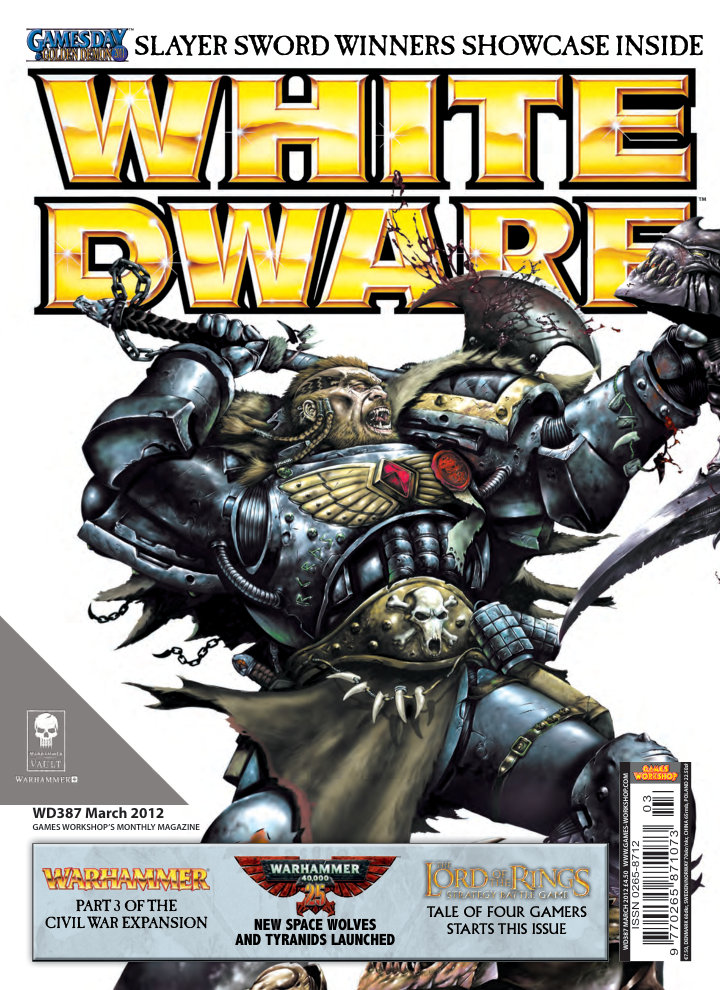
EditorialWD 387 · p. 2
Andrew Kenrick finds a common theme of predators and prey in the issue’s Tyranid and Space Wolves releases. New alien monsters promise overwhelming size and firepower, but the warriors of Fenris answer with their own tradition of hunting deadly creatures and with Thunderwolf Cavalry. He introduces the accompanying tactical advice, Harald Deathwolf background and painting guides, alongside Golden Demon galleries and the return of A Tale of Four Gamers.
Warhammer 40,000Tyranids
ModellingWD 387 · pp. 18–19
This guide matches four Citadel glues to different construction tasks. Thin plastic glue suits small components and precise joints, while its thicker counterpart gives more working time on tanks, monsters and scenery; resin and metal require super glue instead. Illustrated examples show why the size of the joint, the material and the need to fill small gaps should determine the choice rather than using one adhesive for every model.
CommunityWD 387 · p. 21
The news page announces the forthcoming Games Day season and its Blood Angels Captain miniature based on the second-edition cover, then outlines store activities for expanding collections over Easter. Licensed roleplaying news introduces Hand of Corruption for Black Crusade and The Chaos Commandment for Dark Heresy, contrasting a penal-world campaign for Heretics with an investigation that concludes the Apostasy Gambit.
Warhammer 40,000Black Crusade
ShowcaseWD 387 · pp. 22–33
The feature contrasts the major Tyranid invasions and the different ways painters interpret the organisms of their Hive Fleets. Studio models show changes in flesh, carapace and focal colours, while Phil Kelly, Keith Robertson and Tom Hutchings explain collections built around swarms, towering monsters or an adaptable mix of both. The accounts connect a fleet’s visual identity with the kinds of models its owner most enjoys collecting.
Warhammer 40,000Tyranids
LoreWD 387 · p. 24
Behemoth’s direct, headlong invasion destroys hundreds of systems but consumes its own resources as it advances, unlike later fleets that preserve biomass and divide their attacks. Painting comments on the accompanying models show how the familiar red-and-black scheme can still vary: a pale blue Zoanthrope brain draws the eye, while a more subdued Pyrovore suggests a different character within the same fleet.
Warhammer 40,000Tyranids
LoreWD 387 · p. 25
Kraken attacks through many smaller fleets rather than a single wave, leaving the Imperium unable to respond coherently as communications and whole sectors fall silent. Refugees delayed by Warp turbulence bring warnings only after the devastation has spread. The studio examples reinforce variety within its palette, with a mature-looking Venomthrope in darker tones and extra veins on a Gargoyle’s wing membranes.
Warhammer 40,000Tyranids
LoreWD 387 · pp. 26–27
Leviathan exploits the lessons of earlier invasions by approaching through the galactic plane and attacking across a broad front, severing thousands of worlds from communication before the Imperium understands the danger. The model commentary shows how a coherent fleet scheme accommodates individual roles: Deathleaper’s mottling suggests urban camouflage, red claws contrast with heavily armoured Tyrant Guard, and shared flesh shading and carapace highlights tie smaller creatures together.
Warhammer 40,000Tyranids
ShowcaseWD 387 · pp. 28–29
Phil Kelly’s long-running Jormungandr collection favours swarms of small organisms without neglecting spectacular monsters such as a Hierophant, Mawloc and newly added Tervigon. Its black-and-yellow scheme combines quickly painted broods with carefully worked plate markings and irregular inkblot patterns, satisfying both speed and detailed painting. His erupting Mawloc and its memorable destruction of an Assault Squad capture the playful appeal of the army.
Warhammer 40,000Tyranids
PaintingWD 387 · pp. 30–31
Keith Robertson builds Ouroboros around large monsters, using a deceptively simple scheme that contrasts pale matt flesh with glossy black carapaces. A white base receives red and purple shading before pale highlights, while red weapons and small green accents interrupt the monochrome body. Tyranid Warriors provide the army’s Troops and the Venomthrope supports the larger beasts, leaving the new Tyrannofex as the latest centrepiece in a collection chosen chiefly for imposing organisms.
Warhammer 40,000Tyranids6 paint colours
PaintingWD 387 · pp. 32–33
Tom Hutchings imagines Hydra as a meeting of Leviathan and Kraken, painting red and purple organisms with dark claws and occasional green or blue accents. His central technique is an equal mixture of Ogryn Flesh, Leviathan Purple and Gloss Varnish over white, giving shade and a sheen in one stage. The collection supports several army styles, with future Gargoyles and Raveners intended to expand its airborne and subterranean options.
Warhammer 40,000Tyranids4 paint colours
LoreWD 387 · pp. 36–37
Robin Cruddace describes the Swarmlord as an ancient, recurring intelligence that the Hive Mind regenerates when raw adaptation cannot overcome a difficult opponent. Its independence and accumulated experience make every reincarnation more dangerous, even after a defeat such as Calgar’s victory at Ichar IV. A chronology follows its clashes with Eldar and Chaos, then its campaign to break the Ork empire of Octarius by hunting the Warbosses who hold the enemy together.
Warhammer 40,000Tyranids
TacticsWD 387 · pp. 38–43
Robin Cruddace distinguishes the Tyrannofex’s role as a heavily armoured weapon platform from the Tervigon’s ability to strengthen and multiply nearby Troops. His advice stresses assigning each organism a clear battlefield task: choose weapons and targets deliberately for the gun beast, while moving the brood mother towards objectives where newly spawned Termagants will matter. A sample collection and codex extracts then connect those tactical ideas to the creatures’ actual rules.
Warhammer 40,000Tyranids
TacticsWD 387 · p. 39
Cruddace compares the Tyrannofex’s primary weapons by the targets they solve: the acid spray clears infantry and cover, the rupture cannon threatens distant armour, and the fleshborer hive relies on a mass of shots to overwhelm saves. Thorax swarms provide another layer of close defence, with different strengths against infantry and tough targets. Two suggested builds demonstrate the value of concentrating a costly creature on either horde destruction or vehicle hunting.
Warhammer 40,000Tyranids
TacticsWD 387 · p. 40
The Tervigon’s real strength lies in creating scoring units, sustaining synapse and improving nearby Termagants rather than personally killing large numbers of enemies. Cruddace recommends advancing it onto valuable ground, using Catalyst or Onslaught to support the brood and buying biomorphs that can benefit its offspring. He also stresses keeping spare models available and delaying spawning when necessary, so new units appear where they can achieve something useful.
Warhammer 40,000Tyranids
TacticsWD 387 · p. 41
Hutchings’ 1,748-point army overwhelms the enemy with multiple simultaneous targets and plentiful synapse, using a winged Hive Tyrant, two Tervigons and a Trygon Prime alongside supporting broods. Most models deploy from the start so fire cannot concentrate easily on one threat. The exception is a Troops Tervigon using Hive Commander to Outflank, where its ability to produce more units can threaten a flank or claim a distant objective after arrival.
Warhammer 40,000Tyranids
RulesWD 387 · p. 42
The codex extract explains the Tervigon as both a living transport for dormant larvae and a guardian within Tyranid ships. Its spawning rule generates fresh Termagant units until a double exhausts its supply, while Brood Progenitor passes Leadership, Counter-attack and selected biomorph benefits to nearby broods. That dependence has a cost: the mother’s death inflicts a backlash on nearby Termagants, making placement and protection central to its use.
Warhammer 40,000Tyranids
RulesWD 387 · p. 43
The Tyrannofex extract presents a tough living fortress with several layers of ranged weaponry but limited aptitude for prolonged melee. Its profile and weapon descriptions distinguish the acid spray’s projected template, the rupture cannon’s two-stage anti-armour projectile and the fleshborer hive’s torrent of beetles. The background explains how distress pheromones draw more suitable Tyranid fighters to protect the creature when enemies reach close quarters.
Warhammer 40,000Tyranids
PaintingWD 387 · pp. 44–49
Steve Bowerman paints a Hive Fleet Behemoth Tervigon in separate body and leg assemblies so its belly and incubation sacs remain accessible. He tests the scheme on one leg before committing to the whole monster, balancing vivid red flesh with dark, turquoise-edged carapace and pale swollen sacs. The final assembly and selective gloss treatments make the finished model look wet and alien without covering every surface in the same shine.
Warhammer 40,000Tyranids2 paint colours
PaintingWD 387 · p. 45
Bowerman uses a spray gun for the broad red base layers, then builds saturation through Mechrite Red, Blood Red and repeated Baal Red washes. Orange and pale brown highlights sharpen the raised anatomy while a final Devlan Mud application deepens the recesses. The sequence aims to keep a large expanse of red vigorous and readable without over-highlighting it into a garish colour.
Warhammer 40,000Tyranids7 paint colours
PaintingWD 387 · p. 46
A pale flesh scheme gives the incubation sacs a different texture and colour from the red exoskeleton. Tallarn Flesh and Ogryn Flesh establish the shaded base, Dwarf Flesh and Elf Flesh brighten the surface, and purple shading picks out veins and recesses. A green wash on the larvae sacs adds another unhealthy note; Bowerman suggests choosing darker flesh when adapting the method to a fleet with a pale body.
Warhammer 40,000Tyranids6 paint colours
PaintingWD 387 · p. 47
Black carapace plates receive successive feathered lines of turquoise and pale grey, creating a streaked edge that suggests the growth of chitin. Bowerman describes pulling wet paint inward with a rinsed brush rather than simply drawing a solid highlight. The cluster spines use their own grey progression over black, while a watery Goblin Green mixture collects around them to suggest a contrasting organic membrane.
Warhammer 40,000Tyranids6 paint colours
PaintingWD 387 · p. 48
The talons are painted as dark, streaked weapons using grey over Adeptus Battlegrey, a black wash and a pale edge. The toxin sacs instead progress from Dark Angels Green to bright Scorpion Green and white, concentrating light towards the middle. These contrasting treatments separate hard cutting surfaces from translucent-looking poison organs, and the same colours can transfer to claws and hooves elsewhere in the army.
Warhammer 40,000Tyranids8 paint colours
PaintingWD 387 · p. 48
Bowerman gives the face several sharply differentiated details: a purple tongue, shaded bone teeth and yellow eyes. The tongue is lightened through warmer purple and pale bone, while the teeth progress from Khemri Brown through a brown wash to bright tips. Ochre, sepia and two yellows keep the small eyes vivid against the red head, helping the monster retain a focal point despite its enormous body.
Warhammer 40,000Tyranids11 paint colours
LoreWD 387 · pp. 52–59
The feature introduces the Space Wolves’ twelve Great Companies through the Grand Annulus in the Fang, whose carved stones identify their leaders and the current Great Wolf. Logan Grimnar’s fiercely competitive veterans and Ragnar Blackmane’s aggressive planetary assault specialists show different expressions of the Chapter’s traditions. Phil Kelly then expands the saga of Harald Deathwolf, giving another company a character rooted in wolves, hunting and the deeds of its lord.
Warhammer 40,000Space Wolves
LoreWD 387 · pp. 56–58
Phil Kelly recounts Harald Deathwolf’s pursuit of the renegade Svane Vulfbad, whose shattered frost axe becomes part of the cybernetic jaw of Harald’s mount Icetooth. Other verses tell of saving his mortal tribe from Ice Trolls, fighting kraken-spawn in the Fang and destroying a Chaos-corrupted world’s Daemon machinery at great cost. The mix of verse and prose turns trophies and sculpted details into evidence of a continuing personal history.
Warhammer 40,000Space Wolves
TacticsWD 387 · p. 59
Kelly uses a 250-point Wolf Lord build to translate Harald’s identity into a mobile and hard-hitting battlefield leader. Thunderwolf Cavalry and Fenrisian Wolves protect him on the approach, while his mount, frost axe, storm shield and wolftooth necklace make him effective once he reaches combat. The Saga of the Wolfkin also gives the accompanying wolves a role in the story, illustrating how a name and a background can guide both equipment and play.
Warhammer 40,000Space Wolves
PaintingWD 387 · pp. 62–67
Steve Bowerman separates each rider from its Thunderwolf so drybrushing the fur will not interfere with smooth armour layers and precise highlights. He discusses testing the rider’s pose against the mount, using the kit’s locating peg or carefully adjusting the joint for a stronger sense of interaction. Three different fur schemes make the beasts individual, while consistent armour, metallics and company icons keep the pack recognisably part of Harald Deathwolf’s force.
Warhammer 40,000Space Wolves
PaintingWD 387 · p. 63
The power-armour recipe mixes Space Wolves Grey and Shadow Grey for its base, shades only the recesses with Devlan Mud and sharpens edges with progressively lighter grey and bone. Small irregular highlights are then filled with a dark brown-black mixture to create chips. Yellow pack and red company markings use separate warm washes and highlights, showing how to keep heraldry clear against the cool armour.
Warhammer 40,000Space Wolves13 paint colours
PaintingWD 387 · p. 64
Adeptus Battlegrey and black washes establish a grey Thunderwolf with darker coarse fur along its upper body. Drybrushing then distinguishes the lighter underside, using khaki and a little warm brown below while grey highlights define the head and back. The final Space Wolves Grey accents on the longest hairs preserve texture and contrast, and the method also suits smaller wolves or pelts.
Warhammer 40,000Space Wolves6 paint colours
PaintingWD 387 · p. 65
The dark brown Thunderwolf starts with Scorched Brown and repeated black shading, especially over the upper body. Successive browns and khaki lighten the underside, while a brown-grey mixture and pale grey highlights catch the coarser upper fur and face. The controlled division between upper and lower areas creates a natural-looking change of coat colour without losing the depth of the initial dark base.
Warhammer 40,000Space Wolves7 paint colours
PaintingWD 387 · p. 65
Calthan Brown gives the light brown wolf a warmer starting point, followed by sepia across the whole model and black concentrated on the face, paws and spine. A light Khemri Brown drybrush brings back the texture, with Vomit Brown warming the belly and the final mixture defining coarse hair. This approach creates a distinct third animal while retaining the same broad shadow pattern as the darker mounts.
Warhammer 40,000Space Wolves5 paint colours
PaintingWD 387 · pp. 66–67
Bowerman finishes the cavalry with separate shaded recipes for gold, silver and exposed skin, then maps the black pack markings with dots before joining and filling the design. Small details include glowing red bionic lenses, worn saddles and purple mouths. For Harald Deathwolf’s company badge he cuts the wolf head from an existing transfer, paints around it and adds a white star, showing how transfers and freehand work can combine to make an otherwise unavailable icon.
Warhammer 40,000Space Wolves21 paint colours
EditorialWD 387 · pp. 68–69
Jervis Johnson answers recurring Games Day questions about projects, army releases, favourite forces and becoming a designer. He explains why uncertain production dates make early announcements unreliable and why enthusiasm and strong ideas shape development priorities. His account of playtesting separates the internal search for the right background feel from later external scrutiny of loopholes and points, while advice to aspiring designers stresses practice, persistence and being ready when an opportunity appears.
Battle reportWD 387 · pp. 70–74
Andy Hall defends Weathertop with Aragorn and the Hobbits against Tom Hutchings’ five Nazgûl. Repeated Drain Courage spells leave Aragorn unable to attack for much of the game, but the Hobbits hold their own with flaming brands and Sam astonishingly kills the Witch-king with a thrown stone. As the surviving Ringwraiths spend their Will, Aragorn finally charges and the Good side wins. A rematch with the players swapping sides also favours the defenders, this time after the Nazgûl fail to neutralise Aragorn early.
Middle-earth Strategy Battle GameThe Fellowship
RulesWD 387 · p. 71
The narrative scenario places the Hobbits around their campfire while Aragorn approaches from the north and five Ringwraiths close unseen. Detection rolls delay the defenders’ response, the ancient fortress tests the courage of the attackers, and flaming brands can drive a defeated foe further away. The Nazgûl seek Frodo’s death or an empty ruin, while the defenders must preserve their foothold and clear the enemy after the opening turns.
Middle-earth Strategy Battle GameThe Fellowship
RulesWD 387 · pp. 76–81
The third Civil War instalment extends the expansion to Daemons, all three Elf armies and Bretonnia. Brief examples of infernal rivalries, noble insults and the Sundering establish reasons that apparently allied forces might fight, before faction tables give those disputes distinctive terrain, magical effects and victory conditions. The rules continue to use the main framework introduced in January rather than replacing the normal battle with a single fixed scenario.
Warhammer Fantasy BattlesDaemons of Chaos
RulesWD 387 · p. 77
The Daemon table moves battles through the changing domains of the Chaos Gods, altering the power of their servants and the hazards of their surroundings. Khorne punishes spellcasting, Nurgle’s garden can attack units within its terrain and Slaanesh offers tempting rerolls that may eventually remove a character. Another result changes the conditions every turn, making instability itself the central problem for both opposing hosts.
Warhammer Fantasy BattlesDaemons of Chaos
RulesWD 387 · p. 78
High Elf rivalries can awaken unusually powerful Dragons, bring replenishing citizen levies or turn noble duels into especially valuable victories. Magical results amplify wizards or monsters, but attach risks such as an opponent choosing the outcome of a miscast. The most extreme result invests a secretly chosen Hero with Aenarion’s power at the cost of a continuing chance of death, combining political pride with the dangerous weight of legend.
Warhammer Fantasy BattlesHigh Elves
RulesWD 387 · p. 79
The Dark Elf table emphasises poisoned weapons, stronger beasts, murderous magic and plots against the opposing general. A free Assassin may make killing one leader the entire purpose of the battle, while an Altar of Khaine rewards control of the centre and empowers nearby Khainites. Harpies and blood-soaked forests add environmental danger, and replenishing troops can turn a feud into a prolonged contest rather than a simple exchange of casualties.
Warhammer Fantasy BattlesDark Elves
RulesWD 387 · p. 80
Wood Elf disputes are shaped by the season and the unpredictable spirits of Athel Loren. Winter can leave tree creatures dormant, summer drives the armies into excessive Frenzy, and hostile woods or disturbed spites punish careless movement and magic. Other results turn the battle into an archery contest, a competition between Beasts and Life magic, or a struggle for the honour of carrying Orion’s ashes.
Warhammer Fantasy BattlesWood Elves
RulesWD 387 · p. 81
Bretonnian opponents secretly decide whether to pray, resolving the Blessing and first-turn choice without assuming one side automatically yields the initiative. Their table then explores claims to kingship, private duels, rebellious peasants and tokens of favour that can pass to a victorious rival. The appearance of a possible Grail offers a tempting but uncertain transformation for qualifying knights, turning chivalric aspiration into a battlefield decision.
Warhammer Fantasy BattlesBretonnia
InterviewWD 387 · pp. 82–83
Joe Tomaszewski nominates Brian Nelson’s plastic Battle Wizards because the kit balances rich accessories with open robes that invite personal painting. He values models that look effective with a simple wash yet still reward blended colours and intricate freehand. Nelson explains that the components were intended to suggest magical colleges without prescribing them, and the accompanying eight-college challenge gallery demonstrates how far conversions and paint can take the same starting kit.
Warhammer Fantasy BattlesThe Empire
ShowcaseWD 387 · pp. 84–89
The gallery brings together the previous year’s international Slayer Sword winners, showing the range of subjects and presentation that can earn Golden Demon’s highest award. Angelo Di Chello’s Necromancer is accompanied by an account of three intensive days of painting, while Matt Cexwish’s rotating musical diorama reveals both the beginning and tragic end of a knight’s quest. Work by Matteo Murelli, Rémy Tremblay, Vincent Hudon, Kyle Morgan and Rubén Martínez completes the survey of competition painting and modelling.
Warhammer Fantasy BattlesWarhammer 40,000
ShowcaseWD 387 · pp. 90–91
This selection gathers Vampire Counts entries from the previous Golden Demon season, reflecting how frequently the undead appeared among the prize winners. Single miniatures, regiment entries and open-category pieces demonstrate different ways to give the faction a focal point, from an individual character to a larger composition. The credited painters are Sebastian Archer, Jesse Rockwood, Mike Anderson, Steve Party, Mirko Cavalloni and Andrea Ottolini.
Warhammer Fantasy BattlesVampire Counts
CommunityWD 387 · pp. 93–101
Four hobbyists begin new Lord of the Rings armies under monthly painting and gaming challenges. The opening task is to finish two warbands including an army leader, with points for Heroes, minimum formations and full-sized units. The different responses show how deadlines can motivate an established collector, give a display project structure or expose the difficulty of fitting hobby time around ordinary life.
Middle-earth Strategy Battle Game
CommunityWD 387 · pp. 94–95
Dominic Murray chooses Rohan for its models and the cinematic image of massed cavalry, starting with Théoden’s Royal Guard and Erkenbrand’s Red Shields. To control his tendency to jump between projects, he recommends a written plan, small daily sessions, a tested colour scheme and occasional character models as rewards. Distinct warbands offer room for variation without sacrificing the unity of the whole muster, and his first month earns four points.
Middle-earth Strategy Battle GameRohan
CommunityWD 387 · pp. 96–97
Nick Bayton starts an Uruk-hai Scout army intended to recreate the attack at Amon Hen on an Armies on Parade board. Mauhúr’s black-armoured raiders and Lurtz’s tanned leathers distinguish their warbands, but Kommando Khaki highlights across the collection tie them together. Pale bases, finished with a little white, provide contrast with the dark fighters; two complete warbands give him the maximum six points in the opening challenge.
Middle-earth Strategy Battle GameIsengard2 paint colours
CommunityWD 387 · pp. 98–99
Simon Grant returns to Gondor with Boromir leading elite reinforcements for Osgiliath, supported by the Knight of the White Tower and ordinary Warriors. He plans his bow allowance around adding Faramir and Rangers later, then gives the force a shared setting by cutting hundreds of plasticard tiles for the bases. Two full warbands and their Heroes earn six points and leave a 445-point foundation for the next month’s gaming challenge.
Middle-earth Strategy Battle GameGondor
CommunityWD 387 · pp. 100–101
Dan Harden chooses Mordor and Gothmog after Isengard is claimed by another participant, theming his force around the assault on Osgiliath. Sculpted paving gives the dark Orcs a lighter setting and creates a natural rivalry with Simon’s similarly based Gondorians. House renovation limits his first month to a small Morannon Orc group and some Black Guard, leaving him with three points and a substantial painting backlog before the army can march to war.
Middle-earth Strategy Battle GameMordor
ShowcaseWD 387 · pp. 102–103
Christian Byrne chooses bulky Ogres as a change from painting an Empire army and plans a two-thousand-point force before beginning. Orange trousers and banners supply an unusual warm theme, supported by fleshy skin and rusty weapons, while occasional blue verdigris gives contrast. The project becomes a complete parade display on a Realm of Battle board, with a brown Stonehorn and mottled stone-like horns anchoring its earthy appearance.
Warhammer Fantasy BattlesOgre Kingdoms
CommunityWD 387 · p. 107
Bromley’s Firedrakes core club meets at weekends to help members develop projects across painting, modelling, army selection and gaming. Customer work in the display cabinets gives visible examples of what that shared coaching can achieve, while planned tournaments and Golden Demon preparation connect casual sessions to more ambitious goals. The profile emphasises experienced hobbyists helping others alongside the store staff.
CommunityWD 387 · p. 110
Woking’s community covers both casual play and tournament competition, with a recent Warhammer World visitor returning with a Throne of Skulls trophy. The under-sixteen Woking Wolfguard campaign in Lustria and regular beginner sessions provide different entry points for younger and new players. The profile presents organised events and accessible advice as complementary parts of the same store community.
LoreWD 387 · p. 120
Presented as a Magos Biologis identification slate, this visual guide places the main Tyranid organisms beside Space Marines for a direct comparison of scale. It ranges from Rippers and Gaunts through specialist creatures to Hive Tyrants, the new Tervigon and Tyrannofex, and the towering Trygon. The in-world annotations frame the collection as practical recognition material for Imperial troops confronting Hive Fleet Leviathan.
Warhammer 40,000Tyranids