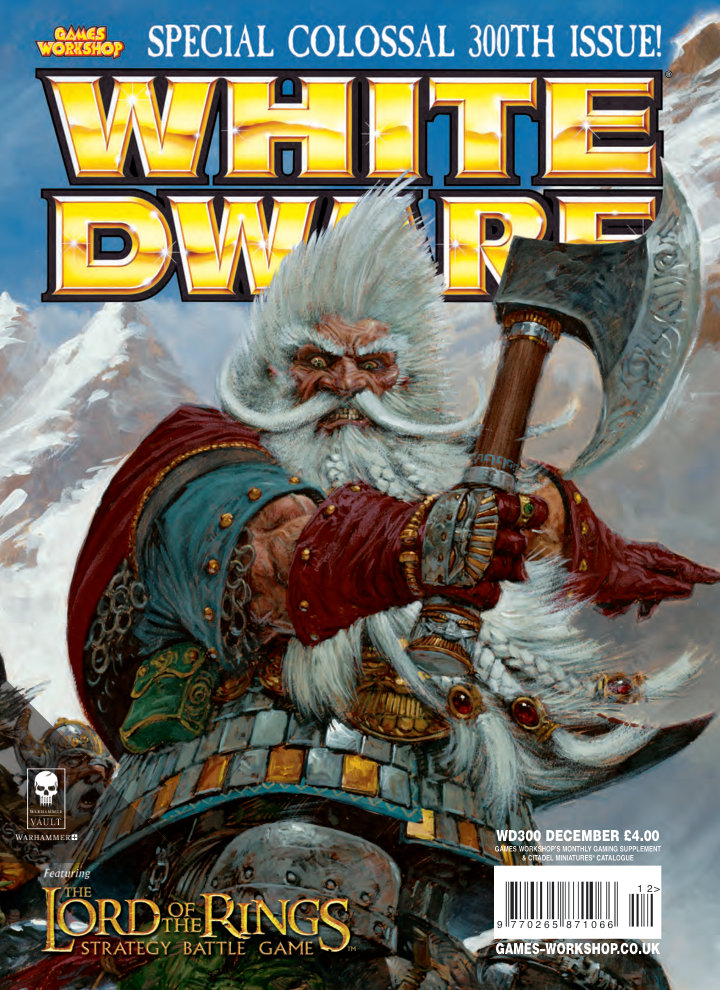
EditorialWD 300 · pp. 2–3
Paul Sawyer marks the anniversary by recalling his first magazine, his earliest miniature and the articles that shaped his enthusiasm. He thanks the people who sustained production through difficult periods and describes how reader feedback changed the magazine, before returning to his own painting projects and the experience of Games Day.
CommunityWD 300 · pp. 4–7
The news previews Forge World’s Eldar Revenant, Hobbit-focused Scouring of the Shire material and two expansions for the historical WarCry card game. A school-club account explains how beginners share painting and responsibility, while a vast Storm of Chaos siege illustrates how local groups turned the campaign into their own event.
Warhammer 40,000Warhammer Fantasy BattlesAeldari
InterviewWD 300 · pp. 8–9
Mark Chambers previews the rebuilt UK hobby website, explaining how a small team tackled a large but difficult-to-navigate archive. Army homepages, downloadable rules, terrain articles and galleries respond to hobbyists’ requests for both discoverable older content and regular new material, with the launch intended as the beginning of continued development.
Warhammer 40,000Warhammer Fantasy Battles
CommunityWD 300 · pp. 10–11
Guy Haley visits Copenhagen’s Giant Fanatic event, where an ambitious schedule of games, changing list restrictions and varied missions tests stamina as well as tactics. His Speed Freeks diary mixes missed starts and difficult match-ups with memorable opponents, alongside the organisers’ aim to keep established players trying different armies and approaches.
Warhammer 40,000Warhammer Fantasy BattlesOrks
CommunityWD 300 · p. 11
The remaining studio updates range from Paul Rudge’s determination to obtain an Ogre army early to Christian Byrne’s carefully planned mobile Ultramarines. Nick Kyme reflects on how the Bugman campaign revived an old collection, while Greg MacGregor considers using new Space Marines as defeated enemies on his Eldar bases.
Warhammer 40,000Warhammer Fantasy BattlesOgre Kingdoms
CommunityWD 300 · pp. 16–21
Guy Haley follows the magazine from Owl & Weasel and the role-playing boom through proprietary game worlds, changing editors and the growth of the miniature hobby. Recollections of favourite issues, technical production changes, international editions and unusual cover gifts frame issue 300 as another stage in a publication repeatedly reshaped by its audience and publisher.
InterviewWD 300 · pp. 24–30
John Blanche discusses the historical and artistic influences behind Games Workshop’s dark worlds, linking their worn, flawed inhabitants to Dickens, Northern European painting and personal visual obsessions. He distinguishes the demands of art direction, concept work and finished painting, while examples from several studio artists show how a shared imagery develops without becoming entirely uniform.
Warhammer Fantasy BattlesWarhammer 40,000
LoreWD 300 · pp. 32–37
Phil Kelly introduces the Ogre Kingdoms through the relationship between appetite, physical power and social rank. Tyrants dominate by strength, Hunters survive independently in the Mountains of Mourn and Butchers turn feasting into religious practice, establishing the culture behind a new army built to hit hard despite being outnumbered and outmanoeuvred.
Warhammer Fantasy BattlesOgre Kingdoms
CampaignWD 300 · pp. 38–49
Nick Kyme takes the linked campaign onto the River Sol, where Goblin pirates try to delay Bugman before the final assault on his brewery. A heavily armed Dwarf barge, ramshackle rafts and the personal feud between their captains turn the journey into a skirmish whose result changes the timing of Bugman’s eventual return.
Warhammer Fantasy BattlesDwarfs
ModellingWD 300 · pp. 40–41
Chris Bone adapts the shape of a Mississippi steamer into a broad fighting platform built from insulation foam, scored balsa and overlapping card hull strips. Old siege and Dwarf components supply railings, loading machinery and swivel guns, while a removable wheelhouse roof preserves access to the small interior details.
Warhammer Fantasy BattlesDwarfs8 paint colours
RulesWD 300 · pp. 42–49
A four-hundred-point Dwarf crew defends its steam barge against a larger pirate force carried on Goblin rafts. The river’s current, floating debris and swimming rules make movement hazardous, while ramming craft, harpoon lines and launched Goblins offer different ways to board or sink the vessel before it clears the narrow waterway.
Warhammer Fantasy BattlesDwarfs
RulesWD 300 · p. 43
Grim’s history as an expelled Barak Varr engineer explains his wooden barge, drinking habits and unusual comfort in water. His personal hatred of Skabend can overwhelm tactical sense, while a special telescope extends his pistol reach; an accompanying Slayer Pirate conversion and Seadog profile provide the captain and his river crew.
Warhammer Fantasy BattlesDwarfs
RulesWD 300 · p. 44
This campaign version depicts Bugman before the destruction of his brewery and the formation of his Ranger band. His rune axe and inexhaustible tankard support a capable Thane, but the article deliberately omits the later greenskin grudge, keeping the character appropriate to the story’s earlier period.
Warhammer Fantasy BattlesDwarfs
RulesWD 300 · pp. 44–45
The Goblin captain’s hook, parrot-like squig and near-aquatic ancestry make him a distinctive river antagonist, especially when his feud with Grim drives him into reckless action. His astonishingly lucky first mate steadies the River Ratz with a banner, and Paul Sawyer converts both characters from metal Gretchin and pirate components.
Warhammer Fantasy BattlesOrcs & Goblins
ModellingWD 300 · p. 48
Paul Sawyer interprets a Gob Launcha as a half-submerged River Troll using a broken chariot to fling Goblins aboard the enemy vessel. The Harpoon Chukka uses halved barrels and siege parts for its raft, with carefully adapted crew poses and an eyeglass-wielding spotter to complete the improvised river artillery.
Warhammer Fantasy BattlesOrcs & Goblins
RulesWD 300 · pp. 50–55
Andy Hoare describes entire armies born under a single Old One’s influence, extending sacred spawnings beyond individual Saurus units to their Skink companions. Official army amendments link each host to a compulsory blessing and a particular magical lore, while explorers’ accounts illustrate how the gods’ different temperaments appear in battle.
Warhammer Fantasy BattlesLizardmen
RulesWD 300 · p. 51
Chotec’s orange-marked followers embody an energetic fire that belies the Lizardmen’s cold-blooded reputation, illustrated by a Bright Wizard’s disastrous search for superiority. The host requires Chotec’s spawning where available, extends it to Skinks and assigns its priests the Lore of Fire.
Warhammer Fantasy BattlesLizardmen
RulesWD 300 · p. 52
The account links Sotek’s rise to the red-crested survivors of Chaqua and Tehenhauin’s long campaign against Clan Pestilens. A Sacred Host bears the Serpent God’s aggressive spawning throughout its eligible units, with specific Skink costs and a restricted magical choice tying the army to its blood-fuelled patron.
Warhammer Fantasy BattlesLizardmen
PaintingWD 300 · p. 52
Colour and physical adaptations distinguish the Old Ones’ blessed spawnings: orange, sea-green, yellow, purple and red each express a different patron. Quetzl is represented through thicker scales and bony spurs, while Huanchi’s stealth leaves no recorded marking, encouraging identity through character rather than a uniform painted stripe.
Warhammer Fantasy BattlesLizardmen
RulesWD 300 · p. 53
Quetzl’s children are recognised by thick scales and bony projections, while one uncertain witness describes a supernatural hand intercepting a cannonball. The host’s rules extend the protective spawning to Skinks and give its priests the Lore of Death, distinguishing physical protection from Tepok’s resistance to magic.
Warhammer Fantasy BattlesLizardmen
RulesWD 300 · p. 53
A stolen dawnstone leads Huanchi’s silent hunters through a long pursuit of Dark Elf raiders, matching their enemies’ stealth until the final ambush. The Sacred Host retains the appropriate spawning throughout its eligible troops, and its Skink Priests use the Lore of Shadows to reflect the predator god’s elusive nature.
Warhammer Fantasy BattlesLizardmen
RulesWD 300 · p. 54
Accounts of gilled, webbed Lizardmen and an ancient victory over northern invaders establish Tzunki’s affinity with water. His host extends the aquatic spawning across its Saurus and Skink elements, while the accompanying army amendments restrict Skink Priests to the Lore of the Heavens.
Warhammer Fantasy BattlesLizardmen
RulesWD 300 · pp. 54–55
Tlazcotl’s followers remain unmoved by horrors that would break other warriors, as a fleeing treasure hunter discovers when pirates meet a silent Saurus line. The army variant applies the fearless spawning to all eligible troops and characters, including paid Skink upgrades, and assigns priests the Lore of Metal.
Warhammer Fantasy BattlesLizardmen
RulesWD 300 · p. 55
Tepok’s purple and blue feathered-serpent imagery is linked to protection of sacred places and survival against devastating sorcery. The host grants its compulsory spawning and magical resistance to the eligible army, extends that protection to Skinks at a higher cost and limits priests to the Lore of Light.
Warhammer Fantasy BattlesLizardmen
CampaignWD 300 · pp. 56–75
Eric Sarlin’s Valley Grismerie campaign uses The General’s Compendium to contest a strategically important route between Bretonnia and the Empire after the Storm of Chaos. Special sites change both army resources and the scenarios fought over them, while a mid-campaign Grail Quest and weighted territory scoring make control of roads, sacred places and corrupted ground matter differently.
Warhammer Fantasy BattlesBretonnia
RulesWD 300 · pp. 58–59
An eighteen-hundred-point standard banner keeps powerful army choices dependent on support and campaign bonuses instead of making every force identical. An added penalty for newly reformed scattered banners prevents deliberate defeats becoming an instant defence of headquarters, while special map sections provide the campaign’s local character.
Warhammer Fantasy Battles
RulesWD 300 · p. 60
Two characters settle a challenge before the main battle through repeated passes along a small tilting field. Weapon Skill, Initiative, equipment and a random score determine who strikes first, with victory improving the leader’s next-battle morale effect and defeat leaving an injury rather than automatically killing the challenger.
Warhammer Fantasy BattlesBretonnia
ModellingWD 300 · p. 61
A balsa fence on bevelled hardboard becomes a compact jousting ground, with impressed horseshoe marks suggesting repeated training runs. Sand sealed under diluted glue gives the base durability, and separately painted shields and banners allow colourful heraldry to be added cleanly after the main terrain is finished.
Warhammer Fantasy BattlesBretonnia
RulesWD 300 · pp. 62–63
An honoured battlefield gives Bretonnian heroes free Stoicism and makes holding the ground more important than casualties when their army is involved. Vampire Counts can instead raise the buried fallen, turning a memorial into a source of reinforcements; campaign rules prevent Bretonnians from fortifying or razing their own sacred field.
Warhammer Fantasy BattlesBretonnia
ModellingWD 300 · p. 64
Tinted resin fills the lake while tall modelling grass, handmade bullrushes and paper lily pads give the banks texture and scale. The tutorial separates the preparation of small plants from final assembly and uses a little green paint in the water to suggest a natural, shallow body of water.
Warhammer Fantasy Battles1 paint colour
RulesWD 300 · pp. 64–65
Control of a sacred lake extends or denies the Lady’s Blessing to nearby Bretonnian battles. On the table the large shallow water feature becomes a valuable fifth objective, and a random manifestation may bring protective fog, effortless passage or healing for the Lady’s favoured troops and allies.
Warhammer Fantasy BattlesBretonnia
RulesWD 300 · pp. 66–68
A corrupted exit from the Under-Empire benefits Skaven territory control but remains effectively ruined for other realms. The battle places that exit among steep hills, where additional ratmen or an uncontrolled Spawn may emerge during play, threatening both armies and creating dangerous interruptions to the ordinary contest.
Warhammer Fantasy BattlesSkaven
ModellingWD 300 · p. 67
Carved foam and a textured hardboard base create a tunnel entrance that can be scaled from a small skirmisher opening to a broad regimental exit. Layered earth-coloured drybrushing brings out the rocky structure, with separately painted Skaven debris and sparse grass turning the basic hill into a recognisable Under-Empire outpost.
Warhammer Fantasy BattlesSkaven4 paint colours
RulesWD 300 · pp. 69–70
Armies converge on a chapel containing valuable relics, with Bretonnians defending its sanctity and other realms able to plunder its resources. A Hermit Knight protects the doorway, nearby Bretonnian units become Stubborn and an uncertain game length makes the final position of eligible units more important than accumulating casualties.
Warhammer Fantasy BattlesBretonnia
ModellingWD 300 · p. 70
The old guardian combines an Empire Wizard head, a knightly torso, Tilean legs and a Grail Knight sword. Pinning the major sections before final gluing allows the stance to be adjusted, while streamers and Men-at-Arms accessories fill out the travelling warrior’s appearance before gaps are finished with putty.
Warhammer Fantasy BattlesBretonnia
ModellingWD 300 · p. 71
Plastic fortress sections form the chapel’s walls and octagonal roof base, combined with recessed doors and stone-textured inserts. A carefully constructed triangular roof and scavenged statues, gargoyles and heraldic pieces turn those large components into a much smaller religious building, intended as a project for experienced terrain builders.
Warhammer Fantasy BattlesBretonnia1 paint colour
RulesWD 300 · pp. 72–73
Local knowledge and cultural ties change how armies operate on the Grismerie map: Bretonnians and Empire troops exploit trade roads, greenskins gain mountain support and High Elves benefit from old fortifications. Additional restrictions on allies and altered terrain generation make the campaign’s geography influence army choices as well as movement.
Warhammer Fantasy BattlesBretonnia
ModellingWD 300 · p. 73
Thin rolled putty is cut into coins and scattered around salvaged chests, weapons, familiars and bead gemstones. The examples encourage a varied collection of loot markers from the bits box, giving the Grail Quest’s monster hoards visible objects to discover and defend.
Warhammer Fantasy Battles
RulesWD 300 · pp. 73–74
Between campaign turns, good and evil alliances send specially assembled forces to hunt monsters whose treasure hoards may conceal the Grail. A neutral Games Master controls the beasts and secretly chooses the true guardian, while possession of the prize can strengthen future armies, improve magic or deny Bretonnians their blessing for the rest of the campaign.
Warhammer Fantasy BattlesBretonnia
RulesWD 300 · p. 75
After twenty turns, weighted territory totals distinguish control of strategic roads, special sites and ordinary land, with different treatment for Skaven warpstone holdings. The winner’s margin determines how securely the valley is held, and a tied result sends the leading realms into a final battle to settle its future.
Warhammer Fantasy Battles
FictionWD 300 · pp. 76–87
A Dwarf expedition trapped by Skaven in the lost halls of Khazad Okul shelters in an old shrine and debates the contradictory legends of Grombrindal. Stories identify him as Snorri Whitebeard, an immortal Slayer, a god or the embodiment of Dwarfkind, until the quiet old guide leaves them and the besiegers begin to scream.
Warhammer Fantasy BattlesDwarfs
ShowcaseWD 300 · pp. 88–89
Competition winners and studio painters present character pieces ranging from a Chaos warlord and Shaggoth to Grombrindal and the elegant Aenur. The gallery contrasts large monsters, carefully posed heroes and distinctive personal colour choices, with the painters and awards credited but no paint recipes supplied.
Warhammer Fantasy BattlesMordheimChaos
FictionWD 300 · pp. 90–103
Gav Thorpe interweaves Snorri Whitebeard’s friendship with Malekith and a later Dwarf expedition led by King Throndin Stoneheart. Bound by a promise to a human baron and by grief for a murdered son, Throndin marches towards greenskin enemies while repeatedly dismissing the warnings of a shabby old traveller.
Warhammer Fantasy BattlesDwarfs
RulesWD 300 · pp. 104–105
Anthony Reynolds provides rules for Grombrindal as a powerful, initially disguised character hidden within a Dwarf regiment. Revealing him changes both the unit’s fighting power and its resilience, while ancestral equipment combines protection against magic and weapons with an axe that makes even well-armoured foes vulnerable.
Warhammer Fantasy BattlesDwarfs
CommunityWD 300 · pp. 106–110
Guy Haley introduces four collectors starting budgeted armies, with a larger first allowance followed by monthly purchases that must be painted before the next instalment. Their choices—Grimgor’s ’Ardboyz, a Nurgle Daemonic Legion, Stirland militia and Tomb Kings—show different ways to balance a coherent theme, practical painting and value for money.
Warhammer Fantasy BattlesOrcs & Goblins
PaintingWD 300 · p. 107
Dave carries his enthusiasm for 40K greenskins into a hard-hitting Warhammer army of Black Orcs, a Stone Troll and an emergency-support Shaman. Layered metals and coloured ink washes make the armoured warriors look seasoned, while a reposed Shaman staff and a trophy standard give the small first purchase its own identity.
Warhammer Fantasy BattlesOrcs & Goblins5 paint colours
ShowcaseWD 300 · p. 108
Asger chooses a low-model-count Nurgle force as a manageable change from his Skaven horde. Reusing the Mordheim strongman as a Herald and allowing a Plaguebearer standard bearer to serve different roles stretches the initial budget, while marshy bases and repeated gloss finishes establish the army’s diseased setting.
Warhammer Fantasy BattlesNurgle2 paint colours
PaintingWD 300 · p. 109
Paul imagines an Empire province defended by veterans, rogues and local militia while its regular troops are away at war. A distinctive captain leads a cost-conscious infantry purchase, with brown underpainting, metallic highlights and an ink wash creating worn armour rather than the appearance of a polished professional regiment.
Warhammer Fantasy BattlesEmpire4 paint colours
ShowcaseWD 300 · p. 110
Stephen starts Tomb Kings to gain mobility, flexibility and magic after playing Dwarfs. The battalion provides a large foundation within the allowance, and differences between plain skeletal archers and more ornate cavalry suggest social rank; a warm, layered desert base scheme ties together the planned blue, gold and bronze army.
Warhammer Fantasy BattlesTomb Kings3 paint colours
LoreWD 300 · pp. 112–117
Pete Haines explains how the Ultramarines’ small numbers demand swift, coordinated operations guided by the Codex Astartes. Fleet organisation, drop assaults and company roles support attacks on decisive targets, while Ultramar’s auxiliary forces protect worlds that a single Chapter could never hold by itself.
Warhammer 40,000Ultramarines
Battle reportWD 300 · pp. 118–135
Graham McNeill’s fifteen-hundred-point Ultramarines spring a dawn ambush on Pete Haines’s infantry-heavy Orks, testing the new Space Marine codex against a horde protected by kustom force fields. Graham concentrates both arriving waves on one flank and uses Tigurius’s command group to hold up several mobs while the firing line destroys the nearest threats.
Warhammer 40,000Ultramarines
RulesWD 300 · p. 119
A feigned weakness draws the defending army into a camp before the attackers arrive in two waves from either short edge. First-turn darkness and divided forces complicate the opening, and the annihilation objective rewards both destroyed enemies and the value of friendly scoring units still alive after six turns.
Warhammer 40,000
ShowcaseWD 300 · pp. 136–139
Adi Wood revisits an Ork collection whose successive experiments had gradually lost a common identity. A new Flash Gitz mob gives him a fresh palette of varied browns and tans, allowing each warrior to look individual while bringing the growing horde together; Steve Cumiskey places the restart in the history of Adi’s brightly coloured and Gorkamorka-era armies.
Warhammer 40,000Orks
ModellingWD 300 · p. 138
Adi builds basic Orks first, then returns to each miniature for small changes that create individuality across a large mob. His Flash Gitz reverse that process: elaborate guns made from combined weapons, wire and armour plates determine the bodies and poses needed to carry them, with accessories covering joins rather than extensive putty work.
Warhammer 40,000Orks
PaintingWD 300 · p. 139
A batch-friendly sequence finishes messy metallic drybrushing before simple green skin, leather and red glyphs. Two compact brown-based clothing palettes provide variation without multiplying the workload, while separate check-pattern and tooth demonstrations show where precise individual brushstrokes add character to otherwise efficient rank-and-file painting.
Warhammer 40,000Orks19 paint colours
InterviewWD 300 · pp. 140–141
Guy Haley interviews Artur Szyndler about a Blood Angels collection painted for enormous participation games in Poland. The chapter-scale display is only a small part of a much larger gaming collection, and Artur explains how rapid painting—even during train journeys—supports the escalating spectacle expected at local demonstration events.
Warhammer 40,000Blood Angels
ShowcaseWD 300 · pp. 142–143
Large-scale conversions, competition pieces and battle scenes demonstrate contrasting approaches to the 41st millennium. Joe Orteza’s Chaos and Titan figures, Bryan Shaw’s Laughing God and works by Christian Byrne, Natalya Melnik, Tim Uson and Bob Evers combine individual character painting with dramatic group composition.
Warhammer 40,000InquisitorChaos Space Marines
RulesWD 300 · pp. 146–153
Mat Ward expands Harad into merchant cities, rival coastal lords, raiders, mercenaries and remote sacred ruins rather than a single uniform army. Optional profiles give those societies different battlefield identities, while historical accounts and conversion examples explain how the new troops fit the region; the article explicitly asks players to obtain their opponent’s permission.
Middle-earth Strategy Battle GameHarad
RulesWD 300 · p. 147
Abrakân’s immense trading wealth supports a loyal guard intended to protect both its ruler and the merchants around the city. Their profile combines ordinary Haradrim poisoned arrows with a courage benefit near a nominated hero, making personal loyalty the main distinction of this city’s defenders.
Middle-earth Strategy Battle GameHarad
RulesWD 300 · pp. 148–149
Seven suspicious Black Númenórean rulers govern Umbar through divided offices and personal military power. Their richly maintained Wardens defend masters who cannot rely on one another, and profiles for the lords and their heavily armoured guards support that political background; converted Gondorian figures demonstrate the appropriate equipment and silhouette.
Middle-earth Strategy Battle GameUmbar
RulesWD 300 · p. 150
Corsair fleets dominate the Bay of Belfalas while remaining largely autonomous from the rulers they nominally serve. Profiles for their captains and crews emphasise modestly equipped raiders with options for bows or throwing spears, set against an account of changing shipbuilding traditions and the dangerous limits of their voyages.
Middle-earth Strategy Battle GameUmbar
RulesWD 300 · p. 151
Khand’s accomplished horsemen enter Harad as feared raiders and soldiers for hire, frustrating attempts to contain them behind fixed defences. Their mercenary profile allows service on either side, but an opening loyalty roll can hand individual warriors to the enemy, turning their useful mobility and bows into a calculated risk.
Middle-earth Strategy Battle GameKhand
RulesWD 300 · p. 151
Gondor’s attempt to govern Harad through local rulers buys periods of stability but also creates ambitious rivals capable of organising rebellion. A King of Harad profile represents either those historical clients or a later chieftain, with mounted and weapon options and the familiar poisoned-arrow rule.
Middle-earth Strategy Battle GameHarad
RulesWD 300 · p. 152
Mârdat’s rise from a client kingdom to a southern empire ends through renewed war, betrayal and an ambition his successors cannot sustain. His optional Serpent Lord profile rewards fighting near fellow heroes and inspires a wider area, while his inclusion unlocks the experienced mounted Serpent Riders associated with his campaigns.
Middle-earth Strategy Battle GameHarad
RulesWD 300 · p. 153
Silent guardians keep intruders away from Karna’s undead horrors and pursue objects whose removal may release them. The Watchers’ exceptional courage and persistent resistance to magical powers translate that thankless vigil into an optional warrior profile, with Sam Lee’s subdued figures illustrating their role as solemn custodians.
Middle-earth Strategy Battle GameHarad
RulesWD 300 · pp. 154–157
Mat Ward revises river-assault mechanics for coastal landings, covering drift, crew-controlled boats, boarding, collisions, swimming and sinking. A flexible raid framework then varies deployment, end conditions and special events, allowing prepared defences, flanking parties, bombardments or hazardous winds to create different stories on the same shoreline.
Middle-earth Strategy Battle Game
ModellingWD 300 · pp. 158–161
Steve Cumiskey and Adi Wood make a removable sea-and-beach section to sit on their existing grassland table. An irregular board edge and raised dunes conceal the change in height, while carved foam, cork rocks and filler waves supply the landforms without committing the entire table to one scenario.
Middle-earth Strategy Battle Game
PaintingWD 300 · p. 161
Successive brown and bone drybrushes build the beach, with small green patches breaking up the sand and helping the dunes meet the surrounding grassland. The sea moves from dark green through Scaly Green to blue shallows, then gains white wave crests and a gloss finish to distinguish water from the matte shore.
Middle-earth Strategy Battle Game11 paint colours
RulesWD 300 · pp. 162–163
The Dol Amroth campaign ends with Mórathol’s exhausted garrison defending a palisade against vengeful Corsairs while Imrahil races to help. Reinforcements arrive unpredictably from the fourth turn, and surviving resources and unburned tents from the previous raid change the final confrontation, linking a desperate defensive stand to earlier decisions.
Middle-earth Strategy Battle GameDol Amroth
FictionWD 300 · pp. 164–167
An anonymous chronicler follows Maethor from noble-born Citadel officer to a solitary hunter seeking the Haradrim who killed his father. His vengeance leads into a wider friendship with Boromir and a daring raid on Harad’s gathering army, before he returns to command the border position once held by his father.
Middle-earth Strategy Battle GameGondor
RulesWD 300 · p. 165
Existing profiles represent Maethor at different points in his life: an ordinary Citadel Guard early on, a Ranger during his southern journeys and an improved Captain after gaining experience. The article explains the extra points cost of the final version and encourages similarly modest custom heroes, subject to agreement with an opponent.
Middle-earth Strategy Battle GameGondor
ModellingWD 300 · p. 167
Nick Kyme builds three distinct versions of Maethor through carefully chosen head and weapon swaps. A young torch-bearing guard becomes a weathered ranger and finally a veteran captain, whose dramatic rescued standard represents a moment in the story rather than a banner allowed by the character’s rules.
Middle-earth Strategy Battle GameGondor
RulesWD 300 · pp. 168–169
A lone ranger ambushes his father’s killer and six exhausted followers among Khand’s hills. Night limits sight and charges, but Maethor’s preparation grants a useful reroll, while the enemy begins broken; the Good player must survive until every opposing model has been killed or driven away.
Middle-earth Strategy Battle GameGondor
Battle reportWD 300 · pp. 170–189
Four players assemble a fifteen-hundred-point-per-side recreation of the fighting before Minas Tirith, with massed Rohirrim, Gondorian reserves and three Mûmakil. The Orc shieldwalls initially delay the cavalry, but a flanking rider reaches the city gate and brings out its knights as the enormous Haradrim reinforcements close in.
Middle-earth Strategy Battle GameRohan
RulesWD 300 · p. 175
Rohan’s charge must break an Orc siege before delayed Mûmakil reinforcements overturn the battle. Reaching the city gate releases Gondorian cavalry, Merry supports Eowyn from her horse and the Good side must defeat enough of the great beasts as well as reducing the opposing army, making timing and access to the gate central objectives.
Middle-earth Strategy Battle GameRohan
ModellingWD 300 · p. 190
John Carter brings his Stealth team’s weapons into line with the rest of his Tau force by replacing their original burst-cannon barrels. Carefully sawn joins and parts from the Crisis suit sprue achieve a consistent appearance through a small, repeatable conversion rather than rebuilding the entire weapon or miniature.
Warhammer 40,000T’au Empire
ModellingWD 300 · pp. 190–192
The returning Ork surgeon presents a gallery of practical and extravagant conversions. A straightforward Tau weapon replacement sits beside grotesque daemons, a Slayer strangling a Troll and a rebuilt Daemon Prince, with explanations and parts lists showing how each modeller gives familiar components an unexpected role.
Warhammer 40,000Warhammer Fantasy BattlesT’au Empire
ModellingWD 300 · p. 191
Three US White Dwarf conversions create unusual adversaries for Daemonhunters: an inverted Lictor torso becomes an alien head, an Ethereal becomes a sinister possessed figure and dragon components give a Spawn-like creature its bulk and wings. The examples show how both radical recombination and restrained changes can produce convincing manifestations of the warp.
Warhammer 40,000Daemons of Chaos
ModellingWD 300 · p. 192
Chris Straw reposes both figures to show a Slayer strangling a stooping Troll. New arms, altered legs and extensive neck and face sculpting turn two separate miniatures into a single struggle, with the Troll’s expression and reaching hands making the action readable without additional scenery.
Warhammer Fantasy BattlesDwarfs
ModellingWD 300 · p. 192
A postal accident becomes Christian Byrne’s opportunity to improve an older Daemon Prince conversion. Rebuilding the Tyrus-based figure lets him clean up rough areas and add a sacrificial banner and oversized optional axe, preserving the original concept while giving the repaired miniature a more dramatic finish.
Warhammer 40,000InquisitorChaos Space Marines