EditorialWD 396 · p. 1
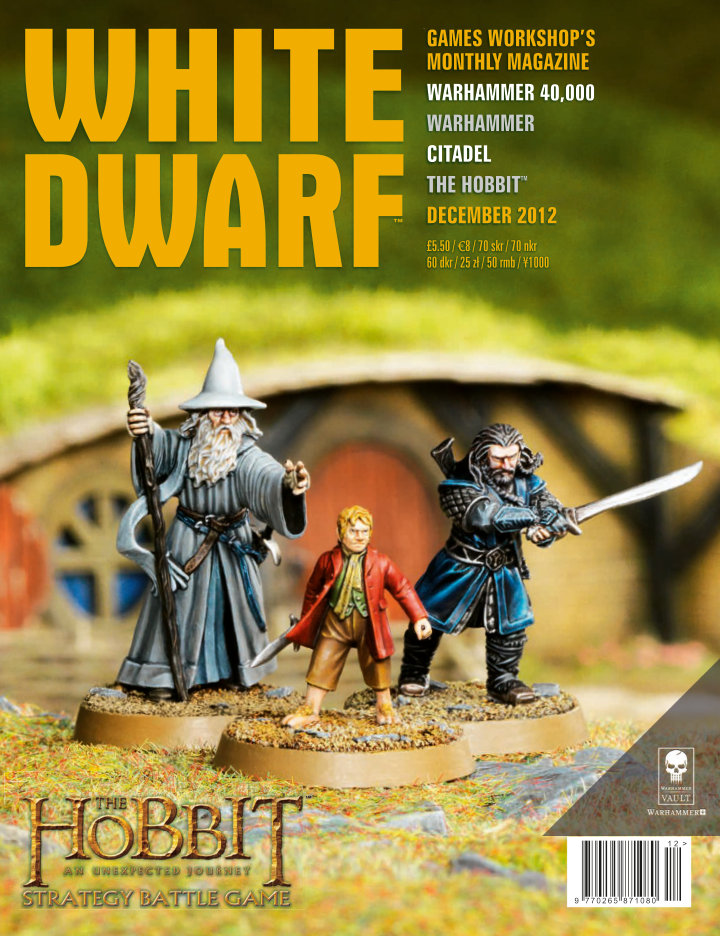
Jes Bickham introduces the Hobbit miniature range through its unusually close character likenesses, from Bilbo and Gandalf to Thorin and the Goblin King. He connects the new models with the Goblin Town battle report and the wider collecting opportunities of the game. The issue also retains its broader hobby coverage, with converted aircraft among the projects that particularly caught his attention.
Middle-earth Strategy Battle Game
ShowcaseWD 396 · pp. 4–35
The team explores the new Hobbit range, led by Escape from Goblin Town and its Dwarves, Wizards, Hobbit and misshapen enemies. Close photographs examine character likenesses, alternative weapons and the sculpted details that distinguish each member of Thorin’s Company. Trolls, Hunter Orcs, Wargs and the White Council broaden the range, while modular walkways establish the underground setting. The feature also explains how existing Lord of the Rings collections and sourcebooks remain part of the expanded collecting hobby.
Middle-earth Strategy Battle GameThorin’s Company
ShowcaseWD 396 · pp. 14–17
Andrew Kenrick reviews the new hardback manual as both a visually detailed book and an extension of the familiar Strategy Battle Game. Its parchment-style presentation and borders echo Dwarven clothing, while examples, an index and appendices support practical use. He highlights new options for Monsters and Heroic Actions, profiles for the movie’s characters, narrative scenarios and a gallery encompassing both Hobbit and Lord of the Rings models.
Middle-earth Strategy Battle GameThorin’s Company
CampaignWD 396 · pp. 36–39
Crusade of Fire presents a team campaign over the Corvus sub-sector after a long-isolating warpstorm subsides. Players can combine its system with Planetary Empires, sharing victories or pursuing personal glory as more worlds enter the struggle. The review outlines the studio campaign’s narrative and three additional modes: Burning Skies expands air combat, Arena of Death moves into Commorragh’s fighting pits, and Daemon Worlds subjects armies to unstable realities and possession.
Warhammer 40,000Imperium
LoreWD 396 · p. 42
Dan Harden reviews CL Werner’s first 40K novel through the misery of the slaves caught between Iron Warriors and invading Orks. Their viewpoint gives both armies frightening scale, while the clash of meticulous plans and unpredictable greenskin attacks steadily enrages the defenders. The review praises the book’s ability to make readers sympathise temporarily with cruel characters without softening the brutality of Castellax or its masters.
Warhammer 40,000Iron Warriors
LoreWD 396 · p. 43
Adam reviews an audio drama in which Garro and Rubio investigate refugees from the betrayed Legions under the suspicious gaze of Custodian Khorarinn. Having once fled treachery himself, Garro must now judge others before their apparent guilt leads to a general condemnation. The review finds this reversal a strong test of his character and praises distinct voice performances, especially Varren, while questioning the vocal portrayal of a White Scar.
The Horus HeresyDeath Guard
LoreWD 396 · p. 44
The Salamanders anthology is reviewed as a companion to Nick Kyme’s trilogy rather than an unrelated collection. Familiar characters appear before and after the main novels, with rare pieces and new stories filling in their wider history. Andrew singles out Firebrand, in which aspirants face Nocturne’s dangerous environment, because its ending changes how readers may understand events already encountered in the trilogy.
Warhammer 40,000Salamanders
LoreWD 396 · p. 44
Dan describes a deliberately biased in-universe manual that covers everything from combat procedures and punishments to recognising enemies and the details of issued equipment. Its dogma is absurd but sufficiently thorough to feel like something the Munitorum would actually hand to a Guardsman. The review treats the book’s appeal as the combination of Imperial satire, believable bureaucratic detail and a convincing physical artefact.
Warhammer 40,000Imperial Guard
LoreWD 396 · p. 45
Jes reviews Andy Smillie’s account of the Flesh Tearers claiming their homeworld. Battles against gigantic death-world creatures provide the immediate action, but the story’s deeper threat is the Chapter’s own nature and inherited curse. A later framing sequence reinforces the tragedy, so the violence and pace do not obscure the sense that the warriors carry their most dangerous enemy within themselves.
Warhammer 40,000Flesh Tearers
LoreWD 396 · p. 45
Adam follows Tyrion and Teclis as threats gather around Ulthuan and Tyrion moves towards his role as the Everqueen’s champion. Recovering Sunfang gives the book its title, but the review emphasises William King’s ability to expand the old High Elf tales he originally wrote into a more immediate character journey. Malekith, Morathi and N’Kari provide the surrounding danger, with the closing scenes singled out as the culmination of Tyrion’s destiny.
Warhammer Fantasy BattlesHigh Elves
ShowcaseWD 396 · pp. 46–47
Two large Marine tanks extend the Heresy range with different forms of heavy firepower. The Fellblade’s domed twin-gun turret, multiple lascannons and hull weapons give it an unmistakable super-heavy presence, while the Typhon’s enormous dreadhammer and heavy frontal shield define it as a siege vehicle. Both retain opportunities for Legion or Chapter identity through compatible doors, linking their new forms to existing Marine collections.
The Horus HeresyWarhammer 40,000Space Marines
CommunityWD 396 · p. 48
The digital-products page surveys smaller publications available alongside the main army books. Army-specific painting guides, tactical material, scenarios and unit rules are presented as ways to add something focused to an existing collection. Examples include Nihilakh Necron colours, Ork Bommer rules and Altar of War missions built around the battlefield character of a particular army.
Warhammer 40,000Warhammer Fantasy BattlesNecrons
InterviewWD 396 · p. 49
Designer Carl Jackson explains how Talisman’s familiar board, cards and encounters become a single-player digital quest game. Short objectives let players fit a session into a few minutes, while replaying for better results supplies a longer challenge and a route to learning the system. Jackson describes the team’s affection for the original board game and presents Prologue as a foundation for a later multiplayer version.
Talisman
ShowcaseWD 396 · pp. 54–59
Keith Robertson revisits an Ogre collection that began with grey-skinned Feastmasters and Halfling cooks, then received a warmer flesh palette during a studio Battalion Challenge. Green bases contrast with rusty metal and tie the force to his childhood painting, while Chaos Dwarf allies and enslaved Giants establish a new eastern-mountain identity. He discusses repainting cherished models, making conversions only when the idea is clear, and steadily collecting towards one example of every unit without turning the project into a deadline.
Warhammer Fantasy BattlesOgre Kingdoms
EditorialWD 396 · pp. 60–61
Jervis examines the unwritten social contract that allows flexible tabletop rules to work. Different groups may value narrative armies or competitive optimisation equally sincerely, so disagreement need not mean either side has misunderstood the hobby. He recommends asking new opponents about army selection, house rules and expectations before play, and discussing moments of discomfort as they arise; a shared understanding makes even fiercely competitive games more enjoyable.
Battle reportWD 396 · pp. 62–75
Dan Harden’s Dwarves must retrieve their weapons and escape Goblin Town while Adam Troke’s replenishing Goblins try to kill enough of the company to stop them. Heroic Marches and cooperative character abilities create a route out, but the Goblin King hurls Thorin into the abyss and later rends Gloin apart. Gandalf finally risks a desperate leap and rolls the six needed to join the escaping group, securing a narrow Good victory. The review considers Special Strikes, new Heroic Actions, Monster attacks and the opportunity cost of spending scarce Might.
Middle-earth Strategy Battle GameThorin’s Company
TacticsWD 396 · pp. 76–79
Andy Clark and Simon Grant compare fully equipped five-hundred-point Nobz and Wolf Guard units. Nobz rely on two wounds, a Painboy, layered saves and many attacks, while Terminator Wolf Guard combine flexible weapon choices, storm shields and heavy shooting. Their predicted result changes with the test: Nobz win all three isolated fights, but Simon’s Wolves dominate a two-thousand-point battle with only minor casualties to the elite unit. The debate exposes the difference between winning a duel and contributing within a full army.
Warhammer 40,000Orks
ModellingWD 396 · pp. 80–81
John Blanche moves from Inquisitorial figures to a gritty Marine warband because one project continually inspires another. He imagines its bare-metal warriors as medieval men-at-arms clustered around a Legionary, using Terminator bulk, Grey Knight details and a Dreadknight pilot’s head to establish the leader. A chance discovery of a Possessed torso creates the accompanying Chaos Marine, whose parts include a Cultist head and an Ork buzz saw. The model’s identity grows from available pieces rather than a fixed plan.
Warhammer 40,000Space Marines
InterviewWD 396 · pp. 82–83
Alex Hedström nominates the Coven Throne for the way its complicated construction disappears into a coherent, narrative display. Spectral horsemen frame the Vampires rather than competing with them, helped by the studio paint scheme. Martin Footitt explains the collaboration with Aly Morrison and Brian Nelson’s concept, describing the pleasure of combining stone, cloth, blood and grotesque cushions while giving the youngest and eldest Vampires distinct roles within the scene.
Warhammer Fantasy BattlesVampire Counts
ShowcaseWD 396 · pp. 84–91
The aircraft gallery ranges from Phil Cowey’s bright Sons of Medusa Stormtalon to elaborate Ork and Necron conversions. Aly Morrison combines several Necron kits into a towering double-ray machine; Colin Grayson borrows an asymmetric historical aircraft concept; Dave Thomas adds excessive engines; and Gavin Newton exposes a maze of machinery beneath a Grot pilot. Oliver Norman’s rescue Valkyrie and Matt Murphy-Kane’s camouflaged Avenger show how role and weathering can define a vehicle as strongly as weapons.
Warhammer 40,000Sons of Medusa4 paint colours
ShowcaseWD 396 · pp. 92–93
Gareth Etherington’s four aircraft illustrate a collector’s attraction to varied designs rather than a single army. A Doom Scythe gains blue electrical recesses, a dark Razorwing uses soft airbrushed blends, and a metallic-blue Stormraven carries freehand Inquisitorial imagery. A Stormtalon adds glowing cockpit detail and scorched engines, with captions identifying several paints and explaining how large panels invite decorative work.
Warhammer 40,000Necrons9 paint colours
ModellingWD 396 · pp. 94–96
Staff conversions adapt spare components into characters with clear identities. Andrew Kenrick makes his Manticore lord Khornate with Skullcrusher parts and a hellblade, while Adam turns the plastic Nurgle lord into a Herald with Plaguebearer extras. Chris Peach builds a Necromancer from a Sorcerer and assorted Empire and Undead pieces, Martin rewards a successful Dreadlord with a new mounted model, and Jes enlarges a Tyranid Prime with Ravener and Hive Tyrant components.
Warhammer 40,000Warhammer Fantasy BattlesWarriors of Chaos
ShowcaseWD 396 · p. 97
Two entries from the Netherlands’ De Lage Landen Schilder Competitie turn large monsters into elaborate scenes. Pascal Rooze’s Stegadon carries a portal with a Skink Priest emerging through a swirling vortex. Chris Steenhuis’s diseased Giant instead emphasises Nurgle corruption through maggots, spikes, tentacles and an unfortunate Halfling, showing how radically the same scale of subject can be transformed.
Warhammer Fantasy BattlesLizardmen
ModellingWD 396 · pp. 98–103
Dave Andrews explains an orbital station built on four apparent floating asteroids, conceived as an Imperial outpost overrun by Daemons. Cut-down terrain hills, cork bark and disguised support rods establish the rocks, while multiple building kits form connected platforms, guns and landing areas. The team planned movement routes and a Marine arrival point before building, then chose the restrained colour The Fang over a proposed yellow so the scenery would support the armies visually. Floating debris and buildings below the rocks complete the illusion of weightlessness.
Warhammer 40,000Imperium1 paint colour
PaintingWD 396 · pp. 104–109
The painting section begins with basic colour selections for Thorin’s Company and Radagast, preserving the individual clothing and hair of the movie characters. Dan follows with complete quick methods for Goblin flesh, worn equipment and bases, then applies broad drybrushing to Goblin Town’s timber before detailing bones and gore. Keith Robertson closes the section with warm Ogre skin and strongly corroded metal, linking the guides to the army and battlefields shown elsewhere in the issue.
Middle-earth Strategy Battle GameWarhammer Fantasy BattlesThorin’s Company38 paint colours
PaintingWD 396 · pp. 104–106
The character charts give starting palettes for all thirteen Dwarves, Bilbo, Gandalf and the limited-edition Radagast. Grey robes distinguish Gandalf, Thorin uses dark blue and leather, and Bilbo’s green waistcoat and red jacket contrast with the earthy browns of Radagast. The Dwarves retain individual combinations: Dwalin’s green clothing, Balin and Dori’s red coats, Fili and Kili’s dark leather and Oin and Nori’s greys keep the company varied without abandoning a shared muted style.
Middle-earth Strategy Battle GameThorin’s Company25 paint colours
PaintingWD 396 · p. 107
Dan’s quick Goblin method separates pale skin, ragged cloth, dirty weapons and the base. Rakarth Flesh returns over a flesh wash before Pallid Wych Flesh and orange eyes provide contrast; brown layers define the loincloth. Metallic drybrushing followed by a dirty wash makes the weapons look neglected, and textured mud receives earthy highlights. The four parallel sequences are intended to get a large, varied Goblin horde ready for play efficiently.
Middle-earth Strategy Battle GameGoblin Town15 paint colours
PaintingWD 396 · p. 108
Dan paints the modular timber scenery with most small pieces still attached to their frames, keeping the larger walkways separate for access. Rhinox Hide and Dryad Bark establish the wood, Agrax Earthshade darkens it and Baneblade Brown drybrushing reveals the grain. Pale layers pick out scattered bones, while red and a dark wash finish the gruesome remains. Only after painting does he cut the smaller pieces free and assemble the terrain.
Middle-earth Strategy Battle GameGoblin Town8 paint colours
PaintingWD 396 · p. 109
Keith’s warm skin finish starts with Cadian Fleshtone and Reikland Fleshshade. The original flesh colour is reapplied to the raised areas, then mixed with Ushabti Bone for a final highlight over the larger muscles and facial details. The compact demonstration explains the warmer appearance of his repainted Ogre collection and is explicitly offered as a method transferable to other skin subjects.
Warhammer Fantasy BattlesOgre Kingdoms3 paint colours
PaintingWD 396 · p. 109
Keith’s corrosion sequence makes rust the dominant surface before restoring small amounts of metal. Skrag Brown is drybrushed with Troll Slayer Orange and Fire Dragon Bright to create a strongly weathered orange finish. Ironbreaker is then applied selectively as remaining or newly exposed metal, producing the chipped weapons and armour that visually unite his Ogre collection.
Warhammer Fantasy BattlesOgre Kingdoms4 paint colours
EditorialWD 396 · pp. 110–111
A heatwave gives Jeremy an excuse to assemble Savage Orcs indoors and recalls a huge 1991 Dwarf-versus-Dark-Elf battle in Philadelphia. His plan to burn a bridge works until a drowned Giant becomes an improvised replacement crossing, reversing the advantage. He celebrates the shared invention and negotiation that made the game memorable despite defeat, then returns to the present when running out of green paint finally forces him outside.
Warhammer Fantasy BattlesDwarfs1 paint colour
CommunityWD 396 · pp. 130–131
Staff projects mix army-building goals and unexpected bursts of productivity. Matt’s Legion of the Damned expand his Marine collection, Adam rapidly paints a Nurgle force with simple washes, Beth develops her Daemonettes and Kris’s escalation games move from 40K into Fantasy. Brief battle accounts record a Death Guard win over Grey Knights and a Tyranid draw against allied Dark Angels and Guard, while doubles preparation sends Matt and Glenn back to their Marine painting desks.
Warhammer 40,000Warhammer Fantasy BattlesLegion of the Damned1 paint colour
InterviewWD 396 · pp. 132–137
Alan Perry, Michael Perry and Aly Morrison discuss translating a film production’s meticulous designs into miniatures. Visits to sets and conversations with actors, weapon specialists and artists inform likenesses, movement, fabric and equipment, while smaller tooling helps capture tiny faces. Their examples range from Radagast’s patterned clothing to Troll cutlery and the Goblin King’s throne, showing how close reference work must coexist with assembly, casting and practical use in a game.
Middle-earth Strategy Battle GameThorin’s Company
InterviewWD 396 · p. 133
Aly Morrison describes turning fabric swatches into moulded patterns on Radagast’s cloak, adding to a character already rich in quirky details. Tool-cutters make that fine surface work possible at miniature scale. Alan Perry then explains how weapon-master demonstrations in Wellington supplied specific flourishes and strikes for Thorin and Dwalin, helping the sculptors choose one iconic moment from each character’s movement.
Middle-earth Strategy Battle GameThorin’s Company
InterviewWD 396 · p. 134
Michael Perry recalls working with little more than a possible scale reference until the film images revealed Bill, Bert and Tom. Their arrival excited the playtesters, while a visit to Alan Lee and John Howe’s art department supplied full-size references for the makeshift cutlery weapons. The designers also learned about uprooted trees used in the fight and included them as alternative parts, connecting the models’ choices to observed production details.
Middle-earth Strategy Battle GameTrolls
InterviewWD 396 · p. 135
Michael Perry and Aly Morrison explain how the Goblin King’s throne bridges terrain and playing piece. Its broken-bed framework must fit a plastic frame, assemble easily and accommodate the King during the scene, while digital work replicates textures and adjusts lines around the hand-sculpted details. Even the grotesque bucket beneath it follows the set photographs, demonstrating how thoroughly the film’s visual humour is carried into the kit.
Middle-earth Strategy Battle GameGoblin Town
InterviewWD 396 · p. 136
The sculptors describe seeing the full-size Goblin Town set as if it were a giant wargaming table. A rough balsa-and-plasticard mock-up establishes the miniature version before Aly Morrison and Nic Ho refine its modular sections. Film stills and concepts inform the looted doors, bones, knots and damaged planks, while the separate terrain set is designed to combine with the starter-box pieces into progressively larger layouts.
Middle-earth Strategy Battle GameGoblin Town
InterviewWD 396 · p. 137
Michael Perry recalls observing Goblin performers in full costume and learning from Terry Notary how their noses lead their short, jerky movements. That three-dimensional reference shapes the miniatures’ hunched weapon-bearing poses. Aly Morrison adds that a smaller cutting tool was required for the moulds to retain the delicate facial detail of Bilbo, Radagast and the Dwarves, allowing recognisable likenesses at an unusually small scale.
Middle-earth Strategy Battle GameGoblin Town
InterviewWD 396 · pp. 138–139
Adam Troke describes writing the Hobbit rules as a long-time fan entrusted with a favourite story. Reading the script and visiting the production help him recreate scenes as replayable scenarios, but he also wants new uses for existing collections. Special Strikes tie tactics to the weapons visible on models, expanded Heroic Actions create more choices, and stronger Monster abilities answer familiar methods of neutralising large creatures. His stated goal is an interactive game that supports the miniatures and enjoyable shared adventures.
Middle-earth Strategy Battle Game
ShowcaseWD 396 · pp. 140–141
Warhammer Forge previews early work for a planned Battle of Black Fire Pass project, including an Averland standard bearer, a Dwarf hero and an oversized Night Goblin standard. The Heresy team adds heavy infantry weapons and Phil Stutcinskas’s triple-neutron-laser Cerberus, while Matt Murphy-Kane paints the first new jetbike as a World Eater. The feature captures unfinished projects and the studio’s enthusiasm at that moment rather than claiming later release outcomes.
Warhammer Fantasy BattlesThe Horus HeresyThe Empire3 paint colours
InterviewWD 396 · p. 142
James Swallow looks back at Garro’s rise from conflicting fragments of Epic-era lore into a popular Heresy protagonist. He discusses drawing from several earlier versions, John Gravato’s knight-like card illustration and Toby Longworth’s performance, which partly takes inspiration from Lawrence of Arabia. Garro’s loyalty gives him strength amid betrayal, but his future remains deliberately unresolved; Swallow offers one firm contemporary revelation while resisting a simple explanation of his destiny.
The Horus HeresyDeath Guard
InterviewWD 396 · p. 143
CL Werner explains why The Siege of Castellax drew him from his usual Old World fiction into 40K: the offensive masters of siege warfare are forced to defend against unpredictable Orks. He discusses keeping villains true to their own justifications without concealing their cruelty, and finding limited sympathy through Rhodaan’s pride and discipline. The contrast between bravery in battle and corruption away from it helps him portray the Iron Warriors as compelling protagonists who remain monstrous.
Warhammer 40,000Iron Warriors