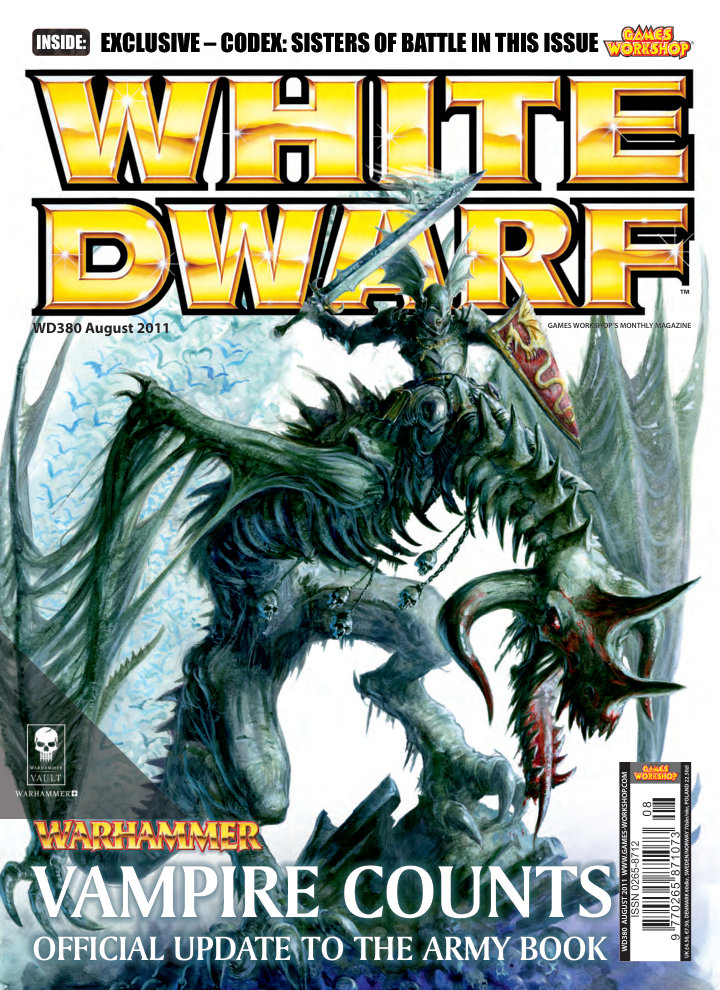
EditorialWD 380 · Inside cover
Andrew Kenrick introduces a month in which the Storm of Magic campaign brings unlikely allies together. New Vampire Counts monsters and official character rules accompany an Empire–Daemon alliance against the Undead, while the first instalment of the Sisters of Battle Codex supplies background and unit rules ahead of September’s army list.
Warhammer Fantasy BattlesWarhammer 40,000
CommunityWD 380 · pp. 14–15
The Scourge of the Storm campaign invites players to register battles between 16 July and 27 August, with participating stores counting results twice and the final outcome due on 31 August. Other news previews the Space Marine collector’s edition and The Church of the Damned, the second Dark Heresy Apostasy Gambit adventure, which takes its investigation into an Ecclesiarchy conspiracy.
Warhammer Fantasy BattlesWarhammer 40,000
RulesWD 380 · p. 15
An official amendment changes the Power Scroll into a one-use arcane item that halves the casting value of a single spell. It costs 35 points and cannot be used with a boosted version of a spell, making the restriction part of the updated rule rather than an optional interpretation.
Warhammer Fantasy Battles
InterviewWD 380 · pp. 16–25
Simon Grant talks to Phil Kelly, Alex Hedström and Brian Nelson about the new Vampire Counts models and rules. Hedström contrasts the rearing, decayed nobility of the Zombie Dragon with the forward-lunging Terrorgheist and its bestial Ghoul King rider; exposed organs and ribs draw on John Blanche’s imagery. Kelly gives Wraiths and Banshees individual histories as heroes, while Nelson discusses the freedom that plastic character kits offer for delicate poses and sculpted bases.
Warhammer Fantasy BattlesVampire Counts
TacticsWD 380 · p. 21
A 2,998-point force places Ashktar on a Terrorgheist above a broad infantry host supported by Necromancers, a Wight King, a Tomb Banshee and two Cairn Wraiths. The accompanying plan uses replenishable blocks to hold enemies, Ethereal heroes to inflict damage safely against ordinary weapons, and Grave Guard or the Varghulf to finish important fights. Dire Wolves hunt war machines while the Ghoul King combines magical support with the Terrorgheist’s ranged scream.
Warhammer Fantasy BattlesVampire Counts
RulesWD 380 · pp. 22–23
The new 225-point Rare monster can instead carry a Vampire Lord with Ghoulkin. Its Death Shriek rolls two dice plus remaining wounds against the target’s Leadership, inflicting magical wounds without armour saves; it can be used after marching, charging or entering combat, subject to the stated targeting limits. The entry also explains its flight, regeneration and optional poisonous maw or death-triggered infestation, alongside the blood bond through which Ghoul Kings raise these gigantic bats.
Warhammer Fantasy BattlesVampire Counts
RulesWD 380 · p. 24
The Tomb Banshee becomes a 95-point Hero with Ethereal, Terror and Undead rules, and may also join a Pact of Sylvania within its stated limit. Her eight-inch Ghostly Howl compares two dice plus two with the victim’s Leadership and ignores armour. The accompanying background presents these spirits as wicked women trapped by fear of the afterlife, illustrated by the slaughter that opens Ironstone Fortress to Vyktros Von Krieger.
Warhammer Fantasy BattlesVampire Counts
RulesWD 380 · p. 25
A 60-point Cairn Wraith Hero combines a great weapon with Ethereal, Terror and Undead. Chill Grasp trades all of its normal attacks for a single strike that automatically wounds if it hits and permits no armour save. The lore describes early sorcerers surviving as bodiless spirits bound to grief or hatred, explaining both their resilience against ordinary troops and their exposure to magical weapons.
Warhammer Fantasy BattlesVampire Counts
LoreWD 380 · pp. 26–33
Andy Hall explores the graveyards dedicated to Morr, where priests guard the dead from necromancers and grave robbers. A village burial ground and the sprawling necropolises of great cities serve the same religious purpose, while the new terrain kit turns that setting into a playable place of walls, tombs and monuments. The feature connects its design, optional terrain rules and the haunted landscape around Mousillon.
Warhammer Fantasy BattlesThe Empire
InterviewWD 380 · pp. 28–29
Dave Andrews explains how the Garden of Morr can function as one enclosed graveyard or as scattered pieces across a battlefield. Removable mausoleums, varied heights and walls that fit together keep the kit useful during a game; combining two sets creates a larger necropolis. The design deliberately accommodates open burial grounds as well as densely occupied arrangements rather than prescribing a single finished layout.
Warhammer Fantasy Battles
RulesWD 380 · pp. 30–31
Suggested rules let players treat a Garden of Morr as mysterious terrain, rolling when a unit first approaches within six inches. Results range from an ordinary graveyard to grasping marshland, a Charnel Pit, a haunted site or an Arcane Ruin, with an extra Storm of Magic interaction. Individual walls, statues and crypts can instead use existing rulebook terrain types; the article asks players to agree these choices before the battle.
Warhammer Fantasy Battles
LoreWD 380 · pp. 32–33
Mawhrin Skell’s Chaos invasion drives the defenders towards Mousillon and draws both the Duke of Quenelles and the Undead into the struggle. A prophetic warning and desperate circumstances produce a sorcerous pact whose consequences may outlast the immediate battle. In the accompanying Bloody Challenge, Moriva Darkstalker and her Zombie Dragon fight Skell’s Manticore among the clouds; the Vampire returns, but Skell disappears from history for a century.
Warhammer Fantasy BattlesBretonnia
TacticsWD 380 · pp. 36–41
Simon Grant examines how mounted models turn movement and a successful charge into extra attacks and knocked-down enemies, while their broad bases leave them vulnerable to overlapping infantry fights. He recommends using speed to choose isolated targets and matching the investment in mounted heroes to the size of the cavalry force. Heroic Moves, support from mounted Wizards and careful management of priority are central to preserving momentum.
Middle-earth Strategy Battle Game
TacticsWD 380 · pp. 38–39
Light cavalry should strike after an enemy has committed and use priority or Heroic Moves to escape before a counterattack. Mounted shooting can wear down isolated enemies without surrendering mobility, while small formations offer useful harassment without absorbing a whole army’s budget. Galadhrim Knights, Riders of Rohan, Haradrim Raiders and Warg Riders illustrate different combinations of bow fire, poison, throwing spears and mount strength.
Middle-earth Strategy Battle GameGaladhrim
TacticsWD 380 · pp. 40–41
Heavy cavalry can form an arrowhead around a strong mounted hero, with supporting riders and a banner turning a breach into a sequence of Heroic Combats. An army built around the charge needs reserves and cheaper heroes to keep movement under control after the first impact. The article also explains how terrain, countercharging mounted models and defensive shielding can blunt an opposing cavalry attack, using Morgul Knights and Imrahil’s Dol Amroth force as examples.
Middle-earth Strategy Battle GameMordor
TacticsWD 380 · pp. 42–49
Simon Grant explains how a sorcerous pact adds Daemons or Undead to a Storm of Magic army through its Monsters and Magic allowance. Such allies begin trusted but can become increasingly unreliable, so their deployment and purpose need thought as well as their raw strength. Five collections show how a pact can supply missing magical tools, a disposable attacking force or an unsettling narrative alliance.
Warhammer Fantasy Battles
TacticsWD 380 · p. 43
Simon Grant combines a 2,993-point High Elf army with a 750-point Khorne pact of a Bloodthirster and Bloodletters. Teclis and several supporting Wizards contest the magical battle while Phoenix Guard and White Lions guard important positions. The aggressive Daemons operate at a distance from their uneasy allies, supplying direct violence while reducing the practical disruption of a deteriorating pact.
Warhammer Fantasy BattlesHigh Elves
TacticsWD 380 · pp. 44–45
Andrew Kenrick uses Azhag’s crown as the story behind a 4,000-point Orcs & Goblins force allied to Tomb Kings. A Tomb Prince and Skeletons protect a remote flank while the Liche Priest adds another Wizard for fulcrum duties. Three Arachnaroks and a bound Chimera supply enormous attacking power, and the plan deliberately keeps a cheap Wizard available to claim an unattended fulcrum late in the game.
Warhammer Fantasy BattlesOrcs & Goblins
TacticsWD 380 · p. 46
Tom Hutchings adds a 993-point Daemon pact to almost 4,000 points of Warriors of Chaos. Foot Wizards and Warriors hold fulcrums, while mobile sorcerers, a Manticore and a Giant threaten the enemy’s. A Tzeentch Herald using Shadow magic can exchange places with the Sorcerer Lord, and the combined attack aims to remove defenders before champions confront the Wizard at the centre of a position.
Warhammer Fantasy BattlesWarriors of Chaos
TacticsWD 380 · p. 47
Andy Hall reinforces a 1,999-point Tomb Kings army with the Vampire Viktoria Von Drak, a Necromancer and Zombies. The new contingent supplies a growing roadblock and different magic without replacing the Tomb Kings’ own strengths. Light magic, archery, Stalkers and Apophas target opposing Wizards, while the Tomb King and his supporting magic threaten monsters with Heroic Killing Blow.
Warhammer Fantasy BattlesTomb Kings
TacticsWD 380 · pp. 48–49
Matt Hutson’s nearly 4,000-point Bretonnian host accepts Moriva Darkstalker, a Zombie Dragon and Blood Knights as an offensive pact. Multiple lance charges are intended to break large enemy units, while the Duke’s Heroic Killing Blow and Falcon Horn address monsters and flyers. The Vampire contingent attacks fulcrums and regenerating creatures, turning the defence of Quenelles into a dangerous bargain with Mousillon.
Warhammer Fantasy BattlesBretonnia
Battle reportWD 380 · pp. 52–71
Andy Hall’s Empire faces Mark Latham’s Vampire Counts in a 3,000-point Storm of Magic battle with a further 750 points each for Monsters and Magic. Balthasar Gelt summons Daemons to support a defensive gunline and infantry blocks, while Luthor Von Krüger’s Zombie Dragon, Blood Knights and two Varghulfs lead the Undead attack. Early shooting destroys the Chimera and Cockatrice, but the Varghulfs tear through artillery and Wizards and briefly leave the Empire without a fulcrum.
Warhammer Fantasy BattlesThe Empire
EditorialWD 380 · pp. 72–73
Jervis Johnson argues that rules for a miniature wargame should grow from its models and imagined world. Abstract games can succeed on their mechanics alone, but an unrelated special ability can weaken a Warhammer design even if it balances well. He recommends returning to the background and miniature when a rule needs improvement, while remaining willing to reconsider familiar assumptions during development.
ShowcaseWD 380 · pp. 76–79
Eight studio painters explore how Storm of Magic monsters can support striking palettes and natural markings without being restricted to realistic colours. Parakeet-like plumage, tiger stripes, pale flesh, bruised membranes and bright manes distinguish Cockatrices, Chimeras, Giants and Manticores. The captions explain the visual decisions behind these schemes, including the use of contrasting body parts and texture, but do not give named paint recipes.
Warhammer Fantasy Battles
InterviewWD 380 · pp. 80–81
Trish Carden selects the Corpse Cart for its unusually vivid horror: swollen wood, piled bodies and struggling Zombies suggest sound, smell and damp decay as well as a striking silhouette. Colin Grayson’s digital chassis and Brian Nelson’s traditionally sculpted figures required close collaboration to fit the tangled load together. Curved rib-like sides and a sagging coffin base help the vehicle feel burdened by its gruesome cargo.
Warhammer Fantasy BattlesVampire Counts
ModellingWD 380 · pp. 82–89
Duncan Rhodes takes the Dark Elf Black Dragon from a planned assembly to a finished centrepiece. The guide builds a stable model from the base upwards, leaves the rider and throne separate for painting, and uses repeated dry fitting to avoid awkward joins. A dark grey body, muted wings, purple rider details and weathered rocky base give the finished monster a coherent scheme despite its many surfaces.
Warhammer Fantasy BattlesDark Elves
ModellingWD 380 · pp. 83–85
The assembly sequence starts with the rocky base and tree before joining the Dragon’s tail, body, limbs and wings. Duncan Rhodes explains the choice of head and rider, the four-part throne and the value of checking the pose before gluing. Keeping the Dreadlord and saddle removable makes the later paint stages easier, and unused rider components can provide character for other Dark Elf models.
Warhammer Fantasy BattlesDark Elves
PaintingWD 380 · pp. 86–88
Chainmail armour and purple cloth establish the Dreadlord’s scheme, with Tallarn Flesh skin and a brown-gold foundation for ornate details. Black and flesh washes separate the surfaces before brighter silver, gold and skin highlights restore definition. The throne repeats the purple and gold colours, adding a brown seat and bone skull so that the rider’s fittings remain visually linked to the Dragon’s armour.
Warhammer Fantasy BattlesDark Elves15 paint colours
PaintingWD 380 · pp. 86–88
Adeptus Battlegrey skin and Charadon Granite membranes are shaded with Badab Black, leaving the monster dark without losing its sculpted detail. Successive grey and khaki highlights describe the musculature and wings, while bone spines, purple mouth tissue and blue-black claws receive their own controlled highlights. Gold armour is washed and restored separately, creating a warm contrast against the creature’s subdued body.
Warhammer Fantasy BattlesDark Elves17 paint colours
PaintingWD 380 · p. 89
The scenic base uses a grey-and-earth foundation for rock and a brown foundation for the tree, followed by a shared dark wash. Drybrushed highlights separate their textures, and green then brown washes give the rocks weathering. Black-painted sand is brought up through Bubonic Brown and Bleached Bone before a Graveyard Earth rim and static grass complete the model; the painted rider and throne are then attached.
Warhammer Fantasy BattlesDark Elves11 paint colours
RulesWD 380 · pp. 90–103
Robin Cruddace and Mat Ward present the first half of a new Sisters of Battle Codex, replacing Codex: Witch Hunters. Background leads into army-wide faith mechanics and profiles for infantry, vehicles and named leaders, establishing how the Orders Militant fight. This instalment supplies unit rules rather than a complete selectable army: the points, options and army-selection list are explicitly reserved for the following month.
Warhammer 40,000Adepta Sororitas
LoreWD 380 · pp. 90–93
The history follows the Daughters of the Emperor from San Leor into Goge Vandire’s service, then through Alicia Dominica’s encounter with the Emperor and the fall of the Reign of Blood. Sebastian Thor’s prohibition on men under arms leaves the women’s orders as the Ecclesiarchy’s military arm. The two convents and the foundation of the six major Orders Militant explain how saints, shared traditions and later divisions shape the modern Sisterhood.
Warhammer 40,000Adepta Sororitas
LoreWD 380 · p. 93
A campaign chronology places the Orders in conflicts from San Leor to the Promethean War. Retribution against the Red Corsairs, the recovery of relics from daemon-haunted Piety and the destruction of Sanctuary 101 show very different costs of faith. The later accounts include Celestine’s victory over Gralastyx and Praxedes’ sacrifice against Hive Fleet Kraken while protecting an evacuation.
Warhammer 40,000Adepta Sororitas
RulesWD 380 · p. 94
The army generates D6 Faith points at the beginning of its Movement phase, with unused points lost at the end of that turn. An Act of Faith spends a point and succeeds on a modified five or more, with bonuses for leadership within the unit and casualties already suffered. The page clarifies how joined characters share an effect and when separate attempts are required, while Shield of Faith grants the army its basic invulnerable protection.
Warhammer 40,000Adepta Sororitas
RulesWD 380 · p. 95
The Canoness combines spiritual authority with command of an Order’s warriors. Her independent-character and Stubborn rules accompany Faith and Shield of Faith, while The Passion grants her unit greater Initiative and Preferred Enemy during an Assault phase. The entry describes a leader whose battlefield authority grows from long service as well as religious devotion.
Warhammer 40,000Adepta Sororitas
RulesWD 380 · p. 95
A Canoness’s Celestian bodyguard can draw on the non-militant orders through a Dialogus and Hospitaller, adding communication and medical support to experienced warriors. Their Endless Crusade Act of Faith operates in the Movement phase, granting Relentless and Move Through Cover until the end of the turn. The combination supports an advance in which heavy equipment does not prevent effective fighting.
Warhammer 40,000Adepta Sororitas
RulesWD 380 · p. 96
Confessors and Preachers accompany wars of faith, recover relics and carry the Ecclesiarchy’s authority into combat. Their Righteous Rage lets a charging unit re-roll failed hits, and the entry gives the two priest profiles alongside Faith, Shield of Faith and the Rosarius. The rules make their religious leadership a practical contribution to an assault.
Warhammer 40,000Adepta Sororitas
RulesWD 380 · p. 96
Small personal retinues allow Ecclesiarchy leaders to retain fighting attendants within the restrictions of the Decree Passive. Crusaders bring power weapons and storm shields, Death Cult Assassins combine paired power weapons with agility, and Arco-flagellants offer a brutal form of penal service. Their separate profiles and protections give the conclave several distinct close-combat roles.
Warhammer 40,000Adepta Sororitas
RulesWD 380 · p. 97
Repentia seek redemption through dangerous assaults, directed by a Mistress with neural whips and armed with heavy eviscerators. Fearless, Feel No Pain, Fleet and Rage govern their advance. Spirit of the Martyr allows a model killed before it can strike to make one final attack after the main fighting, ensuring that a successful Act of Faith can turn even a fatal charge into damage.
Warhammer 40,000Adepta Sororitas
RulesWD 380 · p. 97
The Penitent Engine exposes its condemned pilot within an open-topped walker equipped with close-combat weapons and heavy flamers. Rage drives it forward and its rules ignore shaken and stunned results. Battle Frenzy rewards each unsaved wound with another attack, while explicitly preventing these additional attacks from generating an endless chain of further blows.
Warhammer 40,000Adepta Sororitas
RulesWD 380 · p. 98
The core Battle Sister squad draws on the Schola Progenium’s training and the guidance of its Superior. Light of the Emperor can enable an otherwise forbidden regroup in the Movement phase or allow re-rolls of hit rolls of one in a Shooting or Assault phase. Each fresh use needs its own Faith point and test, so the rule supports several roles without making their benefits automatic.
Warhammer 40,000Adepta Sororitas
RulesWD 380 · p. 98
Veteran Celestians bear marks of distinction and serve where discipline and experience matter most. Their Hand of the Emperor Act of Faith operates during an Assault phase, increasing Strength and granting Fearless. The entry ties their elite standing to a close-combat role that differs from the more general utility of ordinary Battle Sisters.
Warhammer 40,000Adepta Sororitas
RulesWD 380 · p. 99
Dominions concentrate special weapons into an aggressive shock unit and use Scouts to find favourable positions before the main fighting. Holy Fusillade makes their shooting twin-linked for the phase. The rules and accompanying background emphasise decisive short-range fire against an important target rather than a prolonged exchange.
Warhammer 40,000Adepta Sororitas
RulesWD 380 · p. 99
Jump-equipped Seraphim use Hit & Run and the ability to fire both pistols to move between close-range attacks. Angelic Visage improves reliability through re-rolls of their Faith test and Shield of Faith saves, while The Emperor’s Deliverance re-rolls failed wounds in shooting. Their entry presents mobility, concentrated pistol fire and withdrawal as complementary parts of the same role.
Warhammer 40,000Adepta Sororitas
RulesWD 380 · p. 100
Retributors provide the Orders Militant with concentrated heavy-weapon fire, ranging from bolters to flamers and meltas. Divine Guidance grants Rending to their shooting attacks for the phase, giving even familiar weapons a chance to defeat unusually resistant targets. Their background places patience and judgement behind the timely delivery of overwhelming fire.
Warhammer 40,000Adepta Sororitas
RulesWD 380 · p. 100
The Exorcist combines a heavily protected front with a missile launcher housed in an ornate mobile shrine. The entry describes ancient, temperamental machines whose ritual significance sits alongside their long-range battlefield purpose. Its vehicle profile and Shield of Faith appear here, while the following army-list instalment is needed for the complete equipment and selection details.
Warhammer 40,000Adepta Sororitas
RulesWD 380 · p. 101
The Rhino carries ten models, with restrictions on Terminator-armoured passengers, two top fire points and three access points. Its repair rule gives an immobilised crew a chance to restore movement by foregoing shooting. Shield of Faith, a storm bolter and smoke launchers accompany the familiar transport profile, making it the army’s straightforward protected carrier.
Warhammer 40,000Adepta Sororitas
RulesWD 380 · p. 101
The Immolator trades transport capacity for an integral twin-linked heavy flamer, carrying six models without fire points. Its profile, three access points and Shield of Faith define a close-support vehicle rather than a full squad carrier. Background also describes other weapon configurations, with the subsequent army list supplying the selectable equipment options.
Warhammer 40,000Adepta Sororitas
RulesWD 380 · p. 102
Kyrinov’s presence makes nearby friendly units Fearless through the Icon of Chiros, while Heightened Fervour combines the functions of a laud hailer and simulacrum imperialis. His Mace of Valaan can reduce a wounded opponent’s Initiative for the following player turn. Together with the priestly rage and faith rules, these abilities make his religious symbols and personal weapon influence the surrounding battle.
Warhammer 40,000Adepta Sororitas
RulesWD 380 · p. 102
Jacobus improves the army’s faith economy by allowing its Faith-point generation roll to be repeated. His Banner of Sanctity grants his unit an extra Attack and Feel No Pain, complementing Stubborn and Righteous Rage. The Redeemer shotgun supplies short-ranged fire, but the entry’s main emphasis is on the resilience and aggression he brings to his followers.
Warhammer 40,000Adepta Sororitas
RulesWD 380 · p. 103
Celestine fights as an independent jump-infantry saint protected by the Armour of Saint Katherine. The Ardent Blade combines a power-weapon attack that wounds on a four or better with a flame template. Miraculous Intervention leaves a marker when she falls and can return her with D3 wounds in a later turn; if she is alive at the end, her apparent death does not surrender a kill point.
Warhammer 40,000Adepta Sororitas
CommunityWD 380 · pp. 106–107
Rik Turner talks to Andrew Kenrick about an exhibit tracing products from initial concept through sculpting, artwork, rules revisions, packaging and magazine coverage. Storm of Magic, Vampire Counts and the forthcoming Ogre Kingdoms book illustrate that process. Visitors can also meet the people who design, paint and assemble models and attend Finecast workshops, making the studio’s working methods the focus of the event feature.