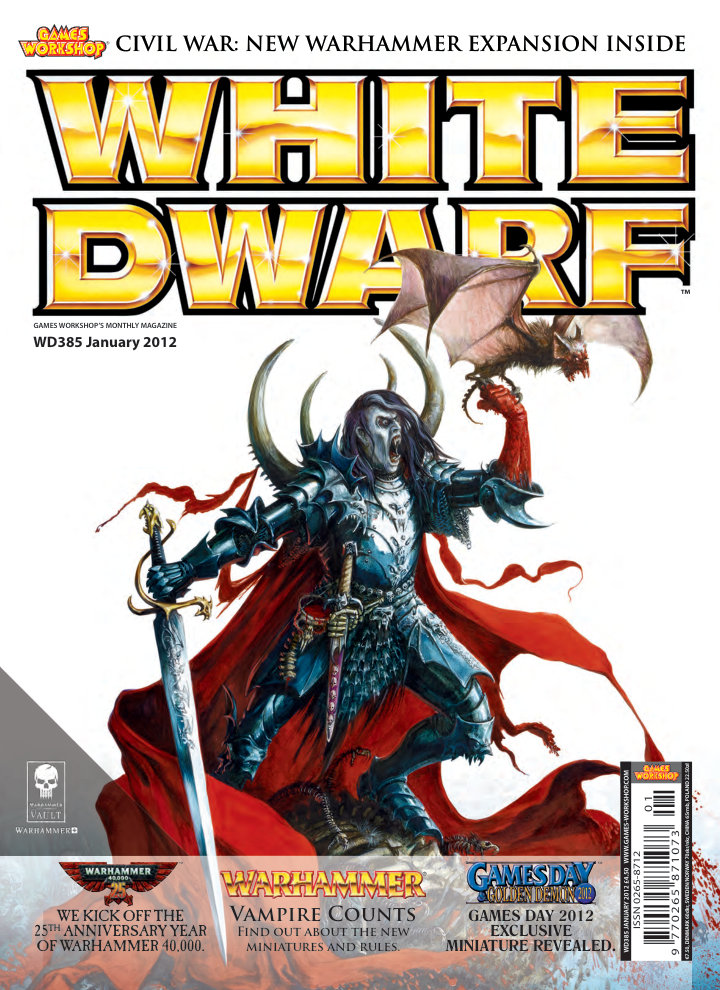
EditorialWD 385 · Inside cover
Andrew Kenrick welcomes the new year with the return of the Vampire Counts, already making Matt Hutson a more dangerous opponent for his Tomb Kings. New flying infantry and the Mortis Engine accompany Mannfred’s latest scheme against Ulthuan. The issue also starts Civil War, an expansion for battles between rival armies drawn from the same race.
Warhammer Fantasy Battles
CommunityWD 385 · p. 19
January’s news points newcomers towards introductory hobby sessions and announces the approaching 25th anniversary of Warhammer 40,000. School League heats expand to sixty-four Hobby Centres, while roleplaying previews explore criminal Rogue Traders and the Old World’s decadent nobility. The page connects the seasonal influx of new models with learning to build, paint and play them.
Warhammer Fantasy BattlesWarhammer 40,000
LoreWD 385 · pp. 22–23
An army-book extract explains why Vampires are more dangerous than other walking dead: ambition and force of personality let them command the creatures drawn to their magic. Former human attachments survive as distorted pride, names and heraldry, while their armies embody mortal fears. The Vampire Wars and the uncertain final fate of Mannfred leave the prospect of a renewed Undead empire unresolved.
Warhammer Fantasy BattlesVampire Counts
TacticsWD 385 · pp. 24–33
Simon Grant explains how Vampire characters sustain the army’s movement and necromancy while acting as powerful fighters themselves. The Hunger, the General’s march radius and the danger of losing that General all affect how a force is built. Examples range from a flying character-killer and a magical specialist to a Coven Throne noble, a Dragon-mounted warlord and a Ghoul King, demonstrating how powers, equipment and supporting units produce very different armies.
Warhammer Fantasy BattlesVampire Counts
TacticsWD 385 · p. 25
Phil Kelly presents two contrasting Vampire Lords. Lord Marius flies out to hunt characters with exceptional Weapon Skill, speed and Strength, but must avoid being trapped by ranked infantry. Lady Camille instead strengthens the Magic phase through an extra Winds of Magic chance, improved Invocation and the Cursed Book, making the support of the Undead ranks her primary task.
Warhammer Fantasy BattlesVampire Counts
RulesWD 385 · pp. 26–27
The Coven Throne’s official preview combines swift Vampire handmaidens, a spirit horde and protective magic within a chariot profile. Battle of Wills can reduce an attacker’s skill, force successful hits to be repeated or turn an enemy unit against itself, while the Scrying Pool grants a chosen re-roll. Simon Grant’s Countess Emilia pairs that rule with a Leadership penalty and protective equipment to exploit the mount’s hypnotic defence.
Warhammer Fantasy BattlesVampire Counts
TacticsWD 385 · pp. 28–29
Countess Emilia’s 3,000-point army rests on three large Skeleton blocks, with Banshees adding damage against hard targets and a Necromancer enlarging the ranks. Black Knights support the Coven Throne, Hexwraiths sweep a flank and a Ghoul horde threatens monsters with poison. A Mortis Engine strengthens nearby casting and damages light units, while Spirit Hosts guard the rear as the discarded lovers of the Lahmian theme.
Warhammer Fantasy BattlesVampire Counts
TacticsWD 385 · pp. 30–31
The 2,997-point Wolf Crag host follows a Vampire Lord on a Zombie Dragon, whose mobility keeps fast units within his marching influence. Low-cost spells and several Necromancers spread magical duties rather than risking everything on one high-level caster. Knights, Vargheists and a Varghulf strike hard, while the infantry holds dangerous opponents or reinforces the advancing elements.
Warhammer Fantasy BattlesVampire Counts
TacticsWD 385 · pp. 32–33
Tom Hutchings builds a 2,750-point force around a Strigoi Ghoul King whose extra wound, Leadership-reducing aura and Skabscrath combine with his Terrorgheist’s scream. Ghouls and Crypt Horrors form a poisonous central line while faster creatures work the flanks. Careful placement of the General offsets marching restrictions, and the army advances across a broad front before its most violent elements punch through a weak point.
Warhammer Fantasy BattlesVampire Counts
TacticsWD 385 · pp. 34–37
The Lore of the Vampires replenishes and strengthens the army as well as attacking its enemies. Invocation can heal multiple nearby units, Raise Dead creates fresh bodies and the lore attribute restores a lost wound. Necromancers offer cheaper magical support or an alternative general, while Corpse Carts and the Mortis Engine amplify nearby effects. The article stresses that vampire power works best with a supporting magical structure.
Warhammer Fantasy BattlesVampire Counts
RulesWD 385 · p. 35
The Mortis Engine carries a dead sorcerer’s relic within a spirit-borne cage of bone. Its aura grows with the turn number, harming enemies and improving nearby Undead regeneration, but doubles damage the Engine and its destruction releases a wider burst. A Blasphemous Tome strengthens Vampire-lore casting for friend or foe while making nearby miscasts more dangerous, giving its support role a substantial risk.
Warhammer Fantasy BattlesVampire Counts
TacticsWD 385 · p. 36
Necromancers can support a Vampire cheaply, enlarge Skeleton units through Master of the Dead or lead an army as a Master Necromancer. The page also explains the Corpse Cart’s response when targeted by Vampire magic: nearby Undead gain Always Strikes First. Keeping suitable extra models available matters because raised Zombies and eligible Skeletons can exceed their initial unit sizes.
Warhammer Fantasy BattlesVampire Counts
TacticsWD 385 · p. 37
Matt Hutson’s 1,999-point army shows how Kemmler can lead without a Vampire. Wights, Skeletons, Zombies and two Cairn Wraiths form the host, with Black Knights poised to support and a Mortis Engine increasing its only Wizard’s casting power. Krell and the Grave Guard protect the Lichemaster, whose option to become Ethereal adds another barrier against assassination.
Warhammer Fantasy BattlesVampire Counts
ShowcaseWD 385 · pp. 38–41
The studio painters combine familiar red and black with ghostly turquoise and green to expand the Vampire Counts’ visual identity. Different bone, rust, skin and spectral effects distinguish Skeletons, Vargheists, Crypt Horrors and their aristocratic masters. Anja Wettergren contrasts a Coven Throne’s cold spirit bearers with luxurious warm fabrics, while a raised Black Knight mount reinforces its supernatural movement.
Warhammer Fantasy BattlesVampire Counts1 paint colour
LoreWD 385 · pp. 42–45
Phil Kelly recounts Mannfred’s attempt to break the alliance of Elves, Dwarfs and Men while acquiring an innocent soul for Nagash’s return. He lures Princess Aliathra’s delegation into a mountain ambush, then Kemmler raises fallen Orcs and Dwarfs against their former allies. A magical escape fails when Terrorgheists capture the princess and Mannfred defeats her consort, leaving both a ritual victim and renewed mistrust between the older races.
Warhammer Fantasy BattlesVampire Counts
RulesWD 385 · pp. 46–47
A High Elf army of at least 3,000 points must escape along a narrow pass while a Ghoul King blocks the route and Krell’s reserve arrives behind it. An Eagle reaching the far edge earns a draw, while Aliathra or a quarter of the original army escaping wins. Required character and unit selections preserve the historical setting, and the bottleneck rules limit how ordinary units can cross the long table edges.
Warhammer Fantasy BattlesVampire Counts
Battle reportWD 385 · pp. 48–56
Jervis Johnson’s Undead surround Simon Grant’s High Elves in the bespoke mountain-pass scenario. Terrorgheists kill or threaten the escaping Eagles, and the Mortis Engine’s final explosion destroys a bird that seemed certain to get away. Dragon Princes survive through armour and the Battle Banner, defeat the Ghoul King and endure a rear attack by Vargheists. Aliathra lives on one wound and rides off with them to secure a narrow High Elf victory.
Warhammer Fantasy BattlesVampire Counts
EditorialWD 385 · pp. 58–59
Jervis Johnson explains why designing rules does not necessarily make their author a strong player. Designers may follow their original imagined battle instead of discovering every efficient use of the mechanics, and may spend games evaluating wording or points rather than pursuing victory. Deadlines limit endless revision and external playtesters expose overlooked possibilities, but neither automatically improves the designer’s win rate.
TacticsWD 385 · pp. 60–67
Mat Ward builds Necron tactics around durable troops, superior shooting and combinations supplied by leaders, Crypteks and C’tan powers. He balances those advantages against slow movement and low Initiative, which make deployment and assault avoidance important. The discussion covers objective troops, specialist attackers and vehicles before showing how relatively small changes in wargear can alter the army’s role.
Warhammer 40,000Necrons
TacticsWD 385 · p. 61
Warriors establish stubborn objective positions, with a Ghost Ark improving mobility and replacing casualties. Immortals can either form small support squads or advance at full strength with a character towards enemy-held ground. Mat Ward connects their gauss-or-tesla choice to target armour and the army’s other anti-vehicle tools rather than treating one weapon as universally superior.
Warhammer 40,000Necrons
TacticsWD 385 · pp. 61–63
Deathmarks exploit a chosen quarry but should avoid exposing themselves to an immediate assault. Flayed Ones can attack or distract, Lychguard choose between heavy hitting and resilient shielding, and Praetorians exchange some melee power for speed and fearlessness. C’tan Shards, Destroyers and Scarabs answer different hard targets, with Scarab Entropic Strike offering a particularly direct way to dismantle heavy vehicle armour.
Warhammer 40,000Necrons
TacticsWD 385 · p. 62
Suggested paired powers give specific C’tan identities a suitable battlefield expression, from the Deceiver’s misdirection to the Nightbringer’s lethal presence and the Void Dragon’s anti-machine abilities. The list also names less familiar star gods and notes the Flayer’s destruction. It is offered as thematic guidance, with players encouraged to choose other combinations and invent or convert further Shards.
Warhammer 40,000Necrons
TacticsWD 385 · pp. 63–64
The Monolith combines short-range firepower with a gate that can bring an unengaged unit directly to an important position. Mat Ward suggests deep striking it near an objective to overcome that range limitation. A stationary Doomsday Ark instead provides long-range destructive fire, while the cheaper Annihilation Barge multiplies tesla hits and can arc damage through tightly packed enemy formations.
Warhammer 40,000Necrons
TacticsWD 385 · p. 64
Gauss provides armour penetration against modest saves and a chance to glance vehicles, making it valuable where other anti-tank options are scarce. Tesla trades that penetration for additional hits when sixes are rolled. Mat Ward recommends considering hordes, armoured infantry and the rest of the army’s weapons together, since sheer hit volume can still overcome power armour.
Warhammer 40,000Necrons
TacticsWD 385 · pp. 64–65
Lords improve a unit’s resilience and melee threat, while a Phaeron allows an advancing phalanx to fire and charge more freely. A Command Barge turns an otherwise spare Overlord into a mobile response unit. Crypteks demand subtler matching: their chosen weapon and secondary equipment should complement the unit they join, avoiding wasted fire against incompatible targets.
Warhammer 40,000Necrons
TacticsWD 385 · p. 66
The 1,495-point sample combines four objective-holding units with Lychguard, Praetorians and Flayed Ones to disrupt the enemy. Two Destruction Crypteks supplement gauss fire against armour, and a Monolith plus Doomsday Ark provide heavier attacks. Charnakh remains deliberately inexpensive, preserving the points needed for a balanced mixture of elites and dependable core troops.
Warhammer 40,000Necrons
TacticsWD 385 · p. 67
Kraggog’s 1,492-point force favours large Warrior phalanxes and considerable firepower over many separate scoring units. One Overlord stabilises the infantry while Kraggog uses his Command Barge to answer crises across the table. A Ghost Ark keeps the main blocks alive, Deathmarks ambush vulnerable support and the Monolith and Annihilation Barge help eliminate opposing scoring units quickly.
Warhammer 40,000Necrons
PaintingWD 385 · pp. 70–75
Chad Mierzwa builds the Ghorgon in manageable parts and paints its broad flesh areas before the smaller materials. Warm skin, brown fur and limited red cloth connect it to the Beastmen army, while horns, skulls, iron and verdigris receive distinct finishes. Tool choices and a planned final assembly protect the detail, and the complete guide includes its base, tongue, eyes and leather straps.
Warhammer Fantasy BattlesBeastmen33 paint colours
PaintingWD 385 · p. 72
The Ghorgon’s skin begins with Tallarn Flesh and a brown-black wash applied directly into the recesses. Restoring the base on the muscles precedes successively lighter flesh mixtures and narrow final bone-tinted highlights. Starting with this broad area allows spraying and large brushwork before the surrounding details need protection.
Warhammer Fantasy BattlesBeastmen5 paint colours
PaintingWD 385 · p. 72
Scorched Brown fur is deepened with Devlan Mud, then drybrushed through a leather-and-brown mixture and pure Snakebite Leather. A thin black wash knocks the texture back to a darker finish. Varying the intensity of drybrushing suits different patches of coarse hair while matching the monster to the rest of the Beastmen army.
Warhammer Fantasy BattlesBeastmen5 paint colours
PaintingWD 385 · p. 73
Brown-based horns receive a sepia shade and feathered pale layers that grow brighter towards the tip, while their iron bands use shaded steel and a clean metallic edge. The same method scales down to hooves and other Beastmen horns. The snout deliberately retains darker flesh or receives a flesh wash to avoid over-highlighting its bovine shape.
Warhammer Fantasy BattlesBeastmen9 paint colours
PaintingWD 385 · p. 73
Tin Bitz and bronze drybrushing create the bell’s coppery foundation, followed by a turquoise-green coating of verdigris. Silvered cracks and edges suggest exposed metal beneath that corrosion. Its binding twine is kept separate with granite, black shading and grey highlights, preventing the two weathered materials from merging visually.
Warhammer Fantasy BattlesBeastmen8 paint colours
PaintingWD 385 · p. 74
The many skulls build from earth brown through pale stone to white, with a generous dark wash settling into sockets and other depressions. Red cloth is painted around them and highlighted with an orange-bone mixture. The dangling skeleton and the remains caught in the mane repeat the bone method, while the teeth use the previously described horn sequence.
Warhammer Fantasy BattlesBeastmen11 paint colours
PaintingWD 385 · p. 74
Slate fragments raise selected areas before sand covers the remaining base. Brown and ochre-bone drybrushing establish the ground, followed by a dark wash and two kinds of grass tufts placed in clumps. Chad recommends enough variation to make the large surface interesting without letting the base compete with the monster.
Warhammer Fantasy BattlesBeastmen4 paint colours
PaintingWD 385 · p. 75
The last separate pieces are attached with superglue after painting. Purple shaded black colours the tongue, ochre placed either side of the socket leaves a dark pupil, and the straps move from granite through earth and grey. The weapon blades repeat the earlier iron treatment, while the bell can hang from the belt or neck according to the chosen build.
Warhammer Fantasy BattlesBeastmen9 paint colours
RulesWD 385 · pp. 78–85
Jervis Johnson’s official expansion adds unpredictable conflict rules when both players select the same army list and agree to use them. A normal pitched battle is modified first by a general Civil War table and then by the relevant army table. This first instalment covers Vampire Counts, Beastmen, Ogre Kingdoms and Lizardmen, with later issues promised for the other races.
Warhammer Fantasy Battles
RulesWD 385 · p. 79
The optional Factions rule lets each player add another quarter of the agreed army value to represent a specialised rival organisation or tribe. These additions ignore duplicate-choice and percentage restrictions but cannot purchase magic items. Examples contrast Nuln artillery, White Wolf forces and Skaven clans, encouraging themed asymmetry without requiring different main army lists.
Warhammer Fantasy Battles
RulesWD 385 · p. 80
The general 2D6 table can turn a familiar battle into annihilation, a rush of Vanguard moves, a contest for hated standards or a struggle decided by the generals’ deaths. Other outcomes apply stubbornness, hatred, frenzy or ambushers to both armies, and one result combines two modifiers. The text explains that conflicts between random rules should be settled through the game’s agreed precedence procedure.
Warhammer Fantasy Battles
LoreWD 385 · p. 81
A chronology illustrates internal conflict across the setting rather than portraying civil war as an Imperial exception. The Sundering, Settra’s revenge on rebel kings and the Time of Three Emperors sit beside Dwarf mining claims, Mousillon’s disgrace and a dispute over a Slann’s remains. Its final example follows Zacharias’ successful return against his former master Melkhior to seize a Book of Nagash.
Warhammer Fantasy BattlesHigh Elves
RulesWD 385 · p. 82
The Vampire table turns dynastic rivalry and concentrated necromancy into effects such as altered Ethereal status, grasping graves, tougher Wights and unrestricted marching. Bloodline results strengthen Strigoi, von Carsteins, Lahmians or Blood Dragons, while Necrarch relic hunters gain magic and may steal defeated characters’ equipment. The outcomes make a conflict within one army book feel distinct from a mirror of an ordinary battle.
Warhammer Fantasy BattlesVampire Counts
RulesWD 385 · p. 83
The Beastmen table can recycle ambushers, change access routes or replace ordered units with skirmishing violence. Ritual feasts, famine, Morrslieb and magical prophecy affect leadership, regeneration, spellcasting and available equipment. A monstrous-menagerie result supplies an extra beast and lets destroyed monsters return through ambush, drawing the woodland setting into the battle’s rules.
Warhammer Fantasy BattlesBeastmen
RulesWD 385 · p. 84
Ogre rivals may fight over a challenge stone, prove their beasts’ strength or compete through their generals’ big names. Other results add mountain hazards, visiting warriors’ skills, a Gnoblar feud or a dangerous edge representing the Great Maw. Several outcomes modify scoring as well as profiles, rewarding the particular contest the table has established.
Warhammer Fantasy BattlesOgre Kingdoms
RulesWD 385 · p. 85
The Lizardmen table ranges from ritual combat with blunted weapons to disputes over spawning pools, temple duty and ancient relics. Jungle terrain and returning core troops can transform the field, while rival Slann may gain disciplines or begin too deep in meditation to act. The relic result can decide the game immediately if its bearer falls, making sacred responsibility more than background flavour.
Warhammer Fantasy BattlesLizardmen
RulesWD 385 · pp. 88–91
The updated Vampire Counts pact brings the new army book’s units into Storm of Magic. A qualifying character and core units remain mandatory, with special and rare choices tied to the number of core selections. The introduction reminds players that an allied pact can deteriorate or disappear, then gives two themed armies showing how the new options can support very different hosts.
Warhammer Fantasy BattlesVampire Counts
TacticsWD 385 · p. 90
A 3,997-point Beastmen army allies with Vashrak the Fallen’s 998-point Ghoul King pact. Ghouls and Horrors reinforce the centre so other herds can ambush, while the King’s Terrorgheist, Leadership penalty and nearby Jabberslythe combine against vulnerable targets. The list keeps the Beastmen’s own abundant monsters, using the pact to add synergy rather than replace their identity.
Warhammer Fantasy BattlesBeastmen
TacticsWD 385 · p. 91
A 2,000-point Warriors of Chaos host adds a 499-point pact led by Master Necromancer Korvin. Replenished Zombies form a protective obstacle while the main army spends its Lord allowance on a brutal Khorne fighter and knights. A Mortis Engine boosts Korvin’s casting and threatens nearby enemy miscasts, turning a small Undead contingent into magical support and expendable numbers.
Warhammer Fantasy BattlesWarriors of Chaos
CommunityWD 385 · pp. 92–93
The new Games Day season combines participation games, studio guests and the Golden Demon and Armies on Parade competitions. Its commemorative miniature is Juan Diaz’s Finecast Blood Angels Captain, based on John Blanche’s second-edition cover; Kornel Kozak explains matching the artwork’s pose, flames and reflections in paint. The worldwide event calendar accompanies that design story.
Warhammer 40,000Blood Angels
ShowcaseWD 385 · pp. 94–95
Dan Harden brings Harad and Khand together under the Betrayer and Suladân for a colourful parade through a ruined desert city. Cut-down Osgiliath architecture frames the army without overwhelming it, and a Mûmak painted over three weeks provides the centrepiece. The display turns his interest in the Fallen Realms into a landscape that explains how the collection belongs together.
Middle-earth Strategy Battle GameHarad
PaintingWD 385 · pp. 98–105
Steve Bowerman separates the intricate Mortis Engine into seven assemblies so its open interior and surrounding spirits remain accessible. Cold spectral colour, weathered bone, mouldy stone and a decaying attendant are painted as distinct materials before the final build. The workshop repeatedly points out how these same recipes can unify Banshees, Skeletons, Necromancers and other units elsewhere in a Vampire Counts army.
Warhammer Fantasy BattlesVampire Counts
PaintingWD 385 · p. 100
Pale grey spirits are washed turquoise-blue and repeatedly drybrushed towards white. Selected green recesses vary the spectral shadows while sharp white edges preserve definition. Armour and weapons receive silver with a blue wash and small sepia stains, keeping the metal recognisable but giving it the same unearthly atmosphere as its bearers.
Warhammer Fantasy BattlesVampire Counts8 paint colours
PaintingWD 385 · p. 101
Cold grey robes and hair are shaded blue-grey and highlighted to white, with turquoise worked into selected recesses. The skin instead begins with dark flesh and grey, then rises through pale grey to a white edge. Green eyes, shaded bone teeth and the previous page’s cold metal recipe complete figures that can be painted the same way as ordinary Tomb Banshees.
Warhammer Fantasy BattlesVampire Counts16 paint colours
PaintingWD 385 · p. 102
Granite stone steps receive a heavy brown drybrush, a dark wash and lighter restored layers. Pale stone edges sharpen the shapes, while stippled green and selective flesh or green washes make individual flagstones appear damp and old. The guide suggests carrying the method across gravestones and similar parts throughout the army.
Warhammer Fantasy BattlesVampire Counts7 paint colours
PaintingWD 385 · p. 103
A pale stone base is shaded with diluted brown before bone and white drybrushing pick out the frame. Brown is returned to the recesses, with green sparingly added to selected areas and white sharpening the edges. The same stages apply to ordinary Skeletons and Wights, with Steve recommending painting bone first when speed matters.
Warhammer Fantasy BattlesVampire Counts5 paint colours
PaintingWD 385 · p. 103
Steel locks and casket surfaces are darkened with black and brown washes before silver edges restore the metal. The wax begins brown, receives sepia shade and builds through desert yellow to pale bone. Separating these textures makes the small reliquary read clearly inside the larger cage.
Warhammer Fantasy BattlesVampire Counts8 paint colours
PaintingWD 385 · p. 103
Green flame is shaded and then layered towards brighter green, with a final green-white-yellow mixture reserved for the sharpest highlights. The technique can be reused on Corpse Carts or Hexwraiths, and the finished model’s lantern receives the same effect. The potion uses related colours with smoother successive blends rather than identical hard flame stages.
Warhammer Fantasy BattlesVampire Counts5 paint colours
PaintingWD 385 · p. 103
The tome’s pages begin brown and are shaded to emphasise the separations between them. Desert Yellow produces a dry parchment colour, then bone-tinted layers and white edges make the leaves readable. The finished book receives small fine-brush details, helping an otherwise tiny component contribute to the model’s ancient, forbidden character.
Warhammer Fantasy BattlesVampire Counts5 paint colours
PaintingWD 385 · p. 104
The attendant’s robes build from dark green into pale rotten green with earth-coloured dirt at the hem, while the hood repeats the method in brown. Flesh receives successive warm and purple washes before pale layers, and dark cloth preserves the blindfold. Matted hair and a worn wooden staff complete the figure using simple repeatable stages suitable for other Necromancers.
Warhammer Fantasy BattlesVampire Counts16 paint colours
CommunityWD 385 · pp. 106–109
The venue team describes the Gaming Hall, store, Bugman’s Bar and Miniatures Hall as complementary parts of a hobby visit. Staff explain how displays draw on an archive of art and models, and how the hall’s castle setting supports events from Throne of Skulls and doubles to narrative campaigns. New masterclasses add practical teaching from painters, sculptors and scenery builders, with planned evening activities making larger events a shared weekend experience.
CommunityWD 385 · p. 112
The Bristol profile focuses on the relocated store’s miniature displays and Jay Goldfinch’s winning 2011 Armies on Parade Necron entry. Readers can inspect that cinematic army and other collections, then discuss future competition plans with staff. The piece presents a local route from learning techniques to exhibiting a completed force, beyond its accompanying address information.
Warhammer 40,000Necrons
CommunityWD 385 · p. 113
The relocated Birmingham store is presented through its larger gaming space and hobby workstations. Its staff’s construction of the Lonely Mountain for the previous Games Day Battle of Five Armies provides a concrete example of a local team contributing to a major shared project. The profile encourages participation in similar activities alongside ordinary games and painting.
Middle-earth Strategy Battle Game
InterviewWD 385 · p. 120
Kevin Chin chooses Juan Diaz’s Terminator Chaplain for an imposing stance, skull-faced menace and richly religious details that suit his Imperial Fists. The storm bolter, shaped crozius and parchments reinforce the role rather than merely decorate it. Diaz recalls the difficulty of updating Jes Goodwin’s classic and his surprise that the first Terminator he sculpted became Kevin’s choice.
Warhammer 40,000Space Marines