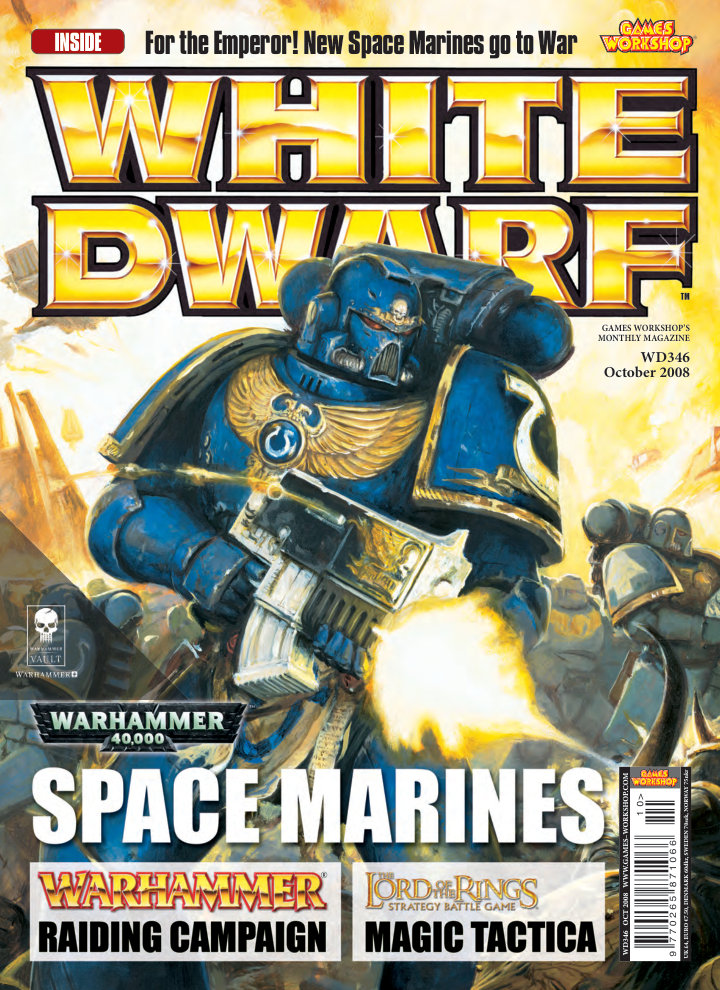
EditorialWD 346 · p. 1
Mark Latham’s long attachment to Space Marines makes the new codex a welcome spur to his Sons of Medusa project. He is painting the Sicarius miniature in the chapter’s bright green scheme and hopes to show it soon. The editorial also reports Phil Kelly’s Studio tournament victory after defeating Matt Hutson in the semi-final, renewing their rivalry and the prospect of another magazine battle.
Warhammer 40,000Sons of Medusa
CommunityWD 346 · p. 14
Warhammer World’s guest display celebrates Matt Hooton’s fifteen years of converting and painting. Early inspiration from Mike McVey and magazine winners led to seven years of attempts before he won two Golden Demons in 2006. The exhibition combines those entries with other work, including his tournament-army and Forge World experience. The notice presents persistence and visible examples as a way to encourage other developing painters.
InterviewWD 346 · pp. 16–33
Andy Hall asks Mat Ward how the new codex restores Tactical squads to the army’s centre while expanding its specialist options. Combat Tactics, chapter heroes, Veterans, Drop Pods and revised equipment provide different routes through the same flexible list. Background on Guilliman and the Chapters connects these changes to their setting. Jes Goodwin then traces the miniatures’ design lineage from Rogue Trader armour through modern plastics and recognisable vehicles.
Warhammer 40,000Space Marines
LoreWD 346 · pp. 26–27
Drop Pods deliver Marines and Dreadnoughts directly to the battle’s critical point, sometimes in formations large enough to bring down an entire Chapter. Harnesses, retro-thrusters and guidance systems explain the model’s functional details, while examples show multiple chapter liveries. The text points to the Skyhammer formation for larger Apocalypse attacks and confirms that the new kit also suits non-Codex chapters such as Space Wolves and Black Templars.
Warhammer 40,000Space Marines
ShowcaseWD 346 · pp. 28–29
The new Land Raider kit supplies two contrasting assault transports: the hurricane-bolter Crusader and flamestorm-armed Redeemer. Photographs and a numbered component guide show the shared chassis and the weapons and fittings that distinguish each version. Rather than a construction tutorial, the spread serves as a close view of the interchangeable plastic options accompanying the codex release and their imposing visual identity.
Warhammer 40,000Space Marines
LoreWD 346 · p. 30
Five chapter sketches contrast different expressions of Space Marine duty. Imperial Fists embody costly tenacity, Crimson Fists endure near-extinction, and White Scars refine the rapid hunt. Salamanders’ frightening appearance is explained through Nocturne and their genetics, while Raven Guard prefer covert action and fast exploitation. Together these portraits give the codex’s shared units distinct histories and motivations without turning the page into a separate army list.
Warhammer 40,000Imperial Fists
InterviewWD 346 · pp. 31–33
Jes Goodwin credits the collaborative origins of RTB01 before explaining how later armour, weapons and chapter heraldry became recognisable. Classical and barbarian influences are mixed rather than copied directly, and the shift to Mk VII changes much more than a helmet. Later multipart kits expand customisation, while vehicles share panels and chamfered shapes. Bob Naismith’s economical original Rhino illustrates how technical constraints can shape an enduring design.
Warhammer 40,000Space Marines
CampaignWD 346 · pp. 36–41
Gav Thorpe completes the raiding series with surprise camp attacks, coastal landings, settlement plunder and a final escape from vengeful defenders. Jervis Johnson adds a Mighty Empires event that temporarily disables a captured asset and awards treasure. A staged campaign links the scenarios through Raid and Pillage points, letting early success purchase more opportunities while exposing the raiders to increasing danger. The final withdrawal decides the campaign.
Warhammer Fantasy BattlesDark Elves
RulesWD 346 · p. 36
Jervis Johnson’s event allows the winner of the round’s first battle to pillage an enemy castle, city or mine. The target loses its normal abilities for the remainder of the round and the raider gains a random treasury payment. Dark Elves may choose the event even if someone else already selected it, reflecting their established coastal predation within the campaign system.
Warhammer Fantasy BattlesDark Elves
RulesWD 346 · p. 37
An unsuspecting army is scattered among camp objectives in randomly selected two-foot squares. Attackers enter from any edge and can burn or loot the tents and supplies, while ordinary defenders must pass activation tests before responding. Characters wake their accompanying troops immediately and nearby action improves other units’ chances. Eight turns leave the raiders balancing plunder against the points the defenders earn for intact objectives and repelled attackers.
Warhammer Fantasy Battles
RulesWD 346 · p. 38
The raiding army arrives in numbered waves along coastal sections, limiting the number of units that can land each turn. Defenders begin inland and must overcome the same surprise activation process as a dawn raid. Loot, prisoners and destroyed buildings reward the attackers, while intact settlements and defeated raiders reward the defenders. Flying units and carefully ordered waves can change how quickly pressure reaches the shore’s objectives.
Warhammer Fantasy BattlesDark Elves
RulesWD 346 · p. 39
Watchtower garrisons are the only defenders initially present when raiders approach a settlement. The rest of the defending army enters from randomly determined edges, creating an uncertain rescue effort. The attackers choose their approach and spend eight turns burning, looting and capturing prisoners. The scoring rewards both successful plunder and preservation of buildings, so relief forces must consider the town’s survival as well as casualties.
Warhammer Fantasy Battles
RulesWD 346 · p. 40
Raiders begin among burnt ruins carrying randomly allocated loot and prisoners, surrounded by an enemy eager for retribution. The defenders move first and hate the attackers, while the raiders must get their prizes off the table within six turns. Anything still on the battlefield can score for the rescuers. Chad Mierzwa’s ruined Chapel and Manor illustrate the aftermath that gives this reversal its setting.
Warhammer Fantasy Battles
CampaignWD 346 · p. 41
A coastal landing leads into attacks on camps and watchtowers that build Raid points. Those points fund further settlement raids, whose victories produce Pillage points for the final escape. Continuing the preliminary attacks offers rewards but risks losing the initiative and skipping straight to withdrawal. In Revenge, stored successes buy critical rerolls; winning that final confrontation decides the whole campaign rather than merely adding another result to a tally.
Warhammer Fantasy Battles
CommunityWD 346 · pp. 43–51
The collectors grow towards thousand-point games and earn additional points for custom objectives. Neil embraces the new Crimson Fists rules, Pete discovers that upgrades cannot replace useful units, Matt combines a mechanised attack with better mission discipline, and Fil adds walkers to his Orks. Their objective models range from fallen Marines to a guard squig. The instalment connects modelling choices with the lessons emerging from regular play.
Warhammer 40,000Crimson Fists3 paint colours
TacticsWD 346 · pp. 44–45
Neil Hodgson adds Pedro Kantor, Sternguard and a chapter-decorated Razorback so that his Crimson Fists’ rules match their appearance. Scoring Veterans and economical full Tactical squads suggest a force organised around mutually supporting infantry blocks. A defeat to Andy Hall’s Tau reveals the cost of crossing exposed ground without Deep Strike or outflanking. Drop Pods and a Redeemer become the next planned answers to that experience.
Warhammer 40,000Crimson Fists
TacticsWD 346 · pp. 46–47
Pete Foley tests his mobile Eldar against Phil Kelly and loses one objective to none after his transport and supporting plan unravel. Small Jetbike units and expensive vehicle upgrades leave too little force to rescue the Autarch or pressure multiple targets. Phil recommends cheap objective holders and a close-combat unit for the empty Falcon. Pete decides to merge the Jetbikes and strip unnecessary equipment before the larger games.
Warhammer 40,000Eldar
TacticsWD 346 · pp. 48–49
Matt Hutson adds a Vindicator, transport and more Marines to give his Red Corsairs both resilience and a stronger attack. Against Alex Boyd’s Orks, Huron leads a mechanised flanking assault while another squad protects the home objective, converting heavy casualties into a mission win. His objective model draws on the Wolf of Fenris story. The painting discussion highlights two-tone vehicles and detailed interiors rather than shortcuts hidden behind closed hatches.
Warhammer 40,000Red Corsairs2 paint colours
TacticsWD 346 · pp. 50–51
A Deff Dread, three Killa Kanz and another Trukk give Fil Dunn more support and a new conversion project. He realises the squadron rules make some purchased upgrades redundant, a useful reminder to check assumptions from earlier editions. Games against Chaos and Tyranids yield mixed results, with another lost home objective proving decisive. Painted metal chips and a guard-squig marker keep the Goff force humorous and visually consistent.
Warhammer 40,000Orks1 paint colour
TacticsWD 346 · pp. 52–57
Simon Grant divides magic into powers that augment allies, blast enemies or confound individual threats. He explains how positioning, movement timing and coordinated attacks turn each category into more than an isolated dice roll. Counterplay includes engaging casters, conserving Will and protecting likely targets. Examples involving Shamans, Ringwraiths and the Wizards stress choosing the right magical job before paying for a prestigious hero.
Middle-earth Strategy Battle GameRivendell
TacticsWD 346 · p. 54
Protective auras, Fury and courage support keep key troops active while healing and extra Will sustain important heroes. Simon Grant distinguishes lasting effects from powers with restrictive end conditions, then recommends pressure on the caster as a counter. A Shaman can support with a spear without joining the fight, preserving Fury if the supported warrior loses. Safe positioning therefore matters as much as successfully casting the initial spell.
Middle-earth Strategy Battle GameMordor
TacticsWD 346 · p. 55
Sorcerous Blast and Nature’s Wrath break formations by putting enemies on the ground, creating openings for nearby warriors. Black Dart and Chill Soul instead threaten selected targets, while Panic Steed can strip even a flying Ringwraith of its mount. Casting during movement allows the army to exploit the result immediately. Heroes with Will can sometimes resist these attacks, but an aggressive assault on the caster offers a more permanent answer.
Middle-earth Strategy Battle GameRivendell
TacticsWD 346 · p. 56
Transfix, Compel and Paralyse let ordinary warriors overwhelm otherwise superior heroes by reducing their fighting ability or separating them from support. Sap Will, Drain Courage and a broken staff can prepare the target over several turns. Simon’s Isengard example combines Gríma, Saruman and Berserkers into an expensive assassination team. Defending against such plans requires reserve Will, thoughtful deployment and keeping the threatening caster occupied.
Middle-earth Strategy Battle GameIsengard
Battle reportWD 346 · pp. 58–83
Mat Ward demonstrates the codex through three 1,750-point armies and three missions. Ultramarines contest scattered jungle objectives with Glenn More’s Eldar, White Scars use speed against Andy Hoare’s Chaos, and Salamanders defend a moon against Phil Kelly’s Tyranids. The resulting draw, win and loss expose different strengths and mistakes. Post-battle discussion connects mobility, chapter characters and combat-squad choices to each mission rather than claiming one universal Marine approach.
Warhammer 40,000Ultramarines
Battle reportWD 346 · pp. 64–69
Sicarius’s Ultramarines establish an early objective lead in a dense jungle, using combat squads, Sternguard and specialist characters. Glenn More’s arriving Eldar and Asurmen’s rampage gradually remove the holders, while Sicarius eventually kills the Phoenix Lord. A final Falcon volley clears another Marine position, leaving the Seize Ground mission drawn at one objective each. The game demonstrates both the reach of flexible Marine squads and the cost of directing too much fire at one hero.
Warhammer 40,000Ultramarines
Battle reportWD 346 · pp. 70–75
Mat Ward’s bike-led White Scars attack Andy Hoare’s Chaos positions in a Capture and Control mission with Dawn of War deployment. Early speed destroys transports and disrupts the defenders, while Vanguard Veterans and a Chaplain absorb or eliminate major threats. The traitors briefly occupy the Marine objective, but returning bikers clear the Daemons as Tactical Marines secure the other site. The result is a two-to-zero White Scars victory.
Warhammer 40,000White Scars
Battle reportWD 346 · pp. 76–81
The Salamanders’ defensive line faces Phil Kelly’s mixed Tyranid swarm in Annihilation. Assault Terminators attack early and the Thunderfire Cannon impedes the advance, but outflanking Genestealers remove the gun and large monsters eventually break the central defence. A Carnifex destroys the Redeemer as the game ends after five turns, securing a ten-to-seven Tyranid win. Splitting Tactical squads gives the attackers additional Kill Points, a mistake identified in the later commentary.
Warhammer 40,000Salamanders
EditorialWD 346 · pp. 84–86
On his sixtieth birthday, John Blanche describes renewed enthusiasm for miniature painting and games through his son’s group. He distinguishes quickly painted army models from slower individual conversions, praising plastic kits for their abundant parts and subtle posing possibilities. A limited palette ties his characteristic style together. An imagined smoke-shrouded mass of Ork bikers becomes a real army project, with an experimental flesh recipe aimed at translucent-looking skin.
Warhammer 40,000Warhammer Fantasy BattlesOrks9 paint colours
PaintingWD 346 · p. 86
John Blanche mixes a dark flesh foundation from Snakebite Leather with small amounts of white and green, then shades it with Devlan Mud. A lighter version of the base restores the highlights before a final green wash unifies the surface. The experiment is intended to suggest the layered, translucent quality he observes in real skin rather than starting with a conventional opaque green. It accompanies his new massed biker project.
Warhammer 40,000Orks4 paint colours
ModellingWD 346 · p. 87
Fil Dunn and Mark Jones prepare a smooth gloss surface before soaking, sliding and positioning a transfer with a brush. Careful drying and sealing protect the image, while varnish or diluted alternatives reduce the final shine. The guide also discusses slitting a decal to fit curves and painting over it to hide film, repair gaps or change its design. Surface preparation and patient handling prevent trapped air and wrinkles.
2 paint colours
PaintingWD 346 · pp. 88–93
Neil Green paints Elrond in the pale Grey Havens costume rather than repeating the warmer Council of Elrond scheme. Thin layers build his face, blue trim and neutral robes, with different highlight widths distinguishing soft cloth from sharp metal. Movie stills guide both colour and the reading of facial shadows. The final sleeve pattern is planned separately before freehand work, with simpler decoration offered as a practical alternative.
Middle-earth Strategy Battle GameRivendell18 paint colours
PaintingWD 346 · p. 90
Elrond’s face begins with a warm brown and purple mixture, followed by increasingly light flesh layers and carefully placed white-tinted highlights. Bone dots at either side of the eye form the pupil through the remaining dark gap. His hair moves from a brown-black foundation to bone-tinted brown highlights. Neil stresses multiple thin coats, using the film’s light and shadow as an observational guide.
Middle-earth Strategy Battle GameRivendell7 paint colours
PaintingWD 346 · p. 91
A blue-black mixture is raised through progressively larger amounts of Bleached Bone to provide restrained contrast against Elrond’s grey robes. The sword separates steel and gold: dark metallic bases receive black or brown washes, then cleaner metallic layers and silver highlights. Planning the relationship between costume colours keeps the miniature readable even when the overall palette is deliberately quiet.
Middle-earth Strategy Battle GameRivendell11 paint colours
PaintingWD 346 · p. 92
Elrond’s grey robe starts with Codex Grey and controlled brown shading in the deepest folds. Successive grey and white mixtures are blended over progressively smaller areas, reserving pure white for barely visible final accents. Neil distinguishes this soft transition from the extreme edge highlights suitable for metal. The accompanying advice starts paint dilution at equal parts water and paint, then adjusts it to the size and purpose of the surface.
Middle-earth Strategy Battle GameRivendell4 paint colours
PaintingWD 346 · p. 93
The sleeve decoration repeats the established blue mixture, then lightens it with bone and settles it into the cloth with a thin brown wash. Neil recommends practising the pattern on paper or card before touching the miniature, and reminds painters that errors can be covered. Omitting the ornament or using a simpler design still produces a finished model; the elaborate freehand is an additional exercise rather than a requirement.
Middle-earth Strategy Battle GameRivendell5 paint colours
PaintingWD 346 · pp. 94–99
Chad Mierzwa, Mark Jones and Nick Bayton distinguish a nearly dry dusting of raised details from the wetter strokes of overbrushing. Infantry, scales, mail, bases and tanks show where each technique works and how they can be combined. Several complete recipes demonstrate the methods, including a glaze that repairs chalky highlights. Brush choice, paint loading and gradual buildup are explained alongside the practical examples.
Warhammer 40,000Warhammer Fantasy Battles28 paint colours
PaintingWD 346 · pp. 95–96
The brush is worked nearly dry on absorbent paper before repeated strokes deposit a fine dusting on raised features. Skeleton bone, Plaguebearer flesh and green Space Marine armour demonstrate the technique on very different models, while the amount of paint determines the texture. A yellow glaze smooths overly chalky white highlights on an Orc’s green skin without erasing the underlying contrast. Gradual buildup allows several highlight strengths.
Warhammer 40,000Warhammer Fantasy BattlesTomb Kings13 paint colours
PaintingWD 346 · pp. 97–98
A brush carrying more paint sweeps raised texture cleanly, preserving the base colour in recesses without the dusty finish of drybrushing. Metallic mail, Uruk-hai armour and Cold One scales show the effect, with washes used afterwards for definition. Two sand-base recipes compare a dark high-contrast ground with a warmer bright one. The examples encourage adapting paint load and tone to the surface rather than treating one technique as universally best.
Warhammer Fantasy BattlesMiddle-earth Strategy Battle GameIsengard13 paint colours
PaintingWD 346 · p. 99
A blue Rhino starts with heavy overbrushing, followed by increasingly light and selective drybrushes that define broad panels and hard edges. The guide explains why very dry paint and firmer strokes suit large flat areas, while warning that the process wears brushes quickly. Separate track steps add metallic wear and brown rust. An alternative blue scheme demonstrates a faster highlight option using Ice Blue.
Warhammer 40,000Space Marines8 paint colours
CommunityWD 346 · pp. 100–101
Adam Troke recalls the first Studio Open Day at Warhammer World, where more than five hundred visitors had arrived before lunch. Staff brought out unusual games, work in progress and painting clinics to make normally hidden creative work accessible. Formula Waaagh!, low-gravity battles, art discussion and a rules seminar illustrate the variety. The report presents direct conversation and shared hobby enthusiasm as the event’s main achievement.
Warhammer 40,000