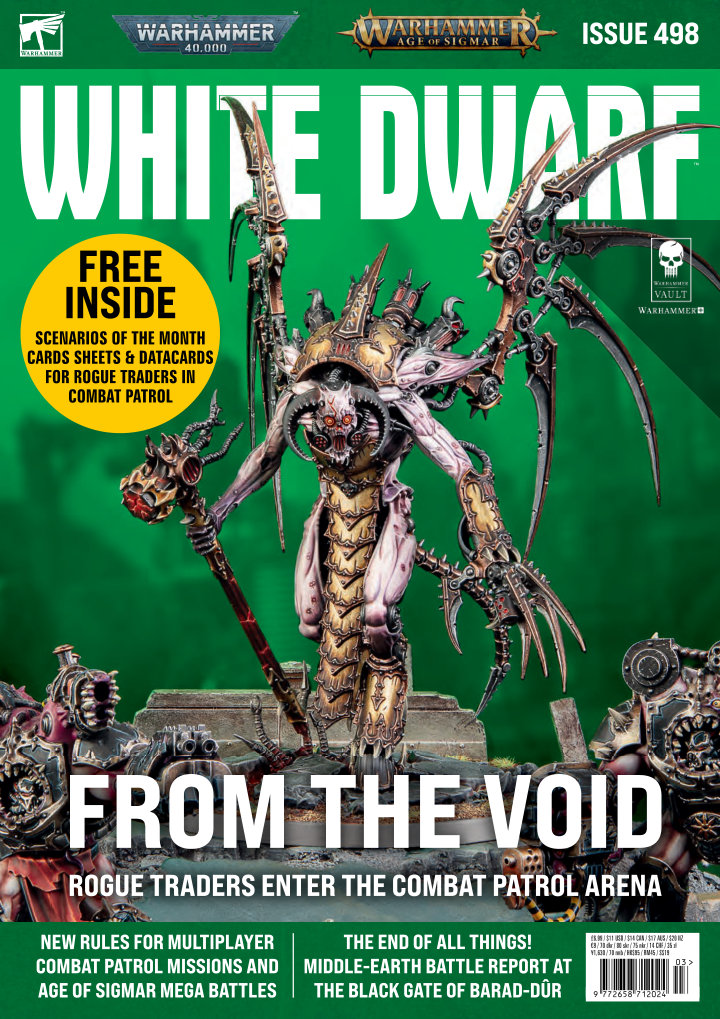
EditorialWD 498 · p. 1
Lyle introduces an unusually scenario-rich issue, ranging from small Warcry hunts and cooperative Cursed City journeys to multiplayer Combat Patrol and enormous Age of Sigmar battles. He invites readers to try the different formats and consider which kinds of games they would like the magazine to develop further. The variety of missions is presented as another way to use existing collections.
CommunityWD 498 · pp. 4–7
Ben Richardson turns miniature boxes into framed dioramas that merge their printed artwork with real scenery. Alexis Siwa describes Be’lakor’s cool blue wings and daemonic skin, while the studio explains the Slann throne’s sandstone and ancient gold. A question about the Doom of Malan’tai explores psychic feeding, and Matteo Pasquali celebrates finally painting an Inquisitor worthy of his childhood ambition.
Age of SigmarWarhammer 40,000Slaves to Darkness13 paint colours
CampaignWD 498 · pp. 8–9
The Bunker campaign moves into its second phase and repeats the additions that allow Combat Patrol and painting to contribute to a team’s progress. Lyle’s Tyranid patrol doubles as the nucleus of a Crusade force, illustrating how one small collection can serve several formats. The rules retain separate personal rewards even when teammates fight each other, while reserving campaign points for battles against rival teams.
Warhammer 40,000
CommunityWD 498 · pp. 10–11
The monthly painting theme turns to elite units, accompanied by the schedule of future challenges and a record of club achievements. Participants can earn rank through painting and gaming rather than results alone. A continuing total and monthly journal encourage the same project to remain part of a longer hobby record.
CampaignWD 498 · pp. 12–15
The Imperial defenders finish the first Bastior phase ahead despite individual defeats and strong invading armies. Player diaries trace Dan’s Mechanicus learning to hold back and use Protector firepower, Matt’s expanding Telennar collection and Wade’s effective Flesh Tearers veterans. Three awarded relics offer a stronger grenade burst, steadier battle-shock tests or a temporary surge of resilience before the team scores reset for phase two.
Warhammer 40,000Adeptus Mechanicus
PaintingWD 498 · pp. 14–15
Matt connects traditionally coloured Aspect Warriors to Craftworld Telennar with shared orange accents, supported by turquoise details and grey wraithbone. Wade’s Third Company receives veteran reinforcements whose deep red, black and warm metallics match the existing Flesh Tearers. Their recipes make the new units part of established Crusade armies while preserving the distinctive roles of individual warriors.
Warhammer 40,000Aeldari23 paint colours
RulesWD 498 · pp. 16–17
Damaged grav-tethers make the battlefield’s empyric flux-nodes drift at the start of each round. Alpha and Omega objectives move in opposing directions, with the trailing player able to influence the roll. Both armies score for temporary control throughout the battle, but a final majority grants a further award, rewarding units able to follow changing positions rather than defend fixed ground.
Warhammer 40,000
RulesWD 498 · pp. 18–19
This historical battleplan recreates the cleansing of Nurgle’s corrupted terrain around the Genesis Gate. Attacking Wizards and Priests sacrifice part of their normal magical activity to attempt rites of purity, while nearby defenders make success harder. Purified scenery is replaced by Awakened Wyldwoods, so the battle physically changes as the attacker attempts to cleanse all three sites within six rounds.
Age of SigmarSylvaneth
RulesWD 498 · pp. 20–21
Command confusion makes a reroll unusually expensive, but each patrol gains an opportunity for a free Heroic Intervention every round. The four-objective mission rewards holding ground and controlling both markers of a matching pair. Players must therefore make their initial plans reliable while remaining ready to countercharge an opponent who reaches a key position.
Warhammer 40,000
TacticsWD 498 · pp. 22–25
Stephen Box explains charging as a second movement opportunity for claiming objectives, blocking routes and suppressing dangerous shooting, as well as killing enemies. His examples cover making space for large models, respecting Fights First, avoiding shooting casualties that lengthen a charge and anticipating Heroic Intervention. The final puzzle asks Chosen to reach an objective screened by a Castellan and Guardsmen with far more combined Objective Control.
Warhammer 40,000Chaos Space Marines
PaintingWD 498 · pp. 26–29
Emily Ridding records the experiments behind a new bright Tyranid force, beginning with natural reference material and several deliberately different test models. Comparing time, contrast and enjoyment reveals which elements can survive across an army. Tests of blue carapace patterning then lead to a final pale-flesh, orange-shell and dark-blue-weapon scheme that combines the strongest discoveries without retaining every labour-intensive stage.
Warhammer 40,000Tyranids
PaintingWD 498 · p. 27
The first test pairs bright yellow carapace with pale pink-tinted flesh, producing an appealing skin tone that is too slow and insufficiently harmonious for Emily’s planned army. The second deliberately explores darker flesh and blue weapons. Although neither becomes the finished scheme, they establish useful colours and show why a test miniature need not be perfected to answer a practical painting question.
Warhammer 40,000Tyranids28 paint colours
PaintingWD 498 · p. 28
The third test develops an effective pale skin recipe and an orange shell, then compares three different blue carapace markings. A central band allows spots to disguise imperfect blending, an inverted pattern demands neater boundaries, and a quick striped version is less satisfying despite its speed. Emily weighs the visual result against the time and pleasure of repeating it across many creatures.
Warhammer 40,000Tyranids21 paint colours
PaintingWD 498 · p. 29
The final recipe simplifies the earlier experiments into warm pale flesh and bright orange carapace against dark blue weapons. Blue-grey joints, pink eyes and a cold grey base sharpen the contrast without adding too many stages. Emily chooses methods she can apply repeatedly to a Combat Patrol rather than preserve the most elaborate treatment from each test.
Warhammer 40,000Tyranids18 paint colours
ModellingWD 498 · p. 29
Patterned plasticard from model-railway or craft suppliers becomes a tiled floor when cut and glued onto a miniature’s base. Covering only part of the base leaves room for rubble and ground texture, while a full covering suggests a temple or palace. Rhuairidh’s adjoining tip recommends the consistency of White Scar Air for sketching freehand designs before filling their shapes.
1 paint colour
CommunityWD 498 · pp. 30–35
Dan Bonter describes Black Hole Wargamers’ team campaign on Vossas Eight, designed to accommodate changing armies and irregular attendance. Studio elite units include weathered statue-like Retributors, quickly shaded Askurgan vampires, converted Space Wolves, mechanically enhanced witch hunters and Flayed Ones rising through a fiery base. The readers’ gallery extends the elite-unit challenge with monsters and veteran warriors from several games.
Warhammer 40,000Age of SigmarOrks18 paint colours
RulesWD 498 · pp. 38–45
Eidelwynne VanTarrion leads a specialist entourage, ten Voidsmen-at-Arms and two Navy Breacher squads in a new Combat Patrol. Mobile close-range firepower, redeployment and split patrol squads support either gathering valuables around the commander or landing deep in enemy territory. Enhancements and stratagems strengthen overwatch, disrupt movement and deliver concentrated broadsides, while an introductory scene shows the crew fighting through an ork-occupied manufactorum.
Warhammer 40,000Imperial Agents
RulesWD 498 · pp. 46–47
The expansion adapts Combat Patrol for three- or four-player free-for-alls and four-player team games. Clockwise turns, command points generated by round, restricted out-of-turn fighting and modified fallback rules prevent the additional players from overwhelming the usual sequence. Separate deployment maps and six mission choices replace the patrols’ normal two-player secondary objectives.
Warhammer 40,000
RulesWD 498 · p. 48
One random objective becomes an active data node each round. Controlling it at the round’s end yields a large reward and removes it from play, while the remaining sites continue to provide ordinary battlefield points. The shrinking network forces every patrol to decide whether to chase the next valuable node or maintain a broader spread of control.
Warhammer 40,000
RulesWD 498 · p. 49
A radioactive storm steadily contracts the safe battlefield around a central sanctuary. Units outside it suffer damage and objectives are consumed, so early salvage opportunities compete with the need to reach safety. The final tally also rewards the force with the most surviving units inside the zone and commanders who have managed to protect themselves.
Warhammer 40,000
RulesWD 498 · p. 50
Commanders score by leading from objective positions, benefit from strong protection when near their troops and become valuable targets for rival patrols. Killing an enemy warlord earns a substantial award, but a final objective tally ensures that heroic duels do not entirely replace holding ground. The mission encourages leaders to commit without carelessly leaving their supporting units behind.
Warhammer 40,000
RulesWD 498 · p. 51
Each patrol receives a nemesis determined by its place in the multiplayer turn order. Invading that rival’s deployment zone and capturing its home objective earn points during the game, directing the battle around the table rather than allowing a purely defensive posture. Ordinary control still matters at the end, creating tension between personal vengeance and the wider contest.
Warhammer 40,000
RulesWD 498 · p. 52
Units can absorb objective markers to become empowered, gaining attack rerolls while carrying the ancient foci with them. Failed battle-shock tests or destruction return the markers to the ground, making the strongest asset a mobile but vulnerable prize. Scoring rewards both conventional control and empowered victories, with a large final bonus for retaining the greatest concentration of foci.
Warhammer 40,000
RulesWD 498 · p. 53
Destroyed infantry units can return at full strength, ensuring the battle remains a relentless struggle despite mounting casualties. Characters, vehicles and monsters cannot use this reinforcement route, and returning troops must wait before charging. Points for kills and holding multiple objectives reward aggressive play while making repeated losses an opportunity for opponents to keep scoring.
Warhammer 40,000
LoreWD 498 · pp. 54–61
Demetrian Titus’s history runs from Scout service and the aftermath of Macragge to command of the Second Company and his disappearance after Graia. The account follows Inquisitor Thrax’s long imprisonment, release into the Deathwatch as the Black Shield Nullus and a near-fatal encounter with Leviathan. Tigurius recognises him during a relief mission, allowing a Rubicon crossing and eventual restoration to his Chapter as a Lieutenant.
Warhammer 40,000Ultramarines
FictionWD 498 · pp. 62–65
The Black Consuls ambush the cultists escorting Kaseena Flamberg to their Patriarch, but a Lictor attack turns the rescue into a three-sided slaughter. The Kelermorph’s belief in deliverance ends when the Star Children kill her, and Kaseena survives only through a final psychic effort. Afterwards Inquisitor Drakkstein admits the investigation has answered almost nothing, while Captain Gelvin prepares to destroy the cult rather than leave Iridis unresolved.
Warhammer 40,000Black Consuls
RulesWD 498 · pp. 66–81
Eight Aspect Warriors form a kill team under an Exarch, mixing Dire Avengers, Howling Banshees and Striking Scorpions or concentrating on one shrine. Each Aspect receives five techniques suited to its style, from mobile shuriken fire to acrobatic swordplay and concealed ambush. Tac Ops, ploys, equipment and complete operative cards reward coordinated specialisms, while the campaign section develops their paths, relics and future missions.
Kill TeamAeldari
RulesWD 498 · pp. 71–75
Dire Avengers combine movement and shooting, exploit cover and recover composure under pressure; Banshees chain charges, evade retaliation and weaponise their screams. Striking Scorpions instead stalk through concealment, attack with sudden mortal damage and disappear after a kill. Limits on repeated techniques make the order of activations important, while a single-Aspect team gains more opportunities to reuse its own shrine’s repertoire.
Kill TeamAeldari
CampaignWD 498 · pp. 77–81
Narrative progression lets Aspect Warriors change paths or become an Exarch while preserving the experience of their previous service. Recovered spirit stones pass a fallen veteran’s lessons to survivors, and shrine statuary, a Ranger and meditation facilities develop the base of operations. Two operations either test mastery across the Aspects or guide the team through uncertain strands of fate towards one crucial final objective.
Kill TeamAeldari
ShowcaseWD 498 · pp. 84–85
The collectors approach their final challenge with almost three hundred painted models between them. Jake adds a menagerie and a personal Daemon Prince, Sebastien turns to Lethis, Laura builds an enormous undead mount and Chris creates a yellow Mangler Squig. The shared character-conversion challenge produces very different interpretations while the score table measures both games and finished units.
Age of Sigmar
ModellingWD 498 · pp. 86–87
Jake returns from Nurgle to Slaves to Darkness with ogroids, Tarantulos Brood and a vivid pink Mindstealer Sphiranx. His favourite conversion is Heartfeasted, combining a Daemon Prince torso with Stormdrake legs and tail on Yndrasta’s tree. A shield from the collection’s first Chaos Warrior appears in its chest, linking the model’s imagined ascension to the actual progress of the series.
Age of SigmarSlaves to Darkness
PaintingWD 498 · pp. 88–89
Sebastien’s Lethis force serves Morrda under Marshal Constantijn Van Brock, whose defence of the city is driven by a family loss to a vampire assassin. Grave Guard shields and subdued, weathered colours establish the Shyishan theme. A shared dark wash across base colours speeds army painting, with pale skin and restrained highlights completing the mournful Freeguild appearance.
Age of SigmarCities of Sigmar18 paint colours
ModellingWD 498 · pp. 90–91
Laura adds Lady Genevieve on the enormous Zombie Dragon Sinscream, a grotesque fusion of Dorghar, undead dragon parts and the Krondspine’s head. A broader Vengorian Lord, a transformed Askurgan and winged Vyrkos courtiers give the court contrasting silhouettes while preserving its aristocratic monstrosity. Their first narrative victory finally lets Necro-Dame’s growing collection demonstrate its ambitions on the table.
Age of SigmarSoulblight Gravelords
PaintingWD 498 · pp. 92–93
Chris converts a Mangler Squig rider into the shaman Zonkzib Bitterfish using only spare parts already accumulated during the series. A staff, altered head and spore-balls create a distinct character without an elaborate reconstruction. One huge yellow squig recalls the Bad Moon, while a blue companion, differently treated teeth and airbrushed gradients give the two beasts separate identities.
Age of SigmarGloomspite Gitz20 paint colours
LoreWD 498 · pp. 94–99
Herolf Agravan combines old taxonomic writings with restricted Freeguild testimony to document the creatures beneath Gallet. Arachnaroks, paralysing Toxipedes, a vast land kraken and its smaller offspring, deceptive Lantern Greatmoths and petrifying cockatrices turn ordinary travel into a sequence of lethal misunderstandings. A disputed addendum describes the armed, apparently intelligent Silent People, leaving their motives less certain than the dangers of the other beasts.
Age of Sigmar
FictionWD 498 · pp. 100–101
Liege-Immortis Karash explains his purpose as the blade that spares Katakros the indignity of personal combat. Certainty begins to fracture when both experience overwhelming visions through the wounds Archaon left them, briefly interrupting the Mortarch’s perfect command. Katakros restores the battle’s order, but Karash secretly writes the event down, troubled by the discovery that even their greatest strategist can glimpse chaos beyond his calculations.
Age of SigmarOssiarch Bonereapers
RulesWD 498 · pp. 102–105
The large-battle pack supports armies of at least three thousand points with expanded unit allowances, legendary enhancements and a broad battlefield. Spellcasting is compressed into fewer, stronger attempts, and melee attacks resolve simultaneously with simplified ranges so that enormous combats remain practical. Two missions add timed deployment, delayed reserves and different incentives for claiming spoils or sustaining an all-out slaughter.
Age of Sigmar
RulesWD 498 · p. 104
Both players secretly bid how long they need to deploy their huge armies, with unfinished units entering reserve. The quickest army chooses the first turn, but later rounds let the player taking second turn secure one objective against immediate contest. Increasingly valuable objectives reward staying in the battle’s developing centre while delayed reinforcements must arrive before they are lost.
Age of Sigmar
RulesWD 498 · p. 105
Armies deploy simultaneously under a time limit, ideally screened from one another, and unfinished units become delayed reserves. Destroyed ordinary units may return once at half strength, giving the fighting another wave without making every loss irrelevant. Points come from destroyed enemies, with extra rewards for heroes, monsters and the opposing general, directing the immense armies towards decisive combat.
Age of Sigmar
CampaignWD 498 · pp. 106–113
The final two journeys pursue the defeated court back towards the Clot and then storm Baron Veingulper’s refuge. Repeated sidequest instructions preserve its connection to Ulfenkarn in Peril or Nightwars, while new Gorewarden and Archregent cards complete the enemy roster. The deluded baron increasingly realises Radukar has deceived him, but still interprets the heroes as daemonic attackers when they close in on his last stand.
Warhammer QuestFlesh-eater Courts
RulesWD 498 · pp. 108–109
Cryptguard try to escape through rally points while the heroes destroy those exits before too many foes reach safety. The retreating troops move differently from normal hostiles and can force their way through heroes at a damaging cost. A Gorewarden and supporting defenders buy time, turning the journey into a race to cut off an apparently beaten enemy.
Warhammer QuestFlesh-eater Courts
RulesWD 498 · pp. 110–111
The heroes reverse the earlier siege by breaking through closed gates to reach the Archregent inside his castle. Defenders continually return, and the baron’s presence increases their reinforcements, so delay makes the final assault harder. Killing him before nightfall completes the sidequest, grants experience and offers the unusual reward of restoring one dead hero at the beginning of a new career.
Warhammer QuestFlesh-eater Courts
CampaignWD 498 · pp. 114–123
The expansion gives Wildercorps Hunters and Gorger Mawpacks three quests each, with trophies, heroic traits and developed encampments suited to their very different needs. Human patrols prove their survival skills and eliminate dangerous targets, while Gorgers serve Butchers, make sacrifices and build a midden. Mawpit terrain adds lethal opportunities for either side, including the chance to throw an opponent into the hungry ground.
WarcryCities of Sigmar
RulesWD 498 · p. 115
The Mawpit’s ribs, skull and stone teeth receive explicit terrain classifications, with the open maw itself fatal to anyone ending an activation there. A desperate reaction stakes a defender’s life against an attacker’s missed blows, while Get in the Pit allows a strong fighter to feed a smaller foe to the ground. The sole survivor on its platform can also gain campaign glory and renown.
Warcry
CampaignWD 498 · pp. 116–119
Dead or Alive rewards tracking and taking down marked enemies, while Born Survivor measures the warband’s ability to bring fighters home. Do or Die culminates in Fated Foe, a leader-hunting battle with late-arriving support, and unlocks a Forward Base. Trophies, Warden traits and a scouting table improve the patrol’s resilience, movement and Trailhounds while keeping exploration central to its development.
WarcryCities of Sigmar
CampaignWD 498 · pp. 120–123
The Butcher’s Bidding turns kills, treasure and captured ground into offerings for gastromantic rewards. Slaughtermaster’s Blessing asks a Clawback to make sacrifices near the Gulping God’s mouth, and Making a Midden ends with defending six fetishes in Cleaning Up. The resulting Oozing Midden and scavenged leftovers offer strength, speed and momentary relief from hunger, often through repulsive or hazardous means.
WarcryOgor Mawtribes
Battle reportWD 498 · pp. 124–135
Six players recreate the linked Black Gate and Mount Doom finale from Quest of the Ringbearer. Frodo’s exhaustion and Gollum’s interference prolong the smaller game while the defenders at the gate suffer disastrous duels against an almost unkillable Troll Chieftain. Frodo finally destroys the Ring, but every major hero outside Mordor has fallen, producing the scenario’s bitterly appropriate draw rather than an uncomplicated victory.
Middle-earth Strategy Battle GameThe Fellowship
FictionWD 498 · pp. 136–141
Sergeant Makhot’s reconnaissance ends in a horrific death as Ushizar watches helplessly through his helm feed. Another phrase match leads the Librarian to Mardas’s restricted Deathwatch journal, recounting a disastrous attack on a Harlequin performance and a dying seer’s warning. Every linked account now belongs to someone Ushizar knew, raising the frightening possibility that the Word Bearers have come for him as their assault reaches the vault doors.
Warhammer 40,000Tome Keepers
ModellingWD 498 · p. 142
The Warhammer World scenery team prepares a modular swamp battlefield for the five-hundredth issue’s large narrative battle. Mangroves, alien spore chimneys and an overgrown defensive position establish a frontier atmosphere. Zone Mortalis stronghold pieces, Deathworld Forest components and casts of real plants combine into scenery that can be rearranged when the battle’s space requirements become clear.
Warhammer 40,000
TacticsWD 498 · p. 143
The Chosen charge the nearby Castellan, but only the minimum necessary models make base contact. The rest move closer to him while retaining room to pile into the more distant Guardsmen during the Fight phase. This avoids gambling on a long charge and lets the unit remove enough enemy Objective Control to contest or capture the site through precise movement.
Warhammer 40,000Chaos Space Marines