EditorialWD 490 · p. 1
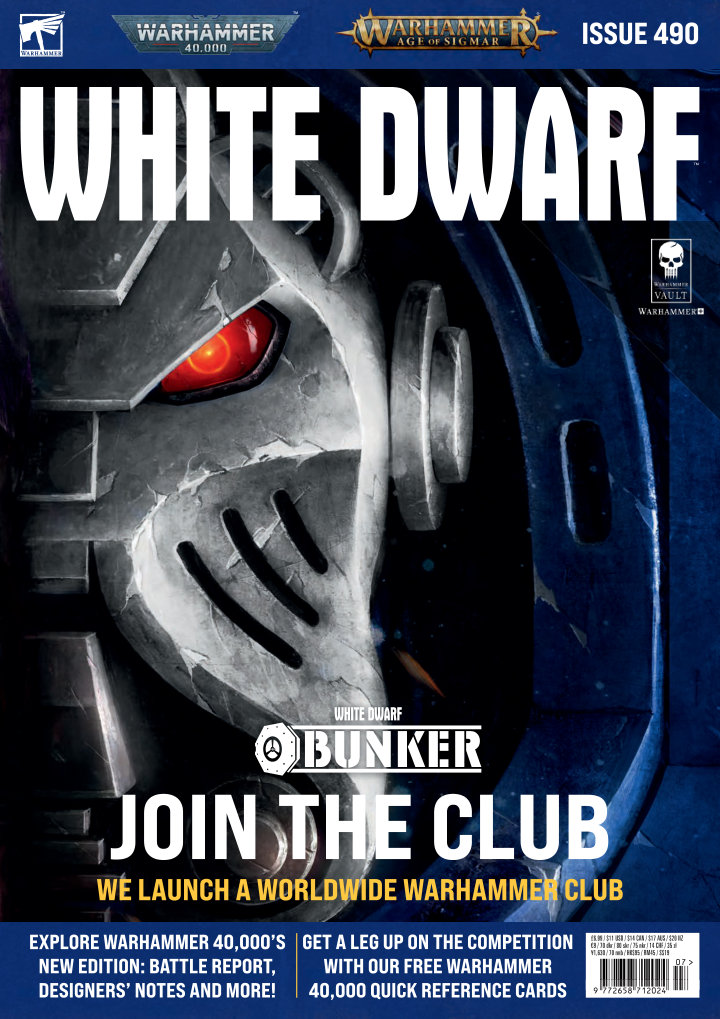
The editorial introduces the White Dwarf Bunker as a worldwide club open to the magazine’s readers. Its shared scenarios, leagues, campaigns and painting challenges aim to connect existing local groups with individual hobbyists. The launch also presents opportunities to join studio activities and compare progress across many different gaming communities.
CommunityWD 490 · pp. 4–7
Readers share therapeutic painting, custom Imperial forces and enthusiasm for several generations of Warhammer games. Ian Balzer links Space Wolves and his Sisterhood of the Wolf through their colours; Fiona Gosschalk’s rainbow Skink Oracle combines bright blends, non-metallic gold and tiny galactic patterns. The replies explain a pale Death Guard recipe and briefly place the major alien species in the era of the Horus Heresy.
Warhammer 40,000Age of SigmarDeath Guard10 paint colours
PaintingWD 490 · p. 4
Tom Moore’s Death Guard armour starts from white and gains a warm aged finish through Skeleton Horde, Ushabti Bone and pale drybrushed and edge highlights. The answer distinguishes this newer recommendation from Tom’s earlier Seraphim Sepia shading. Brown recess stains, sponge-stippled grime and selective blood finish the worn appearance without hiding the light armour.
Warhammer 40,000Death Guard8 paint colours
LoreWD 490 · p. 7
A reader asks what alien civilisations were doing while the Imperium fought itself. The answer briefly distinguishes the recovering Aeldari, sleeping Necrons, primitive T’au, distant Tyranids and the Kin’s involvement on both sides. Orks remained an active military threat despite their defeat at Ullanor, giving the civil war a wider galactic context.
Warhammer 40,000The Horus HeresyAeldari
LoreWD 490 · pp. 8–11
Phil Kelly explores how small battlefield incidents and brief background references grow into major characters, factions and whole games. Ghazghkull’s origins in Andy Chambers’s army, the long development of Ynnead, early Kill Team and the first mentions of the Horus Heresy illustrate different routes from seed to setting. He also explains how collaboration with sculptors allows apparently mysterious prophecies to foreshadow planned releases, then encourages readers to preserve their own gaming stories.
Warhammer 40,000Age of SigmarOrks
CommunityWD 490 · pp. 12–13
Lyle Lowery presents a worldwide hobby club whose satellites can be established clubs, a few friends or individual players. The monthly section combines achievement cards, leagues and campaigns, two large-game scenarios, rotating skirmish events, Basic Training, Hobby Hangout and community reports. The introduction explains how these regular activities let readers participate in a shared project without requiring a new physical club.
Warhammer 40,000Age of Sigmar
CommunityWD 490 · pp. 14–15
The new Bunker challenge system awards monthly achievements for playing scenarios and event games, painting for club activities and completing themed models. Readers record progress on a portable card and advance through ranks, while journal spaces preserve their hobby history. The inaugural rank-and-file painting theme sits within a repeating schedule that also includes leaders, elite units, supernatural subjects, monsters and gods of war.
CampaignWD 490 · pp. 16–17
The Bunker’s first league uses tenth-edition Combat Patrol forces to make regular games easy to arrange. Points reward participation, victories, painted armies and meeting different opponents, while extra titles recognise several kinds of achievement beyond the league winner. The guide explains how to organise models and faction rules, keep a shared table, and use a visible leaderboard to sustain interest through the event.
Warhammer 40,000
CommunityWD 490 · pp. 18–19
The studio’s first month starts with queues at the tables and a flurry of introductory games. John Bracken leads with his T’au and describes using frequent small battles to learn the rules and test deployments against varied opponents. Matt Hutson’s orange Telennar Aeldari provide the hobby spotlight, showing how painting an existing collection’s missing patrol and maintaining a public leaderboard support the league.
Warhammer 40,000T’au Empire9 paint colours
PaintingWD 490 · p. 18
Matt Hutson adds a Combat Patrol to his existing Telennar collection, keeping an orange-and-black scheme and avoiding metallic paints. Grey shaded green and highlighted pale stands in for wraithbone, while bright warm highlights sharpen the orange armour. Paper templates help transfer large craftworld symbols onto jetbike carapaces consistently.
Warhammer 40,000Aeldari9 paint colours
RulesWD 490 · pp. 20–21
Opposing armies establish command infrastructure in contested ground and nominate one objective each as a protective shield generator. Holding ground and keeping a warlord at its own generator earn steady points, while capturing the enemy generator offers a larger reward. Designed for Incursion and Strike Force games, the mission makes defence, aggressive objective play and the generator’s invulnerable protection compete for a commander’s attention.
Warhammer 40,000
RulesWD 490 · pp. 22–23
A historical battleplan recreates the opening assault of the Age of Sigmar, with Stormcast attackers attempting to clear a realmgate held by Khorne’s forces. Both sides can return destroyed non-unique units, but Stormcast reinforcements arrive at variable objectives or near the gate while defenders return from battlefield edges. After five rounds the attacker must leave no enemy near the indestructible realmgate, making sustained pressure essential.
Age of SigmarStormcast Eternals
RulesWD 490 · pp. 24–26
Three matched-play battleplans focus on the warband’s most formidable fighters rather than random asymmetric objectives. The pack explains how fixed deployments and victory conditions combine with standard matched terrain generation and no twist, and can be used individually or together in a tournament. A cursed treasure, an elevated altar and a contest between emerging champions each demand a different balance of strength, survival and positioning.
Warcry
RulesWD 490 · p. 25
Warbands fight over a central treasure whose curse repeatedly harms its bearer and nearby fighters. The carrier can use a life-draining ability to damage a foe and regain some health, but dropping the relic also exacts a price. Victory depends on carrying it at the end of the fourth round, so choosing a durable bearer and timing the final claim matter as much as reaching it first.
Warcry
RulesWD 490 · p. 25
A platform above the battlefield’s centre becomes the altar both warbands must contest. Fighters can spend an ability to attempt to throw a nearby enemy off it, using their melee strength against the target’s resilience. Only exclusive possession at the end wins, so reaching the summit, surviving there and dislodging the last rival form a compact vertical battle.
Warcry
RulesWD 490 · p. 26
The first suitable kill allows each player to nominate a great champion and start tallying that fighter’s damage. A special ability chains movement and attacks after successful kills, while enemies near battlefield edges can be driven off by the champion’s reputation. The winning champion must survive with the higher tally, encouraging players to balance an aggressive rampage against the risk of losing their central fighter.
Warcry
RulesWD 490 · p. 27
Optional matched-play upgrades let players spend spare points on temporary blessings for individual fighters. The table includes changes to movement, toughness, wounds, attacks, strength and damage, as well as command, reaction and wild-dice benefits. Different prices for ordinary and high-wound fighters help the system support smaller elite warbands, with selections made after the battleplan and revealed simultaneously.
Warcry
TacticsWD 490 · pp. 28–31
Stephen Box introduces tactical training through the new edition’s most consequential changes: Objective Control, physical objective markers, moving through friendly units, Fights First and character bodyguards. Further modules examine Lethal Hits, expanded Overwatch, Precision and Rapid Ingress, with examples of units that exploit each mechanic. The emphasis is understanding one’s collection and creating fair, close games through informed positioning and timing.
Warhammer 40,000
TacticsWD 490 · p. 31
A pre-battle puzzle asks which squad should accompany a Space Marine Captain equipped for combat and able to provide a free stratagem. Intercessors, Infernus Marines, Assault Intercessors, Bladeguard and Sternguard offer different numbers, weapons and durability, and an available Lieutenant adds another combination to assess. Readers must weigh mission utility against maximising their commander’s abilities before consulting the later answer.
Warhammer 40,000Space Marines
PaintingWD 490 · pp. 32–35
Lewis Collins begins the Bunker’s army-painting advice with the new Tyranids, whose organic surfaces suit efficient washes, glazes and drybrushing. A staged Hive Fleet Leviathan Termagant establishes an achievable gaming standard, followed by brighter alternatives and bases that either complement or contrast the creature. The discussion prioritises finishing a collection with a manageable method rather than demanding elaborate highlights on every model.
Warhammer 40,000Tyranids33 paint colours
PaintingWD 490 · p. 33
A white undercoat takes a diluted warm skin wash, purple carapace and crimson shading where flesh meets armour. Orange and red Contrast colours distinguish weapons, claws and hooves, completing a quick Battle Ready stage. Further red recesses, pale carapace drybrushing and bright green eyes produce the more finished version without a lengthy edge-highlighting process.
Warhammer 40,000Tyranids14 paint colours
PaintingWD 490 · p. 34
Six Termagants test quick alternatives through coloured washes, mottling and light drybrushing. Their themes include icy blues, bark and moss, bamboo green, purple tonal contrasts, warm magenta and a bright yellow creature with blue mottled skin. Lewis keeps base construction separate while experimenting, making it easy to compare whether a contrasting or complementary environment best serves each palette.
Warhammer 40,000Tyranids16 paint colours
PaintingWD 490 · p. 35
Six test bases range from rusty scrap and dry earth to moss, lava, frozen ground and grass with leaf litter. Texture paints are repurposed to make moss and ice, while crackle effects reveal the hot colour underneath lava. Cotton-bud bamboo, cardboard metal and birch catkins demonstrate how ordinary materials can establish a model’s environment alongside the named paints.
Warhammer 40,000Tyranids9 paint colours
ModellingWD 490 · p. 35
Discarded plastic runners are clipped into irregular rubble, fixed around a flat standing area and blended with texture paint or sand before painting. A second practical tip from Phil Kelly recommends keeping a clean spare brush ready to lift excess shade or misplaced paint before it dries. Both techniques use simple habits and leftovers to rescue or finish everyday hobby work.
CommunityWD 490 · pp. 36–37
Ivan Laureado describes the Spanish-speaking skirmish community he founded during the pandemic. Rules discussion, painting support, lore channels and Familyhammer connect players online, while local contacts and a large Freak Wars meetup carry those relationships into face-to-face gaming. Monthly painting challenges emphasise shared motivation rather than prizes, illustrated by community miniatures.
Kill TeamWarcryThe Wurmspat
ShowcaseWD 490 · pp. 38–39
Studio units answer the first Bunker painting theme with varied approaches to efficient colour and texture. Matt Hutson links the Blooded to his Word Bearers through red helmets; Duncan Waugh combines metallic priming with oil paints on Skitarii; Dominic Cockburn develops skin and fur on Untamed Beasts. Harry Feeney-Barratt provides black and purple Dark Krakens recipes, while Matt Seymour sets flame cultists against cool, wet street lighting.
Warhammer 40,000Kill TeamBlooded16 paint colours
ShowcaseWD 490 · pp. 40–41
Reader units complete the first Bunker challenge gallery, with Ultramarines Assault Intercessors, Kruleboyz Gutrippaz and Myari’s Purifiers. The photographs show how a shared rank-and-file theme accommodates power armour, rough orruk equipment and elegant Lumineth warriors. Each contribution is credited, offering visual inspiration without prescribing an unprinted paint recipe.
Warhammer 40,000Age of SigmarUltramarines
InterviewWD 490 · pp. 44–49
Robin Cruddace and Rich Butler explain why plans for an evolution of ninth edition became a complete tenth-edition overhaul. New datasheets, weapon-specific profiles, a broader toughness range, Objective Control and Leaders joining units aim to make roles clearer and rules easier to reference. Psychic abilities move into the phases where they operate, and Battle-shock represents loss of battlefield effectiveness rather than simply fleeing models.
Warhammer 40,000
LoreWD 490 · pp. 50–57
A sequence of rival Imperial pamphlets frames the Fourth Tyrannic War as a struggle over information as well as survival. Stenosavant Thoramanda Lhyng minimises earlier invasions and insists faith and Imperial forces will stop the new threat; strategos Sabith D’otramar counters with the cost of Macragge, Kraken’s surviving splinters and Leviathan’s immense reach. Their debate introduces the Nautilon, Promethor and Grendyllus tendrils approaching the Imperium’s heart.
Warhammer 40,000Tyranids
InterviewWD 490 · pp. 58–59
Design managers Sam Dinwiddy and Dom Murray describe the narrative that unites the launch set’s Space Marines and Tyranids. A later-wave veteran strike force enters an already conquered world, giving each model a role and matching psychic, flame and heavy-armour adversaries across the box. Designing both forces together helped their details tell a coherent story, from the lone survivor Lieutenant to the unfamiliar Neurotyrant overlord.
Warhammer 40,000Space Marines
InterviewWD 490 · pp. 60–63
The sculptors revisit Tactical Dreadnought Armour while preserving its distinctive silhouette and making the proportions and internal mechanics more believable. Revised weapons, articulation and restrained decoration leave Terminators useful to painters at different levels, while the Captain, Librarian, Biologis and veteran Lieutenant express separate story archetypes. Sternguard, Infernus Marines and the nostalgic Ballistus Dreadnought complete the force through their equipment, heraldry and specialist purpose.
Warhammer 40,000Space Marines
InterviewWD 490 · pp. 64–69
The Tyranid team explains how new organisms expand the swarm while obeying a consistent anatomical language. Enlarged brains, hidden eyes, reduced limbs and controlling symbiotes convey the Neurotyrant’s psychic role, while Leapers, Barbgaunts and Psychophages specialise in ambush, fire support and harvesting. Updated Termagants and a Screamer-Killer that recalls the 1992 model link the range’s history to new poses, biological weapons and the Shadow in the Warp.
Warhammer 40,000Tyranids
Battle reportWD 490 · pp. 70–87
Tom Horth’s Ultramarines and Emily Ridding’s Hive Fleet Leviathan play the new edition for the first time with Robin Cruddace and Duncan Waugh coaching their decisions. Using the launch set forces, they contest moving Servo-skull objectives while comparing Tactical and Fixed secondaries, attached Leaders, doctrines, Synapse and reactive stratagems. The Tyranids advance rapidly, but Terminators and surviving Infernus Marines turn the central fight and push the objectives towards the swarm’s lines.
Warhammer 40,000Ultramarines
CommunityWD 490 · pp. 90–91
Jake Bowley, Ant Saliba, Laura Matarasso and Chris Charles begin the Age of Sigmar half of the new collecting challenge. Points reward painted units, games, victories and shared opponents, with completing a Vanguard box the first bonus objective. The format allows changing armies between stages and introduces an accompanying 1,000-point battlepack, encouraging readers to follow the same path with a focused force or several projects.
Age of Sigmar
PaintingWD 490 · p. 92
Jake Bowley plans a large converted Chaos horde and starts by fixing a repeatable scheme that also tells its story. Dark blue armour with icy highlights suggests warriors hardened by a desolate homeland, contrasted by invented bonesteel trim and burgundy capes. Contrast foundations and a white airbrushed stage establish the main colours quickly, leaving room for characterful additions later.
Age of SigmarSlaves to Darkness15 paint colours
PaintingWD 490 · p. 93
Ant Saliba creates a Bloodtoofs offshoot whose red-and-black armour represents both its heritage and the destruction it causes. His nomadic Splintertusks smash realmgates behind them and collect stones charged with Waaagh! energy, giving future models and conversions a narrative direction. Detailed red, black and bare-metal recipes support a bold divided scheme finished with freehand flames.
Age of SigmarIronjawz17 paint colours
PaintingWD 490 · p. 94
Laura Matarasso establishes an undead court ruling Necro-Dame, a city built over the bones and transformed heart of a primordial godbeast. A Skeleton Warrior tests the collection’s aged bone, rusted armour and black robes, with small areas of dried blood distinguishing it from a cleaner undead scheme. Repurposed heraldic transfers and planned conversions will develop the court’s long history as the challenge progresses.
Age of SigmarSoulblight Gravelords10 paint colours
PaintingWD 490 · p. 95
Chris Charles returns to the all-goblin army he wanted as a teenager and uses the challenge to complete a themed narrative force. Dark blue robes inspired by the Badsnatchers replace conventional black, while carefully tested yellow Bad Moon icons provide the accent. Recipes also cover pale grot skin, establishing colours he can reproduce while exploring Path to Glory for the first time.
Age of SigmarGloomspite Gitz14 paint colours
LoreWD 490 · pp. 96–101
An in-world scholar assembles a dangerous treatise for the Order of Azyr, defining gods as beings deeply attuned to magic rather than omniscient or infallible authorities. The discussion distinguishes death, dormancy, consumption and starvation through lost worship, then contrasts elemental powers such as Gorkamorka with beings who achieved divinity from more tangible origins. Its increasingly provocative conclusion questions the pantheon’s relationship with mortal devotion, ending amid censored accusations about borrowed power.
Age of Sigmar
LoreWD 490 · pp. 102–103
The background introduces Sylvaneth as spirits whose nurturing and destructive qualities mirror nature, with distinct glades spread beyond Ghyran. A collection-building framework connects a wargrove’s name, realm, ancestry, leader and colours rather than treating its palette in isolation. Harvestboon supplies an example of how youthful purpose, root-clan origins and pale bark can give an army a coherent identity.
Age of SigmarSylvaneth
ShowcaseWD 490 · pp. 104–105
Anka Sep’s cherry-blossom Tree-Revenants pair soft pinks with pale greens; Steve Barrett’s Ylthari’s Guardians add sculpted fungi and eerie recess colour to a journey through Ulgu. Charlie Raspin cuts and reposes Kurnoth Hunters to suggest deep swamp water and hanging vines, while Peter McMullin gives Drycha a Spiterider helmet and fleshy bark. Named recipes explain the contrasting organic and metal finishes across the four projects.
Age of SigmarWarcrySylvaneth24 paint colours
PaintingWD 490 · pp. 106–107
Matt Hutson’s autumnal Gnarlroot collection has grown from a 2016 Four Warlords project and incorporates even older Wood Elf models. Warm bark, coloured hair and dried-herb leaf litter distinguish units, while Screamer Pink spites tie everything together from Treelords to Gossamid wings. The accompanying bark and green spirit recipes explain the palette’s balance of woodland warmth and supernatural colour.
Age of SigmarSylvaneth8 paint colours
PaintingWD 490 · pp. 108–109
Inspired by the beauty and scale of a giant sequoia forest, Jimbo Warth paints a wargrove sent to find lost Spirits of Durthu. Orange-shaded pale bark, green spirits and purple skin make its redwood theme distinct, while an axe-bearing Treelord and subtle repositioning personalise the models. The recipes repeat across bark, wings and leaves so the conversions remain part of a coherent army.
Age of SigmarSylvaneth10 paint colours
PaintingWD 490 · pp. 108–109
Rebecca Robson uses silver birches to inform an army embodying nature’s wrath. Separate light and dark subassemblies receive different primers, allowing Contrast and drybrushing to produce cracked pale bark, dark green bodies and bright blue fungi efficiently. The approach keeps the tree inspiration clear while giving leaves and supernatural forms their own colour roles.
Age of SigmarSylvaneth13 paint colours
PaintingWD 490 · pp. 110–111
Josh Mawer imagines Alarielle resurrecting the lamentiri of forest spirits burned during the wars against Chaos. His blackened bark and fiery bodies draw on images of the Australian wildfires, with the painting evolving from successive warm drybrushes to wet-blended Contrast colours on later models. Crackled lava-like bases reinforce the recovered-from-embers story and record his growing confidence over the project.
Age of SigmarSylvaneth11 paint colours
TacticsWD 490 · pp. 112–115
Dave Sanders explains how ready-to-play Rivals decks create new experiences without compulsory deck building. He recommends Seismic Shock for Domitan’s resilient wizards, Toxic Terrors for Gryselle’s fast but fragile fighters, Beastbound Assault for Ephilim’s adaptable daemons and Fearsome Fortress for Grinkrak’s Looncourt. Each pairing links the warband’s survival, positioning and attack patterns to the deck’s scoring plan, encouraging players to learn a deck intact before experimenting further.
Warhammer UnderworldsDomitan’s Stormcoven
CampaignWD 490 · pp. 116–119
The studio’s Aranthian Succession campaign reaches its third cycle as a planet-wide ash storm brings nomad attacks to Cinderak City. Background follows the settlement’s leaders preparing defences, while an in-world news sheet reports the continuing fortunes of studio gangs. The featured Out of the Storm game pits Fright Knights against Dustblind Dyvas, with the attackers prevailing despite heavy casualties and the defenders’ dangerous walker weapons.
NecromundaAsh Waste Nomads
LoreWD 490 · p. 117
With Necromunda’s hives cooling after the Great Darkness, the atmosphere produces a vast storm that engulfs the outlands. Archeotek Azymundus identifies thousands of Grey Waste Walkers within it, prompting Cinderak’s gangs to fortify strongholds or mobilise fighters. The resulting attack breaks into isolated street battles where ash, toxic rain and poor visibility make the larger situation impossible to judge.
NecromundaAsh Waste Nomads
Battle reportWD 490 · p. 119
The campaign scenario sends an attacking gang against a fortified position while a moving storm removes fighters from view and forces them to find their way back. In the illustrated studio engagement, Prince Frederick-Byron’s jetbike raiders exploit close combat and ride-by attacks against Escher defenders. The Dyvas’ walkers inflict painful losses, but both gangs bottle and the remaining Escher eventually withdraw, leaving the Fright Knights the attritional victory.
NecromundaFright Knights
ShowcaseWD 490 · pp. 120–121
Andy Hoare’s gang represents survivors of the forgotten Badzone Palanite Enforcer Precinct KS Alpha, who abandon the underhive when the Great Darkness releases new horrors. Captain Caesar leads mismatched patrolmen, unreliable cyber-mastiffs and a bewildered enlisted scummer from a Chronos-pattern Ironcrawler that doubles as home and fortress. Their story centres on survival and neutrality as they avoid the wider struggle over Helmawr’s throne.
NecromundaPalanite Enforcers
CampaignWD 490 · pp. 122–131
Jay Clare reports on a 25-coach studio league, from its organisation and awards to two rounds of divisional games. Balancing experienced and new coaches, varying opponents and clear tiebreakers makes the event workable despite an awkward number of participants. The reports follow unexpected wins, casualties and narrow qualification margins as the field contracts towards eight knockout teams.
Blood BowlSkaven
CampaignWD 490 · pp. 122–123
The commissioner divides 25 coaches into five groups of five, mixing experience levels and avoiding repeated team types within each division. Two automatic qualifiers from each group and the strongest third-place finishers enter a second round before the eight-team knockout. Awards for painting, newcomers, sporting conduct, casualties and other achievements give coaches meaningful goals even when championship qualification is unlikely.
Blood Bowl
FictionWD 490 · pp. 132–141
The finale of Ancestor’s Burden sends Grombrindal’s five companions into Karak Thorga to confront a living curse born from its last king’s despair at the gods. Durkar’s returned axe opens the final gate, but the book of grudges seizes Myrddi and animates a monstrous throne. Ardellain works to sever the spell, Sivarn channels life to counter death, and Rat-Tail rediscovers a protective slayer’s purpose while suffering a terrible wound.
Age of SigmarDuardin
CampaignWD 490 · p. 142
Erik Niemz and Sam Pearson turn an ordinary game between Kruleboyz and Blades of Khorne into an improvised narrative series. A stolen skull carries the story from a Chaos outpost to a swamp search and then towards a larger fortress assault, with each result inspiring the next battle. The account illustrates the issue’s story-seed theme through a campaign that grows directly from shared games.
Age of SigmarKruleboyz
TacticsWD 490 · p. 143
The answer compares how each possible squad would use the Captain’s protection, combat profile and free stratagem, rather than assuming the most numerous unit is best. Bladeguard are recommended because their durability and melee role benefit strongly from flexible doctrine and retaliation options. Adding the Lieutenant supplies further mobility and Lethal Hits, while both characters share the veterans’ defensive benefits.
Warhammer 40,000Space Marines
CommunityWD 490 · pp. 144–145
The studio updates its bingo progress with games, Combat Patrol preparation, scenery and a newly started Custodes collection. Matt Hutson explains his orange Trans-Hyperian Hernkyn Pioneers, including real road rubble on their bases, while Lyle Lowery presents the sea-inspired Kraken Blades painted for the Great Stomp finale. These finished projects sit alongside brief work-in-progress reports to show how small stages contribute to a broader hobby year.
Warhammer 40,000Age of SigmarDark Angels12 paint colours