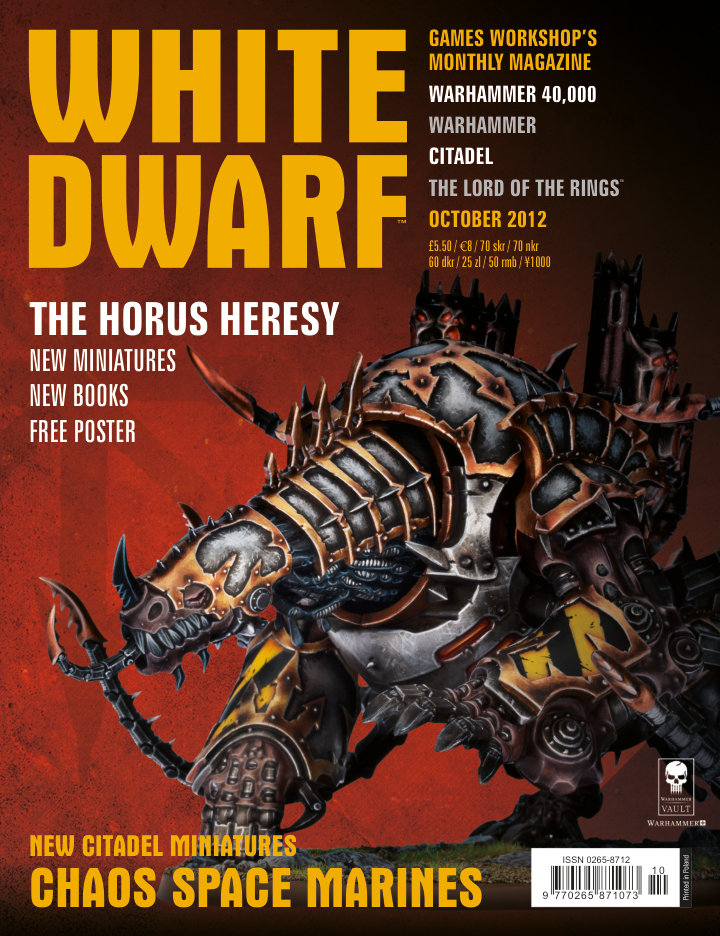
EditorialWD 394 · p. 1
New editor Jes Bickham introduces the redesigned White Dwarf and its expanded team. He presents the change as a response to the growing variety and detail of the miniatures, books and games, and promises a monthly view across the Design Studio, Forge World and Black Library. Chaos Space Marines lead the first issue, while readers are invited to help shape the magazine through their own hobby work and feedback.
ShowcaseWD 394 · pp. 4–35
The team examines the new Chaos range through its sculpted details and assembly options, contrasting the Forgefiend’s ranged weapons with the Maulerfiend’s close-combat machinery and the Heldrake’s predatory silhouette. Raptors and Warp Talons illustrate different degrees of corruption, while the Warpsmith, Dark Apostle and Sorcerer echo Imperial counterparts in sinister forms. Alongside the new kits, remastered characters, upgrades and classic Traitor Marines show the range’s long visual history and the variety available for a personal warband.
Warhammer 40,000Chaos Space Marines
ShowcaseWD 394 · pp. 22–25
Adam Troke reviews the first full-colour hardback 40K codex as both a physical book and a guide to Chaos. He highlights its expanded historical timeline, new artwork, atmospheric army photographs and fold-out reference section, then considers the breadth of the army list for both renegade Chapters and original Traitor Legions. The emphasis is on the book’s presentation and contents, with detailed testing of its units reserved for the battle report.
Warhammer 40,000Chaos Space Marines
CommunityWD 394 · pp. 36–37
The first downloadable White Dwarf is introduced with video commentary, rotating miniature galleries and additional photographs beyond the print edition. The page also describes digital codexes as searchable gaming references with linked equipment explanations, updated errata and detailed model views. Smaller digital publications offer scenarios, painting material and Storm of Magic content, marking a new format for distributing hobby and rules resources.
LoreWD 394 · p. 38
The anthology review focuses on stories that enlarge familiar moments in the Heresy rather than simply repeat its battles. Rogal Dorn’s doubts in The Lightning Tower contrast with Konrad Curze’s violence in The Dark King, while Raven’s Flight follows Corax after the dropsite massacre. John French’s The Crimson Fist is singled out for alternating between Sigismund’s guilt on Terra and Alexis Polux’s predicament at Phall, building tension around two different responses to catastrophe.
The Horus HeresyImperial Fists
LoreWD 394 · p. 39
Jes Bickham surveys a Chaos anthology whose stories explore corruption through very different kinds of villains. Matthew Farrer’s unusual auction frames competing tales, Anthony Reynolds pits Word Bearers against Death Guard over a salvage claim, and other writers revisit Typhus, Huron and the Night Lords. John French’s Alpha Legion story supplies a counterpoint to overt slaughter through espionage, making the collection’s appeal the breadth of Chaos rather than a single Legion or patron.
Warhammer 40,000Chaos Space Marines
LoreWD 394 · p. 40
The two omnibus reviews praise character drama as much as warfare. Chris Wraight’s competing claimants to Averland expose Schwarzhelm’s unease outside battle and bring him into tense contact with the more assured Kurt Helborg. Gav Thorpe’s Sundering trilogy turns remote Elven legends into personal tragedies, particularly Malekith’s fall and the transformations of Alith Anar and Caledor, giving weight to conflicts whose outcomes readers already know.
Warhammer Fantasy BattlesThe Empire
ShowcaseWD 394 · pp. 42–45
Forge World’s new Heresy project is introduced through Betrayal, a leather-bound history and campaign book covering Isstvan III and the forces involved. The accompanying miniature reviews examine the large Spartan transport, heavily protected Cataphractii armour and Mark IV assault and command models as ways to establish an older visual identity. A final Fantasy selection, the Preyton, extends Monstrous Arcanum’s menagerie with a corrupted fusion of predatory beasts.
The Horus HeresyWarhammer 40,000Space Marines
InterviewWD 394 · pp. 46–47
A prototype game of Relic sends the White Dwarf team through a Talisman-based 40K adventure towards a confrontation with Kairos Fateweaver. The players build experience and gather equipment while choosing threats their characters can handle, with very different fortunes for the Inquisitor, Ogryn, Marine and Battle Sister. Designer Adam Sadler explains that power cards and threat choices give players more control, while Corruption cards offer tempting advantages that can eventually turn a character into a Spawn.
RelicWarhammer 40,000Imperium
ShowcaseWD 394 · pp. 52–57
Ben Johnson describes a collection begun with Island of Blood that expanded to almost every Skaven unit, all of them used in games. Muted blue and yellow spot colours and smoky warpstone keep the force consistent, while miniature dioramas make small ratmen look more imposing: Rat Ogres seize Dwarf Gyrocopters and the general rides a captured Anvil of Doom. His rapidly painted regiments contrast with the thirty hours invested in a Forge World Exalted Vermin Lord, illustrating how army cohesion and special centrepieces can coexist.
Warhammer Fantasy BattlesSkaven
EditorialWD 394 · pp. 58–59
Jervis explains why modern army lists use fewer unique-unit restrictions than their predecessors. Limits still support enjoyable games and plausible armies, but each restriction also prevents someone from using models they want to collect. He describes collecting as the foundation of the hobby and encourages carefully agreed experiments that remove restrictions, while cautioning that extra house limits can exclude favourite models without improving the game.
Battle reportWD 394 · pp. 60–75
Andrew Kenrick tests the new Chaos codex against Adam Troke’s White Scars in a 1,750-point Big Guns Never Tire battle. Cultists screen the expensive units, Veterans of the Long War make Chaos Marines frightening in assault, and a Heldrake devastates infantry and even destroys a Dreadnought; the Forgefiend instead suffers repeated overheating. Both sides lose their scoring troops, but the White Scars win 4–0 through secondary objectives. The post-game discussion examines wasted Cultist opportunities, character equipment and the psychological effect of the new Daemon Engines.
Warhammer 40,000Chaos Space Marines
TacticsWD 394 · pp. 76–81
Martin Morrin and Adam Hall debate two contrasting competitive armies: Dark Elves distribute their threats across several units, while Vampire Counts concentrate four Vampires and a Necromancer in a protected Black Knight formation. Their lists and discussion turn on magical support, redirecting units and the timing of decisive combats. A short concluding game validates the predicted danger of Okkam’s Mindrazor: empowered Corsairs kill the Vampires, remain in combat through the Crown of Command and leave the Undead army to crumble.
Warhammer Fantasy BattlesDark Elves
TacticsWD 394 · p. 78
Martin builds a 2,398-point Dark Elf army around magic that improves whichever unit is best placed to attack. A Supreme Sorceress generates and spends power dice aggressively, while the Cauldron of Blood adds attacks, Killing Blow or protection to Corsairs and Black Guard. A heavily protected, stubborn mounted Dreadlord can pin more expensive enemies, leaving the infantry to exploit Mindrazor’s high-Strength attacks and first-round re-rolls.
Warhammer Fantasy BattlesDark Elves
TacticsWD 394 · p. 79
Adam’s 2,399-point Vampire army uses Black Knights to deliver four fast-striking Vampires into the enemy while a Master Necromancer replaces casualties. The Vampire Lord’s Ogre Blade and Red Fury provide the main killing power, and second-rank deployment lets selected characters Make Way into favourable positions once combat starts. Wolves, bats and Hexwraiths shape the approach, buying the central formation the opportunity to attack a valuable target without being trapped by a stronger one.
Warhammer Fantasy BattlesVampire Counts
InterviewWD 394 · pp. 82–89
The feature traces the Heresy from a short background reference into a defining creation myth, a major novel series and a dedicated Forge World miniature project. Alan Merrett, Black Library writers and Forge World designers discuss how each medium expands the same catastrophe while preserving the distinction between the optimistic Great Crusade era and the grim far future. The launch of Betrayal and Simon Egan’s Angron model turns an event long imagined by readers into armies, characters and battles they can collect.
The Horus HeresyWarhammer 40,000Space Marines
InterviewWD 394 · pp. 84–85
Alan Merrett explains how repeated references across supplements, Epic games, articles and the card game gradually made the Heresy central to 40K. Dan Abnett recalls the responsibility of establishing its novelistic tone in Horus Rising, while Graham McNeill describes the pressure to keep a familiar history surprising and recognisably different from the later millennium. Their accounts show how a planned trilogy became a much larger series as both the story’s scope and its readership expanded.
The Horus HeresyWarhammer 40,000
InterviewWD 394 · pp. 86–87
Alan Bligh and Alan Merrett describe Betrayal as the opening of a comprehensive Forge World exploration of the Heresy. Its history runs from the Emperor’s early wars to Isstvan III, with the origins and forces of the four Legions involved developed through text, illustration and models. Larger squads, Legion identities, early equipment and different battle scales are presented as tools for bringing this specific era to the tabletop, including its first collectible Primarch.
The Horus HeresyWorld Eaters
InterviewWD 394 · pp. 88–89
Simon Egan describes three months of research, design and sculpting to reconcile the many existing depictions of Angron. Details from Jes Goodwin’s Khârn and John Blanche’s artwork join gladiatorial armour, shattered chains and the two famous axes, while slain Marines beneath the figure communicate movement and force. Egan aims to capture a proud, brutal character at the beginning of the Heresy rather than reduce him to a single expression of rage.
The Horus HeresyWorld Eaters
ModellingWD 394 · pp. 90–93
John Blanche presents characterful Inquisitorial models as three-dimensional extensions of his sketchbooks. Conversions grow organically from a starting miniature, with a Plague Ogryn becoming a gun-servitor and parts from Isabella von Carstein, a Death Korps officer and an Enforcer entering a strange warband. He treats painting, drawing and converting as facets of the same exploration, adapting the imagined subject to the demands of a different medium rather than expecting a sketch to translate literally.
Warhammer 40,000Inquisition
InterviewWD 394 · pp. 94–95
Anja Wettergren nominates Alex Hedström’s Nightbringer for the strength of its simple, sweeping design and the freedom it offers painters. She recalls choosing the model as a competition prize and admires Martin Footit’s non-metallic treatment. Hedström explains how metal-casting constraints changed the original vortex concept into the familiar looming pose, whose clean lines subsequently made it a popular starting point for conversions ranging from Daemon Princes to Sanguinius.
Warhammer 40,000Necrons
ShowcaseWD 394 · pp. 96–101
The first Parade Ground surveys studio hobbyists through distinctive finished units. Simon Adams contrasts red Necron armour with pale-blue glow, Matt Kennedy keeps his converted Goff Orks consistent through written colour notes, and Steve Bowerman shows woodland Gondor Rangers alongside lightning-marked Night Lords. Duncan Rhodes contributes muted Death Korps inspired by Karl Kopinski and heraldic Bretonnians unified through red, white and yellow, demonstrating how repeated palettes can hold highly varied models together.
Warhammer 40,000Warhammer Fantasy BattlesNecrons
ModellingWD 394 · pp. 102–105
Three aircraft conversions push the Ork Bommer in different directions. Matt Holland shifts the cockpit backwards for an enlarged engine and loots weapons and rokkits from several Ork kits; Dan Harden cuts and rebuilds the wings around old-fashioned propellers and scratch-built engine cowlings. Andy Clark inverts wing extensions for a downward sweep and adds Manticore missiles beneath his Death Skullz bomber, using silhouette and exaggerated weapon loads to distinguish each machine.
Warhammer 40,000Orks
ModellingWD 394 · pp. 106–111
Dave Andrews explains how a proposed swamp board became a polluted Imperial refinery with roads, bridges, a dam and defensive positions that make it playable. Bastions and a raised Skyshield form the industrial centrepiece, while plasticard, spare landing-pad legs, chicken wire and clear sealant extend the terrain kits. Muted water and earth colours keep the scenery behind the armies visually, and broken bridges, wrecked tanks and industrial details supply objectives, cover and a convincing history of warfare.
Warhammer 40,000Imperium4 paint colours
PaintingWD 394 · pp. 112–117
The inaugural Paint Splatter gathers short techniques linked to models and scenery elsewhere in the issue. It covers four Chaos warband schemes, several contrasting approaches to rust, hot and cold daemonic glows, chipped Ork aircraft, checked panels, Skaven freehand and smoky warpstone. Heresy-era armour recipes complete the collection, favouring repeatable sequences of basecoats, washes and layers that can transfer to other subjects.
Warhammer 40,000Warhammer Fantasy BattlesAlpha Legion49 paint colours
PaintingWD 394 · p. 112
The Alpha Legion scheme starts with Macragge Blue and a Druchii Violet wash, then restores the blue before adding green highlights. Skarsnik Green followed by Moot Green shifts the edges towards a luminous green while leaving the broad armour surfaces blue. The short sequence offers a practical way to capture the Legion’s mixed blue-green identity without introducing a separate metallic effect.
Warhammer 40,000Alpha Legion4 paint colours
PaintingWD 394 · p. 112
Red Corsairs armour is built from a deep Khorne Red base, shaded with Carroburg Crimson to emphasise the recesses. Wazdakka Red restores the raised plates, and Wild Rider Red marks the brightest edges. The recipe demonstrates a compact progression from dark red to orange-red highlights while preserving enough depth for the model’s sculpted trim and joints.
Warhammer 40,000Red Corsairs4 paint colours
PaintingWD 394 · p. 112
Black Legion armour keeps Abaddon Black as the main surface and defines its shape with successive grey highlights. Eshin Grey provides the first transition, Dawnstone sharpens it and Administratum Grey supplies the final light edge. This approach makes dark power armour readable without changing the overall impression of black plates.
Warhammer 40,000Black Legion4 paint colours
PaintingWD 394 · p. 112
A Kantor Blue base is darkened with Nuln Oil, then the original colour is reapplied to establish clear armour plates. Alaitoc Blue and Lothern Blue add increasingly bright edges, producing a deep blue suit with enough contrast to show its geometry. The swatch addresses the armour itself, leaving the Legion’s separate lightning and decorative details outside this recipe.
Warhammer 40,000Night Lords4 paint colours
PaintingWD 394 · p. 113
The tank-trap demonstration paints corrosion over a small terrain detail using Skrag Brown and Fire Dragon Bright. Agrax Earthshade ties the warm tones together and darkens the recesses, after which Runefang Steel picks out exposed metal. The contrast between rusty colour and a few bright edges suggests an object that has corroded unevenly rather than becoming a single flat brown surface.
Warhammer 40,0004 paint colours
PaintingWD 394 · p. 113
This Necron method begins with Leadbelcher and a Runefang Steel drybrush, then ages the metal with Agrax Earthshade and Seraphim Sepia washes. A final Runefang Steel drybrush restores worn raised edges while retaining the warm staining below. The sequence offers an aged metallic finish through washes rather than painting every patch of rust separately.
Warhammer 40,000Necrons4 paint colours
PaintingWD 394 · p. 113
The Cultist weapon reverses the usual clean-metal sequence by beginning with Mournfang Brown and layering Troll Slayer Orange over it. Leadbelcher is then applied selectively as surviving metal, allowing the corrosion colours to remain visible beneath and around it. The three-stage example is suited to neglected equipment where rust is a major part of the weapon’s appearance.
Warhammer 40,000Chaos Cultists3 paint colours
PaintingWD 394 · p. 113
Dakkajet engines receive a Warplock Bronze base and Gehenna’s Gold drybrush before successive Agrax Earthshade and Drakenhof Nightshade washes stain the machinery. A final Abaddon Black drybrush suppresses the brightest edges and adds a dirty, exhausted appearance. The combination produces an oily, heat-worn metallic effect distinct from the orange corrosion shown in the neighbouring examples.
Warhammer 40,000Orks5 paint colours
PaintingWD 394 · p. 114
The ectoplasma cannon example makes recessed weapon vents look hot by moving from Mephiston Red through an Agrax Earthshade wash to orange and yellow details. Troll Slayer Orange provides the intermediate heat, while small Flash Gitz Yellow accents become the brightest points. The demonstrated colours can also be used for glowing weapons or other heated machinery.
Warhammer 40,000Chaos Space Marines4 paint colours
PaintingWD 394 · p. 114
Soulfire is presented as a cold, spectral glow against Abaddon Black. Sotek Green and Temple Guard Blue develop the light areas before White Scar is used for the brightest points, making the flame read as luminous through strong contrast. The simple progression is also suggested as a transferable effect for equipment displays and supernatural weapons.
Warhammer 40,000Chaos Space Marines4 paint colours
PaintingWD 394 · p. 114
The Daemonforge sequence builds green light within the machinery, starting from Caliban Green and successively adding Warpstone Glow, Warboss Green and Skarsnik Green. Coelia Greenshade is applied after the highlights to colour and unify them. Keeping the glow within the vent shapes makes the surrounding dark metal feel like a shell around an internal supernatural power source.
Warhammer 40,000Chaos Space Marines5 paint colours
PaintingWD 394 · p. 115
Matt Holland’s converted Dakkajet uses Khorne Red and Mephiston Red to establish a rich red hull. Leadbelcher marks chips and exposed edges, then Nuln Oil darkens the weathering and panel detail. The close-up stages demonstrate how a short armour sequence can give a large aircraft a convincingly battered surface without a complicated colour list.
Warhammer 40,000Orks4 paint colours
PaintingWD 394 · p. 115
Dan’s checked aircraft panels begin with a light Celestra Grey grid over the dark surface. Alternating squares are filled with the same grey, then brightened with Ulthuan Grey to create a readable black-and-white pattern. Leadbelcher is stippled or drybrushed across the finished design to integrate the checks into the surrounding worn metal rather than leave them looking newly applied.
Warhammer 40,000Orks3 paint colours
PaintingWD 394 · p. 116
Ben explains freehand banners as a sequence of manageable drawing tasks. He chooses a symbol from Uniforms and Heraldry of the Skaven, sketches its circles and lines with a sharp pencil and then paints within the outline. Blue and white make the displayed symbols stand out, but the method is intended to work for other armies and colours; no exact named paints are supplied for the banner itself.
Warhammer Fantasy BattlesSkaven
PaintingWD 394 · p. 116
Dan recreates the muted, smoky warpstone seen in Ben’s army with Warboss Green shaded by Agrax Earthshade. Rakarth Flesh is mixed into the green and then used for brighter highlights, after which Biel-Tan Green restores a common colour across the stone. Gloss varnish finishes the surface, producing a subdued mineral effect rather than the very bright green often associated with Skaven magic.
Warhammer Fantasy BattlesSkaven5 paint colours
PaintingWD 394 · p. 117
The Sons of Horus recipe creates sea-green armour through an unusual neutral starting point. Mechanicus Standard Grey receives a Necron Compound drybrush, and a Waywatcher Green wash colours the shaded and highlighted surface together. The compact method prioritises a consistent Legion identity across an army rather than building the green through several opaque layers.
The Horus HeresySons of Horus3 paint colours
PaintingWD 394 · p. 117
The pre-Heresy Emperor’s Children are represented with purple armour rather than a later renegade scheme. Genestealer Purple supplies the base colour, Druchii Violet shades the details and another Genestealer Purple layer restores the main plates. The swatch concentrates on a quick, repeatable armour finish that can accompany the era’s separate Legion insignia and embellishments.
The Horus HeresyEmperor’s Children2 paint colours
PaintingWD 394 · p. 117
World Eaters armour is divided into white plates and blue sections. Ceramite White, Nuln Oil and White Scar provide the white sequence, while Kantor Blue is highlighted with Teclis Blue and washed with Nuln Oil for the contrasting areas. The paired recipes preserve the Legion’s earlier identity and give painters separate treatments for each main colour.
The Horus HeresyWorld Eaters5 paint colours
PaintingWD 394 · p. 117
The Death Guard swatch builds a warm, corroded-looking pale armour from Zandri Dust. Ushabti Bone provides a lighter layer and Seraphim Sepia stains the surface and recesses, giving the plates a weathered cast. This is the armour treatment shown for the Heresy force, with Legion markings left to the separate decals and etched symbols discussed beside the recipes.
The Horus HeresyDeath Guard3 paint colours
EditorialWD 394 · pp. 118–119
Jeremy imagines a monument world whose sacred Imperial statues become targets for destruction and replacement with ruined versions. The idea joins several ambitious projects involving underground battles, Forest Goblin camps and ship boarding, all conceived as settings with stories and bespoke objectives. He acknowledges the preparation these games require and argues for enjoying ordinary battles with friends while gradually building the elaborate terrain and scenarios that keep his imagination active.
CommunityWD 394 · pp. 121–122
The local-events feature connects the Chaos launch with introductory games, painting lessons and army-building help in stores. Glasgow is profiled through its six gaming tables, Sunday and older-player beginner sessions and Thursday club night. The accompanying advice explains what a newcomer can expect from an introductory game or paint session, presenting these activities as routes into a personal collection rather than assuming every beginner wants the same army.
CommunityWD 394 · pp. 138–141
The new team introduces its current projects, from Beth’s first painted Lizardmen to Jes’s Tyranids, Dan’s Imperial Guard and Matt’s long-term Marine collections. Short accounts describe the inaugural hobby-room battle, an escalating league and the wave of Chaos painting prompted by the new kits. A multiplayer Zone Mortalis game adds hidden objectives and surprises, showing how the team’s shared gaming room supports informal experiments as well as formal battle reports.
Warhammer 40,000Warhammer Fantasy Battles
Battle reportWD 394 · p. 139
Andrew’s Death Guard and Jes’s Tyranids christen the new gaming table with Big Guns Never Tire over three objectives. The fight becomes a close-range melee in which Possessed kill Carnifexes and the Hive Tyrant destroys a Daemon Prince before falling to the Chaos Lord. The brief account ends in Andrew’s victory and captures the memorable character clashes that made the first game on the table distinctive.
Warhammer 40,000Death Guard
Battle reportWD 394 · p. 141
Glenn organises seven five-hundred-point forces into loyalist and traitor teams for a battle through a Zone Mortalis complex. Chaos players know the eight mystery objectives in advance, while their opponents discover hazards such as a trapped Maulerfiend and unusually dangerous Possessed. Doors can be attacked or opened through puzzles, though the players eventually favour melta bombs. The loyalists win, with exploration and surprise providing the scenario’s main entertainment.
Warhammer 40,000Space Marines
InterviewWD 394 · pp. 142–145
Phil Kelly explains how older Chaos books and discussions with Jes Goodwin led to a codex centred on a Marine’s long descent from rebellion to mutation. Obsessions, warped equipment and the merging of daemon, machine and flesh generate both visual ideas and new units, including Soul Forges and their Warpsmiths. Veterans of the Long War and Champions of Chaos express ancient hatred and dangerous ambition, while the army list is intended to support everything from Legion siege forces to Cultist masses.
Warhammer 40,000Chaos Space Marines
InterviewWD 394 · pp. 146–147
Jes Goodwin describes mapping new models along a spectrum between mortal, machine and daemon. The project focuses on warriors whose obsessions have visibly transformed them, extending ideas tested in Dark Vengeance into Daemon Engines, Raptors and Warp Talons. He explains the Heldrake as a pilot reduced to a malignant core within a living fighter, combining armour, umbilical cables and Forge World aircraft shapes into a coherent visual language of corruption.
Warhammer 40,000Chaos Space Marines
CommunityWD 394 · pp. 148–149
Forge World staff repaint the life-size Rhino donated after Dawn of War II, adding a storm bolter and large Ultramarines markings before its installation outside Warhammer World. The studio visit also reveals Will Hayes’s Cataphractii weapon variants and Paul Rudge’s loyalist Death Guard collection, grown from a staff painting challenge. These projects connect the team’s personal collecting with the new Heresy range and its public display work.
Warhammer 40,000The Horus HeresyUltramarines
InterviewWD 394 · p. 149
Sam Lamont and Rhys Pugh explain how miniature photography becomes the cinematic imagery in Betrayal. They first compose real models, including distant Drop Pods, and then add flashes, explosions and environmental effects digitally to evoke a soldier’s pict capture. Their examples stress the brutality of Marine civil war and the purposeful symbolism of Legion details, such as the meanings behind Sons of Horus gang markings.
The Horus HeresySons of Horus
InterviewWD 394 · p. 150
Christian Dunn links the two current Chaos anthologies across ten thousand years. Shadows of Treachery revisits the early rebellion while foreshadowing another phase of the Heresy; Treacheries of the Space Marines shows its later consequences. He uses Aaron Dembski-Bowden’s Night Lords stories as a particular example of connected characters and delayed payoffs, arguing that even later renegades inevitably echo the original civil war.
The Horus HeresyWarhammer 40,000Night Lords
InterviewWD 394 · p. 151
Gav Thorpe chooses four favourite elements from writing The Sundering. Malekith’s friendship with Snorri makes his eventual fall more tragic, while Black Fen transforms Alith Anar’s identity and clarifies the division of the Naggarothi. The attempted assassination of Imrik supplies a tense founding moment for the White Lions, and the opposed values of Yeasir and Alandrian give the wider Elven civil war a personal expression.
Warhammer Fantasy BattlesHigh Elves