EditorialWD 362 · p. 1
Mark Latham explains how a large response to Ask Eavy Metal led to a full painting surgery in this issue. He also introduces the Road to Golden Demon feature and Darren Latham’s monstrous-face masterclass, arguing that working among beautifully painted Studio miniatures makes it especially important to appreciate the labour behind them. Reader letters on tactics and battle reports help shape the magazine alongside its new releases.
LoreWD 362 · p. 13
Dan Abnett and Graham McNeill argue opposing views of the coming destruction of Prospero. Abnett presents the Space Wolves as the Emperor’s decisive answer to sorcerers who refuse to accept restraint, while McNeill portrays Magnus as a tragic loyalist whose efforts to prevent disaster provoke misunderstanding and punishment. The paired author statements frame the forthcoming novels as conflicting perspectives on the same catastrophe rather than a single uncontested history.
The Horus HeresySpace Wolves
CommunityWD 362 · pp. 15–17
The Blood Angels’ forthcoming codex and models are previewed through new units such as the Furioso Librarian and the mysterious Sanguinor. Fantasy Flight’s Ascension expands high-level Dark Heresy careers, while Damned Cities continues the Haarlock investigation. A first notice of the Ultramarines film, a historical reenactor’s reading photograph and the conclusion of the Winter Crusade place these announcements alongside wider reader and community activity.
Warhammer 40,000Dark HeresyBlood Angels
InterviewWD 362 · pp. 18–27
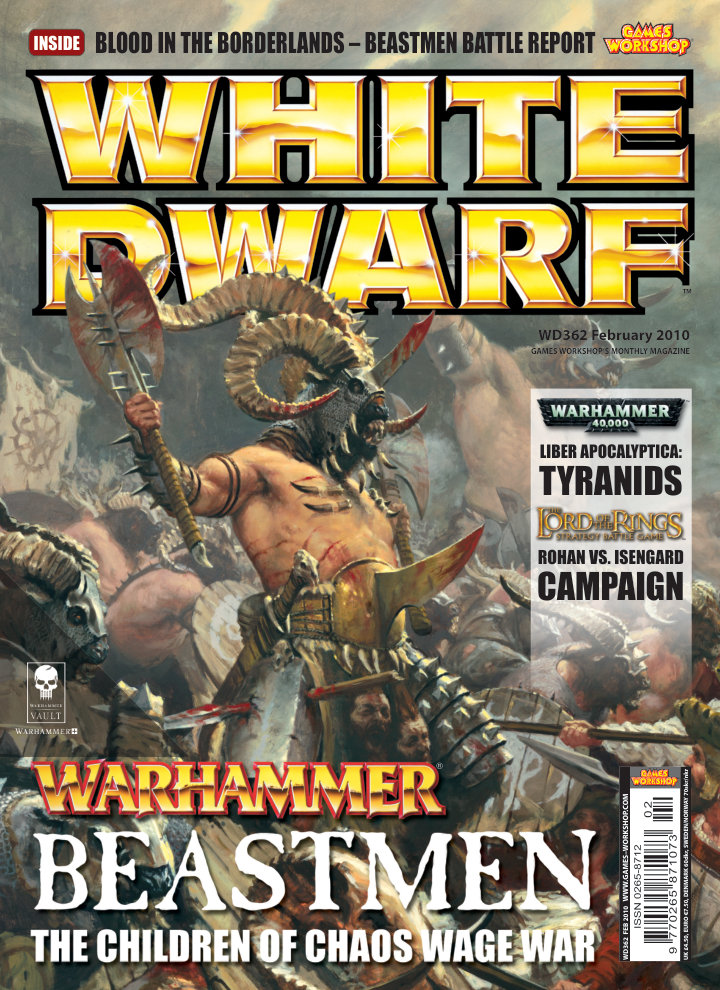
Andy Hall asks Phil Kelly how the new Beastmen book establishes a distinct culture driven by hatred of civilisation. Large regiments, unpredictable ambushes and Primal Fury replace the image of scattered minor raiders, while new monsters reinforce the army’s identity apart from Warriors of Chaos. Sculptors discuss shared weapon shapes, horns and anatomy, and the feature ends with banner design and practical four-stage painting advice.
Warhammer Fantasy BattlesBeastmen12 paint colours
InterviewWD 362 · pp. 24–26
Mike Anderson, Mark Harrison and Aly Morrison explain how scavenged equipment, status-bearing horns and recognisable silhouettes distinguish Gors, Ungors and Bestigors without fragmenting the army. The Minotaurs’ feet and musculature draw on both myth and cattle references, while boars inspire the Razorgor’s explosive bulk. Their collaborative approach extends a familiar Beastman archetype while leaving room for the more unusual monsters still without miniatures.
Warhammer Fantasy BattlesBeastmen
LoreWD 362 · p. 26
Neil Hodgson builds Beastmen iconography around horns and skulls rather than repeated conventional Chaos symbols. Banners should look stolen, roughly altered or made from disturbing materials, reflecting a race that destroys and repurposes rather than manufactures. A red Ungor standard covered in bloody handprints exemplifies the idea: colour, material and motif all communicate the brayherd’s crude violence and contempt for its enemies.
Warhammer Fantasy BattlesBeastmen
PaintingWD 362 · p. 27
Duncan Rhodes supplies four compact recipes for a battle-ready Gor. Dark brown fur is drybrushed, washed and lightly highlighted, while flesh receives a warm wash and a pale finishing mix. Bone uses a brown foundation and controlled light edges, and metal is black-washed before bright silver highlights. The guide keeps each material distinct while remaining short enough to repeat across an entire herd.
Warhammer Fantasy BattlesBeastmen12 paint colours
CampaignWD 362 · pp. 32–37
Adam Troke links five battles in the war between Rohan and Isengard, moving between individual-model skirmishes and company-based War of the Ring engagements. Early victories grant reinforcements or points, rescuing Théodred can preserve him for later battles and casualties at the Deeping Wall alter the final relief. Four scenarios receive printed setup material; the climactic Relief of Helm’s Deep is introduced with a reference to its full rulebook scenario.
Middle-earth Strategy Battle GameWar of the RingRohan
RulesWD 362 · p. 33
Rohan defends a small settlement against raiders entering around its edges, with each side building around specified captains and additional points. Dunlendings gain a temporary attack after a kill, while Rohirrim may ignore wounds through determination. Victory grants extra troops in the later Fords of Isen battle, making the opening skirmish a test of local resistance whose consequences reach the campaign’s larger formations.
Middle-earth Strategy Battle GameRohan
RulesWD 362 · p. 34
The large company-based battle divides Rohan between both banks, a river defence and incoming relief, while Isengard launches main and flanking attacks. Isengard must control all three fords; Rohan must destroy most of the invading companies. Théodred can steady nearby formations after losing a fight, and the river punishes defeated units in the crossing, giving the terrain and staggered reinforcements a direct tactical role.
War of the RingRohan
RulesWD 362 · p. 35
Erkenbrand and Grimbold lead an attempt to carry the wounded Théodred off the battlefield before scavenging enemies kill both rescuers. Evil warriors can return after casualties and arrive from uncertain positions, while defenders close to the Prince benefit from a banner-like effect. A swift rescue allows Théodred to fight later in the campaign; failure can leave Théoden vulnerable to grief in a subsequent game.
Middle-earth Strategy Battle GameRohan
RulesWD 362 · p. 36
Aragorn, Legolas and Gimli help defend the wall against a much larger Isengard force carrying ladders and demolition charges. Good wins by breaking the attackers, while Evil must get ten models through into the courtyard. Charges detonated at the culvert automatically achieve the strongest result, and the outcome either grants extra Might in the relief battle or removes slain heroes from that final confrontation.
Middle-earth Strategy Battle GameRohan
CampaignWD 362 · p. 37
The campaign concludes with Théoden’s desperate ride from Helm’s Deep and the arrival of Gandalf’s relief force. Adam introduces this as a potentially all-day multiplayer engagement and directs readers to the full War of the Ring rulebook scenario instead of reprinting it. The conclusion invites further linked battles towards the Pelennor Fields and suggests that alternate earlier outcomes can reshape familiar events.
War of the RingRohan
TacticsWD 362 · pp. 40–45
Phil Kelly turns to the attacking side of Planetstrike, beginning with the unusually large allowance for elite and fast units. Concentrated firestorms, accurate arrivals and well-timed stratagem combinations can disable a defender before the main assault. He also explains capturing intact bastions, disrupting counterattacks and using target saturation, emphasising that an army suited to ordinary missions may need substantial changes for an orbital invasion.
Warhammer 40,000
TacticsWD 362 · pp. 41–42
The firestorm works best with a target-priority plan rather than scattered hopeful shots, and it can create useful craters when the defender leaves open ground exposed. Ground Observers improve both bombardment and reserve placement, while Scorched Skies combines with pinning effects to disrupt the first turn. Confusion Reigns offers a subtler opportunity by exposing a valuable enemy unit before the barrage and initial assault arrive.
Warhammer 40,000
TacticsWD 362 · pp. 42–43
Crash and Burn, Laserburn and Meteor Strike are assessed as tools for changing the battlefield in a single attack. Their value rises when several strongpoints can be hit together, and Meteor Strike can remove an objective entirely as well as destroy its terrain. Phil recommends using these powerful effects early and combining a focused attack with temporary protection such as Dawn Assault, leaving the defender less room to recover.
Warhammer 40,000
TacticsWD 362 · pp. 43–45
Flame weapons and the Phase-field Generator can kill a bastion’s occupants while leaving its protection available to the attackers. Other stratagems suppress automated fire, freeze a vital objective at the decisive moment or create an extra chance to reach it late in the game. The advice treats capturing, bypassing and disrupting defences as complementary options to destroying every building in sight.
Warhammer 40,000
TacticsWD 362 · p. 44
Christian Byrne’s 2,500-point Ultramarines attack force concentrates three Terminator units around Calgar and a Chaplain. Chainfists and heavy weapons open bastions, assault specialists deal with the occupants and durable Legion of the Damned squads secure objectives under fire. Predators and Vindicators add ranged demolition, giving the printed list a clear sequence from breach to clearance to occupation.
Warhammer 40,000Ultramarines
RulesWD 362 · pp. 46–51
Robin Cruddace describes Hive Fleet Leviathan breaking the Iron Warriors’ fortress world of Forgefane by tunnelling beneath its supposedly impregnable defences. Two printed Apocalypse formations translate that subterranean warfare into linked Lictor, Hormagaunt and Trygon attacks or a clustered brood generating a bioelectric storm. The Tremorbeast appears in the accompanying history, but this issue prints no separate datasheet for that named creature.
Warhammer 40,000Tyranids
RulesWD 362 · p. 48
A Lictor brood guides a Trygon and a large Hormagaunt brood into a first-turn emergence close to the prey. The initial swarm acts through instinctive behaviour, then fresh Hormagaunt units can pour from the tunnel in later turns. Random brood sizes and a doubles result that exhausts the flow make the formation a powerful but finite source of pressure, with space and available models limiting how many creatures can arrive.
Warhammer 40,000Tyranids
RulesWD 362 · p. 49
Three or more Trygons arrive together from strategic reserve around a designated Alpha, avoiding additional scatter for the following beasts. Concentrated fire from at least three members improves hit and wound reliability and can disrupt vehicles through electrical overload. While the Alpha survives, nearby brood members also benefit from an invulnerable field, making proximity both an offensive resource and a defensive requirement.
Warhammer 40,000Tyranids
TacticsWD 362 · pp. 52–55
Andy Smillie defines a balanced army as one able to contribute in movement, magic, shooting and combat without staking victory on one expensive unit. His Wood Elf example spreads points across specialised but cooperating elements and changes deployment according to the opponent. He then explains selective magical defence and contrasts this flexibility with more extreme armies, whose strengths may be easier to use but whose repeated plan exposes predictable weaknesses.
Warhammer Fantasy BattlesWood Elves
TacticsWD 362 · pp. 53–54
The 1,995-point Wood Elf list combines a Treeman Ancient, supporting nobles and a Spellsinger with archers, Dryads, Wardancers, Wild Riders and Waywatchers. Few units represent large victory-point prizes, and different elements can respond to shooting, combat or denial strategies. Against a hard enemy the army seeks modest gains and table quarters; against aggressive troops it delays and thins them before combined charges, while shooting-heavy opponents require a quicker advance.
Warhammer Fantasy BattlesWood Elves
Battle reportWD 362 · pp. 56–75
Phil Kelly’s 4,000-point Beastmen face Adam Troke’s Empire and Alessio Cavatore’s Bretonnians around the ruined village of Arnesvelt. Early shooting hurts the herd, but ambushing Ungors tear apart the gun line and increasingly frenzied Minotaurs destroy elite knights. The allies fight back, even killing the Giant that crushes their Bretonnian Lord as it falls, but the Beastmen claim a 3,256–2,502 minor victory in a continuation of the earlier Drums of War story.
Warhammer Fantasy BattlesBeastmen
EditorialWD 362 · pp. 76–78
Jervis Johnson asks why hobbyists devote time to conversions when the unaltered models already look good. He moves from simple component swaps through putty work and scratch building, arguing that ordinary rank-and-file figures can be as personally meaningful as spectacular centrepieces. Plastic compatibility and spare components support this creativity, but the satisfaction comes from making something individual rather than from the tools themselves.
PaintingWD 362 · pp. 79–85
The expanded painting surgery uses readers’ questions to teach cloth, Chapter insignia, reflective surfaces, red armour, weathering, horns and sculpted banners. Different painters demonstrate both the underlying visual decisions and the named colour sequences, from alternating reflections on a crystal blade to warm–cool contrast in reds. The format develops practical worked examples instead of offering only short answers, with techniques intended to transfer to many other miniatures.
33 paint colours
PaintingWD 362 · p. 79
Joe Tomaszewski compares smooth blending with deliberate line highlighting on the same green cloak. Both begin from a shaded dark green, but one uses many gradual layers while the other relies on a few carefully placed marks at ridges and intersecting folds. The comparison makes clear that colour milestones do not prescribe identical brushwork, and that highlight placement remains essential even when the transitions are soft.
6 paint colours
PaintingWD 362 · p. 80
Darren Latham links a custom Chapter’s name, badge and livery before demonstrating repeatable freehand insignia. A limited contrasting palette and company spot colour establish coherence, while plotted dots, connected outlines and blocked shapes make complicated icons manageable. Transfers and sculpted shoulder-pad symbols offer alternatives, and corrections with the background colour keep repeated badges consistent across an army without requiring a flawless first stroke.
Warhammer 40,000Space Marines
PaintingWD 362 · p. 81
Joe Tomaszewski uses alternating light and dark planes to suggest a reflective crystal sword, then adds fine white reflection marks and a yellow glaze near the hilt. An hourglass follows related principles, with the visible sand considered alongside the shape of the glass. Both examples depend on reference and a chosen light source, making the reflection pattern more important than simply painting the whole object pale blue.
Warhammer 40,000Aeldari9 paint colours
PaintingWD 362 · pp. 82–83
Neil Green demonstrates near-black red armour with strong edge highlights and a glowing magma pattern for a Khorne Lord’s Juggernaut. He then compares red cloth shaded with green or blue, using cooler tones to retain richness and avoid muddy shadows. The examples show two different uses of contrast: bright lines can emphasise a very dark surface, while hue changes give a broad red area more depth.
Warhammer Fantasy BattlesWarriors of Chaos10 paint colours
PaintingWD 362 · p. 83
Kornel Kozak adds age to an Ork Meganob only after its main scheme is complete. Thin turquoise and pale washes form verdigris, while successive flesh, brown and black streaks suggest increasingly concentrated oil. The advice stresses restraint: a few well-positioned marks explain worn machinery, whereas covering everything in weathering would obscure the original colours and weaken the model’s overall appearance.
Warhammer 40,000Orks6 paint colours
PaintingWD 362 · p. 84
Keith Robertson explains that the direction of a horn’s colour progression should contrast with the head or helmet beneath it. Smooth horns use elongated dark triangles and lighter successive layers, while ridged horns rely on selective highlights towards the base. The paired recipes and finished examples show how both texture and the light–dark direction lead the eye back towards the face.
Warhammer Fantasy Battles8 paint colours
PaintingWD 362 · p. 85
Tom Winstone works from a Cadian banner’s background towards its raised foreground details, shading the folds throughout rather than merely colouring separate shapes. The gate motif uses non-metallic metal colours so it reads as an embroidered design, and pale parchment receives planned lettering. Thin preliminary text can be corrected before the strokes are strengthened, while the red, black and white fields retain their own controlled highlight sequences.
Warhammer 40,000Imperial Guard15 paint colours
PaintingWD 362 · pp. 86–89
Nick Bayton paints Michael Perry’s new plastic Fell Beast with film reference guiding its dark, unnatural skin. Khaki-lightened black avoids a uniform grey finish, while mottling, purple-tinted scales and pale wing membranes distinguish different surfaces. The detailed guide includes the Ringwraith, reins, claws, tongue and metalwork, and Nick first completes an unconverted example to understand the construction before attempting further alterations.
Middle-earth Strategy Battle GameWar of the RingNazgûl14 paint colours
PaintingWD 362 · p. 87
The Fell Beast’s skin moves through black-and-khaki layers, dark washes and pale mottling on the underbelly. Grey-drybrushed scales instead receive purple and black washes, while the membranes begin much lighter before their final shade. A short stippling demonstration explains how repeated irregular taps create organic variation, helping the large model remain visually interesting within a deliberately restrained palette.
Middle-earth Strategy Battle GameWar of the RingNazgûl8 paint colours
PaintingWD 362 · p. 88
Grey edge highlights and gloss separate the claws from surrounding dark skin, while a purple-to-bone tongue gains a wet finish from varnish. The Ringwraith’s cloak uses khaki-lightened black and brown shading, with brown leather reins connecting rider and mount. Black-washed metal finishes the equipment, keeping the smaller materials distinct without breaking the model’s overall dark appearance.
Middle-earth Strategy Battle GameWar of the RingNazgûl11 paint colours
CommunityWD 362 · pp. 90–93
James Griffin recounts returning to the hobby, winning two bronzes in 2008 and developing through the criticism and encouragement of Platoon Britannica. His nine finalist entries in 2009 earn no trophy, but the experience strengthens his determination to improve. Studio entrants Seb Perbet and Mike Anderson explain their bespoke dioramas, and an interview with Slayer Sword winner Ben Jarvis reveals the long development of his heavily scratch-built Clockmaker.
InterviewWD 362 · p. 93
Ben Jarvis discusses the Empire Engineer that wins the 2009 UK Slayer Sword. Only the head, arms and legs come directly from Citadel miniatures; the rest of the Clockmaker is built for the project, including intricately planned brass details. He begins soon after the previous Games Day, then benefits from a six-month pause that lets him return with fresh judgement before completing the painting.
Warhammer Fantasy BattlesThe Empire
ModellingWD 362 · pp. 94–97
Chad Mierzwa represents a Beastmen attack through a village at successive stages of ruin instead of inventing an elaborate permanent Beastman settlement. Barricades and a fortified house lead towards damaged buildings, twisted woods and charred foundations. Exposed roofs and walls require convincing internal structure, and simple spare materials build much of the debris, giving the scenery its own narrative of attempted defence and destruction.
Warhammer Fantasy BattlesBeastmen2 paint colours
PaintingWD 362 · p. 97
The burnt surface is made by adding sand to still-wet black undercoat and sealing it with another black coat. After the surrounding building is painted, black drybrushing and a lighter grey pass pick out the charred texture. The recipe accompanies a scratch-built ruined foundation assembled from thick card, chapel statues, leftover frames, barrels and stones, demonstrating how texture and salvaged parts can sell severe destruction.
Warhammer Fantasy BattlesThe Empire2 paint colours
PaintingWD 362 · pp. 98–103
Darren Latham extends face painting to Trolls, Giants, Minotaurs, Ogres, Lizardmen and Daemons. Larger faces need more subtle layers rather than simply enlarged human highlights, while warm glazes keep cool-coloured skin looking alive. Examples explain two-tone complexions, species size and colour relationships, hard scale edges against blended flesh and the eye details that give a large creature expression.
Warhammer Fantasy BattlesMiddle-earth Strategy Battle Game30 paint colours
PaintingWD 362 · p. 99
A Mordor Troll’s face uses lighter flesh below a darker hide, with the join positioned around the eyes and softened according to the sculpt’s texture. Brown and flesh mixtures build the highlights before warm washes enrich the nose, lips and eye area. Darren explains that film-based subjects call for restrained realism, and that the final highlights can reinforce a chosen expression rather than just define anatomy.
Middle-earth Strategy Battle GameWarhammer Fantasy BattlesMordor9 paint colours
PaintingWD 362 · p. 100
A darker flesh foundation suits the Giant’s broad, relatively open facial surfaces. Many thin highlights progressively lighten the skin without harsh lines, while red and blue washes suggest anger or intoxication around the central features. The twelve-stage sequence ends with carefully restricted pale accents and completed eyes and teeth, demonstrating why a larger painting area requires finer control rather than a larger brush and heavier highlight.
Warhammer Fantasy BattlesGiants10 paint colours
PaintingWD 362 · p. 101
The Minotaur receives a darker complexion than smaller Beastmen, with gradual flesh highlights and red-purple washes adding a raw, angry quality. A blue vein gives a small cool accent to the warm skin. The adjacent Ogre discussion explains the reverse problem: grey flesh needs coloured shading to avoid looking lifeless, and clothing choices should not exaggerate the contrast until the creature appears dead.
Warhammer Fantasy BattlesBeastmen13 paint colours
PaintingWD 362 · p. 102
The Kroxigor repeats a two-tone face with its lighter area around the mouth, using khaki to lighten a Regal Blue foundation. Warm shading and a complementary tongue keep the cool skin lively, while sharply edged scales contrast with blended flesh. The examples compare bright Skinks, more subdued Saurus and darker Kroxigor, explaining how colour intensity can communicate size and power within one army.
Warhammer Fantasy BattlesLizardmen7 paint colours
PaintingWD 362 · p. 103
Four Daemon examples use distinct palettes but share neat layers and edge highlights: red for a Bloodletter, pale purple for a Daemonette, saturated purple for a Horror and diseased green for a Plaguebearer. The eye discussion distinguishes natural eyes from reptilian slits, burning Chaos eyes and milky Daemonic ones. An off-white eyeball avoids a startled Giant, while the final reflection crosses iris and pupil to unify the detail.
Warhammer Fantasy BattlesDaemons of Chaos15 paint colours
ShowcaseWD 362 · pp. 106–125
The extended gallery presents the UK Golden Demon winners across all thirteen competition categories, from single figures and squads to vehicles, monsters, duels and dioramas. Ben Jarvis’s Clockmaker receives the Slayer Sword, while subjects as varied as an Ork Stompa, a Krieg patrol, Bilbo and a large-scale Inquisitor show the breadth of the competition. Young Bloods and the Studio’s Open category complete the display, with painter and placing credits accompanying the photographs.
Warhammer 40,000Warhammer Fantasy BattlesChaos Space Marines