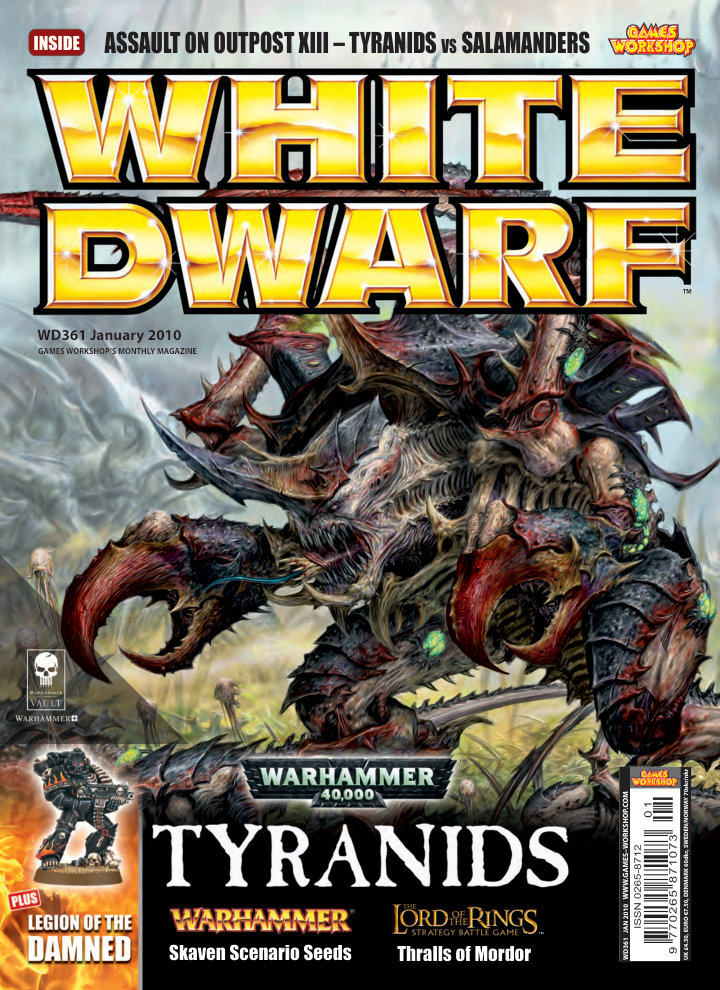
EditorialWD 361 · p. 1
Mark Latham welcomes the Tyranid release and the return of the Legion of the Damned, then checks the White Dwarf team’s previous New Year resolutions. His Sons of Medusa remain unfinished after a diversion into Blood Angels, while Andy Hall succeeds at weekly gaming and Andrew Kenrick expands his Salamanders before beginning Tomb Kings. The contrasting outcomes make the editorial a candid account of how real hobby plans evolve over a year.
CommunityWD 361 · pp. 12–15
Battle Missions is previewed as a collection of more than thirty scenarios designed around individual armies’ character and tactics. The news also announces Rob Scott’s Tempest Guard shoulder-pad competition win, Dawn of War II’s cooperative Last Stand mode and Fantasy Flight’s Radical’s Handbook and Chaos Marauders. Reader travel photographs, a new Studio artist and forthcoming school events round out the picture of hobby activity beyond the monthly release.
Warhammer 40,000Dark HeresySpace Marines
InterviewWD 361 · pp. 16–27
Adam Troke investigates Robin Cruddace’s new Tyranid codex, its expanded invasion history and its greatly enlarged army roster. Artists and sculptors explain how shared anatomy keeps new creatures recognisably Tyranid while solving practical problems such as heavy Gargoyles and Raveners’ burrowing weapons. Rules discussion emphasises adaptable armies, clearer upgrades and legendary organisms, while painted examples distinguish flesh, chitin and symbiotic weapon beasts.
Warhammer 40,000Tyranids
TacticsWD 361 · pp. 19–26
Studio players explain the battlefield roles of the new Tyranid army’s major threats. Expendable broods overwhelm target priorities, Raveners attack from unexpected positions and cheap Gargoyles provide a fast swarm, while more durable Warriors strengthen the middle of the force. Genestealers can include a Broodlord and Carnifexes can form broods, encouraging an army built from cooperating layers rather than a single preferred monster.
Warhammer 40,000Tyranids
InterviewWD 361 · pp. 22–23
Aly Morrison and Tom Walton’s plastic Trygon builds on Simon Egan’s Forge World model while sharing proportions with the Carnifex. Its kit makes three distinct monsters: a close-range Trygon, a Synapse-bearing Trygon Prime or a Mawloc whose eruption damages enemies above it. The frame breakdown and design account show how extra armour, posture and variant heads produce both a consistent creature family and meaningful modelling choices.
Warhammer 40,000Tyranids
RulesWD 361 · pp. 30–35
Jeremy Vetock turns Skaven society into scenario material: treacherous alliances, coveted warpstone, experimental monsters, diseases, sabotage and underground conquest. Each premise suggests objectives, unusual army restrictions or special rules rather than merely changing the enemy’s name in a pitched battle. Twelve actual ideas are supplied; the thirteenth position is deliberately reserved for the Great Horned Rat, and the closing discussion invites players to develop further campaigns of their own.
Warhammer Fantasy BattlesSkaven
RulesWD 361 · p. 31
Two rival Warlords first choose their own characters and Core troops, then secretly bid remaining points for a shared pool of Greater Clan specialists. Winning a bid secures that unit but may leave another desirable formation to the opponent, making bluffing part of army selection. A games master can extend the scheme with concealed traps, sabotaged weapons or turncoats, turning an internal Skaven feud into a negotiation before the fighting begins.
Warhammer Fantasy BattlesSkaven
RulesWD 361 · p. 31
Warpstone becomes the objective of a battle, reflecting its importance to Skaven weapons, breeding, sorcery and currency. The side holding the most deposits wins, but controlling them is dangerous: nearby troops may become stupid or mutate after failed Leadership tests. The premise links a simple objective contest to the corrupting substance both armies are trying to acquire, with the exact extent of mutation left for players to develop.
Warhammer Fantasy BattlesSkaven
RulesWD 361 · p. 32
A Clan Moulder coalition receives unpredictable reinforcements from its breeding pits each turn. A collection-based random chart can release ordinary Giant Rats or Rat Ogres, a Hell Pit Abomination or an unstable one-off creation that may not obey its supposed masters. The idea encourages grotesque conversions and treats the clan’s proximity to the Chaos Wastes as a reason for monsters far beyond its usual commercial stock.
Warhammer Fantasy BattlesSkaven
RulesWD 361 · p. 32
The Skaven must deliver a disease into an enemy settlement before the defenders can stop them. One version follows infiltrators slipping contaminated bodies or vessels into a water supply; another uses an open assault to escort a unit or moving objective through a gate or over a wall. The distinction lets the same unpleasant background support either a stealth mission or a larger breakthrough battle.
Warhammer Fantasy BattlesSkaven
RulesWD 361 · p. 32
A Skaven civil-war battle includes as many free slave units as the players can provide, with the option to recycle losses. At the start of a friendly turn each unit may switch allegiance on a roll of one, so a useful screen can become a threat without warning. The rule expresses the slaves’ miserable position and lack of loyalty, rewarding Warlords who plan for betrayal instead of trusting their numerical advantage.
Warhammer Fantasy BattlesSkaven
RulesWD 361 · p. 33
An attacking army races to destroy an ambitious Clan Skryre device before it is completed and brought to bear. The Skaven fight a delaying action around a scratch-built machine, making scenery construction part of the scenario’s appeal. A related Journey to the Moon variation changes the target to a warpstone-fuelled rocket, with the threat of access to Morrslieb providing a reason for almost any sane opponent to intervene.
Warhammer Fantasy BattlesSkaven
RulesWD 361 · p. 33
Skaven attackers receive extra points while the defenders begin inside a fortified settlement whose buildings serve as objectives. The basic contest can become more destructive by requiring the ratmen to wreck and defile each position rather than merely occupy it. A Screaming Bell collapsing structures gives the proposal a particularly Skaven identity and encourages a table where successive breaches matter to the narrative.
Warhammer Fantasy BattlesSkaven
RulesWD 361 · p. 33
Unusually lavish backing from the Greater Clans lets a Warlord field specialist resources far beyond the ordinary army-list limits. The suggestion triples available Special choices and doubles Rare choices, with Clan Skryre support potentially supplying two Weapon Teams to each suitable regiment. It is an invitation to construct a themed excess of machines, monsters or assassins, representing a particular alliance rather than the normal resources of an independent clan.
Warhammer Fantasy BattlesSkaven
RulesWD 361 · p. 34
Clan Pestilens invades a Lizardmen temple-city, seeking to contaminate spawning pools and capture the magical power of a jungle ziggurat. Plague Monks become Core and the Plagueclaw Catapult Special to establish the invaders’ identity, with a mounted Plague Priest leading the force. The scenario uses both sacred locations and competing Wizards as objectives, making the disease-ridden attack more distinctive than a conventional Lustria battle.
Warhammer Fantasy BattlesSkaven
RulesWD 361 · p. 34
Clan Eshin infiltrators emerge through sewer entrances into a patrolled Empire town, with separate missions against wells, officials, garrisons and magical targets. Assassins and runners must reach their objectives before the alarm exposes them, while opportunities for sabotage and murder can alter the original plan. The proposal deliberately mixes the scale of a wargame with the stealth and individual objectives associated with smaller narrative games.
Warhammer Fantasy BattlesSkaven
RulesWD 361 · p. 34
Two linked games recreate a Skaven invasion of a Dwarfhold. Control of entrances in the first battle grants points and favourable reinforcement routes in the second, where the king’s throne and dais become the decisive objective. Cave-ins, traps or underground creatures can complicate either stage, and additional last stands can extend the campaign as the victors pursue remaining pockets of resistance.
Warhammer Fantasy BattlesSkaven
RulesWD 361 · p. 35
Common Skaven regiments return after destruction, allowing the ratmen to wear down an opponent through repeated waves rather than superior individual fighters. Reinforcements can enter from the home edge or from prepared tunnels distributed around the battlefield. Starting with equal points therefore does not imply equal endurance: the defender’s task becomes surviving the accumulating pressure while Skaven specialists soften especially resilient formations.
Warhammer Fantasy BattlesSkaven
InterviewWD 361 · pp. 38–45
Andy Hall asks Mat Ward and sculptors Neil Langdown and Matt Holland how the Legion of the Damned preserves a supernatural mystery within the technological Imperium. Their rules make the Legion accurate, resilient rescuers, while carefully placed skulls and flames retain the familiar Space Marine silhouette. Suggested armies and a history reaching back to White Dwarf 99 show how the new figures continue an older idea without explaining away their uncertain origins.
Warhammer 40,000Legion of the Damned
RulesWD 361 · p. 41
The complete squad entry allows a Space Marine army to take the Legion in an Elite slot, beginning with a Sergeant and four Legionnaires and offering additional models and specialist weapons. Their save is invulnerable, while Fearless and Slow and Purposeful capture their relentless advance. Aid Unlooked For requires reserve arrival by Deep Strike and permits a scatter re-roll, making unusual entry and durability central to their role.
Warhammer 40,000Legion of the Damned
TacticsWD 361 · p. 42
Matt Hutson builds a 1,500-point White Scars army that combines Khan’s Outflank options with a Drop Pod and the Legion’s Deep Strike. A first-turn strike can concentrate on the greatest threat or divide between important objectives, while Rhinos and bike squads arrive to exploit the disruption. The plan depends on speed and precise pressure because the army is small, with the Legion’s invulnerable protection helping sustain its forward presence.
Warhammer 40,000White Scars
TacticsWD 361 · p. 43
Andrew Kenrick recreates Tigurius’s famous encounter with the Legion as a 2,000-point Ultramarines Planetstrike force. Two Legion squads, two Terminator units and an Ironclad Dreadnought deliver concentrated flame, melta and assault power into Ork bastions. A Tactical Squad can secure the positions after capture, while the article’s reference to an online scenario distinguishes the printed army plan from a complete mission reproduced in the magazine.
Warhammer 40,000Ultramarines
LoreWD 361 · p. 45
The history follows the Legion from painted RTB01 Marines in the March 1988 White Dwarf through their appearance in the 1995 Ultramarines codex and the original metal range. Mike McVey and Dave Andrews supplied the early freehand bones and fire, while Jes Goodwin’s limited Sergeant Centurius marked the hundredth Games Workshop store. The retrospective explains why the new release recalls a long-established visual tradition.
Warhammer 40,000Legion of the Damned
TacticsWD 361 · pp. 46–51
Adam Troke surveys Evil Men as armies with complementary strengths rather than interchangeable servants of Sauron. Harad supplies numbers, cavalry and Mûmakil; Easterlings add armour and supporting ranks; Corsairs bring high fighting skill and thrown weapons at the cost of protection. Practical combinations involving heroes, spears, bows and the Nazgûl lead into a test battle that exposes both the strengths and remaining weaknesses of his new Corsair force.
Middle-earth Strategy Battle GameHarad
TacticsWD 361 · pp. 48–49
The tactical examples show how a dense Haradrim spear formation supports heroes, how a Dragon Knight can maximise attacks with supporting spears, and how the Betrayer improves poisoned archery. Cavalry use Might to maintain a hit-and-run rhythm, while Mûmakil break dense infantry and deliver passengers near objectives. Selecting a particular Nazgûl for the opposing army adds another layer of adaptation rather than a fixed favourite in every list.
Middle-earth Strategy Battle GameHarad
Battle reportWD 361 · pp. 50–51
Adam’s 699-point Corsair army tests its plan against Christian Byrne’s Dwarves in To the Death. The Knight of Umbar isolates Balin with magic, crossbows thin the Iron Guard and Dalamyr helps kill Dáin, delivering a convincing Corsair victory. Adam still identifies the lack of cavalry and vulnerability to enemy bows as serious limitations, considering Haradrim Raiders and the Shadow Lord before taking the army to a tournament.
Middle-earth Strategy Battle GameCorsairs of Umbar
Battle reportWD 361 · pp. 54–73
Robin Cruddace’s Tyranids attack Mat Ward’s Salamanders as a wounded Captain crawls towards evacuation. Synapse creatures recycle destroyed broods, while the defenders score by killing those leaders and preserving Captain Varn. Monstrous creatures demolish all three sections of Outpost XIII, but stubborn Terminators and the Legion of the Damned buy enough time for the Thunderhawks to arrive, securing a narrow 4–3 Space Marine victory despite abandoning the planet.
Warhammer 40,000Tyranids
RulesWD 361 · p. 55
Deployment divides both armies between the wounded Captain and the outpost, forcing the Salamanders to defend two related objectives. Destroying each bastion section earns the Tyranids a point, killing a Synapse brood rewards the Marines and the Captain’s survival or death decides the final point. Synapse leaders also replenish Troops, while Varn can only crawl and is protected from direct shooting, creating a rescue story rather than a normal mission.
Warhammer 40,000Tyranids
ShowcaseWD 361 · pp. 74–76
Colin Grayson’s Skaven army represents a roaming underground court ruled by a Warlord and a grotesque brood mother inspired by John Blanche’s artwork. Every conversion has a narrative function, from tunnelling Rat Ogres to small traps left behind the horde. Greater Clan envoys bring visibly different bodyguards, while future digging machines and scenery will extend the story rather than simply fill additional tournament slots.
Warhammer Fantasy BattlesSkaven
EditorialWD 361 · pp. 77–79
Jervis Johnson reflects on the defeated player’s sulky expression and the way blaming dice can conceal tactical mistakes. His practical remedies begin with recognising the mood, then remembering the opponent’s enjoyment, keeping the result in perspective and studying errors while the game is still underway. He treats gracious play as both a social responsibility and a route to better games, drawing on his own imperfect efforts rather than claiming immunity to frustration.
PaintingWD 361 · pp. 80–87
Anja Wettergren uses the Damned Sergeant to demonstrate a coordinated palette of cool black armour, warmer weapon casings, spectral bone and bright flame motifs. Purple washes lend the metal and bones an otherworldly quality, while different reds distinguish wax, eyes, leather and fire. Scroll lettering, plasma coils and aged bronze finish the model, and the completed squad shows how transferable techniques can preserve cohesion across highly individual sculpts.
Warhammer 40,000Legion of the Damned26 paint colours
PaintingWD 361 · p. 81
Khemri Brown provides an even foundation for the skeletal ornament, followed by dark shading and a purple wash that makes the bone appear subtly unnatural. Successive mixtures with Bleached Bone are blended in thin layers before white defines the sharpest edges. Anja explains that a more ordinary bone treatment could use a muted brown wash instead, making the colour choice a deliberate part of the Legion’s spectral identity.
Warhammer 40,000Legion of the Damned7 paint colours
PaintingWD 361 · p. 82
Blue-black armour receives cool grey edge highlights, while the plasma pistol’s casing uses grey and bone for a warmer black. Boltgun Metal is shaded with black and diluted purple before a silver edge restores definition. The explanation shows how two apparently black surfaces can remain distinct and how changing the wash could make similar metallic recipes suit dirty Orks or green-tinted Necrons.
Warhammer 40,000Legion of the Damned11 paint colours
PaintingWD 361 · p. 83
Anja paints the armour’s flat flame motifs as graphic decoration, putting brighter yellow and white at the upper edges rather than imitating a three-dimensional fire directly. Red provides the base, with orange and increasingly yellow highlights defining each tongue. The article explains that following natural fire too literally would merge dark flame edges with black armour and make the design visually unbalanced.
Warhammer 40,000Legion of the Damned5 paint colours
PaintingWD 361 · p. 84
Dheneb Stone keeps the parchment distinct from the adjacent Bleached Bone skeleton details. Red and brown washes age it before progressively lighter stone and white highlights restore its folds and edges. For the inscription, Anja plans the word on paper and paints outward from the centre letter, avoiding the common problem of running out of space; the page also notes how reversing the flame sequence suits a sculpted brazier.
Warhammer 40,000Legion of the Damned5 paint colours
PaintingWD 361 · p. 85
The wax seals and eyes receive a red distinct from the surrounding flames, shaded black and taken through orange to tiny white accents. Bronze decoration introduces a second metallic family, using a brown-metal base, a wash and pale silver highlights. These details break up otherwise large areas of bone and gunmetal without competing with the dominant black armour and fire design.
Warhammer 40,000Legion of the Damned9 paint colours
PaintingWD 361 · p. 86
Blue plasma coils supply a cool accent planned before painting begins, with successive blue layers ending in very pale ridge highlights. The axe handle instead becomes a reddish brown chosen late in the process to suit the finished model. Bone-yellow highlights lighten that leather before a red glaze enriches it again, showing how small details can echo existing colours while retaining different material identities.
Warhammer 40,000Legion of the Damned7 paint colours
PaintingWD 361 · p. 87
Darren Latham answers a reader who wants to highlight Dark Angels without making the armour too light. He recommends a black undercoat, a Dark Angels Green layer and restrained Snot Green marks confined to the edges. A still finer Scorpion Green highlight is optional, with the adjacent Legion armour method providing the model for controlling placement rather than broadening the bright areas across the panels.
Warhammer 40,000Dark Angels3 paint colours
PaintingWD 361 · pp. 90–95
Chad Mierzwa builds a Tyranid collection around models he enjoys, then develops a cold grey scheme that works in both jungle and urban settings. Selected dynamic poses and scenic bases give the horde variety without making every creature theatrical. Stored batches of mixed paint keep the army consistent, while mottled chitin, warmer soft tissue, glossy claws and rusty base details add contrasting textures and focal points.
Warhammer 40,000Tyranids11 paint colours
ModellingWD 361 · p. 91
Chad changes posture and height selectively to make Tyranid broods loom, crouch or move across their bases. A few striking figures improve an uneven, threatening silhouette, but exaggerating every model makes a unit look comic rather than dangerous. His advice links small conversions to secure assembly, recommending pins for precarious contact points and plastic glue where compatible components cannot be pinned.
Warhammer 40,000Tyranids
PaintingWD 361 · pp. 92–93
A Graveyard Earth and Shadow Grey mixture forms the whole army’s base, with increasing Bleached Bone used for drybrushed highlights. Black carapaces receive ochre stippling and purple edges, while green-blue soft areas and yellow eyes add detail. The larger monsters get extra pale patterning, grey scenic bases provide contrast and Water Effects gives claws a glossy finish; numbered pots of premixed colours make the method repeatable across a large force.
Warhammer 40,000Tyranids11 paint colours
ModellingWD 361 · pp. 94–95
Chad reserves the largest scenic bases for leaders and monsters, using chopped barrels, damaged girders, spare foliage and building parts to imply an advancing army in a believable environment. Angled cuts and surrounding sand make debris appear embedded rather than simply placed on top. A Beastmen example extends the advice to ranked regiments, where neighbouring bases are developed together so scenic details align without preventing the unit from fitting.
Warhammer 40,000Warhammer Fantasy BattlesTyranids
ModellingWD 361 · pp. 98–101
Dave Andrews turns several modular Bastion kits into the layered fortress used in the issue’s battle report. A Gaming Hill, compatible Cities of Death walls and a Sanctum Imperialis doorway broaden its footprint without requiring extensive rebuilding. Cut-out doors, an escape hatch, lamps and extra drill damage give the complex practical detail, while a warm red-oxide finish distinguishes it from the Studio’s existing fortifications.
Warhammer 40,000Imperium3 paint colours
PaintingWD 361 · pp. 100–101
The fortress’s rusty red walls begin with Dark Flesh and receive repeated Blazing Orange drybrushing, with a small amount of white in the last highlight. Additional battle damage, contrasting guns, small coloured details and a black flag make the finished tower legible as an Imperial stronghold. The guide combines the explicit wall recipe with a close look at the completed doors, escape route and upper defences.
Warhammer 40,000Imperium3 paint colours