EditorialWD 344 · p. 1
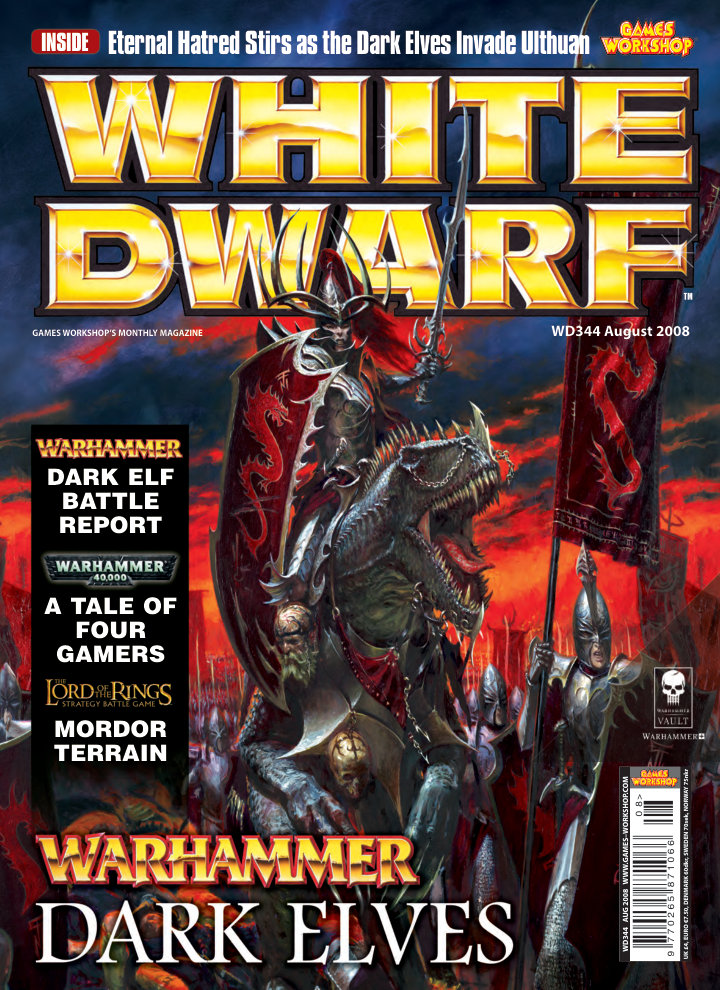
Mark Latham introduces Gav Thorpe’s return to discuss the Dark Elves and describes the Studio tournament following the new Warhammer 40,000 edition. His own early elimination contrasts with Matt Hutson’s continuing Blood Angels campaign. The difficulty of choosing a new army prompts the revival of A Tale of Four Gamers for the far future, with collecting principles intended to apply across game systems.
Warhammer 40,000Warhammer Fantasy Battles
LoreWD 344 · p. 10
The forthcoming boxed game is introduced through Captain Sicarius and the Ultramarines’ defence of Ghospora Hive against Waaagh! Zanzag. Its mix of Orks and Marines includes plastic Deffkoptas, Nobz, Terminators and a Dreadnought, offering both reinforcements and a starting collection. The notice also announces the Terminator and Ork Nob that will accompany the following magazine, linking the historical battle to the new miniature range.
Warhammer 40,000Ultramarines
CommunityWD 344 · p. 11
October’s Space Marine release is previewed with Sternguard and Vanguard Veterans, a plastic Drop Pod and new vehicle variants. The article promises an all-plastic Land Raider Crusader, special characters, Legion of the Damned and support weapons alongside the new codex. It identifies this as the first codex tailored to fifth edition and looks ahead to design coverage and a demonstration battle rather than providing the units’ rules here.
Warhammer 40,000Space Marines
InterviewWD 344 · pp. 14–27
Gav Thorpe presents the Druchii as a society shaped by Malekith’s grievance, ambition and need to dominate, rather than simply an assortment of villains. That outlook carries into aggressive magic, Eternal Hatred, inexpensive supporting Warriors and powerful specialist units. Jes Goodwin and Brian Nelson explain how they developed the new Cold One Knights and Corsairs, while artwork and Chris Peach’s painting examples translate the army’s character into visual choices.
Warhammer Fantasy BattlesDark Elves15 paint colours
TacticsWD 344 · p. 18
Three Assassin builds illustrate the different jobs available through the Gifts of Khaine. A Venom Sword threatens monsters through a lethal Toughness test, while additional attacks and Rending Stars make a flexible troop hunter. The character killer combines flight, Killing Blow and enhanced challenge overkill. The examples demonstrate how a hidden Assassin can be tailored to a target without consuming the army’s normal character allowance.
Warhammer Fantasy BattlesDark Elves
InterviewWD 344 · pp. 20–21
Jes Goodwin describes building a Cold One from a skeleton through speculative muscles to its final hide, using dinosaur references without sacrificing the demands of a ranked miniature. Tail length, sharp features and base size influence the result, and exaggerated claws risk making a beast look juvenile. Bony chin projections solve the problem of controlling its jaws. Coordinating helmet crests with the Corsairs restores recognisable Dark Elf heraldry across the range.
Warhammer Fantasy BattlesDark Elves
InterviewWD 344 · pp. 22–23
Brian Nelson explains the forward motion and piratical swagger of the Black Ark Corsairs. Sea boots, curved blades and an eye patch suggest boarding actions, while the integrated Sea Dragon cloaks are folded and positioned to fit both the frame and a ranked unit. Plastic casting permits fine handbows and plentiful options. The discussion makes the practical compromises of dynamic infantry design visible without losing their nautical identity.
Warhammer Fantasy BattlesDark Elves
ShowcaseWD 344 · pp. 24–25
Paul Dainton’s battle paintings set Cold One Knights against Bretonnian cavalry and Black Guard against Sword Masters, using matched opponents to convey the Dark Elves’ elite menace. Alex Boyd’s army vista moves from a foreground phalanx towards towers and a distant Hydra. The selected images emphasise military organisation as well as brutality, giving the new army book a visual language extending beyond individual miniatures.
Warhammer Fantasy BattlesDark Elves
PaintingWD 344 · pp. 26–27
Chris Peach demonstrates compact recipes for the main surfaces of a Dark Elf army. Washed metallic armour and pale flesh suit Warriors, while Corsairs receive purple lacquer, dark leather and a cloak with green scales over a warm hide. The steps use restrained mixes and successive edge highlights to keep the individual textures distinct. Shield illustrations offer heraldic inspiration tied to a commander, city or Black Ark.
Warhammer Fantasy BattlesDark Elves15 paint colours
PaintingWD 344 · p. 26
A black undercoat and solid Boltgun Metal base establish the Warrior’s armour before a generous Badab Black wash darkens the recesses and dulls the shine. Chainmail then restores definition to the raised edges. Chris Peach presents the sequence as a reusable method for metallic areas, allowing a rank-and-file model to retain strong contrast with relatively few operations.
Warhammer Fantasy BattlesDark Elves4 paint colours
PaintingWD 344 · p. 26
The pale face is built in three stages from Dwarf Flesh, through an equal mix with Elf Flesh, to pure Elf Flesh on the most prominent features. Rather than covering each previous layer, Chris Peach restricts the lighter paint to raised areas. This keeps readable facial shading while making the skin lighter than the surrounding dark armour and clothing.
Warhammer Fantasy BattlesDark Elves2 paint colours
PaintingWD 344 · p. 27
The cloak’s two surfaces receive different palettes: dark green scales rise through a mixed green overbrush to Goblin Green, while the hide moves from Dark Flesh to progressively warmer Vomit Brown mixtures. The final hide highlight adds Dwarf Flesh. Treating scales and skin separately makes the reptilian material recognisable without requiring individual scale painting throughout the unit.
Warhammer Fantasy BattlesDark Elves6 paint colours
PaintingWD 344 · p. 27
Corsair armour begins with an equal mix of Liche Purple and Chaos Black, preserving a dark foundation. Broad purple bands define the edges before a finer purple and Fortress Grey mix picks out the strongest contours. The changing width of the highlights gives the plates their lacquered appearance while keeping the shadows almost black.
Warhammer Fantasy BattlesDark Elves3 paint colours
PaintingWD 344 · p. 27
The Corsair’s boots and gloves retain a Chaos Black base with Adeptus Battlegrey on prominent areas and Codex Grey along the edges. Chris Peach uses the small bright accents to imply polished leather rather than turning the whole material grey. The short sequence complements the adjacent purple armour and green cloak recipes for a complete rank-and-file scheme.
Warhammer Fantasy BattlesDark Elves3 paint colours
FictionWD 344 · pp. 28–29
On leaving the Skull Gate, Malus’s marching column is struck by concealed crossbowmen. Lhunara’s Cold One Knights respond with a savage charge while Malus pursues fleeing attackers through the rocks. Their apparent advantage becomes unsettling when his mount Spite starts behaving abnormally, interrupting a killing blow and charging back towards the road. The extract ends as Malus recognises a more serious danger behind the successful ambush response.
Warhammer Fantasy BattlesDark Elves
CommunityWD 344 · pp. 33–41
Andrew Kenrick relaunches the collecting series with four contrasting approaches: Neil Hodgson’s detailed Crimson Fists, Pete Foley’s tournament Eldar, Matt Hutson’s narrative Red Corsairs and Fil Dunn’s quickly painted Goffs. Monthly projects build towards forces of at least 1,500 points, with completion and games contributing to a friendly competition. Their first instalments reveal how available time, rules ambitions and favourite stories affect both model selection and painting methods.
Warhammer 40,000Crimson Fists21 paint colours
PaintingWD 344 · pp. 34–35
Neil Hodgson builds his Crimson Fists around the Battleforce’s Tactical Marines and supporting squads, using Imperial Fists upgrade parts and red power fists to reinforce the chapter’s identity. A premixed blue basecoat and a custom multi-colour wash make the spray gun useful across armour, metal and flesh. Careful highlights recover the details, while preparing several pots of the same base mixture protects consistency as the force grows.
Warhammer 40,000Crimson Fists10 paint colours
TacticsWD 344 · pp. 36–37
Pete Foley starts with a tournament and a complete 1,496-point list, then paints and tests its components before committing to the remainder. Four small Jetbike units and transported Dire Avengers provide mobile scoring troops, supported by an Autarch, Shining Spears and fast vehicles. His first models already form a legal core. A rune demonstration repaints a transfer with shading and highlights to integrate its film into the model.
Warhammer 40,000Eldar4 paint colours
PaintingWD 344 · p. 36
Pete Foley applies the transfer over Shadow Grey, then repaints it with Iyanden Darksun and uses Bestial Brown for simulated metallic shading. Skull White supplies the strongest highlights, while a final Shadow Grey edge tidies the shape and conceals the surrounding film. The process turns a convenient transfer into a more individual detail without needing to draw the whole rune freehand.
Warhammer 40,000Eldar4 paint colours
PaintingWD 344 · pp. 38–39
Matt Hutson’s reading about Huron Blackheart and the captured Wolf of Fenris defines his new Red Corsairs. He avoids heavily mutated or daemonic troops, combining ordinary Chaos Marines with renegade Space Wolves and an Astral Claws Terminator retinue. A carefully detailed Rhino accompanies the first infantry. His red, bronze and grey recipe uses different washes for separate materials, and the next month’s plan supplies Huron and a larger bodyguard.
Warhammer 40,000Red Corsairs9 paint colours
PaintingWD 344 · pp. 40–41
Fil Dunn chooses Goffs to make a first personal Ork army achievable alongside professional painting. Black armour, a whole-model wash and simple highlights turn a Battleforce into a usable starting collection, helped by Tracey and a concentrated weekend session. Glyph plates personalise the Trukk without slowing the project. A lunchtime defeat against Matt’s new army then supplies practical direction for the next additions rather than following a predetermined list.
Warhammer 40,000Orks9 paint colours
TacticsWD 344 · pp. 42–45
Mat Ward builds an Orc army around numbers, trapping and carefully chosen specialists. Ordinary Orcs provide bodies, Morannon Orcs trade some numerical advantage for strength and armour, and Warg Riders bring mobility. Modest contingents of Uruk-hai, Stalkers and Trackers solve particular problems. Captains, Shamans, Drummers and a Taskmaster support the horde, with conserved Might and well-positioned banners more valuable than reckless individual heroics.
Middle-earth Strategy Battle GameMordor
CampaignWD 344 · pp. 46–51
Jervis Johnson traces Armageddon’s defence from Angron’s invasion to Ghazghkull’s two wars, showing how each era offers a different narrative for large games. Group projects can recreate the Chaeron stand, Yarrick’s defence of Hades or Dante’s orbital intervention. Three printed datasheets add a Blood Angels assault force, Angron with Bloodthirsters and an Ork Submersible, while the text identifies further formations available elsewhere.
Warhammer 40,000Imperial Guard
RulesWD 344 · p. 49
Dante leads three Thunderhawks carrying Honour Guard, Death Company, Veterans, Tactical Marines and Assault Marines in a formation inspired by the second Armageddon war. In addition to its troops, the force grants three strategic assets for timing and supporting the attack. Dante’s command gunship protects nearby units through a shield generator, making its arrival a defensive anchor as well as a dramatic offensive intervention.
Warhammer 40,000Blood Angels
RulesWD 344 · p. 50
Angron appears as a flying monstrous Daemon Prince accompanied by two to twelve Bloodthirsters, turning the first Armageddon invasion into a playable Apocalypse threat. His master-crafted Black Blade inflicts Instant Death, while a nearby roar reduces enemy Leadership. The background connects his rebellion and Khorne worship to his present form. A dedicated profile distinguishes him from the ordinary Daemon Prince on which the entry is based.
Warhammer 40,000World Eaters
RulesWD 344 · p. 51
The Submersible is a super-heavy landing craft with room for sixty models, optional weapons and an unusual deployment restriction. It arrives from a suitably large water area after the first turn, then remains stationary while its passengers can disembark and assault. Orghamek’s flotilla and the surprise attack on Tempestora explain its battlefield role, and the wrecked Orkilus adds an appropriately ominous maritime anecdote.
Warhammer 40,000Orks
Battle reportWD 344 · pp. 52–71
Gav Thorpe’s Dark Elves confront Andrew Kenrick’s High Elves in a 2,250-point pitched battle on Ulthuan’s coast. An ill-judged Dragon Prince charge and the Corsairs’ lethal Assassin give the invaders early control, while the High Elf Star Dragon remains a serious threat. Gav finally arranges a trap around the Black Guard; the surviving prince escapes but his army is effectively destroyed. Both players examine risk, charge arcs and costly magic in the aftermath.
Warhammer Fantasy BattlesDark Elves
EditorialWD 344 · pp. 72–74
Jervis Johnson recalls the social purpose of the first Grand Tournaments: a weekend of shared games, conversation and evening events. Alessio Cavatore’s suggestion of a prestige prize leads to Aly Morrison’s Khorne-on-his-throne trophy and the Throne of Skulls name. Jervis stresses that the new award recognises an existing community rather than changing the event’s spirit. Competition remains the activity that brings hobbyists together, with friendship and feedback equally valuable outcomes.
Warhammer 40,000Warhammer Fantasy Battles
PaintingWD 344 · p. 75
The guide explains the handle, ferrule and sable bristles of a miniature-painting brush, then concentrates on preserving its point. Cleaning with cool water, keeping paint away from the ferrule and avoiding stirring with a good brush prevent splitting. A hand demonstration shows how damp bristles can be gently repointed during work. The comparison with cheap nylon brushes links material quality to paint retention and control.
InterviewWD 344 · pp. 76–79
Dave Andrews traces his varied Studio career back to the Players Guild and its eccentric early Warhammer demonstrations. His terrain starts with recognisable historical architecture, then exaggerates it until it belongs in the fantasy world. A Bright Wizard tower, boat-house inn and evolving Elven towers show ideas travelling both ways between physical models and Warhammer Online. Construction details explain how unusual silhouettes and surfaces make that exchange convincing.
Warhammer Fantasy BattlesEmpire
ModellingWD 344 · pp. 80–85
Chad Mierzwa demonstrates how posing, kit-bashing, painting and basing can turn an ordinary collection into a coherent personal army. Small choices such as matching the head and weapon direction make a model’s action readable; drilled barrels and restrained damage add convincing detail. Painted markings and heat-stained guns complement rubble, mesh and razorwire bases. The closing showcase combines these methods across very different factions rather than prescribing a single army theme.
Warhammer 40,0004 paint colours
ModellingWD 344 · p. 81
Pointing arms, raised weapons, running legs and a consistent direction of gaze make a miniature communicate an action. The examples range from sergeants signalling to troops aiming, charging or scanning with an auspex. A short drilling demonstration starts the barrel with a knife-made guide point before using the drill. These small assembly decisions add purpose and detail without requiring extensive sculpting.
Warhammer 40,000
ModellingWD 344 · p. 82
Straightforward component exchanges are distinguished from conversions that require cutting and repositioning. Marauder standards, mutation parts and Ork biker pieces give ordinary troops new identities while preserving a plausible finished miniature. Shallow drilled bullet marks and knife scratches then suggest campaign history. The examples emphasise that a successful conversion should look intentional after painting, whether it uses a single weapon swap or several kits.
Warhammer 40,000Chaos Space Marines
PaintingWD 344 · p. 83
Chapter symbols, scripture, kill marks and painted faces give models individual histories without altering their shapes. Alongside ambitious freehand examples, Chad Mierzwa demonstrates accessible heat damage on a weapon barrel. A metal base and blue wash suggest discolouration, followed by brown drybrushing and a blackened tip. The feature balances elaborate centrepieces with repeatable effects suitable for ordinary troops.
Warhammer 40,0004 paint colours
ModellingWD 344 · pp. 84–85
Bases connect individual miniatures to one another and to their battlefield. Slate, textured plasticard, mesh, gravel and even a guitar string create different rocky or industrial surfaces. Chad Mierzwa cuts and chips a plastic ruin for rubble, then anchors razorwire to scenery and paperclip posts. A final showcase demonstrates how these materials support movement, character and army identity rather than serving only as a finishing border.
Warhammer 40,000
InterviewWD 344 · pp. 86–91
David Rodriguez recounts learning through trial, restarting serious painting around Spain’s first Golden Demon and later working at Warhammer World and in ’Eavy Metal. He favours realistic weathering, one concentrated project at a time and a face-first approach. His Carnifex, Space Wolves, Giant and Middle-earth characters illustrate controlled contrast, airbrushed skin, directional lighting and component-based conversions. The interview connects his competition successes with deliberate practice and close observation.
Warhammer 40,000Warhammer Fantasy BattlesTyranids
ModellingWD 344 · pp. 94–99
Chad Mierzwa builds a shared visual language for Mordor from twisted trees, angled stone, razor-thorn bushes and incandescent lava. Simple materials such as bark, slate and rubberised horse hair become small terrain pieces, while foam and filler form a full volcanic board with Mark Jones. Exact painting sequences distinguish hot lava from patchy ash wastes. Reprinted terrain rules and an Eye marker connect the modelling directly to the supplement’s hazardous battlefields.
Middle-earth Strategy Battle GameMordor15 paint colours
RulesWD 344 · p. 95
Four environmental rules turn Mordor into an active danger. The moving Red Eye weakens Good fighters and strengthens Evil courage, while lava destroys models that fall into it. Matching priority rolls trigger an eruption table with ash, tremors, falling rock or poisoned air. Razor-thorn obstacles can wound travellers even when they cross successfully, making positioning and alternative routes important before combat begins.
Middle-earth Strategy Battle GameMordor
PaintingWD 344 · p. 95
A drawn eye on a forty-millimetre base becomes a mobile Sauron marker through red and yellow layers, black outlines and progressively brighter highlights. The pupil’s contrast keeps the symbol readable, while a final Red Gore drybrush suggests a glow around its edge. This compact project supplies a practical counter for the adjacent Red Eye terrain rule as well as a characterful tabletop accessory.
Middle-earth Strategy Battle GameMordor7 paint colours
ModellingWD 344 · p. 96
A plastic tree is cut, rotated and rejoined to turn its natural growth into a blasted Mordor silhouette. Bark, slate, gravel and horse-hair thorns extend the effect across an MDF base, with elements angled away from a common imagined source of evil. Black and grey drybrushing unify the materials, while Dheneb Stone picks out ropes. The result shows how modifying a familiar kit can make a distinctly hostile landscape.
Middle-earth Strategy Battle GameMordor5 paint colours
ModellingWD 344 · p. 97
Bark and slate are arranged in the same direction on a smoothed MDF base, surrounded with gravel, sand and thorn-like horse hair. A black undercoat and successive grey drybrushes make the mixed materials read as one barren formation. Alternatives such as pan scourers, mounting card and polystyrene tiles are compared for availability, durability and ease of cutting. Choosing the right base material helps avoid later warping.
Middle-earth Strategy Battle GameMordor4 paint colours
ModellingWD 344 · p. 98
Two layers of insulation foam over MDF provide depth for carved lava channels, with distressed edges and plaster filler forming rough rock and flowing texture. A light Foundation base helps the yellow, orange and red bands remain vivid. Black drybrushing restores surface texture, and bright yellow-white currents imply heat and motion. The six-by-four-foot example can also be divided into smaller sections for storage or varied layouts.
Middle-earth Strategy Battle GameMordor8 paint colours
PaintingWD 344 · p. 99
Sand-covered ground is painted black before selected areas receive blue-grey drybrushing. The remaining black regions are worked up through Graveyard Earth and a grey mixture, creating interlocking patches of cool ash and warmer dust. A final Fortress Grey pass ties the disparate colours together. The sequence makes a large board varied enough to look natural while maintaining a consistent Mordor appearance.
Middle-earth Strategy Battle GameMordor4 paint colours
CommunityWD 344 · pp. 100–102
The guide maps the expanded Birmingham NEC event, replacing the Forum with the much larger Hall One. Larger sales and hobby areas accompany Forge World, Black Library, licensed games and Studio demonstrations. Golden Demon entrants receive a form, while meeting points and the hall plans help visitors coordinate their day. The article frames the extra space as improved access to games, conversions and work in progress rather than simply a larger crowd.
Warhammer 40,000Warhammer Fantasy Battles
CommunityWD 344 · p. 103
Three licensed computer games are previewed for the Games Day stands. Warhammer Online promises a character-led exploration of the fantasy world, Dawn of War II focuses on leading an elite force through brutal far-future battles, and Cyanide’s Blood Bowl combines a turn-based board-game adaptation with a faster real-time mode. The page presents their different approaches through short descriptions and screenshots, giving visitors a reason to investigate the partner area.
Warhammer 40,000Warhammer Fantasy Battles
CommunityWD 344 · p. 113
The national final brings twenty-four schools and a library club to Warhammer World, totalling 144 young gamers. The report recognises the teachers, parents and library staff behind their journeys and notes the value of regular store coaching. It treats the final as a celebration of a year spent collecting, painting and playing in local clubs, with the following season beginning in September and summer activities keeping skills active.
Warhammer 40,000Warhammer Fantasy Battles