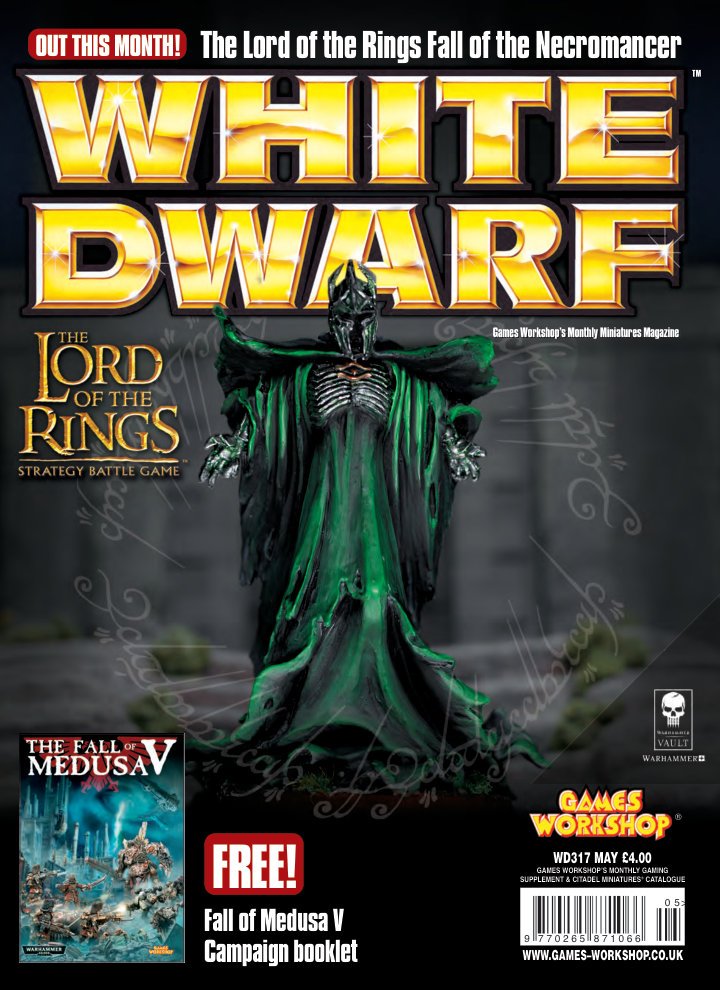
EditorialWD 317 · Inside cover
Grombrindal introduces the Necromancer as Sauron’s weakened identity between his defeat by the Last Alliance and the War of the Ring. His occupation of Dol Guldur corrupts the forest and provides the setting for the White Council’s campaign. New Castellans, monstrous servants and Elves supply both sides with characterful miniatures, while the editorial’s playful distrust of Elves keeps the announcement in the magazine’s familiar Dwarfen voice.
Middle-earth Strategy Battle GameDol Guldur
CommunityWD 317 · pp. 16–17
The preview announces the successor to the 2000 sixth-edition rules as both a hardback rulebook and the Battle for Skull Pass boxed game. Existing army books will remain valid, while the new starter brings complete plastic Dwarf and Goblin forces, a condensed rulebook and introductory material. Photographs reveal upcoming Wood Elf characters and returning Spider Riders, linking the rules announcement to continuing support for established collections.
Warhammer Fantasy BattlesDwarfs
CommunityWD 317 · p. 18
Gotrek and Felix return to the Old World in Orcslayer, where a Dwarf prince’s ancestral promise draws them towards a greenskin-held mountain stronghold while Chaos attacks the Empire. The short preview places the new novel as the eighth instalment in the series and hints at dangers beyond the Orc occupation. A separate correction clarifies that the Strategy Battle Game Grand Tournament has a final only, correcting the heats advertised in the preceding two issues.
Warhammer Fantasy BattlesMiddle-earth Strategy Battle GameDwarfs
InterviewWD 317 · pp. 21–30
The feature explores the sourcebook’s confrontation between the White Council and Sauron’s hidden power in Mirkwood. Mat Ward explains how a campaign drawn from brief literary references supports mighty heroes on one side and monsters, spirits and expendable servants on the other. Character roles and three example armies then show different ways to collect and use the new models, from agile Elf patrols to the Necromancer’s compact, dangerous host.
Middle-earth Strategy Battle GameThe White Council
InterviewWD 317 · pp. 22–23
Mat Ward describes his long-standing wish to turn Tolkien’s tantalising references to the Necromancer into a campaign. A sequence of scenarios lets the White Council’s members excel or struggle before the final confrontation, while careful evil play can leave them exhausted on arrival. Dedicated Wood Elf models, including throwing weapons and cloaks, make the project useful beyond its own setting by expanding the possibilities for other Elven forces.
Middle-earth Strategy Battle GameThe White Council
TacticsWD 317 · pp. 24–25
The overview distinguishes the Council’s central members from advisers and allies whose participation is less certain. Saruman and Gandalf supply powerful magic, Radagast supports and heals, and war-aspect Galadriel becomes a direct combat threat. Elven fighters, archers and specialists broaden the selection, with Círdan’s frailty offset by inspiring powers and Thranduil’s mixed abilities contrasting with Legolas’s precision shooting.
Middle-earth Strategy Battle GameThe White Council
TacticsWD 317 · p. 26
Thranduil’s forest patrol combines a captain, three Sentinels and groups equipped with bows, spears or throwing weapons. Archers remain protected behind the advancing force while Thranduil’s Heroic actions help the knife-armed Elves close and concentrate attacks. The Circlet of Kings offers a timely defensive power, and the Sentinels interfere with enemy models, giving an otherwise lightly protected force ways to dictate which parts of the opposing army it fights.
Middle-earth Strategy Battle GameWood Elves
TacticsWD 317 · p. 27
The thirty-seven-model Lothlórien force combines armoured Elves with lighter flanking groups and missile support. Its high Fight value rewards reaching combat, but vulnerability to enemy bows makes opposing archers an early priority. Haldir is more valuable shooting than becoming trapped in melee; ordinary Elves can wear down a hero’s Might first, leaving him an opportunity to deliver a decisive attack later.
Middle-earth Strategy Battle GameLothlórien
TacticsWD 317 · pp. 28–29
The Necromancer combines the threat of a single lethal blow with magic that weakens enemy heroes for his minions. Castellans supply a straightforward close-combat threat, while spiders, a Warg Chieftain and Bat Swarms offer speed, force or reduced enemy Fight values. The background explains why this dangerous but incomplete Sauron still acts through servants, and the tactical descriptions identify complementary jobs rather than treating every monster as interchangeable.
Middle-earth Strategy Battle GameDol Guldur
TacticsWD 317 · p. 30
The sample host surrounds the Necromancer and three Castellans with Giant Spiders, Bat Swarms and cheap Orc Warriors. Magic pins or drains opposing heroes before the Castellans use Morgul blades, while ordinary Orcs prevent the valuable spirits becoming surrounded. The commentary warns that the elite models’ Will reserves can disappear quickly when trapped in multiple fights, making the apparently expendable troops an essential part of the plan.
Middle-earth Strategy Battle GameDol Guldur
Battle reportWD 317 · pp. 31–40
Adam Troke leads the White Council against Mat Ward’s Necromancer and his most dangerous servants. Adam attacks quickly, using Círdan’s support and the Wizards’ powers to keep the fighters effective while repeatedly forcing Sauron to spend Will in combat. Erestor and Thranduil fall, but the surviving Council eventually opens a firing corridor; Saruman knocks the Necromancer down and Gandalf spends his remaining Might to deliver the final magical blow.
Middle-earth Strategy Battle GameThe White Council
RulesWD 317 · p. 31
Saruman and Gandalf enter from opposite edges while the Necromancer begins beside his tower; every other model starts in reserve. Each turn brings a small number of reinforcements, with the player holding Priority selecting the arrivals and their controlling player choosing an eligible entry point. The complete participating forces and terrain plan frame a direct contest between destroying the Necromancer and eliminating the White Council, giving the timing of each new hero immediate importance.
Middle-earth Strategy Battle GameThe White Council
TacticsWD 317 · p. 32
Mat plans to gain an early numerical advantage by using the Necromancer’s lethal attacks and the Castellans’ Morgul blades against vulnerable Council members. His magic should neutralise heroes before the fighting minions finish them. Trolls and spiders present a different difficulty because their Courage struggles against so many Terror-causing opponents, so he aims to send them towards targets they can actually charge rather than assuming their raw strength will suffice.
Middle-earth Strategy Battle GameDol Guldur
TacticsWD 317 · p. 33
Adam divides his unusually powerful force into dedicated fighters, Wizards and flexible specialists, then plans to use their twenty-five Might points aggressively. The spellcasters protect the fighters and interrupt the enemy, while Legolas, Thranduil and Arwen supply other options. He intends to attack before Mat’s larger magical contingent can assemble, forcing Will expenditure through both spells and close combat rather than allowing an organised defensive counterattack.
Middle-earth Strategy Battle GameThe White Council
EditorialWD 317 · pp. 42–43
Jervis Johnson traces the global summer campaigns back to Ichar IV in 1995, when mailed results, stories and photographs decided whether an Imperial world survived invasion. Internet reporting has made participation easier, but he sees the essential attraction as a shared reason to play and create memorable battles. Medusa V provides the latest opportunity, and Jervis asks participants to contribute narratives and unusual scenarios as well as recording wins and losses.
Warhammer 40,000Warhammer Fantasy Battles
LoreWD 317 · pp. 44–53
Vostroya’s elite Firstborn carry an inherited debt from the Horus Heresy, when the factory world refused to divert workers into soldiers. Guilliman’s settlement binds every family’s eldest son to service, with continuous replacement drafts preserving old regiments and their brotherhood. The feature connects this obligation to hand-crafted weapons, harsh training and stubborn pride, then explores the visual design, Studio painting methods and three ways to represent the regiment in the game.
Warhammer 40,000Imperial Guard23 paint colours
InterviewWD 317 · pp. 48–49
John Blanche explains how eighteenth-century soldiers and Russian Cossacks informed the Firstborn’s archaic appearance. Early sketches emphasise ornate long guns, imposing fur hats, distinctive officers and ritual details rather than centrally standardised equipment. He treats the drawings as prompts for sculptors instead of rigid instructions, explaining why the finished models can differ while retaining the character established by the initial concepts.
Warhammer 40,000Imperial Guard
PaintingWD 317 · pp. 50–51
The Eavy Metal recipes distinguish red cloth, dark steel, warm gold, leather and textured fur through separate foundations, ink shading and highlights. A more detailed face sequence uses purple in the flesh shadows before gradually lighter skin layers, with carefully defined eyes and moustache. Wood grain, wax seals and lenses complete the regiment’s ornamented equipment, while the introduction suggests simplifying the flesh stages when painting an entire army.
Warhammer 40,000Imperial Guard23 paint colours
RulesWD 317 · pp. 52–53
The article permits the models to use the standard Imperial Guard list, a player’s own five doctrines or the Studio’s specified Vostroyan combination. The latter allows Special Weapon squads and Heavy Weapon platoons and adds Sharpshooters, Carapace armour and Hardened Fighters. A unit-selection reference accompanies the options, while the commentary stresses telling opponents which approach is being used rather than treating the miniatures as tied to a single mandatory list.
Warhammer 40,000Imperial Guard
LoreWD 317 · pp. 56–59
The introduction presents the under-empire as an almost limitless threat restrained largely by its own rivalries. Four Great Clans contribute assassination, unstable weaponry, mutated creatures and disease, supported by ordinary Clanrats whose courage grows with their ranks. The collecting overview leads into two contrasting approaches: overwhelming firepower and deceptive movement, showing that the same basic horde can support very different specialised plans.
Warhammer Fantasy BattlesSkaven
TacticsWD 317 · p. 58
A shooting-heavy force concentrates Warp-lightning Cannons, Jezzails and Clanrat-mounted weapon teams instead of elite combat units. Warlock Engineers reinforce that pressure through ranged magic, making the approach particularly threatening to cavalry and large targets. The advice also identifies its fragility: temperamental weapons can kill friendly troops, Jezzails can flee from exposed positions and committing heavily to firepower makes success depend on the same specialised assets surviving.
Warhammer Fantasy BattlesSkaven
TacticsWD 317 · p. 59
Night Runners and Gutter Runners manoeuvre around the enemy while cheap troops occupy the front and conceal Assassins. Scouting and tunnelling let the elite infiltrators threaten positions that the main horde cannot reach quickly. The plan depends on timing and coordination, however: fast enemy cavalry can counter the skirmishers, and keeping an Assassin protected within a unit can make delivering him to the right opponent difficult.
Warhammer Fantasy BattlesSkaven
PaintingWD 317 · p. 60
Roughcoat is presented as a textured undercoat that makes drybrushing scenery and vehicle surfaces easier. The guide contrasts generous terrain applications with the lighter coats needed to preserve miniature detail, and discusses testing unfamiliar materials before coating a finished piece. Practical spraying and nozzle-cleaning instructions accompany the examples, explaining the intended role of the product before subsequent basecoats and drybrushed highlights are applied.
1 paint colour
PaintingWD 317 · pp. 62–67
Neil Langdown demonstrates how a large centrepiece benefits from patient preparation and individually mixed colours. Mid-tone basecoats save time across the Giant’s broad surfaces, then controlled shading and thin layered highlights build depth without obscuring the patchwork clothing. The final details range from a captive peasant and painted shield designs to rope, masonry, wood and dragon scales, making the model a collection of distinct materials rather than one oversized infantryman.
Warhammer Fantasy BattlesDogs of War34 paint colours
PaintingWD 317 · p. 63
The Giant begins from the intended middle values of its colours, allowing shadows to be added later across such a large model. Separate mixtures establish pale flesh and several cloth colours, while simple foundations pick out the shield, scroll and yellow patches. The captive peasant receives his own compact palette, demonstrating how a small narrative accessory can remain distinct without interrupting the larger model’s restrained, weathered appearance.
Warhammer Fantasy BattlesDogs of War14 paint colours
PaintingWD 317 · p. 64
Diluted paint and historical Citadel inks are placed in the recesses rather than washed indiscriminately over the Giant. Mixing some original base colour into a flesh shade keeps the transition controlled, while different dark mixtures suit the patchwork fabrics and shield details. The peasant’s darker skin and clothing receive a simpler sequence, and the advice warns that pooling ink can spoil the smooth foundation established in the previous stage.
Warhammer Fantasy BattlesDogs of War10 paint colours
PaintingWD 317 · p. 65
Thin overlapping layers produce the Giant’s highlight transitions, with each cloth patch lightened through a mixture suited to its foundation. Bone, white, pale green and grey avoid forcing every material towards the same colour. Flesh uses a restrained pale mixture, and the small shield and captive receive separately listed highlights, showing how consistent brushwork can unite a model while still preserving differences in hue and texture.
Warhammer Fantasy BattlesDogs of War17 paint colours
PaintingWD 317 · pp. 66–67
The final material studies distinguish worn metal, pale beard, carved masonry, wood and rope through small colour wheels. Two dragon-scale treatments show how related red mixtures can produce a darker and lighter finish, while a blue grid gives one cloth patch additional interest. Symbol and script tips address brush control, and the Chaos Giant example encourages imaginative colour choices once the underlying material techniques are understood.
Warhammer Fantasy BattlesDogs of War18 paint colours
PaintingWD 317 · pp. 68–69
Aun’Va, Commander Farsight and Shadowsun demonstrate three approaches to the Tau range: aged flesh and ornate bronze, vivid red armour and exceptionally clean white panels. Fil Dunn, Kirsten Williams and Neil Langdown explain details that distinguish the named characters, while a compact palette reference covers common Tau materials. The white-armour walkthrough emphasises thin opaque layers and careful recess lining rather than an overall ink wash or drybrushing.
Warhammer 40,000T’au Empire19 paint colours
PaintingWD 317 · p. 68
Fil Dunn uses Aun’Va’s age and complex freehand markings as opportunities for character painting. The bronze begins from brass, is highlighted with a silver–brass mixture and receives a very thin purple ink wash. The accompanying commentary explains that the white areas were built patiently over a dark undercoat, and that repainting the surrounding foundation tidies the intricate symbols after they have been drawn.
Warhammer 40,000T’au Empire3 paint colours
PaintingWD 317 · p. 68
Kirsten Williams’s Farsight uses successive red layers and extremely fine white accents before two red-ink coats enrich and unify the armour. His alien blade receives a separate metallic sequence, with a blue wash establishing contrast before silver highlights. These two compact recipes distinguish the renegade commander’s striking armour and unusual weapon, while the page directs readers elsewhere for a longer masterclass.
Warhammer 40,000T’au Empire9 paint colours
PaintingWD 317 · p. 68
Four colour wheels give foundations and finishing stages for white armour, red armour, Tau skin and the familiar Tau Sept armour. The white recipe uses grey lining, the red progresses through stronger reds and the blue skin becomes lighter through flesh mixtures. Warm armour moves from orange-brown towards bone, providing a concise set of recurring materials that painters can combine across a cadre rather than treating every figure as a new scheme.
Warhammer 40,000T’au Empire11 paint colours
PaintingWD 317 · p. 69
Neil Langdown compares the patience needed for Aun’Va’s white over black with his own white-undercoat method for Shadowsun. A solid painted white layer prevents a later diluted grey shade soaking unevenly into the primer. The four-step panel guide uses flat grey coverage, precise darker lining and repeated thin white coats, while controlled grey edge highlights give the black equipment depth and keep the experimental battlesuit’s details crisp.
Warhammer 40,000T’au Empire5 paint colours
ModellingWD 317 · pp. 70–74
The workshop shows how careful cuts, pins and revised limb positions bring activity to Crisis suits, Broadsides and commanders. Balanced jumping poses and crushed scenery convey weight, while exchanged heads, experimental weapons and spare shoulder pads alter individual silhouettes. A final Eavy Metal gallery ranges from airborne and melee poses to a mirrored finish, demonstrating the variety possible within the recognisable battlesuit structure.
Warhammer 40,000T’au Empire
ModellingWD 317 · pp. 70–71
A Crisis suit can suggest take-off with a hidden pin through one foot, a heavy landing through bent scenery or a forward firing stance through coordinated arm and head angles. The practical instructions cut a limb below the shoulder, test its position and drill matching holes before securing it. Examples also bend knees and use a defeated Space Marine as a support, with balance treated as essential to a convincing durable pose.
Warhammer 40,000T’au Empire
ModellingWD 317 · p. 72
The heavier Broadside examples communicate stability through a wide stance and weapon arrays aimed across the body. Repositioned missile arms, exchanged weapon mounts and extra plastic pods vary the outline without losing the impression of a firing platform. A target lock on the hand and coordinated head direction help make a static heavy-weapons model appear engaged with a particular enemy rather than standing in an anonymous display pose.
Warhammer 40,000T’au Empire
ModellingWD 317 · p. 73
Experimental weapons and alternate equipment establish a commander’s status, while a conversion based on Farsight demonstrates more extensive changes. The legs are cut and pinned for an aggressive jump, the blade moves between arms and Fire Warrior parts provide new shin and knee armour. The examples also repurpose a drone as a shield generator, showing how familiar spare components can hide joins or suggest distinctive systems without complex resculpting.
Warhammer 40,000T’au Empire
Battle reportWD 317 · pp. 76–92
Joseph “Greg” Wiltshire’s Beastmen meet Gareth Hamilton’s Clan Moulder Skaven over a valuable chunk of warpstone. Gareth’s expendable troops, poisoned swarms and disciplined delays break up the Beastmen’s advance while weapon teams punish their chariots. Greg’s magic-assisted attacks eventually threaten the centre, but a short final overrun leaves his herd an inch from taking the objective and the Skaven retain it.
Warhammer Fantasy BattlesBeastmen
TacticsWD 317 · pp. 78–79
Greg’s 2,476-point army mixes Undivided and Slaaneshi elements, with a dependable Bestigor centre supported by magic, four chariots and a flanking Beast Herd. Minotaurs, Spawn and Dragon Ogres provide powerful threats but relatively few ranked units. His deployment plan uses the high ground and expendable chariots to delay one flank while the other circles towards the Skaven centre, with Wild Call intended to overcome any lost momentum.
Warhammer Fantasy BattlesBeastmen
TacticsWD 317 · pp. 80–81
Gareth’s 2,500-point Moulder-themed force combines Throt and mutated beasts with Clanrats, Stormvermin, weapon teams and disposable Slaves. Swarms guard awkward approaches, while the larger creatures threaten the open flank and the main infantry secures the warpstone. A lightly equipped Harbinger supplies limited magic, and the custom Rat Riders add mobility; Gareth plans to sacrifice cheap bodies to create decisive flank charges instead of trusting individual Skaven fighting ability.
Warhammer Fantasy BattlesSkaven
RulesWD 317 · p. 92
The experimental profile represents Gareth’s converted rat cavalry for this battle only. Riders carry spears and shields on fast Giant Rats, with optional leader and musician upgrades. Fast Cavalry supplies mobility, while Catch Us If You Can! allows a failed rally attempt to be rerolled after choosing to flee a charge. The explicit restriction to this game distinguishes the agreed thematic unit from a general addition to the Skaven army book.
Warhammer Fantasy BattlesSkaven
CommunityWD 317 · pp. 94–95
The competition guide explains the broad category structure, including the restored large-scale category, Young Bloods and the staff-accessible Open competition. It stresses painting, presentation and consistency with the fictional settings, then distinguishes removable display bases from integral dioramas. Conversion and licensing restrictions, entry handling and judging procedures make the article a practical historical reference for preparing a 2006 entry rather than a gallery alone.
Warhammer 40,000Warhammer Fantasy Battles
ShowcaseWD 317 · pp. 96–97
David Waeselynck’s gallery places a bronze-winning diseased Ork alongside a brightly armed Warboss, pale Kroot and a red Daemon Prince. Further entries contrast detailed Inquisitors and an armoured Dominion with a mutated Kroot and a precarious snowy duel. Enlarged detail views draw attention to faces, ornament and textured surfaces, while varied scenic plinths demonstrate how presentation can strengthen models with very different subjects and colour schemes.
Warhammer 40,000InquisitorOrks
ShowcaseWD 317 · pp. 98–101
Alex Cairns’s expanding collections begin with Mortifactors characters assembled from a broad selection of Space Marine and Chaos parts. A force inspired by Storm of Iron combines Iron Warriors, converted Traitor Guard, tanks and a planned Titan, with brass tones linking the separate elements. Eldar painted with metallic accents and an emerging Thousand Sons force show his willingness to explore other armies while retaining a strong interest in distinctive visual identities.
Warhammer 40,000Space Marines5 paint colours
PaintingWD 317 · pp. 100–101
Alex’s Traitor tank company grows from the idea of Iron Warriors sending renegade troops ahead to soften their opponents. Steel Legion infantry gain spikes and altered details, while shields and trophies give the tanks a historical, deliberately brutal character. A progression of dark metal, brass and silver is blended with brown and black inks, creating the shared finish that joins roughly 2,500 points of armour to a much larger Iron Warriors collection.
Warhammer 40,000Traitor Guard5 paint colours
ShowcaseWD 317 · pp. 104–106
Ben Cartwright explains his move from armies to display pieces that demonstrate techniques for other Cambridge hobbyists. His work ranges from layered yellow armour to scaled-down Inquisitor characters, object lighting and extensively sculpted heroes. A Shaggoth shares a small amount of purple through its highlights, while unusual touches such as a Canoness’s teddy bear reveal the collaborative and experimental spirit behind models intended to teach as well as impress.
Warhammer 40,000Warhammer Fantasy BattlesImperial Fists5 paint colours
PaintingWD 317 · p. 104
Ben uses Lysander to investigate an unfamiliar yellow, beginning over a black foundation with a little brown mixed into the first layer. Numerous thin yellow coats build solid coverage rather than relying on one heavy application, then bone lightens the final highlights. A thinned yellow ink finish moderates the result, illustrating the patience and repeated controlled layers behind the apparently simple bright armour.
Warhammer 40,000Imperial Fists5 paint colours
ModellingWD 317 · p. 105
Ben and his friends translate the larger Inquisitor personalities into smaller models, beginning with a shared project inspired by new Deathwatch parts. His Tyrus adopts a jade-marble finish from a larger version, while Malicant gains a sculpted hood, Crash uses an Ork body with a Zombie head and guitar-wire pipes, and Barbaretta combines a Spyrer with Enforcer equipment and a rebuilt shield arm. Each conversion preserves a recognisable personality through selective parts and sculpting.
Warhammer 40,000InquisitorInquisition
ModellingWD 317 · p. 107
Paul Sutton’s Blood Axe Kommando squad begins as an Orky equivalent of the Last Chancers, with exaggerated action-film personalities and cold-weather camouflage inherited from its original campaign. A smaller elite Grot team carries a tankbusta bomb that opponents often overlook. Paul gives the trainee Kommando accompanying them a fitting initiation story, using characterful conversions and humour to make an otherwise modest group memorable in narrative games.
Warhammer 40,000Orks
CommunityWD 317 · pp. 108–109
Nick Kyme visits Lincoln’s Gobstyks and talks to president Will Platten about the regular volunteers who sustain its busy club nights. Alongside tabletop, card and roleplaying games, the club runs a popular Blood Bowl league and recognises painting and attendance with badges. Nick’s accompanying Dwarf game ends in defeat, but the report’s emphasis is on useful facilities, a welcoming first visit and the continuing effort behind a long-lived gaming community.
Warhammer Fantasy BattlesWarhammer 40,000Dwarfs
CommunityWD 317 · p. 110
The venue profile describes the 2006 Warhammer World gaming hall as a place for both casual visits and organised group activity. Purpose-built feature tables and more general boards support the main and Specialist Games, while staff-assisted hobby sessions cater for different experience levels. The shop, Citadel Miniatures Hall and Bugman’s Bar complete the visit, presenting the site as a combination of gaming space, collection display and social venue.
Warhammer Fantasy BattlesWarhammer 40,000
CommunityWD 317 · p. 111
The web roundup points readers towards a White Council ambush report, alternative character painting and a ruined-farm terrain project inspired by Giants. Further features explore humanity’s enemies, provide downloadable rosters and report the Strategy Battle Game Grand Tournament. The page explains the weekly newsletter’s role in delivering previews and additional editorial material, making clear that these are online companions to the magazine rather than full articles reproduced within it.
Middle-earth Strategy Battle GameWarhammer Fantasy Battles
CommunityWD 317 · p. 120
Readers discuss how the magazine influences their collecting and solves practical hobby problems. A cabinet-maker tackles the storage demands of seventeen family armies, an Ultramarines painter shares progress and a new Dwarf collector responds to Nick Kyme’s battle-report success. Grombrindal also directs an impatient Elf player to the newly available Battle Company rules, with shorter replies giving the page the feel of an ongoing conversation between hobbyists and the magazine.
Warhammer 40,000Warhammer Fantasy BattlesUltramarines
EditorialWD 317 · p. 121
Nick Kyme announces his move to Black Library after two and a half years on the UK magazine, with Owen Rees and Christian Byrne reflecting on their time together. Owen reports that an army-list mistake erased the first day’s doubles results but led to enjoyable later games, while Rik Turner continues Tallarn and Blood Ravens projects for Medusa V. The page combines a staff farewell with small, concrete snapshots of the team’s own hobby.
Warhammer 40,000Middle-earth Strategy Battle GameGondor