EditorialWD 496 · p. 1
Lyle Lowery describes the appeal of moving between many small collections rather than concentrating exclusively on one army. Combat Patrol suits this approach by making compact, differently painted forces useful in quick games. Strike Team Solarien introduces another such option, with a Phobos-focused Space Marine patrol and the promise of further magazine forces.
Warhammer 40,000
CommunityWD 496 · pp. 4–7
Sam Wright presents an expanded Ultramarines Fourth Company built around the narrative of Uriel Ventris, and Daniel Vallejo describes painting the Lion’s reflective black armour and green cloak. Other letters discuss the Imperium’s seemingly endless decline and the Blood Angels’ Secoris tragedy. The final painting question returns to Jes Goodwin’s colourful Hive Fleet Eumenides scheme.
Warhammer 40,000Age of SigmarUltramarines15 paint colours
PaintingWD 496 · p. 7
Jes Goodwin’s Tyranid recipe layers green flesh, brown chitin and purple weapons without intervening Shade stages. The progression from dark foundations to clear edge highlights produces a bright, sharply defined organism, at the cost of more careful layering than a wash-led method. It answers a reader’s question about the Parasite of Mortrex shown in issue 478.
Warhammer 40,000Tyranids12 paint colours
CommunityWD 496 · pp. 8–9
Lyle reflects on the end of the Slidecrown Sundering and the pleasure of seeing players’ armies appear in a campaign organiser’s concluding fiction. The next shared event is introduced as a three-team Warhammer 40,000 Crusade campaign that also recognises Combat Patrol games. Painting new units will contribute, but an existing force is enough to join the campaign from its opening stage.
Warhammer 40,000Age of Sigmar
CommunityWD 496 · pp. 10–11
The Bunker’s achievement system turns games played, event units painted and monthly challenge entries into a continuing rank. January’s painting theme is Rank and File, supported by the schedule of later challenges and a journal for recording progress. The portable challenge card makes it possible to carry the same hobby record between club meetings.
RulesWD 496 · pp. 12–13
Each arriving unit is randomly assigned to one of two separated deployment areas, disrupting carefully planned formations before the fighting begins. Most early points come from establishing a foothold on ordinary objectives; the central Prime marker becomes increasingly valuable in rounds three to five. Armies must therefore solve their scattered starting positions while preparing to regroup for the decisive late contest.
Warhammer 40,000
RulesWD 496 · pp. 14–15
This historical battleplan recreates the clash between Kragnos and Gordrakk over leadership of their combined hordes. Both armies require monstrous generals who cannot retreat, while canyon walls shed dangerous boulders onto nearby units. A wounded general can attempt additional monstrous rampages, turning the damage it survives into a final surge of destructive power; only the survival of one general produces a decisive victory.
Age of SigmarOrruk Warclans
RulesWD 496 · pp. 16–19
Six matched-play battleplans provide a compact event around the Scales of Talaxis. Only one battle group begins on the table, keeping the first round brief, and each mission combines objective control with a distinct sidequest: stealing supplies, leveraging a resilient fighter, holding ground, killing near objectives, revealing new treasure or receiving divine gifts. The article also explains pairing, rankings and awards for a club tournament or a single day’s games.
Warcry
TacticsWD 496 · pp. 20–23
Stephen Box turns the terrain rules into practical decisions about where to stand, which unit to fire first and which casualties to remove. Space Marine and T’au examples show how a single obscured model can change saves or deny a later attacker a target, while woods, containers, pipes and ruins create different restrictions. A six-question exercise checks the reader’s understanding of cover, visibility and weapons that ignore it.
Warhammer 40,000Space Marines
PaintingWD 496 · pp. 24–27
Steve Barrett builds a modular jungle from Warcry scenery, spare ruins and plentiful bracken, using vivid foliage to contrast with dark stone and red gnarloaks. Contrast paints and drybrushing cover the awkward textures efficiently, while textured moss can conceal small mistakes. The same methods work on a full battlefield, miniature bases or blocked Underworlds hexes.
Age of SigmarWarcry20 paint colours
PaintingWD 496 · p. 25
The tree recipe layers red Contrast over black before progressively lighter red and orange drybrushes catch its twisted branches. The adjoining stone guide starts from the same dark foundation but develops cool green highlights and a pale final edge. An alternative purple tree palette and a corrective dark glaze provide ways to adjust the colour while preserving the sculpted texture.
Age of SigmarWarcry12 paint colours
PaintingWD 496 · p. 26
Bamboo platforms receive a translucent yellow-green foundation and two pale drybrushes applied along their grain, with rope picked out separately in leather brown. Bones and soil are then coloured before snow texture is repurposed as moss. Green Contrast over the dried texture creates dense, bright growth that both finishes the jungle scene and hides untidy joins or overspray.
Age of SigmarWarcry9 paint colours
CampaignWD 496 · pp. 28–31
The final campaign results decide whether the Viridian Crown is destroyed, preserved or stolen by the Rogues who supported the winning side. Separate narrative endings acknowledge each outcome, while the final armoury grants relics that can continue into later Path to Glory or Warcry stories. Rewards range from lucky protection and renewed vitality to the dangerous power of a stolen crown shard.
Age of SigmarWarcry
CommunityWD 496 · pp. 32–39
Sixteen studio participants finish forty-eight games and sixty-one painted units, with awards recognising sporting play, an inventive story, a favourite army and sheer participation. Their ending sees the crown destroyed in a Tzeentchian explosion despite the Preservers’ last efforts. Army presentations and a Kharadron fiction extract sit alongside the readers’ Rank and File gallery, showing how the campaign generated painting and storytelling as well as games.
Age of SigmarWarcry
PaintingWD 496 · pp. 34–36
Joey’s red Seraphon use extensive drybrushing to finish scales and weapons quickly, while Steve’s Kruleboyz rely on earthy Contrast colours over a sandy undercoat. Kelly varies diluted turquoise on Tzaangors to avoid identical skin tones, and Stuart combines dark metallic spraying with pale preparations for Contrast details on his Slaves to Darkness. Each method keeps the force coherent without requiring every surface to be painted identically.
Age of SigmarSeraphon23 paint colours
PaintingWD 496 · p. 37
Emily’s favourite-army winner combines pastel turquoise scales, pink marble weapons and rich gold ornaments. Different species receive their own variations, including yellower Kroxigor and an orange Carnosaur, while sandy beach bases hold the collection together. The recipes use thin green glazes and pale highlights to preserve the soft colours without losing definition.
Age of SigmarSeraphon13 paint colours
InterviewWD 496 · pp. 42–45
Robin Cruddace and Scott Pirie explain why tenth-edition detachments describe a force’s approach to war without tying its rules to a particular painted subfaction. The five Adeptus Mechanicus examples support radiation warfare, covert Skitarii, aggressive Cult Mechanicus, rapid objective acquisition and deliberately planned robot assaults. Selected enhancements and stratagems demonstrate how these themes reward different units while leaving army selection flexible.
Warhammer 40,000Adeptus Mechanicus
RulesWD 496 · pp. 46–53
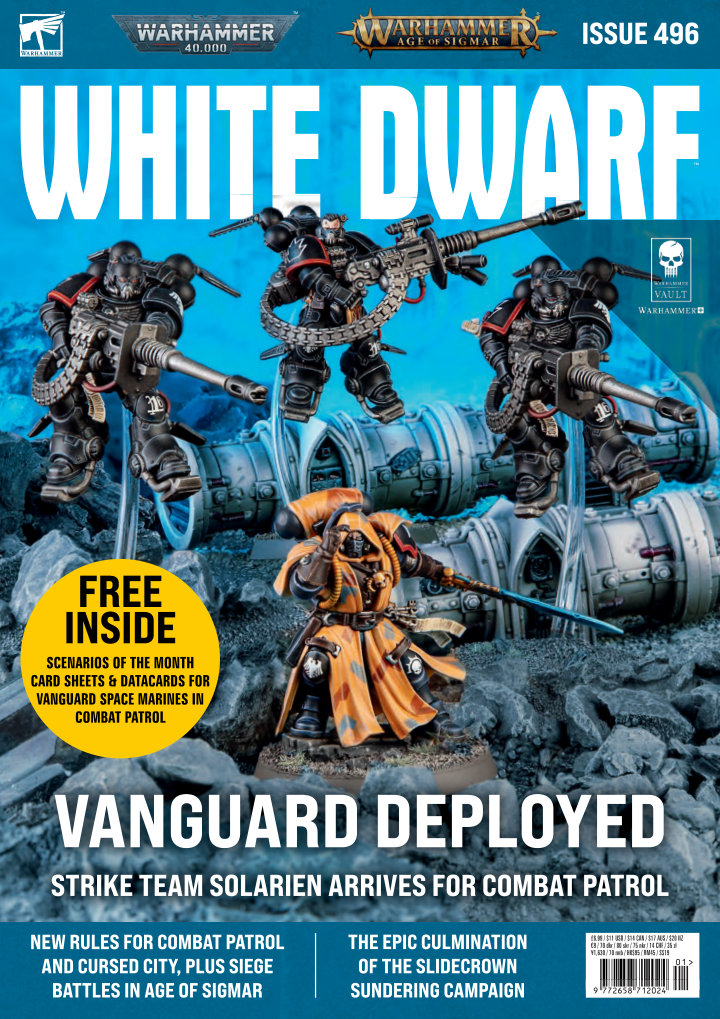
A Phobos Lieutenant and Librarian lead ten Infiltrators and three Suppressors in a new Combat Patrol. The force trades raw weight for infiltration, reserve denial, mobile shooting and objective intelligence; its optional enhancements let the commander either leave secured sites behind or operate as a hidden hunter. Dedicated datasheets, secondary objectives and stratagems provide the complete patrol, illustrated by a short Raven Guard assault on a renegade fortress.
Warhammer 40,000Space Marines
LoreWD 496 · pp. 54–61
The Sautekh Dynasty survives the Great Sleep relatively intact but almost destroys itself in a succession war before Imotekh takes command. His disciplined conquests, terrifying storms and carefully observed duelling codes establish an expanding empire. The account then follows his opposition to the Silent King’s Pariah Nexus, where honourable challenges, captured dolmen gates and defecting vassals turn an external campaign into a calculated Necron civil war.
Warhammer 40,000Necrons
FictionWD 496 · pp. 62–64
On Iridis, the Stilling has reduced much of the population to apathetic routine, but Vania Kluthe’s faith keeps her alert enough to hunt supposed infiltrators. Her attack reveals that she serves the Four-armed Emperor, bringing her into conflict with Inquisitorial acolyte Kaseena Flamberg and a remarkably composed Ratling sniper. Kaseena’s attempt to capture the mutant instead draws a crowd of unnervingly unaffected cultists into the open.
Warhammer 40,000Genestealer Cults
CampaignWD 496 · pp. 66–69
Six three-game campaigns link existing Combat Patrol missions into small military operations. Earlier victories can reveal archeotech, move objectives, grant reconnaissance deployments, determine the next mission, preserve resources or harden defences, but the final game decides the overall winner. Each sequence supplies a different narrative reason for the same compact forces to meet repeatedly without requiring a large campaign ledger.
Warhammer 40,000
Battle reportWD 496 · pp. 72–89
Dan Harden’s Skryre-heavy skaven, led by Thanquol, attack Matt Hutson’s Sylvaneth in an enlarged version of The Inner Sanctum. The ratmen accumulate points and inflict enormous damage, but a surviving Kurnoth Hunter escapes and returns with restored companions. Repeated regrowth and carefully timed spirit-path movement let the Sylvaneth weather the shooting, destroy the dwindling attackers and secure the crown despite severe losses of their own.
Age of SigmarSkaven
LoreWD 496 · pp. 90–95
A correspondent offers the High Despot of Chamon an assessment of the realms’ most storied weapons. Tahlia Vedra’s trophies, Katakros’s ancestral glaive, King Brodd’s obelisk, Gordrakk’s twin axes, Neferata’s dagger, Archaon’s daemon sword and Ghal Maraz all carry political or mythic weight beyond their killing power. The writer distinguishes plausible history from rumour while repeatedly showing how a weapon helps legitimise its bearer.
Age of SigmarCities of Sigmar
FictionWD 496 · pp. 96–97
Sloggrik discovers that a glorious battle is much less appealing when silent Seraphon keep appearing from the sky and their slain bodies dissolve into stellar ichor. He persuades Boss Ozzgurk to abandon Kragnos’s apparently endless duel with a wounded Draconith, imagining a future warclan of his own. Their escape crosses the path of the combatants’ enormous weapons, making survival depend on luck rather than his carefully cultivated cunning.
Age of SigmarOrruk Warclans
ShowcaseWD 496 · pp. 98–99
The allies challenge expands three established armies and introduces Sebastien Toursel as a new warlord. Jake turns to Nurgle, Laura constructs an Ossiarch force to accompany Necro-Dame, and Chris adds Kruleboyz to his Gloomspite collection. The progress table and next character-conversion challenge give the series a shared rhythm while leaving each collector’s army and ambitions distinct.
Age of Sigmar
PaintingWD 496 · pp. 100–101
Jake Bowley’s Maggotkin take their name from an appropriately unpleasant medical term and replace conventional Nurgle green with saturated purple flesh. Rusty bronze and rough dark-green cloth keep the bright bodies grounded in decay, while careful shading prevents the metal treatment from staining the skin. Jake also discusses finding a sustainable balance between painting to a useful standard and actually playing the finished army.
Age of SigmarMaggotkin of Nurgle15 paint colours
PaintingWD 496 · pp. 102–103
Sebastien Toursel begins his catch-up effort with Annihilators and characters painted in a single intensive weekend. Space Wolves details lend these Knights Excelsior a feral Ghurish character, while a concise white-armour recipe and luminous pink staff distinguish them from his earlier teal Fireborne Souls. Simple base, shade and highlight sequences make the ambitious timetable achievable.
Age of SigmarStormcast Eternals12 paint colours
ModellingWD 496 · pp. 104–105
Laura Matarasso combines Necron bodies with Mortek arms and heads to make Ossiarch infantry taller than their skeletal allies. Reposed Kainan leads the force, while a centaur-like Harvester merges Ossiarch kits and decorative Custodes parts. A red-to-bone stippled finish and strings of painted glue create the wet, gore-covered appearance that connects the Sanguinites with Necro-Dame.
Age of SigmarOssiarch Bonereapers9 paint colours
PaintingWD 496 · pp. 106–107
Chris Charles adds Kruleboyz to his Gloomspite Gitz, preserving their shared love of murky places and dubious concoctions. Mixed Contrast colours make the scavenged clothing varied, bright red shields contrast with natural flesh, and layered rust and verdigris establish neglected metals. The accompanying Marshcrawler Sloggoth uses airbrushed flesh tones and translucent glazes to soften the transitions across its large body.
Age of SigmarOrruk Warclans21 paint colours
RulesWD 496 · pp. 108–111
This battlepack stages a 2,000-point attack on a stronghold built from adjoining terrain. Before the assault, secret choices of blockade, breach or tunnelling are opposed by rationing, reinforcement or counter-tunnelling, determining damage, broken defences and hidden approaches. Two battleplans then test whether a divided garrison can hold its objectives until a relief force arrives.
Age of Sigmar
RulesWD 496 · p. 110
The defender splits its army between the stronghold and an off-table relief force while three objectives are placed on terrain inside its territory. The relief column’s arrival becomes more likely as the five-round battle progresses, but its entry point remains uncertain. Victory depends on the final majority of objectives, forcing the garrison to preserve enough of its positions for reinforcement to matter.
Age of Sigmar
RulesWD 496 · p. 111
Two objectives define the siege, with the defender again committing roughly half its units to a delayed relief force. Reinforcements begin arriving individually from the second round rather than as a single column. Holding both sites earns either side a major victory, but preserving one is enough for the defender’s minor victory, creating different priorities for a breakthrough and a stubborn last stand.
Age of Sigmar
InterviewWD 496 · pp. 112–115
Jimbo Warth explains how a General’s Handbook grows from a setting and rules theme into realm effects, battleplans, battle tactics and grand strategies. Collaborative brainstorming and voting narrow the ideas, but the team must also accommodate armies with limited access to the season’s favoured unit types. Examples contrast the useful decision created by Seismic Shift with the overly obvious appeal of Bounty Hunters, before showing how these lessons inform magical, frozen Andtor.
Age of Sigmar
RulesWD 496 · pp. 116–125
Eight Cities of Sigmar characters become alternative heroes for journeys into Ulfenkarn. Their roles emphasise cooperation: command abilities redistribute actions, relics strengthen companions, bodyguards intercept danger, and specialist healers or soul-shepherds keep the party moving. Each receives normal and inspired cards, and a Gargoylian companion empowerment adds another small ally to the expedition.
Warhammer QuestCities of Sigmar
RulesWD 496 · p. 117
The alchemist turns another hero’s weapon into a blazing source of critical successes, then balances defence against vitality by stoking or expending his runic crucible. Inspiration improves these actions and adds a transmutation that can temporarily silence a hostile’s weapons. His progression rewards making the rest of the party’s attacks more effective rather than dealing every killing blow himself.
Warhammer QuestCities of Sigmar
RulesWD 496 · p. 118
The Freeguild Marshal commands companions by improving or transferring activation dice, and a rousing speech gives nearby heroes opportunities to attack. He gains inspiration when these prompted strikes kill enemies. Once inspired, his Will of Steel can replenish spent dice, allowing a decisive command turn to continue beyond its expected limits.
Warhammer QuestCities of Sigmar
RulesWD 496 · p. 119
This small relic envoy damages visible hostiles with a raised holy object and helps adjacent companions in the gambit. Multiple kills from the relic advance his inspiration, after which he can also improve allied weapon actions on his board tile. His value therefore comes from standing where several enemies and friendly heroes can benefit from the same activation.
Warhammer QuestCities of Sigmar
RulesWD 496 · p. 120
Andren sacrifices movement to hold a position, improving nearby heroes’ attacks and his own defence. He gains inspiration when companions resist enemy blows, and his inspired rally lets injured allies turn otherwise obstructed spaces on their character cards into temporary movement or attack opportunities. The card suits a party willing to gather around a determined standard of resistance.
Warhammer QuestCities of Sigmar
RulesWD 496 · p. 121
Grimstandt is a protective champion who can move into the path of an attack intended for another hero. He also prepares a stronger answering blow when an enemy approaches, gaining inspiration through the harm he accepts on his companions’ behalf. His inspired critical strikes can bypass damage prevention, making a well-timed intervention dangerous to the attacker as well as useful to the party.
Warhammer QuestCities of Sigmar
RulesWD 496 · p. 122
The Whisperblade manipulates one destiny die and lures vulnerable hostiles into new positions. His enchanted rapier rolls its damage afresh for each strike, so its strength is unpredictable and cannot be improved by ordinary modifiers. Inspiration offers a tempting damage reroll, but a repeated poor result can leave the blade stuck and prevent further melee attacks that turn.
Warhammer QuestCities of Sigmar
RulesWD 496 · p. 123
Vynder’s surgery can remove several wounds at once, but a failed roll represents a lasting injury that cannot be repaired during the journey. Healing also restores a valuable activation die to a companion, while the inspired surgeon can assist recuperation at the risk of causing further harm. His card makes urgent treatment powerful without allowing the party to regard it as painless or certain.
Warhammer QuestCities of Sigmar
RulesWD 496 · p. 124
The soul-shepherd duo converts an activation die into corpus points spent on allied inspiration, free attacks or movement. Different benefits favour uninjured, lightly wounded and badly wounded companions respectively, so the best tune depends on the party’s condition. Their inspired incense can also force nearby hostiles to reconsider a critical attack, adding protection to their flexible support role.
Warhammer QuestCities of Sigmar
ModellingWD 496 · pp. 126–131
Mark Bedford builds a playable cross-section of the Underhive inspired by the studio’s older vertical dioramas. A shallow wooden frame supports factories, a reactor, a sump and an access shaft, with levels planned around real ladders, stairs and miniature clearance. Spray-painted foundations and grime unify the many kits, while atmospheric lighting reveals the separate stories the densely stacked industrial spaces can suggest.
Necromunda12 paint colours
RulesWD 496 · pp. 132–133
Two nine-fighter crews enter a vertical battlefield through randomly assigned tunnels and race to recover loot from its levels. A loaded fighter handles weapons awkwardly, but entering a tunnel banks the prize before the model emerges at another uncertain entrance. Credits, experience and reputation reward successful scavengers, making route planning and extraction as significant as taking opponents out of action.
Necromunda
FictionWD 496 · pp. 134–141
Jon Flindall opens a Tome Keepers serial with Word Bearers attacking Istrouma while much of the Chapter fights elsewhere. Librarian Ushizar and the young Ilum search the All-vault for the object the invaders want, reading a fallen veteran’s account of an earlier betrayal aboard an Imperial battleship. The recalled battle offers a clue in the enemy leader’s strange words, linking the Chapter’s preserved history to its immediate defence.
Warhammer 40,000Space Marines
ShowcaseWD 496 · p. 142
Mark Bedford places Goliaths on his completed vertical Necromunda board and experiments with lights concealed behind doors. A red gel makes one chamber resemble a burning forge, changing the apparent environment without rebuilding the scenery. The photographs show how a practical gaming structure can also become an atmospheric backdrop for a gang’s story.
NecromundaHouse Goliath
TacticsWD 496 · p. 143
The six cover puzzles are resolved by tracing complete visibility and applying the requirements of each terrain type. The answers distinguish infantry beside pipes from a battlesuit, models actually inside a crater from their squadmates, and obscured targets from those protected by an entire unit’s position. Ignores Cover and a single attacker with a blocked view can reverse what first looks like an obvious saving-throw advantage.
Warhammer 40,000Space Marines