EditorialWD 338 · Inside cover
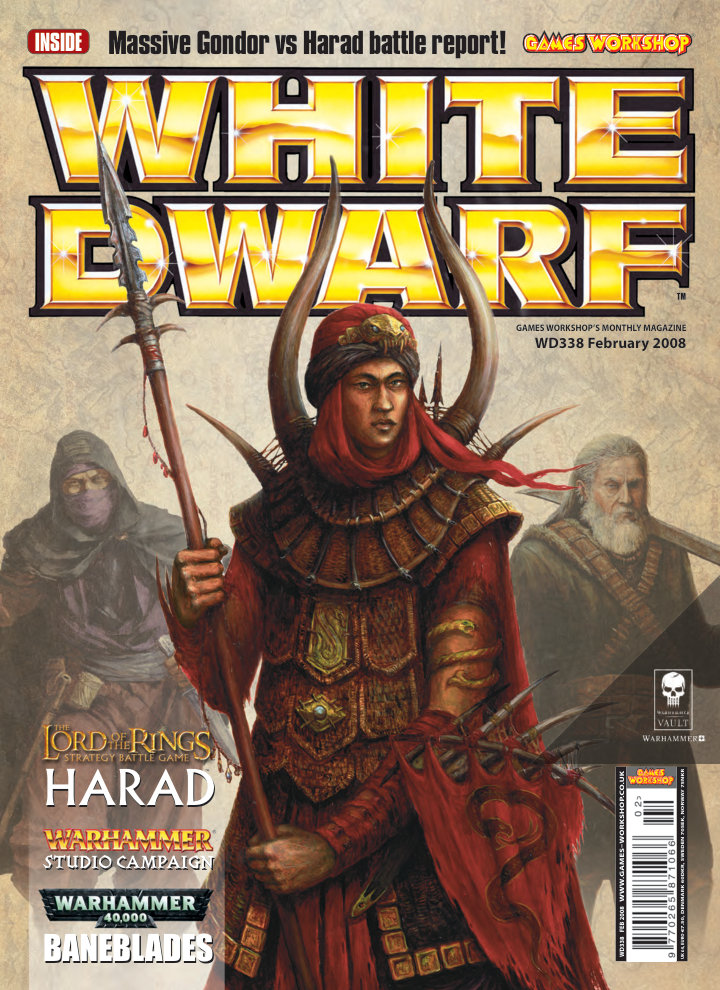
Grombrindal welcomes Harad’s expanded forces, whose Mûmakil, Corsairs and Mahûd promise a colourful and dangerous challenge for Gondor. The issue pairs their designer’s account with a large battle, then turns to a Studio map campaign and Empire tactics. The Shokk Attack Gun and customised Baneblades provide substantial hobby projects, while a Dan Abnett interview brings the developing Horus Heresy novels into the magazine’s wider view of the settings.
Middle-earth Strategy Battle GameWarhammer Fantasy BattlesHarad
CommunityWD 338 · pp. 12–13
The anniversary preview announces an April celebration of Warhammer through games, interviews, scenarios and store activities. John Blanche’s original Harry the Hammer cover inspires a special miniature by Aly Morrison, connecting the event to the game’s earliest imagery. The Black Library’s Time of Legends series will also revisit foundational stories, beginning with Sigmar and continuing into Nagash’s rise. The plans join rules history, art and fiction in one year of celebration.
Warhammer Fantasy Battles
InterviewWD 338 · pp. 18–33
Andy Hall asks Mat Ward how the new sourcebook gives Harad a fuller history and several distinct army identities. The design treats its people as human societies shaped by bitter history, then distinguishes their forces through poisoned weapons, Corsair firepower and the strength of the Mahûd. Revised Mûmak options add flexible crews and dismounting lines. Three example armies and painting guidance show how those different cultures can become collections with recognisable strengths and weaknesses.
Middle-earth Strategy Battle GameHarad
TacticsWD 338 · pp. 26–27
The 697-point army combines numerous inexpensive warriors, selected elites and a Mûmak. Poison helps ordinary Strength-three soldiers threaten tougher opponents, while Watchers of Kârna supply extra attacks and steadier nerves against frightening enemies. The Mûmak is aimed chiefly at valuable warriors rather than heroes who can delay it. Suggestions for adding assassins, Suladân or cavalry explain how the compact example can grow without abandoning its Southron identity.
Middle-earth Strategy Battle GameHarad
TacticsWD 338 · pp. 28–29
A 694-point Corsair force relies on numerous capable fighters, throwing daggers and crossbows rather than heavy protection. Shielded pirates lead the approach while Arbalesters contest the shooting war. Captains provide Might and direct violence, the Bo’sun supplies banner-like support and Dalamyr’s smoke bombs threaten even powerful enemy heroes. Allied cavalry can repair the army’s principal omission, although the volume of missile fire already makes it difficult to exploit.
Middle-earth Strategy Battle GameCorsairs of Umbar
TacticsWD 338 · pp. 30–31
The seven-hundred-point example puts a Mûmak at the centre of a hard-hitting Mahûd warband, using rappelling lines to deliver its warriors into combat. Half-Trolls and blowpipe troops exploit the howdah’s protection before joining the fighting, while the remaining infantry supports the beast or holds positions. The commentary weighs expensive Mûmak upgrades against alternatives such as a king and camel riders, stressing the need to strike before low Courage and lost leaders undermine the force.
Middle-earth Strategy Battle GameMahûd
PaintingWD 338 · pp. 32–33
The guide supplies short recipes for four distinctive Southron subjects. A pale horse develops through grey and white, human skin uses Foundation browns and flesh, a Corsair’s muted clothes combine black with blue and purple, and a camel receives sandy highlights. Banners and warpaint show how tribal identities can be expressed through symbols and repeated colours, giving the separate recipes a purpose within the broader collection.
Middle-earth Strategy Battle GameHarad10 paint colours
Battle reportWD 338 · pp. 36–55
Pete Foley leads Gondor south to prevent Mat Ward’s combined Haradrim, Corsair and Mahûd army joining Mordor. Heroic movement initially pins the two Mûmakil, but one eventually tears through the infantry while assassins and elite Southrons grind down the centre. Corsairs arrive against the Rangers, and uncontrolled stampedes later devastate both sides. Even Gandalf’s intervention cannot reverse the losses; Gondor concedes after nine turns, leaving Harad victorious but badly weakened.
Middle-earth Strategy Battle GameHarad
InterviewWD 338 · pp. 56–59
An overview places the growing Heresy series within the Emperor’s Great Crusade and the betrayals that follow. Dan Abnett then describes Legion as a mystery about the Alpha Legion, using Imperial Army characters to offer an unfamiliar view of the conflict. He discusses negotiating major revelations with Alan Merrett, coordinating with fellow authors and constructing a thirty-first millennium distinct from the later Imperium. The interview emphasises intrigue and uncertain loyalties alongside the series’ battles.
The Horus HeresyWarhammer 40,000Alpha Legion
CampaignWD 338 · pp. 60–65
Phil Kelly reports on a twelve-player Studio campaign across more than a hundred specially prepared hexes. Fabled Aurentia contains dangerous seas, volcanoes, wizard towers and mystery opponents, while winter events and a spreading plague disrupt expanding kingdoms. Player accounts show how those mechanisms change army selection and territorial strategy. After five months and more than fifty battles, Ogre realms dominate, but the organisers conclude that the many memorable surprises also made a case for simpler rules next time.
Warhammer Fantasy BattlesOgre Kingdoms
RulesWD 338 · p. 61
The campaign’s locations do more than offer territory. A creature in the inland sea threatens neighbouring settlements, volcanoes can trigger destructive chains and occupied wizard towers require small character battles before yielding a magical ally. Rivers favour mining, while the ash lands offer cheaper enchanted equipment. These local effects give players reasons to value different parts of the map and create risks that continue after a hex has been conquered.
Warhammer Fantasy Battles
TacticsWD 338 · p. 63
Glenn More uses the Skaven campaign ability to establish a foothold near the Wood Elf realm rather than continue expanding from his starting corner. A heavily magical, missile-rich force is tailored to its new opponent, including scrolls intended to punish flyers and lightly protected units. Early damage looks promising, but Kislev cavalry and a Treekin flank attack overturn the plan. The account demonstrates how a map opportunity still depends on executing the ensuing battle.
Warhammer Fantasy BattlesSkaven
TacticsWD 338 · p. 63
Matt Hutson chooses campaign events according to the turn’s intended gain instead of treating them as incidental bonuses. Saved gold becomes extra troops for a crucial fight, and Spies reveals the opponent’s roster before he selects his own. Against Graham Davey’s Ogres, that combination produces a tailored Dark Elf force with a substantial numerical points advantage and a new territory. The example explains why campaign resources can matter as much as battlefield manoeuvre.
Warhammer Fantasy BattlesDark Elves
RulesWD 338 · p. 64
A spreading supernatural plague changes pleasant campaign hexes into fields of skeletal remains. Wizards belonging to a realm that occupies an infected tile gain a special bound magic missile whose power and Strength grow with the number of phases spent there. The rule turns a dangerous narrative event into a tempting resource, forcing players to consider whether retaining the contaminated territory is worth the wider cost to their realm.
Warhammer Fantasy Battles
TacticsWD 338 · p. 65
Pete Foley contrasts a tournament army prepared for unknown opponents with a campaign list tailored to a known enemy. Specific magic choices and equipment can become far more valuable, illustrated by a flaming Chaos Lord’s spectacular attack on a Treeman. He also explains the political cost of leading the map too early: fewer territories initially can leave a player better event choices while rivals attract hostile effects. His own difficult opening becomes a lesson in adapting to campaign incentives.
Warhammer Fantasy BattlesHordes of Chaos
EditorialWD 338 · pp. 66–68
Jervis explains how familiar symbolic ideas give new designs meaning, using the Dreadnought’s associations with protection and military power as an example. John Blanche’s concepts then combine those ideas with the settings’ established imagery to avoid generic results. The separation of Tomb Kings and Vampire Counts illustrates how refining different kinds of undead horror produces more distinctive armies. Repeated revisions remain creatively useful because each can explore the same underlying ideas in greater depth.
Warhammer 40,000Warhammer Fantasy BattlesSpace Marines
PaintingWD 338 · p. 69
The guide explains how varnish protects painted miniatures and how gloss and matt finishes can be combined. Short controlled spray passes, thorough shaking and clearing the nozzle support an even result, while testing an old model first catches storage or temperature problems. A gloss coat beneath the protective spray adds resilience to prized figures; selected glossy details can then be restored separately. The emphasis is on preserving the paintwork’s finish as well as preventing chips.
2 paint colours
PaintingWD 338 · pp. 70–75
Kirsten Williams separates the Mek, gun, ammunition feed and unfortunate Snotling before painting. Bright layered skin stands against dark Goff clothing, while four metallic treatments distinguish working steel, copper, bronze and polished details. Leather, cloth and wooden tools add further texture, and the final checks, stripes, screens and gem-like lenses make the elaborate weapon readable. The project combines patient display techniques with the characterful improvisation of Ork engineering.
Warhammer 40,000Orks37 paint colours
PaintingWD 338 · p. 71
A dark Foundation base supports several thin green layers, leaving the deepest recesses shaded and adding bone only to the final raised highlights. Teeth, nails and goggle lenses follow their own warm-to-pale progressions. Turquoise gums make the face feel alien rather than human skin merely painted green. Kirsten recommends using washes or glazes to moderate any highlights that become too stark.
Warhammer 40,000Orks10 paint colours
PaintingWD 338 · p. 72
Three related recipes distinguish black, dark grey and light grey areas without losing the Goff model’s restrained background. Ink washes establish depth before base colours are restored where necessary. Successively paler edge lines become smaller and sharper, with the brightest black highlights confined to the extremities so the surface still reads as black. Working across the three tones together also keeps the process efficient.
Warhammer 40,000Orks6 paint colours
PaintingWD 338 · p. 73
The guide assigns distinct colours and ageing treatments to the Mek’s many metal parts. Bronze gains warm ink shading and small green verdigris patches, while dark copper retains a subdued base beneath limited highlights. Brown, black and green washes tarnish the steel, contrasting with brighter layered silver on selected mechanisms. The variations make the dense assembly feel built from different pieces rather than one uniformly metallic object.
Warhammer 40,000Orks11 paint colours
PaintingWD 338 · p. 74
The Mek’s straps develop from dark brown through reddish flesh tones to fine pale edges. Brown and tan cloth patches use separate Foundation and earth-colour sequences, preserving creases beneath progressively lighter layers. The Snotling repeats the skin and nail methods of its owner but gains red-orange eyes. Treating each patch of the feed as a different material reinforces its crude stitched construction.
Warhammer 40,000Orks10 paint colours
InterviewWD 338 · p. 76
Seb Perbet starts from the iconic three-pronged nozzle but asks how the weapon could actually swallow its Snotling ammunition. A greedy-looking hose and a connection inspired by the Studio spray booth make the impossible device feel mechanically considered. The model’s scale must exceed the Lootas’ guns, while cables stop the nozzle resembling an ordinary fan. Small details salute Kev Adams’s earlier miniature, balancing a recognisable classic with a much more elaborate new design.
Warhammer 40,000Orks
FictionWD 338 · p. 77
Big Mek Buzkut turns a stalled Ork assault into a grotesque success by firing frenzied Snotlings into and through the defending Space Marines. Encouraged by the carnage, he drives his invention beyond its limits. The gun tears open a warp rupture and unleashes a monstrous fusion of ammunition and otherworldly flesh, leaving the triumphant inventor considering further adjustments rather than the consequences of his experiment.
Warhammer 40,000Orks
TacticsWD 338 · pp. 80–85
Three experienced players present very different ways to exploit the Empire’s broad army list: a vast infantry force, a balanced defensive army and a mounted knightly order. Each explains how its characters and supporting units make the plan work, from sacrificial detachments to protective prayers and concentrated artillery. Further Studio tips show how inexpensive militia and carefully equipped heroes can change an encounter, demonstrating the range of choices behind an apparently ordinary human army.
Warhammer Fantasy BattlesThe Empire
TacticsWD 338 · p. 81
Marko Lukić builds a two-thousand-point infantry horde around Swordsmen and expendable Halberdier detachments. Small units angle themselves to force awkward charges, opening flanks for the larger blocks and their static combat bonuses. Four wizards supply damage and psychological support, adapting their Lores to the opponent. The plan accepts heavy losses as a resource, while the author acknowledges the patience required to assemble and paint so many soldiers.
Warhammer Fantasy BattlesThe Empire
TacticsWD 338 · pp. 82–83
Göran Farm combines infantry, detachments, knights, artillery and magic so the army can exploit phases an opponent has neglected. Shooting first removes support units, preserving his own auxiliaries for the decisive fights. Against more defensive forces he advances instead, while fast attackers are delayed by expendable units and awkward charges. Overlapping deployment keeps the wide army compact and allows knights to screen missile troops before moving aside.
Warhammer Fantasy BattlesThe Empire
TacticsWD 338 · p. 84
Roy Eggensperger fields an entire knightly order led by a damage-focused Grand Master, a protected standard bearer and Warrior Priests. Two large Inner Circle formations supply the main attacks, while another sizeable regiment preserves a fallback threat if the obvious targets suffer. Small knight units bait, divert and exploit errors much like light cavalry, using armour to survive incidental fire. The force tries to create several simultaneous decisions its opponent cannot solve correctly.
Warhammer Fantasy BattlesThe Empire
TacticsWD 338 · p. 85
Alessio recommends five-man militia detachments as cheap disruptions that can delay enemies without panicking their parent formations. Christian adds a Warrior Priest to Greatswords, combining resilience, Hatred and prayers with supporting troops. Phil turns a weak wizard into a dangerous challenger by pairing a flying movement spell with Van Horstmann’s Speculum. The three examples show how small, purposeful investments can alter the way familiar units threaten an opponent.
Warhammer Fantasy BattlesThe Empire
ModellingWD 338 · pp. 88–95
Six Studio tanks demonstrate how one plastic chassis can express different regiments and battlefield jobs. Extra stores turn a Tallarn vehicle into a long-range expedition tank, jungle camouflage transforms a Catachan Hellhammer and command crews distinguish a Vostroyan machine. Urban Cadian and Mordant vehicles use their own practical details, while Yarrick’s ornate pulpit becomes a dramatic centrepiece. Each example includes an exact palette and explains conversions ranging from small additions to major structural work.
Warhammer 40,000Imperial Guard41 paint colours
ModellingWD 338 · p. 89
Chad Mierzwa replaces side weapons with storage and adds racks, shelves, baggage and extra fuel for long periods away from support. A lengthened cannon reinforces the long-range role, with a metal Tallarn gunner fitting the crew position without major alteration. The desert palette and improvised welded fittings give the same basic chassis an expeditionary identity, showing how equipment can explain a vehicle’s story more effectively than decoration alone.
Warhammer 40,000Imperial Guard10 paint colours
ModellingWD 338 · p. 90
Keith Robertson makes a regimental command vehicle through a communications array, converted Vostroyan crew and a flag taken from a standard bearer. Removing the original bearer requires resculpting details previously hidden by the figure, while the gunner is shortened to fit the turret. The palette combines worn neutral armour with red and metallic accents. A discontinued spray colour is accompanied by a practical mixed substitute for readers following the project.
Warhammer 40,000Imperial Guard16 paint colours
ModellingWD 338 · p. 91
Chad adapts the short-ranged tank for dense jungle rather than city streets. Halved chain links become tie-down hoops, supporting foliage, wire and camouflage rope added after the green paintwork is complete. Heavy mud accumulates across the lower hull and also marks the camouflage, unifying the tank with its environment. The conversion communicates concealment and sustained travel through wet undergrowth without substantially rebuilding the chassis.
Warhammer 40,000Imperial Guard9 paint colours
ModellingWD 338 · p. 92
Dom Murray matches his super-heavy to an urban Cadian army through grey armour and worn recognition stripes. Stippling the original grey over yellow and blue markings makes them appear faded, while a carefully varnished transfer process blends the insignia into the finish. A conversation between a ground-level Guardsman and the elevated gunner adds a small human story, using the tank’s height to suggest its value as an observation point.
Warhammer 40,000Imperial Guard14 paint colours
ModellingWD 338 · p. 93
Andy Hoare equips a Hellhammer for city fighting, including reversed sponsons that cover the rear against approaching infantry. Swapping the left and right assemblies requires removing a locating feature, while small additions of baggage and straps make the machine look lived-in. A mixed Cadian-and-Catachan officer personalises the crew. The extra gun is presented as an agreed Apocalypse embellishment rather than a standard legal upgrade.
Warhammer 40,000Imperial Guard10 paint colours
ModellingWD 338 · pp. 94–95
Neil Hodgson turns the Baneblade into both a weapon and a pulpit through ornate reclaimed components, painted friezes and a measured plasticard platform. A scale turret plan guides the sloping walls and textured floor, while city fittings mount missiles and provide architectural details. Restrained grey highlights keep the black hull sombre, with warm gold-leaf effects and bright metal establishing Yarrick’s status. The project joins practical construction planning with elaborate illustrative work.
Warhammer 40,000Imperial Guard8 paint colours
ShowcaseWD 338 · pp. 96–99
The Studio gallery presents the leaders whose skill and authority hold a Dwarf throng together. Thorgrim’s campaign against the Book of Grudges and Grombrindal’s legendary appearances frame lords, standard bearers and oath-stone heroes. Runesmiths bind magic into equipment, Engineers combine craftsmanship with battlefield experience and Slayers seek redemption through dangerous foes. The painted models connect those distinct callings to a culture shaped by memory, honour and relentless defence of its holds.
Warhammer Fantasy BattlesDwarfs
CommunityWD 338 · p. 103
Stuart Mackaness describes a club that grew from attending narrative weekends to running ambitious campaigns of its own. Plans for Albion group players by race in a difficult landscape, while the Damocles Gulf brings Imperial, Tau and Ork forces into a three-sided struggle. Experience from the Age of Apostasy and Second Tyrannic War informs an approach in which themed armies, uneven situations and contributions to the shared story matter alongside winning individual battles.
Warhammer Fantasy BattlesWarhammer 40,000Imperium