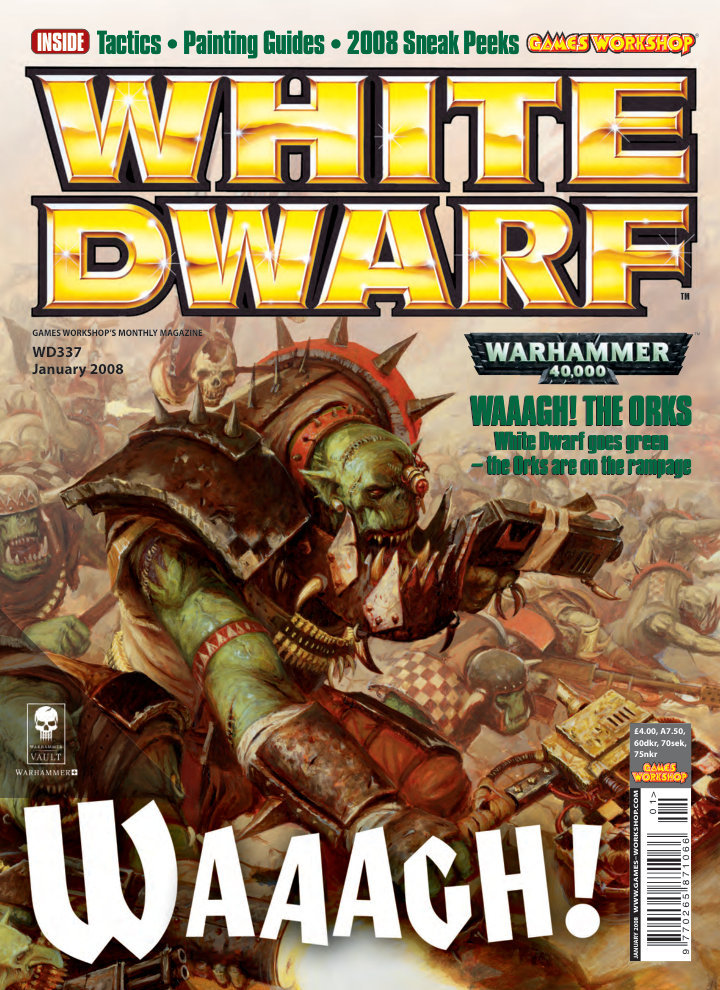
EditorialWD 337 · Inside cover
Grombrindal introduces the returning Orks and their abundant new miniatures, singling out the Shokk Attack Gun despite his customary dislike of greenskins. Flying-monster tactics and Eltharion’s restored classic miniature support Warhammer players, while favourite film scenes inspire Middle-earth games. A tour of the Studio looks beyond the release to the year ahead, making the issue both an Ork celebration and an opening glimpse of 2008’s wider hobby projects.
Warhammer 40,000Warhammer Fantasy BattlesOrks
LoreWD 337 · pp. 16–17
The preview presents the Vampire Counts as an unrelenting host sustained by their masters’ will and replenished from defeated enemies. A forthcoming army book traces the vampires from the Lands of the Dead to the von Carstein wars, while new plastics and characters expand the collection. Skeletons, Grave Guard, Ghouls, Dire Wolves, the Corpse Cart and Varghulf promise a force whose visual variety reflects different forms of undeath.
Warhammer Fantasy BattlesVampire Counts
InterviewWD 337 · pp. 20–35
Ted Williams explains how recognisable weapon rigs, interchangeable parts and robust-looking vehicles refresh the Ork range without abandoning its established anatomy. Phil Kelly draws on the older background books to restore clans, Oddboyz and dark humour, while cheaper Boyz, Furious Charge and a timed Waaagh! make large mobs more effective. A fast army example, component guides and painting recipes turn those design choices into practical options for collecting the newly revised force.
Warhammer 40,000Orks
InterviewWD 337 · pp. 24–26
Phil Kelly combines extensive restored background with rules intended to make the Orks’ horde identity work on the tabletop. Lower costs increase mob size, Furious Charge replaces the old Choppa effect and a once-per-game Waaagh! closes the distance to combat. Mob numbers also govern morale, while Painboyz, Weirdboyz, Mek inventions and massed shooting preserve the force’s eccentric variety. The result aims to be dangerous, unpredictable and funny without losing its brutal character.
Warhammer 40,000Orks
LoreWD 337 · p. 27
Six major clans express different preferences within the same warlike society. Goffs prize direct brutality, Evil Sunz speed and Bad Moons the conspicuous equipment their fast-growing teeth can buy. Deathskulls treat battle as preparation for looting, Snakebites prefer rugged traditions and Blood Axes attract suspicion for their cunning and dealings with outsiders. The descriptions explain how collecting and visual themes can distinguish a warband without imposing entirely separate unit lists.
Warhammer 40,000Orks
ModellingWD 337 · pp. 28–29
A detailed component guide breaks down the new Trukk and its many optional fittings. The assembled vehicle demonstrates the robust flatbed design described in the design notes, while weapons, ramshackle armour and a wrecking ball let modellers express the Orks’ appetite for dangerous additions. Identifying the parts before building makes the kit’s customisation possibilities easier to plan and supports vehicles that look related without being identical.
Warhammer 40,000Orks
ModellingWD 337 · pp. 30–31
The two-page component display presents the new Warbike as both an Ork status symbol and an expression of compulsive speed. Its alternative rider and mechanical parts support heavy, improvised machines rather than delicate motorcycles. The breakdown gives modellers a reference for varying the bikes within a mob, echoing the designers’ idea that each rider continually adds equipment to outdo his rivals.
Warhammer 40,000Orks
TacticsWD 337 · pp. 32–33
Phil Kelly’s fifteen-hundred-point force uses several small Trukk mobs to reach the enemy quickly, accepting transport losses so surviving passengers can continue the assault. Wrecking balls and power klaws supply anti-armour threats, while Warbikers and mounted Nobz exploit the flanks. Buggies and tracks add supporting fire, with Dreadnoughts and Kans protecting objectives behind the spearhead. The plan relies on several overlapping fast threats rather than one indispensable vehicle.
Warhammer 40,000Orks
PaintingWD 337 · pp. 34–35
Fil Dunn’s Studio Goff method builds green faces from dark Foundation paint through brighter greens, with brown-to-bone teeth and red eyes as contrasts. Simple grid lines establish checks before alternate squares are filled, while triangular dags decorate edges. Grey-white highlights and small metallic chips keep the black-and-white insignia lively. Dark-washed metal and bright edges complete a set of techniques that can be repeated across ordinary Boyz and heavily equipped specialists.
Warhammer 40,000Orks12 paint colours
Battle reportWD 337 · pp. 40–59
Phil Kelly’s Goffs and Evil Sunz face Matt Hutson’s Ultramarines in a two-thousand-point Recon mission. Early Ork shooting destroys valuable armour, then a well-timed Waaagh! brings the mobs into combat before the Marines can thin them further. Tigurius kills Meganobz and Warboss Brainbiter, but is overwhelmed in turn. The remaining Marines fight stubbornly before the last Sergeant falls, leaving an Ork victory despite Gitkilla’s humiliating retreat and the Shokk Attack Gun’s unpredictable mishap.
Warhammer 40,000Orks
CommunityWD 337 · pp. 60–65
A review of 2007 links major army releases with the Foundation Paints, new scenery, tools and Apocalypse that changed hobby projects during the year. The tour then follows sculptors, painters, modellers, developers and artists into their next work, including Vampires, Daemons and Mordor. Sliding-core tooling illustrates the technical investment behind increasingly elaborate plastics, while photographs of unfinished projects show how many different crafts contribute to a single release.
Warhammer 40,000Warhammer Fantasy Battles
CommunityWD 337 · pp. 66–71
Mark Latham encourages players to recover the scenes that originally drew them into Middle-earth, whether through a faithful army, recognisable terrain or a small narrative scenario. Studio contributors recall Aragorn at Amon Hen, the journey through Moria, the Rohirrim’s charge and encounters with the Nazgûl. Those examples show how a film or passage can direct collecting, painting and scenery choices together, with a complete Amon Sûl encounter illustrating the approach.
Middle-earth Strategy Battle GameThe Fellowship
RulesWD 337 · p. 71
Four Hobbits defend Frodo inside a small ruined circle while five Ringwraiths close in and Aragorn searches nearby. Flaming brands push surviving attackers back, and the ancient fortress forces the wraiths to test their Courage. The Evil player can unleash a terrifying cry to weaken the defenders, but doing so also makes Aragorn more likely to arrive. Victory depends on protecting or killing Frodo, turning a compact battlefield into a tense struggle over one vulnerable character.
Middle-earth Strategy Battle GameThe Fellowship
CommunityWD 337 · pp. 74–79
Rick Priestley explains a worldwide reorganisation that makes individual models and useful small selections easier to obtain, including restored classics filling gaps in current armies. The accompanying guide describes a fully painted catalogue arranged to match army-list categories and linked to an updating web store. Collectors’ miniatures and grouped Bitz Packs receive distinct roles, while Specialist Games remain online. The feature records how the company changes access to its enormous range for collectors and converters.
EditorialWD 337 · pp. 80–82
Jervis challenges arguments about which game is best by explaining the different experiences each system deliberately offers. Narrative scenario design can cross from Middle-earth into other settings even when the miniature ranges cannot. Borrowed armies, store demonstrations and reciprocal games make exploration possible without immediately collecting another force. A reader’s reflection on hobby as a source of peace also places those experiments within the broader value of creative recreation.
Warhammer Fantasy BattlesWarhammer 40,000
TacticsWD 337 · pp. 84–89
Gav Thorpe organises flying monsters by the jobs their mobility can perform, from delaying an advance and hunting artillery to delivering magic or smashing a crucial unit. Each role demands a different level of investment and risk. Small flyers exploit concealment, while great monsters must account for enemy rank bonuses and concentrated fire. The examples encourage flexible plans and carefully chosen targets rather than assuming an expensive creature should always attack the largest enemy formation.
Warhammer Fantasy BattlesHigh Elves
TacticsWD 337 · p. 85
Small flying monsters can halt an enemy march and redirect charges without needing to kill anything. Great Eagles exploit gaps, woods and carefully angled positions to offer a tempting but unhelpful pursuit, especially against frenzied troops. The guide relates the choice of delayed target to the army’s plan and warns that exposed large monsters are less suited to the role. Friendly countercharges turn a cheap flyer’s withdrawal into a useful attack opportunity.
Warhammer Fantasy BattlesHigh Elves
TacticsWD 337 · p. 86
A hero on a flying mount targets war machines, small missile units and vulnerable skirmishers before they can do their work. Terrain and nearby enemy formations protect the approach, while attacking an artillery line from one end can conceal the flyer and lead into another target. Equipment examples for several armies balance protection and damage, with a warning that multiple attacks or unexpected combat bonuses can overturn a seemingly safe hunt.
Warhammer Fantasy BattlesHigh Elves
TacticsWD 337 · p. 87
A powerful rider and monster can break ordinary troops, but a frontal attack still has to overcome ranks, banners and superior numbers. Flank or rear attacks reduce that burden when the creature has sufficient Unit Strength, making manoeuvre as important as its attack profile. Example lords show different ways to concentrate damage, while the text advises conservative expectations and supporting charges rather than trusting a costly model to roll perfectly.
Warhammer Fantasy BattlesHordes of Chaos
TacticsWD 337 · p. 88
A flying mount lets a wizard reach valuable short-ranged spell targets and escape the situations that make a foot caster vulnerable. Selecting extra spells or choosing them directly helps ensure that mobility serves a useful purpose. A Tzeentch Disc rider demonstrates how magic and credible close-combat attacks can coexist in one flexible piece, though dangerous enemy elites and exposed positions still demand caution.
Warhammer Fantasy BattlesHordes of Chaos
TacticsWD 337 · p. 89
Three Star Dragon combinations illustrate different jobs for the same imposing mount. The Knight Slayer concentrates on a devastating charge, Mobile Firepower uses a magical bow while threatening supporting attacks and the Hunter gains magical strikes against supernatural enemies. The guide stresses choosing targets with an understanding of their durability and retaliation, particularly when fighting other great monsters or Ogre leaders. Breath weapons and movement remain useful even when a decisive charge is unavailable.
Warhammer Fantasy BattlesHigh Elves
PaintingWD 337 · pp. 90–98
Anja Wettergren revisits Jes Goodwin’s classic Eltharion and Stormwing with a finish intended to stand beside the newer High Elf plastics. Three subassemblies preserve access as she completes each material in turn, from striped feathers and leopard fur to polished metals and clean blue-white clothing. Real animal references guide the Griffon’s markings, while patient layering, selective drybrushing and fine final highlights distinguish each texture. The face is painted late to match the completed model’s brightness.
Warhammer Fantasy BattlesHigh Elves38 paint colours
ModellingWD 337 · p. 91
Stormwing’s large metal parts require both structural reinforcement and disguised joins. Anja drills matching holes for paperclip pins in the wings and body, then uses dampened sculpting tools to work putty into the gaps between components. Keeping the Griffon, saddle and torso separate until painting is finished combines a secure assembly with access to awkward surfaces. The instructions make preparation part of the final display finish rather than a stage to rush.
Warhammer Fantasy BattlesHigh Elves
PaintingWD 337 · p. 92
Alternating dark brown and off-white bands establish Stormwing’s wings and upper body. Separate shading washes deepen each band before progressively lighter drybrushing picks out the sculpted feather texture. The amount of paint decreases with each pass, leaving the earlier tones visible and reserving the brightest treatment for the light feathers. The method creates strong patterned contrast without requiring every feather to be individually blended.
Warhammer Fantasy BattlesHigh Elves7 paint colours
PaintingWD 337 · p. 93
Reference photographs help Anja distinguish a leopard’s broken curved markings from simple dots. The pale underside and warmer orange haunches develop through different highlight mixtures, with washes and glazes muting the finish before the final accents. Joe Tomaszewski’s alternatives show how the same anatomy can become a lion, tiger, snow leopard or pale Chracian beast. Natural patterns provide a strong identity without changing the underlying miniature.
Warhammer Fantasy BattlesHigh Elves9 paint colours
PaintingWD 337 · p. 94
A warm flesh base supports the beak’s yellow before thin brown-black shading darkens its point and pale edges restore contrast. The purple tongue follows its own blended sequence to bone and white. Talons instead use earthy greys with increasingly fine pale stripes, creating a harder material than the surrounding fur. Completing these areas separately lets Anja maintain distinct transitions on each small but conspicuous feature.
Warhammer Fantasy BattlesHigh Elves11 paint colours
PaintingWD 337 · p. 95
Anja finishes the metal before surrounding details to reduce the risk of stray metallic pigment. Brown enriches the gold base, followed by warm metal layers, shaded recesses and silver-modified highlights for a polished finish. The weapons use blue and black ink to give their silver an Ithilmar character. Fine final edges unify the gleam across armour, saddle decoration, sword and spear without treating every metallic area as the same material.
Warhammer Fantasy BattlesHigh Elves10 paint colours
PaintingWD 337 · p. 96
Foundation grey establishes the white areas before blue-grey shading and repeated thin white coats create a crisp finish. Blue sections develop from a deep base through brighter mixtures to very pale edges. The guide recommends checking the model after it dries and adding more dilute white where needed, rather than stopping at a predetermined number of coats. A gemstone sequence supplies contrasting red jewels and a precise reflected-light point.
Warhammer Fantasy BattlesHigh Elves11 paint colours
PaintingWD 337 · p. 97
The face begins with warm brown and deep purple-brown shading before flesh and bone highlights establish a pale Elven complexion. A subtle glaze restores colour between the brightest stages, and painting it after the armour helps match the whole model’s contrast. The saddle back follows a separate deep-red progression, narrowing the highlights towards orange and a pale flesh mixture on its sharpest edges.
Warhammer Fantasy BattlesHigh Elves14 paint colours
ModellingWD 337 · p. 99
The workshop recommends leaving a small sprue remnant when removing a component, then cleaning it with a knife and files instead of risking an over-close cut. For conversions, the blade’s flat side faces the material being preserved, giving a cleaner retained edge. Cutters can also remove the bulk of raised detail or roughen plastic for damage effects. Controlled positioning keeps both the model and the workspace manageable.
CommunityWD 337 · p. 103
Warhammer World plans three community-run campaign weekends, supporting Gaming Club Network groups and the Tempus Fugitives rather than retaining every event as an internal project. Their recent storytelling events demonstrate the community’s ability to deliver ambitious games, while the change frees the venue’s team to develop other formats. The accompanying introduction explains the GCN’s independent volunteer role and its contribution to clubs, national events and shared hobby activities.
Warhammer 40,000Warhammer Fantasy Battles
CommunityWD 337 · p. 113
The Association connects military gamers across postings and countries, growing from a small group founded in 1995 to more than a hundred members. It also welcomes Ministry of Defence civil servants and supports historical and fantasy systems alongside Games Workshop games. Newsletters, an online group and organised events help members find opponents wherever they are stationed, making continuity of community the club’s defining purpose.