LoreWD 522 · pp. 2–9
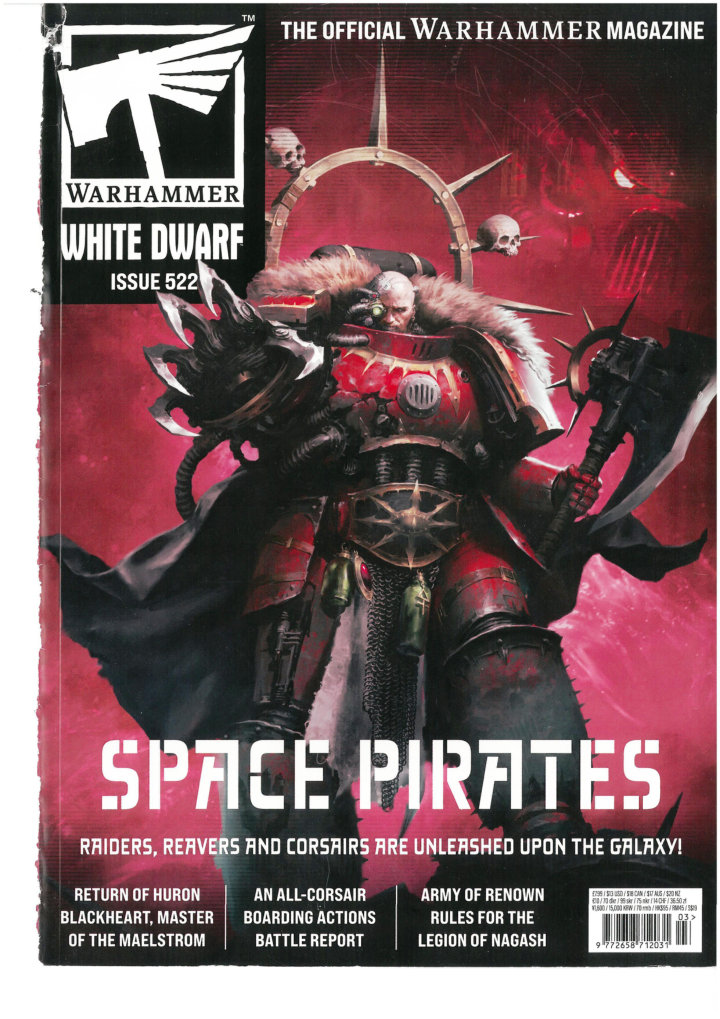
Huron Blackheart’s empire grows from the shattered Astral Claws into a coalition of renegade Marines, mortal followers and alien mercenaries. Personal strength and overwhelming naval power keep his subordinate reavers in line, but he also depends on specialised advisers and enforcers. The feature introduces the inner circle whose surgical, psychic, military and hunting talents sustain that violent rule.
Warhammer 40,000Red Corsairs
LoreWD 522 · p. 4
Huron survives the Badab War through immense reconstructive surgery and builds a new power base amid the Maelstrom’s shifting dangers. He grants followers room to pursue their own ambitions while demanding tribute and obedience, destroying those who challenge him. His Tyrant’s Claw and the uncanny Hamadrya embody the mixture of machinery, sorcery and personal menace surrounding him.
Warhammer 40,000Red Corsairs
LoreWD 522 · p. 5
The former Astral Claws Apothecary keeps Huron’s increasingly limited gene-seed supply viable and searches recruits for useful mutations rather than simple purity. His obsession with the transition from life to death leads to grotesque experiments, tolerated only while enough warriors survive fit to serve the Tyrant.
Warhammer 40,000Red Corsairs
LoreWD 522 · p. 6
A former Executioner remains loyal because Huron supplies a constant succession of worthy victims. Garrix’s skill with a massive axe and willingness to cut through bodyguards make him a powerful instrument of discipline. Although his skull trophies suggest Khorne, the text distinguishes his delight in killing from conscious devotion to the god.
Warhammer 40,000Red Corsairs
LoreWD 522 · p. 7
The former Mantis Warriors Librarian earns his place through psychic power, cunning and extensive intelligence networks. He identifies targets, exposes rivals and manipulates mortal minds, giving Huron options that raw strength alone cannot provide. His value as a counsellor does not make him entirely trustworthy.
Warhammer 40,000Red Corsairs
LoreWD 522 · p. 8
Sargotta provides the prolonged naval-war expertise that the Red Corsairs’ assault specialists often lack. Cognitive implants accelerate her calculations, and a heretek servo-platform lets her seize control of enemy systems during a raid. Her stolen finery and hard-won personal fighting skills make her a convincing pirate captain as well as a fleetmaster.
Warhammer 40,000Red Corsairs
LoreWD 522 · p. 9
A Tarellian bounty hunter pursues those who flee Huron and acts as his intimidating representative among alien contacts. Her Barghesi companion Plunder was taken from an earlier victim after biting off her arm; a stolen control device currently restrains it, though its eventual size and ungovernable aggression remain uncertain.
Warhammer 40,000Red Corsairs
LoreWD 522 · pp. 10–17
Lugft Huron’s early courage, tactical intelligence and charisma explain why a celebrated Chapter promoted him so quickly. Those strengths also fuel a personal cult and an expanding protectorate that eventually rejects Imperial oversight. The account follows the Badab War through the collapse of his alliances, the destruction of his stronghold and the survival that turns the remaining Astral Claws into Red Corsairs.
Warhammer 40,000Astral Claws
LoreWD 522 · pp. 11–13
Huron first distinguishes himself by resisting an Aeldari Warlock’s illusions and saving his scout squad. His command skills develop through Devastator and battle-company service, before the death of Chapter Master Rovik Blake elevates him to the Chapter’s highest office. He then embeds his own allies and heraldry throughout the region, making institutional authority increasingly personal.
Warhammer 40,000Astral Claws
LoreWD 522 · pp. 14–15
Huron stockpiles arms, expands his Chapter and withholds tithes and gene-seed, defending his autonomy as necessary to secure the Maelstrom. Destroying an investigating fleet makes the breach irreparable. As Loyalist pressure increases, allied Chapters surrender or withdraw and his original claim to serve the Imperium becomes bitter, increasingly paranoid opposition to it.
Warhammer 40,000Astral Claws
LoreWD 522 · pp. 15–17
Loyalist forces break the Ring of Steel and storm the Palace of Thorns, where a dying Star Phantoms captain catastrophically wounds Huron. His guard escape with him, and eight days of surgery preserve his life. Conquering a pirate base inside the Maelstrom begins the reconstruction of his forces under a new name and blood-red heraldry.
Warhammer 40,000Astral Claws
LoreWD 522 · pp. 18–19
A publication and miniature retrospective traces the Tyrant from a Rogue Trader quotation through White Dwarf 101, the second-edition Chaos codex, his first model and the Imperial Armour Badab War books. The new plastic miniature emphasises his spiteful expression, invasive bionics and pirate-king stature, while fiction offers further ways to explore the personality behind the model.
Warhammer 40,000Astral Claws
LoreWD 522 · pp. 20–23
A chronological dossier follows the Maelstrom Warders’ appointment, Huron’s rise, the tithe dispute and the conflict’s successive escalations. Key reversals include the Lamenters’ defeat, Angstrom’s withdrawal, the Carcharodons’ arrival and the Executioners’ rejection of their allies’ conduct. The final settlement distinguishes the condemned Astral Claws from other Chapters sentenced to penitent crusades.
Warhammer 40,000Astral Claws
PaintingWD 522 · pp. 24–27
Amber demonstrates two complete Corsair schemes: the deep blue-green Eldritch Raiders and the red-and-black Void Dragons. Smooth glazes, precise edges, crystal weapons and polished gemstones suit the clean Aeldari aesthetic. The accompanying explanations show why complementary shadows can work better than black and how a consistent light source makes gems convincing.
Warhammer 40,000Aeldari Corsairs45 paint colours
PaintingWD 522 · p. 24
A deep blue-green base gains blue recess glazes and progressively lighter turquoise highlights. Thin repeated applications make the transitions smooth before precise edge marks sharpen the close-fitting suit.
Warhammer 40,000Aeldari Corsairs6 paint colours
PaintingWD 522 · p. 24
Near-black blue armour is shaded with black, then raised with cool green-blue glazing. Bright but restrained edges distinguish the rigid plates from the softer bodysuit without losing the Corsair’s dark overall appearance.
Warhammer 40,000Aeldari Corsairs5 paint colours
PaintingWD 522 · p. 25
A pale bone helmet receives two brown-toned shades, concentrating the darker one into recesses. White glazing and edge highlights bring back the light surface, establishing a clear facial focal point against the dark armour.
Warhammer 40,000Aeldari Corsairs4 paint colours
PaintingWD 522 · p. 25
The cloak’s red is shaded with a complementary dark green rather than black, then restored through brighter red glazing and orange finishing edges. This desaturates its shadows while connecting them with the model’s cool armour.
Warhammer 40,000Aeldari Corsairs5 paint colours
PaintingWD 522 · p. 25
Warm gold details are washed with a reddish fleshshade and picked out in silver. The short recipe keeps the metal bright enough to read on the dark suit while leaving the turquoise and red as the principal colours.
Warhammer 40,000Aeldari Corsairs3 paint colours
PaintingWD 522 · p. 25
Opposed dark and light glazes create faceted blue crystal blades. Establishing the broad pattern before refining transitions makes the work easier, and a final thin base-colour glaze can soften any abrupt boundary before the white edge is applied.
Warhammer 40,000Aeldari Corsairs5 paint colours
PaintingWD 522 · p. 25
Neutral grey highlights keep black details distinct from the blue-green suit. Narrow successive edges preserve their darkness while revealing the small shapes and separating them from surrounding coloured surfaces.
Warhammer 40,000Aeldari Corsairs3 paint colours
PaintingWD 522 · p. 26
Black fabric is gradually lifted with grey and dark green glazes, finishing with a pale greenish edge. The unusual hue keeps the suit dark but visually relates it to the cloak and the army’s cool highlights.
Warhammer 40,000Aeldari Corsairs5 paint colours
PaintingWD 522 · p. 26
The Void Dragons’ red plates use dark complementary shading and bright red glazing before orange and yellow edges. Hard, carefully placed highlights distinguish the armour from the softer blends used on neighbouring fabrics.
Warhammer 40,000Aeldari Corsairs5 paint colours
PaintingWD 522 · p. 26
A bone-coloured mask and weapon details provide strong light focal points on the otherwise dark miniature. Brown shading supplies definition while white glazes and edges maintain a smooth, clean finish.
Warhammer 40,000Aeldari Corsairs4 paint colours
PaintingWD 522 · p. 27
The cloak combines deep blue-green shadows with brighter green glazes and pale edges. Its green serves as a deliberate counterpoint to the red armour, using colour contrast rather than excessive brightness to separate the materials.
Warhammer 40,000Aeldari Corsairs5 paint colours
PaintingWD 522 · p. 27
Green crystal is developed from a strong turquoise-green base through dark green shadows and increasingly pale highlights. The final white edge makes the shape crisp while the broad colour pattern suggests light passing through a glassy material.
Warhammer 40,000Aeldari Corsairs5 paint colours
PaintingWD 522 · p. 27
A violet wash gives the face cool, alien shadows before warmer flesh layers recover its contours. The final pale glazes and edges concentrate attention on the features rather than the surrounding helmet and hair.
Warhammer 40,000Aeldari Corsairs5 paint colours
PaintingWD 522 · p. 27
Orange gems are brightened through yellow towards a pale lower edge, with a tiny white reflection placed according to a chosen light source. The highlights sit opposite that reflection to suggest light refracting through the stone.
Warhammer 40,000Aeldari Corsairs4 paint colours
PaintingWD 522 · p. 27
A red foundation is glazed pink and brought up to a pale rim, with a single white reflection completing the spiritstone. Keeping the lighting direction consistent across the whole model makes the small polished surfaces convincing.
Warhammer 40,000Aeldari Corsairs4 paint colours
Battle reportWD 522 · pp. 28–47
Harvey’s Sunblitz Brotherhood boards the Tyranny Incarnate to hunt Huron Blackheart, facing Scott’s Red Corsairs in a two-player adaptation of Chaotic Hunt. Warp rifts create sudden close encounters, and the Aeldari initially cut through much of Huron’s entourage before the Tyrant brings down their prince. A lone Corsair nearly kills Huron at the end, but the Red Corsairs finish with a decisive 45–15 victory.
Warhammer 40,000Aeldari Corsairs
RulesWD 522 · pp. 32–36
A mission normally intended for four players is adapted by giving each commander two deployment zones and removing some warp-rift locations. Priority targets change as units die, while the portals can move a force directly into melee without granting a charge. The changes preserve the hunt’s mobility and uncertainty with only two competing armies.
Warhammer 40,000
ShowcaseWD 522 · pp. 48–55
Harvey combines Sunblitz Brotherhood pirates with their unconventional Lugganath allies, drawing black, yellow, orange and red elements from older artwork and publications. Aspect Warriors retain their own identities while altered helmets and details relate them to the army. A converted prince, freehand vehicle markings and an Avatar painted around a molten core reinforce a collection built chiefly for narrative spectacle.
Warhammer 40,000Aeldari Corsairs27 paint colours
PaintingWD 522 · p. 53
The collection’s painting recipes use an earthy undercoat to support orange and yellow, then differentiate cloth, hard armour and weapons through their highlights. Shared warm colours make a broadly analogous scheme, while cooler black highlights and green Aspect armour keep individual units recognisable.
Warhammer 40,000Aeldari Corsairs27 paint colours
PaintingWD 522 · p. 53
A light earthy undercoat supports the strong orange armour. A mixed orange foundation is shaded with dark red, then raised with increasingly pale orange edges, keeping the craftworlders bright without sacrificing depth.
Warhammer 40,000Aeldari Corsairs6 paint colours
PaintingWD 522 · p. 53
The pirates’ yellow armour begins over the same undercoat as their craftworld allies. Brown shading and renewed yellow glazes retain a warm family resemblance, while the pale final edges make the plates stand out cleanly.
Warhammer 40,000Aeldari Corsairs6 paint colours
PaintingWD 522 · p. 53
Dark burgundy cloth is shaded black, then lifted through progressively brighter reds and a final red-orange mixture. The controlled progression makes soft folds readable while keeping the cloaks distinct from the harder highlighted helmets.
Warhammer 40,000Aeldari Corsairs5 paint colours
PaintingWD 522 · p. 53
Harvey offers two treatments for black surfaces: neutral grey edges for details and cool blue-green highlights for armour. Varying the highlight hue lets several black materials coexist without making every dark component visually identical.
Warhammer 40,000Aeldari Corsairs6 paint colours
PaintingWD 522 · p. 53
The Scorpions’ green armour uses a mixed foundation and a combined black-and-green shade. Turquoise-green edges bring it back to life, giving the Aspect Warriors their own distinctive appearance beside the army’s warmer main colours.
Warhammer 40,000Aeldari Corsairs6 paint colours
PaintingWD 522 · p. 53
Cool grey weapons begin with a dark blue-grey foundation and black wash. Successive blue-grey edges separate their machinery from the warmer armour while supplying a quieter area of colour on otherwise brilliant models.
Warhammer 40,000Aeldari Corsairs4 paint colours
PaintingWD 522 · p. 53
The Corsairs’ red helmets and the Fire Dragons’ orange helmets use related warm progressions. Each receives dark shading and progressively brighter edges, allowing the different units to keep their identities while sharing the collection’s dominant colours.
Warhammer 40,000Aeldari Corsairs8 paint colours
CampaignWD 522 · pp. 56–59
Escalation leagues break a large army project into manageable milestones shared with other players. Regular games at intermediate sizes make each new unit matter, build rules knowledge gradually and leave room to change plans when real games reveal a weakness. The proposed progression runs from Combat Patrol or five hundred points to a full Strike Force, with flexible scheduling for local groups.
Warhammer 40,000
RulesWD 522 · pp. 58–59
A first encounter for growing armies rewards early penetration of enemy territory, sustained objective control and the destruction of important enemy assets. The accompanying advice stresses flexible units: a small force must combine mobility, holding power and answers to monsters and vehicles without offering the opponent an easy collection of valuable targets.
Warhammer 40,000
LoreWD 522 · pp. 60–63
Tom explains how the setting’s armies cross vast distances while preserving the danger and difficulty essential to their stories. Human warp travel, the Kin’s carefully plotted jumps, Ork improvisation, Aeldari Webway routes, experimental T’au drives and Necron translocation all create different possibilities and limitations. The article treats these as narrative tools rather than an attempt to reproduce real astrophysics.
Warhammer 40,000
LoreWD 522 · pp. 61–62
Imperial ships depend on barely understood engines, Geller fields, Navigators and the Astronomican, with the Great Rift making those protections still less reliable. Chaos crews use sorcery and bargains, the Kin favour safer short jumps guided by Ironkin and Votann beacons, and Orks accept erratic travel and occasional daemonic boarding as part of the experience.
Warhammer 40,000Imperium
LoreWD 522 · p. 62
The Aeldari avoid the open Warp through an ancient network built by the Old Ones, but collapsed passages, invaders and deliberately severed routes limit its reach. Necron Dolmen Gates represent another attempt to exploit the network, explaining why portals are strategically important without making them universally available.
Warhammer 40,000Aeldari
LoreWD 522 · pp. 62–63
T’au expansion moves from slow colony voyages to near-light-speed engines and then experimental Slipstream modules. The Fourth Sphere disaster leaves the Startide Nexus, while smaller vessels and communications still benefit from the technology. Ongoing refinement fits the empire’s constant scientific progress without removing the costs of its failures.
Warhammer 40,000T’au Empire
LoreWD 522 · p. 63
Necron portals shift troops between distant holdings and inertialess drives move ships faster than light without entering the Warp. Their apparent superiority is checked by damaged infrastructure, scarce ships and unstable dynastic rulers whose ancient rivalries waste resources. Technical capability alone therefore does not translate into coherent galactic conquest.
Warhammer 40,000Necrons
LoreWD 522 · pp. 64–71
Marshal Vigar Obolswald reports on an unusually intact Ossiarch fortress taken by Lethisian forces. The account moves from responsive bone defences into silent stables, monumental barracks, libraries and the Mortisans’ subterranean workshops, with each discovery costing lives. A closing annotation reveals that the marshal and his remaining command disappeared during their follow-up investigation, turning an apparently victorious survey into a warning.
Age of SigmarOssiarch Bonereapers
LoreWD 522 · p. 66
Bone walls, black stone and nadirite form layered defensive rings whose passages can open or close at a Mortisan’s will. Artillery is integrated into the fortifications, bone appendages attack siege engines and gatehouses behave like crushing jaws. The survey makes clear that a necropolis is an active weapon rather than passive masonry.
Age of SigmarOssiarch Bonereapers
LoreWD 522 · pp. 67–68
Sterile cells house the Ossiarch cavalry’s mounts, with grooming tools and records of failures that imply a disturbing previous identity. Larger constructs occupy separate pens, and a bone-surfaced hippodrome appears intended for testing chariots rather than public entertainment, with hazards its masters can reshape as needed.
Age of SigmarOssiarch Bonereapers
LoreWD 522 · pp. 68–69
Tithe monuments conceal lethal power, while barracks connect through deployment tunnels beneath the city. Exacting bone sculpture and triumphal avenues express a cold, imitative grandeur. War-temples, gravesand basins and the elevated perches of Morghasts reveal how military preparation and Nagash’s religious authority reinforce each other.
Age of SigmarOssiarch Bonereapers
LoreWD 522 · pp. 69–70
The inner citadel is sterile rather than decayed, with soul-stealing materials, soul-fuelled lighting and huge libraries. Its command nexus is a debate chamber rather than a throne room, supported by maps, apparent long-distance communications and undead spying birds. Even decorative or administrative spaces prove deadly to investigators.
Age of SigmarOssiarch Bonereapers
LoreWD 522 · pp. 70–71
Bone stockpiles beneath the city feed the laboratories where Mortisans build their legions. Hidden constructs guard the approaches and some workshops contain soul traps and grave-sand devices, but the deepest wards remain unbroken. A defensive mist strips the expedition’s soul-priest to bare bones, foreshadowing the disappearance of the surviving investigators.
Age of SigmarOssiarch Bonereapers
RulesWD 522 · pp. 72–77
A Legends Army of Renown brings all four Death factions under Nagash’s personal command. It replaces their normal faction rules with shared traits, enhancements, a broad spell lore and a bespoke warscroll for the Great Necromancer. Nagash must lead, the roster otherwise uses non-unique Death units and the article explicitly excludes these Legends rules from competitive matched-play events.
Age of SigmarSoulblight Gravelords
RulesWD 522 · p. 73
Nighthaunt retain their ethereal protection while mixed formations reduce enemy control, making the combination of different undead forces worthwhile. A cursed hero can return beside Nagash, and the Soul-shrive Amulet can empower its wearer or sacrifice their vitality to secure a spell. The rules underline how service to the Great Necromancer is both a privilege and a threat.
Age of SigmarSoulblight Gravelords
RulesWD 522 · pp. 74–75
The expanded spell list heals or restores undead and pairs units from different Death factions to exchange offensive, defensive and movement benefits. Nagash alone can provide overarching protection or unleash his destructive gaze, with optional repeated empowerment adding a gamble to its damage. Positioning the paired allies makes the unified army more than a simple selection of unrelated units.
Age of SigmarSoulblight Gravelords
RulesWD 522 · pp. 76–77
The Army of Renown’s dedicated Nagash warscroll makes him an exceptionally capable caster who can continue casting after a miscast at a reduced advantage. He transfers life between friendly units, sacrifices nearby minions to empower his weapons and devours souls around him to recover. The bespoke profile and roster entry apply specifically to Legions of Nagash.
Age of SigmarSoulblight Gravelords
PaintingWD 522 · pp. 78–81
Emily explains how unrelated factions can look like one collection through repeated colours, carefully placed accents, complementary palettes and consistent bases. The examples move from four undead factions built around Nagash to icy forces, shared brass finishes and neutral basing, showing several degrees of visual connection rather than requiring identical heraldry.
Age of Sigmar42 paint colours
PaintingWD 522 · p. 79
Emily begins with a Nighthaunt model whose textures resemble Nagash, then carries the same metal, bone and purple accents into the other Death factions. A ghoul’s dark blue flesh echoes armour elsewhere, while simple green-tinged bases and tiny red details tie the collection to its centrepiece without erasing faction differences.
Age of SigmarSoulblight Gravelords21 paint colours
PaintingWD 522 · p. 80
Dan’s Soulblight, Ossiarch and Nighthaunt miniatures use cold bone, blue cloth, icy weapons and snow-covered bases to feel at home together. The recipes share pale undercoats and cool washes, allowing an ethereal spirit and an armoured skeleton to belong to the same winter landscape.
Age of SigmarSoulblight Gravelords14 paint colours
PaintingWD 522 · p. 80
Three separate armies retain different main colours but share related brass metalwork. The common material makes them feel as though they inhabit the same region, while small recipe variations suit the Kharadron, Skaven and Cities of Sigmar independently.
Age of SigmarKharadron Overlords6 paint colours
PaintingWD 522 · p. 81
John connects his recent armies through the same understated brown basing. Sand is secured with glue, given several thinned brown coats and drybrushed progressively lighter. The neutral result is bright enough for dark miniatures and dark enough for pale ones, making it useful across very different forces.
3 paint colours
PaintingWD 522 · p. 81
In response to a request for haunted Blood Angels faces, ’Eavy Metal supplies two pale-skin recipes. One uses warm flesh shading and a dark brown recess mixture, while the other keeps the shadows more desaturated. Both recover the pale base and add white, with cool green or blue-grey shading suggested to push the unhealthy appearance.
Warhammer 40,000Age of SigmarBlood Angels8 paint colours
ShowcaseWD 522 · pp. 82–93
The first instalment presents varied Freeguild armies and individual projects, treating place, tactics and personal history as foundations for collecting. Examples range from disciplined Settler’s Gain forces to Misthavn mercenaries, religious fanatics and reluctant villagers. Conversions and small paint recipes show how shared kits can become markedly different human stories.
Age of SigmarCities of Sigmar65 paint colours
LoreWD 522 · p. 83
A planning guide asks where an army comes from, how it fights, what it has survived and how those choices affect its name and colours. Greywater Fastness provides a concrete example: its industrial character, gunpowder formations and specialist tunnel fighters all inform a recognisable identity beyond a standard uniform.
Age of SigmarCities of Sigmar
PaintingWD 522 · pp. 84–85
Adam’s blue-and-white army reflects the Hyshian city’s relationship with the Lumineth. Clean layers and cool blue glazing over metal reinforce that disciplined appearance, and the accompanying recipes distinguish its leather, shields, gold and steel.
Age of SigmarCities of Sigmar10 paint colours
PaintingWD 522 · pp. 84–85
Dom’s mercenaries, indentured troops and rogues are campaigning in Aqshy. A repeatable basecoat, wash and single-highlight approach lets him paint at a useful pace while giving the varied figures a shared identity; the muted grey and worn metal suit their rough background.
Age of SigmarCities of Sigmar9 paint colours
PaintingWD 522 · p. 86
Pontifex Zenestra leads a downtrodden religious mob accompanied by cleaner-looking aspirants to the Order of Azyr. Cawdor and Flagellant parts, torches and candles strengthen the fanatic character, while yellow, black, bronze and leather provide a consistent palette across the conversions.
Age of SigmarCities of Sigmar14 paint colours
PaintingWD 522 · p. 87
With the village’s young people already conscripted, older ill-equipped inhabitants become Steelhelms under a witch hunter’s command. A drunk operates the cannon and a local hunter’s dogs drive a Hydra into battle. The restrained dark fabrics and weathered equipment reinforce an army compelled to fight rather than eager for glory.
Age of SigmarCities of Sigmar13 paint colours
PaintingWD 522 · pp. 88–89
Harvey places a Lethis-inspired army in an icy part of Shyish, imagining veterans worn down by endless fighting against the dead. Snowy bases and cold grey materials oppose subdued purple cloth, producing a wintry setting without changing the city’s core identity.
Age of SigmarCities of Sigmar13 paint colours
PaintingWD 522 · p. 90
Charlie gives a guild of witch hunters common visual language while changing weapons, hands and personal details with Bretonnian, Sisters of Battle and Fyreslayer components. Sculpted hoods and scarves unify the conversions, and carefully blended purple cloth, leather and scratched steel carry the same atmosphere onto their display base.
Age of SigmarCities of Sigmar9 paint colours
PaintingWD 522 · p. 91
Doug paints Zenestra’s gold and steel without metallic pigments. Successively smaller brown-to-yellow layers build the gold reflections, while neutral greys create steel; very pale point highlights provide the final glint. The guide makes the two reflective materials distinct through their colour progressions.
Age of SigmarCities of Sigmar10 paint colours
PaintingWD 522 · p. 91
John approaches the cannon as a storytelling hobby project, concentrating on the large wooden shield and its small details. Layered browns establish weathered grain before pale highlights, while stippled silver over shaded gold creates lively metal accents.
Age of SigmarCities of Sigmar8 paint colours
PaintingWD 522 · pp. 92–93
Kirsty adds tiny rats from the Thanquol and Boneripper kit to suggest skaven lurking around the city’s protectors. Balthas the gryph-hound receives blue plumage inspired by the Sacrosanct plush toy, with cool grey fur and muted green armour supporting the street-level scene.
Age of SigmarCities of Sigmar9 paint colours
PaintingWD 522 · p. 92
Mark contrasts dark, sombre clothing with well-maintained bright metal, reasoning that prosperous Lethis can supply polished equipment. Magenta adds the only strong warmth, while snowy cobbled roads place both leaders within the same setting as his other miniature armies.
Age of SigmarCities of Sigmar8 paint colours
PaintingWD 522 · p. 93
Lizzie pairs Settler’s Gain blues and yellows with a palomino mount and freehand chequerboard detail. She treats the Command Corps as individual miniature projects, experimenting with high-contrast palettes before deciding how to carry those colours into a larger force.
Age of SigmarCities of Sigmar7 paint colours
RulesWD 522 · pp. 94–95
Four Idoneth adventurers enter the Jade Abbey with motives that may extend beyond opposing Gelgus Pust. Its sacred water could offer hope for their cursed souls, making rescue and appropriation difficult to separate. The accompanying cards allow an entirely Deepkin party or individual additions to the original heroes without a new overarching rules system.
Warhammer QuestIdoneth Deepkin
FictionWD 522 · pp. 96–105
Sergeant Elias Bain’s rescue of inexperienced Monpellar Shields is obstructed by Commissar Pietr Malviot, whose hunger for glory leads the combined force deeper into an ork-held underhive. An unnecessary firefight kills Muldrin Tegg while he saves the commissar, as well as other soldiers. Bain nearly shoots Malviot but instead exploits his vanity to persuade him to scout ahead with only the sergeant beside him.
Warhammer 40,000Astra Militarum
CommunityWD 522 · pp. 106–107
The Bunker carries the issue’s pirate theme into its reader gallery while introducing the Elite Units painting challenge. A studio pet pageant provides a deliberately small, approachable group hobby activity, and the regular ranks continue rewarding painting, games and participation in local events.
CommunityWD 522 · pp. 108–109
Readers share a lovingly updated 1990 Ork Battlewagon, an elaborate Warhammer-themed fortieth birthday and a permanent tattoo celebrating issue 500. Andrew Park’s vehicle blends its classic frame with modern market parts, Battlewagon components and old sporting assistants, showing how old and new kits can support one coherent nostalgic project.
LoreWD 522 · p. 109
Grombrindal identifies Lelith as artificially grown rather than Trueborn and explains the unpleasant accelerated processes used in Haemonculi laboratories. Drukhari inherited privilege remains powerful, but exceptional cruelty, ambition or skill can overcome it. Lelith’s rise and rumours about Vect illustrate that tension in Commorragh’s social order.
Warhammer 40,000Drukhari
ShowcaseWD 522 · pp. 110–111
A reader gallery gathers raiders and freebooters from several settings, including Badrukk, a Drukhari Archon, fleetmasters and an earlier incarnation of Huron. Marco Pescini’s Ork Freebooterz consciously echo the vivid skin tones and purple hues of artwork in the early Freebooterz army-list book.
Warhammer 40,000Age of SigmarOrks
ShowcaseWD 522 · pp. 112–115
The reader challenge assembles veteran troops and hard-hitting specialists, including Navy Breachers, Howling Griffons Terminators, Gore-gruntas, Shining Spears, Custodian Guard and Morgok’s Crushers. Phil Winterbourne’s Ultramarines Bladeguard receive the featured distinction and a short account of their polished armour and power swords.
Warhammer 40,000Age of Sigmar
PaintingWD 522 · p. 115
Phil Winterbourne uses smooth glazes and progressively pale edges to give the Bladeguard an ’Eavy Metal appearance. Blue armour is darker towards the bottom of each panel, cloth folds receive separate light and dark glazing, and the swords use opposed gradients with a sharp pale rim. Only the two paints actually named in his explanation are indexed.
Warhammer 40,000Ultramarines2 paint colours
ShowcaseWD 522 · pp. 116–117
Studio painters contribute their own veterans and specialist troops, including Shrouded Skulls Bladeguard, Kronus Hegemony Hearthguard and Rockgut Troggoths. The spread complements the reader challenge by showing how very different armies can each express the idea of an elite unit.
Warhammer 40,000Age of Sigmar
CommunityWD 522 · pp. 118–121
Maxime C organises a pet pageant after a wall of real studio-pet photographs inspires a miniature equivalent. Loose entry requirements allow friendly animals, grotesque companions and dangerous near-pets from across the ranges. Humorous awards recognise conversion work, appearance, menace and charm, offering a low-pressure event that a hobby group can reproduce.
ShowcaseWD 522 · p. 119
A pale, unhealthy-looking ammunition rat is placed among flowers so that its red eyes and strange machine equipment stand out. The tiny entry deliberately contrasts an apparently natural setting with the unsettling mechanisms carried on the animal’s back.
Skaven
ShowcaseWD 522 · p. 119
Maxime’s exotic acid-squig serves as a Burna Boy in a grot army, with transparent stems and a yellow-tinted gloss mixture making its vomit. A tormented experimental rat and a warpainted crab extend the same playful approach to small creatures and non-combat characters.
Gloomspite Gitz2 paint colours
ShowcaseWD 522 · p. 119
Aly reciprocates an earlier cheeky Nurgling gift by sculpting a larger and even less tasteful tribute beneath a seated daemon. The entry treats characterful modelling and a private exchange of hobby jokes as sufficient inspiration for a miniature.
Daemons of Nurgle
ShowcaseWD 522 · p. 119
Two converted dogs originally accompanied a wealthy Necromunda merchant gang when only one suitable model was available. A third imagines a dog blessed by Nurgle and now accompanies a corrupted human Warcry band, turning a simple pet theme into a contrast between familiar animals and disease-touched fantasy.
Guilders
ShowcaseWD 522 · p. 119
Luisa leaves the Arbites miniature unconverted, relying on the original sculpt’s character. Classic armour, skin inspired by her real dog and restrained red accents combine with dirt and rust for a guardian that feels personal without needing elaborate alterations.
Adeptus Arbites
ShowcaseWD 522 · p. 119
Beth pairs an adorable Gyrinx with a goose whose gore-covered appearance exaggerates the reputation of its real-world counterparts. The Gyrinx earns the Cutie Patootie award, while both entries play with the gap between an animal’s appeal and its capacity to cause harm.
Aeldari
ShowcaseWD 522 · p. 120
An albino-crow-inspired gryph-hound has its head armour pared back and uses a simple pale recipe. The Blood Bowl squig-ball gains an extra leg from another supplied ball and a compact red-and-flesh highlight scheme, while bomb rats complete the varied little group.
Cities of Sigmar5 paint colours
ShowcaseWD 522 · p. 120
Maxime’s collection ranges from a vintage Chaos familiar and a two-headed rat inspired by Inquisitor to a miniature of his own Sphynx cat. Converting the hairless cat from Mistress Verentia’s set and adding its favourite toys makes the pet recognisable; the pageant’s Best Coat award supplies the joke.
ShowcaseWD 522 · p. 120
A Necromunda campaign provides the reason to paint both an Escher brute and its smaller feline cousin. Removing the Phelynx’s fins suggests a pallid Sphynx cat, while the Khimerix receives a darker treatment with red scars and veins. The article’s literal Slaanesh Grey wording is retained in the index.
House Escher3 paint colours
ShowcaseWD 522 · p. 120
A classic metal spider becomes a Tzeentchian spawn through adjusted legs, added putty texture and a blue scheme. Tiny reproductions of Realm of Chaos pages on a dune-like base celebrate its period inspiration without requiring a heavily rebuilt creature.
Disciples of Tzeentch
CampaignWD 522 · pp. 122–123
Round two of the studio campaign swings towards Ymorsson’s Syndicate after Hope’s Forge’s earlier success. Ambushes, the elimination of enemy generals and collected emberstone narrow the search for the missing vessel, leaving both coalitions in contention before a stormy third phase. Dan’s diary records a Kharadron defeat against a Marauder-heavy army.
Age of SigmarKharadron Overlords
PaintingWD 522 · p. 123
Jimbo’s Sylvaneth use giant redwoods as the starting point for orange-brown bark. Repeated washes and pale highlights smooth that progression, while green heartwood and purple blades add magical contrast. The recipes show how the forest inspiration carries across both woody texture and brighter supernatural details.
Age of SigmarSylvaneth11 paint colours
CommunityWD 522 · pp. 124–126
The expanded team tracks new hobby projects and games as Andrew returns and Amber joins the challenge. Finished models range from Sisters and Black Templars to a Votann leader, a piratical Canoness, Badab-era Marines and an Incarnate of the Deep. The updates show different motivations, from a growing army to simply enjoying one miniature.
PaintingWD 522 · p. 124
Amber personalises her Order of the Bloody Rose suits with freehand white thorns, imagining individual Sisters embellishing their wargear. Green shading deepens both the red armour and silver, while warm brass supplies a separate metallic accent. The painted decoration reinforces devotion as well as ownership.
Warhammer 40,000Adepta Sororitas8 paint colours
ShowcaseWD 522 · p. 124
Matt rescues a long-neglected squad from his painting shelf as part of a new, entirely Primaris Black Templars army. Their Armageddon Crusade badges connect them to a specific history, while yellow guns preserve a familiar accent from his other projects even as he changes the armour colour.
Warhammer 40,000Black Templars
PaintingWD 522 · p. 125
Ben paints a Kahl for the pleasure of the miniature rather than as an addition to an established army. Bright silver shaded with a dark green suggests a provisional Chromium Alliance, while blue, green and white mixtures make the face appear illuminated from the gorget.
Warhammer 40,000Leagues of Votann5 paint colours
ModellingWD 522 · p. 125
Cameron tests how quickly he can complete a character using the strong black-and-white contrast of the Order of the Ebon Chalice. A Battle Sisters head with an eyepatch adds rougher personality to the ornate figure and quietly continues the issue’s pirate theme.
Warhammer 40,000Adepta Sororitas
ModellingWD 522 · p. 126
Andrew recreates Badab-era Marines using Mark VI Horus Heresy bodies with Mark VII helmets, backpacks and shoulder pads. Huron’s personal icon replaces the Chapter’s normal badge, turning historically appropriate equipment into a question about whether the warriors serve the Imperium, their Chapter or their increasingly dominant master.
Warhammer 40,000Astral Claws
PaintingWD 522 · p. 126
Jimbo builds depth through many blue layers, beginning with airbrushed dark recesses and ending at pale grey. A temporarily dammed base holds tinted clear resin and broken transparent plastic to represent ice; pale drybrushing and edge highlights complete the frozen setting. The source names no specific paint products for this project.
Age of Sigmar
RulesWD 522 · Unnumbered card insert
Narind improves an ally’s next attack but risks harming that ally through imperfect execution of his advice. His Fighting Styles equipment switches between defensive and reach benefits, with the upgraded form also improving reliability, giving the warrior a flexible supporting role.
Warhammer QuestIdoneth Deepkin
RulesWD 522 · Unnumbered card insert
Icthil channels the ethersea to increase a hero’s movement roll. Crashing Tides moves a visible non-boss enemy away, with stronger upgraded equipment pushing it further; the combined abilities help the party open space and reach useful positions.
Warhammer QuestIdoneth Deepkin
RulesWD 522 · Unnumbered card insert
Dorentar accumulates bladestorm tokens through successful hits until his attacks can turn a hit or miss into a critical result. Whirlpool’s Fury draws a non-boss enemy nearer, with a stronger upgraded pull, supporting a fighter who wants targets kept within striking distance.
Warhammer QuestIdoneth Deepkin
RulesWD 522 · Unnumbered card insert
Vahadris gathers soul tokens when enemies fall during his turn, then spends them on rituals that weaken enemy reach or improve the heroes’ mobility and protection. Hangman’s Knot makes the next attack against a nearby victim more accurate if its health is low enough, with the upgraded version easing that condition.
Warhammer QuestIdoneth Deepkin
RulesWD 522 · Unnumbered card insert
A hovering lethal construct moves across the battlefield, destroying objectives and harming units it collides with. Troops in contact can surrender shooting to direct its movement, using their combined control or a strong melee weapon to propel it. Players must balance conventional objective holding against deliberately driving the device through valuable targets.
Warhammer 40,000
RulesWD 522 · Unnumbered card insert
Armies fight for entire quarters of a cavern battlefield rather than individual objective markers. Only units wholly inside a quarter can contest it, making coherent lines and careful movement especially important. The underdog can trigger cave-ins that harm both sides, adding a positional hazard to an otherwise direct contest for ground.
Age of Sigmar
March 2026 features and all supplied game cards are indexed. The Bunker log and monthly scenarios carry April labels independently of the magazine’s publication date. Covers, contents, advertising and decorative dividers are excluded. Recipe panels and fiction with incomplete text recognition were checked visually; source paint-name discrepancies are explained in their recipe entries.