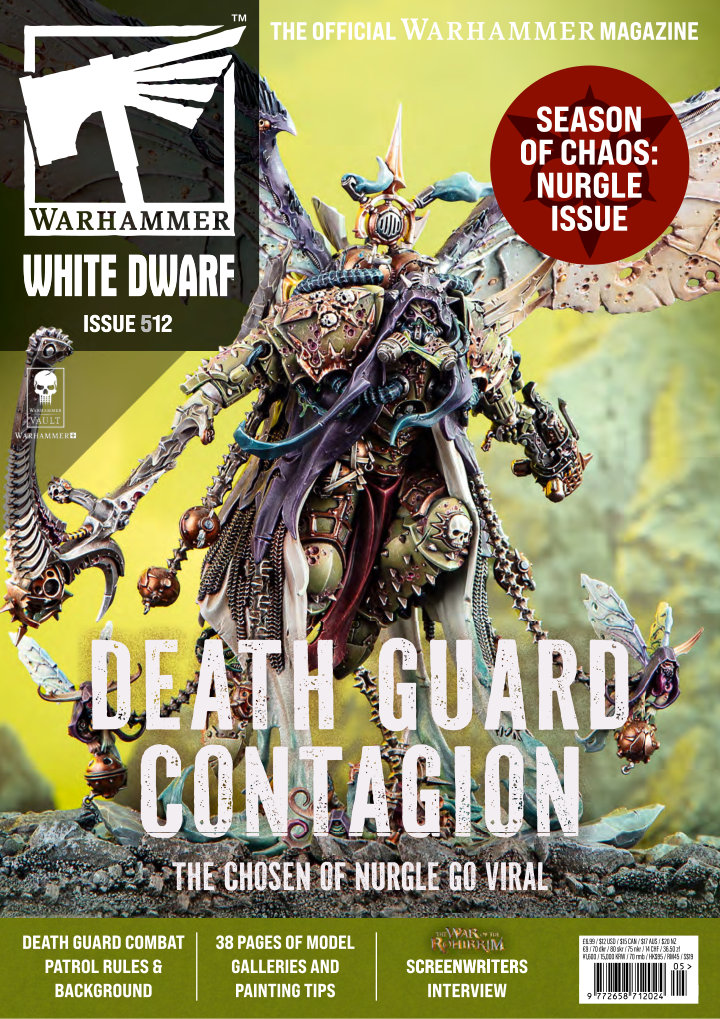
EditorialWD 512 · Inside cover
Lyle Lowery moves the Season of Chaos from Slaanesh to Nurgle, introducing a Death Guard Combat Patrol, infected battlefields and diseased model collections. The Grey Knights provide an opposing perspective, while Gnashka reaches its conclusion and a new five-part duardin serial begins. The editorial links these features through the contrast between spreading corruption and the forces that resist it.
Warhammer 40,000Age of SigmarDeath Guard
CommunityWD 512 · pp. 2–7
Reader work includes Stuart Gatley’s Great Unclean One, Alan Brewster’s Light of Eltharion, Toni Garcia’s Sigvald, Fabio Girelli’s Tome Keepers and Santos Gaitan’s Yndrasta. Letters celebrate family gaming and the Tome Keepers stories, while two ambitious vehicle projects show a scratch-built Imperial tank transporter and an enormous Ork Gargant. The section connects personal stories with practical modelling and painting notes.
Warhammer 40,000Age of SigmarDaemons of Nurgle
ModellingWD 512 · p. 4
Martin Peak combines a widened Taurox cab with Ridgehauler running gear and extensive plasticard work to build a believable Astra Militarum transporter. Reused kit details become winch motors, fuel tanks, batteries and brake equipment, and the cab even contains a re-caff press. Drybrushing, sponge chips and powders weather the vehicle while preserving the painstakingly built detail.
Warhammer 40,000Astra Militarum
PaintingWD 512 · p. 7
Simon Coquin spends six months building a vast Gargant inspired by the Epic Great Gargant, using plasticard and accumulated parts. Leadbelcher and pale underlayers support airbrushed blue panels, while Martian Ironearth, sponged browns and orange, and metallic stippling create thick corrosion. Killa Kan turrets, a reactor cover and a Warhound weapon convey the project’s scale and his ambition to face a Warlord Titan.
Warhammer 40,000EpicOrks9 paint colours
LoreWD 512 · pp. 8–15
Presented as collected Imperial and Grey Knights documents, this dossier explains how suffering and despair feed Nurgle and turn relief from pain into devotion to decay. Accounts of Nurglings, Plaguebearers, Ku’gath and Rotigus lead into the Death Guard’s supernatural resilience, Mortarion’s corruption and the walking pox that transforms civilians into new vectors of infection.
Warhammer 40,000Death Guard
RulesWD 512 · pp. 16–23
Phlegmus Gloem leads five Plague Marines, ten Plaguebearers and three Plague Drones, with Nurglings available through the Festerflute enhancement. The mixed patrol uses an expanding contagion aura to reduce enemy movement, morale and objective control. The Marines provide fire support and objective security while daemons exploit lethal hits and the Drones’ ability to improve wound reliability against a marked target.
Warhammer 40,000Death Guard
RulesWD 512 · pp. 24–25
Six Malign Diseases accumulate infection levels as players choose which plagues to advance at the end of turns. Reaching a disease’s threshold activates its effect for the remainder of the battle, progressively changing cover, shooting, melee strength, leadership and the vulnerability of monsters and vehicles. A player who forgoes Stratagems also chooses an infection increase, making the approaching deterioration part of the resource decisions.
Warhammer 40,000
ShowcaseWD 512 · pp. 26–39
This gallery assembles Nurgle collections across two settings, from sponge-painted Plague Marines and vivid daemon skin to cloned Chaos Knight barons and blue-armoured Death Guard. Contributors explain how weathering, colour contrast and conversions establish their armies’ identities. Historical Legion colours, contemporary mutations and deliberately unstable war engines offer different ways to show decay without repeating the same green palette.
Warhammer 40,000Age of SigmarDeath Guard
PaintingWD 512 · p. 27
Fil replaces conventional edge highlights with sponge work on his Plague Marines. Chaos Black and a Death Guard Green zenithal spray establish the surface, then Elysian Green and Nurgling Green build uneven highlights before a heavy Agrax Earthshade wash ties them together. The method uses roughness as a deliberate part of the diseased armour’s appearance.
Warhammer 40,000Death Guard5 paint colours
PaintingWD 512 · p. 27
Callum starts Rotigus with Wraithbone and Skeleton Horde, then returns to pale highlights to build the main flesh tone. Plaguebearer Flesh, Biel-Tan Green and Drakenhof Nightshade separate diseased areas from that warmer skin. The restricted recipe makes the enormous daemon readable while preserving the contrast between pallid bulk and corrupted patches.
Warhammer 40,000Age of SigmarDaemons of Nurgle6 paint colours
PaintingWD 512 · pp. 28–29
Steve’s force centres on Pusgoyle Blightlords and Plague Drones under the unlucky Festerlord Plasquorr, with wingless Drones converted into maggot-like Beasts of Nurgle using putty tentacles. Recipes distinguish rotten mortal flesh, bright glazed daemon skin, worn metal, glossy wings and yellow boils. The army’s repeated insect forms and persistent failures turn its collection theme into a story about Nurgle’s resilience.
Age of SigmarMaggotkin of Nurgle16 paint colours
PaintingWD 512 · pp. 30–31
Rhuairidh’s Malinax-descended Knight pilots are deteriorating clones of Baron Zol Kothos, each competing to be closest to the original. Asymmetric conversions make the machines seem hollow and unstable, and Typhus Corrosion applied before undercoating gives their armour an organic texture. Stippled bone plates contrast with dark trim, pink daemon flesh and blood-red lenses.
Warhammer 40,000Chaos Knights16 paint colours
PaintingWD 512 · pp. 32–33
Doug builds his Death Guard armour with airbrushed light over Mournfang Brown, followed by Plaguebearer Flesh and warm recessed shading. Oil paints deepen the darkest areas before individual details are finished. Mortarion shares the armour method, but the wings use bright magenta and blue over a black-and-white preparation, creating a vivid centrepiece against the army’s weathered greens.
Warhammer 40,000Death Guard7 paint colours
PaintingWD 512 · pp. 34–35
Alexandre chooses blue armour because its cool hue sets off warm orange rust more clearly than conventional Nurgle green. Stegadon Scale Green, Sotek Green and Ahriman Blue establish the plates, while layered flesh washes and pale highlights create different infected textures on the daemons. Colour theory lets corrosion remain conspicuous and gives green details their own material identity.
Warhammer 40,000Age of SigmarDeath Guard11 paint colours
PaintingWD 512 · pp. 34–35
Dominik adapts the Death Guard’s old Legion colours to their corrupted 41st-millennium descendants, using pale armour and green pauldrons as a base for grime. Heresy-era Contemptor and Deredeo models receive Nurgle icons, horns and spikes, with Boneripper parts supplying a flail arm. Metallic stippling and tarnished bronze connect the ancient equipment to the contemporary army.
Warhammer 40,000The Horus HeresyDeath Guard9 paint colours
PaintingWD 512 · pp. 36–37
Jim’s Fifth Plague Company collection combines pale washed armour, green trim, stained metal and bright pustules to suggest a force leaving contamination in its wake. Reposed Typhus, a Rhino merged with a Corpse Cart and a Maggoth-based Maulerfiend demonstrate the conversion opportunities, including a model chosen for its appearance despite lacking Death Guard army eligibility. Detailed recipes cover armour, rust, brass and infected damage.
Warhammer 40,000Death Guard17 paint colours
ModellingWD 512 · p. 38
Mark transforms a Knight Rampager with the Glottkin’s huge tentacle arm and bone growths, then adds bells, chains, spikes and horns from Death Guard and Maggotkin kits. A manufactorum-style base gives the enormous corrupted machine a clear environment. The conversion relies on matching large organic forms to the Knight chassis rather than only applying small surface icons.
Warhammer 40,000Age of SigmarChaos Knights
ModellingWD 512 · p. 39
Brian favours the Death Guard’s brutal, almost-Chaos appearance as a starting point for converted Heresy characters. Consuls, Apothecaries and Techmarines combine resin and plastic Legion components with carefully chosen Chaos parts. A Plague Surgeon becomes an Apothecary and Alexis Polux’s body becomes a Techmarine, illustrating how a recognisable kit can acquire a very different battlefield identity.
The Horus HeresyDeath Guard
PaintingWD 512 · pp. 40–43
Dan recommends studying real corrosion before choosing where and how to weather a model. Using a Plagueburst Crawler, the tutorials distinguish rust streaks, gritty flakes, crackled paint, dirty black armour, oily steel and copper patina. Washes serve as technical colour effects as well as shading, and exposed bright metal provides contrast where wear has rubbed a surface clean.
Warhammer 40,00017 paint colours
PaintingWD 512 · p. 41
Thin brown lines below rivets and small orange deposits imitate water-borne rust, while reddish Doombull Brown avoids overpowering black armour. Typhus Corrosion supplies actual fine texture for heavier flakes, built up before orange washes and ochre stippling. These three methods scale the weathering from subtle staining to visibly damaged metal.
6 paint colours
PaintingWD 512 · p. 42
Agrellan Earth applied before the undercoat creates cracks that remain visible beneath painted yellow armour and rust colours. Metallic edges or a graphite pencil then mark places where corrosion has broken away. The second method thins Wyldwood over silver for a greasy film, adds stronger recess deposits and restores bright worn edges, producing oily machinery with only a few stages.
10 paint colours
PaintingWD 512 · p. 43
The copper tutorials separate brown tarnishing from pale green verdigris rather than treating all corrosion as orange rust. Thinned Wyldwood gives copper a dark oxidised film, Nihilakh Oxide supplies the milky overall patina, and blue-green washes intensify local deposits. Each effect exploits the contrast between cool corrosion and the warm metal beneath.
5 paint colours
PaintingWD 512 · p. 43
In response to Octavio Lopez, the studio gives separate recipes for blue walls, pale platforms, metal conduits and plasma glow. Painting the Grey Seer floors separately makes the large terrain set easier to handle, while drybrushed greys define the dark blue structure. Pale blue pipes with white recesses create the luminous plasma effect without confusing it with the weathered metal around them.
Warhammer 40,00013 paint colours
LoreWD 512 · pp. 44–49
Twenty illustrated facts outline the Grey Knights’ foundation, psychic brotherhoods, fortress on Titan and ties to the Ordo Malleus. Their personally completed Nemesis weapons, Prognosticars, Aegis and access to forbidden knowledge explain how they fight daemons. The dossier also presents the costs of secrecy, losses after the Great Rift, Draigo’s exile, abandoned personal names and the dangerous presence beneath Titan, showing a force defined by vigilance as much as power.
Warhammer 40,000Grey Knights
InterviewWD 512 · pp. 50–63
Roman Lappat explains his framed relief-like dioramas, inspired by classical art, church memorials and boxed miniature scenes. He builds a rear box inside a chosen frame and treats the whole composition as a single painting, using forced perspective, controlled lighting and models at different scales. Seven examples explore Cadia, the Underhive, Space Marines, Stormcasts and Nurgle, each choosing environmental colour to establish emotion as well as depth.
Warhammer 40,000Age of Sigmar
ModellingWD 512 · pp. 52–53
Roman places the viewer among Cadia’s defenders during its final hours, with many soldiers facing into the scene and a Commissar apparently addressing the audience. Modern Cadians and Kasrkin stand beside older characters, while small Knights, aircraft and a Titan create distant action. Mixed scales and directed poses turn a framed collection of models into a shared moment of impending loss.
Warhammer 40,000EpicAstra Militarum
ModellingWD 512 · pp. 54–55
Roman cuts and angles industrial terrain, stairs and structural plastic to suggest depth inside a shallow Underhive frame. A cooler blue background recedes visually, while the Escher gang and surrounding graffiti use saturated nightclub-inspired colours. The contrast makes the gang’s territorial warning the clear foreground story.
NecromundaHouse Escher
ModellingWD 512 · pp. 56–57
Inspired by John Blanche, Roman shows Black Templars under an artillery barrage with a painted backdrop extending the battle. He builds and paints the entire piece together, ensuring every model shares the same direction, colour and intensity of light. Treating only the visible scene as essential lets the composition function like a cut-out from a larger war.
Warhammer 40,000Black Templars
ModellingWD 512 · pp. 58–59
Roman’s first framed diorama of this type places Stormcast Eternals as a bright, solid centre amid crashing waves of Chaos followers. A broad mix of miniatures, including Underworlds fighters and a distant Manticore, supplies variety without changing the central light-against-darkness theme. Contrasting poses make the surrounding attack feel fluid against the defenders’ still resolve.
Age of SigmarWarhammer UnderworldsStormcast Eternals
ModellingWD 512 · p. 60
A cold winter palette and foam-built ice canyon surround Roman’s hunting Space Wolves. Sculpted beards and fur personalise the Marines, while Belladamma Volga’s wolf becomes a companion for their leader. Tiny Epic Marines and a Dreadnought in the rear extend the force into an apparently much deeper landscape.
Warhammer 40,000EpicSpace Wolves
ModellingWD 512 · p. 61
Roman defines the scene through a cloudy morning breaking into sunlight as Minka leads an attack. Flanking rifle barrels and the distant tank gun guide the eye towards her, while a leaning building supplies visual weight and pressure. The composition turns a small diorama into an image of hope by aligning light, architecture and weapon direction around its central character.
Warhammer 40,000Astra Militarum
PaintingWD 512 · p. 62
Cyberpunk-inspired magenta and yellow light gives Roman’s Garden of Nurgle an unexpectedly vibrant setting. Blooming growth suggests the life that precedes decay, while muted Plague Marines and varied green Nurglings contrast with the illuminated background. A split-complementary scheme balances green against red-magenta and yellow against purple, making the colour itself part of the scene’s unsettling vitality.
Warhammer 40,000Death Guard
PaintingWD 512 · p. 63
A mounted Harbinger passes through a swamp with Poxwalkers, white ravens and Nurglings, painted in the colour mood of a decaying wound. Roman combines model-railway leaves at two scales to suggest distance and uses glazes for sickly stains. Nihilakh Oxide and Waystone Green give the verdigris both pale and dark areas rather than a single uniform wash.
Age of SigmarMaggotkin of Nurgle2 paint colours
LoreWD 512 · pp. 64–69
Dakkbad attacks his own occupied fortress after allowing the boastful Tarkan ogors to discover the Avengorii ambushes. The Ironsunz advance in three brawls, but concealed skeletons and stitched-together undead monsters divide and delay them. As the greenskins’ fury rises, Askoran uses it to awaken an ancient Revenant Draconith beneath the fort, revealing the true purpose of the invasion.
Age of SigmarIronsunz
RulesWD 512 · pp. 70–73
The campaign finale pits Ironjawz against Soulblight invaders over a fort with a central bone pit, and can also be adapted as a standalone battle. Every charging Ironsunz unit increases Waaagh! energy, progressively improving the orruks’ performance until the vampires can spend its peak to replace a destroyed monster. Underdog abilities manipulate the energy or destroy objectives, while normal objective control and battle tactics determine victory.
Age of SigmarIronsunz
PaintingWD 512 · pp. 74–83
Carlos and Tom develop the new Soulblight collection around the passage of time. Bronze armour, varied verdigris, faded fabrics and grave dirt make the Deathrattle look like generations of an ancient civilisation rather than newly manufactured undead. Vhordrai’s glossy blood-red armour deliberately breaks that weathered pattern, while two Draconith palettes tie huge creatures into the army without losing their individual character.
Age of SigmarSoulblight Gravelords65 paint colours
PaintingWD 512 · pp. 74–78
Different patinas on bronze distinguish warriors buried for different lengths of time, while black cloth and white shields provide strong value contrast. Red and purple denote rank, appearing prominently on nobles but only subtly on ordinary skeletons. Recipes cover multiple bone and verdigris variants, wood, metal, straps, leather and mounted-warrior details; shared grave-dirt colours connect models, shields, banners and bases.
Age of SigmarSoulblight Gravelords48 paint colours
PaintingWD 512 · p. 79
Carlos gives every banner faded freehand designs that predate the warriors’ vampiric masters, deliberately excluding obvious vampire symbols. Layered pale cloth, dark heraldry and earth or verdigris stains suggest centuries in the same grave as the bearer. Colour variants use different corrosion and cloth relationships to keep individual units distinct while preserving the collection’s aged appearance.
Age of SigmarSoulblight Gravelords11 paint colours
PaintingWD 512 · pp. 80–81
Tom makes Vhordrai’s red armour look lacquered and blood-bright to elevate him above ordinary Blood Knights and contrast with dusty Deathrattle metal. Shordemaire’s warm, decaying green flesh shifts towards blue-green wing membranes, echoing the army’s verdigris. Detailed colour sequences cover the rider’s armour and cloth, shields, brass, bone and the dragon’s skin and exposed organs, preserving clear separation between rider and mount.
Age of SigmarSoulblight Gravelords35 paint colours
PaintingWD 512 · pp. 82–83
Carlos studies decomposing reptiles to push the familiar black-bone-red zombie-dragon palette into more convincing decay. Neutral cool skin contrasts with warm bone and exposed organs, while saturated crimson-purple membranes fade into paler edges instead of becoming an unreadable black mass. Brighter head bones focus attention, and subtle green-blue glazes connect the creature to the army’s corrosion and poisonous breath.
Age of SigmarSoulblight Gravelords
TacticsWD 512 · pp. 84–89
Louis explains Nemesis as a combination of two Rivals decks, with a twelve-card objective deck and a lean power deck supporting consistent draws. He recommends choosing a primary deck around a warband’s Inspire condition, then a complementary deck that fills gaps, balancing easy scoring with a few high-value opportunities rather than chasing every possible combination.
Warhammer UnderworldsGloomspite Gitz
TacticsWD 512 · pp. 90–93
Louis links deployment, feature-token placement and turn order to the objective cards a warband expects to score. He explains when delaying movement protects a positional plan, how Delving can deny opponents opportunities and why Surge timing matters for combinations. The closing Tunnelpack-versus-Emberwatch puzzle asks the player to score several cards in the final turn while anticipating an enemy push.
Warhammer UnderworldsZikkit’s Tunnelpack
InterviewWD 512 · pp. 94–97
Screenwriters Arty Papageorgiou and Phoebe Gittins discuss discovering Tolkien, their favourite characters and the emotional moments in The War of the Rohirrim. They praise miniatures that convey personality as well as likeness, singling out the Snow Troll, Freca and Lief, and suggest film scenes they would like to recreate as tabletop scenarios. Their choices of Sam, Éowyn and Galadriel reveal the personal heroism that informed their work.
Middle-earth Strategy Battle GameRohan
PaintingWD 512 · pp. 98–101
Graham paints Warriors of Rohan and Hill Tribesmen with muted earthy tones, applying base colours and shared washes in batches to save time. Separate finishing stages distinguish cloth, leather, flesh and metal, while optional swaps between grey and brown make the tribesmen look less uniform. The feature also covers matching Edoras bases and the yellow-to-red-to-charred surfaces of flaming brands.
Middle-earth Strategy Battle GameRohan38 paint colours
PaintingWD 512 · pp. 98–99
A Chaos Black undercoat supports green cloth, brown leather, pale beard and warm metallic details on the Rohirrim. Brown shade deliberately mutes the cloth rather than intensifying its green, and successive highlights define the varied materials. Graham recommends completing the skin late to avoid difficult corrections, and supplies a sand-and-rock basing recipe shared across The Battle of Edoras models.
Middle-earth Strategy Battle GameRohan30 paint colours
PaintingWD 512 · pp. 100–101
The tribesman recipe distributes grey and brown across cloth and fur, using Targor Rageshade to warm the grey areas and Agrax Earthshade on browns. Fine highlights separate beard, fabric, bindings, skin and metal. Graham explicitly encourages swapping these colours or changing the shade to create a less regimented band without needing a new process for every warrior.
Middle-earth Strategy Battle GameHill Tribes27 paint colours
PaintingWD 512 · p. 101
Flaming brands begin bright yellow, with red drybrushing added outward into the flames and dark brown marking charred edges. Tiny white points represent the brightest embers. The reversed darkening sequence keeps the hottest core visibly lighter than the outer parts and suits the small fire shapes carried by the tribesmen.
Middle-earth Strategy Battle GameHill Tribes4 paint colours
FictionWD 512 · pp. 102–111
Albarak kills an attacking leonax while gathering timber, only to discover that it belongs to Warden King Mazur’s hunt. The king threatens execution and the ruin of Albarak’s village, but the mysterious Lord Beratak proposes service in repayment. Bound by the debt, Albarak must pursue a wounded stonehorn through the dangerous waters and cliffs of Ghur, questioning the honour of a hunt driven by royal pride.
Age of SigmarDispossessed
CommunityWD 512 · p. 112
The Bunker’s Kill Team league fills studio tables with freshly painted teams, and the editor highlights a monthly 40K mission where heroes arrive before their reinforcements. Club of the Month returns with an invitation for readers to submit their own groups, while Monsters and Machines provides the painting theme. The page connects the studio activities to wider club participation.
Warhammer 40,000Kill Team
CommunityWD 512 · p. 113
The June challenge log accompanies the recurring achievement tracker, which rewards scenarios, club games and painting up to the monthly limit. Ranks provide a continuing record across activities rather than only wins, and downloadable resources make the same scheme available to local groups. The page supports clubs following either the magazine events or their own programme.
CampaignWD 512 · pp. 114–117
Leila reports the first three paired rounds on Volkus and Gallowdark, with players learning their teams and Approved Ops 2024. Nemesis Claw makes a strong start, Mandrakes fall back after an opening win and Cory’s Legionaries win three games. Matt’s diary shows a low-scoring 8–6 victory over Sam’s Blood Angels Phobos team, where fixation on a heavy gunner leaves openings for his close-combat specialists.
Kill TeamNemesis Claw
PaintingWD 512 · pp. 116–117
Ben gives every Ravager a different fur colour and relies heavily on drybrushing to pick up the sculpted texture. Black, dark brown and light brown sequences use different preparations but share a rough, practical finish, followed by blood splatters. The varied coats make the individual beastmen stand out without breaking the visual unity of their team.
Kill TeamFellgor Ravagers7 paint colours
ShowcaseWD 512 · pp. 118–123
The reader gallery displays Sean Watters’s Medusa, Adam Gladzinski’s Zoat and Ambot, Evan Hicks’s Crisis suits and Antonio Procino’s Old World Giant. Studio examples add weathered Sentinels, an earthy Ironweld cannon, an Imperial Fists turret and a Legio Astorum Warlord. The variety shows both large creatures and machinery as opportunities for texture, subassemblies and distinctive collection colours.
Warhammer 40,000Age of SigmarAstra Militarum
CommunityWD 512 · pp. 120–121
Founder Harry Barratt describes NOMADS as a Blood Bowl network connecting players who might otherwise attend events alone. Group tournament trips and a supportive space for questions help new and returning coaches enter the scene. The Full Beard Cup gathering brings members together and wins both team-appearance and fair-play awards, illustrating the community’s emphasis on companionship as well as competition.
Blood Bowl
PaintingWD 512 · p. 122
Michael layers weathering onto Zandri Dust Sentinels using sponge work and controlled brush marks. A lighter bone-and-sand mix creates the first damage, black deepens scratches and metallic paint defines exposed material. Building the chips in several colours gives the walkers the depth of long service rather than a flat scattering of dark spots.
Warhammer 40,000Astra Militarum4 paint colours
PaintingWD 512 · p. 122
John chooses restrained earth colours for his Cities of Sigmar artillery. Darkened steel and bright edge highlights distinguish the gun, while a pale pavise receives a brown wash and darker lower edge to create a grounded gradient. The simple metal and shield recipes support a modest army identity rather than a heavily decorated centrepiece.
Age of SigmarCities of Sigmar7 paint colours
ModellingWD 512 · p. 123
Matt paints the Firestrike in a carefully ordered set of subassemblies to reach its small details. The base precedes the chassis, then the gunner is built from legs to upper body, with the gun shield and weapons attached last. The sequence is useful for a dense mechanical model where completing assembly too early would block brush access.
Warhammer 40,000Imperial Fists
PaintingWD 512 · p. 123
Sergi paints a Warlord in Legio Astorum colours for a game themed around the Battle for Prospero. Kantor Blue with Nuln Oil defines the main plates, while Yriel Yellow and Casandora Yellow create the contrasting panels. Extensive transfers finish the engine’s identity and let the small-scale model carry detailed heraldry.
Legions ImperialisLegio Astorum4 paint colours
CommunityWD 512 · pp. 124–125
Matt adds a Ballistus Dreadnought with a freehand Third Company stripe to his Imperial Fists, while Lyle and Dan participate in the Grand Narrative across Nottingham and Atlanta. Photographs show the Tome Keepers with a House Hawkshroud ally and Dan facing Genestealer Cults. Updated boards record rapidly growing painting and gaming totals and connect completed projects to actual games.
Warhammer 40,000The Horus HeresyImperial Fists
PaintingWD 512 · p. 124
Matt works on the Ballistus in four main pieces—legs, torso and two arms—and paints the metal before returning to the yellow plates. Leadbelcher, Nuln Oil and a Stormhost Silver drybrush establish the machinery, while a broad red shoulder stripe identifies Garadon’s Third Company. The order of work combines access to hidden details with an uncomplicated metallic recipe.
Warhammer 40,000Imperial Fists3 paint colours
TacticsWD 512 · p. 126
The recommended Tunnelpack sequence charges Nitch onto treasure token 5, resolves a ranged attack and uses Skitter before Careful Survey to reposition Rittak into the missing territory. Nitch then Delves immediately in the Power step to score two more objectives before the opponent can push him away. The comparison with weaker options demonstrates why exact timing, rather than only the final board position, determines the three-glory result.
Warhammer UnderworldsZikkit’s Tunnelpack