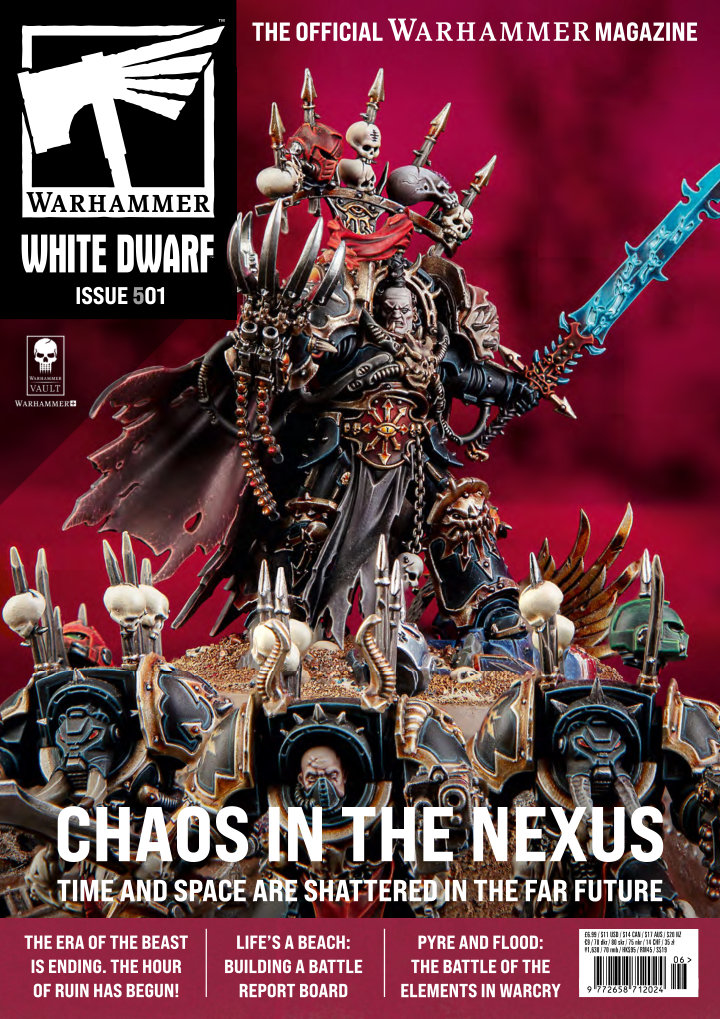
EditorialWD 501 · Inside cover
Lyle uses the approaching Spearhead league to balance his enthusiasm for new factions with attention to existing armies. His plan begins by revisiting Sons of Behemat, then expanding Nighthaunt before permitting an entirely new project. A possible fourth force would come from unpainted models already owned, turning a small fixed-list format into a way to satisfy several different hobby ambitions.
Age of Sigmar
CommunityWD 501 · pp. 2–5
David Garcia Regodón builds a miniature painting desk around Epic models, complete with tiny supplies and its own Golden Demon entry. Henrik Olsen converts giant macro-mutants for a Chaos Knights force, and a question examines the competing fates of souls in the Mortal Realms. Caleb Wissenback’s Rogal Dorn uses translucent coloured shadows over drybrushed metal to create richer, more varied gold.
Warhammer 40,000Age of SigmarChaos Knights3 paint colours
LoreWD 501 · pp. 6–9
Phil looks back across the Era of the Beast, following Kragnos’s release, the return of the Draconith and the escalating wars of Ghur. Gnarlwood expeditions, Dawnbringer innovations and Trugg’s destruction of magical sites connect the edition’s many creatures to its changing story. Gobsprakk’s suppression of evidence about surviving Drogrukh gives the retrospective a final note of betrayal as the Hour of Ruin approaches.
Age of SigmarSons of Behemat
CommunityWD 501 · pp. 10–11
With a Spearhead league approaching and Armies on Parade ahead, the Bunker concentrates on building and painting. Lyle describes the encouragement generated by a shared stream of work-in-progress photographs and practical advice. The accompanying planner helps turn that enthusiasm into a finished display through manageable building, painting and arrangement deadlines.
Age of Sigmar
CommunityWD 501 · pp. 12–13
The monthly theme calls for the hobby’s most powerful battlefield figures, while the achievement card continues to recognise games and completed units as well. A cumulative rank and journal make each month part of a longer record. Future submission dates help painters prepare ambitious centrepieces without limiting how they interpret the challenge.
ShowcaseWD 501 · pp. 14–17
The studio begins preparing compact fixed-list armies for the forthcoming Spearhead league. Its introduction explains how a box can become a complete force while still encouraging command models useful in larger battles. Staff projects range from barrel-armoured gargants to crystalline Chaos imagery, demonstrating that an accessible game format can support personal modelling and painting rather than demand identical-looking armies.
Age of SigmarSons of Behemat
ModellingWD 501 · p. 15
Adam’s three gargants protect themselves with stolen barrels rather than conventional armour. Coffee stirrers form the staves around cardboard rings, and string holds the oversized constructions together. Their imagined theft and an eyepatch planned for the wrong eye add comic character, making the small Sons of Behemat force feel like a recognisable band of individuals.
Age of SigmarSons of Behemat
PaintingWD 501 · p. 15
Matt revisits the blue-and-silver appearance of his old High Elves and deliberately avoids white. Two related blue cloth treatments provide contrast within the limited palette, while gloss mixed into the metal’s shade keeps the armour reflective. A bright green base completes the test model and offers a clear direction for the larger Lumineth Spearhead.
Age of SigmarLumineth Realm-lords9 paint colours
PaintingWD 501 · p. 15
Sergi seeks a quick rewarding process based on drybrushing, beginning with bone-coloured undercoat and irregular dark-brown areas. A diluted shared wash unites the different bones before pale and brown drybrushes restore their texture. Green beneath a light gold drybrush provides a simple aged metallic effect that complements the assembled skeleton.
Age of SigmarOssiarch Bonereapers8 paint colours
PaintingWD 501 · p. 16
Roberto imagines cursed warriors wandering a surreal desert in Tzeentch’s realm, surrounded by pages of ancient books. A pale crystalline finish is reserved for the Chaos Lord, giving the commander a distinction the rank and file do not share. Unusual coloured highlights shape black armour, while freehand banners and warm non-metallic gold reinforce the strange setting.
Age of SigmarSlaves to Darkness15 paint colours
PaintingWD 501 · p. 17
Art’s Dawnbringers combine Hammerhal Aqsha’s burning red with a burgundy honour awarded to the first settlers of Embergard. Simple washed and drybrushed steel gives the soldiers a practical martial appearance, allowing the cloth to carry their identity. The scheme connects an army’s colours to its recent story rather than merely assigning a decorative uniform.
Age of SigmarCities of Sigmar10 paint colours
PaintingWD 501 · p. 17
Harvey chooses dark Shyishan colours for his Lethis army, with rich burgundy progressing through pink highlights. Cold iron armour receives a dark wash and sharp silver edges. Mostly neutral supporting colours and snowy bases preserve the mournful appearance, giving a simple Steelhelm a clear connection to the city’s death-haunted surroundings.
Age of SigmarCities of Sigmar7 paint colours
PaintingWD 501 · p. 17
Greg wants his Kruleboyz dirty but visually coherent, using dark red cloth against noticeably pale green skin. Successive drybrushes establish the skin’s highlights quickly before a diluted green wash blends the progression. The resulting contrast leaves room for grime and rough equipment without losing the shared palette that will identify the completed warband.
Age of SigmarKruleboyz8 paint colours
RulesWD 501 · pp. 18–19
A cyclonic impact drives dust clouds across one of three battlefield sectors every round. Concealed units gain protection from distant fire but their own shooting and movement are constrained, and a central storm can block fire between the flanks entirely. Players must secure several evacuation relays while preserving their troops for a final survival award.
Warhammer 40,000
RulesWD 501 · pp. 20–21
Six to twelve players each command a single inexpensive hero in a fast team contest. Limited allegiance choices keep the rules manageable, slain heroes return from their team’s corners, and the trailing side receives combat and charge bonuses. With no fixed turn limit, the struggle continues until one side accumulates enough objective points, keeping every player involved despite repeated deaths.
Age of Sigmar
RulesWD 501 · pp. 22–23
Six environmental cards add hostile desert conditions to Kill Team battles. Glass storms punish exposed operatives, ambush predators attack unpredictably, unstable sand exhausts long moves, and lightning or interference weakens shooting and orders. Suggested variations use multiple cards, concealed effects or campaign-wide conditions, allowing the same small deck to serve either an even contest or a deliberately asymmetric story.
Kill Team
TacticsWD 501 · pp. 24–27
Sam considers low model count, limited shooting and fragile troops through Sons of Behemat, Slaves to Darkness and Daughters of Khaine examples. Moving objectives, adding smaller gargants, using mobile threats or endless spells and delaying commitment can compensate for those weaknesses. The final puzzle asks the reader to protect Archaon while reaching artillery that appears safely screened.
Age of SigmarSons of Behemat
PaintingWD 501 · pp. 28–31
Dan explains how bases establish a collection’s environment and connect its models to one story. Gritty texture paints and crackle finishes produce different kinds of ground, with preparation and drying time affecting the final pattern. A sequence of earth, stone and more fantastic recipes shows how simple shading, drybrushing and selective gloss can make a plain base support the miniature above it.
PaintingWD 501 · p. 29
Four recipes compare rough badlands, dry dust, cracked earth and wet-looking mud. A coloured foundation becomes visible beneath the crackle paint, while varnish encourages and then protects its broken surface. The examples also show how a wash and two drybrush stages can alter the texture’s character without requiring extra scenic components.
19 paint colours
PaintingWD 501 · p. 30
Black cracked earth, cold grey stone and two Martian reds use the same basic progression but produce markedly different settings. Drybrushing catches the rough surfaces more naturally than precise edge highlights would. Dan also recommends leaving hollows in texture paint for puddles and allowing some base colour onto a model’s feet when it helps bind the warrior to its environment.
19 paint colours
PaintingWD 501 · p. 31
Six further bases expand the method into deserts, lava, snow, ice, swamps and exposed green energy. Bright colour beneath black crackle becomes a molten or supernatural fissure, while gloss strengthens the impression of ice and pooled liquid. Layered textures and restrained highlights create recognisable environments from paint alone, providing alternatives to a standard earth-coloured army base.
22 paint colours
CommunityWD 501 · pp. 32–37
Tokyo’s Rusty Nurgling winners continue the international painting event coverage, with entries ranging from an Alpha Legion warrior to the Triumph of Saint Katherine. The studio’s Gods of War theme pairs Phil’s sweaty, rune-marked Kragnos with Jimbo’s brightly coloured Alarielle and Wardroth Beetle. Reader centrepieces then broaden the gallery with Chaos, undead and Space Wolves heroes.
Age of SigmarWarhammer 40,000Alpha Legion11 paint colours
CommunityWD 501 · pp. 38–39
Halfway through the year, the team’s bingo projects continue alongside preparations for Spearhead. Matt returns to Craftworld Telennar with green-armoured Striking Scorpions, while Dan’s Cybercanids finish their first Necromunda campaign with ten gang members on the roster. Both examples show how an existing force can continue growing through small additions and emerging campaign stories.
Warhammer 40,000NecromundaAeldari3 paint colours
LoreWD 501 · pp. 40–47
A confined scholar explains the Mortal Realms’ magical structure before warning that the skaven have poisoned the nexuses that hold it together. The disaster in Aqshy is therefore more than an enormous invasion: weakened realmspheres permit Blight City to force its way into reality. His increasingly frantic testimony argues that other seemingly isolated infestations could precede further Vermindooms across the cosmos.
Age of SigmarSkaven
FictionWD 501 · pp. 48–55
Merrick searches the ruined Parch for safety after a catastrophic skaven attack, sustained by the apparent presence of his brother. Discovering that Fort Banehearth has already fallen destroys one hope, and a rescuing cavalry force is swallowed by another eruption. His final recognition of what he has actually been carrying exposes both his madness and the terrible bodily effects of the newly corrupted land.
Age of SigmarCities of Sigmar
RulesWD 501 · pp. 56–59
Jimbo adds a Gnarlwood phase in which each gnarloak acts according to whether potential prey is nearby. The trees can move, obstruct sight, prevent escapes or attack with crushing branches, turning scenery into an unpredictable participant. The rules can overlay an ordinary battleplan or provide a large final battle for a Warcry campaign, provided players accept a forest that cannot simply be shot away.
Age of Sigmar
ShowcaseWD 501 · pp. 60–67
Rob Hebblethwaite turns an unexpected discounted purchase into an Ironjawz army with red-brown skin and bare metal armour. Snowy mountain bases sharpen the contrast and inspire a story of isolated orruks surviving in a harsh Ghurish landscape. Skulls, limited natural colours and small sculpted additions make the collection feel more severe than a brightly armoured clan while preserving its straightforward appeal in games.
Age of SigmarIronjawz8 paint colours
PaintingWD 501 · p. 64
Rob finishes the extensive metalwork before returning to the orruks’ flesh, keeping his batch-painting process efficient. Dark washed iron differentiates armour from brighter weapons, while warm brown skin and natural red cloth support the restricted palette. Leaving the eyes without pupils deliberately exaggerates their anger rather than making the warriors look more human.
Age of SigmarIronjawz20 paint colours
CampaignWD 501 · pp. 68–83
Narrative material develops the opposing purposes of the Ydrilan Riverblades and Pyregheists: restoring living waterways or spreading Nagash’s balefire. Each receives quests, character development and a special encampment, with names and origin tables to personalise the warband. Rules for the Idol of the Old Ones add another dangerous resource to the Gnarlwood, while Pyregheists can eventually turn slain enemies into temporary revenants.
WarcryYdrilan Riverblades
RulesWD 501 · p. 69
The idol’s platforms, crown and eyes receive distinct terrain functions, with the crown remaining hazardous despite its tactical value. A fighter beside the damaged gem can attempt to fire an area-damaging beam but risks being struck instead. Troves offer healing or wild dice to a successful ransacker, balancing the promise of treasure against traps.
Warcry
LoreWD 501 · pp. 70–71
The Ydrilan temples train aelves through lethal river trials until their movements embody the relentless current. Their devotion to aelementor spirits leads them to restore waterways even when the resulting floods threaten nearby mortals. In the Gnarlwood they hope to revive the long-smothered River Derovar, turning an apparently local warband expedition into a project that could transform the entire forest.
WarcryYdrilan Riverblades
CampaignWD 501 · p. 72
The Riverblades search for a river’s hidden origin by reaching an edge point secretly selected by their opponent. Completing the search grants a chosen river blessing that shapes the opening round, from climbing and movement to damage and reactions. A later completion replaces the previous blessing, allowing the warband’s elemental relationship to change as its campaign continues.
WarcryYdrilan Riverblades
CampaignWD 501 · p. 73
A Pureflood Seneschal pursues a selected current through repeated battlefield or campaign deeds. The required actions reflect the intended reward, such as travelling, engaging enemies or defeating a leader. On reaching sufficient mastery the fighter gains a corresponding heroic trait, translating spiritual discipline into a measurable narrative progression.
WarcryYdrilan Riverblades
CampaignWD 501 · pp. 74–75
Searching and defeating hostile heroes leads the Riverblades to a final battle against the influence preventing a river’s return. Their opponent secretly nominates the fighter whose death will end the contest, requiring the attackers to identify and eliminate the true obstruction. Success opens a Waterfall Retreat where meditation supplies temporary blessings and improves the heroes’ prospects for renown.
WarcryYdrilan Riverblades
LoreWD 501 · pp. 76–77
Nagash binds cremation priests and corpse-stealers alike into burning spectres, making former protectors and despoilers of the dead share one punishment. Their temporary relief comes through inflicting the same torment on the living. Maintaining Shyish’s balefires and seeking to burn the Gnarlwood serve the Great Necromancer’s larger desire to replace Ghur’s wild vitality with obedient death.
WarcryPyregheists
CampaignWD 501 · p. 78
Pyregheists gather the remains of their immolated victims to obtain an artefact chosen when the quest begins. Pyre tokens and battlefield victories advance the search. The different ashes preserve emotions such as hatred, sorrow and spite, granting effects that strengthen attacks, resist enemies or turn the suffering of the dead into another weapon.
WarcryPyregheists
CampaignWD 501 · p. 79
A Deacon of Flames earns a heroic trait by steadily raising pyres during battles. The available rewards reinforce different manifestations of its cruelty, including faster pursuit, stronger attacks and retaliation against wounded enemies. Several traits instead disrupt nearby abilities, making the promoted leader a threat to an opponent’s coordination as well as its fighters.
WarcryPyregheists
CampaignWD 501 · pp. 80–81
Accumulated pyres unlock a battle in which the Pyregheists must ignite every battlefield quarter while enemies try to halt their spread. Victory establishes a Roaring Balefire encampment. Its soulburned revenant rule copies a suitable slain enemy onto the warband roster for one later battle, turning a successful execution into expendable future support.
WarcryPyregheists
LoreWD 501 · pp. 82–83
The two warbands receive contrasting ways to invent identities. Melodic Riverblade names and temple origins stress spiritual discipline, while Pyregheist titles are labels assigned by frightened victims to beings trapped in fragmentary memories. Leader traits range from willing blindness and ceaseless movement to remembered fear of flames, supplying hooks for individual models and campaign stories.
WarcryYdrilan Riverblades
ModellingWD 501 · pp. 84–91
Paul and Ash explain how classic jungle battlefields and a famous crashed spaceship inspired the anniversary board. A diagonal front, limited sea area and modular scenery preserve playability while alien plants reveal the Tyranids’ transformation of the world. Construction of the wreck even influenced the linked missions, showing how a physical terrain idea helped shape the battle’s story.
Warhammer 40,000Tyranids
PaintingWD 501 · pp. 86–87
Ash starts from Jes’s Tyranid colours and builds a bright battlefield that photographs clearly without obscuring the armies. Blue water and pale sand contrast with red earth, while purple flowers and yellow fungi make the vegetation visibly alien. Separate recipes cover waves, trunks, ruined fortifications and soil, keeping the varied scenery coherent across the board.
Warhammer 40,00036 paint colours
ModellingWD 501 · p. 86
The subterranean transport uses the drill from a Mechanicum Ordinatus Aktaeus, cut so that it emerges at an angle. Rubble around its base suggests a violent arrival rather than a vehicle parked on the surface. A straightforward grey wash-and-drybrush recipe receives the board’s red-earth weathering, anchoring the model in the same ground as the surrounding battle.
Warhammer 40,0009 paint colours
ModellingWD 501 · pp. 88–89
Three decks of Boarding Actions corridors form the ship’s interior before an angled cut creates the impact profile. Heated plasticard wraps the structure in a distorted hull, and spare machinery completes its silhouette. A sprayed sepia wash and stippled damage make painting manageable, while an escape-pod skeleton with a blowtorch pays homage to the possible saboteur in an older magazine’s spaceship terrain.
Warhammer 40,0004 paint colours
LoreWD 501 · pp. 92–97
The Stilling weakens Chaos sorcery and even transhuman emotion, but extreme devotion allows some warbands to press deeper into the Nexus. While Abaddon monitors rather than fully commits, Vashtorr brings Wyrmwood into the anomaly and seeks technologies for his own ascension. Word Bearers exploit despair, Thousand Sons deploy ancient machines, and Fabius Bile plunders exhausted defenders for biological material, multiplying threats the Necrons did not intend to invite.
Warhammer 40,000Chaos Space Marines
FictionWD 501 · pp. 98–101
Shon deploys the Device in its enormous servitor host, convinced that its power guarantees victory over the Necrons. Kasmoteph plans an assassination but resorts to another temporal strike when the machine is about to fire. Their competing interventions entangle the ship in a repeating catastrophe, returning Shon to the story’s opening moment while the Chronomancer recognises that this defeat has happened before.
Warhammer 40,000Adeptus Mechanicus
RulesWD 501 · pp. 102–107
Echo Fissures let ranged attacks turn corners by rebounding through visible points on unstable reality. A shot may use two fissures, but each added trick reduces accuracy or penetration, and Torrent weapons cannot exploit them. Six Boarding Actions missions place these tiles within conventional patrol battles, creating firing opportunities where corridors would ordinarily provide complete safety.
Warhammer 40,000
RulesWD 501 · pp. 108–109
Rebounded attacks gain Lethal Hits, turning difficult indirect angles into a potentially decisive threat. Progressive points reward spreading across as many as four objectives, with extra value on the central markers at the end. The mission therefore combines a broad command-infrastructure seizure with a final struggle for the most important positions.
Warhammer 40,000
RulesWD 501 · pp. 110–111
Echo Fissures give rebounding weapons Sustained Hits, increasing the reward for finding an unexpected shooting line. Ordinary objective control supplies progressive points, but the force with fewer losses earns a substantial final bonus. An underdog’s scouting move can improve its opening position without removing the need to conserve valuable units.
Warhammer 40,000
RulesWD 501 · pp. 112–113
Units in security zones unlock fuel caches, doubling the value of the associated objectives at the round’s end. Caches may relock afterward, although that becomes less likely as the battle progresses. Players must coordinate control-room access with holding the resources themselves, representing the effort to secure power for an escape from a failing ship.
Warhammer 40,000
RulesWD 501 · pp. 114–115
A random roll changes which pair of data cores is most important each round. Scoring still recognises secondary control, but holding both prime locations produces a stronger result. Destroying or breaking the enemy warlord provides a final reward, so flexible units must balance the shifting machine spirits against an opportunity to remove rival command.
Warhammer 40,000
RulesWD 501 · pp. 116–117
Rebounding attacks become Hazardous, making the crystalline shortcuts dangerous to their own users. Progressive scoring values both general control and paired Alpha or Omega objectives. Each side receives an additional final reward for breaking into the opposing pair, encouraging a coordinated advance through the mirrored maze rather than reliance on safe reflected shooting.
Warhammer 40,000
RulesWD 501 · pp. 118–119
A central archeotech objective offers progressive points and can generate command points when nearby enemies are destroyed. Its final value doubles if the controlling warlord is present and steady. Peripheral objectives still matter, but the semi-aware machine’s growing influence draws commanders into a concentrated fight for the chance to impose their own will upon it.
Warhammer 40,000
ShowcaseWD 501 · pp. 120–127
Seven studio collectors begin Legion forces around the raids on reinforcement routes near the Garmon war zone. The project starts with individual units and intends to develop them into armies for the contested Ollanz Cluster. Different tactical identities and weathered palettes emerge immediately, while common base colours suggest that loyalists and traitors are fighting in one shared theatre.
The Horus HeresyEmperor’s Children
PaintingWD 501 · p. 122
Rob builds the Forty-second Millennial around an armoured future, beginning with infantry that can share a vehicle-friendly airbrushed gradient. Palatine Blades parts personalise the Mk VI warriors as a force enriched by fresh supplies and plunder. Dark purple transitions, cool metallic lenses and restrained red cabling distinguish the army without making its planned tanks impractical to paint.
The Horus HeresyEmperor’s Children15 paint colours
PaintingWD 501 · p. 123
After a vast Night Lords collection, Rich chooses a small Alpha Legion force inspired by Exodus. Mk VI bodies receive reconnaissance weapons and heads to support a stealthy theme. Airbrushed transparent blue-green mixtures over silver create the Legion’s metallic scales, while weathered leather and reflective red optics add materials that remain distinct from the armour.
The Horus HeresyAlpha Legion18 paint colours
PaintingWD 501 · p. 124
Owen’s Berserker Assault force prioritises Rampagers and assault infantry rather than the vehicles he designs professionally. Mixed armour marks suggest repeated repairs during a long campaign. Traditional white and blue remain visible beneath deliberate blood splashes, while burnt-umber bases connect these brutal specialists to the shared Ollanz battlefield.
The Horus HeresyWorld Eaters15 paint colours
PaintingWD 501 · p. 125
Stuart’s Inductii combine Medusan Immortals, upgrade parts and varied heads into a newly assembled but battered force. Sponge weathering and rust give the impression of forgotten survivors seeking revenge at the edge of the war. A premixed wash of several shades makes repeated metalwork oily and consistent, while pale flesh and cold optics emphasise their mechanical alterations.
The Horus HeresyIron Hands18 paint colours
PaintingWD 501 · p. 126
Quinn’s grim Salamanders void-assault veterans combine with Adam’s faster White Scars in a Shattered Legion. Ashen Circle models become a command squad, and ash-covered gauntlets reinforce the darker Promethean theme. Both forces carry heavy wear, allowing the White Scars’ bold heraldry and the Salamanders’ muted green to coexist as allies with a shared history of isolation.
The Horus HeresySalamanders22 paint colours
PaintingWD 501 · p. 127
Sophie chooses a compact elite Blood Angels strike force after reading the Heresy novels and reflecting on the Legion’s loyalty. Crimson Paladins establish its mixture of splendour and violent practicality. Simple red, gold and bone recipes receive deliberate battlefield grime, ensuring the warriors look ready for combat rather than confined to a parade ground.
The Horus HeresyBlood Angels16 paint colours
TacticsWD 501 · p. 128
The recommended manoeuvre moves the army toward the weaker flank while keeping Archaon beyond the Great Cannons’ range. Infantry can claim ground as the enemy leaves its static defence, then a Soulscream Bridge delivers Chaos Knights to the guns. The answer also warns that hiding a flying monster behind a Wyldwood does not provide the protection the obvious visual barrier might suggest.
Age of SigmarSlaves to Darkness