EditorialWD 500 · p. 1
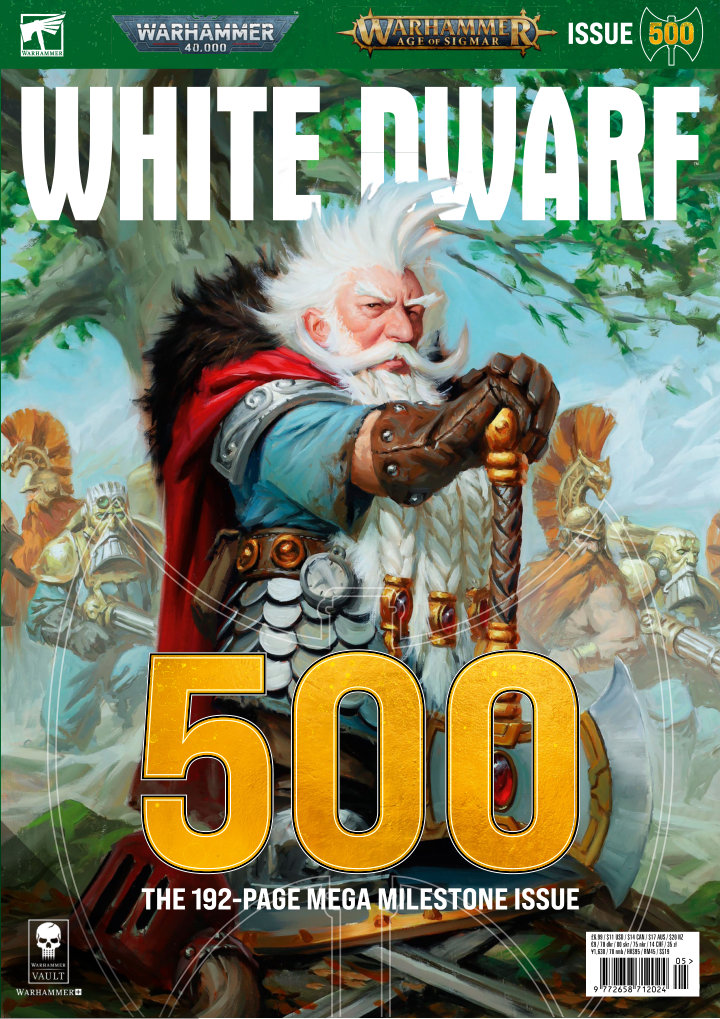
Lyle explains why restored issue numbering counted the monthly magazines but omitted the weekly run, placing this anniversary at number 500. The decision also created an opportunity for a substantial celebration. He introduces the new Grombrindal miniature, rules across the Mortal Realms games, an oil-painted cover, ambitious dioramas and an unusually interconnected battle report within the enlarged issue.
CommunityWD 500 · pp. 4–9
Readers recall the magazine issues and friendships that began or sustained their hobby, from Glazer’s Creek to international editions. James Atkinson’s Einhyr Champion and the studio’s Ymyr Conglomerate receive detailed colour recipes, while Philipp Höppner recreates Ghoulslayer with a converted Maleneth. A question about Shu’gohl considers how population, influence and Sigmarite institutions distinguish a City of Sigmar.
Warhammer 40,000Age of SigmarLeagues of Votann26 paint colours
CommunityWD 500 · pp. 10–11
After a year of leagues and campaigns, the studio Bunker shifts attention toward painting, modelling and Armies on Parade. A planner begins with choosing a faction and story, then develops a palette, estimates construction and painting time and rehearses the finished arrangement. Participants can incorporate those same completed units into their Bunker achievements, connecting a display project to their continuing club activity.
CommunityWD 500 · pp. 12–13
The monthly challenge asks participants to finish monsters and machines, while its journal records other club games and painting achievements. The rank system measures continued involvement rather than battlefield results alone. A forward schedule gives painters time to prepare later themes and lets the magazine itself become a record of their hobby year.
CampaignWD 500 · pp. 14–17
The invaders win the last campaign phase and force an overall draw with the defenders, aided by Steve’s ten newly painted units. Matt, Nyle and Andy take the final individual awards. Coordinator Andy credits a simple core-book structure with sustaining participation, while his Orks’ emerging rivalries and a named monster-slaying weapon illustrate the stories that have grown through the games.
Warhammer 40,000Orks
PaintingWD 500 · p. 16
Harvey emphasises Lugganath’s connections to Corsairs and Harlequins, combining orange Guardians with the yellow of the Sunblitz Brotherhood. A converted Visarch becomes their pirate-like leader through Autarch, Corsair and Incubi components. Blue-grey weapons and bright blue soulstones balance the warm armour, while yellow diamond patterns carry the roguish theme into the army’s decoration.
Warhammer 40,000Aeldari11 paint colours
PaintingWD 500 · pp. 16–17
Lyle’s small Leviathan Combat Patrol provides a change from painting armoured warriors. A purple wash over white establishes the flesh, followed by pale drybrushing that returns after the carapaces and claws are painted. Reusing the same final drybrush across the organism ties the textures together and makes the elite force practical to complete during the Crusade campaign.
Warhammer 40,000Tyranids8 paint colours
RulesWD 500 · pp. 18–19
Both armies escort a weaponised payload toward the enemy’s battlefield edge, moving their objective markers with nearby units. The closest successful delivery earns a large final award, while other escorted markers score according to how deeply they have penetrated opposing territory. Units must therefore protect their own cargo while disrupting an advance whose exact purpose can be tailored to the players’ story.
Warhammer 40,000
RulesWD 500 · pp. 20–21
The historical siege recreates the Anvils of the Heldenhammer’s defence of Glymmsforge against the Legion of Grief. The attacker needs to breach a wall or the gate before the battle ends, while defenders can sacrifice a unit’s normal activities to strengthen a section. The gate’s lower durability makes it an obvious target, but committing troops to fortification leaves them less protected and unable to fight normally.
Age of SigmarStormcast Eternals
RulesWD 500 · pp. 22–23
Each Grand Alliance receives a divine intervention card shuffled into the lower part of its power deck. Drawing it pauses the game and permits glory to be spent on several thematic effects, with a discount for the player currently behind. Healing, inspiration, movement and offensive disruption give a sudden godly reprieve without requiring the gods themselves to appear as fighters.
Warhammer Underworlds
TacticsWD 500 · pp. 24–27
Stephen Box treats the Fight phase as an opportunity to gain ground and control objectives as well as destroy enemies. He explains activation order, Precision, Heroic Intervention and how base contact determines which models may fight. Carefully chosen pile-in and consolidation moves can protect characters, deny an opponent useful movement or place a survivor behind cover on an objective.
Warhammer 40,000Space Marines
PaintingWD 500 · pp. 28–31
Dan explains drybrushing as a technique rather than a property restricted to Dry paints. Applying it across a whole model can establish large materials quickly before smaller details are tidied, especially when armour should look worn. Tank panels, tarnished Kharadron metal, gang equipment and skaven fur demonstrate how brush loading and progressively lighter layers change both texture and speed.
Warhammer 40,000Age of Sigmar
PaintingWD 500 · p. 29
Four increasingly light colours give Dan’s tank armour a battered appearance without waiting for washes to dry across large panels. Broad drybrushes establish the main finish in approximately ten minutes, after which the tracks and smaller details can be treated separately. Letting later areas cover stray paint makes the technique efficient rather than requiring careful avoidance of every rivet and fitting.
Warhammer 40,000Astra Militarum4 paint colours
PaintingWD 500 · pp. 30–31
Successive bronze and silver drybrushes imitate brass polished on its raised surfaces but dark with steam and coal dust in its recesses. A sepia wash adds an oily warmth before a final light silver pass. Dan paints sky-vessels in subassemblies to reach their endrins easily, then contrasts the metal with black cloth, dark armour and cold violet-grey bases.
Age of SigmarKharadron Overlords13 paint colours
PaintingWD 500 · p. 31
Dan extends the same approach to Goliath brass, Skitarii augmetics and mangy skaven fur. Turquoise Contrast over the gang’s brass produces metallic green armour, while progressively lighter flesh tones pick out the rats’ brown texture. Painting extensive metalwork first and repairing adjacent base colours afterward avoids slowing down the most efficient stage of the process.
Warhammer 40,000NecromundaHouse Goliath12 paint colours
CommunityWD 500 · pp. 32–37
The Rusty Nurgling event brings painters together at the Warhammer cafés in North America and Tokyo, with preparation sessions and constructive feedback accompanying the awards. Selected Dallas–Fort Worth winners illustrate its range of subjects. Studio and reader monsters and machines follow, including a chrome Necron Monolith, a quickly drybrushed Carnosaur and a sharply finished Black Templars Dreadnought.
Warhammer 40,000Age of SigmarNecrons14 paint colours
LoreWD 500 · pp. 40–45
The Pariah Nexus disrupts alien invaders in different ways, from Alaitoc’s failing spirit stones to an ork Waaagh! losing momentum. Blackstone experiments let Mek-built machines restore some of that aggression, while Kin prospectors exploit abandoned resources and seek noctilith despite the danger. Drukhari raiders find Stilled victims unsatisfying to torment, but their Haemonculi discover other uses that bring them into conflict with Szeras’s laboratories.
Warhammer 40,000Necrons
FictionWD 500 · pp. 46–49
Kasmoteph’s perspective reveals how he crippled the Mechanicus ship and borrowed an army without informing his overlord. His intended prize is a powerful human device, but its activation begins interacting with the temporal radiation left by his own weapon. Increasingly alarmed, the self-congratulatory Chronomancer hastens through the defenders while insisting that only he can be trusted with technology whose behaviour he no longer fully controls.
Warhammer 40,000Necrons
RulesWD 500 · pp. 50–55
Two independently generated Boarding Actions boards rotate during the battle, repeatedly changing their connections and the entry zones available to each side. Units straddling the join must leap to safety before a section turns, risking casualties or destruction. The struggle for info-vaults therefore demands flexible positioning, while a final survival award makes recklessly pursuing a temporary opening costly.
Warhammer 40,000
PaintingWD 500 · pp. 56–65
The Tome Keepers’ record-keeping traditions and individual company histories provide starting points for personalised collections. Advice on commanders, deployments, monikers and markings precedes several painters’ interpretations of their parchment armour and red accents. Converted officers, specialist Kill Team helmets and a fully developed Fifth Company demonstrate how a shared Chapter identity can support very different scales of project.
Warhammer 40,000Kill TeamTome Keepers
PaintingWD 500 · p. 58
Matt removes Helbrecht’s Black Templars heraldry and combines the model with Captain Messinius components to create Saargon. Kharadron Codewright books replace equipment on both the commander and a serf, making the Chapter’s scholarly identity immediately visible. Washed bone armour and a deep red cloak retain the Tome Keepers palette across the heavily converted centrepiece.
Warhammer 40,000Tome Keepers8 paint colours
PaintingWD 500 · p. 58
A Primaris Ancient supplies the Techmarine’s body, while a Tech-Priest Dominus contributes the bionic arm and axe. Pete builds a very dark red armour finish with orange layers beneath a final red Contrast coat, giving the highlights warmth without losing the depth of the base. Washed silver and bronze distinguish the mechanical equipment.
Warhammer 40,000Tome Keepers8 paint colours
PaintingWD 500 · p. 58
Books from two Chaplain and Grey Knights kits establish this Terminator’s role among the Tome Keepers. A Grey Knights tabard and Repulsor reliquary add further character, while wreckage beneath his foot places him in a battle. Cool blue-green highlights define black armour, with red details providing a stronger focal accent.
Warhammer 40,000Tome Keepers8 paint colours
PaintingWD 500 · p. 58
James chooses the Black Templars Marshal for its dynamic stance, removes its Chapter symbols and replaces the weapons with a gladius and bolt pistol. An Inquisitorial shoulder mark records earlier Deathwatch service. Warm aged armour and red robes keep the veteran within his new Chapter while allowing the conversion to carry its own history.
Warhammer 40,000Tome Keepers9 paint colours
PaintingWD 500 · p. 59
Dan gradually mixes bone into brown to produce especially pale parchment armour for his first Tome Keepers. Neutral black fatigues and brown leather keep the Scouts comparatively discreet. Three different flesh bases are highlighted through common lighter mixes, allowing varied skin tones to remain coherent across the squad without making every face identical.
Warhammer 40,000Tome Keepers12 paint colours
PaintingWD 500 · p. 59
Anthony transfers techniques from a Vior’la army into the Tome Keepers, concentrating on smooth progressions through the light armour. Vibrant red cloaks provide a new painting challenge, while the Techmarine lets him explore an alternative balance of the same palette. Blue-grey highlights on dark details support the clean bone finish without overpowering it.
Warhammer 40,000Tome Keepers14 paint colours
PaintingWD 500 · pp. 60–61
Matt recognises echoes of John Blanche’s art in the Tome Keepers palette and builds individual kill-team specialists rather than full conventional squads. Different helmets suggest grenade, marksman and aggressive close-range roles. Bone armour, rich red chest insignia and restrained gold details unify those characters, with careful dark recesses keeping each pale model readable.
Warhammer 40,000Kill TeamTome Keepers20 paint colours
PaintingWD 500 · pp. 62–65
Jason chooses the less familiar Fifth Company and develops its humanity and appetite for knowledge into a substantial army. Books personalise otherwise standard warriors, while Tor Garadon and several officer kits provide a distinctive command group. An Ancient’s banner records victories in the Hyrakii Deeps, and consistent pale armour, red details and warm ground make the large collection cohesive.
Warhammer 40,000Tome Keepers18 paint colours
Battle reportWD 500 · pp. 66–101
Eight players fight a linked invasion across a jungle beachhead, an offshore gun rig and a doomed freighter. Tome Keepers and Kin try to halt tyrannoforming while smaller actions alter reinforcements, targeting and the ship’s eventual crash. Despite heroic individual kills and a strong mid-game position, the reconquest loses 65–70 as the cult preserves the remaining spore chimneys and denies crucial final points.
Warhammer 40,000Kill TeamTome Keepers
Battle reportWD 500 · pp. 70–101
Lyle’s Phobos-armoured Tome Keepers attempt to save the freighter from Duncan’s Genestealers. An Infiltrator team holds a control-room door shut despite attacks from both sides, but a ground-fired laser kills the Librarian and the Broodlord eventually reaches the controls. The ship’s fall becomes a catastrophic event on the main battlefield, turning a desperate boarding action into a threat to everyone below.
Warhammer 40,000Tome Keepers
Battle reportWD 500 · pp. 70–101
Matt’s Hernkyn Yaegirs meet Ben’s Brood Brothers around an orbital gun and mining controls. The cult’s early control of the weapon damages the allied boarding force, but the Kin gradually win through shooting, close fighting and their Theyn’s refusal to stay down. Holding the promethium system also enables a subterranean transport to arrive on the main board, linking the small skirmish to the beach assault.
Kill TeamLeagues of Votann
CampaignWD 500 · pp. 102–103
Two teams coordinate a Boarding Actions game and a Kill Team engagement before resolving the main invasion battle. The smaller missions determine concrete events rather than award independent victories, so every captured control system contributes to the shared outcome. A prepared event sequence also allows players to recreate the main report without running both preliminary games.
Warhammer 40,000Kill Team
RulesWD 500 · pp. 104–105
The defender uses ship systems to weaken invulnerable saves, supply equipment to allies and scan targets on the planet below. The attacker instead seeks controls that guide reinforcements or send the vessel crashing into the main battlefield. With the defender’s entry zones unavailable after deployment, conserving the boarding force competes with holding the machinery that can decide other battles.
Warhammer 40,000Tome Keepers
RulesWD 500 · pp. 106–107
Control of promethium pipelines fuels an allied subterranean transport, while recovered tunnel maps improve the reinforcement available to the opposing army. The rig’s orbital weapon can also shock or damage sections of the Boarding Actions battlefield. These objectives offer no separate conventional victory: their value lies in how effectively the operatives support their team’s larger invasion plan.
Kill TeamLeagues of Votann
RulesWD 500 · pp. 108–109
Spore chimneys begin at a modest growth level but expand when left uncontrolled, with defending characters able to accelerate them. Attacking infantry must stop moving to attempt purification, making each reduction a costly commitment. A final growth-based score can heavily favour either team, while last-ditch reserves and points for clearing the landing zone sustain the wider beachhead battle.
Warhammer 40,000Tyranids
RulesWD 500 · pp. 110–111
Defenders load vital records onto landers while the attacking army arrives entirely from reserve. Holding a craft over consecutive turns improves the intelligence rescued, but attackers can damage it and defenders must spend time repairing it. The final destruction award makes an apparently secure evacuation vulnerable to a late breakthrough.
Warhammer 40,000Imperium
RulesWD 500 · pp. 112–113
A subterranean labyrinth sends reserves onto uncertain battlefield edges and prevents aircraft, indirect fire and flying deep strikes from working normally. Tectonic movement shifts the demolition objectives during the battle. Players score for securing charges and ultimately pushing intact units into the enemy’s territory, representing the effort to seal hostile tunnels before further swarms arrive.
Warhammer 40,000
InterviewWD 500 · pp. 114–117
Digital artist Scott Sez explains how photographs and a storyboard became the report’s comic-style panels. Umber light makes the jungle feel apocalyptic, teal establishes the gun rig’s cold alien atmosphere, and saturated shipboard colour strengthens the horror of the boarding fight. His account also shows how understanding an in-game event, such as a closed door, can change the visual story completely.
Warhammer 40,000
LoreWD 500 · pp. 118–129
A chronological retrospective follows the magazine from Owl & Weasel and a London flat through colour printing, Nottingham, famous battle reports and worldwide campaigns. It traces changing logos, free gifts, international editions, weekly publication and the later return to monthly numbering. Staff anecdotes and remembered mishaps connect those milestones to the people who produced the magazine rather than presenting only a list of releases.
ShowcaseWD 500 · pp. 130–141
The ’Eavy Metal team creates six dioramas that must work both as physical compositions and as photographed magazine covers. Each piece interprets a painter’s personal sense of Warhammer, from grot jousting to desperate human resistance. The resulting mock covers revisit different eras of the magazine’s graphic design, tying the models’ subjects and palettes to appropriate historical logos and layouts.
Warhammer 40,000Age of Sigmar
ModellingWD 500 · p. 131
Simon and Neil stage a duel between two Boingrot Bounderz, inspired by Dave Andrews’ celebrated Bretonnian joust. Reposed limbs and a carefully angled base make the riders interact convincingly. Saturated traditional colours, weathered equipment and distinctly different squigs combine grot comedy with the pageantry of a tournament, while collaboration keeps the project enjoyable.
Age of SigmarGloomspite Gitz
ModellingWD 500 · pp. 132–133
Drew recreates the excitement of his first Cadian Shock Troops through soldiers charging from a Chimera. Research into vehicle disembarkation gives each trooper a credible role, and a cut-open hull provides the backdrop. Filler, glue and prepared garden soil create convincing mud, turning the heroic composition into a dirty, immediate battlefield scene.
Warhammer 40,000Astra Militarum
ModellingWD 500 · pp. 134–135
Kieran combines Parravon’s pegasus heraldry with the king’s bright dragon standard on a mounted standard bearer. Balancing those dark and light schemes becomes the central painting problem, with patterns doing much of the visual work. Subtle mud and damage place the pageantry in a real battle, and six months of lunch-break sessions demonstrate the value of steady progress.
Warhammer: The Old WorldBretonnia
ModellingWD 500 · pp. 136–137
A Marshal and command corps gather beside Lake Lethis to drink away memories of unbearable fighting. The arrangement directs attention toward her warhammer, while purple, cold teal and small gold accents establish the city’s mournful atmosphere. Six painters divide the figures and details, allowing a substantial collaborative scene to preserve a clear shared narrative.
Age of SigmarCities of Sigmar
ModellingWD 500 · pp. 138–139
Natalie reposes Yndrasta to match the Core Book artwork, cutting and rebuilding nearly every major armour joint. A new head, reversed spear and swept wings replace the original calm stance with an aggressive descent. Sculpted tentacles, bead eyes and glowing effects reproduce the surrounding Chaos, while controlled painting keeps the dynamic heroine readable.
Age of SigmarStormcast Eternals
ModellingWD 500 · pp. 140–141
Rowan adapts the palette of a Vampire Counts book cover to a more flamboyant Blood Bowl vampire. Pinstripes, checks, numbers, blood drops and tiny scuffs reward close inspection without overwhelming the miniature’s form. A large lucky-number-seven mural on the cloak becomes the most demanding element, refined over two days with a sharp brush.
Blood BowlVampire teams
LoreWD 500 · pp. 144–147
Grombrindal’s legend begins with Snorri Whitebeard and the betrayal that rouses him into an immortal instrument of vengeance. Grungni later shapes him anew from duardin memories and divine essence before the Age of Chaos. In the Mortal Realms his role broadens beyond revenge: counsel, shared stories and practical courage reconnect divided duardin peoples with the qualities that let them endure.
Age of SigmarDuardin
RulesWD 500 · pp. 148–149
The White Dwarf joins an Order army as an unusually powerful ally, excluding other allied units. Strong protection and reduced incoming damage let him withstand attacks that would destroy ordinary heroes. Nearby duardin gain courage, resilience and greater weight when contesting objectives, making his legendary leadership as significant as the blows of his rune axe.
Age of SigmarDuardin
RulesWD 500 · pp. 150–151
A behaviour table controls Moonclan Stabbas according to their distance from the enemy, producing hesitation, charges or overwhelming attacks without a second player. Special movement and coherency procedures keep the automated horde functioning as casualties accumulate. An optional spore mist makes the grots harder to hit, allowing the framework to support Grombrindal’s challenge or other custom solo battles.
Age of SigmarGloomspite Gitz
RulesWD 500 · pp. 152–153
Grombrindal faces four automated mobs in a mushroom grove, trying to stop them overrunning nine objectives. Slain grots return as fresh units and nearby mobs merge, so clearing the board once is insufficient. Destroying whole units reduces the horde’s score and can grant another axe attack, rewarding decisive cuts through the swarm before the five-round struggle ends.
Age of SigmarDuardin
RulesWD 500 · pp. 154–155
One player fields Grombrindal alone against an ordinary warband and Rivals deck, winning simply by surviving. Instead of drawing his own deck, he learns from the opponent’s discarded power cards and converts them into special actions. Timed lore questions can overturn either player’s hand, turning his accumulated knowledge into a playful part of the contest.
Warhammer UnderworldsDuardin
RulesWD 500 · pp. 156–157
Order warbands can recruit Grombrindal as a narrative or open-play ally. His abilities combine precise attacks with advice that improves another fighter’s movement, melee attacks and objective presence. A powerful final ability suppresses nearby enemy reactions and ability effects, allowing the veteran wanderer to counter tricks through the experience represented by his profile.
WarcryDuardin
RulesWD 500 · pp. 158–159
A legendary hero undertakes a Cursed City journey alone, outside the normal campaign and without its rewards or crises. A replacement event table adds hostile groups, changes destiny dice and supplies occasional recovery. Grombrindal’s profile turns ailments into inspiration and failed enemy attacks into counteractions, giving one model the resilience and output needed to confront Ulfenkarn’s inhabitants.
Warhammer QuestDuardin
InterviewWD 500 · pp. 160–161
Designer Steven draws on earlier Grombrindal miniatures and Adrian Smith’s issue 300 artwork to create the character’s first model for the Mortal Realms. His raised axe and victorious base recall past incarnations, while Fyreslayer talismans and Kharadron devices connect him to present duardin cultures. Runes, ancestor faces and traditional clothing retain the sense that he is a reforged memory of an older world.
Age of SigmarDuardin
PaintingWD 500 · pp. 162–165
Max makes the White Dwarf’s beard the focal point and studies painted whites to keep it lively through subtle coloured glazes. Different handling of hair, skin, wool and non-metallic metals prevents the detailed miniature from becoming visually uniform. The masterclass explains how neighbouring base colours inform contrast and how real reflective objects help place convincing highlights.
Age of SigmarDuardin
PaintingWD 500 · p. 163
Very thin brown and blue-grey glazes shape the white beard without overwhelming its overall brightness. Painting the face alongside it provides context for judging the depth of those shadows. The skin progresses toward small waxy reflection points, with restrained red glazes on the nose and lips giving the ancient warrior a ruddy, living appearance.
Age of SigmarDuardin16 paint colours
PaintingWD 500 · p. 164
Separate grey foundations distinguish the axe’s head and cutting blades before controlled pale reflections simulate metal. Warm gold is shaped with brown-red shadows and yellow highlights, then brought into balance with the adjacent gromril. The gemstone reverses the expected light pattern, placing its bright region below the darker upper surface to suggest light travelling through it.
Age of SigmarDuardin19 paint colours
PaintingWD 500 · p. 165
Fine directional lines give the fur a texture distinct from the cloak’s broad soft folds. Stippling progressively lighter reds suggests heavy wool, while a pale sketched pattern establishes the runic border before its shadows and highlights are refined. Cutting back into that pattern with red creates the final knotwork, demonstrating how freehand can be corrected as its shape develops.
Age of SigmarDuardin17 paint colours
PaintingWD 500 · p. 165
Supporting recipes distinguish blue cloth, red leather gloves and a cold rocky base from the miniature’s dominant beard and cloak. Discarded Soulblight, Chaos and Kruleboyz shields carry separate palettes, making his defeated enemies recognisable without competing for attention. The coordinated colour choices complete the material variety established in the preceding stages of the masterclass.
Age of SigmarDuardin27 paint colours
FictionWD 500 · pp. 166–169
Blinded and ostracised for worshipping Morai-Heg, Krethusa endures a final murderous attack by fellow Khainites. Elsewhere, Morathi’s consumption of ancient souls inadvertently releases fragments of older divinity from Slaanesh. One reaches Krethusa at the moment of death, awakening prophetic sight and raven-like wings that let the former victim reverse her tormentors’ power over her.
Age of SigmarDaughters of Khaine
ShowcaseWD 500 · pp. 170–183
The series’ final additions bring the combined collections to 368 miniatures, including a towering conversion, dozens of squigs and an entire church. Jake holds a substantial points lead before the promised concluding battle. Full-army photographs show how the participants’ different themes have matured through a year of painting, conversions and games, with each already considering what might come next.
Age of SigmarSlaves to Darkness
PaintingWD 500 · p. 172
Jake finishes loose ends with Be’lakor perched on a tree, his extended tail and altered legs giving the large model a new stance. Orange wings contrast with the collection’s blue tones, and further champions, Furies and a Mutalith expand the host. Accursed Cultists become spare Spawn in case the army’s ambitious heroes receive the wrong kind of reward.
Age of SigmarSlaves to Darkness10 paint colours
PaintingWD 500 · p. 173
Sebastien adds four Maw-gruntas to a Shyish-themed collection, imagining orruks transformed into unexpected followers of Morrda by a stolen corvid relic. Their palette echoes his Lethis troops but varies the base colours, while the same all-over dark wash preserves the shared grimy finish. Skin, pig flesh, fur, leather and purple cloth recipes make the bulky reinforcements practical to paint.
Age of SigmarOrruk Warclans16 paint colours
ModellingWD 500 · p. 178
Laura gives the Court of Grim Divine a necropolis setting rather than adding another giant creature. Converted courtiers use a Dark Commune witch, Teclis and ghostly components to build a varied cast for future battles, while Gorger-based Vargheists extend the monstrous theme. The display board becomes a physical expression of the army’s bleak home rather than a separate neutral backdrop.
Age of SigmarSoulblight Gravelords
PaintingWD 500 · p. 178
Sector Imperialis structures become a fantasy church by covering futuristic iconography with jewellery findings and installing two Warcry bells in enlarged windows. Successive painted layers create an aged architectural finish. Dark undercoating and very thin brown patches simulate the accumulated effects of rainfall, tying the building to its desolate rocky surroundings.
Age of SigmarSoulblight Gravelords4 paint colours
PaintingWD 500 · p. 179
Chris completes the planned Gargant and Dankhold Troggoth, using airbrushed flesh to leave more time for their abundant details. A yellow Loonboss squig begins with pink preshading, and spare small creatures receive bases of their own as game markers. The final collection rewards his decision to stay with one project for a year, while missing heroes and further squigs already suggest its future.
Age of SigmarGloomspite Gitz14 paint colours
FictionWD 500 · pp. 184–189
Several grot leaders launch overlapping schemes against Barak-Thryng, turning stolen ships, falling squigs and a concealed spider into a confused invasion. Apprentice endrinrigger Teffi tries to reach her father’s tavern, where Grombrindal rallies an improvised band across the threatened docks. Escaping aboard a battleship appears to offer safety until another hidden attacker proves the White Dwarf’s unfinished warning about grots painfully accurate.
Age of SigmarKharadron Overlords
CommunityWD 500 · p. 190
Eight studio coaches begin a casually brutal league while their colleagues fight the Bastior campaign. Phil’s Old World Alliance leads the standings after an effective run of touchdowns and injuries, with Lyle’s undead close behind. The Eagles’ win over Rotfester United demonstrates their method of using superior numbers to occupy opponents while a ball-carrier scores.
Blood BowlOld World Alliance
TacticsWD 500 · p. 191
The preferred solution locks every Bladeguard model in contact with expendable Termagants while leaving room for the Tyranid Prime. Most of the Marines’ first attacks must therefore hit the smaller organisms. Removing those casualties opens space for the untouched Warriors to pile in and strike, using movement and casualty order to reduce the danger of the Judiciar’s Fights First.
Warhammer 40,000Tyranids