EditorialWD 493 · p. 1
Lyle Lowery introduces the Slidecrown Sundering as the Bunker’s next shared activity after the Combat Patrol league. Games, painting and creative contributions all help shape the team campaign, and his own planned Sons of Behemat force illustrates how an army’s motivation can generate a personal story within the wider event.
Age of SigmarWarcrySons of Behemat
CommunityWD 493 · pp. 4–7
A busy healthcare worker and parent describes building a portable painting kit to reclaim half-hour lunch breaks for the hobby. Reader miniatures accompany questions about the limits of Ork belief and a Cadian regiment’s colours, while the model of the month develops a dragon’s palette around an existing Stormcast army.
Warhammer 40,000Age of Sigmar
PaintingWD 493 · p. 6
Amy Snuggs paints Krondys to accompany her Anvils of the Heldenhammer, using blue-green scales and a lighter face to guide attention. Drybrushing and glazing develop the large surfaces, while the pale underbelly and wings provide contrast and a ruined-city base links him to a newly reclaimed Dawnbringer settlement.
Age of SigmarStormcast Eternals9 paint colours
PaintingWD 493 · p. 7
The army painters propose a recipe for the Elysion Eagles regiment depicted in codex artwork, since no matching studio models exist. A mixed dark teal base and brown wash aim for a soft cloth finish, while pale layered gold receives a yellow wash to increase its richness.
Warhammer 40,000Astra Militarum8 paint colours
LoreWD 493 · pp. 8–11
Phil Kelly challenges the idea that a Mortal Realm has only one kind of landscape, using Aqshy’s surprisingly varied settlements and wilderness. Snow-covered mountains, acidic islands, geothermal frontier towns and fortified hideouts each show how people exploit local resources and survive hazards without making the Realm of Fire uniformly ablaze.
Age of SigmarCities of Sigmar
CampaignWD 493 · pp. 12–13
Leila Craven explains how the Slidecrown campaign brings players together without requiring the entire club to meet at once. Faction-independent teams allow unusual motivations, while private team discussions, simple result forms and a reconciliation week give an organiser room to collect games and creative submissions into a coherent narrative.
Age of SigmarWarcry
CommunityWD 493 · pp. 14–15
The monthly challenge invites mystical characters and supernatural units alongside the continuing Bunker achievement log. Painting, club games and the scenario of the month can all advance a participant’s rank, and the reusable record encourages players to retain a journal of their developing hobby activity.
Warhammer 40,000Age of Sigmar
CampaignWD 493 · pp. 16–19
The Viridian King’s fatal spell left an antlered crown surrounded by extraordinary life-giving power, and rival armies now descend on the Slidecrown Isle. Preservers, Obliterators and individual Rogues contribute through games, painted units and creative work, moving the Withervane through three stages and earning relics when their chosen side succeeds.
Age of SigmarWarcrySylvaneth
CampaignWD 493 · p. 19
News of the isle’s Aqua Ghyranis reservoirs draws armies with incompatible ambitions, including Sylvaneth who disagree over whether its concentrated power should remain untouched. The opening stage asks Preservers to protect the forest, Obliterators to clear a path through it and Rogues to strip valuable magical resources while the other sides fight.
Age of SigmarWarcry
RulesWD 493 · pp. 20–21
Each commander nominates two experienced units as Priority Targets, making their destruction far more valuable than ordinary objective control at the battle’s end. Markers remain held after troops move away, but protected target units cannot simply disappear into reserve, producing a hunt in which screening important units and cornering the enemy matter greatly.
Warhammer 40,000
RulesWD 493 · pp. 22–23
A four-sided battle ties the Grand Objective to the Grand Alliance of the player taking the first turn each round. Emergency reserves and a bespoke command-point sequence support the multiplayer format, while escalating political choices determine who claims the favoured objective and who finishes first through fourth.
Age of Sigmar
CampaignWD 493 · pp. 24–29
Warbands explore fragments of the Seraphon temple-ship Eye of Chotec that have transformed the Gnarlwood’s swamps into a dangerous treasure field. The campaign replaces standard exploration, lesser artefacts and encampments with local alternatives, starting everyone at the Edge of the Scales and awarding victory for completed quests, with final glory breaking a tie.
Warcry
RulesWD 493 · pp. 24–25
Exploration can lead to a watery ambush, useful loot or a new home among prehistoric islets, giant trees and malfunctioning Seraphon devices. Discoveries often offer a choice between spending glory to relocate and taking an immediate but risky benefit, making the landscape part of the warband’s long-term development.
Warcry
RulesWD 493 · pp. 26–27
Strange food, swamp remedies and misunderstood temple-ship technology provide a varied collection of consumable and perishable artefacts. Their effects range from healing and poisoned blades to moving objectives, manipulating ability dice and hatching a new beast, with several powerful devices carrying an appropriate risk to their users.
Warcry
RulesWD 493 · pp. 28–29
The encampment table gives each discovered site a different balance of points capacity, reputation and campaign benefit. A mobile gnarloak supplies extra wild dice, a watchful idol rearranges battle groups and spawning pools offer unusual transformations, while a map helps players track where their warbands have settled.
Warcry
TacticsWD 493 · pp. 30–33
Sam Pearson uses his own defeats to explain three common errors: exposing a fast monster before a reliable charge is available, allowing reserves behind vulnerable support units and matching expensive threats too early. The alternatives involve comparing threat ranges, leaving inexpensive screens and using disposable units to delay a monster while stronger troops win elsewhere.
Age of SigmarWarhammer 40,000Blades of Khorne
TacticsWD 493 · p. 30
Skarbrand and a Bloodthirster face two Keepers of Secrets on opposite flanks, with Daemonettes holding an objective beside one of them. With only one command point and three Blood Tithe points, the puzzle asks how to reduce both threats and gain an advantage without committing the two Khorne monsters to costly simultaneous duels.
Age of SigmarBlades of Khorne
PaintingWD 493 · pp. 34–37
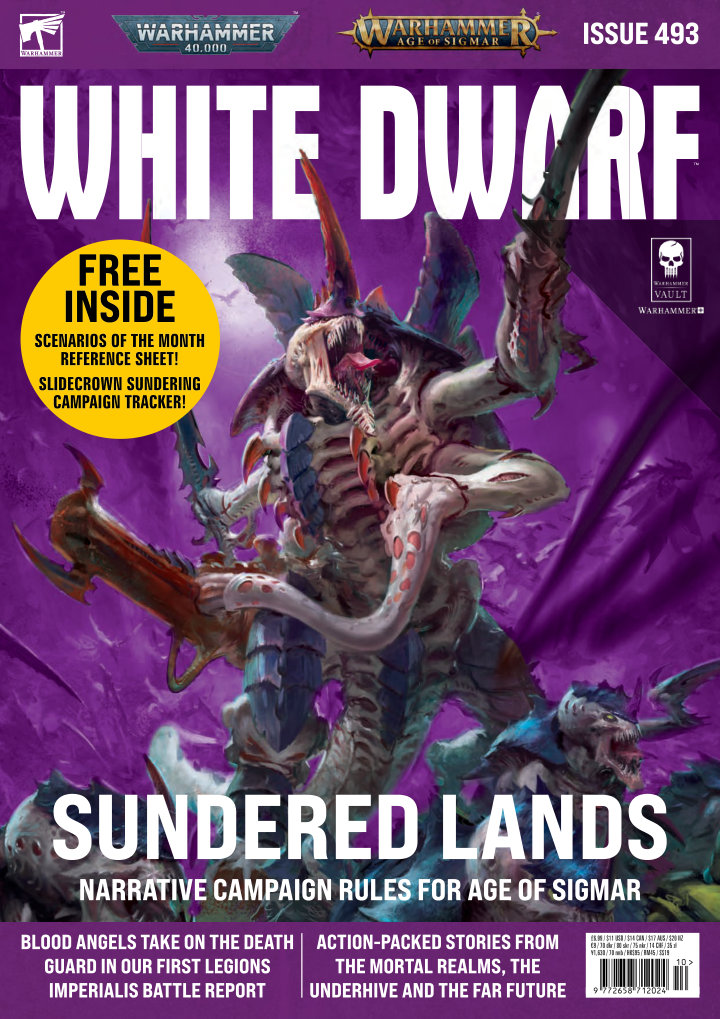
Lewis Collins finishes the Leviathan Tyranids using small batches, timed sessions and an economical sequence of washes. The aim is an effective gaming army rather than individually polished display models, with green carapaces, warm organic bodies and wet jungle bases providing the visual identity across both gaunts and larger monsters.
Warhammer 40,000Tyranids
PaintingWD 493 · p. 35
The revised army recipe begins with a thinned bone layer over a pale spray, then establishes the chitin with two different green washes. Diluted Skeleton Horde gives the skin a restrained warm shade, and dark claws plus crimson joints and weapon details create contrast without adding an edge-highlight stage.
Warhammer 40,000Tyranids8 paint colours
PaintingWD 493 · pp. 36–37
Gloss varnish turns the larger monsters’ claws, brains and tentacles into focal points by using reflected light in place of careful painted highlights. The bases start with textured patches and cut plastic stems, then build a sense of swamp depth through dark water, stippled greens and a final wet finish.
Warhammer 40,000Tyranids7 paint colours
PaintingWD 493 · p. 37
A brown layer is sealed beneath hairspray and a pale acrylic coat, then exposed with a warm, wet stiff brush to create irregular paint chips. The example explains why a spray basecoat can interfere with the method and finishes with varnish; a separate tip recommends stainless-steel agitators for mixing paint pots.
Warhammer 40,0005 paint colours
CommunityWD 493 · p. 38
The studio reflects on a Combat Patrol league involving fifty players and almost two hundred games, with separate honours for participation, painted games, opponents and sportsmanship. Restricting each player to one title spreads recognition beyond the overall leader, and Calum McPherson’s Votann win the painting award before attention shifts to Slidecrown.
Warhammer 40,000
PaintingWD 493 · p. 39
Calum McPherson interprets the Votann’s packaging photography as a moon-base setting, sculpting small craters and airbrushing directional light into the ground. Zenithal undercoats and saturated Contrast colours create magenta armour, with dark undersuits and a faint pink wash on the pale lunar surfaces tying the patrol together.
Warhammer 40,000Leagues of Votann14 paint colours
ShowcaseWD 493 · pp. 40–41
Studio painters approach the supernatural challenge through glazing, wet blending, scratched armour and watery spectral effects. Their choices range from Ephilim’s daemons and Vashtorr to Zarshia Bittersoul, a Necromancer and a Nighthaunt host, showing how different surface treatments can express magic without using the same palette.
Warhammer 40,000Age of SigmarDisciples of Tzeentch
PaintingWD 493 · p. 40
Matt Hutson paints Vashtorr with colours related to his Word Bearers, building warm flesh through drybrushed browns and flesh tones before a unifying glaze. Silver metalwork receives a conventional dark wash and bright drybrush, with selected gold and brass panels stained using transparent yellows and warm flesh colour.
Warhammer 40,000Chaos Space Marines9 paint colours
PaintingWD 493 · p. 41
John Bracken gives Zarshia a bright pink magical flame to stand out against dark, finely scratched armour. Her cloak is blended from a deep blue-green to a much brighter blue, then shaded with a heavily diluted brown-green mixture, preserving the saturated magical focus without making every surface equally bright.
Age of SigmarWarhammer UnderworldsSlaves to Darkness4 paint colours
PaintingWD 493 · p. 41
Pete McMullin uses a Necromancer to practise wet blending from black to red, a transition he found demanding at the time. Brighter red and orange-red accents finish the folds, and the resulting character remains a painting exercise after a more vampire-heavy army list leaves him waiting for a game.
Age of SigmarSoulblight Gravelords4 paint colours
PaintingWD 493 · p. 41
Erik Niemz places his Nighthaunt at Lake Lethis and builds their pale ethereal colour with diluted oxide over a white spray. Extra green-blue shade at the tendril tips and restrained highlights define the forms, while swishes of colour beneath PVA create an economical impression of deep water on the black bases.
Age of SigmarNighthaunt7 paint colours
ShowcaseWD 493 · pp. 42–43
Readers contribute wizards, psykers and strange supernatural beings for the monthly gallery, including Stormcast mages, Ahriman, Synessa and Space Marine Librarians. The spread celebrates completed miniatures from several factions, showing the range of models that fit the challenge without presenting recipes for their photographed colours.
Warhammer 40,000Age of SigmarStormcast Eternals
RulesWD 493 · pp. 46–47
The first Slidecrown battlepack supports smaller narrative battles of up to fifteen hundred points on a compact battlefield. Reduced objective ranges and the absence of battalions and faction terrain simplify preparation, while the trailing player can draw on forest twists such as healing rain, rusting weapons or treacherous bogs.
Age of Sigmar
RulesWD 493 · p. 48
Armies search four sites in an ancient Kurnothi settlement, discovering treasure only when a controlled objective is uncontested. Each find permanently increases that marker’s scoring value, giving players a reason to cultivate a secure position and then fight over the richer sites their rivals have uncovered.
Age of Sigmar
RulesWD 493 · p. 49
Geomantic nexuses improve casting and chanting for units holding them, but the old spell beneath the isle can detonate the connecting ley lines. The growing chance of explosions and the increasing value of objectives turn the same positions into both valuable late-game prizes and dangerous places to concentrate troops.
Age of Sigmar
RulesWD 493 · pp. 50–51
Two Aqua Ghyranis springs heal nearby friendly units at the start of each turn, creating resilient strongpoints in a forest glade. Players score for destroyed enemy units as well as increasingly valuable objective control, so simply occupying a healing spring must be balanced against the rewards of offensive action.
Age of Sigmar
FictionWD 493 · pp. 52–55
Callis and Toll investigate the disappearance of Hammerhal Ghyra’s master vintner and discover a mansion transformed into a cannibal’s abattoir. A pristine decanter offers a terrifyingly seductive alternative vision of events, revealing that Marralyst’s monstrous change is part of a wider scheme carried by wine gifted in the name of the Lord of Summer.
Age of SigmarCities of Sigmar
ShowcaseWD 493 · pp. 56–67
The Idoneth feature links an enclave’s secrecy, home waters and history to the appearance of its warriors and sea creatures. A broad gallery then demonstrates personal approaches ranging from Ghyranite hunting parties and deep-sea raiders to undead sharks, serpentine Namarti and watery character conversions.
Age of SigmarWarcryIdoneth Deepkin
LoreWD 493 · p. 57
The enclave-building advice begins with a name, realm and governing characters before relating those choices to colour and background. Familiar enclaves provide examples of camouflage and regional identity, while the Mor’phann show a darker alternative built around Shyish, soul magic and the unsettling return of fallen Namarti.
Age of SigmarIdoneth Deepkin
PaintingWD 493 · pp. 58–59
Steve Wren combines the Idoneth’s marine imagery with Ghyran and an early alliance with Sylvaneth, imagining harmony between forest and sea. Deep greens, striking orange and green-shaded gold unite a collection that grew through A Tale of Four Warlords, with separate recipes for pallid Namarti skin, cloth, tassels, fins and bone weapons.
Age of SigmarIdoneth Deepkin18 paint colours
PaintingWD 493 · pp. 60–61
François Frion imagines Volturnos leading his best cavalry and archers on underwater hunts for dangerous monsters and new mounts. The Ghyranite party contrasts cool blue aelven skin with warm clothing and red eels, using pale bone armour and softer mount bellies to keep the vivid elements from overwhelming the force.
Age of SigmarIdoneth Deepkin14 paint colours
PaintingWD 493 · pp. 60–61
Lizzie Ward develops a bright blue-and-orange Idoneth scheme during a live Contrast painting demonstration, prioritising strong colour that can be applied quickly. A pale grey undercoat supports the transparent layers, with the main technical challenge being the blend between orange and cream on Volturnos’s mount.
Age of SigmarIdoneth Deepkin12 paint colours
PaintingWD 493 · pp. 62–63
Dan Moody draws on experience with marine life to imagine an Ulgu enclave in almost permanent deep-sea gloom. Dark purple armour and green-blue skin convey that environment, while sculpted wave bases are pressed into putty, painted with layered watery colours and glossed to support the army’s shadowy atmosphere.
Age of SigmarIdoneth Deepkin11 paint colours
PaintingWD 493 · p. 64
Martyn Cashmore combines the Allopex riders with skeletal cavalry parts while retaining recognisable Idoneth equipment. Drilled and resculpted shark flesh exposes its internal structure, but the armour stays immaculate to express undead aelven pride; green rotting skin, cool cloth and differently shaded metals establish the final palette.
Age of SigmarIdoneth Deepkin12 paint colours
PaintingWD 493 · p. 64
Ash Lowe’s queen comes from beneath an ice sheet, expressed through white armour and deep blue cloth. Intersecting painted lines over a blue gradient create a reflected-water pattern on the cloak, while a pale, subtly tinted skin recipe keeps the character within the cold environment of her imagined enclave.
Age of SigmarIdoneth Deepkin13 paint colours
PaintingWD 493 · p. 65
Steve Barret adapts Namarti Reavers to the trenches of Ulgu’s oceans by grafting their upper bodies onto Melusai snake tails. Fangmora fins make the new creatures look capable of fast underwater movement, while pale skin and transparent blue metals contrast with yellow, orange and black bodies.
Age of SigmarIdoneth Deepkin12 paint colours
PaintingWD 493 · p. 65
Ash Lowe repeats the queen’s reflected-water technique on a Ghyran-themed king, changing the cloak to vivid greens while retaining a matching painting style. Golden armour and amber stones supply warm accents, and beach sand beneath tinted transparent resin gives both royal models their blue or green water setting.
Age of SigmarIdoneth Deepkin12 paint colours
PaintingWD 493 · p. 66
Mike Ranzetta gives an Eidolon Stormcast weapons and iconography as rewards for fighting beside its allies. Coral reefs, fish and shipwrecks inform the colourful base, with algae-stained gold supporting a silver-armoured figure whose blue waves are drybrushed and stippled to build visible texture.
Age of SigmarIdoneth Deepkin14 paint colours
PaintingWD 493 · p. 67
Kevin Miane’s Warcry warband comes from a Ghurish offshoot of Ionrach, so orange becomes the dominant colour while still echoing its parent enclave’s tassels. Greenish skin and pale highlights complement the warm cloth, with Contrast layers followed by conventional highlights providing the main painting method.
WarcryAge of SigmarIdoneth Deepkin8 paint colours
PaintingWD 493 · p. 67
Will Ashton converts a figure to appear as a Tidecaster emerging from crashing surf, reinterpreting its mist as water and adding fish from the Gloomtide Shipwreck. The ethereal Mor’phann theme is developed through blue cloth, green-shaded silver armour and layered green blades, connecting the miniature to his wider Idoneth force.
Age of SigmarIdoneth Deepkin11 paint colours
CampaignWD 493 · pp. 68–83
The Kruleboyz Monsta-killaz and Vulkyn Flameseekers enter the Gnarlwood with opposed relationships to its beasts: one captures or steals them, while the other seeks sacred offspring and remnants of Vulcatrix’s flame. Background, quests, heroic traits, artefacts and new encampments turn those motives into campaign objectives for both warbands.
WarcryKruleboyz Monsta-killaz
LoreWD 493 · pp. 70–71
Monsta-killaz secure creatures for Kruleboy beastmasters through traps, cruelty and distraction rather than honourable hunts. When a full-grown monster cannot be captured, eggs or offspring become the prize, with noisy diversions and nimble Howlaz allowing the hunters to steal what they cannot overpower directly.
WarcryAge of SigmarKruleboyz Monsta-killaz
RulesWD 493 · p. 72
The Monsta-killaz build a pilfering score by damaging the enemy, surrounding a victim and removing enough opposing fighters. Success grants their Beastnob a heroic trait, with choices reflecting vicious follow-up strikes, stolen protection, ambush deployment and the ability to exploit especially large prey.
WarcryKruleboyz Monsta-killaz
RulesWD 493 · p. 73
Mayhem grows as wounded enemies remain on the field, hostile beasts fall and friendly beasts attack, with a special hollering ability accelerating the score. Completing the quest awards a selected Mucky Watnot, ranging from obscuring fog and blinding ash to traps, strangling vines and an unreliable stabbing weapon.
WarcryKruleboyz Monsta-killaz
RulesWD 493 · pp. 74–75
The warband earns a Mucky Swamp by keeping beasts near objectives and sending fighters to make a mess between battles. Its new home improves recovery and heroic renown, and enables risky beast-wrangling expeditions that can produce useful trophies, healing, glory or injuries severe enough to kill the hunter.
WarcryKruleboyz Monsta-killaz
LoreWD 493 · pp. 76–77
The Vulkyn creed reveres Vulcatrix alongside Grimnir and seeks the sacred flames that may restore the Ur-Salamander’s power through Magmadroth offspring. Its travelling fellowships recover eggs, explore hostile subterranean places and take mercenary work, while their scale armour expresses belief in a spiritual bond between duardin and the godbeast’s descendants.
WarcryAge of SigmarVulkyn Flameseekers
RulesWD 493 · p. 78
Searching for a lost clutch rewards treasure, objective control and movement through different quarters of the battlefield. The completed quest grants a Runefather a heroic trait, with options that express fiery strength, stubborn defence, suppression of enemy abilities and the refusal to accept a failed attack.
WarcryVulkyn Flameseekers
RulesWD 493 · p. 79
The Flameseekers prepare to accelerate Magmadroth incubation through dangerous Seraphon technology, tracking control of territory, defeated beasts and work around swamp terrain. Once enough progress is made, the quest requires victory in Enhanced Incubation before granting the warband a Fyreslayer Mercenary Compound without its usual glory cost.
WarcryVulkyn Flameseekers
RulesWD 493 · p. 80
The compound raises the warband’s capacity and offers a recurring mercenary contract in the aftermath sequence. Jobs add small goals to later battles—assassination, escort-like positioning, stolen goods, high-ground watch or clearing overgrowth—and completion rewards a lesser artefact rather than replacing the battle’s main victory condition.
WarcryVulkyn Flameseekers
RulesWD 493 · p. 81
The Kyndledroth tracks a valuable artefact by controlling an objective or reaching an uncontested table quarter. Success grants a chosen relic, including a molten throwing axe, a dragging chain, an exploratory eyepiece or a crown that may keep its wearer alive when an attack should have struck them down.
WarcryVulkyn Flameseekers
LoreWD 493 · p. 82
Names, reputations and warrior quirks let a Monsta-killaz band grow beyond its game profiles. Suggested origins include fighting-pit keepers, egg thieves and raiders of Fyreslayer drothvaults, while individual traits emphasise vicious traps, venomous pets, ambition and an entirely practical willingness to flee.
WarcryKruleboyz Monsta-killaz
LoreWD 493 · p. 83
The Flameseeker tables supply duardin names, titles and histories rooted in the cult of Vulcatrix. A warband might be former egg guardians, emissaries or veterans of subterranean wars, while its warriors can carry signs of divine favour, hatred of poachers or disturbing visions of the godbeast’s final fire.
WarcryVulkyn Flameseekers
ShowcaseWD 493 · pp. 86–95
The four collectors add twenty-five units and a remarkable range of conversions while expanding from Combat Patrol into larger games. Their next challenge is an allied patrol, but the current armies already show distinct identities through skull-covered assault vehicles, walking Votann transports, fleet-themed Death Guard and mechanised Imperial troops.
Warhammer 40,000World Eaters
ModellingWD 493 · pp. 88–89
James Ashbey customises Terminators with bare Berzerker heads, chain weapons and rotated trophy racks, then gives ancient Rhinos brutal grinding blades. A heavily skull-encrusted Land Raider and a Master of Executions converted into a Berzerker-Surgeon extend the warband’s character, even as early Combat Patrol defeats expose its neglect of objectives.
Warhammer 40,000World Eaters
ModellingWD 493 · pp. 90–91
Joe Naber expands the Votann with a Hekaton, Thunderkyn, Hearthguard and supporting characters, then merges Sagitaurs with Invictor Warsuits. The detailed conversion places a Votann cockpit and rear vehicle body into the walker frame, adds arm-mounted beam weapons and hinged-looking wheels, creating transports imagined to alternate between road and walking modes.
Warhammer 40,000Leagues of Votann
ShowcaseWD 493 · pp. 92–93
Rhuairidh James builds on an established painting method to add Terminators, a Helbrute and enough Plague Marines for two differently equipped squads. Repeated helmets suggest faded martial pride, while the selection of support characters and continued Combat Patrol play help him discover the different roles the same infantry models can fill.
Warhammer 40,000Death Guard
TacticsWD 493 · p. 92
Rhuairidh’s tactical sidebar considers how Death Guard support characters can change a Plague Marine unit’s battlefield role. Combining offensive or defensive assistance lets a squad become a close-range threat or a more durable objective holder, and painting a wider character selection gives him room to experiment with those partnerships.
Warhammer 40,000Death Guard
ModellingWD 493 · pp. 94–95
Andy Barlow adds the transports needed to mechanise his Cadians, using wheeled Chimeras inspired by an earlier Imperial Guard army. A modified Vanquisher borrows recessed sponsons and a recoiling gun design, while supporting characters, Krieg command figures and a Narmenian colour scheme connect the growing force to favourite Black Library imagery.
Warhammer 40,000Astra Militarum
PaintingWD 493 · p. 95
Two vehicle recipes give Andy’s Cadians green armour and his Narmenian tank a pale bone finish. Drybrushed highlights are followed by sponge-applied dark chips, whose light lower edges use a colour appropriate to each scheme so that the weathering reads as damaged paint rather than isolated black spots.
Warhammer 40,000Astra Militarum10 paint colours
FictionWD 493 · pp. 96–99
Tome Keeper Inceptors plunge from a Thunderhawk through a polluted atmosphere to relieve a landing pad overrun by Tyranids. Garyk’s training and remembered Chapter texts guide the hazardous descent, then identify the synapse creature that must be killed before the swarm can reorganise around the newly landed Space Marines.
Warhammer 40,000Tome Keepers
RulesWD 493 · pp. 100–103
The Tome Keepers’ Crusade rules translate their habit of recording and studying warfare into experience, adaptable Battle Honours and knowledge of recurring foes. New character and unit traits, psychic mentorship and three relics connect battlefield advancement to the Chapter’s scholarly identity while supplementing the Space Marine Crusade framework.
Warhammer 40,000Tome Keepers
RulesWD 493 · p. 101
Destroying the Oath of Moment target earns experience through the chapter’s dedicated agenda. Two requisitions let a unit exchange a Battle Honour or allow commanders with Istrouman Cognisance to share their recorded enemies, turning accumulated campaign knowledge into a resource that can be redistributed across the force.
Warhammer 40,000Tome Keepers
RulesWD 493 · p. 102
The Battle Traits reward preparation, objective fighting and resistance to psychic attack, while commanders can learn from defeats against specific factions. Librarians add another form of scholarship through mentorship, enhanced Objective Control and limited foresight, giving campaign veterans several ways to help the troops around them.
Warhammer 40,000Tome Keepers
RulesWD 493 · p. 103
Three named relics connect the Chapter’s accumulated histories to different campaign benefits. The Journal of Artax improves psychic weapons, the Armour Memoriam offers protection associated with the fallen, and the Chronicle of Istrouma allows a commander to change an Oathsworn campaign agenda without surrendering previously earned Honour.
Warhammer 40,000Tome Keepers
LoreWD 493 · pp. 104–111
A Mechanicus technical treatise reconstructs the uncertain history of Space Marine jump packs from fragmentary records and religiously guarded knowledge. Its author describes their machinery, interface with power armour and tactical uses, then compares Chapter-specific practices, treasured relics and corrupted enemy equipment before considering their importance against the Tyranids.
Warhammer 40,000The Horus HeresySpace Marines
Battle reportWD 493 · pp. 112–127
Tom Clarke’s fast-moving Blood Angels launch Drop Pod assaults into James Gallagher’s Death Guard, Emperor’s Children and Solar Auxilia defences. An early lead survives the Traitors’ grinding counterattack by a narrow margin, with distracting infantry, entrenched objective holders, aircraft and the destruction of both Titans shaping the magazine’s first Legions Imperialis battle.
Legions ImperialisBlood Angels
CampaignWD 493 · pp. 128–129
An invasion campaign links battles at several scales, alternating Legions Imperialis with Age of Darkness and offering an optional Aeronautica engagement. Each result grants a concrete advantage in the next game, but the final assassination-focused battle determines the campaign winner, keeping both players involved through changing fortunes.
The Horus HeresyLegions Imperialis
RulesWD 493 · p. 130
The opening Legions Imperialis mission delays heavier detachments in reserve while the advance elements contest neutral objectives and try to remove enemy formations. The winner establishes a beachhead represented in the next, larger-scale Age of Darkness battle by free defence lines and a potential anti-aircraft emplacement.
Legions Imperialis
RulesWD 493 · pp. 131–132
The second battle rewards capturing objectives in enemy territory more highly than protecting those at home, with the previous winner holding Strategic Advantage. Its victor gains either a decisive initiative choice in the optional aerial interlude or Forward Deployment for a detachment in the next Legions Imperialis battle.
The Horus Heresy
RulesWD 493 · p. 133
The optional Aeronautica interlude pits transport aircraft against a defending fighter force around a designated landing zone. Landing capacity is valuable to the attacker and destroying it equally valuable to the defender, with the outcome granting an outflanking ground force or increased inspirational reach in the following battle.
Aeronautica Imperialis
RulesWD 493 · p. 134
The third ground engagement awards progressively greater points for objectives deeper in opposing territory. Holding more neutral markers grants defensive resolve near controlled positions, and victory determines the final battle’s lighting conditions, with complete destruction of the enemy command potentially wounding its remaining leaders before the climax.
Legions Imperialis
RulesWD 493 · p. 135
The final Age of Darkness mission combines regular objective scoring with a special reward for killing the opposing warlord, increased if that target is a Primarch. Strategic Advantage determines deployment and the opening turn unless seized, and the result of this battle settles the entire invasion campaign.
The Horus Heresy
FictionWD 493 · pp. 136–141
A tyrannical palace kitchenmaster becomes obsessed with a dish that exceeds anything he can create, sacrificing his health and reputation to discover its secret. His search leads into the lower hive and to a victim of his own cruelty, whose revenge offers perfection through suffering and exposes the governor’s household to a far darker appetite.
Warhammer 40,000Chaos
CommunityWD 493 · p. 142
The studio’s Underworlds league ends with Stu Nicholls’s Magore’s Fiends narrowly defeating Harry Feeney-Barratt’s Ephilim’s Pandaemonium. Alongside the final score, awards recognise leader kills, accumulated glory, a favourite warband and sportsmanship, showing several ways players contributed to the league beyond its final standings.
Warhammer UnderworldsBlades of Khorne
TacticsWD 493 · p. 143
The recommended plan sends Skarbrand against one Keeper while the other Bloodthirster attacks the Daemonettes without engaging the second enemy monster. Careful distance allows splash damage and preserved combat, while the newly earned Blood Tithe unlocks a fight in the next hero phase regardless of who wins priority.
Age of SigmarBlades of Khorne
CommunityWD 493 · pp. 144–145
Hobby bingo updates include modular Necromunda terrain, newly started armies at Epic scale and ongoing Custodes projects. Matt Hutson explains how a Storm Speeder’s crew fits into his Imperial Fists company, Lyle Lowery revisits favourite Dark Angels character Azrael, and Adam Barnes adds glowing plasma weapons to his Sons of Horus.
Warhammer 40,000Age of SigmarImperial Fists