CommunityWD 485 · pp. 4–9
Readers discuss how painting and family gaming fit into their lives, share a Phoenix Bomber inspired by studio artwork, and ask about loyal warriors from Traitor Legions. Grombrindal describes surviving Blackshields and the uncertainty surrounding their later fate. The miniature gallery places personal hobby stories alongside finished work, while a large Helm’s Deep project turns a favourite setting into a playable battlefield.
Warhammer 40,000Age of Sigmar
PaintingWD 485 · p. 5
Steffan Jenkins builds saturated red Autarch armour through controlled recess shading, progressively brighter highlights and smoothing glazes. Rather than allowing added white to turn the surface pink, he restores its intensity with a final red glaze. The method preserves separation between the shaded base and brightest edges without losing the main colour.
Warhammer 40,000Aeldari2 paint colours
PaintingWD 485 · p. 6
The studio supplies the red-and-brass recipe behind a Crimson Slaughter model in Codex: Chaos Space Marines. A red spray establishes the armour, with black restricted to recesses so the overall colour remains bright. Orange-red edge highlights and washed brass trim give clear definition while retaining the force’s characteristic warm palette.
Warhammer 40,000Chaos Space Marines7 paint colours
ModellingWD 485 · pp. 8–9
Elliot Prowse builds a modular siege board from film references and earlier studio scenery. Thirteen foam, foamboard and wood sections include replacement damaged gates and a broken culvert, while magnetised stairs accommodate models during play. Individually coloured masonry and sprayed weathering turn the structure into a convincing fortress; two years of intermittent work produce a table where his Rohan and Isengard collections have fought closely contested battles.
Middle-earth Strategy Battle GameRohan
ModellingWD 485 · pp. 10–13
Phil Kelly treats arranging a battlefield as set design. Grouping buildings into streets, trees into woodland or walls into the visible edge of a larger fortress gives scenery a coherent story and focal points. He combines this with practical improvisation, from cardboard warehouses and cloth-covered books to reversible gaming boards, then adds paths and foliage. Agreeing the scenario and offering an opponent deployment choice help reconcile staging with a satisfying game.
Warhammer 40,000Age of Sigmar
LoreWD 485 · pp. 16–21
The Great Stomp enters Lendu, where predatory mountains alter routes, trap travellers and crush settlements. Harm’s Way illustrates the ingenuity required to live there, while Ka-rokk’s Waaagh! forces a path by attacking the landscape itself. Zara Seascryer tries to stop the advance with the Kraken Blades, but her duel with Big Wardrogg ends in a blast that kills both leaders and provokes a vast avalanche.
Age of SigmarOrruk Warclans
CampaignWD 485 · pp. 22–27
This instalment adds Warcry to the Great Stomp’s achievement-and-territory campaign. A warband can accompany an Age of Sigmar army of the same Grand Alliance or use the system independently, earning points to seize or pillage locations. Territories receive distinct skirmish effects, from reserve disruption and healing to movement and protection, and only two apply per battle. Guidance integrates the extra layer with ordinary reputation, glory and aftermath bookkeeping.
WarcryAge of Sigmar
ShowcaseWD 485 · pp. 28–37
Readers present ten major heroes and monsters through different painting aims. The gallery ranges from a swamp landing and celestial dragon wings to lava-lit daemons, autumnal Sylvaneth and an illustration-like Archaon. Contributor accounts explain why they chose particular colours, textures and lighting directions, making the collection a comparison of centrepiece approaches rather than a shared recipe.
Age of Sigmar
PaintingWD 485 · p. 28
Sergei Koop places Gordrakk and Bigteef just after landing in a swamp, using resin water, plants and debris. Yellow armour and layered green skin distinguish the rider, while wet blending joins the Maw-krusha’s scales to its warmer belly. Sponged chips and different washes preserve the contrast between plate, tough hide and softer flesh.
Age of SigmarIronjawz17 paint colours
PaintingWD 485 · p. 29
Kenneth Tan draws on the White and Green Snake spirits to combine pale clothing, green snake-hair and red wings. Varied marks build wing texture before flesh tones and green shading establish unusual colour temperature. Blue light from imagined cave crystals reflects most strongly on Morathi’s lower surfaces, connecting the scheme to its environment.
Age of SigmarDaughters of Khaine1 paint colour
PaintingWD 485 · p. 30
Dennis Stratmeyer imagines Krondys as celestial energy, contrasting blue scales with wings resembling the Aetheric Void. Grey supports blue and pale drybrush layers unified by transparent blue. Airbrushed blues, purple and white create the galactic pattern, and a warm twin-tailed comet contrasts against that cool expanse.
Age of SigmarStormcast Eternals12 paint colours
PaintingWD 485 · p. 31
Laurent Lethuillier uses colour and texture contrast to reinforce Shalaxi’s unsettling ambiguity. Translucent skin opposes deep purple clothing, powdery stockings differ from satin-like fabric, and warm gold offsets cooler surfaces. A green headdress focuses attention on the face, where theatrical makeup and dark surrounding claws sharpen the daemon’s unhealthy appearance.
Age of SigmarHedonites of Slaanesh
PaintingWD 485 · p. 32
Piotr Podolski makes Kroak’s magic visible through luminous gems and devices. Non-metallic metal places reflected highlights precisely across varied gold and bronze, while an obsidian throne adds controlled shine. Airbrushed floating rings, a wet-blended turquoise head and jungle vegetation build a rich magical environment around the ancient Seraphon.
Age of SigmarSeraphon
PaintingWD 485 · p. 33
Max Soule paints almost all of Be’lakor by drybrushing with slightly damp rounded makeup brushes. Resin over cotton wool forms lava splashes, and highlights from below make the daemon appear illuminated by molten rock. Working through blue, pink, red, yellow and white prioritises the complete effect while keeping a large project moving quickly.
Age of SigmarSlaves to Darkness5 paint colours
PaintingWD 485 · p. 34
Seth Oxley combines airbrushed flesh with drybrushed muscular highlights, separating burgundy hair and dark horns from warm gold. Hand-painted zebra stripes demand the most time: he practises first, lays in large marks and fills remaining spaces with smaller ones. The natural pattern gives Kragnos a distinct identity without obscuring his anatomy.
Age of SigmarDestruction13 paint colours
PaintingWD 485 · p. 35
Ludovic Lopez uses a zenithal undercoat to clarify Nagash’s elaborate sculpt. Airbrushed greens cover robes, sword and spirits, with smaller highlight areas focusing on edges, faces and hands. Deepened shadows and a pale flesh-and-white mix provide final definition, using the side of the brush where possible to keep small details neat.
Age of SigmarDeath6 paint colours
PaintingWD 485 · p. 36
Emil Nyström shifts Alarielle’s world towards autumn through reds, greens, browns and a base crowded with moss, roots and crystals. The beetle begins green and receives red ink from below, using opposing colours to suggest iridescence. Bright facial colour and worn reflective gold keep focal details visible within the seasonal palette.
Age of SigmarSylvaneth
PaintingWD 485 · p. 37
Kazuya Kaneko pursues an illustration-like Archaon through discrete unmixed layers. Fine lines imply transitions where colours change strongly, particularly in the lava. Blue reflections and tiny stars suggest Archaon’s power, while softer marks on Dorghar’s skin and sharper claws distinguish organic from hard materials across a project taking roughly two hundred hours.
Age of SigmarSlaves to Darkness9 paint colours
CampaignWD 485 · pp. 38–41
Sam Pearson contrasts a broad multiplayer setting with the closer evolving story of two armies in a short campaign. A bridge battle can lead to pursuit, ambush or rescue as players interpret unexpected events. A sample branching campaign provides structure, while selected Path to Glory rewards or Anvil-generated heroes add progression without importing a full long-term system. He recommends few games and a decisive final battle.
Age of Sigmar
LoreWD 485 · pp. 42–44
Gloomspite tribes converge on the Gnarlwood, drawn by the Stinkhorn mushroom and Ravening Ruin. Some interpret the fallen Seraphon ship as a rival moon struck down by their deity; others seek treasures or want to corrupt Realmshaper Engines into spreading the Everdank. The background connects grot superstition, expansion and the Bad Moon’s appearances to the quests that follow.
WarcryAge of SigmarGloomspite Gitz
RulesWD 485 · p. 45
Optional rules let a Gloomspite warband chase the Bad Moon and determine which of six faces dominates a battle. The results alter abilities, movement, reserves or damage, with effects especially significant for grots. A multiplayer procedure permits different faces over successive rounds, turning the fickle god into a changing shared battlefield condition.
WarcryGloomspite Gitz
RulesWD 485 · pp. 46–49
Tricksy Shinies rewards opportunistic campaign achievements with erratic artefacts such as bouncing boots, a treasure-seeking squig or a dangerous growth potion. Da Fangs of the Bad Moon sends survivors searching for enough loonstone to carve a shrine, risking injuries. Completing its battle unlocks a Loonshrine Shanty, while name, origin and leader tables help create a distinct warband.
WarcryGloomspite Gitz
RulesWD 485 · p. 48
The questing Gitz carve a central loonstone monument under enemy attack. They treat the shrine as a tough target and must inflict enough damage over four rounds, while nearby enemies prevent work. The adversary gains renown opportunities, and victory unlocks the new encampment, making the fight a meaningful campaign milestone.
WarcryGloomspite Gitz
RulesWD 485 · pp. 50–53
Grinkrak’s Looncourt receives Warcry profiles and abilities. Bladeborn leaders bring companions into allied warbands but bypass normal injury, renown and artefact development. Specific reactions combine coordinated activations, mob attacks and sudden movement. An optional archetype approach uses the profiles for invented grot heroes instead, restoring ordinary campaign progression when the group agrees.
WarcryWarhammer UnderworldsGloomspite Gitz
TacticsWD 485 · pp. 54–57
Nyle Ajina explains how complete Rivals decks replace scattered universal cards and change the way players learn construction. Playing cards first can reveal combinations more naturally than analysing them in advance. Rivals starts immediately, Nemesis combines a warband deck with one universal deck, and Relic opens the historical pool. These formats provide a gradual route towards deeper construction while allowing players to retain the experience they prefer.
Warhammer Underworlds
ShowcaseWD 485 · pp. 58–65
A retrospective follows eleven incarnations of the series from 1998 to the latest Mortal Realms challenge. It recalls changing budgets, conversion-heavy armies, painting guidance, multiplayer finales and the shift from Four Gamers to Four Warlords. The timeline crosses Fantasy, Warhammer 40,000, Middle-earth and Age of Sigmar, with victories and mishaps illustrating how deadlines and friendly rivalry motivate collections.
Warhammer Fantasy BattlesWarhammer 40,000
LoreWD 485 · pp. 68–73
After discovering a portal aboard the devastated Night Terror, Dante sends Librarian-led forces to learn how the Arks of Omen transport stolen prizes. Venato Rhalion assembles trusted Blood Angels, but false leads and distant observations fail. He seeks Codicier Bhakir of the Tome Keepers, whose research offers the dangerous Rite of Echoes, which can only be attempted beside an active portal.
Warhammer 40,000Blood Angels
FictionWD 485 · pp. 74–77
Warsmith Czagra attacks an astropathic relay station to seize psykers for sacrifice. Cultists absorb defensive fire before the Bronzewrought advance, and technodaemonic servants tear targeting information and prisoner locations from the station’s systems. His methodical violence mixes calculation, contempt and relentless destruction.
Warhammer 40,000Iron Warriors
RulesWD 485 · pp. 78–83
Boarding pods and docking umbilicals extend Boarding Actions into the first stages of an assault between ships. Pods create attacker entry points outside a board, while umbilicals join decks with explicit movement and visibility rules. A battle sequence covers patrols, squad splitting, deployment, reserves and scoring before six scenarios. Although developed for the Herald of Misery story, these additions also support independent games.
Warhammer 40,000
RulesWD 485 · pp. 84–85
Attackers breach an isolated shipboard citadel through pods while defenders attempt to prevent a beachhead. Most points arrive at the end for controlling three locations, with a smaller reward for killing the opposing warlord. The scoring emphasises surviving the assault and holding position at the decisive moment over collecting an early lead.
Warhammer 40,000
RulesWD 485 · pp. 86–87
Sanctuary spirits lock a selected sector’s hatchways until attackers reach a control shrine. Defenders take the first turn, objectives remain secured after units leave, and progressive scoring rewards held markers. Access control becomes a tactical resource: attackers must open the right path while defenders use the shutdown to preserve position and buy time.
Warhammer 40,000
RulesWD 485 · pp. 88–89
Boarding craft strike either side of a conduit whose loss could isolate distant ship sections. Pods are restricted to designated edges, and defenders act first. Ordinary objective control scores points, but holding matching Alpha or Omega locations adds a large bonus. Players weigh concentrated defence against coordinated attacks on paired sites.
Warhammer 40,000
RulesWD 485 · pp. 90–91
Forces cross docking umbilicals at the poorly lit edge of a space hulk. Darkness reduces ranged accuracy beyond close distance, encouraging short-range commitments around objectives. Alongside progressive control, destroying a unit that began its turn near a marker earns points, tying territorial competition to the increasing violence.
Warhammer 40,000
RulesWD 485 · pp. 92–93
Counterattackers use the same conduits as the original boarders, leaving both ships contested. Conventional objective control and matching Alpha or Omega pairs provide several routes to a strong scoring turn. The joined-deck layout asks players to secure passageways while judging how far to commit onto the enemy vessel.
Warhammer 40,000
RulesWD 485 · pp. 94–95
A ship disengages while fighting continues across its umbilicals. From the second round a random conduit tears free; caught units suffer mortal wounds and leap towards a deck, potentially landing in combat. Progressive objectives and end-game Prime locations remain important as routes collapse, forcing players to adapt to isolated sections.
Warhammer 40,000
RulesWD 485 · pp. 96–97
Czagra’s Iron Warriors receive patrol rules excluding cultists and daemonic elements in favour of hardened Legion troops. Enhancements represent stubborn endurance or calculated reliability, and six stratagems reinforce precision fire, survival, forced entry and revenge. Several directly address corridor warfare, including blocked doors, unseen charge targets and holding steady on overwatch.
Warhammer 40,000Iron Warriors
TacticsWD 485 · pp. 98–99
A worked position compares Genestealer Cult attackers with Marine defenders. One threatened room pits an aggressive cult advance against overwatch and reserves, while Bladeguard block the other route. Elsewhere, inexpensive Neophytes restrict Reivers from reinforcing the main fight. A delaying threat can thus shape the decisive contest without winning its own local battle.
Warhammer 40,000Genestealer Cults
TacticsWD 485 · pp. 100–103
Duncan Waugh explains his general-purpose Tempestus patrol. Bullgryns block a junction, while multiple Scion squads offer redundant objective holders and concentrated special-weapon fire. Short ranges and limited sight lines favour meltaguns; broad Command Squad Orders prepare the force to retreat and keep shooting. He distinguishes each unit’s essential job from expensive extras that would weaken the remaining patrol.
Warhammer 40,000Astra Militarum
Battle reportWD 485 · pp. 104–121
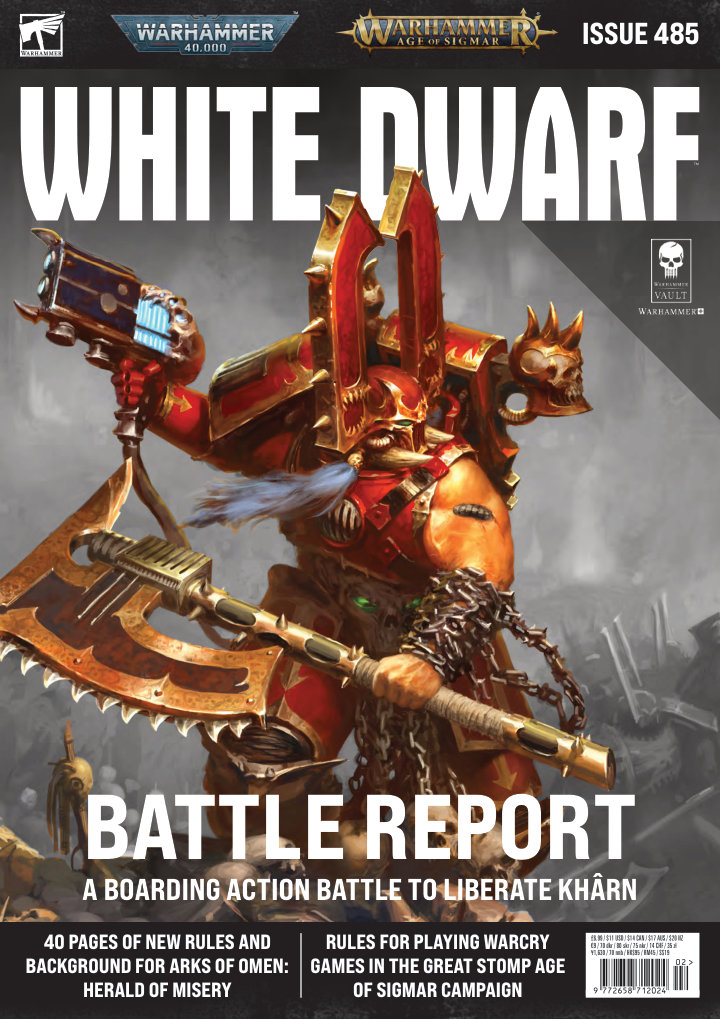
Rich Butler’s World Eaters race to free Khârn from an airlock before Duncan Waugh’s Scions eject him into space. Eightbound speed and door-smashing dictate the pace, while Bullgryns and overwatch try to hold the approach. Ineffective shooting leaves the defenders relying on Tempestor Balat, whose fist kills two wounded Eightbound and nearly preserves the barrier.
Warhammer 40,000World Eaters
CampaignWD 485 · pp. 122–127
Rob Crouchley starts a studio campaign during the Great Darkness, when the failing Pax Helmawr lets Lady Credo’s supporters challenge established power. He explains the Arbitrator’s role and adapts Cinderak Burning through monthly pairings and a shared scenario each cycle. Founding advice balances vehicles, fighters and credits against darkness, restricted supplies and injuries, while an opening gang gallery introduces the contenders.
NecromundaHouse Escher
ShowcaseWD 485 · pp. 128–129
Rich Dansie roots his Helot Cult in anonymous hive workers. A cache of sinister scrap becomes material for masks distributed by a persuasive preacher, apparently celebrating the workers’ facelessness. The masks instead whisper and override their will. Named cult figures, a Spawn and a vehicle develop that shared premise into a gang with an unresolved dark purpose.
NecromundaHelot Chaos Cults
LoreWD 485 · pp. 130–131
The White Consuls’ shattered home world and duty as Astartes Praeses frame Captain Vitrian Messinius. A dossier traces his service beside Guilliman, command of Primaris, gifted wargear and relationships with Ferren Areios, Eloise Athagey and Inquisitor Rostov. Campaign entries connect Terra’s defence, a daemonic outbreak and Indomitus operations to a pragmatic commander hoping to rebuild his Chapter.
Warhammer 40,000White Consuls
FictionWD 485 · pp. 132–141
Larn Rat-Tail accompanies Borgni Daltheim’s treasure hunters towards Karak Thorga, haunted by approaching doom. Ghouls capture many companions, but Daltheim insists on racing rival claimants rather than rescuing them. The missing whitebeard Rigo reappears and draws Larn into recounting the past behind his withdrawal and scars.
Age of SigmarFyreslayers
CommunityWD 485 · pp. 142–145
Studio projects combine completed collections, work in progress and recent games. Matt adds Word Bearers, Dirk finishes Blooded, and hobby bingo ranges from Space Wolves and Goliaths to Middle-earth and Genestealer Cults. A terrain recipe, Adam’s newly fielded Kratos and Lyle’s illuminated Dark Angels Spartan show how deadlines, gaming stories and experiments keep collections moving.
Warhammer 40,000The Horus Heresy4 paint colours
PaintingWD 485 · p. 142
Matt Hutson revisits Word Bearers begun for a pre-lockdown Crusade challenge. Deadlines have expanded them to roughly two thousand points, including Blackstone Fortress renegades, with daemon engines deliberately replacing tanks. A red-armour recipe repeats across the force; Possessed and a Maulerfiend remain future additions, and a planned Tome Keepers battle offers a thematic first outing.
Warhammer 40,000Chaos Space Marines4 paint colours
PaintingWD 485 · p. 143
Dirk Wehner gives Blooded the green armour and red cloth of his Death Guard. Their Corpseman’s spreading gift explains their fall and role as expendable covert support for Heretic Astartes. The recipes layer bright green over a dark base and red over brown, making their allegiance visible while keeping the human renegades distinct.
Kill TeamWarhammer 40,000Blooded8 paint colours