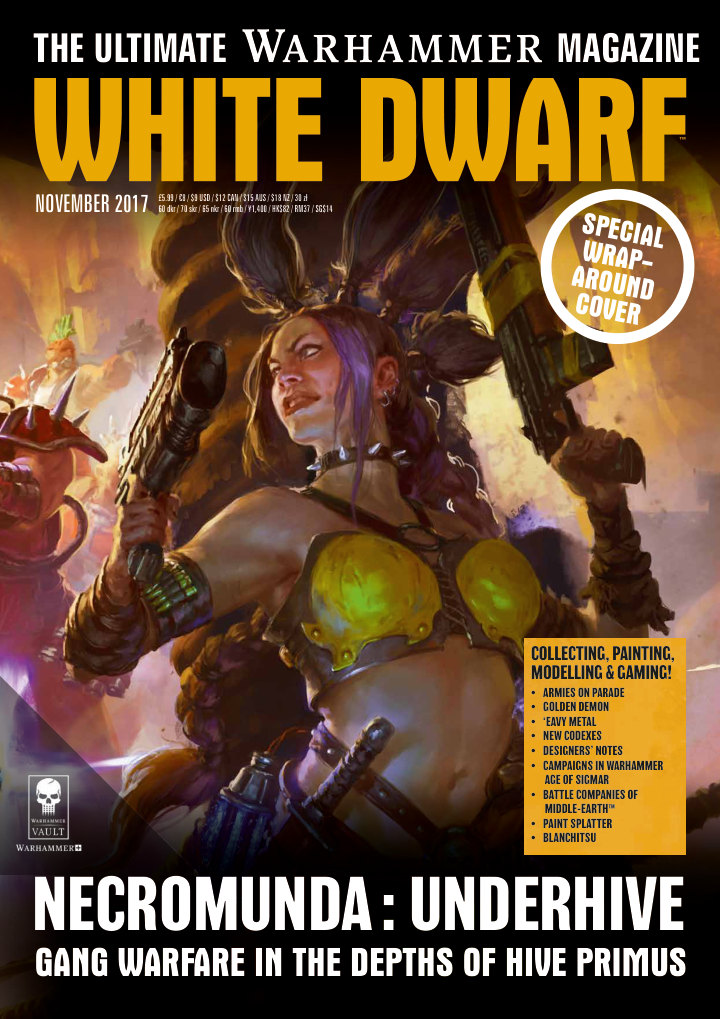
EditorialWD 424 · p. 1
The editor welcomes Necromunda back as a view of Imperial life far removed from its celebrated armies. Memories of long-running gang campaigns introduce the new tunnel game and its three-dimensional companion, setting the theme for an issue that follows the launch through design, modelling, painting and an extended battle report.
CommunityWD 424 · pp. 4–29
The month’s news centres on Necromunda’s return, with its two contrasting gangs and new ways to fight in tunnels or among industrial walkways. Other reports introduce Tyranid and Craftworld codexes, Shadespire warbands, painting equipment, terrain and licensed games, alongside books and an interview with a Kharadron novelist.
ReviewWD 424 · pp. 6–9
The boxed game is introduced through its Goliath and Escher fighters, double-sided tunnel tiles and interactive battlefield accessories. Fighter cards, unusual dice and gang tactics support individual characters, while Gang War extends the same core game onto larger scenery layouts and adds the progression, trading and injuries needed for an ongoing campaign.
NecromundaHouse Goliath
TacticsWD 424 · p. 10
Alex Tuxford recommends protecting the Sepulchral Warden rather than risking the fighter who can return fallen skeletons to play. Seven models and only four activations demand careful planning; movement ploys, surrounding enemies and displacing opposing fighters help overcome the warband’s slow speed while upgraded warriors retain their value after resurrection.
Warhammer UnderworldsSepulchral Guard
TacticsWD 424 · p. 11
James Ashbey advises taking the Orruks into fights to trigger their inspiration, while scoring early objectives to purchase the upgrades that make them dangerous. Extra wounds and survival ploys compensate for limited defence, and forced movement or follow-up attacks can bring enemies within reach of a warband that otherwise struggles to chase them.
Warhammer UnderworldsIronskull’s Boyz
ReviewWD 424 · pp. 12–13
The new Tyranid codex expands beyond the three best-known invasions to give seven hive fleets their own approaches to war. Its background, powers and stratagems are introduced alongside a starter collection centred on Genestealers and a tunnelling monster, emphasising the different attack patterns available within the same alien swarm.
Warhammer 40,000Tyranids
TacticsWD 424 · p. 13
A two-sided matchup table explains both how to use Tyranids against particular enemies and how those opponents can respond. Its recurring principles are to match the right organisms to their prey, disrupt vulnerable shooters and psychic support, and concentrate damage where enemy recovery or powerful retaliation would otherwise undo the attack.
Warhammer 40,000Tyranids
ReviewWD 424 · pp. 14–16
The Craftworlds codex brings its history forward through the Gathering Storm and the shattering of Biel-Tan, then gives the major craftworlds distinct gaming identities. The accompanying collection preview highlights adaptable wraith units and psychic leadership, while Eldrad’s miniature and the faction’s card support illustrate ways to personalise the force.
Warhammer 40,000Aeldari
InterviewWD 424 · p. 15
Jervis Johnson and Robin Cruddace explain how established craftworld personalities were mapped onto army attributes, warlord traits and stratagems. Saim-Hann’s aggressive riders provide a worked example, while the designers discuss the difficulty of balancing an army containing very different infantry, constructs, vehicles and psychic specialists.
Warhammer 40,000Aeldari
ReviewWD 424 · p. 17
A new adversary pack adds reference cards and further opponents for Silver Tower and Shadows over Hammerhal. The preview distinguishes familiar creatures from exotic additions and introduces larger threats such as Chaos Lords and Grey Seers, explaining the pack’s role without reproducing rules that belong to the separate product.
Warhammer QuestChaos
ShowcaseWD 424 · p. 17
A conventional playing-card deck becomes a small collection of John Blanche’s Imperial imagery. The article describes the contrasting suits and the masquerade-like treatment of Chaos and alien identities, presenting the cards as another way of encountering the artist’s distinctive visual world rather than a new tabletop rules system.
ReviewWD 424 · pp. 20–23
The hobby equipment roundup introduces the original Citadel Painting Handle as a way to avoid touching a wet model and reduce the strain of holding its base. A flexible painting mat, water pot and bundled supplies appear alongside industrial pipes, refineries and larger scenery collections suitable for expanding Necromunda or other battlefields.
ReviewWD 424 · pp. 24–25
The Astraeus is presented as a large anti-gravity assault tank designed to open breaches and destroy valuable enemy machines. Annotated details connect it to other Space Marine vehicles while explaining the turret, weapon options, thrusters and void shields that distinguish its role from the smaller transport tanks it resembles.
Warhammer 40,000Space Marines
ReviewWD 424 · p. 25
The returning Battle Companies format is introduced as a way to begin with a handful of fighters and develop them through linked adventures. The book gathers company creation, experience, equipment and scenarios into one supplement, offering a smaller-scale entry to Middle-earth as well as a source of personal characters for larger armies.
Middle-earth Strategy Battle Game
ReviewWD 424 · pp. 26–27
The licensed-games report introduces Vindicator and Predator vehicles to the mobile tank game’s Halloween event. Their battlefield roles are compared through heavy short-range firepower and a more flexible turreted approach, while Chapter-coloured appearances translate familiar Warhammer miniatures into the game’s digital vehicle collection.
World of Tanks BlitzWarhammer 40,000Space Marines
ReviewWD 424 · pp. 28–29
The book roundup follows several armies into very different kinds of trouble: Blood Angels defend Baal, White Scars face an uncertain Tyranid invasion and Kharadron risk everything on a promising aether-gold discovery. It also previews a Raven Guard audio mission and omnibus editions, summarising the magazine’s introductions rather than claiming to review the full books.
Warhammer 40,000Age of Sigmar
InterviewWD 424 · p. 29
C L Werner contrasts the pragmatic, profit-driven Kharadron with more traditional duardin while discussing Overlords of the Iron Dragon. He describes the challenge of writing stories large enough for the Mortal Realms’ extraordinary environments, his attraction to morally dubious characters and his continuing interest in returning to the Skaven.
Age of SigmarKharadron Overlords
CommunityWD 424 · pp. 30–31
Readers ask for more terrain construction, linked modelling and rules features, and small pieces of fiction, while others praise the explanatory style of recent battle reports. Replies address subscription problems and hobby events; the lighter background questions consider Cawl’s armour projects and the uneasy relationship between duardin and aelves.
Warhammer 40,000Age of Sigmar
InterviewWD 424 · pp. 34–35
The retrospective revisits White Dwarf 366 and its tank-heavy Spearhead expansion, placing it beside the vehicle kits and marking guides released at the time. A Bilbo Hall of Fame choice, Blood Angels advice, Orc modelling and the preview of Warhammer’s eighth edition show the wider mix of that earlier magazine.
Warhammer 40,000Warhammer Fantasy Battles
InterviewWD 424 · pp. 36–43
Andy Hoare and James Hewitt explain the return of Necromunda through scenery, alternating fighter activations and expanded gang identities. The interview traces how cards and interactive terrain help maintain a clear battlefield, why Goliath and Escher make an effective contrast, and how the tunnel game connects to campaign play on three-dimensional tables.
NecromundaHouse Goliath
InterviewWD 424 · p. 38
Dave Thomas and Mark Bedford connect the new Goliaths’ shapes to their lives in the foundries. Heavy lifting braces, protective workwear, respirators and industrial weapons turn apparently extravagant decoration into functional equipment, while integrated stimms and imposing physical proportions preserve the older gang’s blunt, threatening character.
NecromundaHouse Goliath
InterviewWD 424 · p. 39
Gavin Newton and Mark Bedford describe preserving Jes Goodwin’s flamboyant Escher identity while increasing movement and variety in the plastic miniatures. Exotic feathers, pelts and elegant weapons express status and off-world connections, while chemical containers link their appearance to the House’s pharmaceutical influence rather than treating the accessories as arbitrary ornament.
NecromundaHouse Escher
InterviewWD 424 · p. 42
Rob Macfarlane describes scenery designed to do something during a game, rather than simply block sight. Loot containers, possible traps and door controls give fighters reasons to interact with their surroundings; the visual approach favours worn industrial function while retaining small details that locate the tunnels in the Imperium.
Necromunda
LoreWD 424 · pp. 44–49
Necromunda’s hive cities are presented as the product of exhausted resources, recycled waste and extreme concentrations of labour. A layered feudal society allows its vast industrial output to continue without any realistic central record of its population, while gang violence settles disputes between employers whose public business relationships must remain intact.
Necromunda
LoreWD 424 · pp. 45–46
The distinction between the Great Houses and Clan Houses explains where Necromunda’s wealth and power reside. Noble investors control privileges and off-world interests, while manufacturers depend on one another for essential supplies; carefully limited proxy wars let them damage rivals without provoking the wider disruption that would threaten everyone’s trade.
NecromundaHouse Helmawr
LoreWD 424 · pp. 46–47
Cawdor turns salvage and recycling into acts of religious devotion, with masks and strict conduct marking its followers of the Redemption. Its enormous, impoverished population provides a necessary service to the other Houses, while a privileged ruling court and a thane who regards himself as the Emperor’s servant create tensions within the established order.
NecromundaHouse Cawdor
LoreWD 424 · p. 47
Delaque derives influence from information as well as manufactured goods, maintaining a particularly close relationship with Helmawr. The account links its members’ shadowy appearance and secretive organisation to extensive espionage, describing a concealed leadership and dangerous means of gaining intelligence that leave even its own people uncertain about who truly rules.
NecromundaHouse Delaque
LoreWD 424 · pp. 47–48
Escher’s pharmaceutical industry makes the other Houses dependent on its specialised chemicals, even as generations of exposure have transformed its own population. The House’s almost entirely female society, exotic biological trade and dismissive attitude to Goliath are framed through the young Queen Adina’s response to an early challenge against her rule.
NecromundaHouse Escher
LoreWD 424 · pp. 48–49
Goliath’s foundries reward strength above all other qualities, producing formidable but short-lived workers through selective breeding and chemical support. The House’s contempt for weakness sits beside an uncomfortable dependence on Escher growth stimulants, while succession through violence makes the reigning Over-tyrant’s personal power the foundation of his authority.
NecromundaHouse Goliath
LoreWD 424 · p. 49
Orlock controls both valuable metal-recovery operations and the dangerous transport routes connecting them to the hives. Its history of industrial sabotage and rivalry with Delaque accompanies a family-based political structure in which marriage, bargaining and coercion coexist with a surprisingly durable sense of internal discipline.
NecromundaHouse Orlock
LoreWD 424 · p. 49
Van Saar’s superior technology comes from a damaged Standard Template Construct whose output also poisons the people using it. Protective suits and imported treatments sustain its workers, while a rigid hierarchy reserves the most advanced and hazardous products for senior families, making privilege and physical decline closely intertwined.
NecromundaHouse Van Saar
Battle reportWD 424 · pp. 52–65
Martyn Lyon’s Goliath Ironlords defend a tunnel complex against Matt Hutson’s Escher Carrion Queens. The players expand the introductory scenario to use both full gangs, giving short-ranged industrial weapons, traps and chemical attacks a congested battlefield in which every fighter’s position matters.
NecromundaHouse Goliath
CampaignWD 424 · pp. 66–71
The Firestorm campaign is explained as a map contest whose card-driven resources affect army size, strategic options and development between battles. Captured regions, secret objectives, negotiation and several routes to victory create competing ambitions, while a Studio campaign demonstrates how the system can accommodate both careful planning and a newcomer learning the game.
Age of Sigmar
LoreWD 424 · pp. 67–69
The campaign map is built around the relics of the vanished Agloraxi Empire in Aqshy. Vast automata, a captive elemental, reality-spanning mechanisms and immense lenses turn individual regions into pieces of an ancient weapon system, giving strategic objectives a setting-specific reason to matter beyond their value as territory.
Age of Sigmar
Battle reportWD 424 · p. 70
Jonathan’s Kharadron defend the Coast of Ill Omen with a valuable starting advantage that allows him to field an Ironclad. Stuart’s mobile Tzaangor force threatens objectives and destroys the Endrinriggers, but the skyship survives the decisive attacks and methodically eliminates the remaining opposition, preserving Jonathan’s territory.
Age of SigmarKharadron Overlords
Battle reportWD 424 · p. 71
Dan Harden and Melissa Holland renew a Skaven–Seraphon rivalry around an ancient artefact. Ripperdactyls and the Bastiladon inflict enormous losses, with the latter unleashing a dramatic tide of snakes, but surviving Stormvermin destroy the monster and secure Dan’s first victory despite the damage sustained along the way.
Age of SigmarSkaven
PaintingWD 424 · pp. 74–75
Dom Murray builds a Bloodbound display around a warlord’s throne in a frozen ruin. Red, brass and snow establish a tightly limited palette, while glossy shading and restrained highlights keep the army practical to complete; blood effects, a Slaughterbrute and a corrupted Realmgate reinforce the impression of a warband gathering before battle.
Age of SigmarBlades of Khorne7 paint colours
PaintingWD 424 · p. 75
The tundra board is painted broadly enough to stay subordinate to the army it supports. Brown earth, bronze-touched ruins and generous drifts of texture snow tie the components into one cold landscape, with overspray on the scenery deliberately helping connect the structures to the surrounding ground.
Age of Sigmar7 paint colours
ShowcaseWD 424 · pp. 76–77
James Karch reinforces his established Sons of Guilliman with Primaris Marines, finding their large armour panels well suited to the quartered scheme. Small pose changes, individual honours and freehand Chapter symbols add variation, while the discussion explains how natural divisions in the armour make a complicated-looking pattern easier to plan and paint.
Warhammer 40,000Space Marines
ModellingWD 424 · p. 77
Karch treats the display board as a supporting backdrop and chooses faded neutral tones that let the Marines remain dominant. Sector Imperialis tiles are combined with pieces from an older Realm of Battle project and mounted on a wooden frame, creating a stable urban setting through reused terrain rather than an elaborate new centrepiece.
Warhammer 40,000Sons of Guilliman
ShowcaseWD 424 · pp. 78–79
Rik Turner’s display begins with a desire to build a Chaos fortress and develops into Archaon leading twelve Varanguard through its gate. The scenery frames the airborne centrepiece, while conversions provide Slaaneshi riders absent from the standard parts; the painter credits existing tutorials with helping him complete the demanding character over several weeks.
Age of SigmarSlaves to Darkness
PaintingWD 424 · p. 79
Turner completes the large fortress through a deliberately economical sequence of sprayed colour and drybrushing. Dark foundations, muddy lower walls and lighter stone raised from above give the structure weight, while picked-out skulls and bronze fittings preserve its Chaos identity without requiring every surface to be laboriously layered.
Age of Sigmar8 paint colours
ShowcaseWD 424 · pp. 80–81
Gareth Cosby turns a long-standing fascination with Mechanicus artwork into a rapidly completed Martian army. A metallic undercoat makes the many mechanical details manageable, while a cog-shaped display inspired by the Void Shield Generator supports Skitarii, a Taranis Knight and contrasting assassins within one industrial scene.
Warhammer 40,000Adeptus Mechanicus1 paint colour
PaintingWD 424 · p. 80
The Mechanicus display uses corroded metal and polluted ground as a subdued setting for bright Martian robes. Cosby experiments with rust, verdigris and foul liquid effects across the scenery, letting differences in surface and material establish an industrial environment while keeping the army clearly visible against it.
Warhammer 40,0004 paint colours
PaintingWD 424 · pp. 82–83
David Soper’s gold-winning Megaboss combines textured non-metallic armour with a forceful red accent and deliberately bold glyphs. His commentary explains how stippled bone, careful colour placement and restrained translucent blood create convincing materials, while judges praise the painter’s control of surface detail and the small story supplied by the severed Dracoth head.
Age of SigmarIronjawz3 paint colours
ShowcaseWD 424 · p. 84
Karol Rudyk’s silver-winning Slaughterpriest carries a banner developed over several years and painted with recreations of published artwork. The converted bearer’s reflective red and gold armour, fine skin and textured horns support the freehand centrepiece, with the judges noting that movement and a balancing base keep the ambitious composition coherent.
Age of SigmarBlades of Khorne
ShowcaseWD 424 · p. 85
Marc Masclans returns to a small Warhammer figure after working with larger subjects, concentrating on a defiant face and the differences between materials. Smooth flesh, hard reflected light on the blade and worn armour demonstrate how texture can strengthen character, earning a bronze award and praise for the model’s atmospheric realism.
Age of SigmarDarkoath
PaintingWD 424 · pp. 86–87
Chris Clayton gives his winning mounted Stormcast a cool, slightly unsettling interpretation of immortality. Teal creatures, rich purple details and carefully finished metal distinguish the materials; animal markings indicate rank, while airbrushing, wet blending and thin glazes support the intricate patterns and the painter’s specially mixed gold finish.
Age of SigmarStormcast Eternals1 paint colour
ModellingWD 424 · p. 88
Adie Bay surrounds a scratch-built interpretation of Ikit Claw with Rat Ogors and an extensively altered multi-armed brute. Discordant purple, raw pink flesh and unhealthy green make the group unsettling, while the judges emphasise how the arrangement keeps every figure visible and makes the leader unmistakable despite the size of his companions.
Age of SigmarSkaven
ShowcaseWD 424 · p. 89
Stefan Johnsson starts with dark, earthy armour but introduces bright blue-green beards when the group needs a stronger focal colour. A magenta magical effect is repeated elsewhere to connect the figures, producing a bronze-winning unit whose clean edges and restrained bases support its unusual palette without overwhelming the miniatures.
Age of SigmarLegion of Azgorh
InterviewWD 424 · pp. 90–95
Tom Winstone reflects on the route from early character painting to the ’Eavy Metal team and presents favourite models from across his career. His emphasis on subtle blending, considered colour relationships and material differences is reinforced by fellow painters, who explain how consistency and small background-informed details give his work credibility.
PaintingWD 424 · p. 90
Typhus retains small links to his earlier miniature while adopting the natural greens and muted tones of the new Death Guard collection. Winstone uses the pale helmet to pull attention into a head enclosed by bulky armour, showing how a familiar character can remain distinct without breaking the visual identity of the surrounding army.
Warhammer 40,000Death Guard
PaintingWD 424 · p. 91
Winstone explains why Magnus needed a colour that stood apart from blue-armoured Rubric Marines and Lords of Change. A pinker red supports transitions into purple and blue without suggesting Khorne, while the strong use of red and blue makes the daemon primarch visually dominant within an already spectacular Tzeentch force.
Warhammer 40,000Thousand Sons
PaintingWD 424 · p. 92
Valkia becomes an exercise in maintaining Khorne’s limited palette while accommodating a shield formed from a Slaaneshi daemon. Different treatments of horns, skulls and the shield keep their materials and associations distinct, demonstrating how similar pale details can serve different purposes when their underlying colour temperatures change.
Age of SigmarBlades of Khorne
PaintingWD 424 · p. 92
For his first ’Eavy Metal character, Winstone gives Seth’s smooth power armour an unusual stippled surface that suggests accumulated age. Repeated pale blue accents connect Chapter markings, the halo and the weapon grip, providing a cool counterpart to the rich red without allowing isolated details to distract from the figure.
Warhammer 40,000Flesh Tearers
PaintingWD 424 · p. 92
The Librarian demonstrates how several blues and yellows can coexist without becoming visually repetitive. Dark armour, a lighter Chapter pad and luminous psychic effects receive different treatments, while cream cloth, yellow cables and gold ornament show how technique and surface character matter as much as choosing a different hue.
Warhammer 40,000Space Marines
PaintingWD 424 · p. 93
Winstone pushes an established monster towards a stronger winter identity using cold blues, whites and greys. Small warmer areas of flesh, bone and leather are distributed through the whole figure, while drybrushing and thin layers make the extensive fur practical to paint and show that a large model need not demand difficult edge work everywhere.
Age of SigmarBeastclaw Raiders
PaintingWD 424 · p. 94
Max Faleij praises the contrast between Winstone’s deep red armour and smaller reflective teal details on these Longbeards. Softly painted beards vary between figures, gold completes the colour relationship and a simple runic banner fits the subject, showing how a unit can remain consistent while retaining individual character.
Age of SigmarDispossessed
PaintingWD 424 · p. 94
Simon Adams examines how Winstone controls the focal point of a predominantly black miniature. Bright yellow and gold remain small accents, while a heavily darkened red cape contributes colour without pulling attention away from the warrior’s centre, illustrating the difference between a useful spot colour and an overpowering secondary area.
Warhammer 40,000Space Wolves
PaintingWD 424 · p. 95
Chris Innes uses the Metamorphs to explain Winstone’s consistency across models painted months apart. Related colours, repeated yellow accents and rank-signalling red tie the unit to the larger cult, while tiny flame markings on fuel containers show how knowledge of the fictional equipment can justify an extra painted detail.
Warhammer 40,000Genestealer Cults
PaintingWD 424 · p. 95
Joe Tomaszewski highlights the range Winstone achieves within Khorne’s familiar palette. The armour remains rich yet threatening, the cloth approaches black and the Flesh Hound uses another red treatment, proving that variations in tone, texture and placement can differentiate adjoining surfaces without introducing unrelated colours.
Age of SigmarBlades of Khorne
InterviewWD 424 · pp. 96–99
Jes Bickham explains how the new Tyranid codex connects its game changes to the opening of the Great Rift. Questions about inedible daemons and scattered hive fleets lead into new stories and more distinct adaptations, giving players reasons to choose a particular swarm beyond its colours while improving familiar organisms that had struggled in the Index rules.
Warhammer 40,000Tyranids
InterviewWD 424 · p. 97
The Carnifex is reconsidered through the options already supplied in its plastic kit. Restored biomorph choices make it a flexible line-breaker rather than a monster overshadowed by specialised successors, while the Screamer-Killer and Thornback return as fixed configurations whose identities reach back into the Tyranids’ earlier history.
Warhammer 40,000Tyranids
TacticsWD 424 · p. 98
The Genestealer discussion links weapon and head choices to renewed battlefield options and draws attention to the small scenery components in the kit. Infestation nodes can provide alternative places to deploy, but enemy proximity can remove them, making their placement and protection part of using a fast, dangerous assault brood effectively.
Warhammer 40,000Tyranids
InterviewWD 424 · p. 99
Mike Brandt describes feedback intended to retain the Tyranids’ threatening swarm identity while making neglected monsters useful. Tougher Hive Tyrants, revised shooting and a less restrictive Synapse arrangement are presented as responses to specific problems observed in play, illustrating the relationship between tournament experience and the codex’s broader thematic goals.
Warhammer 40,000Tyranids
ShowcaseWD 424 · pp. 100–107
James Perry presents seven House Raven Knights developed over a year, using equipment swaps and individual identities to make each enormous machine distinct. A deliberately Mechanicus appearance allows the collection to serve different narrative loyalties and periods, while damage, honours and elaborate Nurgle-tainted bases make the suits feel like working engines with histories of their own.
Warhammer 40,000The Horus HeresyImperial Knights
LoreWD 424 · pp. 102–103
The background inset places House Raven’s immense armoury within its long alliance with Metalica. Changes to the household crest record the Keep Inviolate, the Order of Companions and its forge-world pact, giving the showcased army a heraldic framework without requiring its collector to copy every established character.
Warhammer 40,000House Raven
ModellingWD 424 · pp. 104–105
Large Knight bases give Perry room for small scenes rather than a plain patch of ground. Spare Nurgle components supply mouths, flies and pools of corruption, including a fishing Nurgling assembled from intestinal details and a Skink head; the accompanying discussion recommends judging damage and decoration against the whole model before adding more.
Warhammer 40,000The Horus HeresyHouse Raven
PaintingWD 424 · p. 106
Perry records the full working palette for his Knight household, from the shaded mechanical skeleton to bright armour panels and fine damage. Separate recipes cover stained metals, heat effects, pistons, lenses and heraldic colours, making the large project repeatable while retaining the clean, bright finish he prefers over excessive mud and scorching.
Warhammer 40,000The Horus HeresyHouse Raven30 paint colours
InterviewWD 424 · pp. 108–109
Adam Troke and Jay Clare revisit the small-warband campaign format and explain how its new book expands the original articles. Experience, promotion and persistent injuries turn ordinary warriors into memorable individuals, while additional factions and a journey to Fornost provide variety; the magazine supplies two companies that could not fit into the book.
Middle-earth Strategy Battle Game
RulesWD 424 · p. 110
The allied company combines Men of Dale with Warriors of Erebor, reflecting the trading relationship and shared defence of their kingdoms. Its recruitment and advancement tables preserve that mixed character, while the company-specific hero upgrade rewards the close-combat expertise developed by training alongside allies.
Middle-earth Strategy Battle GameErebor
RulesWD 424 · p. 111
Gundabad’s company begins with a compact core of armoured Orcs and can grow through a varied reinforcement table. Wargs, Goblin Mercenaries and stranger creatures expand its options, while the Ogre rules restrict the normal promotion path and the hero upgrade trades multiple attacks for a more forceful single blow.
Middle-earth Strategy Battle GameGundabad
ModellingWD 424 · pp. 112–113
The Goliath assembly guide separates genuine modular freedom from combinations that produce awkward poses. Examples compare weapon placement, head direction and the movement implied by different legs, recommending temporary test fits so a heavily armed fighter still looks balanced, purposeful and physically capable of the action being depicted.
NecromundaHouse Goliath
ModellingWD 424 · p. 114
Escher bodies, heads and hairstyles offer many combinations, but the guide shows why clearance and visual direction still need attention. Hair can obstruct a weapon or hide a face, a heavy chem-thrower needs a convincing stance and the leader’s coat has a specific fit, making thoughtful part selection more useful than treating every option as interchangeable.
NecromundaHouse Escher
ModellingWD 424 · p. 115
The industrial bases are prepared separately so their detailed surfaces can be washed and drybrushed freely. Marking the future position of each foot and masking a small area before painting preserves bare plastic for a secure final join, avoiding the choice between a neat finished base and a reliable attachment.
Necromunda
PaintingWD 424 · pp. 116–117
Jay Goldfinch’s Goliath scheme pairs dark warm skin with worn red furnace plates, black workwear and several kinds of metal. Fine final flesh highlights keep the brown foundation dominant, while the guide distinguishes leather from enamel and adds bright green hair and a small illuminated cuff; controlled washes and painted chips give the armour weight without obscuring it.
NecromundaHouse Goliath31 paint colours
PaintingWD 424 · pp. 118–120
The Escher guide starts from a mid-tone undercoat suited to both yellow armour and dark clothing. Pale skin, patterned off-world pelts, a transparent-looking chemical vial and two-colour hair express the gang’s flamboyance, while the accompanying advice explains leopard spots, gemstone reflections and the small highlights that make glass and polished metal readable.
NecromundaHouse Escher40 paint colours
PaintingWD 424 · p. 120
A short basing tutorial establishes black and yellow hazard chevrons on an industrial surface. Pencil or ruler guides can make the stripes less daunting, while painted chips, local staining and a final edge highlight turn small imperfections into convincing wear rather than demanding the appearance of newly installed flooring.
Necromunda4 paint colours
PaintingWD 424 · p. 121
Five skin recipes provide dark, ruddy, light, pale and pallid alternatives that can be used across different gangs and armies. The commentary shows how the same paint can act as a foundation or a highlight, and how moving a wash before or after a layer changes the overall complexion without requiring an entirely new selection of colours.
12 paint colours
PaintingWD 424 · p. 122
Steve Bowerman and Tom Moore paint black-armoured Guardians with contrasting pale helmets and wraithbone weapons. Keeping the heads separate allows different undercoats and reduces repeated coverage work, while blue-grey edge highlights, turquoise details and crimson plumes give the otherwise restrained scheme enough colour to remain clear at miniature scale.
Warhammer 40,000Aeldari16 paint colours
PaintingWD 424 · p. 123
The Farseer recipe uses red robes and a pale helmet to retain Saim-Hann’s identity while gold rune armour, green stones and a luminous blade mark the rider’s status. Wider cloth highlights distinguish fabric from hard armour, and a thinned blue glaze is allowed to gather on the witchblade to suggest the flow of psychic energy.
Warhammer 40,000Aeldari20 paint colours
PaintingWD 424 · p. 123
Dan Hyams answers a reader asking how to reproduce the earthy bases shown with his Destruction army. Sand receives a brown foundation followed by several light drybrushes, building a subdued effect rather than one heavy highlight; a clean rim and a few tufts complete a practical surface suited to an entire collection.
Age of Sigmar4 paint colours
PaintingWD 424 · pp. 124–125
The Windrider guide keeps recess washes controlled so the smooth red canopy stays bright and clean. Black frames, pale helmets and fine edge highlights establish Saim-Hann’s sharp visual character, while separate assemblies improve access; masking advice explains how to add the bold black canopy markings without losing their geometric shape.
Warhammer 40,000Aeldari24 paint colours
PaintingWD 424 · pp. 126–127
The Dire Avenger recipe separates the blue armour from the white helmet during painting, then adds red crests, yellow straps and purple spirit stones. Careful blue shading connects the pale cloth to the rest of the model, while a geometric freehand sequence builds the shrine’s banner symbol from simple lines and shapes before the final details are filled in.
Warhammer 40,000Aeldari28 paint colours
ModellingWD 424 · pp. 128–133
The final Pilgrym instalment turns from its principal characters to the crowds that made the Throneworld feel inhabited. Pilgrims, workers, servants and grotesque mutants give the collaborative game a social setting, showing how minor figures and shared visual ideas can make a modelling project feel much larger than its central conflict.
Warhammer 40,000
ModellingWD 424 · p. 129
Toni Sokura assembles a band whose status in distant Imperial society means little once its members reach Terra. Mixed fantasy, cultist and Mechanicus components give the pilgrims unfamiliar forms, while their heavily ornamented mobile crypt embodies a culture that broadcasts reverence for the dead even as its tracks crush the living in its path.
Warhammer 40,000
ModellingWD 424 · p. 130
Tammy Nicholls converts Crypt Ghouls into blind, fungal-infected predators lurking beneath Terra. Small cuts and sculpted changes make their bodies less recognisably human, while a pale airbrushed foundation and wet blood effects strengthen the impression of verminous creatures that were once ordinary people.
Warhammer 40,0002 paint colours
ModellingWD 424 · p. 130
The Agri-workers represent people whose whole world is a small productive corner of the Imperium. Rural-looking ritual equipment, decay and a belief in the Emperor as a life-giving Green Man suggest a marginal form of the creed, while fungal changes connect their apparently ordinary labour to the horror surrounding the Grubs.
Warhammer 40,000
ModellingWD 424 · p. 131
Peter Hudson depicts the exhausted survivors of a pilgrimage that once numbered thousands. Flagellant bodies acquire small technological and ritual additions, preserving their appearance as vulnerable mortals whose dwindling procession has been shaped by disease, hunger and exploitation on the final approach to the Emperor’s palace.
Warhammer 40,000
ModellingWD 424 · p. 131
Hunched Skaven bodies become pack slaves carrying the products of Inquisitorial archaeology, watched by an armed servant of the Ordo Scriptorum. The accompanying protector figure suggests another response to Terra’s predatory society, placing weary civilians, enforcers and a local defender beside the project’s grander religious and political actors.
Warhammer 40,000
ModellingWD 424 · p. 132
Inspired by a John Blanche illustration, Ahmad Jafar builds pilgrims who venerate Imperial architecture as an extension of the Emperor. Spire-like heads, altered weapons and extensive sculpting turn familiar Flagellant components into a surreal sect; sending the models from Iraq also illustrates how miniatures let distant contributors participate in the shared event.
Warhammer 40,000
ModellingWD 424 · p. 133
Mikael Silvanto populates the ceremonial setting with a towering cardinal, a bishop and penitent militia. Mechanicum, wizard and cultist parts combine into recognisably religious silhouettes, while industrial hazard stripes become an unexpectedly appropriate sacred motif, connecting the group’s visual identity to the wider material culture of the Imperium.
Warhammer 40,000
ShowcaseWD 424 · pp. 136–139
The reader gallery brings together Legion infantry, Blood Angels vehicles, a witch-hunter scene and a range of Imperial and supernatural subjects. The photography advice stresses clear lighting, a plain background and an angle that reveals the face and principal details, helping collectors present their work as clearly as the varied models shown here.
Warhammer 40,000Age of Sigmar
PaintingWD 424 · p. 139
Rémi Argoud gives his Liberators individual sunrise scenes on their shields, using an airbrushed sky and foam-stippled clouds. Purple and brown shading add depth to the gold, while red glowing eyes provide a small focal accent; the feature shows how a repeated image can personalise a whole unit without requiring large narrative frescoes.
Age of SigmarStormcast Eternals1 paint colour
InterviewWD 424 · pp. 140–141
Kev Lawrence describes building a large Gundabad collection through manageable batches, with character models providing changes of pace. A limited palette ties the warriors together while varied skin and carefully glazed whites distinguish their leaders; layered resin, fish and a crackled icy surface make the display board evoke the frozen landscape around Erebor.
Middle-earth Strategy Battle GameGundabad
CommunityWD 424 · pp. 142–144
The team’s current projects include a completed Sylvaneth collection, reinforcements for the Firestorm campaign and a looted Ork walker taking shape from a Dreadknight. Short gaming accounts cover Shadespire and practice Necromunda battles, while the next report’s industrial board and a Lord of Change show how ongoing work feeds future magazine features.
Warhammer 40,000Age of Sigmar
ModellingWD 424 · p. 143
The Forge World team prepares a three-dimensional industrial board for the following issue’s battle report. Walkways, towers, barricades and pipelines demonstrate how the Sector Mechanicus range can turn the tunnel game’s setting into a vertical battlefield, with gutters and other details reserved for the later painted finish.
Necromunda
InterviewWD 424 · p. 143
Stuart Edney recommends agreeing a schedule well in advance and treating the organiser’s role as helping everyone enjoy a shared campaign. The Firestorm map provides a clear record of progress, while multiple victory conditions generate rivalries naturally; the practical advice focuses on sustaining participation as much as choosing an engaging set of rules.
PaintingWD 424 · p. 144
Stuart’s Lord of Change uses traditional blue to contrast with his red Tzaangors and establish the daemon as the army’s commander. Drybrushing makes the feathers manageable, shades reinforce the musculature and gemstone effects add interest; the commentary connects its role in the collection to the colour decisions discussed earlier by Tom Winstone.
Age of SigmarDisciples of Tzeentch
All contents-listed features and substantive separately titled articles in the magazine are indexed, including painting guides, exclusive Battle Companies and Pilgrym groups. Covers, contents, advertisements, subscription material and standalone product price listings are excluded. The advertised 16-page Christmas gift guide is absent from this copy; no missing catalogue pages have been reconstructed.