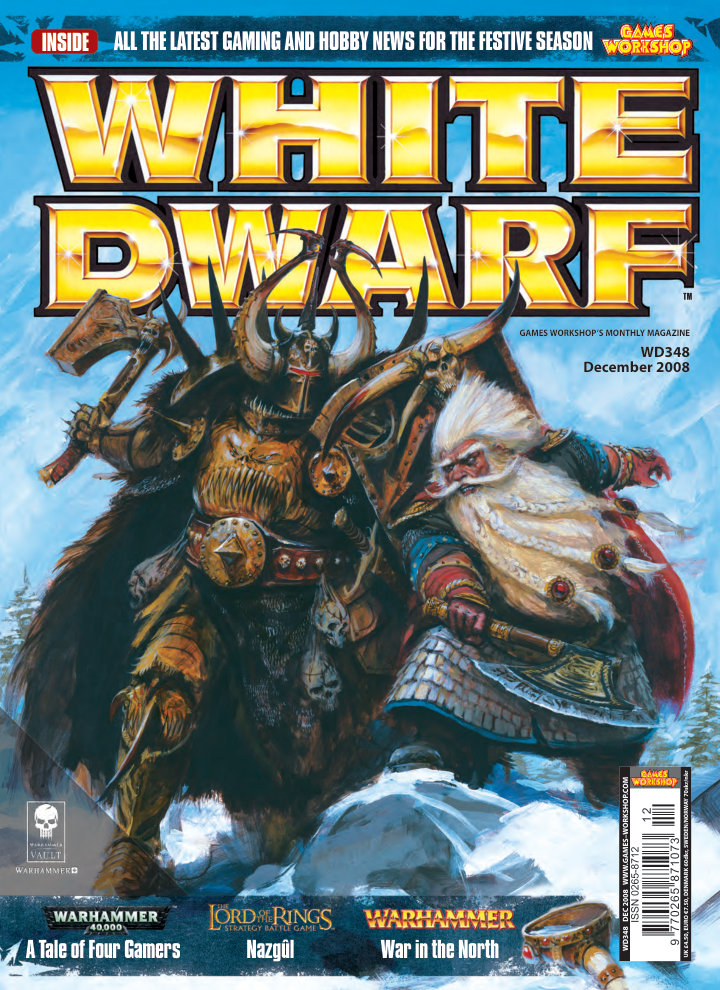
EditorialWD 348 · p. 1
Mark Latham introduces December as an opportunity for varied holiday games, highlighting the new Chaos campaign, Ringwraith scenarios, Apocalypse formations and Grombrindal’s rules. The four collectors finish their challenge with a large team battle whose result surprised him. A tribute to Alan and Michael Perry marks thirty years of sculpting, while the second Marine painting instalment provides another project for readers’ holiday time.
Warhammer 40,000Warhammer Fantasy Battles
CommunityWD 348 · pp. 10–12
The Lizardmen preview promises a new book, plastic Stegadon variants, Temple Guard and other reinforcements as the Slann turn to war. A separate report shows the full-sized Blood Ravens Rhino built from an FV432 for THQ’s Dawn of War II promotion. Studio notes look ahead to an enormous Ork gun and intensive Middle-earth army painting, while web news describes an expanding free archive of hobby articles.
Warhammer Fantasy BattlesWarhammer 40,000Lizardmen
CommunityWD 348 · p. 11
The new free catalogue introduces the Specialist range through its models and the different experiences its games offer, from fleet actions to mass fantasy battles. The notice also explains that rules can be downloaded and supporting miniatures remain available online. Blood Bowl players become individually purchasable in December, answering requests for more flexible team construction. It is a snapshot of how the range was supported and accessed at the time.
Battlefleet GothicWarmaster
CampaignWD 348 · pp. 14–21
Phil Kelly adapts Mighty Empires for rival Chaos warlords competing to lead a southern invasion. Persistent gifts, magical instability and transformation into a Prince or Spawn give each general a developing identity. An escalating sequence of battles moves from the wastes through sacred duels to a combined-army finale. Four Studio collectors introduce contrasting forces, showing how the campaign can accompany a new army rather than demand a finished collection.
Warhammer Fantasy BattlesWarriors of Chaos
RulesWD 348 · pp. 15–16
A nominated general carries Eye of the Gods rewards between battles and can eventually ascend, earning bonus campaign territory; a further insanity result instead risks irreversible Spawnhood. Daemonic Heralds regain greater forms according to their patron’s sacred number. Enhanced spellcasting also triggers a dangerous flux table when spells fail. The ordered campaign grows in points, preserves its general and links preliminary battles to later alliances and a final contest.
Warhammer Fantasy BattlesWarriors of Chaos
RulesWD 348 · p. 17
Randomly selected Chaos landmarks turn the opening campaign battles into encounters with the landscape itself. Geological aberrations and brazen spires damage nearby troops, while a defended shrine grants favour. Familiar rulebook features fill out the terrain table. Haywire magic adds new miscast and irresistible-force combinations and can interact with the campaign’s flux table, making apparently routine casting a substantial tactical risk.
Warhammer Fantasy BattlesWarriors of Chaos
RulesWD 348 · p. 18
Each side nominates a Chaos character who must seek out the rival champion for an uninterrupted duel. Their armies fight around monuments and difficult ground, but other units may not charge the chosen combatant. Mounts cannot contribute attacks to the sacred contest. The victor earns several reward rolls, while destroying the opponent before the duel earns immediate Spawnhood for the offender, ensuring that winning by interference carries its own punishment.
Warhammer Fantasy BattlesWarriors of Chaos
RulesWD 348 · p. 19
The final four-player battle combines earlier victors with the troops of defeated rivals. Losing generals are removed, and their former followers now share the winning commander’s leadership, standards and magical resources. Chaos Wastes terrain and haywire magic continue to shape the battlefield. Two people therefore control each enlarged army, turning the campaign’s previous rivalries into uneasy alliances for the right to lead the invasion.
Warhammer Fantasy BattlesWarriors of Chaos
RulesWD 348 · p. 19
Three campaign-map additions give terrain markers lasting strategic value. A stone circle supplies magical energy, siege equipment reduces the cost of conquering fortified places, and a Tower of Skulls is expensive to claim but grants a selected unit divine favour. These short rules make Nick Bayton’s customised Troll Country map more than decorative, linking control of particular tiles to benefits in later tabletop games.
Warhammer Fantasy BattlesWarriors of Chaos
ShowcaseWD 348 · pp. 20–21
Four hobbyists explain the visual and tactical ideas behind their campaign armies. Wade Pryce’s Khorne force favours direct aggression, Nick Bayton’s mounted troops seek coordinated charges, and Pete Foley combines Daemons from all four powers. Phil Kelly starts with an expensive block of Chosen because he enjoys the models, intending them as a future lord’s bodyguard. The introductions show very different routes into the same campaign.
Warhammer Fantasy BattlesWarriors of Chaos
InterviewWD 348 · pp. 22–29
Mat Ward explains creating individual warlike Ringwraith appearances while retaining the Nine’s anonymity through descriptive titles. Debate with Adam Troke establishes seven identities and initial rules before the Perrys sculpt the figures. Four printed profiles distinguish protective shadows, fear-driven command, corruption and magical endurance. Four scenarios then explore both open battlefield magic and the pursuit of the Hobbits from the Shire towards Rivendell.
Middle-earth Strategy Battle GameMordor
RulesWD 348 · p. 24
The Shadow Lord’s corruption is expressed through a darkness that protects him and nearby models from shooting, restricting successful hits to sixes. His profile retains the familiar Ringwraith powers and vulnerabilities, with mounted and Fell Beast options for repositioning. The accompanying background describes a minor king whose ambition made Sauron’s gift irresistible, turning protective obscurity into an outward sign of his dark pride.
Middle-earth Strategy Battle GameMordor
RulesWD 348 · p. 24
A more skilled and courageous Ringwraith leads through terror of failure, making nearby Evil warriors count as supported by a banner. Heroes are expressly excluded from that benefit. The full profile includes standard Nazgûl powers and mounted options, while the background portrays a cruel Númenórean ruler whose mortal habits only intensified under Sauron. His purpose is to strengthen the battleline rather than simply provide another independent spellcaster.
Middle-earth Strategy Battle GameMordor
RulesWD 348 · p. 25
The Tainted disrupts leadership around him: nearby warriors cannot benefit from Stand Fast or join Heroic Moves. Models in contact, including friends, risk wounds from his seeping corruption. His profile otherwise uses the standard Ringwraith magical framework and optional mounts. The background stresses a willing, unusually swift surrender to evil, reflected in rules that make even allies wary of his immediate presence.
Middle-earth Strategy Battle GameMordor
RulesWD 348 · p. 25
The Undying exchanges normal Fate protection for the ability to spend his large Will reserve in the same way. Successful spells from nearby heroes replenish that reserve, encouraging careful placement among other magic users. The profile connects this endurance to an obsessive desire to outlast every rival. Mounted options and standard Ringwraith powers remain available, but the distinctive resource economy is the core of his battlefield identity.
Middle-earth Strategy Battle GameMordor
RulesWD 348 · p. 26
Each army must include a spellcaster and deploy from opposite corners of a contested battlefield. Victory depends on casualties caused by particular offensive spells or enemies slain after magical impairment, with the game continuing until one side is destroyed. Keeping those victims aside makes the final count practical. The mission changes target selection by rewarding effective magical cooperation rather than simply surviving with the larger force.
Middle-earth Strategy Battle GameMordor
RulesWD 348 · p. 27
Four unarmed Hobbits must reach and unmoor Bucklebury Ferry before a mounted Ringwraith finds them. Trees conceal them under altered visibility rules, and thrown stones can divert the searching rider until discovery restores Evil control and normal speed. Leaving companions behind risks a difficult jump into the boat or loss in the river. The scenario makes stealth and timing central to the first encounter with the Nazgûl.
Middle-earth Strategy Battle GameThe Fellowship
RulesWD 348 · p. 28
Strider leads the Hobbits from the Prancing Pony while four mounted Nazgûl enter Bree searching for the Ring. The hunt and concealment rules continue from the ferry scenario, but nearby Ringwraiths can now force Frodo to test his resolve against wearing the Ring. Companions help him resist. Escaping through the correct edges wins, while lost companions or a compromised escape can reduce the result to a draw.
Middle-earth Strategy Battle GameThe Fellowship
RulesWD 348 · p. 29
Five Ringwraiths approach the Hobbits’ camp at Amon Sûl before the defenders detect them and summon Strider’s return. Flaming brands can drive a defeated wraith away, making the campfire both the cause of exposure and a defensive resource. Good must clear the ruins after the sixth turn; the Witch-king’s blade or a companion’s death can still spoil the outcome. The scenario balances sudden danger with a delayed heroic rescue.
Middle-earth Strategy Battle GameThe Fellowship
InterviewWD 348 · pp. 30–35
Alan and Michael Perry recount being hired while still at school, learning casting constraints through mistakes and gradually moving from free-ranging fantasy figures to organised Warhammer ranges. Favourite models and historical examples trace their influence on monsters, troops and Middle-earth. Michael describes returning to sculpting left-handed after losing his right arm. Their friendship with John Howe and Peter Jackson connects later licensed work with a much longer fascination for history and Tolkien.
Warhammer Fantasy BattlesWarhammer 40,000
InterviewWD 348 · p. 35
Peter Jackson explains that sculpting toy soldiers is a career he might have pursued if he were not making films. He praises the Perrys’ varied poses, remembers their Scouring of the Shire figures and hopes to build a large Helm’s Deep display. Their informal tuition has helped him begin a First World War soldier, although faces and fingers remain challenges. The interview shows their friendship extending beyond the film licence into a shared hobby.
Middle-earth Strategy Battle Game
RulesWD 348 · pp. 36–41
Jervis Johnson connects the Marines’ small numbers with rapid deployment, precision strikes and adaptable formations. Historical examples include improvisations forced by casualties as well as doctrines adopted across Chapters. Three new datasheets turn coordinated Redeemers, Thunderfire batteries and missile-filled Drop Pods into Apocalypse formations. A reference list identifies earlier Marine datasheets in books and magazines, helping groups plan narrative large battles from their existing collections.
Warhammer 40,000Space Marines
RulesWD 348 · p. 39
Three Redeemers operate as a squadron and can combine their flamestorm cannons into one Hellstorm attack instead of normal shooting. Its strength depends on the number of available cannons, while armour penetration and ignored cover remain fixed. Placement must remain within every contributing vehicle’s reach and sight. The Knights of the Raven’s siege of Jeghan explains the tactic’s origin as an answer to stubbornly entrenched rebels.
Warhammer 40,000Space Marines
RulesWD 348 · p. 40
A Master of the Forge commands three or more Thunderfire Cannons as one battery. It can exchange individual shooting for a scalable Apocalypse barrage or prepare an Overwatch attack during the enemy turn, provided it starts sufficiently far from opponents. The Black Guard’s defence of Doom Gorge supplies the example, with massed fire halting Tyranid waves before a counterattack. The formation rewards preparation and concentrated defensive support.
Warhammer 40,000Space Marines
RulesWD 348 · p. 41
Three missile-equipped Drop Pods form a coordinated element, with later pods landing near the command pod without scattering. Their improved sensors and ammunition increase the launchers’ range and barrage output. A full force combines three elements around a locator pod and grants Careful Planning. These pods carry no passengers: their purpose is to arrive directly inside the enemy position and saturate it with fire.
Warhammer 40,000Space Marines
LoreWD 348 · pp. 42–45
Adam Troke retells Grombrindal’s appearances at moments of Dwarfen despair, from holding a bridge to rallying miners and helping legendary heroes. His identity remains uncertain, with Snorri Whitebeard and divine connections among the competing explanations. Updated rules portray a hidden, fearless ancestor with formidable relics. Aly Morrison then explains sculpting the new pipe-smoking version as a compact, self-contained figure distinct from the earlier anniversary model.
Warhammer Fantasy BattlesDwarfs
RulesWD 348 · p. 44
The five-hundred-point Lord can hide inside a unit until combat, then remain fighting even if his companions flee. His ancestral relics supply exceptional protection, magical resistance, reliable nearby rallying and a powerful rerolling axe. The article explains exactly when his leadership and revealed presence begin to function. A closing note requests that opponents see the rules and explicitly excludes the character from tournaments and organised events.
Warhammer Fantasy BattlesDwarfs
InterviewWD 348 · p. 45
Aly Morrison gives the new Grombrindal a relaxed pipe-smoking pose rather than repeating the shield-borne anniversary spectacle. He enjoys one-piece Dwarfs that can be sculpted in a sustained sitting, using a bake-hardening material to retain working time. Details hidden beneath the beard still matter from unexpected angles. Earlier versions by Colin Dixon and Juan Díaz provide a short visual history of the magazine’s namesake miniature.
Warhammer Fantasy BattlesDwarfs
Battle reportWD 348 · pp. 46–71
Andrew Kenrick oversees a team Apocalypse finale on two combined Realm of Battle sets. Neil’s Crimson Fists and Pete’s Eldar recover from losing their Baneblade immediately, eventually securing two objectives to Matt and Fil’s one. Secret missions make the rivalry inside each team significant: Pete’s unintended destruction of Wazdakka denies Neil a bonus, while Matt kills Asurmen. Pete wins the series with thirty-seven points and also receives the judges’ best-painted-army award.
Warhammer 40,000Crimson Fists
CommunityWD 348 · pp. 48–49
Neil Hodgson adds a Baneblade, a Vindicator squadron, a Predator and more infantry for his first Apocalypse battle. A two-power-fist Captain requires careful cutting and reshaping, while a deadline keeps the ambitious expansion moving. He reflects on starting with an image of a disciplined Codex Chapter and gradually developing its background through the collection. Drop Pods, Scouts and further specialists remain future projects because the force is now a usable foundation.
Warhammer 40,000Crimson Fists
TacticsWD 348 · pp. 50–51
Pete Foley selects the Phoenix Court of Khaine because its few models can also serve in ordinary armies, making an Apocalypse addition fit his tournament interests. His final 1,474-point standard list retains mobile Jetbikes, transported Banshees and a supporting Farseer. He credits early testing with revealing the finesse the Eldar require, and explains how tournaments motivate his many parallel projects. The impressive Court supplies a different kind of threat for the finale.
Warhammer 40,000Eldar
ModellingWD 348 · pp. 52–53
Matt Hutson paints sixteen bikes, including a converted Chaos Lord, to field a formation perfectly suited to the Red Corsairs. Spare components distinguish the champions, but repeating so many similar models tests even his enthusiasm. He reflects on the challenge of following a particular story closely and plans to relax those limits in future additions. His secret battle plan combines hunting Asurmen with an asset that can remove an objective altogether.
Warhammer 40,000Red Corsairs
ModellingWD 348 · pp. 54–55
Fil Dunn expands the Goffs with another Dread, a heavily altered Land Raider Battlewagon and a Gargantuan Squiggoth. Spare power klaws distinguish the command walker, while a Ghazghkull model serves as a more economical mega-armoured boss. His original image of black, chipped machinery survives even after adding more Boyz than planned. The account stresses collecting attractive models organically, finishing them before play and continuing the army beyond the challenge.
Warhammer 40,000Orks
InterviewWD 348 · pp. 74–77
The new series explores foundational Fantasy events through trilogies about Sigmar, Nagash and the Sundering. Gav Thorpe discusses turning established historical outlines into character-driven fiction, focusing Malekith’s vast story on crucial moments rather than an exhaustive chronology. Early Elf-Dwarf relations and small links between authors’ books give the distant past emotional and narrative continuity. The feature also previews Alith Anar as a darker, contrasting viewpoint on the same disaster.
Warhammer Fantasy BattlesHigh Elves
InterviewWD 348 · pp. 76–77
Gav Thorpe describes a Sundering proposal that grew alongside the new Elf army books and became part of Time of Legends. Revisions narrowed an unwieldy historical epic into Malekith’s life, allowing later books to revisit other events from different perspectives. He highlights the poignant friendship with Snorri Whitebeard and explains collaboration with Graham McNeill and Mike Lee on connecting details. The aim is to reveal motives and personalities as well as familiar outcomes.
Warhammer Fantasy BattlesHigh Elves
EditorialWD 348 · pp. 78–80
Jervis Johnson recalls receiving a painted chipboard table as a young gamer and making do with improvised, mismatched scenery. Later discussions with Rick Priestley and Alan Merrett lead towards terrain manufactured with the same care as the miniatures. Dave Cross’s material and fastening experiments finally produce portable plastic tiles, with Dave Andrews shaping their surface. The column connects the new board to a longstanding aspiration for complete, convincing miniature battlefields.
ModellingWD 348 · p. 81
Mark Jones explains when plastic cement, superglue and PVA are appropriate, then demonstrates preparing joints for reliable assembly. Filed and keyed surfaces improve metal contact, and dry-fitting exposes poor joins before glue is applied. Repairs require removing old paint and glue rather than repeatedly attaching a broken arm to residue. Large parts may need pins, while a small surfactant addition helps PVA behave over broad basing areas.
PaintingWD 348 · pp. 82–89
Keith Robertson paints the mounted Chaos Lord as a Nurgle follower, contrasting dull green armour and corroded metal with the steed’s red exposed flesh. The rider is slightly lighter than the mount so the eye finds him first. Layered glazes create patchy age and colour variation, while verdigris follows places where water would collect. Detailed recipes carry the treatment through cloak, mutations, horns and a restrained scenic base.
Warhammer Fantasy BattlesWarriors of Chaos37 paint colours
PaintingWD 348 · p. 83
The mount’s exposed skin starts in dark brown, is washed with black and flesh shade, then rises through red-brown layers to sharp warm highlights on the sinews. Painted cuts repeat the highlight mixture and dark lining to suggest a veteran beast. A separate branded mark receives red, brown and bone accents. Its rich flesh provides the planned contrast to the rider’s subdued Nurgle armour.
Warhammer Fantasy BattlesWarriors of Chaos8 paint colours
PaintingWD 348 · p. 84
The rider’s green armour is raised through desert yellow and pale flesh mixtures, then varied with selectively placed purple, yellow and red glazes. Fine cuts and brown shading suggest damage. The mount’s barding follows a darker green-black foundation with related pale edges and weathering. Using similar hues at different brightness keeps the model unified while ensuring the Chaos Lord remains the visual focus.
Warhammer Fantasy BattlesWarriors of Chaos13 paint colours
PaintingWD 348 · p. 85
Keith studies weathered statues to place blue-green verdigris in recesses and downward streaks where moisture would collect. Brass is built from dark metal through bronze and silver, washed back and then selectively corroded. The hammer’s steel receives repeated dark washes and coloured glazes before its brighter edges. These separate treatments make the model look aged without giving every metal surface the same colour or texture.
Warhammer Fantasy BattlesWarriors of Chaos12 paint colours
PaintingWD 348 · pp. 86–87
The cloak’s muted purple and red colours rise into khaki, while shield wood is defined with earth-toned grain and pale edges. Fur receives a dark central pattern and light drybrushing; leather keeps sharp pale damage against black. The mutated arm instead uses flesh layers and cool purple-blue glazes. Keith explains that a glaze changes colour through repeated transparent films rather than flooding recesses like a shading wash.
Warhammer Fantasy BattlesWarriors of Chaos15 paint colours
PaintingWD 348 · p. 88
Keith pulls the brush away through long tapering strokes to make the transitions between horn colours jagged rather than banded. The helmet horns move from a dark base towards pale tips, while those on the mount reverse the progression. Both recipes use the same family of browns, ochre and bone with a small final white accent. The paired examples show how brush movement can create texture while preserving different material effects.
Warhammer Fantasy BattlesWarriors of Chaos6 paint colours
PaintingWD 348 · p. 89
Turquoise highlights on the tail repeat a spot colour already used on the helm and shield, balancing the full miniature. Skin trophies, rusted chainmail and buckle details use local colour contrasts to separate neighbouring surfaces. Slate, spare skulls and grass build a small scenic base, with the skulls kept deliberately neutral. These finishing decisions organise the complex model rather than allowing every detail to compete equally.
Warhammer Fantasy BattlesWarriors of Chaos13 paint colours
PaintingWD 348 · pp. 90–99
Fil Dunn and Chad Mierzwa turn a painted Marine army into a more individual force through chapter symbols, rank markings, honours and personal heraldry. Transfers, sculpted pads and freehand all provide routes to the same identity. Specialist colours and commander examples show where conventions vary, while vehicle details add wear, mud and smoke. Chapter and vehicle galleries demonstrate how these markings fit complete models rather than remaining isolated symbols.
Warhammer 40,000Space Marines15 paint colours
LoreWD 348 · p. 91
An Ultramarine’s shoulder guards, helmet and company colour locate him within the Chapter’s organisation. The page distinguishes Tactical, Assault and Devastator markings, veteran status and sergeant helmets, then shows variations across companies. Chapter badges can themselves vary while remaining recognisable. The guide gives hobbyists a framework for consistent markings without claiming every painted symbol is an exact duplicate throughout the army.
Warhammer 40,000Ultramarines
PaintingWD 348 · pp. 92–93
Chad Mierzwa demonstrates applying a transfer to a gloss-prepared pad, removing moisture and smoothing wrinkles before a matt finish. Fil Dunn instead builds a freehand icon from simple balanced shapes, thickening and filling the outline before correcting its edges. Variant shoulder examples combine squad identity with campaign, command and personal symbols. Brief portraits of the Aurora Chapter, Praetors of Orpheus and Mentors show the variety those techniques can represent.
Warhammer 40,000Space Marines2 paint colours
PaintingWD 348 · p. 94
The Iron Halo, Iron Skull, laurels, Crux and other distinctions connect a miniature’s decoration to deeds and rank. The guide explains where honours can be sculpted, painted or applied as transfers, and supplies a specific recipe for parchment and wax purity seals. Goblin Green is suggested for physical leaf wreaths. Kill tallies and written scrolls add personal history, with fine diluted lettering preferred for controlled results.
Warhammer 40,000Space Marines5 paint colours
ShowcaseWD 348 · p. 95
The Chapter’s specialist roles use distinct colour and icon conventions even within the same army. Apothecaries display white and the helix, Librarians use blue and rank devices, Chaplains favour black and skulls, and Techmarines retain red Mechanicus associations. Selected models from several Chapters illustrate partial as well as complete adoption of these schemes. The page treats ornate armour, parchment and sculpted badges as further opportunities for individual detail.
Warhammer 40,000Space Marines
ShowcaseWD 348 · pp. 96–97
Sicarius, Calgar and Kantor demonstrate how commanders stand apart through accumulated honours rather than a wholly different uniform. Personal devices repeat across armour and banners, while painted ornament extends sculpted detail. The following gallery broadens the view to many Chapters, showing how familiar squad types retain individual identities through colour and heraldry. Together the examples make rank, history and chapter allegiance legible at miniature scale.
Warhammer 40,000Ultramarines
PaintingWD 348 · pp. 98–99
A Rhino demonstrates squad insignia, track wear, chipped edges, exhaust staining and layered mud. Named recipes keep the white markings crisp while separating fresh metal from grime and dried earth. The following vehicles show how those ideas accompany company marks, scripture and honours across Chapters, from an Attack Bike to Dreadnoughts. The emphasis is on linking a vehicle to its force and service history rather than leaving it as plain coloured armour.
Warhammer 40,000Ultramarines8 paint colours