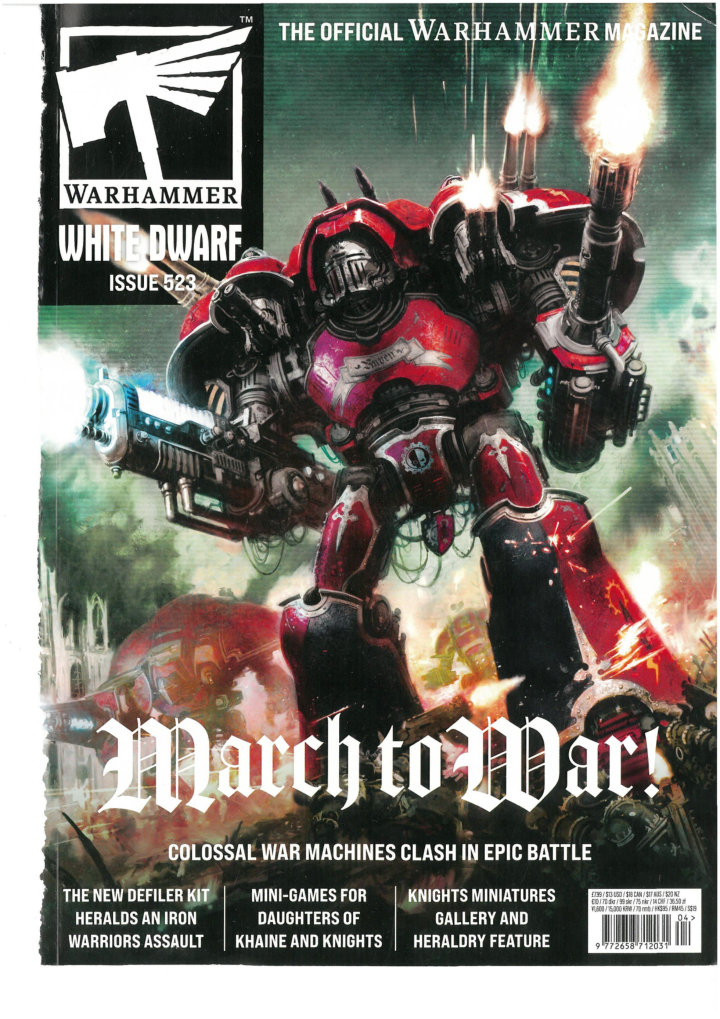
EditorialWD 523 · Unnumbered editorial
The editors introduce an issue devoted to Imperial and Chaos Knights and the new Iron Warriors releases, including the redesigned Defiler. They also explain the decision to publish Jamie Farquhar’s Iron Warriors collection as a tribute following his death in 2024: his conversions had already appeared throughout the magazine’s Arks of Omen storyline, but his whole army had never received its own feature.
Warhammer 40,000Imperial Knights
LoreWD 523 · pp. 2–13
Knightly heraldry records far more than a household’s preferred colours. This illustrated primer explains how the Code Chivalric makes crests, pennants, rank stripes and campaign badges a public statement of ancestry, allegiance and individual achievement, then compares Imperial, Mechanicus and Freeblade conventions. House Terryn and House Taranis demonstrate how historical victories and changes of allegiance gradually transform a crest.
Warhammer 40,000Imperial Knights
LoreWD 523 · pp. 3–5
Imperial household crests usually pair a family emblem with the Imperial aquila, expressing loyalty to both lineage and Emperor. The history of House Terryn traces its white horse from a founder’s vision through a monster-slaying victory to an oath of Imperial allegiance. Sir Monteryn’s banner illustrates how shared house devices sit beside personal campaign and kill honours, while rank stripes may even use pigments visible only through a Knight’s specialist sensors.
Warhammer 40,000Imperial Knights
LoreWD 523 · pp. 6–9
Households sworn to the Machine God express their fealty through metallic badges, the cog-and-skull Opus Machina and highly formalised insignia. House Taranis provides examples of recognition numbers and cogs with sacred technological meanings, while its evolving crest commemorates founding victories and later autonomy within the armies of Mars. Banner reverses also carry catechisms and ancestral honours for the lesser troops following behind.
Warhammer 40,000Imperial Knights
LoreWD 523 · p. 8
During the assault on Hyperior III, Ulantor leads House Taranis Knights and Martian Skitarii against Dark Mechanicum hereteks on an artificial world. The Red Doom survives the defences and destroys the occult machinery keeping the planet in orbit. A last evacuation saves Ulantor and a few Skitarii before the corrupted world falls into its star.
Warhammer 40,000Imperial Knights
LoreWD 523 · pp. 10–11
Freeblades include survivors, exiles and wandering champions whose lost households are replaced by personal quests. Their heraldry often discards old family devices in favour of individual mottos, skulls and other reminders of mortality, though a last surviving scion may instead preserve an exceptionally elaborate record of their lineage. Illustrated banners show how these choices turn an outcast’s armour into an account of identity and obligation.
Warhammer 40,000Imperial Knights
LoreWD 523 · pp. 12–13
When Wrath’s Fall is overrun after the Great Rift opens, Baroness Prime Klydia Irosta escapes with her household’s technological relics hastily embedded in her Knight. The artefacts become inseparable from its systems and reshape the voices within her Throne Mechanicum, from which the name Aereus emerges. Following her fallen princeps’ final command, she now guards sacred machines and the Omnissiah’s servants with relentless, sometimes unsettling devotion.
Warhammer 40,000Imperial Knights
ShowcaseWD 523 · pp. 14–29
The first half of this Knight gallery gathers loyal and fallen war engines from across the studio, pairing their invented histories with conversion notes and complete named painting recipes. Freeblades, House Hawkshroud, Nurgle-corrupted Knights and grotesque clone baronies demonstrate the range available within one model family. The accompanying advice encourages hobbyists to make birthplace, fighting style, personalities and allegiance visible in a household’s colours and heraldry.
Warhammer 40,000Imperial Knights
ModellingWD 523 · p. 15
A set of prompts turns a Knight collection into a household with a recognisable identity: decide where it lives, how it fights, who leads it and what its suits’ machine spirits are like before choosing livery and devices. House Lucaris illustrates the process with its devastated home world, aggressive tactics, unstable leadership and serpent heraldry. The emphasis is on making visual choices communicate a coherent background.
Warhammer 40,000Imperial Knights
PaintingWD 523 · p. 16
Ben’s Freeblade is piloted by Morgana Zosma, the last survivor of House Gottenheim, who erases her old heraldry and vows to protect those in danger. Muted bone, green and orange panels are built with mixed highlights rather than stark black-and-white contrasts, while freehand constellations hint at her origins. The recipe also covers dark metallic trim and the pale green glow of the weapons.
Warhammer 40,000Imperial Knights11 paint colours
PaintingWD 523 · p. 17
Sir Kellerbon watches Caledion IV’s salt flats for the return of daemons driven off by red-armoured angels generations earlier. Sam’s vivid yellow Knight turns that half-remembered ancestral oath into a striking House Hawkshroud model. Airbrushed Imperial Fist and Iyanden Yellow create the armour, contrasted with a shaded iron chassis, black panels and a luminous green plasma weapon.
Warhammer 40,000Imperial Knights11 paint colours
PaintingWD 523 · p. 18
Jason’s Knight Crusader has earned the right to display Salamanders colours after fighting beside the Chapter. The model is painted in subassemblies, with a metal chassis and airbrushed green armour. Its flames are approached in reverse: a white surface receives a yellow-to-red gradient, then Abaddon Black is painted around the flame shapes, avoiding the difficulty of building bright fire over black.
Warhammer 40,000Imperial Knights15 paint colours
PaintingWD 523 · p. 19
Lady Erasmyra Drayl abandons House Lucaris to serve alongside World Eaters, becoming a bloody icon to their Jakhals. James represents that history with handprints and runes across bone armour, plus a Corpse Cart brazier carrying the skulls of worthy foes. Blue-black panels and bright copper trim frame the model, with Skrag Brown beneath Blood for the Blood God producing dried and fresh-looking splashes.
Warhammer 40,000Chaos Knights10 paint colours
PaintingWD 523 · p. 20
Forger belongs to a household that nearly vanished during the Horus Heresy but preserved its allegiance to loyal Mechanicum forces. Pete poses the Knight with its chainsword extended in challenge and uses masking tape to divide the armour and shoulder heraldry cleanly. The compact recipe explains shaded red and white panels alongside silver trim, making the halved livery practical to reproduce.
Warhammer 40,000Imperial Knights6 paint colours
PaintingWD 523 · p. 21
Recovered millennia after its disappearance, Helios is repainted for Lord Ghawdex’s Iron Tide and given a new pilot whose identity remains secret. Dan links the Knight to his Iron Warriors with black-and-yellow panels and a hound-skull emblem from an old Blackshields transfer sheet. Separate recipes cover highlighted black, shaded yellow, streaked rust, a steel skeleton and layered brass.
Warhammer 40,000Chaos Knights13 paint colours
PaintingWD 523 · pp. 22–23
Matt’s fallen household spreads Nurgle’s blessings through heavily converted Knights and War Dogs, including Dunecrawler legs, Forgefiend parts and even an Empire Cannon face. Its Knight Tyrant incorporates Horticulous Slimux and Mulch to represent a possessed former ruler. Bright turquoise armour, dark brass and pale skin make the corruption stand out, while the recipe provides cracked sandy bases as well as the principal model colours.
Warhammer 40,000Chaos Knights14 paint colours
PaintingWD 523 · pp. 24–25
Charivari is an experimental Xanite Lancer piloted by a progressively degraded clone of Baron Zol Kothos. Rhuairidh removes armour and an arm, uses a Reaver Titan plate as a blank face, and adds turbines and bomb-shaped fuel tanks to create a disturbing, fast-moving silhouette. Stippled bone panels, worn iron trim and crimson-shaded gold support its appearance as an unnatural scavenger stalking a battlefield.
Warhammer 40,000Chaos Knights12 paint colours
PaintingWD 523 · pp. 26–27
The hungry machine spirit of Totentanz consumes its clone pilots, an end their barony perversely considers honourable. Its conversion combines Styrix and Castigator head parts, drilled-in spikes, an opened chest and foil banners cut from a tomato-paste tube. Textured black metal, rust, bone panels and red details reinforce the burned, corpse-laden effect; the modelling medium used for texture is described separately from the actual paint recipe.
Warhammer 40,000Chaos Knights13 paint colours
PaintingWD 523 · pp. 28–29
Daniel’s lance is led by Baroness Osanna Mordell in the Castellan Inviolate Will, supported by retainers with their own histories and heraldry. Much of the painting is airbrushed in separate armour and chassis assemblies, using Shade paints to form smooth gradients over yellow. Teal personal devices provide a contrast, and masking tape establishes the commander’s chequered faceplate before the final colour is sprayed.
Warhammer 40,000Imperial Knights11 paint colours
RulesWD 523 · pp. 30–43
Based on Imperial Knights: Renegade, this standalone game pits two super-heavy combatants against one another using secretly chosen actions and location-based damage. This instalment supplies Questoris and Abhorrent Knight profiles, movement and aiming tables, three missions and a short demonstration battle. Its central tension is deciding whether to fire quickly, spend time on an accurate shot, improve protection or manoeuvre into a decisive melee attack.
Warhammer 40,000Imperial Knights
RulesWD 523 · pp. 32–33
Each Knight normally spends three action points secretly selecting different actions, then both players reveal their plans and resolve them in a fixed sequence. Cheap snap shots occur before movement, while aimed fire consumes more resources and resolves later; matching actions require a roll-off. Movement can bend around obstacles and is followed by pivoting to face the opponent, so predicting an enemy’s next position matters as much as choosing a powerful weapon.
Warhammer 40,000Imperial Knights
RulesWD 523 · pp. 34–35
Ranged attacks nominate a square on the opponent’s location grid, then scatter horizontally and vertically according to the attack’s accuracy. Melee attacks strike a chosen location directly, making their limited reach exceptionally dangerous. Armour penetration, cover and each weapon’s damage determine whether a location is crippled; destroyed weapons and other damaged systems progressively restrict the Knight until six critically damaged locations bring it down.
Warhammer 40,000Imperial Knights
RulesWD 523 · pp. 36–37
The Questoris reference combines movement distances, ion-shield rotation, critical damage effects and a broad loyalist weapon list. The model’s actual equipment determines its available attacks, with options ranging from missile pods and conversion weapons to a chainsword or thunderstrike gauntlet. The layout makes weapons and vulnerable body sections part of the same tactical problem: a well-placed hit can remove an important capability before the Knight is destroyed.
Warhammer 40,000Imperial Knights
RulesWD 523 · pp. 38–39
The Chaos counterpart provides its own location grid and weapon table, including daemonbreath cannon, electroscourge, fellbore and warpstrike claw options. Its critical damage and ion-shield rules use the same framework as the loyalist Knight, allowing different loadouts to fight directly. A specific restriction on terrorpulse missiles also demonstrates that an attractive weapon option can come at the cost of defensive shield rotation.
Warhammer 40,000Chaos Knights
RulesWD 523 · p. 40
A fleeing commander hides amongst ruins while an enemy Knight hunts them, until a friendly super-heavy arrives to intervene. The attacker must destroy the defender before it can scan both designated terrain features by approaching them. This creates an asymmetric race between battlefield movement and destructive firepower rather than a simple exchange of shots until one engine falls.
Warhammer 40,000Imperial Knights
RulesWD 523 · p. 41
A Knight that has already broken through the front line confronts an equally powerful defender in the enemy’s rear. The attacker’s objective is to escape through the southern battlefield edge, while the defender must destroy it first. Terrain and the opposed deployment make decisions about running, charging and disabling leg sections central to whether the breakthrough continues.
Warhammer 40,000Imperial Knights
RulesWD 523 · p. 41
Two super-heavy combatants meet amongst ruined buildings and wrecked machines, setting aside the wider battle to settle a personal contest. The mission uses a direct destruction objective, with the first player to bring down the opposing Knight winning. Its straightforward deployment makes it a useful setting for learning how weapon range, cover, action timing and critical damage interact.
Warhammer 40,000Imperial Knights
Battle reportWD 523 · pp. 42–43
Ben’s Pavise Maxima attempts to stop Dan’s Gilded King in a demonstration of Unstoppable, Immovable. Dan advances aggressively while taking inaccurate snap shots; Ben uses standard fire and then aimed attacks as the distance closes, destroying several locations including the renegade’s head. The Gilded King reaches melee and inflicts a brutal chainsword strike, but Pavise Maxima survives to deliver the killing blow.
Warhammer 40,000Imperial Knights
InterviewWD 523 · pp. 44–51
The miniatures designers explain how the new Defiler moves away from the original tank-on-legs shape towards the fleshy, curved forms of newer Daemon Engines. Organic joints, alternative torsos, socketed arms and repositionable legs combine a strong flowing silhouette with considerable posing freedom. The feature also introduces Kravek Morne, new Mutilators and an Iron Warriors upgrade frame, showing how their shared mechanical and daemonic details reinforce Legion identity.
Warhammer 40,000Chaos Space Marines
ModellingWD 523 · pp. 45–49
The redesigned Defiler combines shorter legs, a taller organic torso and hanging cables into an S-shaped profile that can be posed more freely than a purely mechanical vehicle. Locator tabs can be removed to alter its stance while pipes still meet their sockets, and ten faceplates support several Traitor Legion identities. A retrospective places the kit alongside the original Defiler’s early codex appearance and first miniature reveal.
Warhammer 40,000Chaos Space Marines
ModellingWD 523 · p. 50
Kravek Morne represents an Iron Warriors commander specialised in smashing through fortifications rather than directing a distant siege. His augmented Cataphractii armour balances a planted, advancing stance with restless servo-arms and mechatendrils, echoing Perturabo’s imagery. The Last Argument hammer hints at a connection with Vashtorr, while a raised spinal interface visibly links his auxiliary tools to the implants in his head.
Warhammer 40,000Chaos Space Marines
ModellingWD 523 · pp. 50–51
The Mutilators’ design presents close-combat weapons as things absorbed into a Chaos warrior’s body rather than carried in the hands. Blades, mauls and flails emerge directly from swollen flesh and armour, with cables and pipes taking the place of natural structures. Shared reactors and layered shoulder armour establish a common silhouette while different heads and mutations underline how far individual warriors have lost their original identities.
Warhammer 40,000Chaos Space Marines
ModellingWD 523 · p. 51
The Iron Warriors upgrade frame adapts Heresy-era Mark III cues to a later, more threatening Legion appearance through narrower faceplates, heavy banding, studs and bionics. It provides helmeted and exposed heads, numerous Legion shoulder pads and bionic arms with a hammer or power fist. The designers explain how these details make ordinary Legionaries read immediately as Iron Warriors without requiring a complete replacement kit.
Warhammer 40,000Chaos Space Marines
PaintingWD 523 · p. 52
James equips his Night Lords Defiler with his favourite weapons and divides it into head, torso, arms and claws for painting. He paints the trim before filling the armour panels, simplifying the crowded Chaos detail, and sets red-tinted flesh against dark blue armour. The named recipe covers layered blue highlights, pink flesh, shaded steel and brass, while a Dark Angels trophy provides a small narrative connection to the Legion’s enemies.
Warhammer 40,000Chaos Space Marines13 paint colours
PaintingWD 523 · p. 53
Matt adds a Defiler to his Vashtorr-led Word Bearers, choosing the ectoplasma destructor, fiery weapons and electroscourge to match the army’s possessed machines. Raised claws make the otherwise standard leg arrangement more aggressive, while separate assemblies keep the painting accessible. The recipe combines progressively highlighted brown flesh, deep red armour and silver trim shaded with blue, with a darker steel finish on the iron parts.
Warhammer 40,000Chaos Space Marines11 paint colours
PaintingWD 523 · p. 54
Jes uses the Defiler as an early addition to a new Emperor’s Children army, starting with a sprayed metallic foundation and picking out selected brass areas before the first all-over wash. Careful drybrushing restores the exposed metal, then purple panels and pale flesh are built over that framework. Glazed highlights and purple-tinted shading give the skin a smooth, unhealthy appearance that complements the extravagant armour.
Warhammer 40,000Chaos Space Marines11 paint colours
PaintingWD 523 · p. 55
Dan’s infantry-heavy Iron Warriors receive long-ranged support from a Defiler armed with the Hades battle cannon and paired lascannon sets. A Sector Mechanicus component is trimmed to fit the base, and the legs are reposed to meet its industrial surface. The recipe contrasts black armour and hazard chevrons with steel, brass, painted rust streaks and a cool blue-grey base weathered with corrosion and orange.
Warhammer 40,000Chaos Space Marines17 paint colours
ShowcaseWD 523 · pp. 56–65
Jamie Farquhar’s extensively converted Iron Warriors receive a posthumous army feature, retaining the words and photographs prepared before his death in August 2024. He describes how John Blanche’s art, siege warfare and an affinity with Perturabo shaped a collection exceeding 800 models. Mechanical alterations, evolving character incarnations and trophies from memorable opponents turn the army into a continuing record of games and friendships.
Warhammer 40,000Chaos Space Marines
CommunityWD 523 · pp. 58–59
Jamie traces his army’s beginnings to the Chaos conversion artwork in White Dwarf 202 and later Index Astartes material, supported by Iron Warriors fiction and a longstanding interest in siegecraft. He returns to those older inspirations during lockdown to make his own versions of classic conversions. His account presents modelling as a way to express stories and personal connections, including why Perturabo’s frustrations resonated with him.
Warhammer 40,000Chaos Space Marines
PaintingWD 523 · p. 60
Jamie gives his Iron Warriors aged silver armour through repeated washing and drybrushing, contrasting it with brighter gold trim and the dark blue cloth used across his successive armies. Black-and-yellow hazard patterns receive metallic stippling so the markings look as battle-worn as the armour. The full recipe records iron, cloth, gold and both halves of the chevrons rather than reducing the scheme to its main silver colour.
Warhammer 40,000Chaos Space Marines18 paint colours
ShowcaseWD 523 · p. 61
Three character conversions made for White Dwarf’s Arks of Omen storyline remain display pieces within Jamie’s wider collection. He has also built another Warsmith Czagra for use in games, separating the original narrative model from its tabletop counterpart. The page illustrates how named personalities can continue through a collection while particular miniatures preserve the moment in which a story was created.
Warhammer 40,000Chaos Space Marines
ModellingWD 523 · pp. 62–63
Jamie’s Knight Despoiler Mortis is conceived as the engine that opens a breach for the Iron Warriors. The conversion combines an Imperial Knight, three old Chaos Hellcannons and a Plague Furnace censer, then accumulates new equipment and trophies as the years pass. Individual helmets commemorate specific opponents and milestones, including a thousandth Iron Warriors game, making the model a physical record of shared battles.
Warhammer 40,000Chaos Space Marines
ModellingWD 523 · pp. 63–65
The closing army details show how Jamie keeps the Iron Warriors’ mechanical character even when representing mutated units. A Venomcrawler joins a Helstalker front to a Venomcrawler rear, Obliterators combine an eclectic range of industrial and weapon components, and older Dreadnought models stand in for Helbrutes. Devastator backpacks supply ammunition storage for Havocs, while trophies and corpses preserve links to opponents and local gaming communities.
Warhammer 40,000Chaos Space Marines
RulesWD 523 · pp. 66–81
An exploration of Khainite gladiatorial worship leads into a cooperative battlepack in which four challengers attempt to ascend the Tower of Blades. Players combine fighting styles, random origins and flaws, then face generated floors with increasingly resilient enemies, magical hazards, injuries and upgrades. The tower can be run by an additional player or through an enemy behaviour chart, supporting both group play and a single player controlling the whole party.
Age of SigmarDaughters of Khaine
LoreWD 523 · pp. 66–69
For the Daughters of Khaine, arena combat simultaneously honours their god, hones collective battlefield skill and offers a route to prestige. The austere Draichi Ganeth sect takes that ideal to its extreme in the Tower of Blades, where ordinary monsters share floors with magical ordeals, lethal reflections and psychological trials. The Iron Hags choose most entrants, but Death Night opens the challenge more widely; only eight warriors are said to have conquered the tower.
Age of SigmarDaughters of Khaine
LoreWD 523 · p. 69
The arena’s champions belong to distinct martial traditions, from showy Gladiatrixes and polearm-wielding Valthrain to illusion-using Mircaitha and devotional Hekaritrices. Rarer specialists include masked Slaughter-Sisters, aelves borrowing Scathborn arms and blindfolded Corvintathi associated with Morai-Heg. These descriptions explain why superficially similar Khainite gladiators may approach an ordeal through spectacle, faith, precision or deception.
Age of SigmarDaughters of Khaine
RulesWD 523 · pp. 70–73
Players build a party of four challengers from a common starting warscroll, selecting a fighting style and then rolling an origin and flaw for each. The printable record leaves room to track the resulting abilities and later developments. Daughters of Khaine models are recommended, with small bases preferred, but the rules encourage using suitable miniatures already available rather than requiring a particular new kit.
Age of SigmarDaughters of Khaine
RulesWD 523 · p. 71
Four fighting styles give each challenger a different contribution to the party. Gladiatrixes control enemy attention and inspire extra fighting, Valthrain risk everything on decisive blows, Mircaitha combine shadow shooting with relocation, and Hekaritrices offer prayers that improve attacks, protection or recovery. The options reward coordination, as a useful supporting ability can be more valuable than four characters pursuing individual damage.
Age of SigmarDaughters of Khaine
RulesWD 523 · p. 72
Random origins provide benefits reflecting past training, divine attention or hidden allegiances, while flaws impose liabilities such as old wounds, excessive caution, selfishness or a compulsion to seek battle. Because the results sit on the challenger’s warscroll, they continually influence positioning and cooperation. A promising fighter may need careful support to offset the very personality trait that gives the character its identity.
Age of SigmarDaughters of Khaine
FictionWD 523 · p. 74
Drakana’s dwindling party confronts a captive Treelord on an icy floor of the Tower of Blades. A coordinated distraction and poisoned shot bring down the forest spirit, but the surviving gladiators remain fiercely distrustful even when one offers another a hand. Their progress to the next floor exposes the contradiction at the heart of the trial: cooperation keeps them alive, while their culture treats dependence as weakness.
Age of SigmarDaughters of Khaine
RulesWD 523 · pp. 75–77
The battlepack adapts the Age of Sigmar turn sequence so the challengers act together before the enemy, sharing command points and resolving friendly attacks before the enemy’s turn. Each floor combines a randomly selected opponent with a twist, and higher floors add another twist to the encounter. A small board with impassable terrain keeps the action concentrated, while a behaviour chart directs enemies towards a chosen focus if no separate opponent is playing them.
Age of SigmarDaughters of Khaine
CampaignWD 523 · pp. 76–81
Surviving a floor removes current wounds but leaves the campaign’s longer-term consequences intact. Fallen challengers return with randomly determined injuries, while those who stayed alive generate upgrades that can be allocated to party members. The injury table includes impaired movement, unreliable courage and reduced attacks; upgrades improve characteristics, add critical effects or grant a ranged weapon, encouraging the group to balance damaged specialists against rising threats.
Age of SigmarDaughters of Khaine
RulesWD 523 · p. 77
The floor generator introduces environmental threats and opportunities rather than merely increasing enemy statistics. Mirrors can restrict effective fighting areas, blood magic may heal or punish clustered warriors, and unstable ground or frozen floors change movement decisions. A second opponent can appear, while the apparent summit comes with a warning about Ulgu’s deceptive nature; the result keeps repeated ascents from following a predictable sequence.
Age of SigmarDaughters of Khaine
RulesWD 523 · pp. 78–80
The enemy set offers six distinct encounters, each with suggestions for suitable miniatures and permission to substitute other models. A twisted Treelord and magical viper manipulate position, a regenerating troggoth rewards surrounding it, and a burning avatar exposes a weakness after charging. The phantasm can turn a challenger against allies, while a cracked crypt produces undead opponents and punishes immobility, creating very different tactical puzzles.
Age of SigmarDaughters of Khaine
RulesWD 523 · p. 78
The Twisted Treelord pulls distant challengers closer and lashes those already within reach, with its binding effect becoming harder to escape on later visits. The Blood-drenched Viper instead relocates towards a distant target and may resist damage unless the party dispels its protection. Together these warscrolls demonstrate how the tower forces players to adapt their formation rather than simply surround every enemy.
Age of SigmarDaughters of Khaine
RulesWD 523 · p. 79
The Pit Troggoth’s escalating regeneration makes sustained pressure essential, but engaging it with several challengers confuses it and divides its attacks. The Ironshod Avatar presents the opposite problem: its burning surface punishes poor strikes, while a recent charge briefly leaves a weakness in its defences. Both profiles turn the choice of when and how to commit the party into the key to surviving the floor.
Age of SigmarDaughters of Khaine
RulesWD 523 · p. 80
The Hypnotic Phantasm interferes with the party directly by possessing a challenger and can escape if too many opponents engage it. The Cracked Crypt is an immobile encounter that summons additional undead when attacked and damages challengers who fail to move. Its accompanying Undead Combatant profile supplies the lesser enemies, with model suggestions deliberately broad enough to include several existing collections.
Age of SigmarDaughters of Khaine
CampaignWD 523 · pp. 82–91
The four collectors expand their forces to the next campaign milestone, add faction terrain or Landmarks of Ghyran, and continue their Blighted Wilds games. Their routes converge on Cursed Kernel, a scenario whose moving objective produces several stubborn draws before the warlords find a way forward. Updated rosters, painting progress and candid reports show the practical difference between defeating enemy units and actually completing the battleplan.
Age of SigmarSoulblight Gravelords
CampaignWD 523 · pp. 84–85
Amber spends more time playing and establishing her dynasty’s identity after a relatively small painting target. Wolves and petunias become heraldic symbols of the family’s hope, resentment and vengeance, while Sekhar joins as an uneasy ally and the Cursed Sepulchre supplies faction terrain. A draw against the faster Gitmob and a win against Stormcast Eternals reinforce the value of keeping the Deathrattle horde together and supporting it with more Barrow Knights.
Age of SigmarSoulblight Gravelords
PaintingWD 523 · p. 85
Amber constructs the petunia device from three rough diamond shapes in thinned Rhinox Hide, then simplifies them into small house-like outlines. Black Legion makes the final shapes more definite, after which dots and inward lines cut the design into petals. The method separates planning from neat finishing, allowing an intricate-looking emblem to be built from a handful of manageable marks.
Age of SigmarSoulblight Gravelords2 paint colours
PaintingWD 523 · p. 85
The rampant wolf begins as a pattern of small guide dots centred on the banner, followed by a thin sketch that can easily be corrected. Amber traces the figure with Black Legion and uses the Zandri Dust background colour to cut back around limbs, mouth, eye and fur. This makes the final silhouette crisp without requiring every detail to be perfect on the first pass.
Age of SigmarSoulblight Gravelords3 paint colours
CampaignWD 523 · pp. 86–87
Andrew’s Stormcasts struggle to convert combat strength into control of the Cursed Kernel. A hard-fought draw against Dan is followed by defeat against Amber, when slow Annihilators miss their opportunity and expend their frustration on a Cursed Sepulchre. His collection adds reinforced Vindictors and the Divine Visage, a broken monumental head representing a Landmark of Ghyran and the remnants of the Age of Myth.
Age of SigmarStormcast Eternals
CampaignWD 523 · pp. 88–89
Dan’s army progresses through purifying tainted terrain more reliably than through winning battles, and he chooses to retain lasting scars as part of its story. New arrivals include a Fusi-Major, another cannon and a heavily armoured marshal with a converted young envoy. The overgrown Fountain of Futilia becomes a magically defended Landmark, while a draw against Stormcasts and defeat against the speedy Gitmob reveal the limitations of the army’s battlefield reach.
Age of SigmarCities of Sigmar
CampaignWD 523 · pp. 90–91
Matt reinforces chariots and Snarlfang Riders rather than adding a rival named leader, keeping Brillz at the centre of his army’s story. Games reveal a force that can pin enemies and race between objectives but struggles to penetrate heavy armour, making wolf attacks, the Doom Diver and magical mortal damage especially valuable. His Cursed Kernel plan secures a draw against Amber and then a decisive win over Dan.
Age of SigmarGloomspite Gitz
ModellingWD 523 · pp. 92–95
Andrew creates overgrown ruins for the campaign in Ghyran, treating terrain as the visual setting that makes a battle belong to a particular place. Shaped XPVC bases define gameplay boundaries and leave room for slate, twigs and vegetation, while subdued, varied stone suggests architecture slowly reclaimed by nature. A detailed paint sequence and a separate mossy-scenery contribution from Dan show how different collections can still share a coherent battlefield.
Age of Sigmar
PaintingWD 523 · p. 93
Andrew begins the ruins with black primer and a grey spray, then shades them with a thinned dark-brown-and-black mixture. Relayering and progressively lighter drybrushing restore the stone texture before burgundy and green glazes introduce natural variation. A final pale drybrush ties the surface together, while the skulls and earth are matched to his existing bases without supplying an additional named recipe for those details.
Age of Sigmar11 paint colours
ModellingWD 523 · p. 94
A step-by-step construction guide places a terrain piece on a shaped XPVC base with bevelled edges, then blends it into the ground with modelling putty. Foraged slate and twigs supply convincing natural detail, and plastic skulls provide a setting-specific accent. After priming and painting to match the rest of the collection, layers of flock, foliage and tufts create the appearance of long-established, overgrown ruins.
Age of Sigmar1 paint colour
PaintingWD 523 · p. 95
Dan offers a quicker scenery scheme that remains compatible with Andrew’s Ghyran terrain. A pale zenithal layer over black is shaded with diluted Militarum Green, then drybrushed, while the ground follows the same greens as his army bases. Stippled moss adds another layer of vegetation, and the explicit use of Contrast Medium keeps the stone’s wash translucent rather than obscuring the lighter foundation.
Age of Sigmar10 paint colours
FictionWD 523 · pp. 96–105
After their Valkyrie is shot down, Elias Bain and the understrength Callous Jacks must rescue a Ketanrin legate and his surviving niece from an immobilised Chimera. Bain discards the official’s precious possessions to make room for his men, then fights a desperate retreat through the jungle with an Ork pursuit closing on their failing transport. Calling friendly artillery onto their own position becomes their best chance of reaching the Imperial lines.
Warhammer 40,000Astra Militarum
CommunityWD 523 · pp. 106–107
The Bunker introduces its psykers, sorcerers and supernatural painting challenge, invites future themed gallery submissions and previews the Models for Heroes exhibition feature. The regular achievement system rewards games and painting with monthly points and cumulative ranks. A challenge log and annual schedule help readers organise entries, while the editorial explains why a reader’s letter grew into a larger celebration of a supportive hobby community.
CommunityWD 523 · pp. 108–109
Readers share an Imperial Fists successor Chapter developed after a create-your-own-Chapter feature, a converted Minotaurs officer photographed at Knossos, and Nurgling-based markers that make a Death Guard army’s affliction effects easier to track. The exchange connects background writing, travel photography and practical gaming aids. A separate Grombrindal answer explores how Salamanders religious traditions sit alongside Imperial beliefs.
Warhammer 40,000Space Marines
LoreWD 523 · p. 109
A reader asks whether the Salamanders worship the Emperor as a god or follow the more usual Space Marine pattern of ancestor reverence. Grombrindal explains their Promethean tradition through Vulkan’s teachings, self-reliance, sacrifice and symbolic fire rituals, while distinguishing their Emperor-veneration from the Black Templars’ explicitly divine worship. Nocturne’s creatures and the mythic Outlander also form part of the Chapter’s religious identity.
Warhammer 40,000Space Marines
ShowcaseWD 523 · pp. 110–111
The issue’s Knight theme extends to a paired reader gallery: Gregor Pilarski’s Knight Preceptor Mordred and Adam Staincliffe’s Knight Tyrant Memento Mori. The large photographs invite comparison between a loyalist champion and its fallen counterpart, using contrasting heraldry, finishes and silhouette. No named painting recipes accompany the two models, so their colours are presented as visual inspiration rather than reconstructed instructions.
Warhammer 40,000Imperial Knights
ShowcaseWD 523 · pp. 112–115
Readers answer the supernatural painting challenge with wizards and psykers from several settings, including Aeldari Farseers, Ahriman, Radagast, Teclis, a Plaguecaster and a Neurotyrant. The gallery ranges from individual spellcasters to the Purple Sun manifestation, illustrating how magic can be conveyed through both figures and effects. Sarah Berens’s Be’lakor receives the Model of the Month spotlight and a short explanation of its eerie contrast and energy colours.
Warhammer 40,000Age of SigmarAeldari
PaintingWD 523 · p. 115
Sarah Berens contrasts Be’lakor’s dark body with pale flesh and leathery wings, using airbrushed transitions followed by bright edge highlights. Diluted speckles add irregular wing texture instead of leaving the surfaces uniformly smooth. Turquoise magical energy runs through the sword, chest symbol and base cracks, with Kabalite Green and Sybarite Green explicitly identified as the colours that connect those separate areas.
Warhammer 40,000Age of SigmarChaos Daemons2 paint colours
ShowcaseWD 523 · pp. 116–117
The studio’s matching gallery contributes orc shamans, Aeldari Farseers, rogue psykers and Vizzik Skour to the supernatural theme. Individual painters interpret magical subjects across different Warhammer ranges, showing how a single prompt can support both restrained character models and imposing centrepieces. These captioned photographs name their contributors and subjects but supply no paint recipes.
Warhammer 40,000Age of SigmarAeldari
CommunityWD 523 · pp. 118–123
A letter from Mick Wilson introduces Models for Heroes, the group founded by Malcolm Childs to support serving and former armed-forces and emergency-services personnel through model making. Wilson describes discovering Warhammer during a January 2025 visit and later contributing painted miniatures to a Warhammer World display. Photographs and participants’ own reflections explore what concentration, creativity, achievement and companionship have meant in their personal lives.
CommunityWD 523 · pp. 119–123
Exhibitors from Models for Heroes explain their work through short statements and three words describing what the hobby means to them. Their accounts emphasise experiences such as peaceful concentration, renewed confidence, fellowship and rediscovering a long-abandoned creative interest. The accompanying miniatures make these personal stories visible, while some participants describe sharing the hobby further through group sessions or a school club.
CommunityWD 523 · pp. 124–126
The team reports hobby progress ranging from Sekhetar Robots and Heresy-era Iron Warriors to a converted Freeguild officer and a Vampire Lord. Short painting explanations sit beside personal stories, model-building choices and the running bingo totals. An extra page of tiny Knights links the issue’s main theme to Epic-scale collections, demonstrating how familiar household ideas can work at very different miniature scales.
PaintingWD 523 · p. 124
Matt paints his Sekhetar Robots in silver and brass rather than a bone scheme, keeping the arms separate while spraying the metallic base. Nuln Oil and a bright silver highlight define the steel, while shaded bronze receives progressively lighter metallic highlights. Green markings connect the machines to his recently painted Rubric Marines, although the products used for those markings are not named.
Warhammer 40,000Thousand Sons6 paint colours
PaintingWD 523 · p. 124
Adam’s new Legionaries wear Mark IV armour to represent recruits replacing losses after the Horus Heresy has begun. A black foundation and successive metallic drybrushes give them a darker, grittier appearance, followed by two washes and contrasting brass details. Sponging establishes the chevrons before battle damage is added, reinforcing the unit’s industrial character without changing its recruitment story.
The Horus HeresyIron Warriors6 paint colours
ModellingWD 523 · p. 125
Ben paints the Cavalier-Marshal’s horse after a brown horse he once knew and replaces the rider’s head with a weathered one from the Traitor Guardsmen upgrade frame. The swap changes the impression from polished commander to wandering knight or hired sword. Named Errol the Bald for his receding hairline, the model demonstrates how a small conversion and a personal reference can establish character without an elaborate new build.
Age of SigmarCities of Sigmar
PaintingWD 523 · p. 125
Amber revisits an earlier Soulblight army rather than her current Warlords collection, borrowing the purple armour idea she admired on Lauka Vai. Shyish Purple over Grey Knights Steel produces the principal metallic colour, supported by brass shaded with Reikland Fleshshade. A pale green complexion gives the vampire an unhealthy appearance, though no named skin recipe is provided.
Age of SigmarSoulblight Gravelords4 paint colours
PaintingWD 523 · p. 126
Matt’s Epic-scale House Hermetika Knights accompany his Legio Ignatum Titans, echoing their shared service on Beta-Garmon and their compatible colour schemes. Masking tape creates crisp white stripes over red and black panels, while a blue-and-yellow Freeblade recalls older Knight colour schemes. The metalwork deliberately reuses the Sekhetar Robots method described earlier in the issue, connecting the tiny war engines to an established, repeatable recipe.
Adeptus TitanicusLegions ImperialisImperial Knights6 paint colours
ModellingWD 523 · p. 126
Rhuairidh’s Nal-Haxan Experimental Division explores the idea that Knight suits existed in many experimental forms before the Imperium. Converted Epic-scale machines echo the deliberately lopsided silhouettes of his full-sized Chaos Knights, combining components from several larger kits with tiny Knight bodies. Taser weapons, gang equipment, Ambot parts and a full-sized missile launcher make each engine feel like an unsettling prototype rather than a uniform production model.
Legions ImperialisHouse Malinax
RulesWD 523 · Unnumbered card insert
Four sides of reference cards reproduce the tools needed to run Questoris and Abhorrent Knights in Titanic Duel: location grids, action costs, movement, aiming, critical damage and weapon options. They bring the information from the main rules feature together for use beside the table. The insert supports the issue’s standalone duel system and is not a separate set of Warhammer 40,000 datasheets.
Warhammer 40,000Imperial Knights
RulesWD 523 · Unnumbered card insert
This mission centres on an arcane device that shrouds nearby units in darkness, restricting attacks and stratagem use from outside its immediate vicinity. Players can temporarily disable the effect by controlling supporting objectives, gaining points for doing so as well as for seizing and holding the centre. The competing rewards invite a choice between embracing the device’s power and denying it through repeated deactivation.
Warhammer 40,000
RulesWD 523 · Unnumbered card insert
Magically significant objectives favour wizards, priests and heroes carrying artefacts, preventing ordinary units from contesting them against those empowered rivals. The underdog can extract an ancient relic to improve a hero’s weapon and give that model the required status. Standard objective scoring and a five-round game are combined with battle-tactic tie-breaks, making the choice and preservation of powerful characters particularly important.
Age of Sigmar
April 2026 features and all supplied Titanic Duel and Bunker cards are indexed. Monthly scenario cards and the Bunker log carry May labels. The contents places Hobby Hangout at page 98; its actual pages are 92–95. Covers, contents, advertising and decorative material are excluded. Named recipes were checked visually, and first-name-only studio credits are retained without guessed surnames.