EditorialWD 449 · p. 1
The editor introduces a festive issue built around new ways to play, from a multiplayer wizard race to aerial battles and a Gotrek challenge. The accompanying gifts connect those projects with the month’s magazine, encouraging readers to use a quieter season for both painting and games.
CommunityWD 449 · pp. 4–7
Reader letters consider custom army traits and the Christmas possibilities of miniature collecting, with photographs of an outdoor Kill Team game and a Hobbit-themed decoration. Painting questions and a converted Kroot collection broaden the section into practical advice and examples of personal projects.
PaintingWD 449 · p. 4
Dan Hyams’s question prompts a recipe for pale pink Chaos armour stained with carefully diluted brown streaks. Green cloth provides a cool contrast, while progressively lighter flesh colours pick out the armour’s edges without losing the sickly appearance that distinguishes the warband.
Warhammer 40,000Chaos Space Marines11 paint colours
LoreWD 449 · p. 5
Grombrindal considers the absent ancestor goddess through the beliefs and shrines of the duardin. The answer preserves uncertainty about her whereabouts rather than supplying a definite fate, illustrating how devotion to a missing deity can continue to shape the peoples of the Mortal Realms.
Age of SigmarDuardin
PaintingWD 449 · p. 5
Francesco Olivieri gives a Primaris Lieutenant the red heraldry of a Sword Brother and a near-black armour mixture with a small blue component. Successive grey and white marks define damage and sharp highlights, giving an otherwise dark miniature readable edges and a worn campaigning appearance.
Warhammer 40,000Black Templars5 paint colours
Army showcaseWD 449 · pp. 6–7
Andrew Bailey’s Kroot mercenaries use scavenged machinery to stand in for an Adeptus Mechanicus army after escaping the Fourth Sphere’s violence. Kroot torsos on mechanical legs, a Krootox-hauled walker and a bionic Great Knarloc turn a background premise into a consistent collection of unusual vehicles and infantry.
Warhammer 40,000Kroot
PaintingWD 449 · pp. 6–7
The Ironbeaks combine warm, shaded flesh with cool blue quills and restrained red markings. Bailey credits his painting collaborator Tim, and explains how thin glazes and progressively paler flesh highlights maintain a unified organic appearance across a collection assembled from very different kits.
Warhammer 40,000Kroot9 paint colours
LoreWD 449 · pp. 8–11
Phil Kelly explores how invented names acquire spoken forms through writers, editors, audio performers and players. Examples from the Mortal Realms and the far future show the ambiguities of English spelling, with room for regional habits and personal preference rather than a compulsory pronunciation for every unfamiliar word.
Age of SigmarWarhammer 40,000
ModellingWD 449 · pp. 14–21
The crossroads of the Eightpoints inspires scarred warriors, scavenged equipment and remnants of older civilisations. Painted examples range from burning Sylvaneth to tainted Stormcast, while conversion projects and scenery recipes demonstrate that a shared setting can unite very different palettes and factions.
Age of SigmarWarcry
PaintingWD 449 · p. 16
Ashley Lowe reverses the usual woodland palette by suggesting flame beneath blackened bark. Bright orange and yellow interiors remain visible between dark, progressively highlighted branches, making the tree spirits appear scorched and animated from within rather than simply painted red.
Age of SigmarSylvaneth6 paint colours
PaintingWD 449 · p. 16
Aly Morrison uses a crackling texture before painting a pale, stained finish over the miniature. The result resembles damaged ceramic rather than conventional shining armour, giving a Stormcast hero a visibly altered surface suited to a long exposure to the Eightpoints.
Age of SigmarStormcast Eternals3 paint colours
PaintingWD 449 · p. 17
Andy Barlow’s Warcry collection develops several pink tones from a restrained selection of contrasting red areas and a translucent pink paint. The commentary emphasises the variety available within a small palette, giving the warband a recognisable identity without making every surface identical.
WarcryDaughters of Khaine1 paint colour
PaintingWD 449 · p. 17
Steve Party adapts the Corvus Cabal to a desert environment through a predominantly monochrome finish and dark feathers. The limited palette allows the avian forms and equipment to carry the theme, showing how an existing warband can suggest a different habitat through painting alone.
WarcryCorvus Cabal2 paint colours
PaintingWD 449 · p. 17
John Ashton gives Vanguard-Raptors a weathered appearance with textured corrosion and orange rust. A small red accent interrupts the worn metal, making the warriors appear like experienced inhabitants of a hostile landscape while preserving a clear visual focus on each miniature.
Age of SigmarStormcast Eternals2 paint colours
PaintingWD 449 · p. 18
Israel Gonzalez combines watery green spectral layers with concentrated orange and yellow light. Swapped heads and weapons individualise the Thorns of the Briar Queen, while Neferata components elevate the leader; the strong warm highlights make the ghostly forms appear illuminated against their cooler bodies.
Age of SigmarNighthaunt4 paint colours
ModellingWD 449 · p. 18
Ashley Lowe combines an Eternal Guard hood, a Black Ark Fleetmaster’s hook and Escher accessories with an Idoneth Tidecaster. The altered silhouette and scavenged details make the figure seem adapted to the Eightpoints, while a murky green finish reinforces the departure from a bright oceanic setting.
Age of SigmarWarcryIdoneth Deepkin
ModellingWD 449 · p. 18
Ant Saliba equips a Megaboss with additional trophies and an imposing double axe. Black and red bind the conversion to the region’s brutal imagery, using familiar orruk components to suggest a particularly successful survivor rather than replacing the character’s recognisable underlying form.
Age of SigmarWarcryIronjawz
ModellingWD 449 · p. 19
Maxime Pastourel contrasts industrial yellow armour with dark, icy bases and a selection of striking component swaps. A large hammer and Space Marine head distinguish the Dominar, while parts drawn from a Skaven miniature create an unusual legionary without breaking the warband’s heavy workshop aesthetic.
Age of SigmarWarcryIron Golem
ModellingWD 449 · p. 19
Adam Cooper mixes Ironskull’s Boyz with Brute and Ardboy components to build a cohesive Ironjawz group. The conversions retain a broad orruk silhouette while changing equipment and poses, and their battered appearance suggests warriors whose armour has endured the harsh conditions of the Eightpoints.
Age of SigmarWarcryIronjawz
PaintingWD 449 · pp. 20–21
The Warcry ruins guide uses a pale undercoat and translucent colours to establish four different stone finishes, then adds simple wood and metal recipes. Painting one horizontal wall face at a time controls pooling, while drybrushing, mud and algae turn the clean stages into aged scenery suitable for a shared battlefield.
WarcryAge of Sigmar16 paint colours
PaintingWD 449 · pp. 20–21
Two cool grey stone variants share the same pale undercoat and white drybrush but use different translucent base colours. The comparison demonstrates how a small change in the middle stage alters the apparent temperature of masonry while preserving a consistent method across large terrain pieces.
WarcryAge of Sigmar4 paint colours
PaintingWD 449 · pp. 20–21
Turquoise stone receives a matching pale blue drybrush, while the ochre alternative uses a bone-coloured highlight. The latter also colours the caps of the principal grey ruins, showing how contrasting masonry can be combined within one structure instead of assigning a single colour to every block.
WarcryAge of Sigmar5 paint colours
PaintingWD 449 · pp. 20–21
Wooden stairs and metal gratings receive quick, separate finishes before the surrounding stone is dirtied with texture and drybrushing. Green staining is concentrated near the lower portions of walls, linking the terrain to its ground surface and introducing age without obscuring the architectural detail.
WarcryAge of Sigmar9 paint colours
RulesWD 449 · pp. 22–25
Four wizards race through a magical tower in Chamon whose awakening has drawn them toward a dangerously powerful centre. Players balance movement, stored power and opportunities to cast, with rune spaces, collisions and counterspells turning a simple inward race into an interactive contest over position and resources.
The Spellflux Spire
RulesWD 449 · pp. 24–25
Casting exhausts a wizard and risks opposition from rivals who can spend power to unbind the spell. Fireballs push enemies back, draining magic changes their reserves, and flight offers a burst of movement, so the timing of a spell matters as much as its immediate effect on the board.
The Spellflux Spire
RulesWD 449 · pp. 26–29
Gotrek’s search for Felix brings him to the Eightpoints and into two unusual Warcry challenges. His exceptional resilience and unusually frequent actions make him a scenario figure rather than a normal points purchase, with one quest built around hunting monsters and the other around surviving the Slayer himself.
WarcryGotrek Gurnisson
RulesWD 449 · p. 27
The printed fighter profile gives Gotrek a short move but formidable durability and close-combat damage. Extra movement, attacks and damage reduction reinforce his role as a lone legendary warrior, and the surrounding text limits his use to the specially designed challenges rather than supplying an ordinary warband cost.
WarcryGotrek Gurnisson
RulesWD 449 · p. 28
An Order warband joins Gotrek in a monster hunt whose real quarry is hidden among several possible targets. Replenishing monsters keep the pressure on the expedition, while discovering and killing the prime creature determines the outcome and treasure rewards turn the encounter into a campaign opportunity.
WarcryGotrek Gurnisson
RulesWD 449 · p. 29
A Chaos warband stakes territory on its ability to confront Gotrek as he repeatedly activates during the battle. Survival time, damage inflicted and the possibility of finally killing the Slayer create different degrees of reward, allowing a heavily outmatched force to measure success by more than simply holding the field.
WarcryGotrek Gurnisson
LoreWD 449 · pp. 30–37
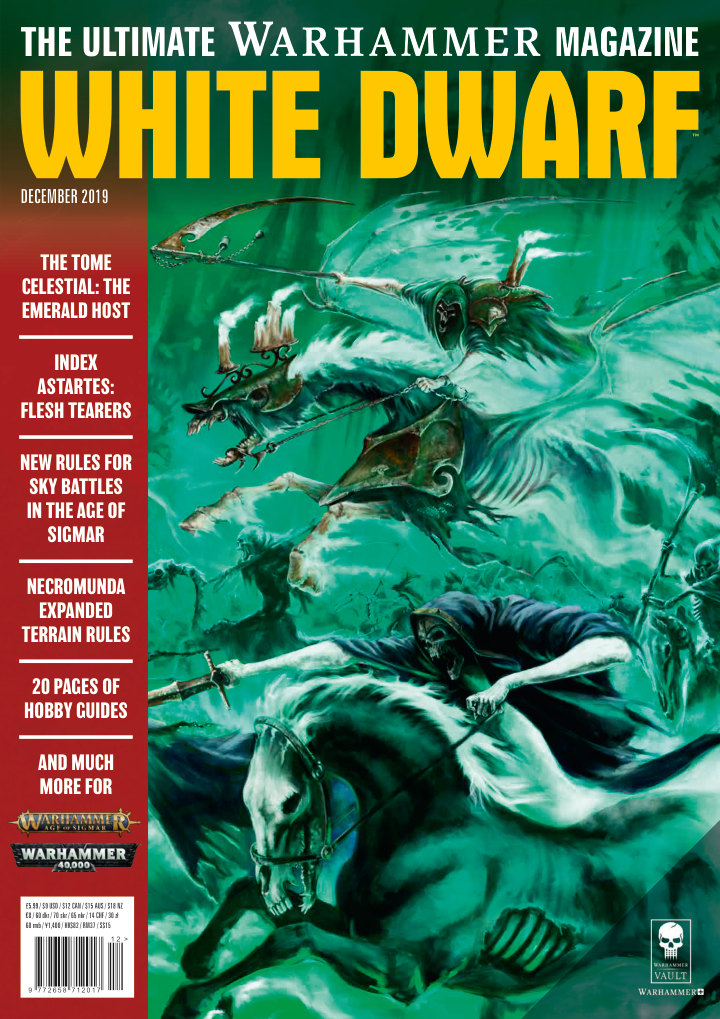
Nick Horth traces Lady Olynder’s rise through the treachery of Dolorum and her later punishment under Nagash. The knights and conspirators she once manipulated become bound instruments of her will, while the Emerald Curse transforms a named enemy’s world into a place of fading colour, grief and relentless pursuit.
Age of SigmarNighthaunt
LoreWD 449 · pp. 30–33
Olynder’s carefully performed mourning conceals ruthless political ambition and the destruction of those who stand in her way. A plague and her bargain with Nagash do not free her from consequences: she becomes a vessel for grief, forced to experience the emotion that had previously served as a tool of manipulation.
Age of SigmarNighthaunt
LoreWD 449 · p. 33
The mounted retainers who once served Dolorum’s noble houses remain attached to their murderous ruler in death. Their spectral service makes protection an enduring punishment, tying the cavalry of the Emerald Host to the betrayals that destroyed their former lives and the realm they were supposed to defend.
Age of SigmarNighthaunt
LoreWD 449 · pp. 34–35
Malcor’s ambition leads him to plot against Olynder, betray his fellow conspirators and imagine that marriage will secure power he has not earned. His death exposes how badly he has misjudged her, and his afterlife as a Knight of Shrouds turns his desire for advancement into permanent service to the woman he tried to control.
Age of SigmarNighthaunt
LoreWD 449 · p. 35
An Idoneth king discovers that withdrawal beneath the waves does not guarantee safety from Olynder’s hunters. The brief account carries the host’s curse into an underwater kingdom, showing that its chosen quarry can remain vulnerable even in an environment that would defeat an ordinary pursuing army.
Age of SigmarNighthaunt
RulesWD 449 · p. 36
This large formation combines the Forgotten Scions and Dolorous Guard with optional supporting battalions. A chosen enemy hero suffers the host’s curse before the battle begins, making the background’s targeted haunting a concrete vulnerability that the rest of the army can exploit.
Age of SigmarNighthaunt
RulesWD 449 · p. 37
A mounted Knight of Shrouds leads Dreadblade Harrows as the personal agents of the Mortarch of Grief. Additional sword attacks and a recurring command opportunity make the leader more active, rewarding a compact mounted formation that can carry the host’s authority to a decisive part of the battlefield.
Age of SigmarNighthaunt
RulesWD 449 · p. 37
Several Hexwraith units become both charging cavalry and a protective screen for the army’s general. Their enhanced charge attacks encourage aggressive movement, while nearby riders can intercept wounds, translating their unwilling eternal duty into a combination of offence and personal protection.
Age of SigmarNighthaunt
PaintingWD 449 · pp. 38–39
James Perry establishes pale spectral forms with a diluted green technical paint over a light undercoat, then adds translucent highlights. Dark cloth, weathered wood, bone and rusty metal contrast with the ghostly body, while shared earth shading ties the natural materials to the paving, leaves and roses of the base.
Age of SigmarNighthaunt26 paint colours
PaintingWD 449 · pp. 40–41
Perry paints the same kind of ghost with translucent base colours, thinning the strongly pigmented green with medium while keeping the cowl and wood more saturated. A few additional highlights complete each material; advice about brush size and working from dark areas towards light ones helps control the runnier paints around small details.
Age of SigmarNighthaunt26 paint colours
PaintingWD 449 · p. 41
A warmer pale undercoat and a darker green base create a more intense alternative to the principal ghost recipe. Pale grey and white highlights recover the illuminated edges, showing how the same translucent-paint method can produce a different supernatural presence with only a few substitutions.
Age of SigmarNighthaunt4 paint colours
PaintingWD 449 · p. 41
This alternative replaces spectral green with a warm red-to-orange sequence over a pale undercoat. The highlights preserve the shape of the flowing ghost while suggesting a fiery apparition, providing a complete small palette for collectors who want an army to depart sharply from the standard ethereal colour.
Age of SigmarNighthaunt4 paint colours
PaintingWD 449 · p. 41
A cool pale undercoat and a translucent blue create a lighter, colder ghost effect. Grey and white highlights keep the upper edges luminous, demonstrating that the green tutorial’s underlying approach can be reused without retaining its colour or changing the miniature’s sculpted spectral form.
Age of SigmarNighthaunt4 paint colours
RulesWD 449 · pp. 42–53
A standalone aerial game pits the flying monsters and vessels of the Mortal Realms against one another using velocity, manoeuvres and weapon arcs. This opening instalment supplies the core system, a duel and two profiles, with later additions promised for a campaign whose engagements are governed by momentum as well as firepower.
Skies of Slaughter
RulesWD 449 · pp. 44–48
Velocity sets both the order of activation and the distance a flyer must travel, making turns and special manoeuvres a commitment. Dangerous flying, collisions, leaving the battlefield and uncontrolled spins create escalating risks, so managing speed and room to recover becomes central to surviving an aerial engagement.
Skies of Slaughter
RulesWD 449 · pp. 49–51
Weapons depend on their individual arcs and characteristics, and damage can have consequences beyond the immediate wound it inflicts. Tailing a target improves an attack while retaliation is less effective, and coordinated wings create local exchanges in which position, toughness and the recovery sequence all shape the result.
Skies of Slaughter
RulesWD 449 · p. 52
The introductory duel starts one flyer on each side and asks the players to destroy their opposing craft. Its simple deployment and victory condition make it a teaching scenario for movement and fire arcs, with withdrawal producing an inconclusive result rather than a reward for avoiding the fight.
Skies of Slaughter
RulesWD 449 · p. 53
The Ironclad profile represents a durable flying fortress with several different guns and restricted agility. Its relatively low top speed and difficult acceleration distinguish it from a hunting monster, encouraging the player to plan approach routes and overlapping fields of fire instead of relying on rapid turns.
Skies of SlaughterKharadron Overlords
RulesWD 449 · p. 53
The Bloodthirster exchanges the airship’s endurance and armament for stronger mobility and close-range aggression. Its weapons and disruptive presence make nearby flying more dangerous for enemies, creating an asymmetrical duel in which a monster attempts to close the gap on a slower but heavily armed vessel.
Skies of SlaughterBlades of Khorne
Army showcaseWD 449 · pp. 56–65
The four collectors enter the penultimate stage of their Vigilus projects with new vehicles, reinforcements and games against studio opponents. Their reports mix painting methods, conversion choices and lessons from battles, showing how each army’s final additions are shaped by the experience of using the earlier collection.
Warhammer 40,000Genestealer Cults
Army showcaseWD 449 · pp. 58–59
Sam adds Ridgerunners and Hive Guard to increase his cult’s long-range anti-tank options. An opponent’s infiltration restrictions frustrate the army’s usual plan, but destroying a Redemptor gives a memorable success; another game offers a chance to turn an enemy Knight’s own weapons against its allies.
Warhammer 40,000Genestealer Cults
PaintingWD 449 · p. 59
A pale grey base and restrained shading create an industrial finish that remains distinct from the cult’s red markings. Small grey chips interrupt the heraldry, diluted earth shade picks out recesses and a pale flesh-coloured edge highlight raises the final definition without making the armour appear clean.
Warhammer 40,000Genestealer Cults6 paint colours
Army showcaseWD 449 · pp. 60–61
James Karch expands his Raven Guard infantry with Infiltrators and Incursors supported by two Invictor warsuits. His converted lieutenant carries a grav-chute as a modelling choice, and the account considers how the growing force’s identity and battlefield experience will lead into the project’s final additions.
Warhammer 40,000Raven Guard
Army showcaseWD 449 · pp. 62–63
Mark Bedford grafts a Glottkin tentacle onto a Chaos Knight and builds additional plague character conversions to accompany it. The scale of the organic component suits the machine, while a shared shipboard basing theme turns the collection into a force emerging from the same contaminated environment.
Warhammer 40,000Death Guard
PaintingWD 449 · p. 63
Bedford combines darkened silver, textured corrosion and orange rust across the Knight’s framework. Pale armour is dirtied rather than left pristine, and mixed translucent blues, greens and pinks distinguish the fleshy tentacle from the surrounding machinery while keeping it visibly part of the diseased model.
Warhammer 40,000Death Guard9 paint colours
Army showcaseWD 449 · pp. 64–65
James Gallagher adds several Flesh Hound packs and Karanak to support his Black Legion in large games. Quick translucent painting makes the reinforcements achievable, while their speed and ability to engage enemy Knights give the rest of the army more freedom to advance and choose its own fights.
Warhammer 40,000Black Legion
PaintingWD 449 · p. 65
The hounds’ red skin begins with translucent colour over a warm pale undercoat and is deepened with purple shades before bright highlights. Green teeth, orange eyes and shaded bronze collars supply contrasting details, while a simple bone-coloured base supports rapid production of several matching packs.
Warhammer 40,000Daemons of Khorne15 paint colours
Designer’s notesWD 449 · pp. 66–69
Alexander Tuxford describes a Warhammer Fest exercise in which visitors helped develop a hypothetical Ork codex incident with writer Andy Clark. The example explains how a short timeline entry can give both sides a convincing objective, communicate setting through action and leave useful possibilities beyond the battle’s immediate outcome.
Warhammer 40,000Orks
LoreWD 449 · p. 69
An Aeldari seer raises orbital protection around a threatened maiden world while a Goff warboss takes offence at the enemy’s black colour scheme. The arrival of his space hulk breaks the apparent solution, producing a compact campaign seed in which foreknowledge and overwhelming violence collide without requiring the total destruction of either faction.
Warhammer 40,000Goffs
LoreWD 449 · pp. 70–79
Andy Smillie and Tom Horth examine a Chapter feared for both its battlefield savagery and the danger it poses to allies. Cretacia’s traditions, the concealed scale of the Death Company and Gabriel Seth’s struggle for survival establish the Flesh Tearers as warriors whose discipline is continually tested by an inherited curse.
Warhammer 40,000Flesh Tearers
LoreWD 449 · pp. 70–73
The Chapter’s history connects Amit’s search for a future after the Legion’s division with the violent environment of Cretacia. Tribal recruitment and a death-world culture help shape the Flesh Tearers, while their fearsome reputation and fraught relationships with allies complicate every attempt to preserve their dwindling strength.
Warhammer 40,000Flesh Tearers
LoreWD 449 · pp. 72–75
The Flesh Tearers can fall to the Black Rage suddenly, making the Death Company more than a formation assembled predictably before a battle. Appollus preserves those who survive, while Seth resists an easy acceptance of Astorath’s mercy, exposing a difficult conflict between compassion, survival and the Chapter’s sense of duty.
Warhammer 40,000Flesh Tearers
LoreWD 449 · pp. 74–75
Seth’s aggression conceals a calculating commander who understands the precarious state of his Chapter. His determination to secure a future for the Flesh Tearers is tied to penance rather than confidence in redemption, and the history of his weapon connects that struggle with the legacy of the Chapter’s founder.
Warhammer 40,000Flesh Tearers
FictionWD 449 · pp. 76–77
A newly arrived Primaris captain confronts Seth’s brutal test of his identity and restraint. The encounter reveals why the Chapter Master fears that stronger warriors may also carry a stronger curse, while the violence and its aftermath establish the beginnings of a shared understanding between the newcomers and the Chapter they are meant to save.
Warhammer 40,000Flesh Tearers
FictionWD 449 · p. 77
A wounded Flesh Tearer’s struggle on Baal becomes a confrontation with the seductive power of his inherited rage. Appollus urges him back into the fight, but the experience leaves survival entangled with the fear that the strength keeping him alive may also be drawing him toward the loss of himself.
Warhammer 40,000Flesh Tearers
RulesWD 449 · pp. 78–79
The Flesh Tearers attack an orbital installation whose defender must protect a critical objective while bringing scattered forces into the battle. Restricted reinforcement routes, an opening dawn assault and additional stratagems turn the mission into a contest between a rapid breakthrough and the defender’s ability to keep the installation operating.
Warhammer 40,000Flesh Tearers
ModellingWD 449 · p. 80
James Gallagher equips a characterful Flesh Tearers group with bare heads, skull imagery and oversized close-combat weapons. A magnetised Chaplain and deliberately dramatic weapon swaps show how a small collection can prioritise narrative identity, with the models’ appearance extending beyond an ordinary selection of standard equipment options.
Kill TeamFlesh Tearers
ModellingWD 449 · p. 81
Nick Bayton answers Andy Smillie’s challenge by modelling the characters associated with Seth’s retinue. Primaris bodies, older Blood Angels details and carefully chosen weapons create recognisable versions of the Chapter Master, Appollus and his companions, showing how audio fiction can provide a practical brief for a conversion project.
Warhammer 40,000Flesh Tearers
PaintingWD 449 · p. 81
Bayton builds the retinue’s deep red from a darkened mixture, then works through increasingly vivid edge highlights. The black areas receive a cool blue sequence instead of neutral grey, keeping the armour distinct from the red while giving the separate character conversions a coherent shared finish.
Warhammer 40,000Flesh Tearers9 paint colours
PaintingWD 449 · pp. 82–83
James Perry separates the Reiver’s armour and equipment into repeatable base, shade and highlight sequences. Deep red armour is balanced by black panels and green purity seals, with additional recipes for skin, hair, parchment and bone; the advice stresses keeping the first edge highlight visible beneath the finer final line.
Warhammer 40,000Flesh Tearers29 paint colours
PaintingWD 449 · pp. 83–85
Both Reivers use textured mud drybrushed through warm brown and pale bone, with a solid brown rim completing the base. A separate vehicle suggestion recommends an airbrush red for collectors who want tanks to match their infantry, while acknowledging the Chapter’s usual preference for black vehicles.
Warhammer 40,000Flesh Tearers5 paint colours
PaintingWD 449 · pp. 84–85
A light undercoat and translucent red and black establish the main armour colours before conventional edge highlights are added. Perry uses two thin coats on broad surfaces to control pooling, then treats lenses, seals, parchment and bone individually; the resulting method offers a parallel route to the classic guide rather than a completely different scheme.
Warhammer 40,000Flesh Tearers23 paint colours
RulesWD 449 · pp. 86–87
The Red Gobbo joins open and narrative Kill Team games as a commander whose presence makes an otherwise fragile grot force more effective. Leadership abilities, an inspirational icon and a risky supply of grenades favour a characterful uprising, with separate commander levels rather than a generic addition to competitive rosters.
Kill TeamOrks
RulesWD 449 · pp. 88–89
A grot uprising protects three objectives while the opposing team attempts to destroy them with specially supplied explosives. The number of objectives remaining sets the result after a short battle, and campaign rewards connect the festive scenario to ongoing resources rather than relying only on casualties inflicted.
Kill TeamOrks
Battle reportWD 449 · pp. 90–109
Three Imperial commanders attempt to retrieve relics from a burning city while two T’au forces advance against them. The fighting ends in a 10–10 draw: the Imperials recover valuable objectives, but the T’au destroy their opposing commanders and leave the surviving defenders under severe pressure as the city continues to burn.
Warhammer 40,000Adeptus Custodes
RulesWD 449 · pp. 92–95
The battle adapts the Conflagration mission with several indoor relic locations and a special opportunity to fight spreading fires. Randomly changing active objectives force the Imperials to balance extraction with survival, while the environmental danger gives both sides reasons to reconsider apparently strong firing positions.
Warhammer 40,000Imperium
TacticsWD 449 · pp. 110–113
Dave Sanders revisits the Sepulchral Guard for Beastgrave with an objective-focused deck that can score during the round and again at the game’s end. Their resistance to being driven back and ability to return fallen fighters support careful positional play, provided the player anticipates movement needs before the right cards reach their hand.
Warhammer UnderworldsSepulchral Guard
TacticsWD 449 · p. 112
The gambit choices move fighters and objective tokens, refresh the hand and return a fallen warrior at a useful moment. The discussion treats movement as a limited resource for the slow undead, with card combinations supplying the flexibility needed to score rather than merely pushing the warband into a direct fight.
Warhammer UnderworldsSepulchral Guard
TacticsWD 449 · p. 113
End-game keys reward fighters who can remain on important objectives, but taking too many too early can clog the hand. Other upgrades create speed, combat threats or a penalty for killing a bearer, and the advice considers which survivors should carry each tool and how resurrected fighters preserve their investment.
Warhammer UnderworldsSepulchral Guard
LoreWD 449 · pp. 114–117
The history of Penitent 707 begins with a punishment for an offence against the regime of Zanzastus IV and ends with a dangerous journey to the Precipice. Taddeus acquires the surviving captive, but a failed pacifier leaves the augmented warrior capable of attacking explorers as readily as the enemies around them.
Warhammer Quest: Blackstone FortressEcclesiarchy
RulesWD 449 · pp. 115–117
The retinue framework explains how an attached character acts alongside an expedition rather than replacing an explorer. Penitent 707 has sharply different behaviour while pacified and inspired: the dangerous state prioritises nearby victims, creating an ally whose combat power cannot be separated from the risk of losing control.
Warhammer Quest: Blackstone Fortress
RulesWD 449 · pp. 118–119
The explorers must recover discoveries and solve the activation sequence that can pacify a rampaging 707. His continued attacks make delay dangerous, especially after the hostiles are gone; recruiting him requires the penitent and at least one explorer to survive, turning the mission into a rescue rather than a straightforward hunt.
Warhammer Quest: Blackstone Fortress
Army showcaseWD 449 · pp. 120–127
Thomas Blackburn presents several Imperial collections built after returning to the hobby through the Uriel Ventris novels. His Ultramarines, Blood Angels, Deathwatch and Custodes combine personal conversions with distinct painting methods, while club campaigns provide both a reason to expand them and an opportunity to develop their background.
Warhammer 40,000Ultramarines
Army showcaseWD 449 · pp. 120–123
Graham McNeill’s novels inspire Blackburn’s attempt to build a complete Fourth Company, mixing Primaris and older Marines with transports and supporting armour. Conversions of Uriel Ventris and Pasanius connect the growing collection to its fictional starting point, while the company structure gives the project a clear long-term goal.
Warhammer 40,000Ultramarines
PaintingWD 449 · p. 122
The blue armour receives dark shading and successive cool edge highlights before brown damage marks break up the finished surface. Blackburn uses weathering to give the Fourth Company a campaigning appearance, making a consistent armour recipe the common foundation beneath individually converted characters and different generations of Marines.
Warhammer 40,000Ultramarines6 paint colours
Army showcaseWD 449 · pp. 124–125
The devastation of Baal inspires an all-Primaris Blood Angels collection with transports and bold markings influenced by earlier studio armies. A converted Captain Antargo combines a Primaris body with a Sanguinary Guard axe and bionic components, giving the force a specific identity rather than treating it as a recoloured Ultramarines army.
Warhammer 40,000Blood Angels
PaintingWD 449 · pp. 124–125
Blackburn gives the Blood Angels a warm red armour finish that deepens in recesses and rises through scarlet to a bright orange highlight. Dark brown damage keeps the surfaces from appearing factory fresh, linking the more vivid colour scheme to the worn presentation used elsewhere in his collection.
Warhammer 40,000Blood Angels5 paint colours
Army showcaseWD 449 · pp. 126–127
The Custodes began as a collection usable in the Horus Heresy and later expanded into the far future, including a converted Ixion Hale and a Contemptor-Galatus. The Deathwatch instead emphasise mobile warriors and transports, giving Blackburn two different approaches to collecting and playing elite Imperial forces.
Warhammer 40,000Adeptus Custodes
PaintingWD 449 · pp. 126–127
Warm shading and several metallic highlights give the Custodes their rich gold armour, while the Deathwatch use cool blue-grey edges over black. The separate recipes make the elite forces immediately distinguishable, showing how tightly controlled highlight families can create different visual identities within one collector’s wider Imperial project.
Warhammer 40,000Adeptus Custodes9 paint colours
CommunityWD 449 · p. 127
Blackburn’s Macclesfield club runs a large narrative campaign that rewards background writing and painting alongside games. The account shows how a shared setting can keep many collectors involved through different kinds of contribution, giving his growing armies a story and a social reason to reach the tabletop.
Warhammer 40,000
RulesWD 449 · pp. 128–133
The new Zone Mortalis terrain prompts an expanded set of rules for fighting through industrial interiors in two or three dimensions. Lifts, doors, stairs, access systems and environmental hazards make the battlefield an active part of a gang fight, with the chosen terrain conventions agreed before play begins.
Necromunda
RulesWD 449 · pp. 128–131
The rules distinguish a flat representation of corridors from a physically three-dimensional battlefield and explain which apparent wall tops are accessible. Lifts move between levels and can crush fighters, while stairs provide movement routes with their own falling risks, making elevation useful without treating every sculpted surface as climbable.
Necromunda
RulesWD 449 · pp. 130–131
Doors become obstacles that can open, close and endanger fighters caught in their path. Control panels allow a more technical approach to the machinery, using an Intelligence-based action to affect a system rather than requiring every gang member to solve a blocked route through movement or brute force.
Necromunda
RulesWD 449 · pp. 131–132
Ductways connect tight spaces through a demanding crawl, while hatches allow a fighter to leave the visible board and attempt to emerge elsewhere later. Failed navigation gives the opponent influence over the outcome, turning a useful shortcut into a deliberate risk rather than an automatic escape or redeployment.
Necromunda
RulesWD 449 · p. 132
Toxic pools punish vulnerable fighters, pitfalls make forced movement near an edge especially dangerous and industrial stills can release gas when damaged. Each feature changes the value of the surrounding ground, encouraging gangs to consider where a fighter may be pushed or pinned as carefully as where that fighter begins.
Necromunda
RulesWD 449 · p. 133
A protein reclamator combines dangerous machinery with opportunities for a fighter to escape before the mechanism is triggered. Its control panel can activate a lethal cycle, giving the terrain a direct tactical purpose and connecting the grim industrial function of the model with a consequential campaign hazard.
Necromunda
ModellingWD 449 · pp. 134–137
Mark Bedford builds a protein reclamator by cutting down and recombining Noctilith Crowns with industrial scenery and mechanical components. A large circular platform, improvised conveyor and body-filled processing area make the device readable as an actual installation, with a stable two-tile footprint suitable for a Necromunda battlefield.
Necromunda
PaintingWD 449 · pp. 136–137
Bedford layers dirty metal, corroded pale machinery and chipped yellow hazard markings to age the processing plant. Diluted rust colours run over dampened surfaces, while a pale base and repeated translucent reds create the glossy contents of the vat; bone and gore finishes complete the unfortunate material being processed.
Necromunda14 paint colours
TacticsWD 449 · pp. 138–141
Rob Alderman explains how Saruman controls a battle through reliable magic rather than close combat. Efficient use of his free Will, carefully timed channelled spells and mounted movement let him isolate important enemies, while the Palantír creates an opportunity to take the initiative at the moment an opponent can least afford it.
Middle-earth Strategy Battle GameIsengard
TacticsWD 449 · pp. 139–140
Alderman recommends establishing protection early and conserving stored Will for more difficult casts. Command exposes valuable enemies to concentrated attacks, Sorcerous Blast can remove support or dismount a hero by striking another model first, and movement before and after casting helps the mounted wizard act without remaining unnecessarily exposed.
Middle-earth Strategy Battle GameIsengard
TacticsWD 449 · p. 141
The once-per-game control of Priority can either drain an opponent’s Might early or exploit its absence later, especially with Gríma nearby. The closing advice also considers the uncorrupted Saruman in the White Council and his alliance with Rivendell, where his manipulation complements other reliable spellcasters.
Middle-earth Strategy Battle GameIsengard
CommunityWD 449 · pp. 142–144
The team closes the year with completed magical effects, armoured reinforcements and Ben Humber’s Raven’s Watch models from the battle report. A farewell marks his departure for a year of travel, while a short memorial remembers former editor Mike Brunton and his work across the magazine and other Games Workshop publications.
Warhammer 40,000Age of Sigmar
PaintingWD 449 · p. 142
Matt Hutson finishes his early experiment with translucent paints by separating deep red outer lava from brighter orange and yellow interiors. The short recipe uses the contrast between those areas to suggest heat within the Fyreslayer manifestations, making the magical effects readable without a long sequence of conventional layers.
Age of SigmarFyreslayers4 paint colours
ModellingWD 449 · p. 143
Dan Harden builds a conspicuously armed replacement Tank Commander, adding crew, a flag and a converted officer’s head to mark his role. Matt Hutson expands his Imperial Fists with a plasma-armed Repulsor Executioner, using separate subassemblies and Chapter transfers to make the large model manageable and consistent with the rest of his force.
Warhammer 40,000Astra Militarum
Read throughout the supplied magazine. Paint recipe stages were inspected as rendered pages. Paint Splatter pages 82–85 have erroneous October footers and some Red Gobbo pages retain September labels; the cover and issue body identify December 2019. Advertisements, contents, preview notices and purely promotional gift notices are excluded. Advertised loose inserts are not separately scanned; the body’s Spellflux Spire board, Gotrek profile and associated rules are indexed. Distinct substantial rules, recipes and named showcases are separately searchable beneath their parent features.