EditorialWD 370 · p. 1
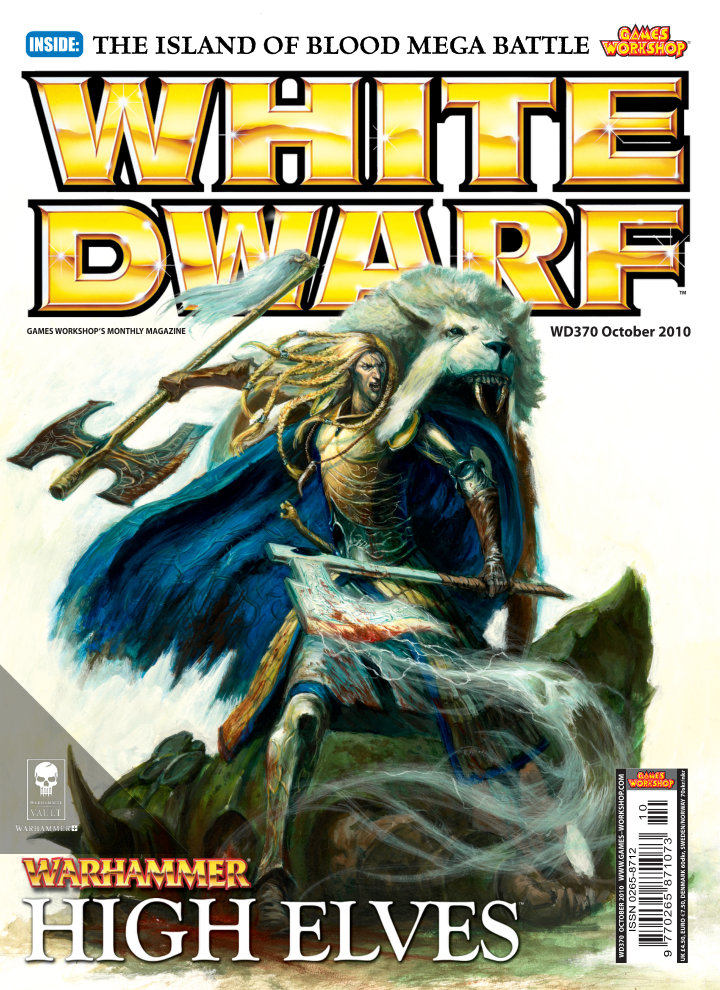
Andrew Kenrick welcomes the new plastic High Elf elite units and the enormous Island of Blood battle, reflecting on the Asur’s longstanding place at the centre of Warhammer. His own unfinished High Elf project has survived diversions into Warriors of Chaos and Tomb Kings, and the new models provide the excuse to return to it.
Warhammer Fantasy BattlesHigh Elves
CommunityWD 370 · pp. 11–13
News introduces the cooperative Space Hulk: Death Angel card game, in which Blood Angels players must coordinate movement and attacks to survive the Sin of Damnation. Other items announce the worldwide Island of Blood refight and the month’s High Elf online material, including Jes Goodwin’s design history, heraldry, painting guides and High Magic tactics.
Warhammer Fantasy BattlesWarhammer 40,000High Elves
LoreWD 370 · pp. 14–25
Adam Troke follows High Elf military service from a citizen’s years of archery training to spear regiments, noble cavalry and the commanders who gather contingents from across Ulthuan. The account connects regional obligations, white robes, specialist forces and the uncertain length of campaigns to a civilisation whose declining population must still defend a vast inheritance. Sculptor interviews, regimental heraldry and Althran’s response to the breach of Unicorn Gate illustrate how that background becomes distinctive miniatures and collections.
Warhammer Fantasy BattlesHigh Elves
InterviewWD 370 · p. 17
Martin Footitt explains how the new Dragon Princes preserve Jes Goodwin’s established imagery while using sharper sculpting and more components to achieve convincing layered armour. Overhanging horse armour, visible reins and crisp fluting give the cavalry depth, while interchangeable breastplates, helms, lances and shields retain individual character. Contrasts between cloth, mail, plate and horse flesh also make the models rewarding painting subjects.
Warhammer Fantasy BattlesHigh Elves
InterviewWD 370 · pp. 18–19
Mark Harrison gives the new White Lions an aggressive woodland-fighter identity through forward motion, flowing robes and trailing lion pelts. Their heavy shoulder armour addresses the moment of exposure when swinging a two-handed axe, while repeated Chracian motifs unify the regiment. The accompanying background explains their defence of the mountain passes and their ancient role as the Phoenix Kings’ personal protectors.
Warhammer Fantasy BattlesHigh Elves
InterviewWD 370 · p. 21
Mike Anderson describes the Phoenix Guard design shared with Matt Holland and Neil Langdown, drawing on the original full-length armoured coats and Jes Goodwin’s sketches. Negative space between mail and cloaks makes the garments flow naturally, while closed mouths and a drum communicate the guardians’ vow of silence. Flames, ornate banners and heavy armour reinforce their sacred role at Asuryan’s shrine.
Warhammer Fantasy BattlesHigh Elves
LoreWD 370 · p. 23
Eight illustrated regimental identities show how High Elves can share their army’s white robes and polished steel while retaining local and personal histories. Sea Guard adopt a fallen leader’s heraldry, a Caledor household commemorates its slain Dragon, and Griffon Gate veterans record glories through moon and star motifs. The examples distinguish geographic allegiance, patronage and honours earned together, providing concrete material for themed shield and banner designs.
Warhammer Fantasy BattlesHigh Elves
LoreWD 370 · pp. 24–25
A Dark Elf incursion in 2498 breaches a postern gate long enough to send raiders into Ellyrion, forcing Finubar to commission Althran Stormrider to hunt them down. The story follows the mustering of his household warriors, allies, mage and sacred reinforcements before an ambush draws the invaders into a decisive battle. An accompanying 2,998-point army translates that narrative gathering into a coherent themed High Elf force.
Warhammer Fantasy BattlesHigh Elves
Battle reportWD 370 · pp. 28–55
Ten players refight the campaign’s climax with more than ten thousand points per side, a coastal battlefield and Jervis Johnson overseeing a scenario full of Skaven intrigue. Rat Swarms and Unbreakable war machines delay the relief army, two Dragons die to spectacular cannon shots, and rival Warlords spend critical moments undermining one another. Althran survives the bridge fight and kills Spinetail while Caladris completes his search; the Phoenix Stone’s spell finally destroys the Skaven on High Elf turn four. The report shows how separate heroic clashes and private ambitions can animate a very large shared game.
Warhammer Fantasy BattlesHigh Elves
RulesWD 370 · pp. 34–37
The relief army races to penetrate the Skaven deployment area while a small High Elf garrison fights successive attackers on the narrow temple bridge. Modified building-assault rules make bridge units Unbreakable and Unstable, creating a desperate battle of attrition while Caladris searches for the Phoenix Stone and prepares a potentially decisive spell. Reinforcement schedules, inspirational statues, hidden treasure and a one-off shipwreck ambush support the battlefield narrative; secret loyalties and permission to attack fellow Skaven leaders give their side competing personal objectives.
Warhammer Fantasy BattlesHigh Elves
InterviewWD 370 · pp. 58–63
Adam Troke speaks to Mat Ward and the Perry twins about new models for the Dwarves and their enemies beneath the Misty Mountains. Flói Stonehand expands a name in the Book of Mazarbul into a wise loremaster, while the King’s Champion becomes a furious royal envoy protected by two shield-bearing heralds. Armoured Gundabad Blackshields give the Goblins an elite contingent, and Michael Perry explains the long development of the sleek, tunnel-adapted Cave Drake, designed to look distinct from a wingless Dragon.
Middle-earth Strategy Battle GameWar of the RingKhazad-dûm
TacticsWD 370 · pp. 64–69
Mat Ward compares the protection, cost and battlefield opportunities of infantry characters, cavalry, chariots, monstrous mounts and ridden monsters. Cheap mounts can improve armour or keep pace with a unit, but mismatched troop types lose protection from cannon fire; flying monstrous cavalry offer especially useful mobility and extra wounds for heroes and wizards. Dragons and similar beasts provide destructive power and wider command influence, balanced against separate rider and mount vulnerabilities. Worked character builds and equipment advice keep each choice tied to a specific job rather than sheer spectacle.
Warhammer Fantasy Battles
TacticsWD 370 · pp. 70–71
Jervis Johnson explains why the new rules reduce the reliability of march blocking and charge redirection. He advocates combining elite damage-dealers with ranked core troops or missile fire to remove Steadfast, then planning for combats that last several turns. Estimating when one unit will finish its fight helps a general arrange the next flank attack, replacing reliance on a single spectacular charge with sustained pressure from cooperating units.
Warhammer Fantasy Battles
PaintingWD 370 · pp. 72–79
Darren Latham paints Althran on foot to match his mounted version while refining the cloak lining and balancing the new shield’s red against the established blue and white scheme. The extensive guide covers warm gold, cool polished silver, silky cloth, pale Elven skin, natural blond hair, wood grain, leather, freehand and gems. Joe Tomaszewski’s vivid green Spinetail completes a duel diorama whose interaction comes from the original poses and careful placement rather than major conversion.
Warhammer Fantasy BattlesHigh Elves
PaintingWD 370 · p. 73
Wildlife reference gives Sharpclaw a convincing combination of falcon and big-cat characteristics. Darren Latham studies the beak’s changing tones, the shape of the bright iris and the unexpectedly dark claws, then alternates brown plumage and highlights individual feathers. Mixing the coat colour into the dark rear-body markings integrates the pattern with the animal rather than making it look painted onto its surface.
Warhammer Fantasy BattlesHigh Elves3 paint colours
PaintingWD 370 · p. 74
Thin successive metallic coats produce Althran’s rich gold armour, followed by red, brown and black recess shading and increasingly bright silver-edged highlights. The scale mail uses blue shade for a clean, cool finish. On the sword, alternating dark patches borrow the reflection placement of non-metallic metal even though the paints themselves are metallic, giving the blade more deliberate depth and shape.
Warhammer Fantasy BattlesHigh Elves10 paint colours
PaintingWD 370 · p. 75
Althran’s blue cloak is layered with thin paint and highlighted according to light falling from above, avoiding bright lower ripples that would confuse the silky effect. Kommando Khaki is added to the pale blue mixtures to improve their flow. A separate Foundation-paint sequence creates the clean white sash, finished with red freehand tassel designs that reinforce the High Elf palette.
Warhammer Fantasy BattlesHigh Elves9 paint colours
PaintingWD 370 · p. 76
Darren Latham preserves the sharp definition of Althran’s pale face with deep shading around the eyes and nose, then builds light flesh highlights and subtle red-blue glazes. The blond hair begins with leather and desert tones rather than bright yellow, receives sepia and brown washes, and finishes with bone and white strands. Both processes avoid hard black borders that would make the delicate complexion look artificial.
Warhammer Fantasy BattlesHigh Elves14 paint colours
PaintingWD 370 · p. 77
Irregular descending lines, knots and progressively lighter brown accents create the wood grain on the shield’s back. The front is painted as stretched purplish-red leather, with dark recesses, cool pale highlights and carefully defined scuffs. Darren concentrates wear on equipment rather than robes, allowing the prince to look battle-tested while retaining the High Elves’ clean appearance.
Warhammer Fantasy BattlesHigh Elves10 paint colours
PaintingWD 370 · p. 78
A planned sketch guides the intricate cloak pattern, which is first traced in thin paint that can be wiped away before the lines are strengthened. Brown shading, yellow-brown mid-tones and pale highlights then follow both the woven intersections and the cloth’s folds. Larger red gems receive an additional dark line across their lower section, increasing apparent depth before tiny orange-white reflections complete the effect.
Warhammer Fantasy BattlesHigh Elves9 paint colours
ShowcaseWD 370 · p. 79
Darren Latham and Joe Tomaszewski position Althran and Spinetail so that the High Elf appears to parry the Skaven’s crooked sword from either viewing angle. The models were sculpted for this interaction, making conversion unnecessary. Spinetail’s almost luminous green provides a deliberate contrast to Althran’s clean blues, while small details on the shield, tail and base complete the shared scene.
Warhammer Fantasy BattlesHigh Elves4 paint colours
ShowcaseWD 370 · pp. 82–87
Matt Toone challenges studio hobbyists to complete a Warhammer Battalion within a few weeks, drawing eighteen participants from painters, sculptors and other departments. Adam Troke presents the resulting range of armies alongside the Spirit of Warhammer competition, including Oliver Norman’s extensively kit-bashed Hedge Wizard. Longer profiles contrast Martin Footitt’s restrained Blanche-inspired Ogres with Mark Harrison’s bloodied, glowing-eyed Vampire Counts, showing how a short deadline can focus both colour and modelling choices.
Warhammer Fantasy Battles
ShowcaseWD 370 · pp. 84–85
Martin Footitt reorganises the Ogre Battalion into a larger block of Bulls and paints it in red, black and metal inspired by John Blanche’s artwork. He adapts his display-painting habits to an army by concentrating extra highlights on focal points such as faces, while Gnoblars are completed as a rapid batch. Retro red weapon hafts, scorched cannon barrels and a large fanged-maw banner give the compact collection its distinctive character.
Warhammer Fantasy BattlesOgre Kingdoms
PaintingWD 370 · pp. 86–87
Mark Harrison builds a coherent horror-themed force through converted Zombies, blue supernatural lights and conspicuous fresh gore. His blood mixture is reserved most heavily for creatures that would stop to feed, leaving the Skeletons comparatively restrained. Washes over white undercoats create much of the cadaverous colour, while realistic dark bones and luminous eyes distinguish dead material from the magic animating it.
Warhammer Fantasy BattlesVampire Counts4 paint colours
InterviewWD 370 · pp. 88–89
Dan Abnett recalls being recruited for Black Library comics and choosing human Guardsmen as the most accessible subjects for his early fiction. Gaunt’s Ghosts and the Sabbat Worlds began as spontaneous names, then acquired geography, chronology and religious history as the stories grew. He introduces the first shared anthology as an opportunity for other writers to explore air combat, occupied worlds and old battlefields within a setting that had expanded far beyond its original backdrop.
Warhammer 40,000Imperial Guard
ShowcaseWD 370 · pp. 90–97
Duncan Rhodes builds the Infernal Host of Kor Megron after Horus Heresy novels and the plastic Daemon Prince draw him to the Word Bearers’ deliberate villainy. Large Marine squads anchor the collection, while Possessed parts identify favoured champions and daemon allies express the Legion’s pacts. Mutated vehicles appear fused with their crews, the prince’s armour blends into his flesh, and comparatively unaltered Terminators suggest a calculating power behind the throne. The workshop includes the 1,606-point collection and practical recipes for its recurring colours.
Warhammer 40,000Chaos Space Marines
PaintingWD 370 · p. 93
Duncan Rhodes follows Chad Mierzwa’s pink-skin suggestion, spraying a flesh base and applying a red wash before rebuilding the raised areas with a flesh-and-red mixture. Bone increases the highlight while gold ornaments, purple tongue, pale claws, blue-shaded flame and yellow eyes establish contrasting details. The sequence makes the daemons distinctive while keeping them visually related to the army’s crimson armour.
Warhammer 40,000Chaos Daemons17 paint colours
PaintingWD 370 · pp. 94–95
Duncan’s Possessed communicate allegiance to Chaos through restrained hints of individual gods rather than overtly dividing the unit into separate cults. The accompanying paint sequence establishes red armour, grey flesh, bright metal trim and pale bony mutations before dark washing and rebuilding the colours. Bone and skin highlights use related pale tones, and the same treatment carries across the Marines and Daemon Prince to unify the host.
Warhammer 40,000Chaos Space Marines11 paint colours
ModellingWD 370 · pp. 98–103
Chad Mierzwa corrupts an Imperial bastion, defence lines and monuments to accompany Duncan’s Word Bearers. Gothic candles and gargoyles turn familiar fortifications into shrines, while Chaos vehicle parts, damaged aquilas, irregular bullet scars and entangling razorwire express occupation and desecration. Contrasting chalky monuments and sombre fortifications make the blood, burns and symbols prominent, and the finished display places them in an Ultramarines assault upon Black Legion positions.
Warhammer 40,000Chaos Space Marines
PaintingWD 370 · p. 100
Chad gives the desecrated monuments a chalky sandstone finish through a brown foundation and progressively paler overbrushing and drybrushing. Dark scorch marks and dried blood then stand out sharply against the stone, while rust tones age the razorwire wrapped around the statue. Blinding the monument with wire also gives the physical conversion a symbolic meaning within the scene.
Warhammer 40,000Chaos Space Marines8 paint colours
PaintingWD 370 · p. 101
The bastion and Aegis lines receive sombre grey-brown colours over black, with warm recesses and increasing Rotting Flesh in the highlights. Earthy weathering restores dirt and depth between the raised areas. Replaced gun muzzles, spikes, candles and Chaos icons adapt the Imperial structures without obscuring their recognisable military purpose.
Warhammer 40,000Chaos Space Marines5 paint colours
LoreWD 370 · pp. 102–103
A short narrative gives the completed terrain its setting on Testament III, where the Black Legion has occupied an ancient missionary’s resting place for fifty years after sacrificing the planet’s population. Ultramarines First Company elements descend to destroy the Daemon Prince Marrovore the Black and avenge the dead. The fortified compound itself has become possessed, making the corrupted scenery an active part of the invasion’s opposition.
Warhammer 40,000Ultramarines