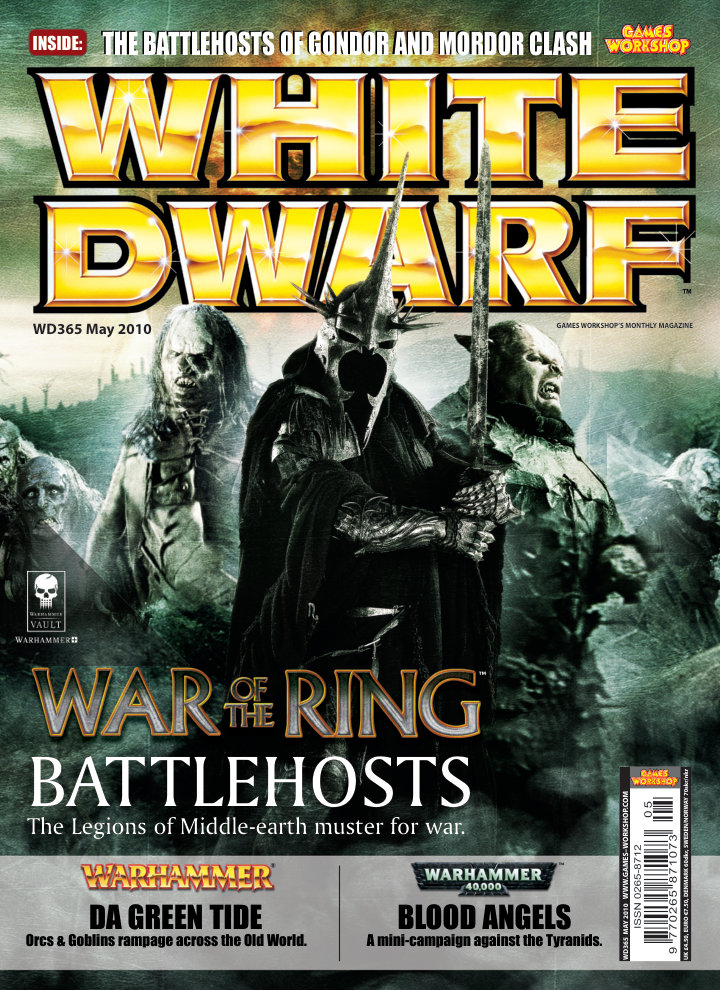
EditorialWD 365 · p. 1
Mark Latham marks his final issue as editor after working on fifty issues, thirty-three of them in charge. He recalls the expansion of painting instruction and features such as Old War Stories, Hall of Fame and Army Masters, then hands the magazine to Andrew Kenrick as he moves into games development. His enthusiasm for Battlehosts, Boar Boyz and River Trolls makes the farewell a reflection on both editorial work and continuing personal hobby interests.
LoreWD 365 · p. 13
Gav Thorpe introduces Korlandril, an Eldar artist whose wounded pride drives him onto the Path of the Warrior and into the Striking Scorpion Aspect. The preview frames the novel around the psychological cost of immersion in a martial identity, including the danger of becoming an Exarch. Companion books following the Seer and Outcast paths promise different views of the same society rather than a conventional Imperial perspective.
Warhammer 40,000Aeldari
Battle reportWD 365 · p. 13
Andy Hall reports an unusually large recreation of the Red Pox attack on Quenelles, with eight Bretonnian dukes facing five Skaven lords. Alessio Cavatore coordinated the game, whose decisive massed cavalry charge gave the Bretonnians victory. Hall nevertheless claims a local success for the Skaven after his Plague Monks reached the walls, illustrating how a narrative mega-battle can produce memorable achievements even for the losing side.
Warhammer Fantasy BattlesBretonnia
CommunityWD 365 · p. 14
The preview describes Fantasy Flight’s two-player Siege of Terra board game, in which one player commands the Emperor’s defence and the other Horus’s assault. Orders, combat cards and the arrangement of armies and Titans translate the conflict into strategic choices across the palace battlefield. The feature explains the scale and premise of this separate board game rather than presenting rules for a Horus Heresy miniature army.
Horus Heresy (board game)Imperium
CommunityWD 365 · p. 14
The new untimed trial lets players explore all twenty-four careers up to rank ten, with the Empire–Chaos frontier as its central setting. The news highlights public quests, the Hunter’s Vale and several competitive scenarios, and explains the streaming client’s smaller initial download. It presents a route into the online game through cooperative and competitive play, preserving the historical trial offer as contemporary news.
Warhammer Online: Age of ReckoningThe Empire
InterviewWD 365 · pp. 16–25
Adam Troke asks Robin Cruddace how Battlehosts rewards collecting the formations and heroes associated with Middle-earth’s stories. The expansion adds coordinated bonuses, faction-specific Fortunes and Fates, and themed groups ranging from Ents to the defenders of Minas Tirith. Examples explain the importance of keeping a host near its key hero, while the Perry twins discuss new command miniatures and the feature closes with a Dol Amroth painting guide.
War of the RingGondor14 paint colours
TacticsWD 365 · pp. 18–24
The examples demonstrate how a battlehost adds a tactical relationship between familiar formations rather than replacing ordinary army selection. Treebeard helps nearby Ents charge, Gandalf steadies Minas Tirith’s defenders, and Imrahil spreads an Epic Charge through the Swanhost. Isengard, Rohan and Mordor examples combine these central abilities with supporting units, showing why a thematic force still needs room for flexible additions and careful positioning.
War of the RingGondor
RulesWD 365 · p. 24
The revised Morgul Knight entry adds command options to accompany the new plastic miniatures, listing a company cost and upgrades for a commander, banner and horn. Their lances, protection and Terror maintain the regiment’s role as heavy shock cavalry. An accompanying Thralls of Mordor rule allows Black Númenóreans and Morgul Knights in Mordor armies, with the Dark Marshal changing their classification to Common formations.
War of the RingMordor
PaintingWD 365 · p. 25
Duncan Rhodes gives a compact sequence for the Swan Knights’ polished metal, strong blue cloth and cool white heraldry. Black and blue washes define the armour before silver highlights, while progressively lighter blue layers distinguish the cloth. White begins from a grey foundation to retain shadows, with warm flesh and brown leather finishing the model; the shield repeats the same palette to keep the mounted regiment coherent.
War of the RingMiddle-earth Strategy Battle GameGondor14 paint colours
CampaignWD 365 · pp. 28–35
Adam Troke connects the new modular scenery to Osgiliath’s repeated changes of fortune, from Boromir’s victories to Faramir’s desperate retreat. Two complete scenarios use different Middle-earth systems, followed by further narrative prompts, Dave Andrews’s design explanation and practical terrain advice. The closing recipes reproduce both the Studio’s pale stone ruins and a spectral Angmar variation, making the feature useful for play as well as scenery construction.
War of the RingMiddle-earth Strategy Battle GameGondor9 paint colours
RulesWD 365 · p. 29
Faramir, Damrod and Madril lead an ambush against Gothmog’s infiltrating Orcs on a densely ruined battlefield. The evil army is split between models already in the city and first-turn arrivals whose entry points are partly chosen by the defender. Good can win by breaking the attackers and killing Gothmog, while an escape edge opens from turn six, turning the later game into a struggle to preserve enough of the garrison.
Middle-earth Strategy Battle GameGondor
RulesWD 365 · pp. 30–31
Large thematic hosts contest five buildings across Osgiliath over six turns. Gondor combines its garrison and Faramir’s Knights with selected supporting formations, while Mordor brings the Witch-king, Gothmog’s Morannon Orcs, siege troops and the Fortress of Barad-dûr. The scenario specifies Fortunes, Fates and existing river-crossing rules, then gives Boromir a once-per-game army-wide use of his Horn of Gondor to rally the defence.
War of the RingGondor
CampaignWD 365 · p. 32
Five short scenario premises show how the same ruins can represent several places and stages of the War of the Ring. They range from Boromir and Faramir holding the bridge and Faramir’s doomed return charge to fighting in Arnor, haunted Angmar and Amon Hen. These are starting points for players to develop rather than complete force lists or mission rules, emphasising how terrain can support different scales of narrative.
War of the RingMiddle-earth Strategy Battle GameGondor
InterviewWD 365 · p. 33
Dave Andrews explains how he studied the film architecture without copying one building, aiming instead for a versatile family of convincing stone ruins. Thick walls make stacked conversions stable, arches admit mounted figures and upper floors support movement trays. These functional decisions sit alongside statues and recognisable Gothic shapes, showing how the kit was designed for both individual-model skirmishes and formation-based battles.
War of the RingMiddle-earth Strategy Battle GameGondor
TacticsWD 365 · p. 34
The tactical discussion compares what ruins offer in the two games. Skirmish defenders can block archways, exploit covered firing positions and force enemies to choose between being trapped and falling from upper floors. In War of the Ring, a strong defensive position protects formations but remains vulnerable to artillery and monsters. The advice treats the scenery’s doors, height and footprint as actual battlefield choices rather than decorative features.
War of the RingMiddle-earth Strategy Battle GameGondor
PaintingWD 365 · p. 35
Chris Peach and Chad Mierzwa’s Studio ruins use a black undercoat, sprayed stone foundation and pale drybrushing for a consistent set of buildings. Earth and green in the corners suggest accumulated dirt, while grey drybrushing distinguishes the wooden floors. A separate Angmar version begins with a vivid green foundation before muted stone highlights, and uses hamster bedding for cobwebs to strengthen the haunted effect.
War of the RingMiddle-earth Strategy Battle GameGondor9 paint colours
ModellingWD 365 · pp. 36–41
Nick Bayton turns the plastic Fell Beast into a collection of all nine Ringwraiths by identifying the defining feature of each metal character. Swapped heads and arms, sculpted armour, altered wings and carefully matched paint schemes distinguish the riders. The Witch-king receives a removable display base confronting Théoden, while the opening discusses the coordinated attacks and enhanced survivability that make the Nazgûl battlehost formidable.
War of the RingMiddle-earth Strategy Battle GameMordor13 paint colours
TacticsWD 365 · pp. 36–37
The battlehost groups four to nine Winged Nazgûl and rewards attacks made together. Repeated swoops build additional damage, multiple charging beasts make Terror more difficult to resist, and the Witch-king makes nearby members Very Hard to Kill. The discussion contrasts this monster formation with the Nine Are Abroad legendary infantry formation, giving collectors two different ways to field the complete company of Ringwraiths.
War of the RingMordor
PaintingWD 365 · pp. 38–41
The showcase explains how small but recognisable changes preserve each Ringwraith’s identity when mounted on a Fell Beast. The Shadow Lord uses cloak runes, the Undying his staff and red lining, and Khamûl sculpted armour. The Tainted incorporates part of the mounted metal model into the beast’s neck, while the Dark Marshal gains horns and knightly armour; named colour notes cover red, metallic, gold and supernatural green effects.
War of the RingMiddle-earth Strategy Battle GameMordor13 paint colours
Battle reportWD 365 · pp. 42–61
Nick Bayton’s Gondor and Arnor army faces Chris Peach’s Mordor in a 3,000-point debut for Battlehosts. The Swan Knights smash the enormous Gorgoroth Horde but Mordor destroys much of Gondor’s supporting force and surrounds the objective ruins. Saruman’s spellcasting repeatedly prevents decisive assaults, and the Foot Knights of Dol Amroth survive the final attack to leave Nick holding both objectives in an exceptionally close defensive victory.
War of the RingGondor
TacticsWD 365 · pp. 44–45
Chris Peach builds around a fifteen-company Gorgoroth Horde and the Fortress of Barad-dûr, using the former to absorb punishment while elite troops and cavalry advance. The Mouth of Sauron supports nearby heroes’ Might, the Witch-king speeds the march and the Dwimmerlaik attacks enemy resources. Trolls, Warg Riders and additional Orc formations complete a plan based on pressure and expendable bodies rather than delicate manoeuvres.
War of the RingMordor
TacticsWD 365 · pp. 46–47
Nick Bayton combines the Swanhost of Dol Amroth with the Fiefdoms of Gondor to give cavalry, infantry and specialist support complementary jobs. Imrahil’s coordinated charge is the striking arm, while the fiefdoms gain improved fighting ability through mutual support. Archers, a trebuchet, bolt throwers and Saruman add ranged control, allowing the sturdy defenders to occupy objectives while more mobile troops confront the advancing Orcs.
War of the RingGondor
RulesWD 365 · pp. 48–49
The battle uses two objective ruins instead of the usual single High Ground objective. Each holds up to six companies, and occupation determines control; cavalry and monsters can claim an empty ruin by touching it. Shieldwalls deployment extends eighteen inches onto the table to accommodate the large armies. The accompanying discussion explains why battlehost formations should usually stay together, while allowing specialist archers to operate independently.
War of the RingGondor
InterviewWD 365 · pp. 64–73
Andy Hall asks Jeremy Vetock why Orcs and Goblins remain an endlessly expandable army. Jeremy values their comic unpredictability and variety, describing staggered infantry blocks, supporting hard hitters and delayed Fanatics rather than a single unbeatable combination. The feature introduces the major greenskin troop types and new Boar Boyz, then Mark Latham demonstrates his own preference for a large Boyz-led force in a detailed army list.
Warhammer Fantasy BattlesOrcs & Goblins
TacticsWD 365 · pp. 66–71
Jeremy’s preferred approach lets numerous durable infantry blocks absorb attention while Black Orcs, cavalry, chariots or a Giant provide the finishing blow. He recommends keeping some Night Goblin Fanatics for later turns, using netters to blunt retaliation and placing Trolls near the general to manage Stupidity. The interview stresses that embracing an army’s character can coexist with competitive decisions, provided the player plans around uncertainty.
Warhammer Fantasy BattlesOrcs & Goblins
TacticsWD 365 · pp. 72–73
Mark’s 3,504-point list begins with three substantial Orc Boy units and Night Goblins, then adds small Boar Boy units and chariots for coordinated charges. Gorbad Ironclaw permits additional Big ’Uns, while both Orc and Goblin spellcasters give ranged threats from the two Waaagh lores. Black Orcs, River Trolls, a Giant and entertaining artillery round out a deliberately populous army chosen around the models he enjoys.
Warhammer Fantasy BattlesOrcs & Goblins
LoreWD 365 · pp. 76–81
Mat Ward recounts how Mephiston’s mission against a Genestealer infestation becomes the defence of Hollonan against a splinter of Hive Fleet Kraken. The Blood Angels hold the underhive after their commander falls, until successor Chapters and unexpected Ulthwé allies break the siege. Two missions recreate stages of the struggle, and historical force diagrams identify the beleaguered strike force, Imperial Guard defenders and relief formations.
Warhammer 40,000Blood Angels
RulesWD 365 · p. 77
This Cities of Death mission pits Mephiston’s defenders against Tyranids trying to break through into the civilian population. Blood Angels cannot reserve forces, and the Tyranids cannot outflank; escaping broods score extra points while destroyed Synapse creatures are especially valuable to the defenders. The compulsory Red Thirst Rises stratagem selects bloodthirsty units in advance and lets all friendly troops use Mephiston’s Leadership while he lives.
Warhammer 40,000Blood Angels
RulesWD 365 · pp. 78–79
A Planetstrike survival battle recreates the final defence, allowing Ulthwé units to reinforce the Blood Angels. Half the defenders begin in reserve and the Planned Arrival stratagem fixes the entry edge for selected relief units, while destroyed Tyranid Troops return through their drop zone. The defenders must survive and retain enough objectives to win; Tyranid control can force a draw even if the allied armies avoid annihilation.
Warhammer 40,000Blood Angels
LoreWD 365 · pp. 80–81
The organisation charts distinguish Mephiston’s original Strike Force Sanguinatus from the later Deliverance force and successor-Chapter reinforcements. Blood Strike gathers warriors most affected by battle-lust, while the understrength 508th Army includes several recognisable Imperial Guard regiments. Eldrad’s Striking Scorpions and Autarch Malan Ulanis’s diversionary warhost explain how the Eldar intervention reaches the underhive, supplying named units for themed collections and campaign recreations.
Warhammer 40,000Blood Angels
TacticsWD 365 · pp. 82–85
Andy Smillie concludes his army-composition series with forces built around a few exceptionally resilient investments. Tough infantry, reliable leadership and difficult-to-kill characters deny easy victory points while cheaper support units interfere with the enemy. Lizardmen and Vampire Counts examples show different ways to achieve staying power, and the final advice warns that elite forces still need answers to Fear, Terror and the danger of an expensive but fragile wizard.
Warhammer Fantasy BattlesLizardmen
TacticsWD 365 · p. 83
The 1,996-point Lizardmen army anchors its defence around a Slann and Temple Guard, an Engine of the Gods and a second Stegadon. Cold Blooded leadership and the Engine’s ranged ward encourage the core units to deploy close together. Skinks screen and delay the opponent while Terradons supply mobile support, illustrating how a compact defensive army still needs flexible units to manage where its costly centre fights.
Warhammer Fantasy BattlesLizardmen
TacticsWD 365 · p. 84
The 1,995-point Vampire Counts list aims to raise Crypt Ghouls faster than the enemy can remove them, backed by extensive casting resources and a Corpse Cart. A heavily supported Grave Guard regiment holds the most dangerous opposing unit while the Vampire Lord concentrates on replenishment. Dire Wolves, Fell Bats and a Varghulf threaten the flanks, and the deployment plan deliberately commits cheap units before revealing the important infantry positions.
Warhammer Fantasy BattlesVampire Counts
EditorialWD 365 · pp. 86–88
Jervis Johnson argues that arranging good scenery thoughtfully matters as much as owning it. He replaces a scattered collection of terrain with a village, adjoining woods, roads and a sinister focal ruin, encouraging a model’s-eye inspection of the resulting landscape. Small decorative pieces make the setting convincing, and agreed treatment of incidental scenery keeps formation games moving while allowing the battlefield to contribute to the story.
Warhammer Fantasy BattlesWarhammer 40,000
PaintingWD 365 · pp. 89–93
Darren Latham explains that judges first look for a model that belongs convincingly in its fictional setting, then assess painting and presentation. Previous entrants discuss choosing an inspiring project, balancing a range of techniques and making colours work both close up and at arm’s length. Photographs of established masters lead into previews of Joe Tomaszewski and Fil Dunn, with persistence and learning from unsuccessful entries presented as essential preparation.
Warhammer Fantasy BattlesWarhammer 40,000
PaintingWD 365 · pp. 94–101
Keith Robertson combines Black Orc and Boar Boy parts to make a mounted boss, using a restricted selection of kits and small sculpted joins. The painting contrasts a naturalistic striped boar with dark green flesh and heavily weathered red armour. Detailed sequences cover the fur pattern, warm skin, dull metal, cool-shadowed reds and chipped surfaces, then finish with wood grain, bone, brass and the decorated base.
Warhammer Fantasy BattlesOrcs & Goblins32 paint colours
ModellingWD 365 · p. 95
Keith selects compatible Black Orc and Boar Boy parts before assembly so the rider looks natural on his mount. Sculpted waist armour joins the upper body to the legs, a gauntleted hand grips the boar’s ruff and reversed helmet horns alter the silhouette. Added weapons reinforce the Black Orc’s identity, while a raised corpse-strewn base uses the Warhammer Basing Kit to give the charge a stronger display presence.
Warhammer Fantasy BattlesOrcs & Goblins
PaintingWD 365 · p. 96
Keith plans the boar’s stripe pattern on paper before painting, using real patterned fur to avoid an arbitrary cartoon effect. A muted brown coat is shaded, drybrushed and selectively highlighted before the black stripes are blocked in. Successive grey marks follow individual clumps of dark hair, keeping the pattern readable while retaining the sculpted fur’s texture and a restrained palette beneath the brighter rider.
Warhammer Fantasy BattlesOrcs & Goblins8 paint colours
PaintingWD 365 · p. 97
The mouth, ears and snout begin with a brown–flesh mixture that links the exposed skin to the coat. Red-brown shading adds warmth, and pale flesh, grey and bone mixtures define the edges without turning the animal brightly pink. The final light accents are restricted to raised details, preserving the subdued naturalistic mount that supports rather than competes with the Orc’s stronger colours.
Warhammer Fantasy BattlesOrcs & Goblins7 paint colours
PaintingWD 365 · p. 97
The boar’s steel armour is deliberately dull, beginning with dark metal and four controlled thin coats of black wash rather than one heavy application. A brown wash ages the surface further, then bright silver edging, scratches and chips restore contrast where the metal has been struck. Keith repeats the same method on the extra blade fitted to the boar’s head and several of the rider’s metal details.
Warhammer Fantasy BattlesOrcs & Goblins4 paint colours
PaintingWD 365 · p. 98
The Black Orc’s complexion starts from a very dark green and builds through increasingly lighter green layers. Yellow and pale green make the final highlight, while red and flesh washes warm the recesses to prevent the face looking inert. This balance retains the nearly black skin associated with Black Orcs while making the model read as a living creature and providing contrast against its red equipment.
Warhammer Fantasy BattlesOrcs & Goblins6 paint colours
PaintingWD 365 · p. 99
The red plates are highlighted through orange and yellow-brown, with blue wash drawn into shaded areas for a strong cool contrast. Keith then paints a lighter irregular patch, fills it with dark brown while preserving the lower edge, and adds silver at the centre to suggest exposed metal. The sequence makes the boss stand out within the Studio army while keeping his equipment battered and convincingly Orcish.
Warhammer Fantasy BattlesOrcs & Goblins6 paint colours
PaintingWD 365 · p. 99
Dark brown mixed with black establishes the recesses between the straps and surrounding equipment. Brown and bone mixtures then pick out their raised surfaces and edges in two controlled stages. The brief sequence offers a neutral worn material that remains distinct from both red armour and green flesh, demonstrating how even a small accessory should contribute to the finished model’s overall colour balance.
Warhammer Fantasy BattlesOrcs & Goblins3 paint colours
PaintingWD 365 · p. 100
Painted lines create wood grain on the spear, with local green staining and a dark knot adding character. Other details reuse the armour methods, while bronze, silver and brown washes distinguish the axe icon. The base receives separate bone and slate treatments, and a red glaze enriches the shield icon. A reference sends readers to issue 362 for horn painting rather than repeating that recipe here.
Warhammer Fantasy BattlesOrcs & Goblins22 paint colours
PaintingWD 365 · p. 101
Keith answers readers painting Raven Guard and Ultramarines by treating helmet eyes as lenses. The colour becomes progressively lighter towards the inner corner, with a small white reflection at the outer end; a glowing variant extends the main colour around the socket using the directional-lighting approach from issue 360. The answer supplies a transferable placement method and diagram rather than a named paint recipe.
Warhammer 40,000Raven Guard
CommunityWD 365 · p. 117
The Chelmsford Bunker describes growing from a garage group founded in 1999 into a club capable of hosting twenty tables and large weekend events. Its history includes twelve-foot Apocalypse games, Blood Bowl tournaments and Games Day participation tables such as an eleven-Mûmakil charge. The profile stresses the informal coaching and practical support that help adults return to gaming, alongside the club’s collaborations with other groups and Games Workshop events.
Warhammer 40,000Middle-earth Strategy Battle Game