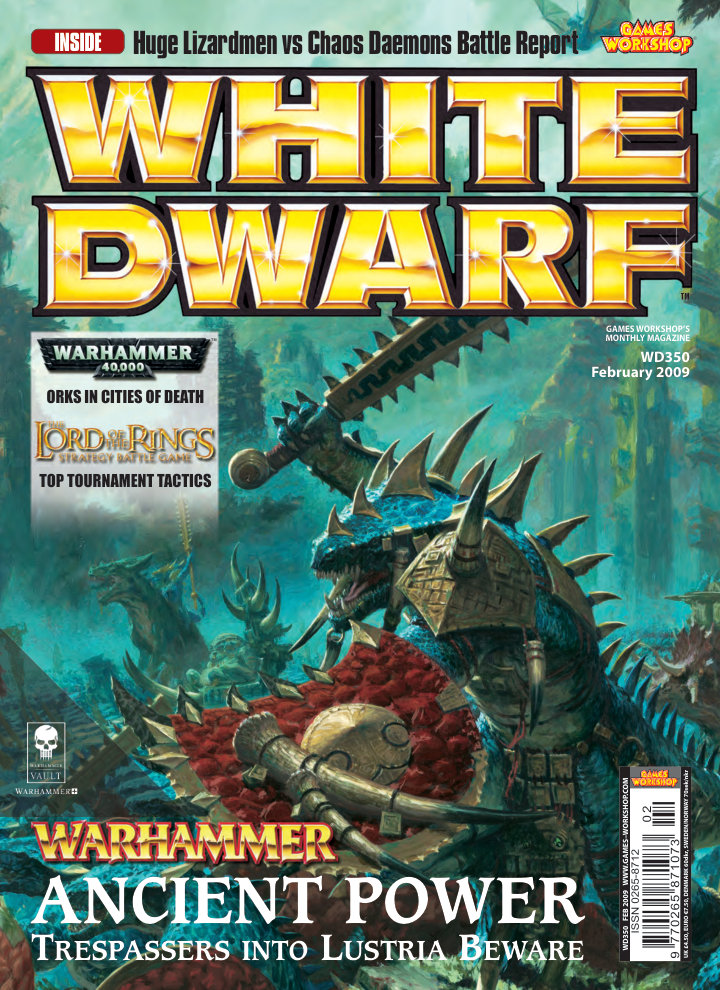
EditorialWD 350 · p. 1
Mark Latham describes the competing enthusiasm of the designers bringing Lizardmen, Orks and War of the Ring into the magazine. The new Citadel Hall of Fame also sparks a Studio-wide discussion of favourite miniatures, with choices ranging from the Skaven Doomwheel to a humble Rhino. His own affection for Kurt Helborg helped start an Empire collection, illustrating how one memorable sculpt can set a much larger hobby project in motion.
CommunityWD 350 · pp. 12–15
The news pages preview plastic Ents for War of the Ring and the enormous Ork Stompa planned for the next Apocalypse release. Gotrek and Felix receive an audio adventure involving a stolen relic of Stromfels, while Talisman’s Reaper expansion adds Death as an active hazard. Mark Latham’s Trafalgar introduces Age of Sail naval battles, and a short School League announcement explains the next stage of the regional competition.
War of the RingWarhammer 40,000Ents
InterviewWD 350 · pp. 16–31
Andy Hall interviews Andy Hoare and Robin Cruddace about making the Lizardmen a more continuously active and richly described civilisation. Their alien interpretation of the Old Ones’ plan can make them terrifying aggressors rather than straightforward defenders of order. The discussion connects the expanded temple-city history to resilient Saurus, mixed Skink–Kroxigor units, new Stegadon configurations and more flexible Slann, before presenting practical collecting and painting advice.
Warhammer Fantasy BattlesLizardmen
InterviewWD 350 · pp. 25–27
Dave Thomas and Martin Footitt explain how plastic construction allowed a larger, more aggressive-looking Stegadon than the earlier metal model. The stepped howdah follows the creature’s back and supports a giant bow, blowpipes or an Engine of the Gods, while interchangeable heads and horns distinguish multiple beasts. Annotated frame photographs show the many crew, weapon and decorative components behind that flexibility.
Warhammer Fantasy BattlesLizardmen
TacticsWD 350 · pp. 28–29
The suggested collection begins with substantial Saurus regiments, supported by both skirmishing and ranked Skinks to channel opponents and exploit flanks. Temple Guard provide a dependable anchor, Cold One Cavalry protect or attack a flank, and metal characters and specialist creatures fill the remaining gaps. A Slann strengthens the central formation further, while Salamanders and Razordons add the short-ranged shooting needed to complement the close-combat core.
Warhammer Fantasy BattlesLizardmen
PaintingWD 350 · pp. 30–31
The Eavy Metal guide gives Saurus skin a turquoise-blue progression while retaining darker, sharply outlined back scales. Red shield scales and layered metallic gold supply contrasting warm areas, with separate finishing instructions for horns, teeth and eyes. Alternative finished Saurus demonstrate that a predominantly blue army can still vary considerably through tone, mottling and the relative darkness of skin and scales.
Warhammer Fantasy BattlesLizardmen18 paint colours
PaintingWD 350 · p. 30
Skin begins with Regal Blue mixed with Hawk Turquoise, then becomes progressively lighter through Hawk Turquoise and Ice Blue. Back scales instead start with pure Regal Blue and a Badab Black wash, keeping the recesses deep before lighter edge highlights are added. The final pale-grey scale highlight distinguishes the hard surface from the softer turquoise flesh and makes individual scales legible across the model.
Warhammer Fantasy BattlesLizardmen5 paint colours
PaintingWD 350 · p. 31
The shield’s red scales are shaded black and worked through Mechrite Red, orange and a final brown edge, giving them a bright contrast to the blue warrior. Its gold rim begins with a brown-metal mixture, receives a Devlan Mud wash and ends in a pale gold–silver highlight. Horns, teeth and eyes receive compact separate recipes so the finished miniature has clean points of interest beyond the main skin scheme.
Warhammer Fantasy BattlesLizardmen14 paint colours
TacticsWD 350 · pp. 36–41
Jeremy Vetock gathers the Studio’s Ork players’ favourite ways to overwhelm an opponent with too many simultaneous threats. The basic surge becomes more effective when attacks are layered, flanks have distinct jobs and vulnerable but disruptive specialists draw fire away from the main mobs. Oddboyz then improve resilience, mobility or firepower, while the players’ disagreements show that the codex supports many effective approaches rather than one mandatory army formula.
Warhammer 40,000Orks
TacticsWD 350 · pp. 37–38
A direct Ork advance succeeds only if enough fighting power survives to break the enemy line. The article contrasts a mass of Boyz, a mechanised rush and a smaller assault of walkers and Battlewagons, then illustrates Fil Dunn’s strong and fast flanks around a Boyz centre. Phil Kelly instead commits Trukks in successive waves, accepting losses in the first line so another attack is already approaching when the opponent responds.
Warhammer 40,000Orks
TacticsWD 350 · p. 39
A threatening Looted Wagon, infiltrating Kommandos or fast Stormboyz can divert fire from the force that will actually win the battle. Snikrot and Zagstruk make these distractions particularly difficult to ignore by appearing in dangerous positions and causing immediate damage. The plan accepts that such units may die quickly: their value lies in the disruption and time bought for the larger Boyz mobs and Deff Dreads advancing behind them.
Warhammer 40,000Orks
TacticsWD 350 · pp. 40–41
Oddboyz improve an Ork force in distinct ways: Painboyz protect Nobz, Meks can repair a Battlewagon carrying Lootas, and a Big Mek’s force field shelters nearby mobs. Runtherds and cheap Gretchin take over objective duty so Boyz keep advancing. The surrounding examples add a Warphead-led shoota mob and Adrian Wood’s advice to shoot dangerous fighters while assaulting dangerous shooters, reinforcing the need to match a unit’s job to the target.
Warhammer 40,000Orks
TacticsWD 350 · pp. 42–47
Christian Byrne prepares both Good and Evil armies for his first Lord of the Rings Grand Tournament, with Adam Troke coaching the tactical transition from Warhammer 40,000. An Isengard defeat teaches the cost of too few warriors and exposing a Troll, while a Gondor victory demonstrates coordinated heroic actions. Painting remains a major motivation, and Christian explains how coherent colours and a strong presentation help an army attract attention at a tournament.
Middle-earth Strategy Battle GameIsengard
Battle reportWD 350 · p. 44
Christian’s 699-point Isengard army loses its carefully painted Troll early to Adam’s Dwarf shooting and finds itself outnumbered in a scenario where casualties can end the game. Saruman’s Sorcerous Blast and Gríma’s interference with enemy Might briefly improve the position, but the Dwarves eventually overwhelm the White Wizard. The printed army list makes clear why Christian resolves to bring more ordinary warriors instead of relying on a single spectacular monster.
Middle-earth Strategy Battle GameIsengard
Battle reportWD 350 · p. 45
Christian’s enlarged Minas Tirith force, supported by the Grey Company and Legolas, faces Chris Peach’s Easterlings and Haradrim. Shooting removes Khamûl’s Fell Beast, while a flanking infantry group gradually turns the armoured melee. Khamûl nearly isolates and kills Boromir with magic, but linked Heroic Combats let Halbarad and Legolas intervene, giving Christian the win and demonstrating the value of several cooperating heroes.
Middle-earth Strategy Battle GameGondor
PaintingWD 350 · pp. 46–47
Christian Byrne argues that a tournament army must first catch the passing viewer’s attention before its detailed brushwork can be appreciated. He then contrasts dark, weathered Uruk-hai armour with bright Minas Tirith plate: repeated black washes and brown recesses age the former, while silver panels and carefully redefined joints keep the latter clean. A finished gallery shows how these approaches sit alongside freehand markings and distinctive character models.
Middle-earth Strategy Battle GameIsengard4 paint colours
RulesWD 350 · pp. 48–50
Mat Ward explains how companies combine into formations and why larger formations survive casualties better than isolated companies. Models still track damage and attacks, but movement and fighting operate at a scale that makes huge battles practical. Charges, flanking and superior fighting skill add dice rather than guaranteed results, while flexible formation movement allows sweeping manoeuvres without requiring players to manage every warrior’s individual route.
War of the Ring
RulesWD 350 · pp. 52–57
Andy Hoare adapts Cities of Death to Ork warfare with two missions and six faction-specific stratagems. Ork-decorated ruins and Jeremy Vetock’s scratch-built settlement establish the setting, then occupation, demolition, guard squigs, teleporters and erratic workshops make the city behave like a greenskin stronghold. He explicitly invites agreement over whether to use the expansion’s scoring definition or the newer core rules, presenting the material as a model for players’ own themed scenarios.
Warhammer 40,000Orks
RulesWD 350 · p. 54
The Orks advance from a conventional long-edge deployment to pillage an Imperial city. Destroyed enemy units earn kill points for both sides, but the Orks also score for occupied ruins outside their deployment zone, while their opponent scores for Ork units left behind at home. Three stratagems per side and random game length preserve the cityfight framework while the extra scoring pressures the greenskins to commit to an attack.
Warhammer 40,000Orks
RulesWD 350 · p. 55
An enemy tries to burn the Orks out of a captured city, with only a limited number of elite units and a headquarters choice deployed at the start. Alongside kill points, destroyed ruins reward the attacker and surviving ruins reward the Orks. The attacker receives an extra stratagem but must spend one on a demolition-related option, making destruction of the battlefield itself a central objective rather than incidental scenery damage.
Warhammer 40,000Orks
RulesWD 350 · pp. 56–57
Six stratagems turn an ordinary ruined city into an unpredictable Ork settlement. Guard Squigs react to nearby units, Spiky Bits punish assaults into a fortified ruin and paired Tellyportas offer movement at the cost of dangerous tests. A Kunnin’ Trap may explode at the wrong moment, the Drops threaten trespassers with filthy hazards, and a Mek’s Workshop can recycle nearby wrecked tanks into randomly determined Ork vehicles.
Warhammer 40,000Orks
Battle reportWD 350 · pp. 58–77
Andy Hoare’s Lizardmen attack Robin Cruddace’s Daemons at Xahutec in a collection-based battle rather than a matched-points contest. Destroyed Daemonic units repeatedly return through a central portal, forcing Lord Kroak’s Temple Guard to advance while other units hold the attackers away. Kroq-Gar dies to the first spell, but Grymloq survives to kill the Bloodthirster; the Temple Guard endure the final assault and Kroak seals the portal for a Lizardmen victory.
Warhammer Fantasy BattlesLizardmen
FictionWD 350 · pp. 59–74
Tiktaq’to discovers the ground splitting open near the ruined City of Echoes and sees a Daemonic portal form above the wound. His aerial observations frame the battle as the ancient conflict between order and Chaos returning to Lustria. Later passages show him timing his descent, destroying a Daemon with dropped rocks and witnessing Kroak’s closing ritual, connecting the tabletop’s decisive moments into a single narrated expedition.
Warhammer Fantasy BattlesLizardmen
RulesWD 350 · p. 60
A central portal on an eight-foot battlefield continually replenishes the Daemonic army while Lizardmen approach from the short edges. A Lizardmen character must contact the portal and survive the following Daemonic turn to win; otherwise Chaos prevails. The We Are Legion rule includes random arrival positions, damaging misfires and even possession of enemy units, deliberately compensating for the smaller Daemon collection rather than promising equal points on each side.
Warhammer Fantasy BattlesLizardmen
EditorialWD 350 · pp. 78–80
Jervis Johnson proposes collecting as a fifth element of the hobby, alongside miniatures, modelling, gaming and background. The pleasure of shaping a collection can be constrained if army lists are mistaken for limits on what a player may own. Apocalypse, Legendary Battles, the Collectors Range and flexible new releases are offered as ways to support everything from a balanced army to a whole Chapter or a favourite sculptor’s complete work.
ModellingWD 350 · p. 81
Mark Jones explains how to apply Water Effects in shallow layers and allow each to cure before adding more depth. Gentle handling avoids trapped bubbles, while herbs, beads and tinted mixtures create vegetation, larger bubbles or coloured water. The same material can form thin glazing in model windows; level storage and patience during drying matter because fingerprints or an uncured thick pour can spoil the finished effect.
ModellingWD 350 · pp. 82–87
Chad Mierzwa combines Citadel Woods, older jungle plants and Warhammer 40,000 foliage into varied Lustrian scenery, then builds a spawning pool and an ancient portal. Foam card, glyph plates and deliberately weathered edges supply the architectural character, while sand gives painted stone a rough surface. The recipes unite the pieces through green foliage, earth and warm stone so the separate projects read as a coherent jungle battlefield.
Warhammer Fantasy BattlesLizardmen11 paint colours
ModellingWD 350 · pp. 83–84
Citadel Woods trunks receive tropical fronds from the Warhammer 40,000 Trees set, with additional Jungle Plants thickening the bases. Dark trunks and progressively lighter green leaves establish depth, while diluted Camo Green adds moss and lichen. Variations use different foliage, small copses or barbecue-skewer trunks, allowing the same materials and palette to make a varied jungle rather than a row of identical trees.
Warhammer Fantasy BattlesLizardmen9 paint colours
ModellingWD 350 · p. 85
The Arcane Ruins base provides a foundation for a sacred Lizardmen pool, enlarged with foam-card walls and a raised rim. Filler closes the gaps, carved wear suggests old stone and glyph plates establish its origin. Warm brown stone is drybrushed lighter, then patched with green moss and surrounded by plants; the accompanying material advice explains why exposed foam needs PVA and brush painting rather than solvents or aerosol undercoat.
Warhammer Fantasy BattlesLizardmen5 paint colours
ModellingWD 350 · pp. 86–87
Successively smaller foam-card layers create a stepped platform, with a circular portal and carved staircase set above it. Chips, grooves, glyph plates and fine sand turn the simple geometry into worn Lustrian architecture. The painting repeats the spawning pool’s warm stone and moss recipe, while a brown, grassy base and small fronds tie the monument into the surrounding jungle scenery.
Warhammer Fantasy BattlesLizardmen6 paint colours
InterviewWD 350 · pp. 88–92
Australian painter Luke McFarlane describes moving from a fascination with an Eldar miniature and Space Crusade to prize-winning character models. A scratch-built Lightning taught him to mix controlled sequences of shades and highlights, and he now finishes one small area at a time while experimenting with stronger contrast. His gallery ranges from desaturated military realism to vivid armour, showing an evolving style rather than a conscious attempt to imitate comic-book shading.
Warhammer 40,000Space Marines8 paint colours
PaintingWD 350 · pp. 90–92
Luke’s Ordo Malleus Inquisitor uses an Assault Terminator, a rebuilt hammer and a plasticard shield, with crimson armour shaded black and highlighted using Bronzed Flesh. An orange Space Marine combines a reposed leg with a progressively lighter yellow mixture, while a Cadian officer’s skin uses brown shading and white highlights. The gallery also explains shortened weapons, freehand squad marks and environmental bases as ways to give individual figures a story.
Warhammer 40,000Ordo Malleus8 paint colours
InterviewWD 350 · pp. 94–95
Aly Morrison nominates Colin Grayson’s Bretonnian Grail Reliquae for translating Dave Gallagher’s bizarre concept into a convincing three-dimensional composition. Pilgrims carrying a dead knight form the silhouette of a horse, with a bit, horseshoes and carefully angled sword reinforcing the illusion. Aly sees both comedy and darkness in the piece and recommends studying its details as painting inspiration; a gallery adds Grayson’s Helstorm Rocket Battery and Thunderfire Cannon.
Warhammer Fantasy BattlesWarhammer 40,000Bretonnia
PaintingWD 350 · pp. 96–101
The Eavy Metal team treats the face as a miniature’s focal point and explains how thin layers preserve its expression. Basic skin recipes expand into hair, eyes, stubble, scars and a more elaborate character-face method, with separate green-skin approaches for Orcs and Goblins. Diagrams show where shadows and highlights belong, while the examples stress subtle changes in colour and placement instead of a single universal flesh recipe.
Warhammer 40,000Warhammer Fantasy Battles27 paint colours
PaintingWD 350 · p. 97
A diagram locates the deepest shadows around the eyes, nose, jaw and lower lip, with highlights on the brow, cheeks, nose and chin. The accompanying four-step recipe moves from Tallarn Flesh and Ogryn Flesh to a bone-and-flesh highlight. Alternative dark, mid-tone and pale palettes show how changing both the chosen colours and their proportions affects complexion, and the guide recommends judging skin against the model’s other finished colours.
10 paint colours
PaintingWD 350 · p. 98
Black hair is built from a black-grey base through selective grey highlights and a final black wash; brown or blond hair begins with Calthan Brown and receives thin strand-like yellow and bone marks. Hairlines use a related darker colour rather than an artificial black outline. A separate hand recipe repeats the basic flesh progression while concentrating the final light on knuckles, showing how similar principles apply to another small exposed area.
12 paint colours
PaintingWD 350 · p. 99
Eyes are painted inside a dark outline, with pupils touching both lids to avoid a startled expression. Stubble comes from adding browns and greys to the existing skin highlight and applying it within a believable beard line. Raised healed scars retain the normal flesh highlights beneath coloured glazes, while fresh cuts begin with red; the examples also suggest cool turquoise recesses as a way to enrich an otherwise warm complexion.
9 paint colours
PaintingWD 350 · p. 100
The nine-stage character-face method alternates controlled washes with progressively smaller highlights. Dark Flesh and a brown-black mixture deepen the initial flesh base, then grey and bone lighten the raised features. Blue around the eyes and red on the lower lip introduce subtle variation before a restrained white highlight establishes expression, making its exact placement as important as the chosen colours.
9 paint colours
PaintingWD 350 · p. 101
The Orc face starts very dark with Orkhide Shade and Badab Black, preserving strong shadows beneath the brow and around the mouth. Knarloc Green supplies the mid-tone before Goblin Green defines the raised forms. Adding Bleached Bone to the final green highlight brings out the prominent facial planes without replacing the darker green structure, after which the eyes and teeth complete the expression.
Warhammer Fantasy BattlesWarhammer 40,000Orcs & Goblins5 paint colours
PaintingWD 350 · p. 101
Goblin and Gretchin skin receives a brighter treatment than the adjacent Orc example. Knarloc Green is washed with Thraka Green, then Goblin Green establishes the main complexion. A three-colour green, yellow and bone highlight leads to pure Bleached Bone on the most prominent details, producing a lighter and sharper face while the recesses retain their green depth.
Warhammer Fantasy BattlesWarhammer 40,000Orcs & Goblins5 paint colours
CommunityWD 350 · p. 103
Warhammer World’s rotating exhibitions combine original illustrations, development sculpts and painted miniatures to explain how finished Games Workshop designs take shape. The programme looks back through older work as well as celebrating new releases, with Lizardmen and Lord of the Rings displays followed by John Blanche’s selection for his twenty-fifth full-time year. The profile encourages close inspection of original brushwork and early models rather than treating the displays as a release catalogue.