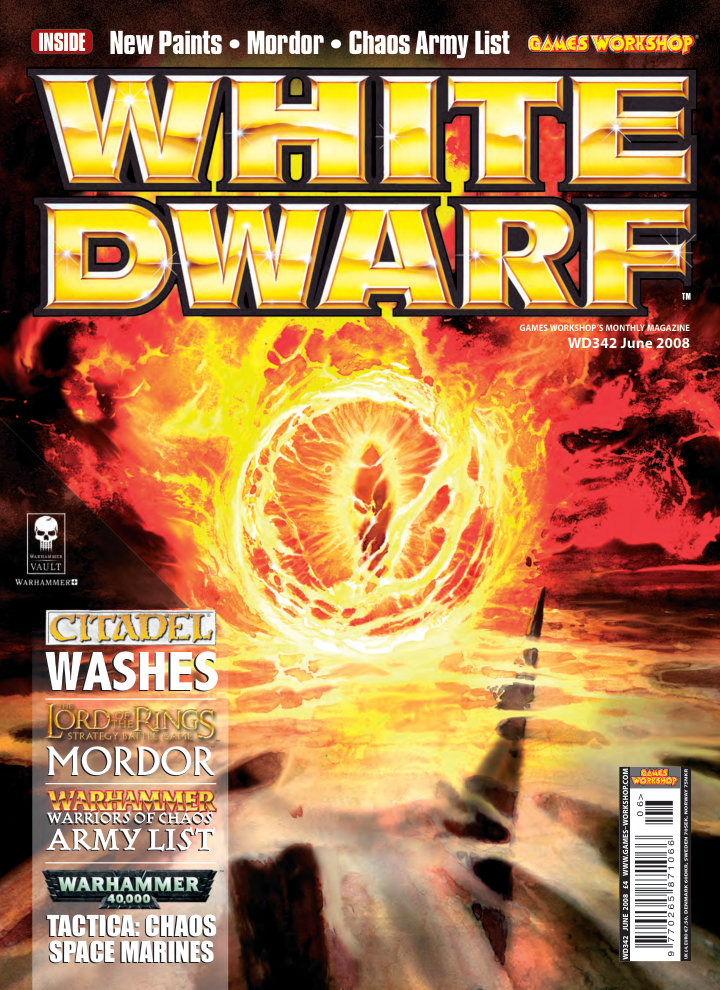
EditorialWD 342 · Inside cover
Grombrindal introduces Mordor as Adam Troke’s final sourcebook before leaving the Studio, celebrating the developer’s contribution to the Middle-earth game. Painting occupies another large part of the issue through the revised Citadel range, new washes, a spray gun and the return of Painting Workshop. The editorial frames these articles as practical companions to the new painting book and invites readers to judge the promised improvements for themselves.
Middle-earth Strategy Battle GameMordor
CommunityWD 342 · pp. 10–11
The Dark Elf preview announces an updated army book, returning personalities and new miniature kits for the raiders of Naggaroth. Lokhir Fellheart joins established characters, while plastic Cold Ones and Black Ark Corsairs expand the range. Repeater handbows give the Corsairs a new visible equipment choice. Short background describes the bitterness and cruelty behind their raids, connecting the coming release to their long conflict with the High Elves.
Warhammer Fantasy BattlesDark Elves
CommunityWD 342 · p. 12
Warhammer World announces five-day camps built around assembling, painting and playing with a new or expanded army. A selected battalion or battleforce, materials, tuition and a carrying case support the week’s project, with games testing the growing force. The page also lists forthcoming exhibitions and previews Aly Morrison’s new Bugman miniature. The programme turns the earlier hobby-camp proposal into bookable activities with a clear collecting goal.
Warhammer 40,000Warhammer Fantasy Battles
InterviewWD 342 · pp. 14–25
Andy Hall talks to Adam Troke about expanding Mordor without losing the familiar identity of Sauron’s forces. Distinctive Ringwraiths, Black Númenóreans and Morgul Knights give elite options, while new Orc support heroes and a versatile Troll kit strengthen the ordinary ranks. Two example armies demonstrate mounted raiding and a large combined host. Neil Green’s painting recipes then show how the new washes can give Orc flesh, cloth and armour depth with straightforward stages.
Middle-earth Strategy Battle GameMordor13 paint colours
TacticsWD 342 · pp. 20–21
Mat Ward combines affordable Warg Riders with a mounted Captain and Shaman for protection and reliable Heroic Moves. Morgul Knights add a stronger charge and Terror to discourage opposing attacks, while Shelob keeps pace as a threat to enemy heroes. Gothmog supplies further opportunities to act without spending Might. The army uses Mordor’s range to create a mobile force whose different elements support the same aggressive style.
Middle-earth Strategy Battle GameMordor
TacticsWD 342 · pp. 22–23
Christian Byrne builds a large force around numerous Orcs, supported by heroes, a drummer and a taskmaster. Three Trolls provide different fighting and morale roles, including a mobile war drum. The Shadow Lord protects a smaller elite contingent of Black Númenóreans and Morgul Knights as it advances with the Mouth of Sauron. The design combines expendable numbers with concentrated terror, magic and powerful monsters rather than relying on any one element.
Middle-earth Strategy Battle GameMordor
PaintingWD 342 · pp. 24–25
Neil Green offers pale and green Orc skin sequences, each built from a simple base, intermediate layer and highlight before a brown wash unifies the surface. Armour uses brighter metallic drybrushing followed by black shading. Brown and dark cloth repeat the same principle with earth or grey tones. The final washes soften transitions and restore recesses, giving a mixed collection a suitably worn appearance without demanding elaborate individual techniques.
Middle-earth Strategy Battle GameMordor13 paint colours
InterviewWD 342 · pp. 28–33
Andy Hall visits Dave Cross to examine the new washes, spray gun and painting book. Cross explains the difference between opaque Foundation paints and translucent paint-based shading, while ’Eavy Metal painters describe experiments with metal and colour. Demonstrations compare washing before or after highlights, and Chad Mierzwa develops a complete Tyranid scheme from a shaded white undercoat. The feature presents the releases through their practical effect on consistent army painting.
Warhammer 40,000Middle-earth Strategy Battle Game30 paint colours
PaintingWD 342 · pp. 30–31
The guide explains how wash quantity changes the strength of shading and compares selective application with an overall coat. Chad’s Haradrim example receives highlights before several coloured washes, blending transitions and strengthening recesses. A second demonstration shades metal immediately after its basecoat and adds bright highlights afterwards. Smaller examples show how the same approach changes Orc armour, Plaguebearer skin, old bone and Bloodletter flesh.
Middle-earth Strategy Battle GameWarhammer Fantasy BattlesHarad22 paint colours
PaintingWD 342 · pp. 32–33
Chad starts from white and uses purple washes as a guide to the Termagant’s anatomy. Restored bone-coloured skin contrasts with a black-and-purple carapace, whose pale edge lines make its hard plates readable. Red-orange claws and bright yellow eyes add smaller contrasting details, with teeth picked out separately. Repeating the controlled method across a whole brood shows how a quick army technique can still produce convincing texture and a strong finished appearance.
Warhammer 40,000Tyranids10 paint colours
Battle reportWD 342 · pp. 36–55
Adam Troke’s Mordor army meets Alessio Cavatore’s Gondor force on a lava-cut battlefield in a seven-hundred-point Domination game. Risky jumps and defended crossings make terrain as important as casualties. Gandalf destroys the Troll, but Black Númenóreans pin him down while the Dark Marshal and Grishnákh pressure Faramir. Gondor breaks just before Mordor, and fleeing defenders plus a final assault leave Adam controlling all four objectives in his farewell battle report.
Middle-earth Strategy Battle GameMordor
RulesWD 342 · p. 37
Domination places one key terrain objective in each quarter and deploys the armies from opposite corners. Control is decided by the number of models touching each feature when the battle ends. Once a force breaks, a die roll can end play after each turn, creating urgency without a guaranteed final round. Capturing three objectives wins narrowly and all four produces a major victory, encouraging armies to split their effort across the board.
Middle-earth Strategy Battle Game
RulesWD 342 · p. 42
The lava rules make every unbridged crossing a consequential decision. Models must jump successfully to reach the opposite bank, and those that fail or are pushed into the flow are immediately removed. A particularly good jump allows continued movement after landing. This simple terrain change creates choke points, rewards control of safe approaches and makes movement or knockback magic dangerous in ways ordinary open ground would not.
Middle-earth Strategy Battle Game
TacticsWD 342 · pp. 56–61
Christian Byrne draws on tournament practice to compare a mobile collection chosen partly for painting quality with a more tightly optimised army. Rhinos deliver coordinated firepower in the first, while winged Daemon Princes manipulate targets for resilient Plague Marines in the second. Obliterators supply adaptable support in both. Deployment diagrams and warnings about common opposing builds show how the plans depend on cover, timing and mutual support rather than simply buying the strongest units.
Warhammer 40,000Chaos Space Marines
TacticsWD 342 · pp. 57–59
Christian’s transport army keeps its Rhino-borne squads together so no isolated unit can be defeated before support arrives. Smoke and the vehicles’ own hulls protect the approach, then massed rapid fire prepares the target for later assault. A Slaaneshi Sorcerer, Nurgle Prince and teleporting Obliterators add specialised threats, supported by a Vindicator and plasma Havocs. The list balances his favourite painted models with a practical mobile attack.
Warhammer 40,000Chaos Space Marines
TacticsWD 342 · p. 60
Two winged Slaaneshi Daemon Princes use Lash of Submission to place enemies where Plague Marines and summoned threats can exploit them. The durable infantry advances through cover, while independent Obliterators appear near icons or threaten distant vehicles. A Greater Daemon adds another close-combat attacker without consuming many points. The plan uses psychic movement both offensively and defensively, but requires the exposed Princes to choose their positions carefully.
Warhammer 40,000Chaos Space Marines
TacticsWD 342 · p. 61
Christian surveys four tournament threats: mechanised Eldar, Wazdakka’s bikers, mobile Tau and monster-heavy Tyranids. Their strengths differ, from late objective grabs and concentrated shooting to fast Ork assaults or numerous monstrous creatures. He explains the broad patterns that make each hard to face, including isolation of enemy units and the effect of escalation. The closing note makes clear that these competitive priorities suit players who enjoy closely contested tournament games.
Warhammer 40,000Eldar
InterviewWD 342 · pp. 62–65
Mark Latham visits EA Mythic and finds developers determined to preserve Warhammer’s imagery and character in an online world. Six races form opposing alliances, with matched adversaries, varied careers and personalised equipment feeding an escalating war towards enemy capitals. The artists’ consultation with the Studio and the developers’ own miniature collections support that aim. Screenshots and concept art demonstrate the familiar places and personalities behind the forthcoming computer game.
Warhammer Fantasy BattlesThe Empire
RulesWD 342 · pp. 66–67
Inspired by a cooperative computer-game quest, the scenario starts with greenskins hunting Squigs to secure the help of a reluctant Giant. Once the Squigs are gone, the Orcs form up and guide their new ally into a disguised mine beside a Dwarf gate. The explosion opens the hold and may injure or remove the Giant. A six-turn battle then follows, with scheduled reinforcements and surviving first-stage troops carrying the results of the opening task into the siege.
Warhammer Fantasy BattlesOrcs & Goblins
RulesWD 342 · pp. 68–75
Alessio Cavatore supplies a temporary independent Warriors of Chaos list after the Daemon release invalidates Hordes of Chaos. It covers army selection, Marks, characters, core troops, mounted support, monsters and magic items, keeping the existing mortal miniatures playable until a full replacement book. Daemonic mounts share a consolidated profile and formations no longer draw on the separate Daemon or Beastmen books. The article distinguishes this practical interim list from the forthcoming expanded range and army book.
Warhammer Fantasy BattlesWarriors of Chaos
RulesWD 342 · p. 75
The interim list provides common equipment alongside Chaos weapons, armour, talismans, arcane aids and banners. Several items reinforce a god’s particular style, while others trade a powerful benefit for risk or impose new tests on opponents. Defensive options include regeneration and missile protection, and spellcasting tools alter dice or add magical resources. The selection lets players equip the temporary list’s characters without returning to the superseded mixed Chaos army book.
Warhammer Fantasy BattlesWarriors of Chaos
EditorialWD 342 · pp. 77–79
Jervis previews the aims behind the new Warhammer 40,000 rulebook: inspiring background, attractive models and rules that make their story feel immediate. He explains why the developers prefer a model’s actual view across the scenery to the previous abstract height and area-terrain system. A missile shot seen through opposing windows illustrates the imaginative effect he wants. The column treats cinematic involvement as a design priority and places rules alongside the other parts of the hobby.
Warhammer 40,000
PaintingWD 342 · pp. 80–87
The relaunched workshop begins with preparation and undercoat choice before explaining layering, washes and extreme highlights. Colour samples show how gradual mixtures or deliberate contrast affect the result, while photographed examples apply each method to an Elf, Orc and Tau warrior. Advice on paint consistency, excess wash and brush position connects the theory to common difficulties. Displays by several Studio painters demonstrate that the same foundations can support different personal styles.
Warhammer Fantasy BattlesWarhammer 40,00039 paint colours
ModellingWD 342 · p. 81
Preparing a whole unit together saves time and makes later colour choices more consistent, while a test model limits the cost of an uncertain scheme. The article distinguishes the gripping function of primer from its role as a starting colour. White favours bright colours and black offers convenient dark recesses, each with disadvantages to consider. Cleaning mould lines before painting prevents an avoidable interruption once the surface is already finished.
PaintingWD 342 · pp. 82–83
The guide compares a few contrasting layers with many narrow intermediate shades. Mixing adjoining colours in changing proportions can make transitions smoother, while adding a pale neutral helps unrelated tones belong together. Thinned paint prevents the layers from becoming heavy and obscuring detail. A High Elf Archer demonstrates grey-to-white robes and blue ribbons, and Dave Andrews’s work shows how disciplined colour selection supports the same method at a high standard.
Warhammer Fantasy BattlesHigh Elves17 paint colours
PaintingWD 342 · pp. 84–85
Washes stain raised areas lightly while collecting more strongly in recesses, creating natural-looking shade on textured surfaces. The article explains removing excess liquid and bubbles, testing unfamiliar combinations and choosing surfaces that suit the method. A Mordor Orc demonstrates metal, cloth and flesh, while colour pairings offer starting points for other schemes. Christian Byrne’s Wraithguard shows how a strong Foundation base and a complementary wash can prepare later layers.
Middle-earth Strategy Battle GameWarhammer 40,000Mordor24 paint colours
PaintingWD 342 · pp. 86–87
Fine pale lines on hard edges create a stylised impression of light and sharpen a miniature’s silhouette. The guide discusses fixed versus overhead illumination and demonstrates using the brush’s side on accessible edges, switching to its tip for corners. A Tau Fire Warrior provides separate examples for black weapon casing, brown fatigues and ochre armour. Studio Marines and other models show how the technique can finish both subtle blends and stark schemes.
Warhammer 40,000Tau Empire8 paint colours
PaintingWD 342 · pp. 88–91
The guide assembles the spray gun, hose, paint jar and propellant supply, then uses the jar’s marks to dilute Foundation paint. Test bursts reveal consistency or pressure problems before the model is sprayed. Washes can be sprayed directly onto textured scenery, while tanks receive camouflage through controlled lines or masking putty. Cleaning between colours and after a session is part of the process, with alternating propellant cans suggested for longer periods of work.
Warhammer 40,000
PaintingWD 342 · pp. 94–99
Joe Tomaszewski paints Skulltaker’s head separately to reach the surrounding detail, building red flesh through many thin layers. Shiny black leather and a non-metallic brass symbol distinguish the cloak from the model’s true metallic armour. Grey-based skulls add age and contrast, while an obsidian sword and reversed light-to-dark flame sequence finish the focal details. The masterclass combines careful material separation with the strong red, black and brass identity of Khorne.
Warhammer 40,000Warhammer Fantasy BattlesChaos Daemons25 paint colours
PaintingWD 342 · p. 95
Repeated thin red layers establish smooth skin over a black foundation before increasingly bright mixtures define raised muscles. Dark brown-black shading restores the deepest recesses, and an orange-yellow final highlight picks out the uppermost details. Eyes progress to a small white light, while teeth use subdued grey-bone colours. Keeping the head separate improves access and makes the face easier to control throughout the process.
Warhammer 40,000Warhammer Fantasy BattlesKhorne11 paint colours
PaintingWD 342 · p. 96
The cloak’s leather begins as dark grey with black recesses, then gains narrow lighter lines that imply a glossy surface. Its enormous Khorne symbol uses brown and white rather than metallic paint, making the decoration read as part of the fabric while still suggesting brass. Strongly defined edges and a final bright line supply the illusion of reflection. Restrained leather highlights keep that symbol the dominant feature.
Warhammer 40,000Warhammer Fantasy BattlesKhorne6 paint colours
PaintingWD 342 · p. 97
The many trophies begin from a dirty grey Foundation colour rather than a warm ivory base. Increasing amounts of bone cover most surfaces but preserve patches of the original grey, making the skulls appear weathered. Fine pure-white highlights then give the most prominent edges a chalky quality. Repeating the sequence across cloak, horns and base keeps the numerous small details consistent without turning them into a uniformly bright mass.
Warhammer 40,000Warhammer Fantasy BattlesKhorne4 paint colours
PaintingWD 342 · p. 98
Joe paints underlying iron before its bronze ornaments, avoiding damage to already finished detail. Both metals start darkened with black, gain a stronger metallic layer and are dulled with a brown wash. Limited silver or silver-bronze highlights then restore selected glints. The method separates real armour and fittings from the cloak’s painted metal illusion while preserving a worn finish across the miniature.
Warhammer 40,000Warhammer Fantasy BattlesKhorne6 paint colours
PaintingWD 342 · p. 99
Purple flesh colours define the tongue, while the sword and claws use sharp grey-white marks over black to suggest obsidian and growth lines. The burning skull reverses ordinary highlighting: white recesses form the hottest core and darker yellow, orange, red and black move towards the flame tips. Tiny pale marks suggest cinders. Joining the head and finishing the sand base completes the model after these deliberately different surface effects.
Warhammer 40,000Warhammer Fantasy BattlesKhorne12 paint colours
CommunityWD 342 · pp. 100–103
The category guide explains how to enter single figures, units, large creatures, vehicles, regiments, monsters and Middle-earth models. Further categories allow large-scale miniatures, duels and dioramas, with size and presentation limits distinguishing them. Young Bloods offers younger painters a focused single-model competition, while the Open category permits broader projects and Games Workshop employees. Previous winning examples illustrate the range of work, and the text points entrants towards complete forms and guidelines.
Warhammer 40,000Warhammer Fantasy Battles
CommunityWD 342 · p. 113
The new National Painting Competition divides entrants into Youngblood and Open age groups, each with four categories covering single miniatures, units, monsters or vehicles, and duels or dioramas. The guide sets basic model, unit and base requirements and identifies the store judging date. A companion notice offers preview sessions for the new washes, spray gun and painting book. Readers can therefore prepare entries while testing the materials highlighted elsewhere in the issue.
Warhammer 40,000Warhammer Fantasy Battles