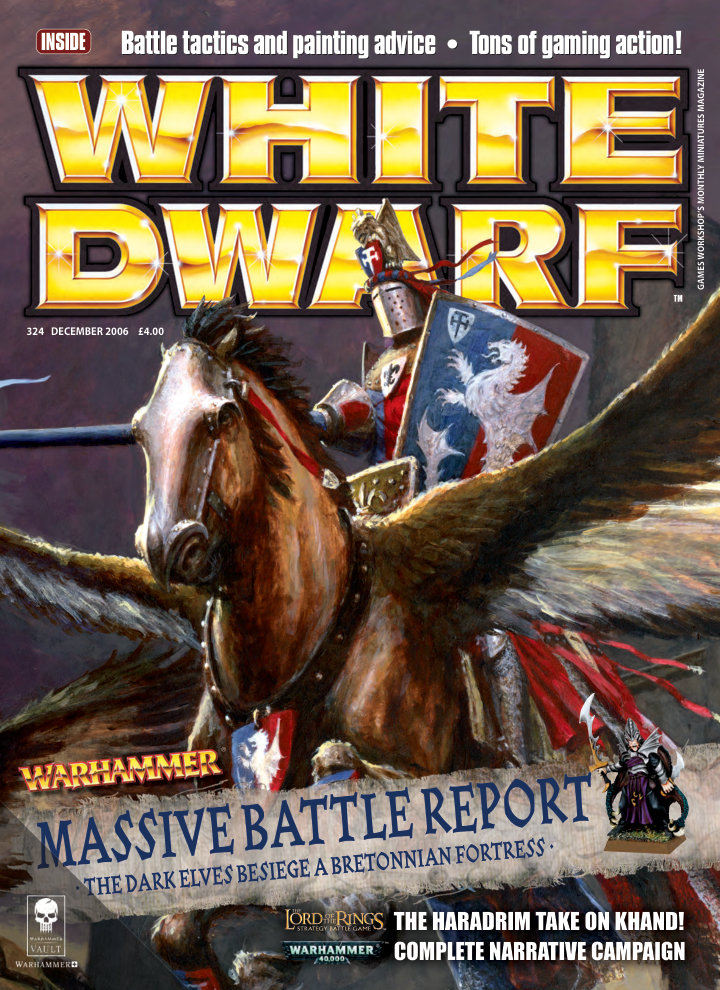
EditorialWD 324 · Inside cover
Grombrindal introduces a Christmas issue built around unusually ambitious games: a Bretonnian castle defence against eight thousand points of Dark Elves and complete campaigns for both Warhammer 40,000 and The Lord of the Rings. Hobby accessories and modelling material accompany the games, with the editorial presenting them as projects to occupy readers over the holiday.
LoreWD 324 · pp. 10–11
The forthcoming sourcebook returns to the ruined northern kingdom of Arnor, joining its ancient fall to the later story of Arathorn and Aragorn. The preview introduces forces for Arnor, Angmar and the Grey Company, including Arvedui, Gûlavhar and Bûrhdur, and explains that the book combines linked scenarios, army lists, profiles and hobby material rather than merely presenting a new miniature range.
Middle-earth Strategy Battle GameArnor
CommunityWD 324 · p. 12
The news page announces the planned Warhammer 40,000 roleplaying trilogy, beginning with Inquisitorial agents in Dark Heresy and envisaging later Rogue Trader exploration and Space Marine kill-teams. It also previews Lee Lightner’s Sons of Fenris and looks back at the September launch celebrations for the new Warhammer game and Battle for Skull Pass.
Warhammer 40,000Warhammer Fantasy BattlesSpace Wolves
CommunityWD 324 · pp. 16–23
A newcomer’s introduction explains collecting, painting and playing as complementary parts of the hobby before comparing the three main games. Ranked regiments and manoeuvre define Warhammer, loose squads and vehicles shape Warhammer 40,000, and individually moving warriors with finite heroic resources distinguish The Lord of the Rings. The guide also explains points values, supplements, clubs and events so that a first collection can develop into a playable army.
Warhammer Fantasy BattlesWarhammer 40,000
RulesWD 324 · pp. 24–27
An eight-thousand-point Dark Elf host attacks a Bretonnian fortress while the Green Knight and a Wood Elf relief force attempt to save it. The custom rules divide the castle into controllable sections, distinguish ladders, grapples and siege towers, and make its gate a destructible weak point. Victory after seven turns depends on occupying castle sections with viable units, forcing the attackers to concentrate on the walls rather than simply destroy the defenders.
Warhammer Fantasy BattlesBretonnia
Battle reportWD 324 · pp. 24–41
Phil Kelly’s peasants and Mat Ward’s forest spirits defend against Adam Troke and Matthew Hutson’s immense Dark Elf army. An extraordinary opening volley sends the enemy general and much of his cavalry fleeing, while the Bretonnian foot troops hold the ramparts longer than expected. The late relief force suffers from blocked approaches and punishing counterattacks; persistent Corsairs eventually seize the gatehouse, Lord Balderin falls, and the Dark Elves win control of the castle despite their enormous losses.
Warhammer Fantasy BattlesBretonnia
LoreWD 324 · pp. 42–43
Saim-Hann emissary Triadhu Firesong demands the evacuation of Lilia Mundi, claiming it as the Eldar maiden world Lelialthar, and kills the Iron Blood clans’ elder when challenged. His son Khemu rallies the clans with the support of their mysterious Sky Warriors, the Black Templars who recruit on the planet. The account describes the hidden Chapter keep and leaves the Eldar’s underlying purpose uncertain, framing the conflict through human tribal history and Imperial records.
Warhammer 40,000Aeldari
CampaignWD 324 · pp. 44–47
A linear series retells the Lilia Mundi war through small actions, escalating ground battles and an optional fleet engagement before a decisive relief operation. Results usually determine an advantage such as first turn or extra troops in the following game, keeping the story connected without letting an early defeat decide everything. The last battle counts twice toward campaign victory, and the author encourages additional missions or an allied feral-world contingent to personalise the conflict.
Warhammer 40,000Battlefleet GothicAeldari
RulesWD 324 · p. 45
The opening encounter uses the rulebook’s Kill-team Assassinate mission to represent Khemu’s first attempt to win his followers’ trust by spilling Eldar blood. Black Templar Initiates and Neophytes can stand in for the tribal warriors and their mentors, or players can convert individual Iron Bloods. The winner gains one hundred extra points for the next engagement, making the skirmish relevant to the campaign’s larger war.
Warhammer 40,000Black Templars
RulesWD 324 · p. 45
A Combat Patrol clash represents the arrival of the Eldar sky dragons and the Iron Bloods’ first major resistance. A Black Templar victory awards a character a free Holy Relic, treating a vessel of captured alien blood as a tribal symbol of unfinished vengeance. An Eldar win instead permits a night attack in the next mission, shifting the subsequent battle’s conditions.
Warhammer 40,000Black Templars
RulesWD 324 · p. 45
The third linked action translates tales of Eldar night raids into a Sabotage mission from the rulebook’s Raid Missions section. The Eldar attack a Black Templar force in a five-hundred- to thousand-point game, and an earlier Eldar victory may impose Night Fighting. Its winner takes the first turn at Wikoli’s Landing, connecting the raids directly to the coming pitched engagement.
Warhammer 40,000Black Templars
RulesWD 324 · p. 45
After ten days of skirmishing, the Sky Warriors bring the raiders to a conventional battle in a broad forest clearing. The campaign uses a roughly thousand-point Cleanse mission, giving the previous game’s winner the first turn. This is the transition from elusive raids to a concentrated fight, with its result granting the same initiative advantage in the following Recon battle.
Warhammer 40,000Black Templars
RulesWD 324 · p. 45
The fifth battle uses Recon to represent the Black Templars pushing through the Eldar lines while aircraft gather overhead. Forces rise to roughly one thousand to fifteen hundred points, and the preceding victor goes first. The outcome then decides which side attacks in the Rearguard mission, giving the advancing force a reason to press its advantage.
Warhammer 40,000Black Templars
RulesWD 324 · p. 45
A fifteen-hundred-point Rearguard mission portrays the Sky Warriors fighting while surrounded by the swift Eldar. Rather than prescribe a new scenario, the campaign directs players to the rulebook’s Breakout Battles section and makes the previous game’s winner the attacker. It establishes the defenders’ desperate situation immediately before reinforcements attempt to break through from orbit.
Warhammer 40,000Black Templars
RulesWD 324 · p. 45
The optional seventh game switches to Battlefleet Gothic, with a Space Marine fleet attempting a Planetary Assault against the Eldar ships above Lilia Mundi. Each assault point earned gives the Imperial player fifty additional points of Space Marines in the final ground battle. Groups without fleets can omit this stage without awarding either side an advantage, preserving the campaign’s continuity.
Battlefleet GothicSpace Marines
RulesWD 324 · pp. 46–47
The Eldar attack a small nominated defensive core while most Black Templars arrive as reserves, entering by Deep Strike or from any table edge. The attackers must destroy or irretrievably break every key defensive unit, while a single surviving unit gives the defenders victory. A six-turn minimum followed by random game length creates a relief race, and the suggested autumnal, wooded battlefield reinforces the story of the clan homeland.
Warhammer 40,000Black Templars
LoreWD 324 · pp. 48–51
An illustrated dossier identifies the Saim-Hann invaders and the Black Templar defenders through the roles they played in the war. Eldar jetbikes and anti-personnel Vypers terrorise a population poorly equipped to resist them, while a depleted Chapter garrison is strengthened in successive arrivals. Named figures, surviving Neophytes and veteran Dreadnoughts turn the accompanying armies into participants with histories rather than anonymous collections.
Warhammer 40,000Aeldari
CampaignWD 324 · pp. 52–59
Mat Ward constructs a hypothetical early career for Suladan, exiled from Umbar to the seemingly unimportant fortress of Pazghar just before a Khandish invasion. Four linked scenarios move from siege and sacrifice to the rescue of Abrakan and the recovery of the frontier fortress. Flexible Legions of Middle-earth force selections sit beside historical suggested lists, and a hero-survival table preserves continuity without guaranteeing that every named character will return.
Middle-earth Strategy Battle GameHarad
RulesWD 324 · p. 56
Suladan and a tiny Haradrim garrison must hold a compact fortress for twenty turns against the Khandish army. Fallen attackers can return through the Without Number reinforcement rule, with entry points controlled by the player holding priority. Khand wins by establishing ten models inside the fortress at the end, so the defenders need to deny access rather than expect to eliminate the invading army.
Middle-earth Strategy Battle GameHarad
RulesWD 324 · p. 57
Haran leads a doomed diversion into the Khandish camp to cover Suladan’s escape. His small force must kill thirty enemies before being wiped out, with cavalry worth two toward that total and more Khandish warriors answering the alarm each turn. Darkness reduces shooting range but improves the chance of wounding, creating a brief, violent raid in which the Haradrim measure success by the damage they cause.
Middle-earth Strategy Battle GameHarad
RulesWD 324 · p. 58
The attack on Abrakan brings mounted Suladan and Haradrim reinforcements into a struggle for the merchant city. Harad wins by killing the aggressive Khandish king Vangaris, whereas Khand must reduce its opponents to a quarter of their original numbers. Special rules compel Vangaris to charge when possible and let Suladan pass Courage tests automatically, encouraging the decisive confrontation on which the campaign’s story depends.
Middle-earth Strategy Battle GameHarad
RulesWD 324 · p. 59
The campaign concludes with Suladan commanding one of two Mûmakil against the Khandish occupation of Pazghar. Harad must wipe out the enemy, while the defenders need only kill Suladan, putting the apparently overwhelming attacking beasts beside a vulnerable central objective. Surviving heroes from the previous game may return, and the article suggests alternative Elven, Dwarven or Gondorian themes for groups using different collections.
Middle-earth Strategy Battle GameHarad
ModellingWD 324 · pp. 60–63
A former Gondorian border fort becomes a reusable campaign objective through foam-card construction, individually applied card bricks and layered arched windows. Separate walls, stables, stairs and a removable watchtower preserve access for models and allow different layouts. Hinged balsa gates and replaceable Haradrim or Khandish banners make changes of ownership visible, while restrained drybrushing unifies the varied building materials.
Middle-earth Strategy Battle GameGondor10 paint colours
PaintingWD 324 · p. 63
Four colour charts distinguish the fortress’s stone walls, tiled roofs, wooden doors and metal fittings. Grey drybrushing gives the masonry a pale Gondorian appearance, brown-to-khaki highlights pick out the timber, and mixed brown and black inks weather the ironwork. The finished building is based to suit the player’s terrain, then supplied with interchangeable banners to represent whichever army currently occupies it.
Middle-earth Strategy Battle GameGondor10 paint colours
EditorialWD 324 · pp. 64–66
Jervis Johnson credits the Studio support staff before reviewing the plastic Giant, the Eldar range and Cities of Death as major achievements of 2006. Playing straightforward games against his son Jack has also reminded him of the pleasure of expanding an army without constant development or reporting duties. He resolves to play more, build a new Warhammer army and meet visiting gamers at Warhammer World.
ModellingWD 324 · p. 67
Four examples show how dead grass, slate, clump foliage and resin skull piles can make a character’s base more convincing. The guide stresses fitting the figure before assembly when a large scenic element affects its stance, scattering smaller slate around a raised rock and combining grasses for varied vegetation. It also explains how to avoid conspicuous glue marks and make static grass stand upright.
ShowcaseWD 324 · pp. 68–71
A visual introduction to Black Hole Entertainment’s real-time strategy game shows how Warhammer regiments and heroes translate to the computer screen. It explains unit status, hero skills, the campaign map and the recruitment and replenishment of armies between battles. An interactive army painter can customise individual models as well as units, while screenshots illustrate the contrasting armies and battlefield roles available.
Warhammer Fantasy BattlesWarhammer: Mark of ChaosThe Empire
ShowcaseWD 324 · pp. 72–81
The international gallery surveys Slayer Sword winners from Germany, France, Spain, Italy, the United States and the United Kingdom. Subjects range from Stefan Rath’s Orion and Alfonso Giraldes Bermejo’s Blood Pact soldier to Andrea Ottolini’s Eisenhorn and Albert Moretó Font’s Orc Warlord. The accompanying interviews reveal the long preparation, detailed freehand and repeated refinements behind models that appear effortless in the finished photographs.
Warhammer Fantasy BattlesWarhammer 40,000
InterviewWD 324 · pp. 72–73
Alan Merrett explains Golden Demon as a way to reward painters, inspire other hobbyists and push Games Workshop’s own standards. Judging begins with painting, but uneven conversions or unfinished details can weaken an otherwise strong entry. He distinguishes imaginative interpretations of established settings from unrelated references or speculative cultures, and describes Youngbloods and the Open competition as complementary places for other kinds of participation.
InterviewWD 324 · p. 76
Fernando Prieto describes the one-hundred-and-eighty-hour creation of his converted Space Marine hero, including a scratch-built homunculus inspired by codex art. Thin layers and a deliberately patient approach produce the clean finish, while the unicorn heraldry has a personal origin in his girlfriend’s favourite creature. The interview stresses checking each component until satisfied and dedicating substantial time before the competition.
Warhammer 40,000Space Marines
InterviewWD 324 · p. 78
Natalya Melnik explains her Chicago-winning Fellowship as an attempt to reproduce the film characters with natural colours, realistic expressions and finely painted clothing. Embroidery on Boromir and Gimli demonstrates the controlled detail for which she is known. Rather than cite a special shortcut, she attributes the result to a fine brush and confident painting, with affection for the whole Fellowship shaping the project.
Middle-earth Strategy Battle GameThe Fellowship
InterviewWD 324 · p. 80
Todd Swanson’s Beastmen warband took more than three hundred hours, beginning with models he was particularly enthusiastic to paint. He describes conversions that preserve the apparent quality of the original sculpts, planned freehand designs and repeated repainting whenever an area falls short. His central advice is to eliminate mistakes and achieve seamless transitions, accepting the time required rather than rush an entry.
Warhammer Fantasy BattlesBeasts of Chaos
InterviewWD 324 · p. 81
The UK Slayer Sword winner traces his Orc Warlord from inspiration in Adrian Smith’s artwork to months of modelling and painting, followed by sustained daily work before Games Day. The teeth and feet were especially demanding details, and he admits nearly abandoning the piece. A previous second place and encouragement from the Spanish painting community kept him focused on completing the model to a winning standard.
Warhammer Fantasy BattlesOrcs & Goblins
TacticsWD 324 · pp. 82–87
Phil Kelly and Ant Reynolds argue that deployment can create a decisive advantage before the first turn. Cheap units can conceal an army’s real intentions, valuable troops benefit from terrain and careful character placement, and hill positions improve shooting. Diagrammed corner defences, refused flanks and strong centres demonstrate competing plans; the final discussion adapts them for small elite armies and Vampire Counts, whose dependence on their General constrains how far units can spread.
Warhammer Fantasy BattlesSkaven
ModellingWD 324 · pp. 88–93
The workshop compares the spirit-driven Wraithlord with the piloted War Walker, then breaks down both plastic kits through component diagrams and assembly illustrations. Optional weapons and decorative parts allow models to be tailored to a collection rather than assembled identically. Finished examples connect craftworld identity to battlefield equipment and heraldry, including the kills represented by the vines on Biel-Tan walkers.
Warhammer 40,000Aeldari
ModellingWD 324 · pp. 88–89
A numbered breakdown identifies the Wraithlord’s head, torso, limbs, weapons and ornamental pieces before showing their assembly sequence. The forty-eight-piece kit includes alternative arm and shoulder weapons, hands, vanes and a sword, giving both posing and equipment choices. The guide makes those alternatives visible beside a finished model so that readers can plan the build before committing parts with glue.
Warhammer 40,000Aeldari
ModellingWD 324 · pp. 90–91
The War Walker instructions identify the chassis, pilot, sensors, vanes and interchangeable guns with a numbered parts key and an illustrated build. Optional elements are distinguished from the standard assembly, and completed examples show the variety possible within a squadron. The emphasis is on understanding the kit’s structure and choices before using repeated walkers as a coordinated part of an Eldar collection.
Warhammer 40,000Aeldari
RulesWD 324 · pp. 92–93
Weapon profiles accompany walkers from Biel-Tan, Saim-Hann, Iyanden and Telennar, covering anti-tank lances, missile modes, shuriken fire, flamers and the Wraithsword’s close-combat rerolls. Short background notes place those loadouts in each craftworld’s traditions: Iyanden favours durable long-range constructs while Telennar pilots synchronise their targeting. This spread links the physical kit choices to their contemporary battlefield capabilities.
Warhammer 40,000Aeldari
PaintingWD 324 · pp. 94–95
Neil Hodgson uses the plastic Boromir from Mines of Moria to demonstrate how film stills guide a miniature’s colours, textures and small details. A staged method progresses from neat basecoats through shading and highlights, with separate notes for sleeve embroidery, facial tones, leather and the Horn of Gondor. Weathering the robes and recreating cracked Moria stone on the base connect the figure to its particular scene.
Middle-earth Strategy Battle GameThe Fellowship16 paint colours
ShowcaseWD 324 · pp. 98–101
Chris Peach and Rik Turner prepare contrasting Lord of the Rings armies for the Grand Tournament after the release of Legions of Middle-earth. Chris combines orange-and-black Easterlings with supporting Haradrim and Khamûl, converting a female captain from Éowyn. Rik builds an Eregion army around Gil-galad and Elrond, explains why his unofficial cavalry cannot attend the tournament, and describes sculpting a diving Great Eagle to avoid duplicated models.
Middle-earth Strategy Battle GameEasterlings20 paint colours
PaintingWD 324 · p. 99
Chris Peach replaces the familiar red-and-gold Easterling appearance with black robes, vivid orange cloth and brass armour to suggest a sinister, wealthy force from Tset-Hedren. The accompanying recipes separate robes, scarves, armour, weapons and bases, using dark ink shading to retain definition around the metallic details. The colours unify Easterling infantry and cavalry while making the collection distinct from its film inspiration.
Middle-earth Strategy Battle GameEasterlings12 paint colours
PaintingWD 324 · p. 100
Rik Turner’s Elven army uses blue robes and pale grey sashes beneath bright gold armour, with dark green and blue inks separating the metallic finishes. A compact recipe chart records the cloth, armour, weapons and neutral bases for repetition across the force. Painting warriors in groups of twelve makes both the collection’s visual organisation and later army selections easier to manage.
Middle-earth Strategy Battle GameEregion13 paint colours
ModellingWD 324 · p. 101
Rik Turner researches real eagle anatomy to create a diving pose instead of repeating the standard Great Eagle model. He draws new wing shapes on plasticard, builds individual feathers with Green Stuff from the tips inward, and lets each surface cure before working on the reverse. Reworked tail feathers and filled joints complete a conversion designed to look convincingly airborne.
Middle-earth Strategy Battle GameGreat Eagles
ShowcaseWD 324 · pp. 102–107
Gareth Hamilton’s Empire army represents displaced survivors of the Storm of Chaos, assembled from a deliberately eclectic collection of metal miniatures. A Mordheim Witch Hunter started a search through the back catalogue that brought together human, Dwarf, Halfling, Bretonnian and Elven figures. The army’s coherent refugee narrative makes those varied models work together, while its stubborn infantry line supports countercharges rather than relying on a single elite cavalry formation.
Warhammer Fantasy BattlesThe Empire
CommunityWD 324 · p. 113
A short photographic report catches the scale of Games Day 2006 as the issue goes to press, showing the crowds, gaming displays and shared excitement of the event. It serves as an initial visual record ahead of the promised full report in the next issue, rather than a list of results or a detailed account of each demonstration.