EditorialWD 288 · p. 2
Paul Sawyer sets aside the usual celebration of his job to mark the death of Steve Hambrook. Jervis Johnson’s accompanying tribute recalls a friend and colleague whose editing work supported the Citadel Journal and several Specialist Games magazines. Together the pieces describe the personal loss felt by the studio and its readers, while directing contemporary condolences to Hambrook’s family.
CommunityWD 288 · pp. 4–5
Forge World’s new Mark IV Dreadnoughts and the forthcoming Liber Chaotica: Tzeentch lead the release news. Other notices cover Warhammer Online merchandise, collectible Space Marines and organised events ranging from nautical Warhammer games to the Return to Damocles campaign. The spread also includes corrections to an earlier reference sheet, reflecting the continuing maintenance of the games alongside new products.
Warhammer 40,000Warhammer Fantasy Battles
RulesWD 288 · p. 4
Gav Thorpe explains the principles behind the reference chart supplied with issue 286, including entries anticipating forthcoming model bases and rules. The correction list addresses several armies’ mounts, monsters and machines. A specific clarification distinguishes the Warp-lightning Cannon’s chariot-like treatment from an ordinary war machine, showing why base dimensions and Unit Strength must be considered alongside the unit’s own rules.
Warhammer Fantasy BattlesThe Empire
ModellingWD 288 · pp. 12–17
Paul Rudge recreates the Descent video-game level as a playable trench battlefield. Polystyrene sheets provide its structure, with extra depth added after testing reveals that soldiers remain too visible. Templates help produce matching arches, and removable walls preserve access and line-of-sight checks. Painting separates red-brown earth, weathered stone, rusted supports and sharpened stakes, while fallen Fire Warriors and small puddles carry details from the digital setting onto the table.
Warhammer 40,000T’au Empire14 paint colours
RulesWD 288 · pp. 20–21
Nick Kyme adapts Kais’s journey through Chaos-held trenches into a small Warhammer 40,000 mission. The T’au must move their hero to a warp portal before the defenders kill him, with sentries delaying the ordered arrival of Chaos reinforcements. Special trench rules make climbing into the open risky, while Kais’s modified weapon and protective destiny give him a distinctive role. Tactical advice stresses supporting his advance without becoming trapped in prolonged combat.
Warhammer 40,000T’au Empire
Battle reportWD 288 · pp. 22–27
Kuju’s James Brooksby and David Millard command the T’au against Christian Byrne’s Chaos force in the new Descent scenario. Aggressively placed Pathfinders establish a firing lane, but Raptors threaten to stop Kais until the T’au commit their remaining troops to rescue him. Reliable rail-rifle fire and a catastrophically inaccurate Chaos missile launcher help Kuju secure victory. The discussion examines deployment and coordinated support, and the visiting developers reflect on seeing their video-game environment made into a physical battlefield.
Warhammer 40,000T’au Empire
ModellingWD 288 · p. 29
Christian Byrne combines Fire Warrior components with a compatible Pathfinder rail rifle to make Kais recognisable as the video game’s hero. A Death Cult Assassin’s blade and the hilt of a bonding knife create the sword carried on his backpack. The short guide demonstrates how a few specific equipment changes can distinguish a named character from the ordinary troops around him.
Warhammer 40,000T’au Empire
CommunityWD 288 · pp. 30–33
Che Webster tours the 2003 UK Games Day and Golden Demon at Birmingham’s National Indoor Arena. Club-run games, spectacular large battles and computer-game demonstrations share the event with painting, modelling and scenery activities. The lower hall houses competition entries and opportunities to meet studio artists and designers, while archive displays trace earlier work. Awards close a report that emphasises the contribution of clubs and staff to the scale and variety of the day.
Warhammer 40,000Warhammer Fantasy Battles
LoreWD 288 · pp. 34–39
An Imperial scholar reconstructs Rahmohtep’s reign from looted objects, inscriptions and uncertain accounts. The Scarab King’s rivalry with Khemri and supposed divine favour introduce an army whose elite guards, charioteers, cavalry and infantry were buried with their ruler. Drawings of weapons, shields and standards give the reconstruction a material basis. The narrator’s refusal to believe in animated statues or curses adds irony, as readers recognise the Tomb Kings’ reality beneath his confident historical explanation.
Warhammer Fantasy BattlesTomb Kings
LoreWD 288 · pp. 44–49
Andy Hoare traces the Crimson Fists from the Imperial Fists’ division after the Heresy to the catastrophe on Rynn’s World. Alexis Polux shapes the young chapter’s rational, determined character, while recruitment traditions and campaigns establish its expertise against alien foes. The account of Waaagh! Snagrod explains how a disastrous missile strike destroys the fortress-monastery and forces Pedro Kantor into a desperate struggle with a tiny surviving force.
Warhammer 40,000Space Marines
CommunityWD 288 · p. 50
Jervis Johnson introduces Battlefleet Gothic: Armada and Inquisitor’s Death of an Angel as permanent supplements rather than magazine releases. Armada gathers official fleets and new additions, while the Inquisitor book carries a mystery into Karis Cephalon through linked campaigns and scenarios. New figures support that story, and Warmaster receives a Tomb Kings scorpion and Skaven Stormvermin. The column explains how publications and miniatures fit together across the Specialist Games range.
Battlefleet GothicInquisitorT’au Empire
PaintingWD 288 · pp. 52–54
Matt Anderson uses a Border Patrol campaign as the incentive to build a manageable Tomb Kings force. A converted Liche Priest, a regiment of Skeletons and three Ushabti provide a small collection that can later grow into an army. The painting account develops bleached bone, turquoise, cowhide shields and metallic details, while an unsuccessful verdigris experiment leads to dark green stone constructs. His explanations connect the limited roster, assembly decisions and painting workload to getting the army into play.
Warhammer Fantasy BattlesTomb Kings14 paint colours
RulesWD 288 · p. 55
The updated small-game format restates the force restrictions and resolves questions raised by continued play. Clarifications cover Empire detachments, Skaven weapon teams, Salamanders and the meaning of infantry, while exceptions accommodate Tomb Kings and Vampire Counts. A final decision-making guide encourages players to use existing precedents, reasonable outcomes and a die roll where necessary, recognising that a compact variant will produce situations the main game was not designed around.
Warhammer Fantasy BattlesThe Empire
LoreWD 288 · pp. 56–59
The profile explores the Last Chancers as condemned soldiers whose abilities remain useful to the Imperium. Schaeffer offers survival and redemption through missions most of his recruits will never return from, while Lieutenant Kage embodies the psychological cost of that service. An expedition into the Eye of Terror illustrates the colonel’s brutal effectiveness against a Black Legion outpost. A Kill Team excerpt places that promise of a last chance directly in the recruits’ experience.
Warhammer 40,000Astra Militarum
RulesWD 288 · p. 59
The rules turn Schaeffer, Kage and a variable group of penal soldiers into a flexible formation divided into small sub-units. Specialists gain weapons or unusual equipment, and eligible groups can infiltrate, deep strike or ride in Chimeras. The colonel’s harsh discipline sustains the scattered force, while Kage receives abilities reflecting his dangerous instincts. Restrictions on doctrines and support models preserve the unit’s identity as a deliberately assembled collection of misfits.
Warhammer 40,000Astra Militarum
LoreWD 288 · pp. 60–63
Gav Thorpe describes the political crisis caused by Luthor Huss’s claim that Valten is Sigmar reborn. Pilgrims gather outside Altdorf as the Grand Theogonist demands their dispersal, leaving Karl Franz to choose between dangerous rival sources of authority. Valten’s entrance to the city brings the dispute before the Emperor. Franz answers by giving him Ghal Maraz while retaining the Runefang and his political office, presenting shared leadership as the means to unite the Empire against the approaching Chaos invasion.
Warhammer Fantasy BattlesThe Empire
RulesWD 288 · p. 61
Karl Franz’s character entry presents the Emperor mounted on Deathclaw with a choice of his legendary weapons. Leadership effects extend his influence over nearby troops, while the Silver Seal protects both rider and Griffon. Army-selection benefits represent his command of the Reiksguard. The profile also explains Deathclaw’s loyalty after his master falls, tying a battlefield rule to the long relationship between the two.
Warhammer Fantasy BattlesThe Empire
RulesWD 288 · p. 63
The mounted Valten profile emphasises personal resolve and the inspiration created by his deeds. His attacks contribute to nearby fights, while special rules counter the effects of being surrounded and can let him endure apparently fatal wounds. Ghal Maraz supplies the force behind those feats. An equipment note connects the entry to the surrounding story by requiring Karl Franz to use his Runefang when both leaders appear in the same army.
Warhammer Fantasy BattlesThe Empire
CommunityWD 288 · pp. 66–69
Mark Chambers and Ian Huxley review Eye of Terror events across shops and independent stockists. A boarding action aboard the Planet Killer provides the roadshow’s shared narrative, with Sheffield’s Grey Knights fighting to disable the vessel before it escapes. Other reports describe large linked battles, event cards, a scratch-built Chaos Titan and a compact tournament. Painting and scenery activities run alongside the games, showing how the campaign engaged people beyond ordinary matched battles.
Warhammer 40,000Grey Knights
Battle reportWD 288 · pp. 72–91
Pete Haines and Gav Thorpe attempt to unite two separated Dwarf forces before Andy Chambers’s Nurgle army and Anthony Reynolds’s Undead overwhelm them. The attackers concentrate on one throng first, using superior mobility and summoned Zombies to isolate fights and shield valuable units. Individual Dwarf regiments make stubborn stands, but the allied armies cannot create a coherent line in time. The conclusions examine the scenario’s disadvantage for slow troops, the loss of magical defence and the importance of following a plan instead of reacting piecemeal.
Warhammer Fantasy BattlesDwarfs
RulesWD 288 · pp. 98–99
Adam O’Brien brings the Nine to the Shire’s border, where a small band of Rangers tries to deny them a crossing. Staggered Ringwraith arrivals and a turn limit complicate an apparently overwhelming advantage in strength. The wraiths must get enough searchers off the western edge, while the Rangers use the river and cover to delay them. Campaign instructions determine whether casualties from earlier encounters have recovered their full Will.
Middle-earth Strategy Battle GameMordor
RulesWD 288 · pp. 100–102
The Grand Tournament framework requires each entrant to bring both a Good and an Evil force, then play scenarios from both perspectives. Revised selection limits permit hero-heavy armies and define which publications and profiles take precedence. The article explains rosters, event-specific rules and scoring for play, presentation, theme and sportsmanship. Advice for using the missions at home makes the format useful beyond the tournament itself.
Middle-earth Strategy Battle Game
Army buildingWD 288 · pp. 103–105
Alessio Cavatore, Matthew Ward, Mark Bedford and Mark Cox present paired forces and explain their different approaches. Mounted Rohan offers speed, Elven leaders combine combat and magic, and Isildur leads a larger human contingent. The Evil lists range from balanced Isengard formations to a tiny group built around Ringwraith and Barrow-wight magic. The examples show how the same event framework can accommodate both numerous warriors and a few specialised characters.
Middle-earth Strategy Battle GameRohan
RulesWD 288 · p. 106
A Good force must cross the battlefield and escape through the enemy’s edge to reinforce a besieged garrison. The degree of victory depends on how many models get through and whether a hero accompanies them, so sacrificing troops to open a route can be more useful than destroying the defenders. Alternating halves of each force during deployment gives both players a chance to respond to the developing plan.
Middle-earth Strategy Battle Game
RulesWD 288 · p. 106
Both armies enter as scattered reinforcements and race to control an objective at the table’s centre. Arrival rolls can delay models or bring them onto a flank, forcing commanders to assemble a useful force while contesting the ground. Once either side has suffered enough losses, the game can end unexpectedly. Victory depends on the troops within the objective area at that moment, rewarding concentration and timing.
Middle-earth Strategy Battle Game
RulesWD 288 · p. 107
The Good player chooses which half of the Evil army has been trapped, then surrounds it and attempts to kill its most expensive model. The defenders start with the initiative and do not suffer the usual courage checks for reaching half strength. Their leader must escape, with wounds suffered affecting the degree of victory. The asymmetric selection and deployment make protecting one model the central tactical problem.
Middle-earth Strategy Battle Game
RulesWD 288 · p. 107
The final tournament mission resolves a direct clash through casualties, but a surviving hero determines whether the winner earns a major or minor victory. Deployment depth varies for each half of a force, creating uncertainty in the opening positions. First-turn priority is rolled rather than automatically granted to Good. The straightforward objective provides a contrasting test to the breakthrough, objective and escape scenarios.
Middle-earth Strategy Battle Game
RulesWD 288 · pp. 108–109
The Captains of the West divide their force before the Black Gate and face an encircling army of Mordor. Eagles can arrive to help, but the Good side must preserve Aragorn as well as break the opposing force; losing him limits the best possible result to a draw. A points-match option supports other armies. The setup creates a large game where coordinating separated groups matters as much as the strength of individual heroes.
Middle-earth Strategy Battle GameGondor
Battle reportWD 288 · pp. 108–121
Six players divide the armies before Mordor’s gate, with cavalry, heroes and arriving Eagles attempting to defeat the larger Evil force in separate groups. The attackers adjust their plan around the Good side’s speed and powerful characters, eventually using Ringwraith magic to draw Aragorn into a trap. Mordor’s army breaks, but the king’s death denies the Free Peoples an outright victory and leaves a draw. The players’ conclusions highlight coordination, timely reinforcement and the danger of committing a crucial hero beyond support.
Middle-earth Strategy Battle GameGondor
RulesWD 288 · p. 109
Two additional Great Eagles receive profiles to accompany Gwaihir in the Black Gate battle. Their flight and resilience make them useful support against forces that depend on manoeuvre or large creatures. The entry also describes their role as monstrous mounts for the Wizards and the conditions for including them in another army. The source explicitly asks players to obtain their opponent’s agreement outside the featured scenario.
Middle-earth Strategy Battle GameEagles
TacticsWD 288 · pp. 122–125
Matthew Ward combines the new banner, archery and spear rules into practical battlefield formations. Banners encourage concentrated lines, while archers can fire through a friendly front rank before giving way to supporting spearmen. Volley fire creates opportunities for protected shooting, but needs spotters and suitable targets. Diagrams of the Wall and Bastion show how to combine these tools, and counter-tactics focus on cavalry, feints and removing the enemy’s eyes rather than simply attacking its strongest point.
Middle-earth Strategy Battle GameGondor
PaintingWD 288 · pp. 126–127
Tammy Haye explains how ’Eavy Metal captures the film Orcs’ irregular appearance without losing the clarity of small miniatures. Mixing charts provide varied cloth, leather and skin tones from a limited shared palette, and changing the location of each colour keeps repeated models distinct. Leaders use additional tones, while the darker uniformity of Mordor Uruk-hai creates a deliberate contrast. A captain’s pink-grey skin recipe and examples of disguised Hobbits show how the principles extend beyond ordinary warriors.
Middle-earth Strategy Battle GameMordor15 paint colours
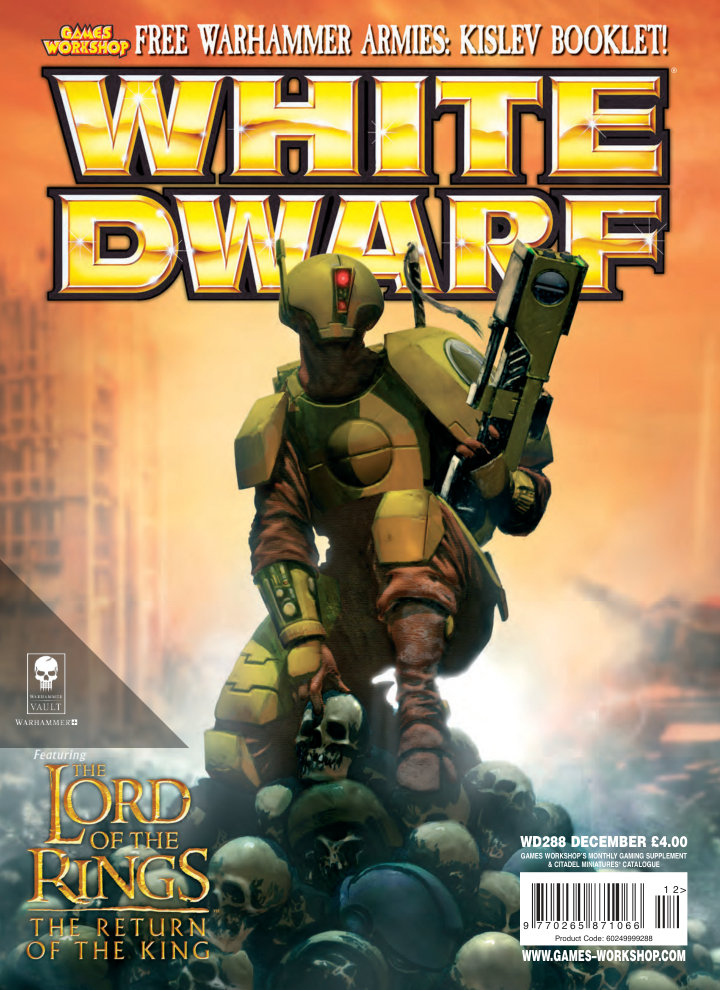
Imprint confirms December 2003, issue 288. Repeated 56 footers are noted on affected records. The separate free Kislev booklet is not present in this scan. Main features, substantial rules and tutorials are indexed; release catalogues, directories and advertisements are excluded.