EditorialWD 502 · Inside cover
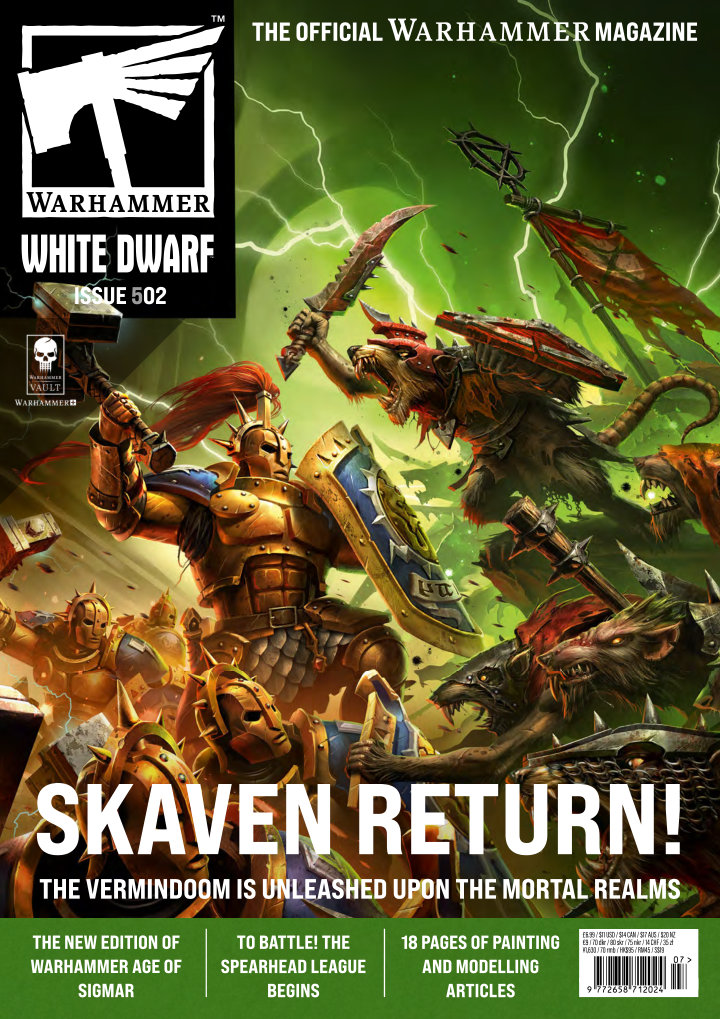
Lyle introduces the Skaventide launch through its new models, fourth-edition rules and compact Spearhead format. The issue combines developer and designer insights with a teaching battle report and painting guides. Reference cards, a Mortal Realms map and a Warcry campaign poster accompany the articles, while the Bunker offers a simple league for readers ready to begin playing Spearhead.
Age of Sigmar
CommunityWD 502 · pp. 2–5
Marco Schulze returns to Tyranids after a long break with a grotesque gunbeast, revisiting the fleets that appeared in earlier publications. Grombrindal reports that duardin unification has produced a noisy clan gathering rather than an easy agreement. Rudy Bigand’s converted Ravenwing Chaplain uses recognisable wing motifs, cool black armour and restrained warm gold to distinguish it from his Black Templars.
Warhammer 40,000Age of SigmarTyranids13 paint colours
LoreWD 502 · pp. 6–9
Leila explores what endless Reforging costs a Stormcast when physical restoration no longer preserves compassion or identity. The Ruination chambers and Morrda’s final mercy arise from that tragedy rather than ordinary corruption. Bleak Citadels provide contemplation, watchful Lord-Relictors and Memorian descendants who sustain fading memories, while corvid creatures reinforce the connection between these warriors, mourning and the possibility of oblivion.
Age of SigmarStormcast Eternals
CommunityWD 502 · pp. 10–11
The Bunker looks back over its first year of Combat Patrol, Slidecrown, Crusade and skirmish events. Lyle contrasts the large studio club with smaller, store-based and online groups that can use the same activities in their own ways. Painted-army favourites and the leading studio achievement scores illustrate the mix of collecting, games and shared encouragement the club has generated.
CommunityWD 502 · pp. 12–13
The painting cycle returns to ordinary troops, encouraging participants to finish the units that form the substance of their armies. Achievement points also recognise scenario games and other club activities, so a completed rank-and-file project joins a broader monthly record. The continuing journal and rank table reward regular involvement across the hobby year.
CampaignWD 502 · pp. 14–17
The league awards points for playing, winning, facing new opponents and defeating someone above the player on the table. Separate titles recognise painted armies, enemy generals slain and victories in Aqshy or Ghyran, providing several goals beyond the championship. Sam’s diary describes an introductory player overcoming a large deficit, illustrating the format’s capacity for close games and late reversals.
Age of Sigmar
PaintingWD 502 · pp. 16–17
Sergi chooses models he helped design and builds a rapid Ossiarch scheme around shared washes and drybrushing. Different bone areas preserve the impression of assembled remains, while green-based copper and red eyes provide contrasting accents. The repeatable process prepares a complete Spearhead for the league without removing the tactile detail that makes the models appealing.
Age of SigmarOssiarch Bonereapers13 paint colours
RulesWD 502 · pp. 18–19
An annihilating weapon drives both armies out of their deployment zones, where escalating damage makes delay increasingly costly. Selected infantry gain infiltration or scouting movement to help establish an escape route. Progressive objective control matters, but a nominated saviour unit must also reach a marker by the end to secure the final evacuation award.
Warhammer 40,000
RulesWD 502 · pp. 20–21
The classic battleplan returns with each army divided into three roughly equal groups that enter over successive rounds. Underdog twists can delay an enemy reserve early or strengthen a friendly unit later. Objective control and battle tactics determine the result, so players must balance the first contingent’s survival against the positions needed by reinforcements.
Age of Sigmar
CampaignWD 502 · pp. 22–25
Each warband nominates a Chosen One who follows a branching campaign map toward the guarded secrets of Talaxis. Trials grant mythic traits and artefacts, while four Ending battles turn accumulated power into progress toward final victory. Taking a longer route improves the hero’s chances against Talaxis’s defences, but successful Endings consume rewards and a slain hero leaves only artefacts to a successor.
Warcry
CampaignWD 502 · p. 26
The Blade’s trials demand either more melee kills than any other fighter or several victories despite self-inflicted harm. Their rewards turn a damaging strike into a second nearby injury or briefly make a weapon much deadlier. The path therefore develops a personal duellist whose success depends on getting the Chosen One into the decisive combats.
Warcry
CampaignWD 502 · p. 26
Crusaders prove themselves by clearing chosen quarters and bringing down leaders, priests or especially powerful enemies. Laurels can strengthen either attack or defence, while divine favour improves the punishment delivered by Counter reactions. Territorial advance and deliberate selection of worthy targets give this path a different rhythm from indiscriminate slaughter.
Warcry
RulesWD 502 · p. 27
The Chosen One faces an enemy duellist near the battlefield centre, with the contest ending when that rival falls or four rounds pass. The defender gains extra wounds, but accumulated mythic rewards turn the Chosen One’s melee strikes into damaging shock waves. Winning requires a personal kill or driving the duellist to the edge, making the broader warband support one decisive confrontation.
Warcry
CampaignWD 502 · p. 28
A Devout hero first spreads power through several corners of the battlefield, then demonstrates conviction by resisting the temptation to rely on abilities and reactions. Rewards protect against hostile ability damage and may let a powerful quad be used without consuming its dice. Faith is expressed as both active missionary work and disciplined restraint.
Warcry
CampaignWD 502 · p. 28
The Zealot hunts whichever enemy has most recently used an ability, or follows a prophecy represented by objectives disappearing under random rolls. Its rewards heal the Chosen One through ability use and prevent nearby enemies using their own tricks. The campaign turns fanaticism into a volatile struggle to identify and destroy the current embodiment of heresy.
Warcry
RulesWD 502 · p. 29
At the centre of the battlefield, the Chosen One attempts to consecrate or desecrate the land while remaining free of nearby enemies. Mythic rewards improve each ritual roll, and a dangerous blood-sacrifice ability provides another route to progress. Extra wounds help the hero endure, but the warband must still create enough space for the divine work to be completed.
Warcry
CampaignWD 502 · p. 30
Bandits either beat treasure from the toughest enemy or race to collect everything scattered across the field. Sticky Fingers lets a victorious Chosen One steal an enemy weapon, while a mirror can redirect damage from a hostile ability. The path rewards opportunism and turns another warband’s possessions into resources for the rising thief.
Warcry
CampaignWD 502 · p. 30
Adventurers seek valuable objectives and learn to rely on companions fighting close to their Chosen One. Their rewards improve withdrawal through difficult spaces and generate wild dice from nearby enemy reactions. The result supports a mobile hero who succeeds through adaptable teamwork rather than remaining permanently locked in the same duel.
Warcry
RulesWD 502 · p. 31
Every eligible enemy fighter begins carrying apparent treasure, but only one prize is real. Dropping tokens tests their authenticity, with nearby accumulated mythic power improving the search. Once the genuine relic is exposed, all false prizes vanish, transforming a broad hunt into a focused struggle over the single remaining reward.
Warcry
CampaignWD 502 · p. 32
The Scholar uncovers the hidden values of objectives or accumulates knowledge represented by unused wild dice. An amulet improves a future initiative roll, while enlightenment grants extraordinary strength and toughness when the player lacks initiative. These trials and rewards make information, patience and preparedness central to the character’s rise.
Warcry
CampaignWD 502 · p. 32
A Warlord seizes enemy linchpin terrain and systematically clears chosen battlefield quarters. Its artefact and trait become stronger while the warband is outnumbered, adding force or movement when opposition appears greatest. The path combines visible territorial ambition with tools for a leader who refuses to accept numerical disadvantage as a reason to stop advancing.
Warcry
RulesWD 502 · p. 33
The defender secretly chooses a number representing indecipherable runes. From the second round, an unengaged Chosen One can gain partial clues from dice rolled at a terrain feature, with mythic rewards increasing the information available. The hero must finally guess correctly and survive; a wrong answer immediately loses the battle, making knowledge and risk central to the Ending.
Warcry
TacticsWD 502 · pp. 34–37
Jimbo examines the new edition’s ten core commands and how they influence both players’ turns. Movement, return fire, countercharges and magical intervention can deny objectives or tactics without simply increasing damage. Advice on saving points for crucial moments leads to a Slaanesh puzzle in which a small redeployment and a selective countercharge can frustrate the enemy’s attempt to seize the centre.
Age of Sigmar
PaintingWD 502 · pp. 38–43
Dan separates how paint is applied from what the painter wants that application to achieve. Twelve techniques and five results explain why the same wash, glaze or drybrush can serve different purposes. Worked armour examples, material guidance and definitions of Battle Ready and Parade Ready establish a shared vocabulary for interpreting future magazine recipes without prescribing one method for every model.
8 paint colours
PaintingWD 502 · p. 39
Ultramarine blue, Hammers of Sigmar gold and Iyanden yellow illustrate the revised recipe vocabulary. Each starts with an undercoat and base colour but uses different shading and highlighting methods, demonstrating that the desired result does not dictate a single technique. The compact examples also show how a strong limited progression can establish a recognisable faction finish.
Warhammer 40,000Age of SigmarUltramarines14 paint colours
CommunityWD 502 · pp. 44–49
Mr Omura introduces a new library-based club in rural Yusuhara, where painting workshops and simple mixed-faction games bring children and adults together. The Rank and File gallery follows with reader infantry and studio examples. Bright mining cultists, camouflaged Scouts, earthy Beast Snaggas and sun-faded Blood Sisters show how ordinary units can communicate a distinctive environment or background.
Warhammer 40,000Age of SigmarGenestealer Cults19 paint colours
CommunityWD 502 · pp. 50–51
Matt adds a Telennar Vyper beside his recently completed Scorpions, using a canopy pattern that keeps enough glass visible to suggest its pilot. Subassemblies leave the turret flexible for future weapon choices. Ben’s cult Sentinel joins the Brood Brothers from the anniversary report, its stolen shipping-company colours and glowing optics linking the infiltration story to his Tyranid palette.
Warhammer 40,000Aeldari1 paint colour
Battle reportWD 502 · pp. 52–71
Ben Humber’s Skaven and Matt Hutson’s Stormcasts learn fourth edition with Ben Johnson and Matt Rose advising them. Skryre weapons repeatedly explode, but dangerous Rat Ogors and flexible Clanrats keep the vermin in contention. Translocation, return fire, changing priority choices and objective control produce a close educational battle, ending in a Skaven win despite a final Stormcast surge.
Age of SigmarSkaven
InterviewWD 502 · pp. 72–79
The rules team explains the priorities behind fourth edition: easier learning, deeper mastery, greater interaction and close games. Changes to combat range, shooting, warscrolls and ability structure emerge from those aims rather than isolated simplification. Spearhead and the General’s Handbook provide different ways to use the system, while unified timings and keywords make the many interacting rules easier to follow.
Age of Sigmar
InterviewWD 502 · pp. 73–74
Sam describes a compact format built around one boxed force and a small dedicated battlefield. Battle-tactic cards offer a choice between scoring and a useful effect, ensuring awkward objectives still have value. Realm-specific twists favour the current underdog, helping a short introductory game retain tactical decisions and the possibility of a late comeback.
Age of Sigmar
InterviewWD 502 · pp. 74–75
Louis connects a universal combat range to lessons from earlier Galletian Veterans rules and the practical frustrations of large bases. Shooting generally stops when a unit is engaged, creating a clearer counter to dedicated ranged troops. Army-wide limits on repeated powerful abilities also encourage a varied force rather than multiplying one especially efficient warscroll.
Age of Sigmar
InterviewWD 502 · pp. 75–76
John explains how fewer, more distinctive abilities make a unit’s intended role apparent at a glance. Shared concepts move into keywords, freeing space for rules that distinguish otherwise similar warriors. Vindictors become a shieldwall against charges, while Liberators defend home objectives, giving army construction a meaningful choice beyond comparing superficially similar profiles.
Age of SigmarStormcast Eternals
InterviewWD 502 · pp. 76–78
Jimbo introduces updated classic battleplans, mapped terrain layouts and concise universal and Grand Alliance battle tactics. The Skaventide version presents the handbook as cards for use at the table. Honour-guard choices made during deployment allow a regiment to respond to the particular opponent, adding adaptation after the army list has already been written.
Age of Sigmar
InterviewWD 502 · pp. 78–79
Matt explains how ordinary actions such as running now share the same ability framework as specialised unit rules. A timing bar, declaration, effect and keywords make sequencing and reactions more consistent. Most phases let the active player resolve relevant abilities before the opponent, while alternating Fight abilities remain a deliberate exception within combat.
Age of Sigmar
InterviewWD 502 · pp. 80–91
The miniatures team traces two different visions of ruin: Stormcasts whose humanity is fading and Skaven whose presence degrades everything around them. Ancient armour, death masks and purifying fire distinguish the Ruination chamber, while individual textures and scavenged equipment make the rats wretched rather than uniform. Terrain design extends the same narrative into human buildings overtaken by the Horned Rat’s followers.
Age of SigmarStormcast Eternals
InterviewWD 502 · pp. 82–85
Ruination warriors receive baroque armour, simple helmets, executioner’s axes and crow-skull symbols that communicate approaching final death. Human Memorians and their priestly equipment remind viewers what those warriors are losing. Redesigned Liberators retain a healthier Warrior-chamber identity, while Prosecutors’ flaming wings deliberately replace the earlier rays of light with the new chamber’s purification motif.
Age of SigmarStormcast Eternals
InterviewWD 502 · pp. 86–89
The designers use “wretched” as their organising principle, making every Clanrat different in pose, texture and damaged equipment. Gnawholes bring fragments of Blight City into the bases of major characters. Plausible but alarming technology, sickly mutated mounts and interchangeable Rat Ogor parts preserve the faction’s familiar madness while expanding its range of silhouettes and details.
Age of SigmarSkaven
InterviewWD 502 · pp. 90–91
Dom’s scenery tells the story of ordinary human buildings overtaken and cannibalised by Skaven. Cut-away metal trim, warpstone warning devices, low scratched runes and hidden rats suggest how the new occupants use the ruins. Small details such as keys still hanging beside a door imply the inhabitants’ sudden fate, giving the pieces a narrative beyond general battle damage.
Age of SigmarSkaven
PaintingWD 502 · pp. 92–97
Nathan demonstrates complete Hallowed Knights and Verminus schemes before offering the alternative Great-grand Gnawhorde palette. Battle Ready stages prioritise efficient base colours and shared washes, while later highlights develop materials and sharpen focal areas. The guide draws on the issue’s new painting vocabulary, particularly controlled glazes that brighten silver without obscuring its metallic appearance.
Age of SigmarStormcast Eternals
PaintingWD 502 · pp. 92–93
Silver armour provides an efficient starting point, with gold, blue panels and warm small details established before shading. Shared dark washes make the early stages practical for a unit. A controlled silver glaze, cool recess shading and bright edges then refine the armour, while parchment, leather and the red plume receive distinct highlights for a display finish.
Age of SigmarStormcast Eternals30 paint colours
PaintingWD 502 · pp. 94–95
Painting from recessed skin and fur toward the outer cloth avoids repeatedly reaching past finished details. Most materials then share an earthshade wash, leaving the red cloth and dirty metal with their own darker treatments. A few strong highlights preserve the miniature’s dingy character, while pink glazes and brighter tail colour distinguish vulnerable flesh from rough fabric and equipment.
Age of SigmarSkaven24 paint colours
PaintingWD 502 · p. 94
The green warpstone treatment uses a dark foundation and sharp bright edges so that even small fuel cells and trinkets attract attention. It is demonstrated on machinery rather than the low-ranking Clawleader, who owns none. The simple progression supplies a consistent signature material that can recur throughout a Skaven collection regardless of the surrounding clan colours.
Age of SigmarSkaven3 paint colours
PaintingWD 502 · pp. 96–97
Grey cloth and pale armour identify a ravenous host whose constant hunger extends to its own members. Mixed clan colours, blood spatters and damaged equipment support the impression of a scavenged patchwork army. Separate fur and flesh treatments preserve variety, while cold green blight energy supplies a shared supernatural accent across the larger models.
Age of SigmarSkaven24 paint colours
LoreWD 502 · pp. 98–105
Isolation leaves both Imperial defenders and the distant Fifth Sphere Expansion short of resources, while Genestealer uprisings turn their conflict into a three-sided war. Human faith supplies resistance and phenomena the T’au cannot readily explain. Petricorum’s forests and mines become a major battleground, where early T’au victories, cult rebellion and incoming Sisters of Battle create an unresolved struggle for the primary hive.
Warhammer 40,000T’au Empire
LoreWD 502 · pp. 102–105
Petricorum’s industrial wealth makes it a priority for Shadowsun and a world the Imperium cannot afford to lose. Kroot and other auxiliaries help open the T’au advance through difficult country, but the Cult of the Light Above rises inside First Claim as the armies close. Vitruscan raids delay the invaders until Sacred Rose reinforcements arrive, whereupon purging the hidden cult takes precedence over repelling the external threat.
Warhammer 40,000T’au Empire
FictionWD 502 · pp. 106–109
Commander Novaspear leads an advance on Petricorum but distrusts the Kroot whose scouting his isolated force needs. Trail Shaper Brekh’kor identifies a route and uses a familiar military metaphor to suggest a coordinated attack. When the T’au become pinned, her apparently absent warriors strike the exposed human flanks, forcing Novaspear to recognise the judgment and commitment behind methods he had dismissed as disorderly.
Warhammer 40,000T’au Empire
InterviewWD 502 · pp. 110–113
Dave and Josh explain how tournament observation shaped the new Chapter Approved pack. Clearer actions, revised primary and secondary scoring and more usable mission rules aim to make both Fixed and Tactical choices viable. Battleline receives deliberate incentives, while deterministic Secret Missions replace seldom-used Gambits with a costly but credible way for a trailing player to pursue a comeback.
Warhammer 40,000
CampaignWD 502 · pp. 114–117
The matched-play mission pack becomes a framework for Crusade battles, using Tactical secondary objectives in place of normal agendas. Scoring those cards awards experience to the units that performed the relevant deeds. The sequence combines campaign armies, underdog blessings and Secret Missions with the familiar deck-generated battlefield, then returns survivors to their continuing Order of Battle.
Warhammer 40,000
RulesWD 502 · p. 118
An experience gap grants the underdog additional resources rather than changing the opposing army. The six blessings offer command points, protected Battleline, greater flexibility after falling back, replacement secondary cards, accurate fire at a selected objective or forward scouting. The number available grows with the Crusade-point difference, helping a developing force compete with established veterans.
Warhammer 40,000
RulesWD 502 · p. 119
Two six-result tables provide ready combinations of deployment, primary objective and mission rule. Players roll for Alpha or Omega and then a particular setup, avoiding the need to negotiate or generate every component independently. The selections mix familiar capture missions with the pack’s newer terrain, weather and Battleline effects, supplying variety within a controlled campaign format.
Warhammer 40,000
RulesWD 502 · p. 120
A mission-by-mission table links secondary scoring to the troops responsible for it. Units earn experience through successful actions, objective control, movement into dangerous territory or destroying the appropriate targets. Earlier infiltration and more demanding accomplishments sometimes improve the reward, encouraging campaign players to develop specialists through the same decisions that win the battle.
Warhammer 40,000
RulesWD 502 · p. 121
Three artificer relics manipulate the secondary deck rather than directly increase combat strength. The Rod of Command previews and cycles its top card, the Shard of Shattered Futures removes unwanted possibilities before play, and the Nameless Tome makes New Orders free. Their background gives strategic foresight an unsettling origin, connecting reliable mission planning to potentially dangerous ancient knowledge.
Warhammer 40,000
ModellingWD 502 · pp. 122–125
Ashley recreates the film landscape on four insulation-topped MDF sections, carving pools deep enough to sit level with the surrounding ground. Filler, gravel and glue seal the foam before tinted resin is poured, with submerged casualties, broom-fibre reeds and surface flock suggesting the marshes’ haunted water. Modular scatter pieces improve storage and allow the same terrain to support different adventures.
Middle-earth Strategy Battle Game2 paint colours
ModellingWD 502 · p. 126
Twigs and dried roots become fallen trees on textured XPVC bases. Dark brown ground receives two drybrush stages before varied flock, clump foliage and tufts blend the natural materials into the marsh. Building these pieces separately from the main board makes the dead woodland easier to store and rearrange while preserving the film-inspired atmosphere.
Middle-earth Strategy Battle Game4 paint colours
ModellingWD 502 · p. 127
Scrunched coconut fibre forms a lightweight bush framework over a sanded XPVC base. After dark and green sprays, clump foliage adheres to the fibres and diluted glue seals the structure. Brown highlighted ground, twigs and tufts finish a compact piece that provides both a convincing marsh thicket and useful line-of-sight cover during games.
Middle-earth Strategy Battle Game5 paint colours
TacticsWD 502 · p. 128
Redeploying the Seekers creates a screen that makes the objective difficult to reach directly. A separate Counter-charge sends the Slickblade Seekers into the central Chaos Warriors while avoiding nearby Chosen. If even one cavalry model survives, that combat prevents the Warriors completing Seize the Centre, showing how spending commands on positioning can deny points without winning every fight.
Age of SigmarHedonites of Slaanesh