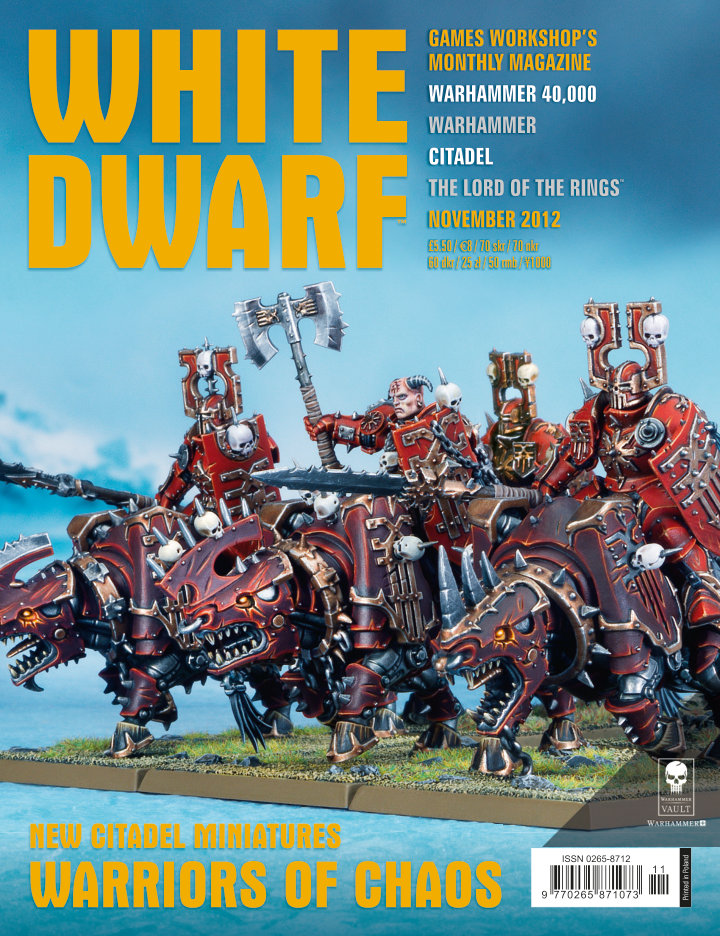
EditorialWD 395 · p. 1
Jes Bickham recalls a metal Chaos Warrior named Daethskar as the miniature that first drew him into the hobby. The new Warriors of Chaos releases renew that early fascination, particularly the Warshrine, Skullcrushers, Hellstriders and character models. He introduces the battle report as a test of what these additions can do against his own Ogres, connecting a personal collecting history with the issue’s central release.
Warhammer Fantasy BattlesWarriors of Chaos
ShowcaseWD 395 · pp. 4–25
The release showcase examines the Warriors of Chaos through highly detailed new centrepieces and remastered classics. A sacrificial Warshrine carried by mutated bearers contrasts with the armoured mass of Skullcrushers and the unsettling anatomy of Slaaneshi Hellstriders. Scyla, Valkia and Festus each embody a different form of divine corruption, while returning lords, Chosen and Be’lakor illustrate the established range. The 2013 filmmaker White Dwarf provides a humorous counterpoint, with his steam-powered camera and elaborate director’s accessories.
Warhammer Fantasy BattlesWarhammer 40,000Warriors of Chaos
ShowcaseWD 395 · pp. 34–37
The Wall of Martyrs is presented as a modular Imperial defensive position whose ornate trenches are piled with fallen Guardsmen and abandoned equipment. Its bunker has a removable roof, while emplacements can operate alone or link defence lines into varied layouts. The review stresses practical model placement as well as appearance: paths, firing slits and pits are sized to hold squads and heavy-weapon teams, making the scenery useful across an actual battlefield.
Warhammer 40,000Imperium
ShowcaseWD 395 · pp. 38–40
The Forge World selection moves from compact, muscular Magma Dragons to a gaunt Incarnate Elemental of Fire, examining how sculpted anatomy and flame convey different kinds of power. New Marine jetbikes provide an Art Deco-inspired Heresy silhouette with several heavy-weapon options, while redesigned Bull Centaurs bring a much larger, heavily armoured presence to the Chaos Dwarfs. The descriptions focus on the miniatures’ character and modelling appeal rather than supplying new rules.
Warhammer Fantasy BattlesThe Horus HeresyChaos Dwarfs
CommunityWD 395 · p. 41
The digital Vampire Counts army book brings the force to iPad with searchable rules, linked explanations, updated material and extensive miniature galleries. Its presentation combines full-colour art with rotating model views intended to help both gamers and painters. The page also reiterates the digital magazine’s extra interviews and galleries, documenting the growing range of interactive hobby publications.
Warhammer Fantasy BattlesVampire Counts
LoreWD 395 · p. 42
Adam Troke reviews Pariah without revealing its twists, concentrating on Alizebeth Bequin’s training, viewpoint and uncertain place among competing powers. He praises the vivid supporting characters and natural dialogue that continue the strengths of Eisenhorn and Ravenor, while acknowledging the deliberate complexity of the mystery. The appeal lies in gradually reconsidering who characters really are and what they want as apparently secure assumptions give way.
Warhammer 40,000Inquisition
LoreWD 395 · p. 43
The review follows the unlikely partnership of Perturabo and Fulgrim as their Legions pursue a weapon of immense power. The Iron Warriors’ disciplined brutality contrasts with the Emperor’s Children’s accelerating excess, while surviving loyalists and Eldar complicate the expedition. Adam highlights the background woven into the Iron Warriors’ actions and the insight offered through Forrix, presenting the novel as an exploration of its Primarchs as well as a violent adventure.
The Horus HeresyIron Warriors
LoreWD 395 · p. 44
The paperback review positions Salvation’s Reach as a pivotal opportunity in the Sabbat Worlds war: captured intelligence leads the Tanith to a secret weapons facility guarded by the Sons of Sek. Preparations and the eventual assault are interwoven with regimental politics, attempted murder and personal relationships. Adam’s praise centres on the vivid attack sequence and the way a military objective continues the larger story begun in Blood Pact.
Warhammer 40,000Imperial Guard
LoreWD 395 · p. 44
Andrew reviews the opening novel of a new Time of Legends trilogy about the War of Vengeance. Nick Kyme’s story spans long stretches of Dwarf and Elven history, using potent magic and runic artefacts to give the age a different feel from the contemporary Old World. The review notes that some large time jumps are abrupt, but finds the gradual destruction of relations between the two peoples a convincing and tragic foundation for the war.
Warhammer Fantasy BattlesDwarfs
ShowcaseWD 395 · p. 45
Adam examines John Blanche’s collection of Space Marine artwork as a source of memory and shared enthusiasm. Classic rulebook and box-cover images sit beside concepts and previously unseen work, ranging from John Sibbick’s Rogue Trader to a Grey Knight by Kekai Kotaki. The review describes how familiar pictures spark discussion among hobbyists, making the anthology a record of the imagery that shaped different generations of collectors.
Warhammer 40,000Space Marines
InterviewWD 395 · pp. 46–47
Andrew Kenrick asks developer Andrew Fisher how Only War brings 40K roleplaying back to the human scale of Imperial Guardsmen. Fisher explains the Comrade system as a way to make battlefield mortality personal without constantly killing player characters, and discusses regiment creation and integrated vehicle combat, including tanks. The interview situates the game in the Spinward Front and previews Final Testament’s struggle over an Ordinatus, while short neighbouring notices cover Warhammer Quest for iPad and The Outer Reach for Deathwatch.
Only WarWarhammer 40,000Imperial Guard
ShowcaseWD 395 · pp. 52–57
Rich Packer’s Empire army continues the adventures of Heinrich Lowen and Magnus the Bright, two heroes from his Advanced Heroquest games. Their retirement to Grunburg becomes a reason to build an army whose banners, bases and characters acquire trophies from campaigns across the Old World and beyond. Rich describes collecting as an ongoing narrative, incorporating old miniatures, unusual conversions and new favourites whenever a fitting story emerges; the force is deliberately never finished.
Warhammer Fantasy BattlesThe Empire
EditorialWD 395 · pp. 58–59
Jervis argues that tournament composition restrictions are one form of house rules and can be worthwhile when suited to a particular event. He recalls using set limits to make unfamiliar opponents’ games faster and more manageable, while recognising the appeal of unrestricted collecting. His objection is to treating either approach as universally correct: varied tournaments, terrain and scenarios let players choose the experiences they enjoy, with Astronomi-con offered as a favourite example of creative event design.
Battle reportWD 395 · pp. 60–71
Andrew Kenrick’s almost three-thousand-point Chaos army meets Jes Bickham’s Ogres in Battleline, testing the Warshrine, Skullcrushers, Hellstriders and new character models. Ogre charges initially kill Scyla and drive off the Hellstriders, but a Warshrine Toughness bonus and Festus’s hex prepare a devastating central fight. Valkia destroys the Ironblaster and overruns into the Ironguts, helping break the army’s leaders; by turn four only a Gorger remains. The review stresses the timing and interaction of Chaos support effects, alongside the risk of placing too many Ogre characters in one unit.
Warhammer Fantasy BattlesWarriors of Chaos
ModellingWD 395 · pp. 72–75
John Blanche explains how single-frame Fantasy heroes become individual members of his 40K Inquisitorial warband. Their archaic armour and distinct silhouettes provide starting points, but the character develops through an organic search among spare components rather than a fixed list of required roles. A Chaos Sorcerer gains Grey Knight and Sister of Battle parts, the Nurgle lord becomes a thug, and a faced Cairn Wraith acquires an unsettling priestly quality, showing how bits and paint can redirect a sculpt’s identity.
Warhammer 40,000Warhammer Fantasy BattlesInquisition
InterviewWD 395 · pp. 76–77
Nuala Kinrade nominates the Mangler Squigs for combining the malicious humour she loved in her first painted Squig with extraordinary scale and uncontrolled movement. Crushed Goblins, chains and manic expressions ensure that neither handlers nor beasts seem in charge. Trish Carden recalls the freedom and enjoyment of sculpting them after talking with Jeremy Vetock, describing their appeal as the balance between a ridiculous creature and a genuinely lethal monster.
Warhammer Fantasy BattlesOrcs & Goblins
ShowcaseWD 395 · pp. 78–83
The tank gallery examines how markings, conversions and weathering give large vehicles individual histories. Glenn More’s Ultramar-linked Demolisher uses salt weathering and earth powders, Carl Dafforn’s Crusader carries Black Templar campaign details, and Dom Murray varies winter-camouflaged Russes with crew objectives and kill marks. Rob Fletcher’s huge Praetor uses controlled airbrushed camouflage, while Jamie Forster’s reversed Russ hull and Battlewagon parts turn a former Imperial tank into a brightly painted Death Skullz vehicle.
Warhammer 40,000Imperial Guard5 paint colours
ModellingWD 395 · pp. 84–89
Nine converted leaders demonstrate how small part swaps and more involved surgery can establish an army’s central character. Jes’s winged Tyrant gains Tervigon weapons, Dan rebuilds a Cultist as a Terrax Colonel, and several Marine captains combine Chapter kits for distinctive armour and motion. Other examples turn a Grey Knight into an aged Inquisitor, mix Elven ranges for an Autarch, increase an Ork’s firepower and reshape a Chaos Sorcerer into a Dark Eldar Archon, with captions identifying the useful components.
Warhammer 40,000Tyranids
ModellingWD 395 · pp. 90–95
Ray Dranfield and Mick Cudworth build a battlefield around a renegade wizard’s ramshackle tower and thousands of skulls. Witchfate Tor forms the core, widened Temple of Skulls pieces stabilise the base, and rooms from other kits project outward on precarious supports. Spare stone faces become carved hillside monuments, while an altar and soul pool extend the story. The designers discuss visual inspiration, usable standing spaces and the practical labour behind roughly four thousand five hundred skulls.
Warhammer Fantasy BattlesThe Empire
PaintingWD 395 · pp. 96–101
This month’s techniques support the Chaos release and the featured battlefields. Four patron-specific Warrior schemes and separate treatments for horns, leather, bone and fur lead into red, iron and molten Juggernauts. Glenn’s salt-weathering tutorial reveals chipped tank paint, while the scenery team supplies contrasting ground and stone recipes for the Valley of Skulls and practical finishes for the Wall of Martyrs.
Warhammer Fantasy BattlesWarhammer 40,000Warriors of Chaos40 paint colours
PaintingWD 395 · p. 96
The Khornate Warrior’s red armour develops from Khorne Red through Evil Sunz Scarlet and Wild Rider Red layers. Bloodletter glaze brings the warm colours together before Ironbreaker is applied as exposed metal and chips. The result combines a strong patron colour with visible wear rather than treating the plate as a clean, uninterrupted red surface.
Warhammer Fantasy BattlesWarriors of Chaos5 paint colours
PaintingWD 395 · p. 96
Tzeentch’s blue-tinted armour begins as metal: Leadbelcher is layered with Ironbreaker, shaded with Nuln Oil and highlighted with Runefang Steel. Guilliman Blue glaze is then applied over the metallic finish, preserving the reflected highlights beneath a coloured tint. This creates an effect distinct from the opaque blue armour used on many Marine schemes.
Warhammer Fantasy BattlesWarriors of Chaos5 paint colours
PaintingWD 395 · p. 96
The Nurgle scheme uses Castellan Green as a subdued base rather than a bright supernatural colour. Agrax Earthshade darkens the recesses, with Loren Forest and Straken Green progressively restoring and highlighting the plates. Its limited, earthy palette gives the armour a putrid green appearance while keeping the sculpted shape easy to read.
Warhammer Fantasy BattlesWarriors of Chaos4 paint colours
PaintingWD 395 · p. 96
The Slaaneshi Warrior contrasts black armour with rich gold trim. Abaddon Black is defined through Dawnstone and Administratum Grey highlights, then Nuln Oil reinforces the dark finish; Gehenna’s Gold supplies the contrasting decorative metal. The scheme achieves its identity through the relationship of the two materials rather than a predominantly purple suit.
Warhammer Fantasy BattlesWarriors of Chaos5 paint colours
PaintingWD 395 · p. 97
Dan’s four texture guides give the heavily armoured Warriors complementary natural materials. Horns progress from warm brown to pale tips, leather returns to its dark base after a wash before receiving a restrained highlight, and skulls build through grey-brown and bone tones. Fur relies on drybrushed greys around a dark wash, with the closing advice encouraging painters to choose methods appropriate to texture instead of applying every colour in the same way.
Warhammer Fantasy BattlesWarriors of Chaos14 paint colours
PaintingWD 395 · p. 98
A traditional red Juggernaut starts with Mephiston Red shaded by Nuln Oil. Evil Sunz Scarlet and Wild Rider Red pick out the plates and edges, and Carroburg Crimson is applied afterwards to deepen and unify the red. This produces a vivid daemonic armour finish with dark recesses around the creature’s mechanical details.
Warhammer Fantasy BattlesKhorne5 paint colours
PaintingWD 395 · p. 98
The iron alternative uses Leadbelcher and repeated Nuln Oil washes to build a dark metallic Juggernaut. Ironbreaker restores a sharper highlight between the washes, allowing bright metal to remain on prominent edges while the broad surfaces stay sombre. It offers a heavy, industrial-looking mount whose Khornate identity can be carried by markings and surrounding details.
Warhammer Fantasy BattlesKhorne3 paint colours
PaintingWD 395 · p. 98
The molten-armour demonstration draws a network of bright cracks across a dark plate. Khorne Red establishes the lines, then Evil Sunz Scarlet, Troll Slayer Orange and Yriel Yellow intensify selected areas as though heat is breaking through the shell. Bloodletter glaze ties the progression together, producing a very different surface from the neighbouring conventional red and metallic finishes.
Warhammer Fantasy BattlesKhorne5 paint colours
PaintingWD 395 · p. 99
Glenn More demonstrates chipped paint on a Leman Russ by masking a Doombull Brown underlayer with ordinary table salt. He wets selected areas, applies fine salt and leaves it overnight before spraying the tank’s camouflage over the top. Washing the dried salt away reveals irregular brown damage beneath the new colour, making the hull appear weathered through long use. The guide warns through its example against covering so much of the model that the effect overwhelms the paintwork.
Warhammer 40,000Imperial Guard1 paint colour
PaintingWD 395 · p. 100
Ray and Mick deliberately separate warm, dusty wasteland from cold grey stone. The ground is built through Mournfang Brown, Skrag Brown, Averland Sunset and Rakarth Flesh drybrushing, while Stormvermin Fur and Dawnstone establish the masonry before a brown wash and Fenrisian Grey highlight. They emphasise using little paint and several light passes to preserve texture and depth across large scenery pieces.
Warhammer Fantasy Battles8 paint colours
PaintingWD 395 · p. 101
Chad Mierzwa separates the trench system into four material groups. Plascrete walls receive grey drybrushes; metal decking begins rusty brown and orange before exposed Leadbelcher is added; mantlets use shaded metal and a bright drybrush. The fallen Cadian armour and crates share an earthy green finish highlighted with Tyrant Skull, keeping the dense detail coordinated across the fortifications.
Warhammer 40,000Imperium11 paint colours
EditorialWD 395 · pp. 102–103
When his usual gaming friends become unavailable, Jeremy visits local stores and confronts the awkwardness of entering an established group of strangers. Once armies reach the table, shared enthusiasm quickly replaces that discomfort. He reflects on adjusting his exuberant, narrative style to opponents who prefer a straighter contest, and finds that seeking games outside his familiar circle produces new friendships as well as battles.
CommunityWD 395 · p. 105
The Salisbury profile describes a refurbished store whose gaming tables are central to its local appeal. A Lord of the Rings battlefield incorporates scenes from each film, while an enormous cathedral board supplies a distinctly local setting for 40K. These displays accompany regular collecting, painting and gaming activities, giving the store a particular identity beyond the month’s Warriors of Chaos promotion.
CommunityWD 395 · pp. 122–125
The team settles into a completed hobby room with a painting bar, illuminated army shelves and an expandable gaming table. Staff projects range from Beth’s growing Lizardmen and Daemonettes to Dan’s daunting Ork backlog and Andrew’s wave of Chaos models. Flyer collecting dominates the month, and informal games produce both Glenn’s Grey Knight defeat against Necrons and Jes’s redemptive Ogre victory over Matt’s Dwarfs.
Warhammer 40,000Warhammer Fantasy Battles
ShowcaseWD 395 · p. 124
New-edition air warfare inspires several team members to expand their collections at the same time. Jes completes a Doom Scythe, Andrew finishes his Death Guard Heldrake, and Glenn and Matt add Stormtalons, with Matt repainting his preferred yellow tone and Glenn converting a reconnaissance aircraft. Adam contributes an Ork Bomma simply because he likes the model, showing that collecting enthusiasm extends beyond an existing army.
Warhammer 40,000Necrons
Battle reportWD 395 · p. 125
Glenn’s Grey Knights face Jes’s Necrons in a struggle over an ancient relic. A large Warrior unit accompanied by three characters reaches the objective, and repeated mindshackle effects turn the ensuing Terminator assault against its attackers. A lone Grey Knight destroys the Monolith with his hammer, but that moment cannot reverse the defeat. Glenn’s separate tournament note values playing friends as much as the formal event result.
Warhammer 40,000Grey Knights
InterviewWD 395 · pp. 126–127
Mark Harrison, Mike Fores and Matt Holland explain their collaboration on a Warshrine intended to tower over the army. Ordinary carriers became burden-adapted mutants, while the altar gained a sacrificial workflow, a reliquary and a strange idol developed from a suggestion by Jes Goodwin. The sculptors discuss deliberately mismatched materials, plausible anatomy for extra limbs and the challenge of keeping separately sculpted pieces at the same scale.
Warhammer Fantasy BattlesWarriors of Chaos
InterviewWD 395 · pp. 128–129
Dave Andrews describes years of experiments that led from impractical trenches built into thick boards to a sectional network placed on existing terrain. He deliberately avoids familiar historical trench materials, imagining prefabricated fortifications delivered and assembled by the Mechanicus instead. Imperial imagery and dead Cadians supply the 40K identity, while physical mock-ups test squad capacity, weapon-team positions, storage and varied arrangements before the finished kit is produced.
Warhammer 40,000Imperium
ShowcaseWD 395 · pp. 130–131
Blake Spence’s Isstvan-inspired cityscape tiles bring paved roads, rubble, wrecked vehicles and building plinths into a modular battlefield. The studio visit also follows work on Stuart Williamson’s huge Fellblade and the Typhon siege tank, while Mark Bedford accelerates his personal Blood Angels painting and objective-marker conversions. The feature records projects still in development rather than presenting finished release specifications.
The Horus HeresyWarhammer 40,000Space Marines
InterviewWD 395 · pp. 132–133
Graham McNeill explains how a planned continuation of Fulgrim’s story grew into an equally important study of Perturabo. The Iron Warriors’ disciplined brutality and internal rivalries demanded more attention, while their Primarch’s thwarted wish to create reveals motives beyond rage and siegecraft. McNeill discusses using Legion behaviour to establish identity, bringing older Iron Warrior characters into their earlier lives, and retaining determined loyalist survivors as opponents who will not simply disappear.
The Horus HeresyIron Warriors
InterviewWD 395 · pp. 134–135
Dan Abnett reflects on returning to Eisenhorn after deliberately leaving the game character’s fate open to collectors. Ravenor revealed a larger narrative, and Bequin’s perspective now allows a third trilogy to bring familiar figures together while leaving readers uncertain about their motives. Abnett explains the challenges of first-person exposition, the appeal of domestic and investigative life in 40K, and how a narrator who knows less than established readers can make discovery part of the experience.
Warhammer 40,000Inquisition