EditorialWD 359 · p. 1
Mark writes as an increasingly alarmed Imperial scribe hearing rats outside his study. Jeremy Vetock’s new Skaven book becomes a forbidden scholarly account that confirms the rumours. References to Middle-earth and distant armoured heroes offer brief diversions from the threat. The playful introduction makes Imperial denial part of the issue’s launch theme.
Warhammer Fantasy BattlesWarhammer 40,000
ReviewWD 359 · p. 3
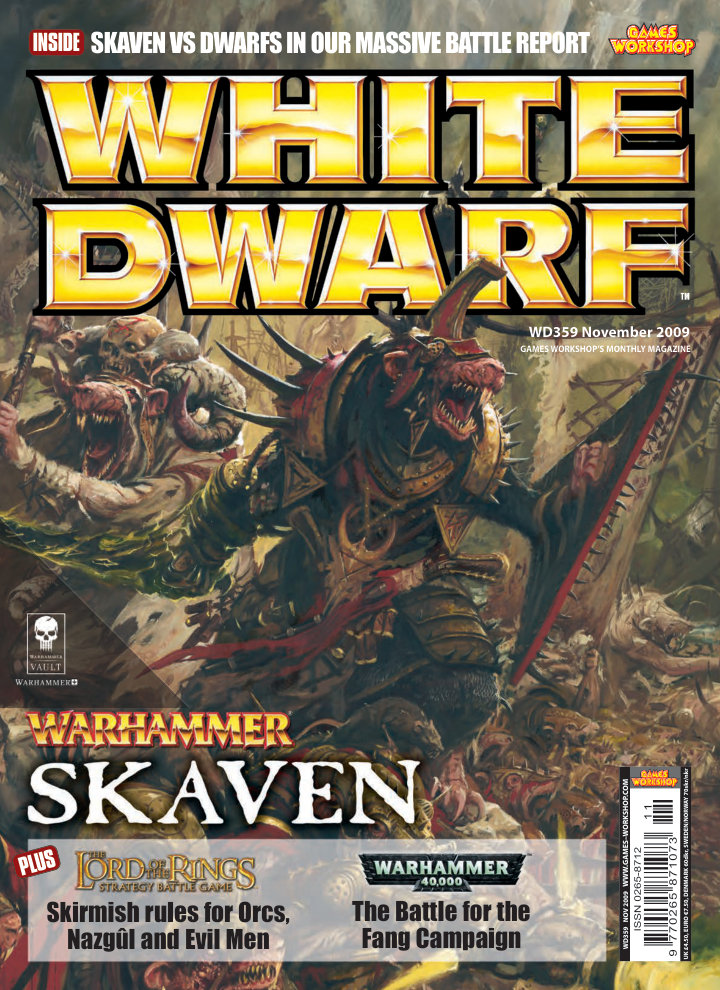
The new army book explores the ratmen’s origins, concealed empire and competing clans. Its expanded bestiary introduces fresh engines and creatures alongside returning favourites. A model gallery connects the background to collecting an army. The release provides the foundation for the issue’s designer feature and battle report.
Warhammer Fantasy BattlesSkaven
ReviewWD 359 · p. 4
Two plastic infantry kits rebuild the core of the Skaven army. The Clanrats use a small number of parts for rapid assembly and offer hand weapons or spears. Stormvermin carry halberds and include distinctive command figures. The notice contrasts expendable mass infantry with a more imposing elite regiment.
Warhammer Fantasy BattlesSkaven
ReviewWD 359 · p. 5
A large plastic kit builds either a Grey Seer’s bell or a Plague Priest’s furnace. Shared structural parts support two very different religious machines. Each is pushed into battle by an accompanying regiment rather than moving as an ordinary chariot. The models give the army striking centrepieces associated with different clans.
Warhammer Fantasy BattlesSkaven
ReviewWD 359 · p. 6
The Doomwheel returns as a plastic machine powered by frantic rats and dangerous engineering. Unreliable lightning makes nearby allies as vulnerable as opponents. Skweel supplies a different expression of Skaven ingenuity through his unusually capable pack beasts. His wolf-rat companion Gutsnagger helps communicate that relationship in the model.
Warhammer Fantasy BattlesSkaven
ReviewWD 359 · p. 7
New character models refresh two sharply different Skaven personalities. Queek displays his trophies openly, while Snikch embodies Clan Eshin’s concealed violence. The battalion instead gathers ordinary troops and beasts for a larger collection. Together the releases support both individual focal models and the army’s essential mass of bodies.
Warhammer Fantasy BattlesSkaven
ReviewWD 359 · p. 8
The novel begins a new Gaunt’s Ghosts story arc with the regiment stationed away from the front. A captured Chaos officer creates a dangerous intelligence problem. His insistence on speaking to Gaunt draws the commissar into events that threaten the apparent respite. The notice presents intrigue and pursuit alongside the series’ familiar military setting.
Warhammer 40,000Astra Militarum
ReviewWD 359 · p. 8
This hardback gathers Richter Kless’s studies of the four Chaos powers. His supposed scholarship becomes inseparable from the corruption he investigates. The illustrated volume presents the gods through a disturbed observer rather than a detached handbook. The release emphasises its role as a substantial background collection.
Warhammer Fantasy BattlesChaos
ReviewWD 359 · p. 8
The sequel to Scourge the Heretic follows Inquisitorial operatives on Scintilla. Their investigation involves two criminal organisations and the danger behind their activities. The protagonists must distinguish ordinary wrongdoing from deeper corruption. The notice connects the novel to the investigative atmosphere of Dark Heresy.
Warhammer 40,000Inquisition
ReviewWD 359 · p. 8
Veteran engineer Magnus Ironblood is drawn into another campaign with an inadequately supplied force. His experience must compensate for the army’s weaknesses. The premise places engineering, battlefield judgement and reluctant service at the centre of an Empire story. The release frames it as a soldier’s struggle rather than a grand account of princes and heroes.
Warhammer Fantasy BattlesEmpire
ReviewWD 359 · p. 9
The towering resin war engine receives a release showcase with its crew and extensive detail. Its height gives a tangible sense of the scale of an Imperial Titan. The designers’ contributions combine machinery with the human figures operating it. The model is presented as a major collecting and construction project.
Warhammer 40,000Adeptus Titanicus
NewsWD 359 · p. 10
A preview announces a January return for the Tyranids. Robin hints at new organisms and a wider range of threats. The small notice is an introduction to the forthcoming launch rather than a usable rules update. It establishes an impending alien theme alongside the current Skaven release.
Warhammer 40,000Tyranids
NewsWD 359 · p. 10
The card game asks players to develop their capital while attacking an opponent’s city. Card choices balance resources, fighting strength and competing priorities. The core set supplies initial decks, with regular Battle Packs intended to expand the possibilities. The preview explains the living-card format and its continuing releases.
Warhammer: InvasionEmpire
NewsWD 359 · p. 10
A hunt for an older giant miniature produces responses from collectors in different countries. Mark Farr and Robert Allen help reconnect the model with its history. The story illustrates how widely early Citadel figures travelled and how long they remained in private collections. It concludes a small piece of miniature archaeology rather than announcing a new kit.
FeatureWD 359 · pp. 14–23
Andy interviews Jeremy about an army whose internal rivalry is as important as its numbers. The book broadens the major clans, removes former collection restrictions and returns the Vermin Lord. New weapon teams, engines and magical choices create threats that can also endanger their owners. Imperial disbelief, playtesting observations and an infantry painting guide connect the background to the tabletop.
Warhammer Fantasy BattlesSkaven14 paint colours
Painting guideWD 359 · p. 23
Nick demonstrates quick sequences for skin, fur, red cloth and metal. A shared brown base ties the organic areas together while brighter highlights retain definition across a regiment. Dark washing gives the armour an aged finish. An additional orange-and-brown treatment suggests rust without replacing the underlying metallic highlights.
Warhammer Fantasy BattlesSkaven14 paint colours
RulesWD 359 · pp. 28–33
Mat introduces new Evil profiles for the skirmish game after the previous issue’s formation-battle coverage. Haradrim and Easterling support models are joined by Black Guard, Kardûsh and two distinctive Ringwraiths. Special rules reward positioning, resource management and cooperation between heroes and troops. The article includes profiles, equipment, points and spell information for the featured additions.
Middle-earth Strategy Battle GameHarad
RulesWD 359 · pp. 28–29
The Taskmaster can support nearby heroic actions without always consuming the acting hero’s Might. The Golden King combines a litter, guards and a banner in a single model, with a way to undermine enemy Courage. Merchant Guard fight with heavy weapons without the usual penalty. A Hornblower upgrade supplies a further army-wide morale benefit.
Middle-earth Strategy Battle GameHarad
RulesWD 359 · p. 30
The Dragon Knight concentrates on personal combat and receives rules for controlling his fighting stance. That prowess comes without the ordinary ability to lead nearby warriors through Stand Fast. The War Priest instead supports an Easterling force through Fury and Bladewrath. Their contrasting roles make the choice between individual aggression and army support explicit.
Middle-earth Strategy Battle GameEasterlings
RulesWD 359 · p. 31
Warriors, a captain and a drummer give Mordor an unusually forceful infantry contingent. The captain’s Courage improves in the presence of Sauron or a Ringwraith. Drumming speeds nearby troops but restricts charging while they use that movement. The profiles encourage the player to coordinate an intimidating advance rather than rely on a single hero.
Middle-earth Strategy Battle GameMordor
RulesWD 359 · p. 32
Kardûsh fuels his sorcery through the lives of nearby Orcs. One rule restores his own Will, while another lets him sacrifice himself to replenish a Ringwraith. Fury and Flameburst provide protective and offensive applications for that resource. The profile makes his expendable followers part of a deliberately cruel support system.
Middle-earth Strategy Battle GameMordor
RulesWD 359 · p. 33
The Betrayer improves poison attacks around him and can re-roll his own failed wounds. The Knight of Umbar instead copies selected characteristics from an opponent and conserves Will when he wins a fight. Both retain the magical tools expected of Ringwraiths. Their different abilities support either a specialised army combination or a challenging personal duel.
Middle-earth Strategy Battle GameMordor
CampaignWD 359 · pp. 35–41
The six participants report their first linked battles and prepare a second round. Mat dominates both games on the Harad Road, while Chris and Nick split their victories at Karush. A skirmish draw and a substitute player complicate the third pairing. New scenario packs move the campaign to Abrakhan, a dangerous valley and haunted Karna, with clarified rules for draws and changed armies.
Middle-earth Strategy Battle GameWar of the RingGondor
ScenarioWD 359 · p. 39
The skirmish divides the field into road-defined quarters and asks each side to control the most ground. Its result affects the arrival of a formation in the following larger battle. That second encounter uses an eight-turn fight to the death. The pair shifts the campaign from collecting relics to securing a strategic route.
Middle-earth Strategy Battle GameWar of the RingGondor
ScenarioWD 359 · p. 40
Five objectives and a variable ending encourage a mobile skirmish. Moving close to the valley’s rocky walls adds the threat of falling stone. The larger battle changes deployment and ambush options according to the preceding result. Both games make the surrounding landscape part of the tactical problem.
Middle-earth Strategy Battle GameWar of the RingGondor
ScenarioWD 359 · p. 41
Players recover heavy plunder while a Barrow-wight and the dead interfere with the skirmish. The neutral creatures follow a defined control system and threaten treasure carriers in particular. The larger battle gives the earlier winner a central prize-bearing formation. Special blades, dangerous side effects and transferable treasure keep the reward contested.
Middle-earth Strategy Battle GameWar of the RingGondor
CampaignWD 359 · pp. 42–49
Adam develops two invasions of Fenris into a campaign setting. Magnus’s attack in the thirty-second millennium supplies the main sequence, with a later siege by Bucharis adding historical context. Fenrisian weather and terrain introduce hazards beyond ordinary gunfire. Four scenarios follow the fighting from a scout landing to an Apocalypse confrontation involving the saga’s principal heroes.
Warhammer 40,000Space Wolves
BackgroundWD 359 · pp. 43–44
Magnus draws Harek away before striking the Space Wolves’ home fortress. Bjorn’s defence and Haakon’s desperate mission allow the absent Great Wolf to return, though victory claims his life. A second account describes the much later siege during Bucharis’s rebellion. Reinforcements returning from the Great Hunt again change the course of a prolonged defence.
Warhammer 40,000Space Wolves
RulesWD 359 · p. 45
Escalating weather reduces visibility and makes movement progressively more dangerous. Frozen water can swallow heavily equipped troops or vehicles. Icy fighting positions punish poorly placed melee attacks. The optional rules turn Fenris into an active source of pressure and provide a framework for games beyond the accompanying campaign.
Warhammer 40,000Space Wolves
ScenarioWD 359 · p. 46
A small Space Wolf force enters from the edges around a centrally deployed enemy. Scouts must make up much of the attacking infantry, and vehicles are excluded. The objective depends on the number of surviving models rather than an ordinary collection of markers. The restrictions establish the campaign’s opening as a reconnaissance action.
Warhammer 40,000Space Wolves
ScenarioWD 359 · p. 47
The defenders must protect the Fang’s gate against a sustained assault. Its unusually high armour value and the shield’s protection at long range make close demolition necessary. The attackers receive the equipment needed to threaten it. Surviving the variable game length gives the Space Wolves their chance to hold.
Warhammer 40,000Space Wolves
ScenarioWD 359 · p. 47
A restricted force fights for a central landing pad. The Space Wolf side uses Scouts as its troops while both armies lose most specialist categories. Holding the pad at the end of a turn completes the mission. The small game represents the urgent effort to carry news through the siege.
Warhammer 40,000Space Wolves
ScenarioWD 359 · pp. 48–49
The final encounter makes Harek, Bjorn and Magnus living objectives. Only part of the Space Wolf army begins on the table, with the rest arriving to relieve the defenders. Different strategic assets reflect the returning fleet and the Daemon Primarch’s power. A substantial Space Wolf sample force accompanies the large-scale scenario.
Warhammer 40,000Space Wolves
Battle reportWD 359 · pp. 52–71
Graham’s Dwarfs attack a captured ancestral tower defended by two rival Skaven commanders. Andy and Glenn repeatedly undermine one another while their new engines and magical devices cause havoc. King Forik and his Hammerers seize the building and survive the final assault. The Dwarfs win the objective despite devastating losses, with Andy finishing ahead of Glenn among the defeated ratmen.
Warhammer Fantasy BattlesDwarfs
ScenarioWD 359 · pp. 53–54
The main objective is control of a tower with an unpredictable warp generator. Delayed Skaven reinforcements and a Dwarf mining force shape the approach to it. Each ratman commander also has a concealed ambition that can turn the apparent alliance into another contest. The special rules give the Dwarf king’s determination a direct effect on nearby morale.
Warhammer Fantasy BattlesDwarfs
ColumnWD 359 · pp. 74–75
Jervis argues that physical miniatures, demanding preparation and face-to-face play are central to the hobby’s appeal. He welcomes useful digital tools while questioning changes that would remove those qualities. Painting and learning complex games reward sustained effort in a way he values. The column treats a specialised audience as a strength rather than a problem to eliminate.
Hobby featureWD 359 · pp. 76–77
Andy examines Dave Thomas’s humorous subscription miniature. A beer-powered backpack, retro equipment and a captured Goblin in disguise extend the joke around Grombrindal’s spacesuit. Keith’s orange-and-blue painting choice creates stronger separation than the sculptor’s original cream concept. Short recipes explain the suit and backpack, linking the finished model to the collaboration behind it.
8 paint colours
ScenarioWD 359 · pp. 78–79
An attacker begins with mobile units against a defender holding the opposite quarter. Four objectives encourage pressure into the neutral areas as well as the defended corner. Night Fighting lasts until a random sunrise, while different reserve restrictions shape the two forces. Jervis recommends repeated games because attack and defence demand different tactical approaches.
Warhammer 40,000
Miniature showcaseWD 359 · pp. 80–87
The series returns to seven previously featured painters to show how their work has developed. Experiments with non-metallic metal, scratch-built scenes, conversions and unusual colour choices reveal different ambitions. Introductory advice covers spot colours, a core palette and corrective glazes. The selection emphasises continuing experimentation rather than treating an earlier showcase as a finished achievement.
Miniature showcaseWD 359 · p. 81
Darren’s recent miniatures demonstrate his growing confidence with non-metallic metal. Gold appears on helmets, armour and smaller accessories rather than only on a single display piece. His successful Celestial Wizard applies the same technique to a staff. The page connects several different subjects through a developing painting method.
High Elves
Miniature showcaseWD 359 · pp. 82–83
Mike uses individual models to test verdigris, smooth cloth and an albino complexion. Two large scratch-built scenes draw on the grimy humour of Warhammer art. A fighting cock, a curious cabin boy and tiny marine details make the settings rewarding to inspect. The gallery connects technical experiments to storytelling through sculpted objects.
Bretonnia
Miniature showcaseWD 359 · p. 84
Neil balances his new sculpting work with continued painting. A red Khorne Herald recalls the bright schemes that first attracted him to the hobby. A Chaos Lord uses cooler colours and a largely metallic palette. The pair shows both continuity and a deliberate departure in his recent work.
Daemons of Chaos
Miniature showcaseWD 359 · p. 85
Keith combines older and newer parts in a converted Plague Marine champion. An Ultramarine veteran receives additional plastic details, while a Battlewagon becomes a larger experimental project. Modified tracks and a pointed dozer blade change the vehicle’s silhouette. A new mud-splash treatment reinforces the interest in trying unfamiliar effects.
Death Guard
Miniature showcaseWD 359 · p. 86
Martin contrasts a warmly painted Tomb King with cold blue gems and an accidentally thematic base. His Amethyst Wizard supplies another recent project. Luke’s Australian competition entries include a Slayer Sword-winning battlesuit and a gold-winning Eldar figure. An extensively converted jetbike adds intricate freehand work to the selection.
Tomb Kings
Miniature showcaseWD 359 · p. 87
Mark uses multipart plastic figures to explore the positioning of duelling opponents. Working inside a small square base requires a readable relationship between the combatants. A Night Goblin riding a large Cave Squig offers a contrasting single centrepiece. Both projects depend on modelling choices that give the figures an immediate sense of character.
Orcs & Goblins
Painting guideWD 359 · pp. 88–91
Nick organises Easterling infantry into manageable painting batches. Four-stage methods produce the film-inspired red robes and gold armour, with command figures receiving sharper finishing work. Alternate schemes and a horse recipe broaden the approach beyond the initial company. Converted banners, a chariot, a siege bow and a drummer show how the painted collection develops.
Middle-earth Strategy Battle GameWar of the RingEasterlings26 paint colours
Painting guideWD 359 · p. 89
Gold is built over a brown-and-metallic base before a flesh wash unifies the finish. The robes use a darker red with restrained shading and pale highlights. A yellow banner and metal blades receive their own short sequences. Nick recommends completing each stage across a small group before moving to the next.
Middle-earth Strategy Battle GameEasterlings14 paint colours
Painting guideWD 359 · p. 90
Blue cloth with silver armour offers one alternative to the familiar red-and-gold combination. Red lacquer and dark green-tinted metal supply two further choices. The horse sequence builds a brown coat and a brighter treatment for its tassels. Shared methods from the infantry keep the cavalry recognisably part of the same force.
Middle-earth Strategy Battle GameEasterlings20 paint colours
Army showcaseWD 359 · pp. 92–93
Dom builds the army around a disciplined first project of forty infantry and a Rune Priest. Poses and markings distinguish the packs before vehicles and specialist units are added. A dark grey scheme recalls older artwork, with heavy damage concentrated on forward-facing surfaces. His ambition to complete Ragnar’s Great Company gives the growing collection a clear narrative destination.
Warhammer 40,000Space Wolves3 paint colours
Painting guideWD 359 · pp. 94–101
Neil paints the White Scars captain through patient layers and carefully controlled blends. Warm reds, fur and gold prevent the predominantly white model from losing its silhouette. The article covers armour, skin, a trophy head, the cloak, weapons, shoulder pads and small details. A wider discussion of white explains why surface, material and underlying colour determine the approach.
Warhammer 40,000White Scars37 paint colours
Painting guideWD 359 · p. 95
Thin layers build a warm white over a grey-and-brown foundation. Darker paint defines recesses without turning the armour into a visibly grey surface. Small chips use a deeper interior and a bright edge to suggest depth. The explanation stresses painting order because white exposes stray marks more clearly than darker colours.
Warhammer 40,000White Scars6 paint colours
Painting guideWD 359 · p. 96
The living face and trophy head use related blends with different final impressions. Incremental additions of a pale grey provide smooth transitions rather than obvious stripes. Purple shading and cool highlights give the severed head a lifeless quality. Metallic studs, lips and facial hair receive finishing treatments after the principal skin work.
Warhammer 40,000White Scars15 paint colours
Painting guideWD 359 · p. 97
The workshop distinguishes hard neutral whites from cool clean cloth and warmer worn fabrics. It explains how undertones and surface material change the effect even when the final highlight is the same. Foundation paints provide coverage without requiring a thick layer. Organic white surfaces can instead be defined with local shading rather than a strongly coloured base.
Warhammer 40,000White Scars9 paint colours
Painting guideWD 359 · p. 98
A rich lining introduces warmth against the pale armour. Brown fur receives controlled painted highlights as well as drybrushing, keeping the texture from becoming uniformly dusty. Washes tie the layers together before the brightest edges are restored. The article also encourages using animal references for alternative pelts.
Warhammer 40,000White Scars8 paint colours
Painting guideWD 359 · p. 99
A blotchy blue pattern becomes the foundation of the sword’s energy effect. Successively lighter lines and glazes integrate the pattern before a bright edge finishes it. Metallic gold is shaded and then rebuilt with progressively paler highlights. A separate recap offers a non-metallic alternative linked to the earlier Games Day masterclass.
Warhammer 40,000White Scars12 paint colours
Painting guideWD 359 · p. 100
The red trim and lightning bolt gain bright edges before a unifying red wash. Purity-seal streamers move from brown toward pale parchment. The opposite shoulder combines progressively lighter braids with a warm stone badge. Different washes preserve the distinction between those two neighbouring materials.
Warhammer 40,000White Scars16 paint colours
Painting guideWD 359 · p. 101
Small ornaments reuse earlier recipes so the finished model remains coherent. The laurel, yellow symbols, dark holster and gem introduce carefully placed variations. Highlight placement gives the gem a reflective appearance while preserving its colour relationship to the Chapter symbol. Repeated treatments link the skull, hair and wax seals to larger painted areas.
Warhammer 40,000White Scars7 paint colours
BackgroundWD 359 · p. 102
Kor’sarro holds a White Scars office devoted to enemies who have escaped the Chapter. Each hunt ends only when its quarry is found and beheaded, even if other duties interrupt the pursuit. The returning trophy receives a ritual transformation before joining those lining the fortress approach. The background connects the captain’s distinctive model to a wider culture of vengeance and remembrance.
Warhammer 40,000White Scars
BackgroundWD 359 · p. 103
Short profiles place Kor’sarro beside other prominent Space Marine leaders. Calgar embodies Ultramar’s military tradition, while Lysander’s return restores a lost veteran. Vulkan’s continuing search and Kantor’s rebuilding effort give the other heroes different obligations. Named weapons and relics reinforce their identities without adding new rules.
Warhammer 40,000Ultramarines
CommunityWD 359 · pp. 104–105
Matt recounts a week in which participants build, paint and fight with new armies. Coaches move from assembly advice to painting techniques, camouflage and battlefield instruction. Shared final battles give the projects a social purpose beyond completing the models. The report explains how those skills and new friendships can continue after the camp ends.
1 paint colour
CommunityWD 359 · pp. 116–117
Richard explains the GCN as an affiliation that supports independent gaming clubs. Shared events, practical guides and volunteers help clubs develop and cooperate. The article also outlines the membership standards and support arrangements described at the time. Its emphasis is on making a local group part of a wider gaming community.
The full feature, rules, painting, release and community content is indexed, including the directory’s two-page GCN article. Advertisements, product catalogues, routine event calendars, store listings and subscription ordering are omitted. The next campaign instalments are previews, not additional rules in this issue.