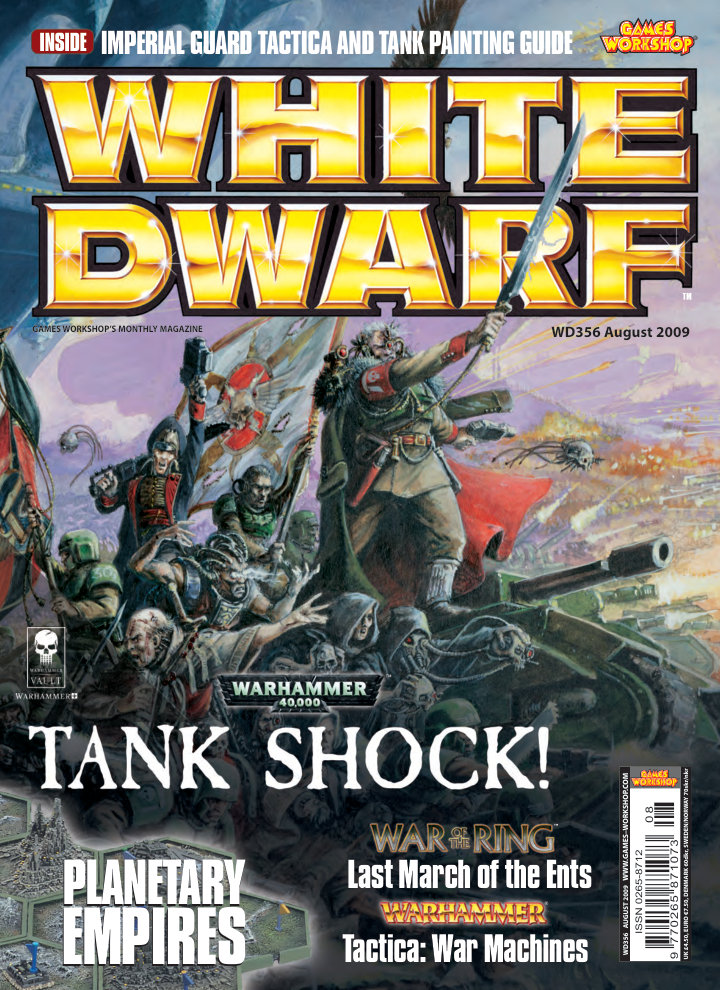
EditorialWD 356 · p. 1
The editor introduces a month dominated by campaigns and armour. Planetary Empires provides the strategic setting while new tanks and a painting manual support the models themselves. The issue also continues detailed techniques for faces. Gaming projects and painting projects are presented as complementary reasons to return to the hobby table.
Warhammer 40,000Warhammer Fantasy Battles
ReviewWD 356 · p. 3
The ninety-six-page manual gathers vehicle modelling and painting methods from studio specialists. It covers elegant alien craft as well as heavy Imperial armour. Preparation, assembly and finishing are presented for both newcomers and experienced collectors. The notice introduces the book whose contributors and additional examples appear later in the magazine.
Warhammer 40,000
ReviewWD 356 · p. 4
The new plastic kit builds the fast flame tank or one of two alternative vehicles. The Bane Wolf uses chemical weaponry while the Devil Dog carries a melta cannon. Hull weapons and crew options provide further variation. The notice emphasises the ability to choose different battlefield jobs from the same core model.
Warhammer 40,000Astra Militarum
ReviewWD 356 · p. 5
Three turret configurations turn the tank into a siege weapon, high-volume gun platform or plasma-armed relic. The kit also includes the available hull and sponson choices. Extra armour preserves the Demolisher’s familiar robust appearance. The release connects greater assembly flexibility to different tactical requirements.
Warhammer 40,000Astra Militarum
ReviewWD 356 · p. 6
A wrecked Rhino and dead trees create a ready-made patch of devastated battlefield. Limited assembly makes it a quick addition to a terrain collection. Alongside it, a new water pot supports brushes at its lip and a shield-shaped palette provides a mixing surface. The page brings together scenery and practical painting equipment.
Warhammer 40,000
ReviewWD 356 · p. 7
Forty-eight double-sided tiles form a reusable campaign map. Additional markers represent important resources and installations. A sample rules booklet connects ownership of those locations to battles. Separate hive-city pieces add especially valuable objectives to the strategic landscape.
Warhammer 40,000
ReviewWD 356 · p. 8
Gideon Ravenor and his operatives pursue investigations across unusual places and times. Their determination links the collection’s three novels. An introduction and short story accompany the main sequence. The notice offers a consolidated route into the Inquisitor’s adventures rather than a new standalone episode.
Warhammer 40,000Inquisition
ReviewWD 356 · p. 8
Thanquol pursues the Wormstone as a means to poison Altdorf. Success would also raise his standing with the Council of Thirteen. The familiar enemy of Gotrek and Felix becomes the centre of his own adventure. The notice foregrounds the combination of ambition and destructive scheming that defines the character.
Warhammer Fantasy BattlesSkaven
ReviewWD 356 · p. 9
Roth and Silverstein seek ancient artefacts while the Ironclad invasion threatens the Medina Corridor. The accompanying extract places the Inquisitor in immediate danger from a death-cult assassin. A short author profile describes Zou’s military exercises as a starting point for his writing. The page introduces both the larger mystery and the novel’s close-quarters action.
Warhammer 40,000Inquisition
ReviewWD 356 · p. 10
A melta cannon and power fist provide new ways to equip the Reaver Titan. Separately available weapons let collectors adapt an existing engine. Uraka and his herald add a Khorne counterpart to the recent daemon releases. The notice directs readers to the Vraks book for the daemon’s background and rules.
Warhammer 40,000Adeptus Titanicus
NewsWD 356 · p. 11
The October release promises a new codex and an expanded miniature range. Two plastic examples show the emerging appearance of Grey Hunters and Blood Claws. The preview stresses the Chapter’s legendary and savage identity. It announces the future launch without supplying the forthcoming army rules.
Warhammer 40,000Space Wolves
ReviewWD 356 · p. 11
The Battlewagon gains a plastic upgrade frame with a deff rolla. Marine and Guard vehicle packs provide additional weapons and accessories. The crashed lander from Battle for Macragge becomes available separately as terrain. Together the notices offer ways to extend existing collections through spare components and returning scenery.
Warhammer 40,000
NewsWD 356 · p. 12
The new roleplaying game takes characters beyond the familiar duties of an Imperial agent. Exploration, trade and ambition can place entire worlds within their reach. It remains compatible with Dark Heresy while offering a different kind of freedom. The notice introduces the premise and scale of the adventures rather than reproducing character-generation rules.
Rogue Trader
ReviewWD 356 · p. 12
Rick designs a comic journey from a tavern table to the bar and back. Other patrons and inhabitants turn obtaining food and drink into an unpredictable challenge. Ralph’s art reinforces the humour of the setting. The notice introduces a game sold at Bugman’s itself and explains its local inspiration.
The Bugman’s Game
InterviewWD 356 · pp. 16–21
Andy discusses the map kit’s development with Jervis. Compatibility with Mighty Empires expands the available landscapes, while a deliberately concise campaign system encourages adaptation. Resource tiles and a handicap against runaway leaders connect the map to individual battles. Industrial and ice-world examples show how painting and invented geography establish very different settings.
Warhammer 40,0005 paint colours
PaintingWD 356 · pp. 20–21
Shroud’s nuclear winter surrounds a geothermal mining economy and a single great hive. Chad paints the tiles separately underneath before assembling the map for its grey-blue finish. Pale drybrushing and a light white spray suggest frost and snow. A turn-taking method for drawing tiles and placing upgrades gives the players a shared way to create their own planet.
Warhammer 40,0005 paint colours
TacticaWD 356 · pp. 22–29
Andy gathers advice from several experienced Guard commanders. Orders and combined squads make the infantry more adaptable, while armour and airborne troops solve different problems. The contributors discuss splitting a battle line, withholding tanks in reserve and denying useful targets to enemy weapons. Sentinels and the new flame-tank variants illustrate how specialised units fit into a broader plan.
Warhammer 40,000Astra Militarum
TacticaWD 356 · pp. 24–25
Corey’s infantry approach combines numerous heavy weapons with a prepared counterassault force. He divides the army into a protected winning flank and a force expected to absorb enemy pressure. Fire discipline first removes transports that threaten the stronger side. The method deliberately buys time rather than expecting every platoon to survive.
Warhammer 40,000Astra Militarum
TacticaWD 356 · pp. 26–27
Andy divides tanks into assault vehicles, infantry support and distant gun platforms. Each role asks different things of range, movement and accompanying troops. Supporting infantry are especially important around cover and in urban battles. Graham adds a reserve tactic that introduces heavy vehicles after the opponent has already committed against the infantry.
Warhammer 40,000Astra Militarum
TacticaWD 356 · p. 28
Christian uses Valkyries and Vendettas to deliver elite troops where they can make a decisive intervention. Outflanking and grav-chute insertion offer different routes past the enemy’s main line. Storm Troopers clear objectives with specialised weapons even though they cannot claim those objectives themselves. Orders further improve their ability to dislodge protected targets.
Warhammer 40,000Astra Militarum
CampaignWD 356 · pp. 34–47
Phil creates two campaign maps so both sides can attack as well as defend. The Ork-driven planetoid approaches Meridian while Imperial and allied forces attempt to stop it. Planetstrike openings lead into mixed games and an Apocalypse finale. Shared sides, valuable special locations and alternative endings make the framework usable by players with very different amounts of free time.
Warhammer 40,000Orks
RulesWD 356 · pp. 36–39
The campaign progresses through invasion, wider war and a large finale. Red and blue flags show team control while individual markings preserve each player’s achievements. Initial placement, unclaimed tiles and rules for returning after losing all territory keep participation flexible. Upgrades are built into the map or distributed between phases, with conquest still based on the Planetary Empires framework.
Warhammer 40,000
RulesWD 356 · pp. 40–43
Meridian’s locations affect both strategic conquest and the battles fought below. Rivers, mountains and defensive networks resist capture, while forests and crater pits favour particular approaches. The Arcadia laser can erase tiles and the Benefact missile threatens to end the whole campaign. An observatory reveals enemy preparations, and a Warp Gate offers dangerous passage through the webway.
Warhammer 40,000
RulesWD 356 · pp. 44–46
Azurite crystals protect defenders from some orbital attacks, while engines can bring the collision forward. A huge cannon strikes Meridian and a refinery strengthens flame weapons at a risk to their users. The volcanic Realm of Fire offers its own hostile conditions. The campaign can finish through territorial success, destruction of the Rok or a final struggle before impact.
Warhammer 40,000
FeatureWD 356 · pp. 48–49
The feature explains why a local store cannot hold every part of the range. Specialist games, collectors’ miniatures and conversion packs therefore remain accessible through ordering. Examples show the breadth beyond the main boxed products. This is an account of the contemporary retail system, including web, store and independent-stockist routes.
TacticaWD 356 · pp. 50–57
Pete treats artillery as a set of tools that must be chosen, positioned and protected for particular opponents. He distinguishes weapons for armour, massed troops and several roles. Unusual machines such as the Steam Tank, Hellcannon and Screaming Skull Catapult need more individual handling. The final advice reverses perspective to explain surviving and attacking an enemy artillery line.
Warhammer Fantasy BattlesThe Empire
Battle ReportWD 356 · pp. 58–75
Graham and Alessio take the Ents against Nick and Chris’s Isengard defenders. Renewing Orc companies and burning missiles slow the assault on the dam. All three named Ents fall, but the remaining tree-herders eventually destroy the structure and flood the works. The victory feels costly, and both teams assess how movement, protection and the defenders’ archers shaped the long battle.
War of the RingFangorn
ScenarioWD 356 · pp. 60–61
The Ents win by breaking a heavily defended dam before every attacker is destroyed. Saruman can operate dangerous machinery from Orthanc, and Orc companies return through underground openings. Burning pitch strengthens missile fire against the vulnerable tree-herders. Merry and Pippin encourage a chosen Ent and can transfer to another protector as casualties mount.
War of the RingFangorn
ColumnWD 356 · pp. 77–79
Jervis traces the magazine’s battle-report format through early contributions and studio games. A memorable report needs a purpose beyond listing moves. Recording, maps, photography and later reconstruction require far more work than the finished pages reveal. He explains why preserving the actual dice results serves those accounts better than altering inconvenient events.
ModellingWD 356 · pp. 80–89
Andy explains the new manual’s ambition to teach vehicle work without assuming existing expertise. Additional projects apply its methods to a Hellhound, new tank kits and camouflage netting. Ork upgrades and several painted vehicles broaden the examples beyond the Guard. The feature connects practical assembly with weathering, blending and personal markings.
Warhammer 40,00014 paint colours
PaintingWD 356 · pp. 82–83
Chad adapts Keith’s tank methods to the new flame vehicle. Sprayed dark green and layered drybrushing establish the hull, while brown-and-black lining defines recesses. Ochre camouflage receives its own wash and pale highlights. Successive metallic coats and differently placed washes create the inferno cannon’s scorched nozzle.
Warhammer 40,000Astra Militarum12 paint colours
InterviewWD 356 · pp. 84–85
Tom and Dale preserve the vehicles’ recognisable shapes while making the frames more efficient. Removing unseen wheel components simplifies construction and lets tracks fit more neatly. Each box now offers several tank configurations and extensive equipment choices. They explain the balance between compact parts, sharp detail and useful assembly options.
Warhammer 40,000Astra Militarum
ModellingWD 356 · p. 86
A plastic-strut frame supports lightweight metal mesh over a Basilisk. Painting the mesh separately makes the structure easier to finish. Green layers and added plant leaves suggest camouflage rather than an ordinary wire cage. A Sentinel example shows how the technique transfers to another vehicle.
Warhammer 40,000Astra Militarum2 paint colours
ModellingWD 356 · p. 87
The new frame supplies the vehicle’s conspicuous crushing roller and additional artillery. A lobba and killkannon expand the modeller’s choices. The text encourages using the pieces in other inventions rather than restricting them to the intended chassis. Painted checks and small footprints illustrate how surface detail adds character to a working Ork machine.
Warhammer 40,000Orks
PaintingWD 356 · pp. 88–89
Chipped Ork bikes contrast battered metal with worn brass. Joe’s Defiler uses different freehand designs across its legs, while Darren’s Falcon demonstrates careful blending and masked bands. The Whirlwind receives restrained scratches and track dust rather than overwhelming decay. Together the examples show how finish can communicate both faction and recent service.
Warhammer 40,000Orks7 paint colours
PaintingWD 356 · pp. 92–99
Darren extends the earlier face workshop with different skin tones, species and individual details. Thin layers preserve expression while subtle underlying colour makes flesh appear alive. Age, gender, stubble, tattoos and decay require different placement as well as different mixtures. Demonstrations range from human and Elven faces to Orks, Tau, Zombies and Dwarfs.
Warhammer Fantasy BattlesWarhammer 40,00031 paint colours
PaintingWD 356 · p. 93
The darker face retains enough mid-tone colour for eyes and lips to read clearly. Carefully placed highlights define its expression without turning the entire complexion pale. The accompanying ageing comparison uses less saturated highlights and fine expression lines. Identical heads can therefore suggest very different life histories.
8 paint colours
PaintingWD 356 · p. 94
A pale undercoat and thin mid-tone foundation keep Arwen’s face delicate. Restrained lip colour and shading beneath the cheekbones preserve its shape. The text warns that misplaced warmth can flatten the face or make it appear flushed. Comparisons discuss how realistic Middle-earth figures differ from more exaggerated fantasy subjects.
Middle-earth Strategy Battle GameRivendell8 paint colours
PaintingWD 356 · p. 95
A natural green mid-tone replaces a brighter cartoon-like approach. Brown and dark washes establish depth before warm highlights rebuild the form. Red around lips and scars and blue near the eyes imply living colour beneath the skin. Final highlights integrate those additions into a face intended for a special character model.
Warhammer 40,000Orks10 paint colours
PaintingWD 356 · p. 96
Purple-brown shading makes the blue-grey face feel organic rather than mechanical. Neutral khaki adds warmth to the highlights without a severe contrast. Aun’va illustrates ageing within the same palette, while Shadowsun receives a softer youthful treatment. The examples show how the underlying principle can produce individual character.
Warhammer 40,000T’au Empire8 paint colours
PaintingWD 356 · p. 97
Purple shifts the flesh foundation toward a lifeless appearance. Warm washes around features are countered by greenish highlights. Gore then distinguishes the Zombie’s condition from a merely pale living face. Related examples show how the same principles extend to Vampires and Ghouls with different levels of freshness and decay.
Warhammer Fantasy BattlesVampire Counts7 paint colours
PaintingWD 356 · p. 98
Flesh colour mixed into the dark wash makes stubble appear beneath the skin. Two related mixtures build the effect without becoming a full beard. Renewed highlights soften the transition into the rest of the face. The same approach can suggest a shaved scalp if the natural hairline is respected.
Warhammer 40,000Catachan Jungle Fighters6 paint colours
PaintingWD 356 · p. 98
Thin coloured washes add warmth to the nose and cheeks. Including the existing flesh colour prevents the additions looking painted onto the surface. Reapplied highlights connect the new colour to the original face. The effect can also be used sparingly on ears, lips and knuckles.
Warhammer Fantasy BattlesDwarfs6 paint colours
PaintingWD 356 · p. 99
The design is planned on paper before a thin dark outline establishes its position. Blue and flesh colours make the final mark less severe than pure black. A skin-toned highlight helps it appear embedded rather than resting on top. Varying saturation and darkness can imply an older or newer tattoo.
Warhammer Fantasy BattlesWarriors of Chaos5 paint colours
PaintingWD 356 · p. 99
Small red glazes and brighter centres create inflamed spots, with a yellow point suggesting a particularly unpleasant blemish. Fine feathering adds body hair gradually instead of drawing solid strands. A pale halo suggests clean reflective hair. Neutral grey mixtures and careful placement communicate ageing around the temples or across the whole head.
5 paint colours
ShowcaseWD 356 · pp. 102–103
Keith nominates Brian’s Shaman as a figure that still fits the range more than a decade after release. Its posture, face and ritual equipment helped establish a stronger, less comic greenskin design. Neil’s recent version demonstrates the sculpt’s continuing appeal to painters. A gallery relates Nazgob to the accompanying Warboss and Boar Boy designs.
Warhammer Fantasy BattlesOrcs & Goblins
CommunityWD 356 · pp. 106–108
The preview focuses on opportunities to make models and learn directly from studio specialists. The Hobby Zone supplies materials, advice and the Scrap Demon challenge. Designers, painters and games developers prepare more interactive activities. Practical information describes pre-release limits, coach travel and the changing venue arrangement for the September event.
CommunityWD 356 · p. 109
Rik explains the designation used for independent retailers offering a fuller hobby service. Gaming tables, painting areas and knowledgeable staff complement the product range. Such stores may also support clubs and local events. The feature describes their role in the contemporary community network, illustrated by Fanatic in Denmark.
All substantial articles, new-release reviews, printed campaign rules, tactics, battle report, modelling, face-painting recipes and community features in the supplied magazine are indexed. Rok of Ages results are promised for the following issue; they are not invented here. Routine price lists, maps of retailers and event calendars are excluded as separate articles.