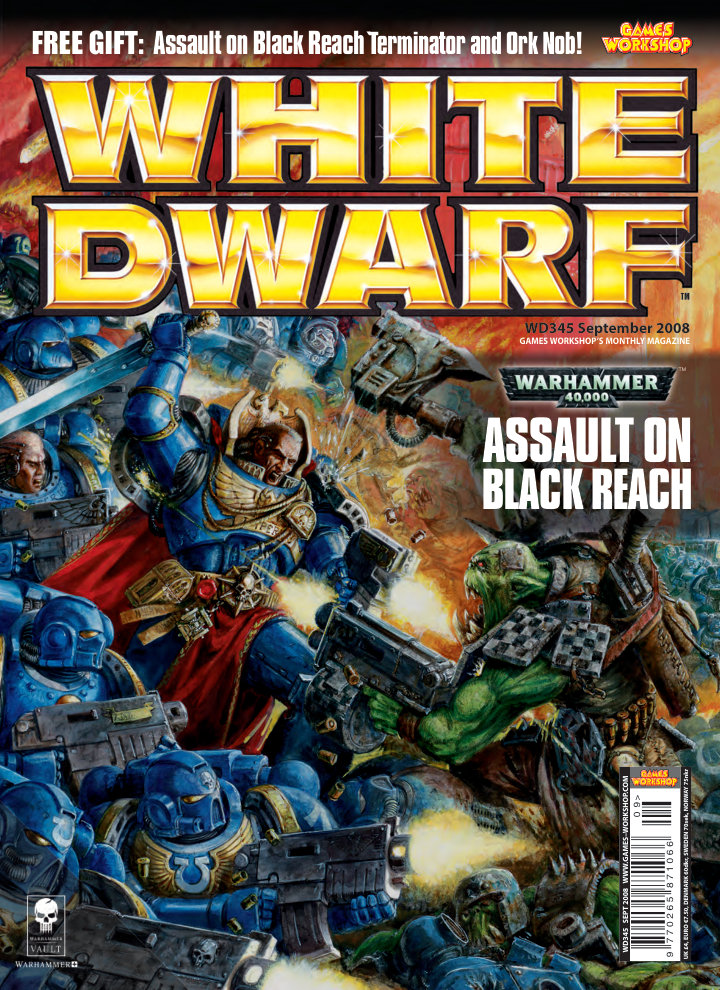
EditorialWD 345 · p. 1
A move to a brighter office uncovers the White Dwarf team’s neglected miniatures and prompts lunchtime painting and games. Mark Latham divides his attention between Reikland and Space Marines, then compares the excitement of Black Reach with opening his own second-edition box years earlier. He hopes today’s newcomers will form similar memories. The editorial connects a major release with the everyday pleasure of reviving projects and sharing them with colleagues.
Warhammer 40,000Warhammer Fantasy Battles
CommunityWD 345 · pp. 10–11
The November Warriors of Chaos release is previewed as the successor to the magazine’s interim list. Phil Kelly’s book promises Warshrines, Forsaken, a Troll King and Sigvald, alongside new plastic cavalry and Warhounds. The introduction places armoured Chaos Warriors within the wider northern tribes and their destructive ambitions. Mike Anderson’s Chaos Lord provides a first visual example of the accompanying character range.
Warhammer Fantasy BattlesWarriors of Chaos
CommunityWD 345 · p. 12
Battle March brings the Mark of Chaos game and its expansion together on Xbox 360, with a separate expansion for PC. The preview introduces Dark Elves, expanded Orc forces, campaigns and online competition while stressing army command over resource management. Customisation and developing heroes give players further ways to shape their forces. Its multiple modes offer both a solo campaign and battles against distant opponents.
Warhammer Fantasy BattlesDark Elves
CommunityWD 345 · p. 13
The new School League season invites clubs to prepare armies and teams after the summer, with fifth-edition 40K and Black Reach providing fresh challenges. Store activities can include tactical tuition, painting, scenery making and club tournaments before the regional and national stages. The notice explains how teachers can obtain an information pack and arrange visits or contacts with nearby school and library clubs.
Warhammer 40,000Warhammer Fantasy Battles
InterviewWD 345 · pp. 14–21
Andy Hall opens the new boxed game and examines how its forty-six miniatures, complete pocket rules and hobby booklet form a starting collection. Ted Williams, Dave Thomas and Seb Perbet describe balancing viable Ork and Marine forces while fitting ambitious models onto four frames. The Dreadnought’s reduced parts count, Deffkopta design and careful frame stacking reveal how sculpting and mould-making work together. Character equipment was fixed early enough to support strong poses.
Warhammer 40,000Space Marines
RulesWD 345 · pp. 24–35
Mark Latham and Mat Ward use five new hero miniatures to revisit the alliances represented at Rivendell. Elrond and Gandalf embody its wisdom, Aragorn links it to Arnor, and Legolas and Gimli bring Mirkwood and Erebor into the discussion. Complete profiles, sample armies and two scenarios turn that background into playable choices. The battles range from the three hunters’ pursuit across Rohan to an imagined assault on the council itself.
Middle-earth Strategy Battle GameRivendell
RulesWD 345 · p. 26
Elrond’s profile combines a capable Elf lord with powers suited to protecting his allies and controlling a battle. Vilya improves his Fate reliability, foresight points can alter the Good priority roll, and Wrath of Bruinen knocks down nearby enemies with particularly dangerous results in water. The surrounding discussion places him among the council’s surviving veterans, whose learning does not diminish their ability to fight.
Middle-earth Strategy Battle GameRivendell
RulesWD 345 · p. 27
Gandalf receives a full profile with Glamdring, Narya, optional mounts and a staff that supplies Will each turn. His spell selection ranges from protection and immobilisation to command and a blasting attack. The rules emphasise a flexible supporter who can also defend himself in close combat. Short comparisons with Glorfindel and Erestor suggest other ways of investing points in Rivendell’s experienced heroes.
Middle-earth Strategy Battle GameThe Fellowship
RulesWD 345 · pp. 28–29
The new Aragorn profile emphasises leadership of the northern Rangers rather than only personal swordsmanship. A free Might point each turn supports heroics, while nearby Rangers and named companions gain banner support and easier travel through rough ground. The background explains his seat at the council through Arnor’s enduring links with Elrond. Halbarad, Arathorn and the Elven twins illustrate the allies suited to that role.
Middle-earth Strategy Battle GameGrey Company
RulesWD 345 · pp. 30–31
Legolas’s profile provides either three normal shots or a single automatic hit, alongside options for armour, a cloak and a horse. His background places Mirkwood’s delegates within the daily struggle against Sauron’s corruption and explains how Gollum’s escape brought him to Rivendell. The accompanying force demonstrates fragile but accurate Wood Elf troops, whose defence depends on swift attacks rather than heavy protection.
Middle-earth Strategy Battle GameMirkwood
TacticsWD 345 · p. 31
A five-hundred-point hunting party combines Legolas and a Captain with equal groups of bowmen, blade-armed warriors and spear support. Three Sentinels add specialist capabilities. The list concentrates on the Wood Elves’ accurate attacks while acknowledging their lower Defence, and the accompanying colour illustrations suggest several regional identities without supplying named-paint recipes. It provides a manageable expression of Mirkwood’s character for a small game.
Middle-earth Strategy Battle GameMirkwood
RulesWD 345 · pp. 32–33
Gimli’s complete profile makes the choice between extra attacks and his exceptional two-handed axe central to each fight. Heavy armour and strong courage suit a hero who helps his allies endure close combat. The surrounding account explains the Dwarves’ distrust of Elves, their own besieged holds and Sauron’s failed approaches to Erebor. Dáin offers a comparison for players seeking an even tougher leader.
Middle-earth Strategy Battle GameErebor
TacticsWD 345 · p. 33
Gimli and a Captain lead a compact mixed Dwarf force of Khazad Guard, Iron Guard and Warriors supported by a banner and ballista. Different weapons supply shielding, heavier blows and ranged pressure. The list’s introduction recommends enduring enemy attacks before a decisive counterattack, reflecting the army’s high protection rather than relying on speed. Clan colour examples and runic traditions add background without a detailed painting prescription.
Middle-earth Strategy Battle GameErebor
RulesWD 345 · p. 34
Aragorn, Legolas and Gimli must cross Rohan while an endless sequence of Evil creatures tries to wear them down. Reinforcements arrive from randomly determined edges, so the heroes must balance forward movement with resisting new threats. Escape by all three wins for Good; two surviving escapees produce a draw. The scenario uses a broad selection of modestly priced enemies to recreate the pursuit rather than a conventional equal-points battle.
Middle-earth Strategy Battle GameThe Fellowship
RulesWD 345 · p. 35
An alternate outcome at Bruinen lets the Witch-king attack Rivendell while the council is assembled. Good must escort Frodo off the battlefield, facing enemies deployed around all four edges and returning slain warriors. Frodo cannot use the Ring while the Witch-king lives, and neither force breaks. The large points allowance lets players combine the famous council heroes with a substantial defending garrison.
Middle-earth Strategy Battle GameRivendell
CampaignWD 345 · pp. 36–41
Gav Thorpe expands warfare beyond pitched battles into the looting, slavery and arson that fill the setting’s history. Common rules govern burning buildings, prisoners, treasure and watchtowers, then two scenarios put them into action. A mobile Dark Elf force provides an example of raiders organised for such tasks. The article invites house-rule experimentation and prepares for further scenarios and linked campaigning in the second instalment.
Warhammer Fantasy BattlesDark Elves
RulesWD 345 · pp. 37–38
Torch-bearing units and flaming attacks can set buildings alight, forcing occupants to endure casualties and risking collapse. Pursuing fleeing troops produces prisoners, while searching buildings creates loot markers limited by a carrier’s unit strength. Loot can be dropped, transferred or taken off the table. Watchtowers improve fire and defensive combat but remain vulnerable to fire, creating conflicting incentives to hold, plunder or destroy a building.
Warhammer Fantasy Battles
RulesWD 345 · p. 39
Raiders try to silence a beacon tower before its defenders can raise the alarm. Equal-sized forces deploy around a central watchtower, with a compulsory infantry garrison and the attackers moving first. Capturing the tower wins immediately, while the defenders must still occupy it after eight turns. The restricted approaches and reinforced building rules make this a focused assault rather than a race to destroy the entire opposing army.
Warhammer Fantasy Battles
RulesWD 345 · p. 40
Three central buildings become the target of a ten-turn raid. The attackers earn points from loot they still possess, while the defenders score for destroyed or fleeing attacking units. Starting around the settlement gives the defenders an immediate position to protect, but the raiders can approach from different directions. A Dark Elf atrocity at Handelsee supplies the narrative example for a mission in which theft matters more than holding ground.
Warhammer Fantasy BattlesDark Elves
TacticsWD 345 · p. 41
Lokhir Fellheart leads a 1,996-point expedition from the Tower of Blessed Dread, built around Corsairs, concealed Assassins and fast scouting troops. Dark Riders and Shades establish the raiding character while Cold One Knights and bolt throwers add support. The commentary recommends mobile units and skirmishers for these scenarios, explaining the force as a landing party rather than a generic battle line.
Warhammer Fantasy BattlesDark Elves
CommunityWD 345 · pp. 43–51
The four collectors must now put legal armies on the table, with points awarded for painting and the best result from their first games. Black Reach supplies large additions for Neil’s Crimson Fists and Fil’s Goffs, while Pete revises his Eldar and Matt adds Huron Blackheart. Their victories and draws reveal the importance of supporting units, protecting scoring troops and remembering objectives rather than concentrating solely on casualties.
Warhammer 40,000Crimson Fists
TacticsWD 345 · pp. 44–45
Neil Hodgson adds the Black Reach Marines to his Crimson Fists and takes a 748-point force against Chris Peach’s renegade Guard. Losing Assault Marines and the Dreadnought immediately looks disastrous, but Tactical squads and Captain Fernandez recover the game through resilient armour and disciplined fighting. He describes adapting painting methods for the Dreadnought and adding detail to the Captain, then plans Pedro Kantor and Sternguard to deepen the army’s chapter identity.
Warhammer 40,000Crimson Fists
TacticsWD 345 · pp. 46–47
Pete Foley discovers through a loss to Space Marines that his Eldar need more coordinated support. Phil Kelly’s advice leads him to replace two Vypers with a Farseer using Guide and Doom, retaining his scoring troops and Falcons in a revised 1,496-point list. A subsequent win against Dark Eldar demonstrates the difference. The article also notes the new edition’s limits on defensive weapons and the vulnerability of vehicles in assault.
Warhammer 40,000Eldar
TacticsWD 345 · pp. 48–49
Huron Blackheart and extra Terminators make Matt Hutson’s Red Corsairs ready for a proper game. The army’s many flame weapons punish Andrew Kenrick’s Salamanders, but neglecting nearby objectives turns a dominant fighting performance into a draw. Matt plans additional Troops and a Vindicator to improve flexibility. He also describes using an earlier painting Masterclass and Keith Robertson’s help with printed transfers to refine the army’s appearance.
Warhammer 40,000Red Corsairs
TacticsWD 345 · pp. 50–51
Fil Dunn batch-paints the Black Reach Orks and mixes them into larger mobs before facing Glenn More’s Eldar. His Warboss and Nobz fight effectively after losing their Trukk, while Deffkoptas destroy a transport and threaten returning Jetbikes. Abandoning his own objective, however, helps the Eldar force a draw. The experience encourages more transports and a distracting walker, showing how a first game can expose the gap between aggression and mission success.
Warhammer 40,000Orks
CampaignWD 345 · pp. 52–59
Phil Kelly follows Sicarius’s attempt to behead Zanzag’s invasion through three linked missions. An initial duel amid orbital bombardment leads to a large assault on the Warboss’s hidden base, then a pursuit through the mountains to a final confrontation. Campaign points reward objectives and slain commanders across the series. The middle battle invites friends to combine collections for Apocalypse, while the first uses only the new boxed game.
Warhammer 40,000Ultramarines
RulesWD 345 · p. 55
Using only Black Reach’s models, the armies deploy close to Zanzag and fight for six turns to kill the opposing commander. Sicarius’s gamble is represented by orbital bombardments that may strike models near the edges or even everyone on the table. A successful decapitation earns a campaign point. The small force and dangerous environment create a rapid opening confrontation without requiring players to expand their collections first.
Warhammer 40,000Ultramarines
RulesWD 345 · pp. 56–57
A traced Ork Submersible reveals Zanzag’s cavern, letting the Ultramarines attack through its waterfall entrance. This Apocalypse game adds a Thunderhawk and Submersible to forces of at least 3,000 points each, with slain leaders becoming exclusive objectives. Surprise grants the Marines the first turn and temporarily unsettles the Orks, while Zanzag’s special ammunition improves their shootas. The cave confines the gunship to skimmer movement.
Warhammer 40,000Ultramarines
RulesWD 345 · pp. 58–59
The campaign concludes with 1,500-point armies containing the boxed forces and fighting over table quarters. Killing the enemy commander adds to the territory score and can also earn an extra campaign point, linking personal rivalry to the mission. Variable game length makes late positioning uncertain. A damaged promethium pipeline offers cover but risks burning infantry that end a turn on it.
Warhammer 40,000Ultramarines
Battle reportWD 345 · pp. 60–79
Matt Hutson and Phil Kelly expand the Black Reach armies to 1,500 points for the campaign finale. Trukk-borne Nobz strike early, but the Ultramarine Dreadnought destroys vehicles and kills Zanzag during a brutal counterattack. Sicarius falls to a surviving Nob in the same melee. Deffkoptas remove Scouts and surviving Orks hold the necessary ground when the game ends after turn five, giving Phil a three-to-one mission victory despite immense losses.
Warhammer 40,000Ultramarines
TacticsWD 345 · pp. 80–82
Andy Hall reviews the first year of Apocalypse and the Reload supplement’s expansion of formations, faction-specific assets and optional large-game formats. Secret orders, supreme commanders and multiple tables take the concept beyond merely assembling a bigger army. Fifth-edition running and revised blast weapons affect these battles, while scoring-unit wording needs a shared decision. The article recommends agreeing whether only Troops or all units score before play begins.
Warhammer 40,000
EditorialWD 345 · pp. 84–86
Jervis Johnson explains how Specialist Games add depth to the settings and variety to playing, painting and modelling. Different scales and campaign structures reveal parts of the worlds that their main battle games cannot. He describes downloadable rules, web-based model sales and a planned full-colour catalogue as the support strategy, while acknowledging that new releases remain distant. The column is a contemporary statement of the range’s place in the wider hobby.
Battlefleet GothicInquisitor
ModellingWD 345 · p. 87
Will Bowdrey’s tip repurposes the tray sheets as sturdy paved bases for buildings. Alan Merrett’s examples use scored and chipped edges, kit offcuts and rubble to blend the regular grid into ruined terrain. A refresher also explains cutting the double-sided twenty- or twenty-five-millimetre sheet and fitting its corners before the straight borders. The same product therefore supports both ranked units and distinctive scenery.
Warhammer Fantasy BattlesWarhammer 40,000
PaintingWD 345 · pp. 88–93
Chad Mierzwa turns the push-fit Marines and Orks into painted starting armies through accessible layers, washes and highlights. Tactical Marines receive a simpler blue recipe, while Terminators add pale helmets and detailed seals. Goff Boyz and Nobz use related but distinct skin recipes, with checks, scratches and transfers supplying identity. Assembly, basing and showcase examples help newcomers apply the same approach to the entire box.
Warhammer 40,000Ultramarines30 paint colours
PaintingWD 345 · p. 89
A Chaos Black undercoat supports Mordian Blue armour and Boltgun Metal weapons before gold rims and red eyes add contrast. Ultramarines Blue and Mithril Silver provide optional highlights on the broad surfaces and equipment. The page explains company colours and the new transfer sheet’s chapter, campaign and squad markings, showing how the same models can represent several different chapters without changing their construction.
Warhammer 40,000Ultramarines7 paint colours
PaintingWD 345 · p. 90
The Terminator’s dark blue base is washed black, then rebuilt with brighter blue-grey edges and a layered white helmet. Raised insignia, metallic weapons and purity seals receive distinct treatments, including sepia-shaded parchment and orange-highlighted red wax. Freehand script supplies a final personal detail. The guide recommends the same palette for the Dreadnought and illustrates a conversion using spare Terminator parts and a cyclone launcher.
Warhammer 40,000Ultramarines14 paint colours
PaintingWD 345 · p. 91
Boyz receive a black foundation, dark green skin and metallic weapons before Goblin Green and a bone mixture bring the flesh up to its final highlight. Brown straps and pale teeth complete the basic scheme, with Chainmail on weapon edges. The page demonstrates checks through a drawn grid and explains clan transfers. A shared sand base, painted brown and drybrushed bone, ties all the workshop models together.
Warhammer 40,000Orks8 paint colours
PaintingWD 345 · p. 92
The Nob’s skin moves from Orkhide Shade through Knarloc Green, black shading and a green wash to a final Goblin Green highlight. Grey-edged black cloth, layered tusks, warm leather and gold ammunition distinguish the equipment. Fine metallic scratches suggest battered armour, an effect repeated on the Deffkopta. Trying head and weapon positions before gluing gives even these push-fit miniatures individual postures.
Warhammer 40,000Orks20 paint colours
ShowcaseWD 345 · p. 93
Six painters demonstrate how far the boxed miniatures can be taken beyond the preceding starter recipes. Darren Latham’s Warboss and Fil Dunn’s big-shoota Ork contrast with Space Marine characters by Joe Tomaszewski and Sebastian Archer, Anja Wettergren’s Terminator and Keith Robertson’s Dreadnought. The selection makes the same limited-component models serve as individual painting projects while retaining their recognisable battlefield roles.
Warhammer 40,000Orks
PaintingWD 345 · pp. 94–99
Neil Green paints Mike Anderson’s Dreadlord on Jes Goodwin’s Cold One with a deliberately cool mount and rich purple clothing. Blue-grey highlights prevent the green hide from becoming too warm, while restrained gold marks the rider and beast as exceptional. The guide follows every major surface through layered colour and washes, then adds a carefully planned shield rune. Joe Tomaszewski’s alternative standard bearer illustrates gold inlay and a related heraldic approach.
Warhammer Fantasy BattlesDark Elves28 paint colours
PaintingWD 345 · p. 95
The Cold One’s hide rises from dark green through Catachan and Camo Green mixtures, with Space Wolves Grey cooling the final highlights. Its scales instead begin in Regal Blue and are edged with Rotting Flesh mixtures before blue and green washes enrich the tone. Thin directional strokes define the tail. Planning the complementary surfaces avoids the warmer red appearance used on some Lizardmen mounts.
Warhammer Fantasy BattlesDark Elves8 paint colours
PaintingWD 345 · p. 96
Purple cloth is shaded with black and raised through Warlock Purple and Bleached Bone mixtures, then unified with a tinted wash before a final highlight. The Dreadlord’s face starts warmer with Vermin Brown, moves through Dwarf Flesh and bone mixtures and receives dark brown shading and carefully dotted eyes. The contrasting recipes give the noble a rich focal colour and readable features against the mount’s colder palette.
Warhammer Fantasy BattlesDark Elves8 paint colours
PaintingWD 345 · p. 97
Steel armour receives a dark mixed shade, restored metallic highlights and successive brown and black washes before its brightest edges. Gold begins in a brown mixture and is raised with pure gold and silver, then warmed by brown and sepia washes. Neil uses it selectively to mark status. Joe Tomaszewski’s alternative separates an inlaid design with black before painting the gold and re-highlighting the adjacent silver.
Warhammer Fantasy BattlesDark Elves10 paint colours
PaintingWD 345 · p. 98
Grey highlights followed by a black wash create readable dark surfaces without losing their black appearance. For the shield, Neil first plans a rune on paper and marks its proportions before painting it in brown, edging it with bone and tidying it with white and purple. Joe’s battle standard applies the same care to centring a larger emblem. The advice treats spacing and correction as essential parts of freehand work.
Warhammer Fantasy BattlesDark Elves8 paint colours
PaintingWD 345 · p. 99
The final pass treats the Cold One’s eye, teeth and claws with warm brown and bone, then gives the skulls a darker earth foundation and bright white accents. A blue-black rune on the creature’s skull completes its identity. Neil cautions against rushing these small surfaces, since their precision helps the finished rider and mount read as one carefully resolved model.
Warhammer Fantasy BattlesDark Elves6 paint colours
CommunityWD 345 · pp. 100–101
Poland’s second Golden Demon moves to the Poznań Game Arena within a large multimedia fair. Beyond the painting competition, the preview promises Scrap Demon conversions, introductory hobby activities and Studio guests. Examples from the inaugural event include Julien Casses’s Hobbit diorama and Aleksander Witkowski’s Inquisitor retinue, showing the standard the organisers hope to build upon. The article gives the November dates and directs entrants to the event’s own updates.
Warhammer 40,000Middle-earth Strategy Battle Game