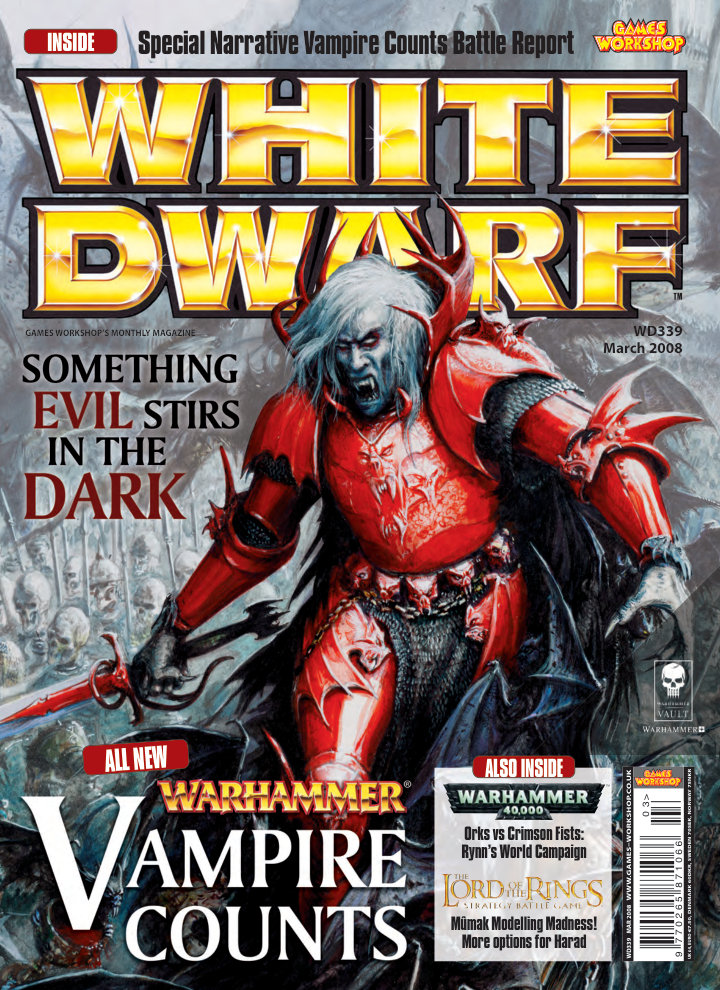
EditorialWD 339 · Inside cover
Grombrindal introduces a month devoted to the renewed Vampire Counts and promises investigations of their rules and visual identity. Their invasion supplies the narrative battle against the Empire, while other features revisit the earliest Warhammer 40,000 scenario and explore fast vehicles. The introduction also points Middle-earth collectors towards upgraded Mûmakil and the Studio’s Elf collection, maintaining its Dwarfen suspicion of both undead ambition and elegant pointy ears.
Warhammer Fantasy BattlesWarhammer 40,000Vampire Counts
CommunityWD 339 · pp. 12–13
The preview announces simultaneous Daemon army books for Warhammer and Warhammer 40,000, presenting the creatures as fragments of their gods’ wills released into the material world. Photographs introduce plastic Bloodletters and Daemonettes alongside a Beast of Nurgle. The shared release is framed as a major expansion of the Daemons’ independent identity in both settings, with the new books and miniature range scheduled for May.
Warhammer 40,000Warhammer Fantasy BattlesChaos Daemons
CommunityWD 339 · p. 14
Soulstorm expands the real-time strategy series with nine playable armies, new units for existing factions and airborne units able to cross previously impassable ground. Its campaign extends Dark Crusade’s territory system across a star system, while multiplayer medals add another measure of progress. The illustrated preview highlights Dark Eldar and aircraft, emphasising how the expansion changes movement and campaign scale as well as increasing the available forces.
Warhammer 40,000Dark Eldar
InterviewWD 339 · pp. 18–33
Andy Hall questions Gav Thorpe about giving the Vampire Counts a stronger identity and freeing players from rigid Bloodline categories. The new army treats its troops as a unified undead host, spreads marching support through Vampiric units and makes repeatable necromancy central to replenishing losses. Sculptors explain the archaic equipment and monstrous armour, before a sample army and painting advice translate those ideas into a collection. The result stresses powerful individual vampires directing a distinctive, magically sustained horde.
Warhammer Fantasy BattlesVampire Counts12 paint colours
TacticsWD 339 · p. 21
The thousand-point example begins with the infantry supplied by a battalion and two Vampires whose powers support different units. Dire Wolves provide speed, Grave Guard add a tougher fighting element and the Zombies supply cheap numbers. Gav suggests replacing one Vampire with the battalion’s Corpse Cart as an alternative. The list illustrates his broader advice to combine fear-causing infantry with enough Vampires to sustain both its magic and movement.
Warhammer Fantasy BattlesVampire Counts
InterviewWD 339 · p. 28
Brian Nelson reduces the underlying skeletons to more believable proportions and plans their poses around coherent ranked regiments. Aly Morrison and Mike Anderson add antiquated weapons, scraps of clothing and shields that distinguish these long-dead warriors from contemporary human armies. Cloth and standards blow in a shared supernatural wind, visually linking them to the wider range. A coffin-lid shield preserves an established Warhammer joke within the more disciplined design.
Warhammer Fantasy BattlesVampire Counts
InterviewWD 339 · p. 29
Mark Harrison uses ridged, angular armour, blood-drop jewellery and bat motifs to separate the von Carsteins from other armoured Warhammer heroes. Their cloaks incorporate trapped spirits, while Konrad wears an especially literal mass of living bats. The Varghulf takes John Blanche’s bestial concept towards a crouching combination of wolf, bat and sloth. Attention to articulated claws and bunched muscles makes the invented creature convincing in a poised, predatory stance.
Warhammer Fantasy BattlesVampire Counts
TacticsWD 339 · pp. 30–31
Mark Latham concentrates spellcasting support around a Vampire Lord and uses bound items to exhaust enemy defences before essential spells. Grave Guard protect the characters, while smaller Core units can grow through repeated summoning. Black Knights offer unusual movement and Spirit Hosts screen the expensive centre from missiles or obstruct a dangerous opponent. The list accepts difficult elite-unit choices to keep its character-driven infantry strategy within two thousand points.
Warhammer Fantasy BattlesVampire Counts
PaintingWD 339 · pp. 32–33
Neil Green shows how warm layered bone and dark, aged metal produce a more considered skeleton than a single white drybrush. Red and brass shield treatments repeat the ink shading and green corrosion, giving the regiment a shared ancient appearance. A gallery demonstrates alternative flesh, bone and armour schemes, while banners use restrained colours and threatening heraldry. The recipes concentrate on repeatable infantry methods with room for striking command models.
Warhammer Fantasy BattlesVampire Counts12 paint colours
PaintingWD 339 · p. 32
Brown foundation colour gives the bones depth before successive pale layers pick out the raised surfaces. Armour begins as dark steel and receives the same brown-and-black ink wash, followed by brighter metal highlights. A final thin green wash makes the equipment appear corroded. Treating the bones and armour together establishes a quick, unified process suitable for the many warriors an undead regiment requires.
Warhammer Fantasy BattlesVampire Counts9 paint colours
PaintingWD 339 · p. 33
Two shield sequences create red-painted iron and weathered brass. Both use mixed dark bases, a brown-and-black wash and restored highlights, then green shading for aged metal. The red field is strengthened separately so it stays distinct from the corroded rim and boss. Nearby examples show how morbid symbols and subdued banner colours extend the same visual identity across the army without requiring identical heraldry on every unit.
Warhammer Fantasy BattlesVampire Counts9 paint colours
Battle reportWD 339 · pp. 36–57
Gav Thorpe referees a three-thousand-point clash between Mat Ward’s Vampire Counts and Mark Latham’s Empire, giving each commander private objectives and a deployment map. Vlad’s crossing stalls against stubborn Flagellants while a scouting Vampire threatens the village behind the Imperial line. The Empire’s priests and ordinary soldiers weather the assault, but summoned Zombies and surviving Grave Guard secure enough objectives for a draw. The debrief shows how hidden information and a river crossing reshape familiar army choices.
Warhammer Fantasy BattlesVampire Counts
RulesWD 339 · pp. 38–39
The scenario stages Vlad’s attempt to cross the Stir with close deployment zones and secretly drawn starting positions. The Empire must field an Arch Lector and lacks several later inventions, while the attackers must include Vlad. Building-style rules make the central bridge defensible without allowing it to become an impassable trap. Asymmetric victory conditions reward the Empire for killing Vampires and denying the crossing, while the undead gain points by occupying key structures or slaying Arch Lectors.
Warhammer Fantasy BattlesVampire Counts
EditorialWD 339 · pp. 58–60
Guest columnist Rick Priestley takes inspiration from a large Blood Bowl gathering to challenge the idea that tournaments exist only for ruthless competitors. Mixing unfamiliar players exposes different assumptions, making tolerance important and revealing the rules writer’s tension between teaching and quick reference. He also argues that standard army sizes reflect tables, collections and available evenings rather than tournament control. Carefully prepared narrative games and convenient ordinary battles both have a place in the hobby.
Blood BowlWarhammer Fantasy Battles
ModellingWD 339 · p. 61
Straight saw cuts let two City Ruins wall sections join into a longer building, while a paired Eldar head swap demonstrates careful conversion of metal models. The guide stresses choosing the cut to protect nearby details, filing the new joint and filling unavoidable gaps. Advice on clean, smooth work surfaces explains how to secure the vice, and regular removal of metal or plastic fragments keeps the saw cutting accurately.
Warhammer 40,000Eldar
InterviewWD 339 · pp. 64–67
John Blanche describes concept art as a way to ask sculptors questions and inspire their own solutions. An extensive body of advance sketches gives the Vampire Counts a shared identity rooted in entropy, Victorian Gothic shapes and magically altered materials. He explores stitched creatures and the Varghulf’s bestial form, then explains a female vampire whose imagined glass armour grew from watching Cinderella. The accompanying art demonstrates possibilities that need not all become miniatures.
Warhammer Fantasy BattlesVampire Counts
TacticsWD 339 · pp. 68–73
Robin Cruddace organises fast vehicles around tank hunting, infantry suppression and timely transport. Their movement creates flank shots and forces opponents to redistribute defenders, but fragile armour makes cover and coordinated attacks essential. Skimmers gain additional protection and freedom of movement, while equipment choices can keep damaged vehicles useful. Counter-tactics favour multiple hits and prioritising loaded transports; the final reminder is that a surviving mobile vehicle can decide an objective late in the game.
Warhammer 40,000Eldar
ModellingWD 339 · pp. 74–81
Chad Mierzwa builds two distinct Mûmakil to represent new Harad upgrades. A Far Harad beast receives wooden tusk weapons and a wart-covered hide, while its Haradrim counterpart carries a studded control harness and chains. Seam repair restores the skin texture before painting, and broad red markings with dark sigils turn the enormous heads into focal points. A small grappling-hook construction also shows how to make rappelling lines for the howdah.
Middle-earth Strategy Battle GameHarad16 paint colours
PaintingWD 339 · pp. 78–79
A layered grey hide receives a warmer earth-grey drybrush on prominent areas before the warpaint is added. Opaque red markings make the vast face readable, with black sigils following the eyelid and other contours. Brown-to-ivory tusks and spikes contrast with the skin, while muted howdah colours reinforce the Mahûd model’s rustic appearance. Painting the entire hide first leaves freedom to adjust the position of the markings.
Middle-earth Strategy Battle GameFar Harad11 paint colours
ModellingWD 339 · p. 79
Four bent paperclips form a small grappling hook, with a jewellery-chain loop joining it to a rope made from twisted wire or thread. Wrapping the hook’s shank gives it a convincing bound construction. Once dry, black undercoat, brown rope and metallic hooks finish the piece. The lines can hang from the howdah to make the selected upgrade visible, with their length adjusted to the desired position along the beast’s flank.
Middle-earth Strategy Battle GameHarad3 paint colours
PaintingWD 339 · pp. 80–81
The Haradrim Mûmak’s black harness gains restrained grey highlights, keeping its large straps distinct from the paler skin. Dark metallic bases develop into weathered steel studs and chains, with bright silver confined to their sharpest details. Jewellery loops and skull ornaments receive warmer gold finishes. The guide also recommends hardening loose chain before painting and using the side of the brush for irregular sigils that look applied by the beast’s crew.
Middle-earth Strategy Battle GameHarad8 paint colours
CampaignWD 339 · pp. 82–89
Phil Kelly revisits the invasion that devastated the Crimson Fists, turning the events from Badlanding to New Rynn City into seven linked games. Reconnaissance and sabotage can change later forces or Strategic Assets, while an optional Apocalypse battle recreates the fortress-monastery’s destruction. The centrepiece updates the original farm encounter with Pedro Kantor and Thrugg Bullneck. Survivors and character injuries carry forward, giving the campaign a continuing story even when history takes a different course.
Warhammer 40,000Crimson Fists
RulesWD 339 · p. 84
The opening battle pits an Ork landing force against Imperial defenders in a thousand-point Blitz mission. A delayed preliminary bombardment gives the garrison a limited response to the invasion. Victory margin earns additional points for the later counterattack, so even the opening engagement influences the continuing campaign. Its background contrasts Badlanding’s neglected defences and small garrison with the increasingly bold Ork advance.
Warhammer 40,000Orks
RulesWD 339 · p. 84
A reconnaissance mission sends at least five Space Marine Scouts ahead of the main strike force at Krugerport. Success allows the surviving team to join the next battle in addition to the normal army. If the Ork guards detect and destroy them, the defenders instead receive a substantial mob of shoota-armed Boyz. The small infiltration game therefore changes the forces available for the much larger sabotage mission that follows.
Warhammer 40,000Crimson Fists
RulesWD 339 · p. 84
The Crimson Fists attack Krugerport with a two-thousand-point force, seeking to destroy the communications tower before Ork reinforcements overwhelm them. Earlier battles can add troops or points to either side. Destroying the objective reduces the Orks’ Strategic Assets in the subsequent Apocalypse engagement, while preserving it grants an additional asset. The sabotage mission makes reconnaissance and the removal of an enemy command link matter beyond their immediate battlefield.
Warhammer 40,000Crimson Fists
RulesWD 339 · p. 85
An optional Apocalypse game represents the full invasion of Rynn’s World, with Imperial bombardments and a Defence Laser supplementing the defending army. A turn-based roll determines when the fortress arsenal detonates, striking every model on the table with devastating force. Even a lone survivor can claim an objective, turning the catastrophe into a desperate contest for remaining positions. Players without sufficient models can proceed directly to the farm encounter.
Warhammer 40,000Crimson Fists
RulesWD 339 · pp. 86–87
Kantor and a small band of Crimson Fists hide in a ruined farm while Thrugg Bullneck’s patrol approaches from dispersed positions. The Space Marines must defeat the attackers while protecting their Chapter Master, whereas Thrugg wants Kantor dead and a hidden stash recovered. Eight turns and hidden deployment shape the encounter. Character injuries, recovered loot and surviving Marines influence later games, and an overwhelming Imperial victory can bypass the next mission.
Warhammer 40,000Crimson Fists
ModellingWD 339 · p. 88
The Studio builds the farm’s ruined perimeter from City Ruins components, retaining elevated positions for the defenders. An older scenery piece becomes the generator, with the article suggesting modified household-appliance parts for a similar industrial structure. Weapons, ammunition and a crystal create an Orkish loot marker on a small base. The project concentrates on the three recognisable terrain elements needed to make the scenario’s location and hidden stash clear.
Warhammer 40,000
RulesWD 339 · p. 89
The farm’s Space Marine survivors face three hundred points of Ork troops among densely packed urban ruins. This adapted Combat Patrol encounter carries the winning side’s survivors into the final battle. If the Marines were completely defeated at the farm, the mission changes to a Breakout with them attacking. The flexible link keeps the campaign moving towards the besieged city while still rewarding earlier success and preserving the cost of losses.
Warhammer 40,000Crimson Fists
RulesWD 339 · p. 89
Kantor reaches an underzoom held by Sergeant Huron Grimm just before Snagrod’s army attacks. The concluding Apocalypse game has no points limit and lets a surviving Thrugg join the Orks in addition to their usual force. Kantor keeps the Crimson Fists Fearless while he stands, and each side receives thematic Strategic Assets. Winning this defence decides the campaign, with the historical aftermath suggesting further battles around the besieged capital.
Warhammer 40,000Crimson Fists
InterviewWD 339 · pp. 90–94
Martin Footitt traces his route from HeroQuest and occasional games with his cousin to professional painting and miniature design. Years with ’Eavy Metal improved his technique, while independent sculpting practice eventually led to a design role. His Golden Demon pieces demonstrate smooth metallics, controlled palettes and scenic storytelling, from a heavily converted Grey Knight to a firing Bretonnian trebuchet. The profile explains the choices behind each project without presenting named paint recipes.
Warhammer 40,000Warhammer Fantasy BattlesGrey Knights
ShowcaseWD 339 · pp. 96–99
The Studio’s Elf collection is arranged around Helm’s Deep, Rivendell, the Last Alliance and the woodland realms. Painted heroes and command figures connect the miniatures to their places in Middle-earth’s history, including the alliance with Men and the Elves’ gradual departure. The gallery ranges from armoured High Elves to woodland sentinels and an alternative transformed Galadriel. Brief background captions give the collection context without supplying painting recipes.
Middle-earth Strategy Battle GameElves
CommunityWD 339 · p. 102
The new Battlefields weekend emphasises varied games and social play, drawing on the successful Warhammer event. Participants bring a three-thousand-point collection from which they select different forces for non-standard missions, Cities of Death and doubles Apocalypse games. Part of the collection can include units outside ordinary force organisation. Certificates record everyone’s games, reinforcing the organisers’ aim to provide a broad shared gaming experience rather than a conventional tournament ranking.
Warhammer 40,000
CommunityWD 339 · p. 103
Warhammer World’s Hobby Station offers guided projects ranging from miniature assembly and painting to scratch-built scenery. Short sessions include materials and the finished project, with activities designed for newcomers, experienced hobbyists and accompanying friends or parents. The Easter programme introduces pre-booked full-day sessions for more ambitious kits. Possible summer hobby camps would combine extended projects with coached games, but the article presents these as plans still being developed.