EditorialWD 322 · Inside cover
Grombrindal views the resurgent Orcs and Goblins from the perspective of their Dwarf enemies. Their refusal to disappear after defeat, appetite for fighting and newly effective weapons make them a formidable recurring threat. He nevertheless recognises the appeal of commanding an unpredictable army of monsters, suggesting that even a Dwarf might learn something useful by leading the foe for a change.
Warhammer Fantasy BattlesOrcs & Goblins
CommunityWD 322 · p. 14
The news page looks ahead to opportunities to inspect the revised Eldar range and rules before release, alongside a staff terrain project inspired by Cities of Death. The Direct team has turned its new modular buildings into the Celestine District, a personal part of the Sybilla Tertius campaign setting. Competition results and a reader’s irreverent Tyranid answer complete the page’s mixture of release news and hobby activity.
Warhammer 40,000Aeldari
RulesWD 322 · pp. 17–27
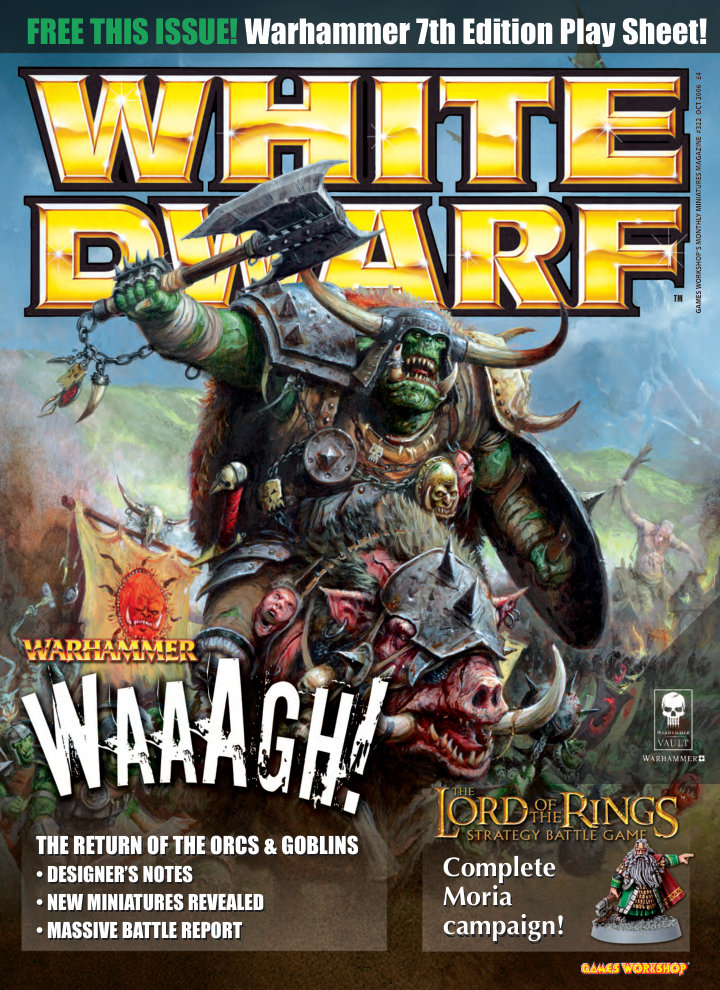
Mat Ward describes an army book designed to make ordinary Orcs attractive while retaining the variety and mischief of Goblins. More effective choppas, stronger leaders and a once-per-game Waaagh! reward large fighting units, while simplified animosity can propel them towards the enemy as well as interrupt their advance. Revised magic, nets, Squig units and Rare choices preserve the army’s unpredictability, and returning warlords connect those changes with a fuller account of greenskin history.
Warhammer Fantasy BattlesOrcs & Goblins
ModellingWD 322 · pp. 20–21
The plastic Orc character kit provides the parts to make both a mounted and a foot leader with a broad choice of weapons and equipment. Different heads, bodies, armour pieces and accessories let the modeller represent an ordinary Orc or Black Orc, a Warboss or Big Boss, and even a battle standard bearer. The illustrated component guide makes the kit’s flexibility concrete rather than treating the finished examples as the only possible configurations.
Warhammer Fantasy BattlesOrcs & Goblins
TacticsWD 322 · pp. 28–29
Mat Ward builds his advice around numbers: extra units compensate for animosity, preserve rank bonuses and make panic losses harder to trigger. Fast Goblin riders or a scouting Big Boss tackle war machines, while artillery, Fanatics and a hard cavalry threat deter an opponent’s own rapid attack. The sample army shows those tools working around substantial infantry mobs, with a warning that excessively wide fronts can waste Orc attacks and expose too many Goblins.
Warhammer Fantasy BattlesOrcs & Goblins
Battle reportWD 322 · pp. 30–45
Mark Latham’s greenskins and Andy Hoare’s Lizardmen fight a 4,000-point battle over desecrated shrines on the Plain of Tuskers. Skink poison and early animosity initially stall the Orcs, but their infantry reaches combat and a Wyvern-riding Warboss exploits the dense concentration of enemy characters with Shaga’s Screamin’ Sword. A mistimed supporting swarm and the order of late combats help the Big ’Uns break through the Lizardman centre. Mark takes a solid victory, while both players and referee Adam Troke assess the power of ordinary troops, challenges and combined assaults.
Warhammer Fantasy BattlesOrcs & Goblins
RulesWD 322 · p. 31
The battle introduces a custom terrain feature whose benefit depends on which army controls it. The greenskins draw an additional power and dispel die from the corrupted monument, whereas its possession drives the Lizardmen to Hatred. Placing it in the centre gives both forces a reason to contest a recognisable part of the story, demonstrating how a small asymmetric rule can make terrain strategically meaningful.
Warhammer Fantasy BattlesOrcs & Goblins
EditorialWD 322 · pp. 46–48
Jervis Johnson uses Phil Kelly’s work on Codex: Eldar to explain the long process behind an army book. Feedback and the design of new miniatures begin well before release; an initial list then undergoes repeated tests for battlefield character, balance and clarity while the background, hobby material and production work develop around it. The account emphasises the collaboration and revision hidden behind a finished book, including the effort to keep existing collections usable.
Warhammer 40,000
PaintingWD 322 · p. 50
The spray-paint guide turns undercoating a batch of models into a repeatable process. Clean, assembled figures are secured to a tray, the can is thoroughly shaken and paint is applied with a sweeping motion at the recommended distance. Finishing by clearing the nozzle, allowing the coat to become touch-dry and storing the can appropriately helps preserve both the models’ surface detail and the reliability of the equipment.
1 paint colour
LoreWD 322 · pp. 51–65
The army survey introduces fourteen peoples through the histories and fighting traditions that make their collections distinctive. Elite Elven hosts, human kingdoms, ancient Undead and overwhelming rat or greenskin hordes offer very different spectacles, while Chaos, Lizardmen and the spirits of Athel Loren add otherworldly motives and creatures. Each profile links a faction’s place in the setting to its characteristic troops, giving a new collector a broad basis for choosing an army.
Warhammer Fantasy BattlesDark Elves
LoreWD 322 · p. 52
The exiled Dark Elves wage war from Naggaroth through raids, slavery and sacrifices to Khaine. Their combination of sorcery, swift mounted threats, assassins and repeated missile fire reflects an army that rewards precise and cruelly timed attacks. Executioners, Corsairs, Witch Elves and the beasts controlled by their masters give the host several different expressions of the same murderous culture.
Warhammer Fantasy BattlesDark Elves
LoreWD 322 · p. 53
The High Elves’ long history is expressed through disciplined citizen soldiers, specialised warriors and an exceptional command of magic. Spearmen and bolt throwers provide a dependable defensive foundation, while swift cavalry and nobles riding great creatures can carry the battle forward. The profile connects the distinct traditions of Swordmasters, White Lions, Dragon Princes and Phoenix Guard with a small but highly refined army.
Warhammer Fantasy BattlesHigh Elves
LoreWD 322 · p. 54
The Empire survives through an uneasy combination of political unity, the church of Sigmar and practical military institutions. State troops form its varied provincial armies, supported by the Colleges of Magic, blackpowder weapons and the inventions of its engineers. The profile stresses a civilisation threatened both at its borders and within its cities, giving its apparently ordinary human soldiers a central role in defending an extraordinary world.
Warhammer Fantasy BattlesEmpire
LoreWD 322 · p. 55
The northern Chaos realms bring the ambitions of mortal warlords together with the tangible presence of the gods’ daemonic servants. Marauders may rise into armoured champions on the path to immortality, while the creatures marching beside them reveal how far ordinary reality has broken down. Knights, Greater Daemons and the possessed Dragon Galrauch illustrate an army defined by power, corruption and the threat of a unified invasion.
Warhammer Fantasy BattlesChaos
LoreWD 322 · p. 56
Bretonnia’s armies embody a society organised around knightly duty and faith in the Lady of the Lake. Young Knights Errant, experienced Knights of the Realm and the rarer questing and Grail warriors occupy different stages of that tradition, with peasant troops supporting their charges. Pegasus riders and the mysterious Green Knight extend the chivalric image into the fantastic without displacing the central spectacle of a mounted noble host.
Warhammer Fantasy BattlesBretonnia
LoreWD 322 · p. 57
A Vampire Counts army is held together by the will and magic of its master rather than the ordinary needs of living soldiers. Skeletons, Zombies, spectral creatures and corrupted beasts advance without fear, swelling with the dead of earlier battles. The profile connects the army’s oppressive atmosphere to the immense personal power of its Vampire general, with Wraiths, Ghouls and mounted dead showing the different forms undeath can take.
Warhammer Fantasy BattlesVampire Counts
LoreWD 322 · p. 58
The Skaven’s vast under-empire reaches beneath much of the world, but rival clans and constant betrayal restrain their ambitions. Grey Seers seek the unity needed for conquest, drawing on the Horned Rat and warpstone-enhanced magic. Their armies combine overwhelming numbers with mutated beasts, assassins, plague cults and unstable weapons, making the race’s internal diversity as important as the mass of Clanrats at the front.
Warhammer Fantasy BattlesSkaven
LoreWD 322 · p. 59
The Lizardmen pursue the vanished Old Ones’ plan under the direction of ancient Slann Mage-priests. Purpose-bred Saurus form the martial centre, nimble Skinks harass intruders and enormous jungle creatures add strength and terror. The contrast between cold strategic calculation and vividly coloured beasts gives the army an identity rooted in restoring a cosmic order rather than ordinary territorial ambition.
Warhammer Fantasy BattlesLizardmen
LoreWD 322 · p. 60
Nehekhara’s rulers awaken with their ancient ambitions intact and expect the soldiers buried beside them to serve again. Liche Priests provide the magic that restores warriors and animates the great constructs, while kings and princes supply the will directing the host. Skeleton ranks, royal chariots, Ushabti and Bone Giants preserve the shapes of a civilisation transformed into enduring, resentful unlife.
Warhammer Fantasy BattlesTomb Kings
LoreWD 322 · p. 61
The Ogre tribes of the Mountains of Mourn are expanding into the wider world in numbers greater than scattered mercenary bands. Their armies rely on tremendous physical impact, supported by Gnoblar slaves, Leadbelchers, monstrous companions and Butchers invoking the Great Maw. Tyrants and their chosen Ironguts embody a society in which appetite, size and strength establish authority as well as battlefield power.
Warhammer Fantasy BattlesOgre Kingdoms
LoreWD 322 · p. 62
The Dwarfs defend diminished but stubbornly enduring mountain realms, recording each injury as a grudge that demands repayment. Their close formations and exceptional equipment are backed by engineering traditions that produce reliable artillery, firearms and Gyrocopters. Fearless Slayers and venerable lords offer different responses to the same culture of memory and duty, while the army’s enemies must survive both bombardment and the final shield wall.
Warhammer Fantasy BattlesDwarfs
LoreWD 322 · p. 63
The greenskin tribes share an inexhaustible desire for fighting but pursue it through very different temperaments. Orcs prefer direct violence, Goblins rely on cunning and self-preservation, and Black Orcs impose a harder hierarchy through superior strength. Their armies gather those rival impulses together with monsters, boars, improvised artillery and drug-fuelled Fanatics, creating a host as dangerous to predict as it is to face.
Warhammer Fantasy BattlesOrcs & Goblins
LoreWD 322 · p. 64
Athel Loren’s defenders combine skilled Elven archery and swift hunters with the hostile spirits of the living forest. Wardancers, Eternal Guard and noble leaders bring different martial disciplines, while Dryads, Treekin and Treemen manifest the woodland’s own anger. The profile presents the army’s magic and movement as expressions of a close relationship with a realm that is far more than passive terrain.
Warhammer Fantasy BattlesWood Elves
LoreWD 322 · p. 65
The Beastmen make the Old World’s fear of its deepest forests tangible. Mutated by Chaos, they attack through sudden ambushes and loose, fast-moving warbands rather than the disciplined formations of civilisation. Minotaurs, Centigors, Trolls and ancient Shaggoths gather around that raiding core, turning the horde’s apparent disorder into a means of surrounding and overwhelming its victims.
Warhammer Fantasy BattlesBeasts of Chaos
CampaignWD 322 · pp. 68–77
Balin’s expedition attempts to reclaim Khazad-dûm in six linked encounters, first driving into the mines and pursuing Durbûrz before facing ambush and the awakened Balrog. The campaign offers historical forces and points-based alternatives, with a recovery table preserving continuity when a named hero falls. Most victories count equally, but the final stand carries extra weight, allowing the growing danger of the story to influence the overall outcome.
Middle-earth Strategy Battle GameDwarves
RulesWD 322 · p. 72
The opening encounter splits the Dwarf scouts into two groups approaching Moria’s eastern entrance while Goblins defend the gate. Good must get at least a quarter of its force through the doorway, making the objective an escape route into the mountain rather than the destruction of every defender. Loose scree complicates jumping and climbing for the attackers, while the Goblins’ familiarity with the slopes gives them a local advantage.
Middle-earth Strategy Battle GameDwarves
RulesWD 322 · p. 73
Balin and a small advance party begin near the centre of a pillar-filled hall with the rest of the expedition arriving from an edge and Cave Trolls already close at hand. Deep darkness restricts distant shooting but makes any successful shot particularly dangerous. Both sides seek to reduce the enemy to a quarter of its strength, with the survival of Balin and Durbûrz determining whether a nominal success can be more than a draw.
Middle-earth Strategy Battle GameDwarves
RulesWD 322 · p. 74
The Dwarfs enter a cramped throne chamber to kill Durbûrz before his followers wipe them out. Goblins may return from the deeper mines as reinforcements, so steady attrition alone cannot provide a secure solution. Durbûrz’s survival also affects later scenarios by allowing Evil to field him without paying points, making a direct and successful strike at the ruler valuable beyond this single battle.
Middle-earth Strategy Battle GameDwarves
RulesWD 322 · p. 75
Thrár and two surviving Dwarfs hide at one of three possible places among the rubble while Balin leads a rescue party towards them. Counters keep the location uncertain until a model searches nearby, giving either side the opportunity to discover the fugitives first. Good must defeat or drive away the attackers without losing either essential leader, so finding the hidden party and protecting it become inseparable tasks.
Middle-earth Strategy Battle GameDwarves
RulesWD 322 · p. 76
Balin is caught outside the Eastgate while gazing into the waters of Kheled-zâram. The Goblins have the initiative and positions chosen to intercept him, while the Dwarfs must get their leader back through the entrance across hazardous mountain ground. Even a successful escape carries a campaign risk: an unharmed Balin can join the final battle freely, but any wound exposes him to the fatal poison described by the scenario.
Middle-earth Strategy Battle GameDwarves
RulesWD 322 · p. 77
The surviving expedition holds a tomb chamber as Goblins enter from its gates and the Balrog waits until the lesser attackers have arrived. The central tomb serves as a rallying banner, and the Dwarfs must break down the assault before their own force is eliminated. With the finale worth two campaign victories, this desperate defence can decide the larger struggle even after several earlier successes or failures.
Middle-earth Strategy Battle GameDwarves
TacticsWD 322 · pp. 80–85
The tactica compares walkers with conventional tanks and divides their work into long-range fire, close support and assault. Infantry-like movement makes dense terrain useful rather than merely hazardous, but the chosen weapons and upgrades must match the task. Dreadnoughts, Sentinels, War Walkers, Ork machines and Defilers illustrate those choices, while monstrous creatures can fill similar roles and enemies with power fists, rending attacks or gauss weapons demand particular caution.
Warhammer 40,000Space Marines
TacticsWD 322 · pp. 81–83
Fire-support walkers are divided between machines that remain back with a clear lane and those advancing behind the infantry. The article encourages choosing a target class before buying weapons, using cover to protect vulnerable platforms and considering several machines when one would be too easy to remove. Dreadnoughts can exchange close-combat equipment for guns, Defilers offer indirect fire and lighter squadrons provide a concentrated barrage if their loadouts are kept coherent.
Warhammer 40,000Space Marines
TacticsWD 322 · pp. 84–85
Assault walkers can dominate troops unable to damage their armour, but their success depends first on reaching a suitable target intact. Protective upgrades and a screening transport can help, whereas high-Strength characters, multiple power fists and massed rending attacks make poor engagements. Ork and Chaos examples show different balances of low cost and heavy reinforcement, with a final warning that ranged platforms such as Sentinels and War Walkers should not imitate a true combat Dreadnought.
Warhammer 40,000Space Marines
PaintingWD 322 · pp. 86–89
The Necron showcase ranges from weathered Lords to the strikingly different appearances of the two C’tan and the large Monolith. Inks age metal, coloured cloth gives characters contrast and alternative Warrior schemes demonstrate that blue-tinted silver, ancient bronze or even white can replace a uniform steel finish. Carefully painted glyphs and bright green details add focus without requiring every large surface to receive an elaborate treatment.
Warhammer 40,000Necrons22 paint colours
PaintingWD 322 · pp. 90–93
Close details of Aragorn, Legolas and Gimli show how restrained clothing can still support fine weapon, bow and jewellery decoration. Ents introduce several woodland palettes, while Morgul Stalkers and Vraskû use different skin and equipment finishes to distinguish the armies of Evil. The feature culminates in an Orthanc diorama where the Palantír’s fiery light connects the characters and the marble setting into one atmospheric scene.
Middle-earth Strategy Battle GameThe Fellowship30 paint colours
PaintingWD 322 · p. 91
The Ent recipes separate ordinary bark, living foliage and pale birch surfaces rather than treating the whole creature as one brown shape. Dark bark progresses through warmer browns, the leaves brighten from deep to yellowish green, and the birch begins with an earthy tone before grey and white highlights. The photographed details show how those related but distinct finishes make the sculpted plant textures readable.
Middle-earth Strategy Battle GameFangorn9 paint colours
PaintingWD 322 · p. 93
Anja Wettergren paints the Eye inside the Palantír from red through orange and yellow to a sharp pale centre, adding the dark pupil last. The diorama extends that apparent light onto Saruman, Gríma and a bright ring around the stone, giving the separate miniatures a shared source of illumination. Streaks of grey and white over black create the marble floor without drawing attention away from the glowing sphere.
Middle-earth Strategy Battle GameIsengard5 paint colours
PaintingWD 322 · pp. 94–96
Four approaches offer different balances of speed and finish for green skin, from neat flat colour to drybrushed highlights, ink shading and Anja Wettergren’s more carefully layered method. The guide adapts the result to the model: Black Orcs remain darker, while Goblins and Gretchin can take paler highlights. Teeth, horns, warpaint and simple triangular dags give the painter further ways to distinguish units without losing the green skin that visually unifies the army.
Warhammer Fantasy BattlesWarhammer 40,000Orcs & Goblins12 paint colours
ShowcaseWD 322 · pp. 98–99
Chris Peach’s converted Dwarf expedition provides a smaller counterpart to his many large painted armies. Built before a full Dwarf range was available, it uses kings and an Amon Hen Gimli as starting points, with sculpted helmets, shoulder armour and cloak tassels giving the heroes individual history and stature. His enthusiasm for both batch painting and large battles is balanced by an interest in evocative Moria encounters and the enjoyment of playing an entire tournament weekend.
Middle-earth Strategy Battle GameDwarves
CommunityWD 322 · p. 100
Fifteen schools reach the national final after a year of building armies and competing through regional heats. The small-force formats let students demonstrate tactical skill while painting and scenery masterclasses broaden the day beyond the results. Matt Anderson reports a close event and recognises both the winning schools and the individual painting awards, presenting the league as a growing shared hobby achievement.
Warhammer Fantasy BattlesWarhammer 40,000
ShowcaseWD 322 · pp. 101–105
Andrew and Nicola Taylor translate Adrian Smith’s Horus Heresy artwork into paired Custodes and Sisters of Silence forces. Extensive combinations of plastic parts, modelling putty, paper and older kits create armies whose theme came before battlefield efficiency. Contemporary Daemonhunters and Witch Hunters entries make the models usable in a doubles tournament, and Andrew later expands the Custodes with Terminators and two distinctive Dreadnoughts for a full-sized force.
Warhammer 40,000Adeptus Custodes19 paint colours
PaintingWD 322 · p. 102
The gold armour is built through a sequence of bronze and gold paints towards a restrained silver highlight, aiming for richness without relying on ink shading. Red and white robes provide clear contrast, while blue-glazed blades and warm brown cloaks distinguish other materials. The printed list is an approximate account of the colours used on the heavily converted forces, supporting the display’s coherent palette rather than claiming one universal recipe for every model.
Warhammer 40,000Adeptus Custodes19 paint colours
RulesWD 322 · pp. 103–105
The lists explain how the converted models actually function in contemporary Warhammer 40,000. Custodians use Grey Knight and Inquisitor entries from Codex: Daemonhunters, while the Sisters of Silence use Witch Hunters and a Callidus Assassin to represent their specialist roles. The smaller partnered forces rely on mutual support and favourable deployment, and the expanded Custodes force adds Terminators, further infantry and two Dreadnoughts while preserving the original theme.
Warhammer 40,000Adeptus Custodes
TacticsWD 322 · pp. 106–110
Steve Slatford describes how a disappointing tournament prompted an expanding obsession with Orcs and Goblins. His collection’s new options are assessed through the changes to courage, psychology, magic, choppas and netters, with a substantial roster showing the resulting mixture of infantry, riders, artillery and monsters. A Night Goblin Shaman’s account gives the blue-clad tribe a history of toll-taking, piracy and constant fighting, tying the army’s appearance to the same mischievous personality that motivates its owner.
Warhammer Fantasy BattlesOrcs & Goblins
PaintingWD 322 · p. 110
The Blue Uns contrast bright green skin with blue robes, using ink shading to keep both colours defined. Warm wood and leather, neutral cloth and weathered metal vary the equipment without obscuring the tribe’s main colours. Pale teeth and earthy bases complete a recipe intended to work across ordinary infantry, characters and mounted Goblins as one recognisable collection.
Warhammer Fantasy BattlesOrcs & Goblins17 paint colours
CommunityWD 322 · pp. 112–113
Owen Rees and Rik Turner visit Reading’s enlarged store and the terrain projects supporting its games. The displays include a large Helm’s Deep battlefield, three-dimensional campaign maps and a Dwarf airship inspired by Dragonslayer for a War of the Beard encounter with Dragon Princes. The report connects the new playing and painting space to an active cycle of building, demonstrating and eventually sharing scenery with a local club.
Warhammer Fantasy BattlesMiddle-earth Strategy Battle Game